आवरणपूजावर्णनम् (Āvaraṇa-pūjā-varṇanam) — Description of Enclosure/Layered Worship
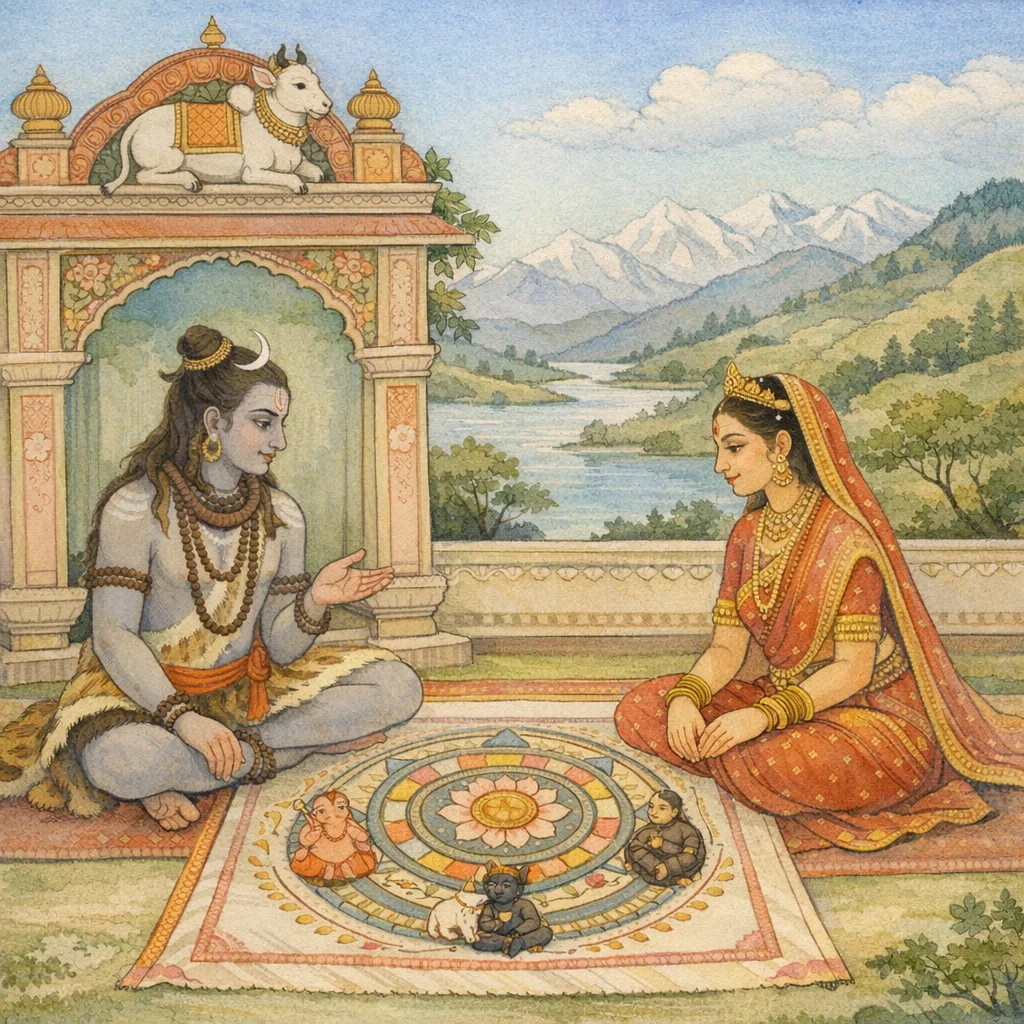
This chapter presents Īśvara’s instruction to Mahādevī on the precise procedure of pañcāvaraṇa-pūjā, worship performed through five concentric enclosures. It prescribes an ordered ritual sequence, beginning with preliminary worship and moving into a mandalic placement of deities and powers. The wise practitioner (sudhīḥ) is first to worship Heramba and Ṣaṇmukha with offerings such as fragrance (gandha). Next, the pañcabrahmāṇi are worshiped around in a directional circular order (Īśāna, east, south, north, west), followed by the ṣaḍaṅgāni set in specified quarters (including Āgneya, Īśāna, Nairṛta, Vāyu). Central elements such as netra and astra are noted as protective and empowering ritual limbs. A second enclosure lists further figures (styled as cakravartins), places Vṛṣeśāna at the center of the eastern gate, and then assigns Śaiva attendants—Nandin, Mahākāla, and Bhṛṅgīśa—according to gate positions. Overall, the chapter serves as a blueprint of ritual space, translating theology into layered, direction-based liturgy.
Shlokas
Verse 1
ईश्वर उवाच । अत्रास्ति च महादेवि खल्वावरणपंचकम् । पंचावरणपूजान्तु प्रारभेत यथाक्रमम्
Īśvara said: “Here, O Mahādevī, there is indeed a fivefold arrangement of āvaraṇas (enclosures). Therefore one should begin the worship of the five āvaraṇas in the proper sequence.”
Verse 2
प्रथमम्पूजितौ यत्र तत्रैव क्रमशस्सुधीः । गन्धाद्यैरर्चयेत्पूर्वं देवौ हेरंबषण्मुखौ
Wherever they are to be worshipped first, the wise devotee should, in that very place and in due order, begin by offering sandal paste and the like, first venerating the two gods—Heramba (Gaṇeśa) and Ṣaṇmukha (Kārttikeya).
Verse 3
पंच ब्रह्माणि परितो वृत्ते सम्पूजयेत्क्रमात् । ईशानदेशे पूर्वे च दक्षिणे चोत्तरे तथा
One should, in due order, worship the five Brahma-aspects all around within a circular arrangement—placing them in the Īśāna (north-east) quarter, as well as in the east, the south, and the north.
Verse 4
पश्चिमे च ततस्तस्मिन्षडंगानि समर्चयेत । आग्नेये च तथैशाने नैरृते वायुदेशके
Then, in that western quarter, one should duly worship the six auxiliaries (ṣaḍaṅgas). Likewise, in the south‑east, in the north‑east, in the south‑west, and in the quarter of Vāyu, one should perform the same worship in their respective directions.
Verse 5
मध्ये नेत्रन्तद्वदस्त्रम्पूर्वादिपरितः क्रमात् । प्रथमावरणम्प्रोक्तं द्वितीयावरणं शृणु
In the center the (divine) Eye is to be placed; likewise, the Astra-mantra is to be arranged all around it in proper sequence, beginning from the eastern direction. Thus the first protective enclosure has been explained—now listen to the second enclosure.
Verse 6
अनन्तम्पूर्वदिक्पत्रे सूक्ष्मन्दक्षिणतस्तथा । शिवोत्तमं पश्चिमत एकनेत्रन्तथोत्तरे
On the petal facing the eastern direction is the form called Ananta; on the southern side is Sūkṣma. On the western side is Śivottama; and on the northern side likewise is Ekanetra.
Verse 7
एकरुद्रन्तथैशाने त्रिमूर्तिं वह्निदिग्दले । श्रीकण्ठं नैरृते वायौ शिखण्डीशं समर्चयेत्
One should worship Ekarudra in the Īśāna (north‑east) direction; Trimūrti in the direction of Agni (south‑east); Śrīkaṇṭha in the Nairṛta (south‑west); and Śikhaṇḍīśa in the direction of Vāyu (north‑west).
Verse 8
द्वितीयावरणे चैव पूज्यास्ते चक्रवर्तिनः । पूर्वद्वारस्य मध्ये तु वृषेशानम्प्रपूजयेत्
In the second enclosure of the sacred maṇḍala and temple order, those cakravartins, the universal sovereigns, are indeed to be worshipped. And in the very center of the eastern gateway, one should adore Vṛṣeśāna—Śiva, Lord of Dharma, signified by the Bull.
Verse 9
तद्दक्षिणे नन्दिनञ्च महाकालन्तदुत्तरे । भृंगीशन्दक्षिणद्वारपश्चिमे सम्प्रपूजयेत्
To the right of that principal deity one should worship Nandin; to its north, Mahākāla. And on the western side of the southern gateway, one should duly worship Bhṛṅgīśa.
Verse 10
तत्पूर्वकोष्ठे गन्धाद्यैस्सम्प्रपूज्य विनायकम् । पश्चिमोत्तरकोष्ठे च वृषभन्दक्षिणे गुहम्
In the eastern chamber one should duly worship Vināyaka (Gaṇeśa) with fragrances and the like. In the north‑western chamber one should worship Vṛṣabha (Nandin), and in the southern chamber Guha (Skanda/Kārttikeya).
Verse 11
उत्तरद्वारपूर्वे तु प्रदक्षिणविधानतः । नामाष्टकविधानेन पूजयेदुच्यते हि तत्
To the east of the northern gateway, following the prescribed rule of pradakṣiṇā (clockwise circumambulation), one should worship (Śiva) by the method of the aṣṭa‑nāma—the eightfold set of divine Names; thus indeed it is taught.
Verse 12
भवं शर्वं तथेशानं रुद्रम्पशुपतिम्पुनः । उग्रम्भीमम्महादेवन्तृतीयावरणन्त्विदम्
“(Worship) Bhava, Śarva, and also Īśāna; Rudra and again Paśupati; Ugra, Bhīma, and Mahādeva—this is the third enclosing circle (āvaraṇa) of worship.”
Verse 13
यो वेदादौ स्वर इति समावाह्य महेश्वरम् । पूजयेत्पूर्वदिग्भागे कमले कर्णिकोपरि
He who, at the beginning of the Veda, invokes Maheśvara with the sacred sound “Svara,” should worship Him in the eastern quarter, upon a lotus, on its central pericarp.
Verse 14
ईश्वरम्पूर्वदिक्पत्रे विश्वेशन्दक्षिणे ततः । सौम्ये तु परमेशानं सर्वेशम्प श्चिमे यजेत्
One should worship Īśvara on the petal in the eastern direction; then Viśveśa in the south; in the northern quarter, Parameśāna; and in the west, Sarveśa.
Verse 15
दक्षिणे तु यजेद्रुद्रमावोराजानमित्यृचा । आवाह्य गन्धपुष्पाद्यैः कर्णिकायान्दलेषु च
On the southern side, one should worship Rudra with the Ṛgvedic verse beginning “āvo rājānam.” Having invoked Him there, one should offer fragrance, flowers, and the like—upon the central pericarp and also upon the petals.
Verse 16
शिवः पूर्वे दक्षिणतो हर उत्तरतो मृडः । भवः पश्चिमदिक्पत्रे पूज्या एते यथाक्रमम्
In the east is Śiva; in the south is Hara; in the north is Mṛḍa; and on the leaf placed toward the western direction is Bhava. These are to be worshipped in this very order.
Verse 17
उत्तरे विष्णुमावाह्य गन्धपुष्पादिभिर्यजेत् । प्रतद्विष्णुरिति प्रोच्य कर्णिकायान्दलेषु च
In the northern quarter, one should invoke Lord Viṣṇu and worship Him with fragrance, flowers, and the like. While doing so, one should utter, “This is Viṣṇu,” (placing that awareness) in the pericarp and also upon the petals (of the ritual lotus/maṇḍala).
Verse 18
वासुदेवम्पूर्वभागे दक्षिणे चानिरुद्धकम् । सौम्ये संकर्षणञ्चैव प्रद्युम्नम्पश्चिमे यजेत्
One should worship Vāsudeva in the eastern quarter; Aniruddha in the southern; Saṅkarṣaṇa in the northern; and Pradyumna in the western quarter.
Verse 19
ब्रह्माणम्पश्चिमे पद्मे समावाह्य समर्चयेत् । हिरण्यगर्भः समवर्तत इति मंत्रेण मंत्रवित्
The knower of mantras should invoke Brahmā upon the western lotus-seat and worship him duly, using the mantra: “Hiraṇyagarbhaḥ samavartata” (“The Golden Embryo manifested”).
Verse 20
हिरण्यगर्भं पूर्वस्यां विराजन्दक्षिणे ततः । उत्तरे पुष्करञ्चैव कालम्पश्चिमतो यजेत्
One should worship Hiraṇyagarbha in the eastern direction, Virāj in the south; likewise Puṣkara in the north, and Kāla in the west.
Verse 21
सर्वोर्द्ध्वपंक्तौ पूर्वादिप्रदक्षिणविधानतः । तत्तत्स्थानेषु संपूज्य लोकपालाननुक्रमात्
Then, along the entire upper row—beginning from the East and proceeding in the prescribed clockwise order—one should duly worship the Lokapālas (guardians of the directions), honoring each in their respective place, one after another.
Verse 22
रान्तंपान्तं तथा ज्ञान्तं लान्तं लान्तमपूर्वकम् । षान्तं सान्तञ्च वेदाद्यं श्रीबीजञ्च दशक्रमात्
In the tenfold sequence, one should take the syllables ending with rā, with pā, and with jñā; then the syllable ending with lā, and again the syllable ending with lā in a special, unprecedented manner; and the syllables ending with ṣā and with sā; along with the Vedic primordial syllable “Oṃ”, and also the auspicious “Śrī” seed—thus, in tenfold order.
Verse 23
बीजानि लोकपालानामेतैरेतान्समर्चयेत् । नैरृते चोत्तरे तद्वदीशानस्य च दक्षिणे
With these mantric seed‑syllables, one should duly worship the Lokapālas, the guardians of the directions. In the south‑west and in the north, and likewise to the south of Īśāna, the worship is to be performed in the prescribed manner.
Verse 24
ब्रह्म विष्णू च विधिना पूजयेदुपचारकैः । बाह्यरेखासु देवेशम्पञ्चमावरणे यजेत्
In due order, one should worship Brahmā and Viṣṇu with the prescribed offerings. Upon the outer lines of the maṇḍala, in the fifth enclosure, one should perform worship of the Lord of the gods, Śiva.
Verse 25
श्रीमत्त्रिशूलमीशाने वज्रं माहेन्द्रदिङ्मुखे । परशुं वह्निदिग्भागे याम्ये सायकमर्चयेत्
One should worship the auspicious trident in the north‑east (the Īśāna direction); the thunderbolt in the eastern quarter presided over by Mahendra; the axe in the south‑east, the region of Fire; and the arrow in the southern quarter (Yama’s direction).
Verse 26
नैरृते तु यजेत्खड्गम्पाशं वरुणगोचरे । अंकुशं मारुते भागे पिनाकं चोत्तरे यजेत्
In the south‑western direction one should worship the sword; in Varuṇa’s quarter one should worship the noose. In the region of Vāyu one should worship the goad, and in the northern direction one should worship Pināka (Śiva’s bow).
Verse 27
पश्चिमाभिमुखं रौद्रं क्षेत्रपालं समर्चयेत् । यथाविधि विधानज्ञश्शिवप्रीत्यर्थमेव च
Facing west, the worshipper should duly honor the fierce Kṣetrapāla, guardian of the sacred precinct, performing the rite exactly as prescribed—solely to please Lord Śiva.
Verse 28
कृताञ्जलिपुटास्सर्वे चिन्त्याः स्मितमुखाम्बुजाः । सादरं प्रेक्षमाणाश्च देवं देवीञ्च सर्वदा
All of them, with hands joined in reverent añjali, were absorbed in inward contemplation, their lotus-like faces smiling. With devoted respect they continually gazed upon the Lord and the Goddess.
Verse 29
इत्थमावरणाभ्यर्चां कृत्वा विक्षेपशान्तये । पुनरभ्यर्च्य देवेशम्प्रणवं च शिवं वदेत्
Thus, having performed the worship of the surrounding deities (āvaraṇa-pūjā) to pacify mental distraction, one should again worship the Lord of the gods and then utter the Praṇava (Oṁ) and the sacred name “Śiva.”
Verse 30
एवमभ्यर्च्य विधिवद्गन्धाद्यैरुपचारकैः । उपचर्य्य ततो दद्यान्नैवेद्यं विधिसाधितम्
Thus, having duly worshipped (Śiva) with offerings such as fragrance and other ritual services, and having attended upon Him, one should then present the naivedya, the food-offering prepared according to the prescribed rite.
Verse 31
पुनराचमनीयं च दद्यादर्घ्यं यथा पुरा । ततो निवेद्य पानीयन्ताम्बूलं चोपदेशतः
Then, as before, one should again offer ācamanīya, the water for ritual sipping, and present the arghya offering. Thereafter, according to the prescribed instruction, one should offer drinking-water and tāmbūla (betel-leaf) as naivedya to the Lord.
Verse 32
नीराजनादिकं कृत्वा पूजाशेषं समापयेत् । ध्यात्वा देवं च देवीञ्च मनुमष्टोत्तरं जपेत्
After performing nīrājana (ārati) and the other concluding rites, one should duly complete the remainder of the worship. Then, meditating on Lord Śiva and the Goddess Devī, one should repeat the sacred mantra one hundred and eight times.
Verse 33
तत उत्थाय रचितपुष्पाञ्जलिपुटः स्थितः । जपेद्ध्यात्वा महादेवं यो देवानामिति क्रमात्
Then, rising and standing with hands joined in a flower-offering (añjali), one should meditate on Mahādeva and, in proper sequence, recite the mantra beginning with “yo devānām….”
Verse 34
यो वेदादौ स्वरः प्रोक्त इत्यंतम्परमेश्वरि । पुष्पाञ्जलिन्ततो दत्त्वा त्रिः प्रदक्षिणमाचरेत्
O Parameśvarī, one should contemplate the sacred primal sound declared at the beginning of the Vedas; then, offering a handful of flowers, one should perform three pradakṣiṇā, circumambulating Śiva’s holy presence.
Verse 35
साष्टांगम्प्रणमेत्तं स भक्त्या परमयान्वितः । पुनः प्रदक्षिणां कृत्वा प्रणमेत्पुनरेकधा
Endowed with supreme devotion, he should bow to Him with the eight-limbed prostration. Then, having again performed circumambulation, he should once more bow down in reverence.
Verse 36
स्थित्वासने समभ्यर्च्य देवं नामाष्टकेन च । साधु वासाधु वा कर्म यद्यदाचरितं मया
Seated upon the proper seat, having duly worshipped the Lord with the eight sacred Names, whatever action—good or improper—has been performed by me, may it be laid before Him for purification and grace.
Verse 37
तत्सर्वं भगवञ्छम्भो भवदाराधनम्परम् । इति शंखोदकेनैव सपुष्पेण समर्पयेत्
“O Bhagavān Śambhu, all this is offered as an act wholly devoted to Your worship.” Saying thus, one should present it with water from a conch, together with flowers.
Verse 38
पूज्यं पुनस्समभ्यर्च्य सार्थं नामाष्टकं जपेत् । तदेव शृणु देवेशि संब्रुवे तव भक्तितः
Having worshipped the adorable Lord once again with due reverence, one should repeat the meaningful ‘eightfold set of Names’ (Nāmāṣṭaka). Hear that very hymn, O Goddess, Queen of the Devas—I shall declare it out of devotion to you.
Frequently Asked Questions
Rather than a narrative episode, the chapter presents a theological-ritual argument by procedure: Śiva teaches that correct worship is inherently hierarchical and spatial—divine powers are approached through ordered layers (āvaraṇas), where precedence and direction encode doctrinal relationships.
The rahasya lies in ritual topology: concentric enclosures symbolize graded access to the divine, while directional placements externalize an inner yogic map. Elements like netra and astra function as protective/empowering principles, indicating that pūjā is simultaneously invocation and safeguarding of sacred space and consciousness.
Śiva appears as Īśvara—the authoritative revealer of ritual order—while Śaiva manifestations and attendants are highlighted through named forms/powers (e.g., Vṛṣeśāna at the eastern gate, plus Nandin and Mahākāla). The focus is less on Gaurī’s forms and more on Śaiva mandalic personnel within enclosure worship.