Sukta 90
Sukta 10.90
Nārāyaṇa / Purusha-sūkta tradition (later Anukramaṇī attribution varies; commonly ‘Nārāyaṇa’ or ‘unknown’ in scholarly catalogues)
Puruṣa (Cosmic Being)
Triṣṭubh (standard for much of 10.90; verify per verse in critical edition)
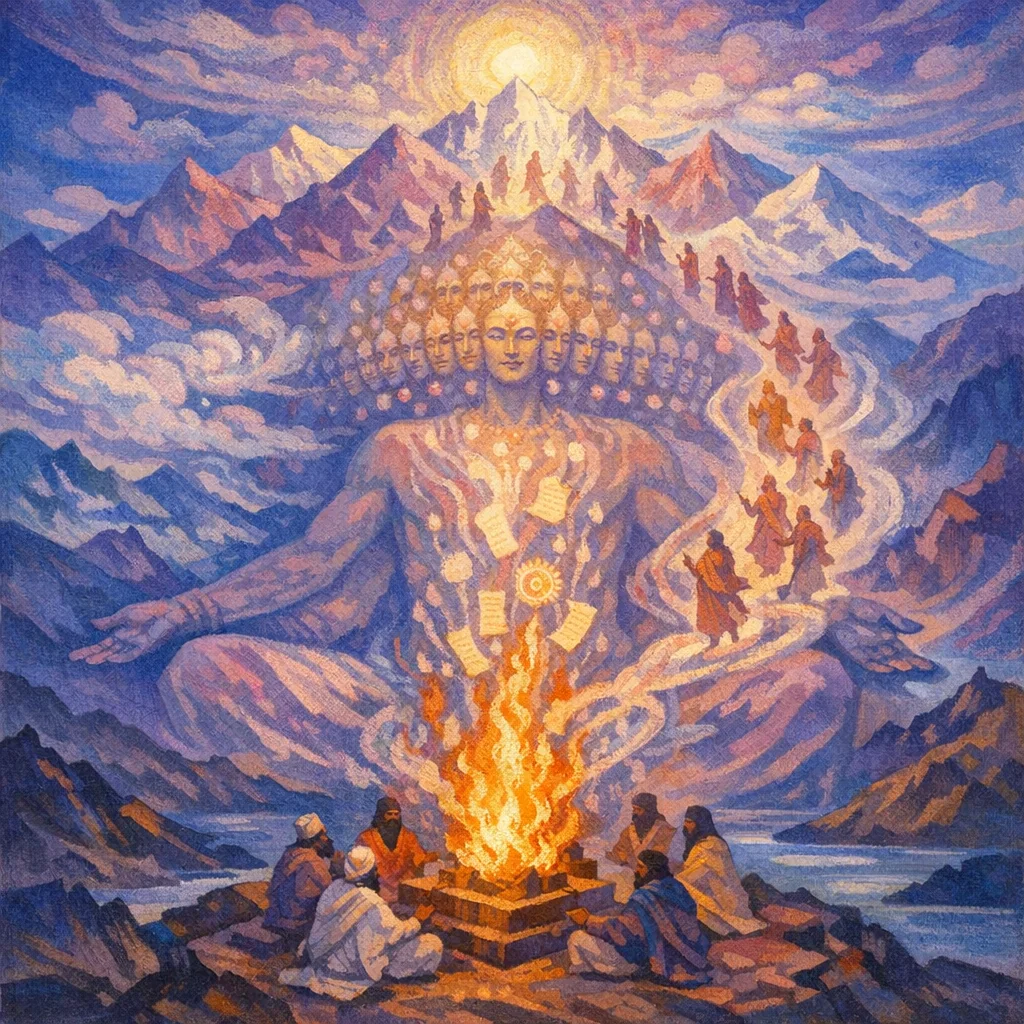
The Puruṣa Sūkta presents the Cosmic Person (Puruṣa) as all-pervading—containing the whole world and yet exceeding it. It describes creation as a primordial sacrifice in which the universe, the Veda, and social-cosmic functions emerge as ordered expressions of one integral Being. The hymn’s purpose is contemplative and ritual: to ground yajña and dharma in a single cosmic prototype.
Mantras
Mantra 1
सहस्रशीर्षा पुरुषः सहस्राक्षः सहस्रपात् । स भूमिं विश्वतो वृत्वात्यतिष्ठद्दशाङ्गुलम् ॥
The Purusha is a vast being of innumerable heads, eyes, and feet. Encompassing the earth on every side, he yet exceeds it—standing beyond by a measure: the Transcendent that contains the whole manifestation and surpasses it.
Mantra 2
पुरुष एवेदं सर्वं यद्भूतं यच्च भव्यम् । उतामृतत्वस्येशानो यदन्नेनातिरोहति ॥
Purusha indeed is all this—whatever has become and whatever is yet to become. And he is lord of immortality, for he rises beyond (and supports) by food: by the substance of experience he enters and exceeds embodied life, turning it into a step toward the deathless.
Mantra 3
एतावानस्य महिमातो ज्यायाँश्च पूरुषः । पादोऽस्य विश्वा भूतानि त्रिपादस्यामृतं दिवि ॥
Such is his greatness—and Purusha is yet greater than this. One quarter of him is all beings; three quarters of him are the immortal in the heaven: the unmanifest plenitude exceeds the manifest world.
Mantra 4
त्रिपादूर्ध्व उदैत्पुरुषः पादोऽस्येहाभवत्पुनः । ततो विष्वङ्व्यक्रामत्साशनानशने अभि ॥
Three quarters of Purusha rose upward; one quarter became again here. From that he spread out everywhere, toward what eats and what does not eat—entering all forms of life and even what seems inert, pervading both the conscious and the apparently unconscious.
Mantra 5
तस्माद्विराळजायत विराजो अधि पूरुषः । स जातो अत्यरिच्यत पश्चाद्भूमिमथो पुरः ॥
From him was born Virāj, and from Virāj the Purusha came forth. When he was born, he exceeded—behind the earth and also in front: the manifested order arises from the Vast and yet the Conscious Being surpasses its own manifestation.
Mantra 6
यत्पुरुषेण हविषा देवा यज्ञमतन्वत । वसन्तो अस्यासीदाज्यं ग्रीष्म इध्मः शरद्धविः ॥
When the gods extended the sacrifice with Purusha as the offering, Spring became his ghee, Summer his fuel, Autumn his oblation: the whole rhythm of time is taken as the means for the inner offering by which consciousness is transformed.
Mantra 7
तं यज्ञं बर्हिषि प्रौक्षन्पुरुषं जातमग्रतः । तेन देवा अयजन्त साध्या ऋषयश्च ये ॥
That sacrifice they sprinkled upon the sacred seat—the Purusha born in the front of things. By that the gods sacrificed, and the Sādhyas and the seers as well: all the higher powers join in the act of consecration that brings creation into right order.
Mantra 8
तस्माद्यज्ञात्सर्वहुतः सम्भृतं पृषदाज्यम् । पशून्ताँश्चक्रे वायव्यानारण्यान्ग्राम्याश्च ये ॥
From that all-offered sacrifice was gathered the speckled clarified essence; and from it he formed the beasts—those of the winds, those of the forest, and those of the village: the life-forces and instinctive energies are shaped out of the sacrificial transformation and distributed into their domains.
Mantra 9
तस्माद्यज्ञात्सर्वहुत ऋचः सामानि जज्ञिरे । छन्दांसि जज्ञिरे तस्माद्यजुस्तस्मादजायत ॥
From that all-offering Sacrifice were born the Ṛc-verses and the Sāman-harmonies; from that were born the meters that carry the Word; from that too the Yajus-formulas came into manifestation—powers of utterance shaped for the inner offering.
Mantra 10
तस्मादश्वा अजायन्त ये के चोभयादतः । गावो ह जज्ञिरे तस्मात्तस्माज्जाता अजावयः ॥
From that same Source were born the steeds—every force that moves in both ways; from that were born the Cows, the rays of illumined knowledge; from that too came forth the goat and the sheep—powers of varied nourishment and supporting energies in the sacrifice of becoming.
Mantra 11
यत्पुरुषं व्यदधुः कतिधा व्यकल्पयन् । मुखं किमस्य कौ बाहू का ऊरू पादा उच्येते ॥
When they set the Purusha forth and arranged him in many ways, what became his mouth, what his arms? What are declared as his thighs and what as his feet—how are the powers of the One distributed for the work of manifestation?
Mantra 12
ब्राह्मणोऽस्य मुखमासीद्बाहू राजन्यः कृतः । ऊरू तदस्य यद्वैश्यः पद्भ्यां शूद्रो अजायत ॥
The Brāhmaṇa-power was his mouth—the seeing speech that holds the truth; his arms became the Rājanya-force—the strength that protects and governs; his thighs are the Vaiśya-power—the wide support and mutuality; from his feet was born the Śūdra-force—the grounding capacity that bears the works in the world.
Mantra 13
चन्द्रमा मनसो जातश्चक्षोः सूर्यो अजायत । मुखादिन्द्रश्चाग्निश्च प्राणाद्वायुरजायत ॥
The Moon was born from the Mind—its reflective and measuring light; from the Eye was born the Sun—the seeing that reveals truth. From the Mouth came Indra and Agni—the victorious force and the transforming will; from the Breath arose Vāyu—the life-current that carries the movement of being.
Mantra 14
नाभ्या आसीदन्तरिक्षं शीर्ष्णो द्यौः समवर्तत । पद्भ्यां भूमिर्दिशः श्रोत्रात्तथा लोकाँ अकल्पयन् ॥
From the navel arose the mid-world—the field of life and movement; from the head the heaven came into ordered being. From the feet the Earth was founded; from the ear the directions—thus they fashioned the worlds, setting the soul’s habitation in a measured order.
Mantra 15
सप्तास्यासन्परिधयस्त्रिः सप्त समिधः कृताः । देवा यद्यज्ञं तन्वाना अबध्नन्पुरुषं पशुम् ॥
Seven were the enclosing measures, and thrice seven the fuel-sticks were made ready; when the gods were extending the sacrifice, they bound the Purusha as the offering-animal—meaning the whole being was held steady for transformation in the Fire.
Mantra 16
यज्ञेन यज्ञमयजन्त देवास्तानि धर्माणि प्रथमान्यासन् । ते ह नाकं महिमानः सचन्त यत्र पूर्वे साध्याः सन्ति देवाः ॥
By sacrifice the gods sacrificed the Sacrifice; these were the first laws of the Truth. By that greatness they reached the highest heaven, where the ancient Sādhyas dwell—the accomplished powers who stand at the origin of the divine work.
Frequently Asked Questions
Puruṣa is the Cosmic Person—the all-pervading Being who contains the universe and also transcends it. The hymn presents all worlds and beings as expressions of this one total reality.
It teaches that the universe arises through a primordial “all-offering” in which order, life, and sacred speech unfold from the One. Yajña is shown not only as a ritual act but as a cosmic principle of transformation and harmony.
Because it became a key text for explaining the unity behind diversity, the sacred basis of dharma, and the idea that Vedic speech and ritual mirror cosmic structure. It is widely recited in rituals and interpreted in Vedānta and devotional traditions.