Adhyaya 41: Yayāti’s Fall, the Gift of Worlds, and the King’s Dharma of Non-Cruelty
ययाति-अष्टक-प्रतर्दन-वासुमान् संवादः
Speaker: Aṣṭaka, Yayāti, Pratardana, Vasumān
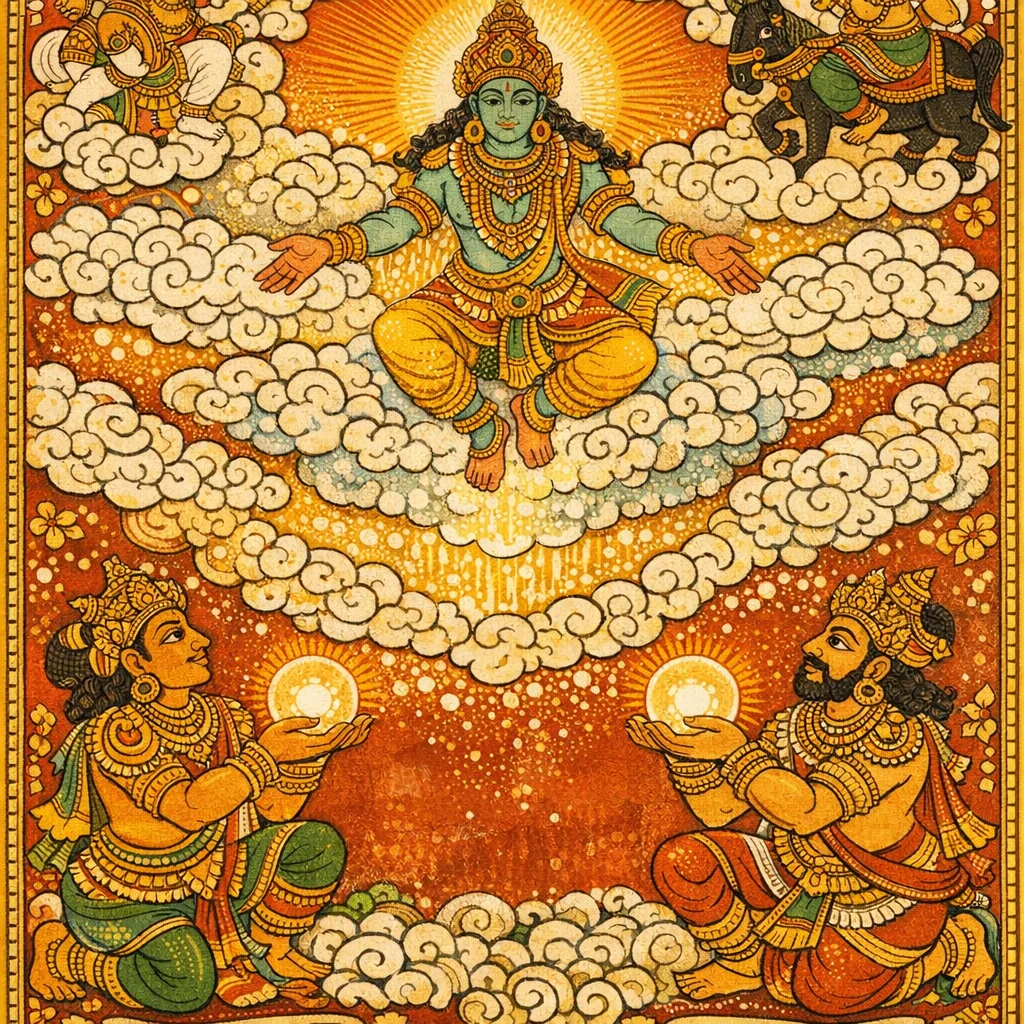
Aṣṭaka asks Yayāti who attains divine affinity first; Yayāti extols the restrained mendicant above householders driven by desire. He warns that rare long life, if misused, demands remorse and severe austerity, and defines true dharma as non-cruelty, straightforwardness, samādhi, and ārya-conduct. Seeing Yayāti’s radiance, Aṣṭaka asks his origin; Yayāti reveals his merit is exhausted and he must fall to an earthly naraka, with the lokapālas as witnesses. As he descends, Aṣṭaka asks how his own worlds are secured; Yayāti says they endure in heaven so long as cattle, horses, and living beings are properly maintained on earth. Aṣṭaka offers his worlds to Yayāti, but Yayāti refuses a life based on accepting gifts and affirms his prior generosity to the twice-born. Pratardana repeats the inquiry and offers his worlds; Yayāti describes many worlds of limited duration. The teaching ends with rājadharma: the wise king must not act cruelly when fate brings disaster; Vasumān proposes an unprecedented, higher path of understanding and conduct.
Key Concepts
Shlokas in Adhyaya 41
Verse 1
*अष्टक उवाच कतरस्त्वेतयोः पूर्वं देवानामेति सात्म्यताम् उभयोर्धावतो राजन् सूर्यचन्द्रमसोरिव //
Aṣṭaka said: “Which of these two reaches, first, the state of becoming one in nature with the gods? O King, as the Sun and the Moon race onward together.”
Verse 2
*ययातिरुवाच अनिकेतगृहस्थेषु कामवृत्तेषु संयतः ग्राम एव चरन्भिक्षुस् तयोः पूर्वतरं गतः //
Yayāti said: “Self-restrained among householders who have no fixed abode and who live by desire, the mendicant, moving about within the village alone, went ahead of them earlier.”
Verse 3
अप्राप्यं दीर्घमायुश्च यः प्राप्तो विकृतिं चरेत् तप्येत यदि तत्कृत्वा चरेत्सोग्रं तपस्ततः //
If someone has obtained what is seldom attained—a long span of life—yet lives in a perverted way, then, having acted so, he should feel remorse and thereafter undertake severe austerity (tapas).
Verse 4
यद्वै नृशंसं तदपत् ह्यमाहुर् यः सेवते धर्ममनर्थबुद्धिः असावनीशः स तथैव राजंस् तदार्जवं स समाधिस्तदार्यम् //
Indeed, they declare that what is cruel is itself a “fall” (downfall). He who practices dharma with a mind fixed on selfish gain is not master of himself; and so too, O King. True dharma is straightforwardness; that is inner collectedness (samādhi); that is the conduct of the noble (ārya).
Verse 5
*अष्टक उवाच केनाद्य त्वं तु प्रहितो ऽसि राजन् युवा स्रग्वी दर्शनीयः सुवर्चाः कुत आगतः कतमस्यां दिशि त्वमुताहोस्वित्पार्थिवस्थानम् अस्ति //
Aṣṭaka said: “By whom have you been sent here today, O king? You are youthful, garlanded, handsome, and radiant. From where have you come, and in which direction do you dwell? Or is there, perhaps, a royal abode—a kingdom—where you are established?”
Verse 6
*ययातिरुवाच इमं भौमं नरकं क्षीणपुण्यः प्रवेष्टुम् ऊर्वीं गगनाद्विप्रकीर्णः उक्त्वाहं वः प्रपतिष्याम्य् अनन्तरं त्वरन्त्वमी ब्रह्मणो लोकपा ये //
Yayāti said: “My merit is spent; I am to enter this earthly hell. Cast down from the sky and scattered toward the ground, having said this to you, I shall fall immediately. Let the guardians of the worlds who belong to Brahmā (lokapāla) hurry.”
Verse 7
सतां सकाशे तु वृतः प्रपातस् ते सङ्गता गुणवन्तस्तु सर्वे शक्राच्च लब्धो हि वरो मयैष पतिष्यता भूमितलं नरेन्द्र //
O king, this precipice has been approached in the presence of the righteous; all the virtuous have gathered here. And the boon that I obtained from Śakra (Indra) is indeed such that I shall fall upon the surface of the earth.
Verse 8
*अष्टक उवाच पृच्छामि त्वां प्रपतन्तं प्रपातं यदि लोकाः पार्थिव सन्ति मे ऽत्र यद्यन्तरिक्षे यदि वा दिवि श्रिताः क्षेत्रज्ञं त्वां तस्य धर्मस्य मन्ये //
Aṣṭaka said: “I ask you, as you plunge headlong into this fall—do my worlds exist on the earth, or in the mid-region (the atmosphere), or are they established in heaven? I regard you as the knower of the field (kṣetrajña) and as one who understands the dharma that governs this.”
Verse 9
*ययातिरुवाच यावत्पृथिव्यां विहितं गवाश्वं सहारण्यैः पशुभिः पक्षिभिश्च तावल्लोका दिवि ते संस्थिता वै तथा विजानीहि नरेन्द्रसिंह //
Yayāti said: “So long as, upon the earth, your cattle and horses are duly established—together with the creatures of the forests, the beasts and the birds—so long indeed do your worlds remain firmly set in heaven. Know it thus, O lion among kings.”
Verse 10
*अष्टक उवाच तांस्ते ददामि मा प्रपत प्रपातं ये मे लोका दिवि राजेन्द्र सन्ति यद्यन्तरिक्षे यदि वा दिवि श्रितास्तानाक्रम क्षिप्रममित्रहाऽथसि //
Aṣṭaka said: “I grant those realms to you—do not fall into ruin. O king, the worlds that are mine in heaven—whether stationed in the mid-space or established in the celestial regions—take possession of them at once, for you are a swift slayer of foes.”
Verse 11
*ययातिरुवाच नास्मद्विधो ऽब्राह्मणो ब्रह्मविच्च प्रतिग्रहे वर्तते राजमुख्य यथा प्रदेयं सततं द्विजेभ्यस् तदा ददे पूर्वम् अहं नरेन्द्र //
Yayāti said: “O foremost of kings, a person like me is not a non-Brahmin; indeed, he is a knower of Brahman. Yet I do not live by accepting gifts. Whatever is to be given continually to the twice-born (dvija), O king, I gave that earlier.”
Verse 12
नाब्राह्मणः कृपणो जातु जीवेद् यद्यपि स्याद्ब्राह्मणी वीरपत्नी सो ऽहं यदेवाकृतपूर्वं चरेयं विवित्समानः किमु तत्र साधुः //
A brāhmaṇa should never live as a miser, even if his wife is a brāhmaṇī and the spouse of a valiant man. Therefore I shall undertake what I have not done before; seeking true understanding, what could be wrong or improper in that?
Verse 13
*प्रतर्दन उवाच पृच्छामि त्वां स्पृहणीयरूप प्रतर्दनो ऽहं यदि मे सन्ति लोकाः यद्यन्तरिक्षे यदि वा दिवि श्रुताः क्षेत्रज्ञं त्वां तस्य धर्मस्य मन्ये //
Pratardana said: “I ask you, O one of desirable form. I am Pratardana. If there are worlds (destinies) for me—whether spoken of in the mid-region (antarikṣa) or established in heaven—then I regard you as the Knower of the Field (kṣetrajña), and I consider your teaching to be the highest Dharma.”
Verse 14
*ययातिरुवाच सन्ति लोका बहवस्ते नरेन्द्र अप्येकैकं सप्त शतान्यहानि मधुच्युतो घृतवन्तो विशोकास् तेनान्तवन्तः प्रतिपालयन्ति //
Yayāti said: “O king, there are many worlds. In each of them one lives for seven hundred days, abounding in honey and clarified butter (ghṛta), free from sorrow; yet because they are bounded by an end, they are maintained only for a limited term.”
Verse 15
*प्रतर्दन उवाच तांस्ते ददामि पतमानस्य राजन् ये मे लोकास्तव ते वै भवन्तु यद्यन्तरिक्षे यदि वा दिवि श्रितास् तानाक्रम क्षिप्रमपेतमोहः //
Pratardana said: “O King, as I am about to fall (perish), I give those realms to you. Whatever worlds are mine—let them indeed become yours, whether they abide in the mid-region (antarikṣa) or are established in heaven. Take possession of them at once, casting off delusion quickly.”
Verse 16
*ययातिरुवाच नु तुल्यतेजाः सुकृतं हि कामये योगक्षेमं पार्थिवात्पार्थिवः सन् दैवादेशादापदं प्राप्य विद्वांश् चरेन्नृशंसं हि न जातु राजा //
Yayāti said: “O you of equal splendor, I seek the merit born of righteous deeds (sukṛta) and the secure well-being of the realm (yogakṣema). Though a king is a king among kings, if by the ordinance of fate he falls into calamity, the wise should not act with cruelty; a ruler must never be ruthless.”
Verse 17
धर्म्यं मार्गं चिन्तयानो यशस्यं कुर्यात्तपो धर्ममवेक्षमाणः न मद्विधो धर्मबुद्धिर्हि राजा ह्य् एवं कुर्यात्कृपणं मां यथात्थ //
Reflecting on the righteous path that brings true renown, a king should practise austerity (tapas) with his gaze fixed upon dharma. For no king possessed of dharma-minded discernment would act as you have—treating me as a wretched and helpless one—just as you yourself declared.
Verse 18
कुर्यामपूर्वं न कृतं यदन्यैर् विवित्समानः किम् उ तत्र साधुः ब्रुवाणमेवं नृपतिं ययातिं नृपोत्तमो वसुमानब्रवीत् तम् //
“Let us first do something unprecedented—something not done by others before. If one seeks to know it and accomplish it, what fault is there in that?” Thus speaking to King Yayāti, the excellent king Vasumān addressed him.
Frequently Asked Questions
The chapter teaches that cruelty itself constitutes spiritual and royal downfall, while true dharma is marked by straightforwardness (ārjava), inner collectedness (samādhi), and noble conduct. It also emphasizes that when merit ends and calamity arises by fate, a king must remain restrained and never become ruthless; ethical governance and dharma-oriented austerity preserve true renown.
This adhyaya is primarily Rajadharma and ethical philosophy: punya-kshaya and falling from heaven, the superiority of self-restraint and mendicant detachment, the definitions of dharma (ārjava, samādhi, ārya-conduct), and kingship ethics forbidding cruelty. It also touches on dana/pratigraha norms concerning brahmanas and royal integrity. Vastu and temple-architecture topics are not central in these verses.