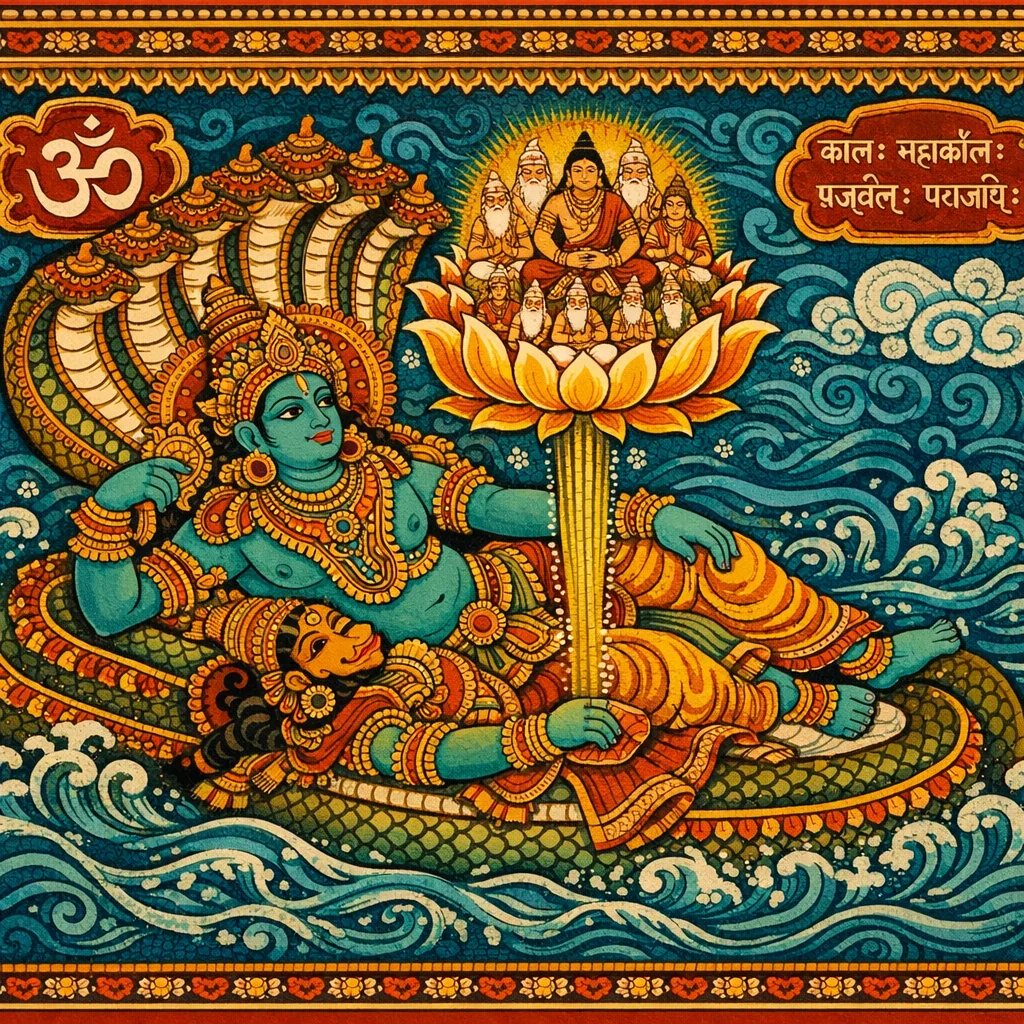
Adhyaya 164: Questions on Padmanabha’s Lotus-Creation in the Padma Mahakalpa; Prelude to Narayana-Tattva and Time
पाद्ममहाकल्पे पद्मनाभसृष्टिप्रश्नः (नारायणतत्त्व-स्तुति-प्रस्तावः)
Speaker: Rishis, Suta, Vaivasvata Manu, Lord Matsya
After hearing Narasiṃha’s greatness, the sages ask for a fuller retelling of that same glory, now centered on Padmanābha’s lotus-creation and the world’s golden nature. Sūta marks the continuity as fresh questions are again addressed to Keśava. Manu then asks a structured set of cosmological questions: Padmanābha’s yogic sleep upon the waters, the arising of gods and ṛṣis on the lotus, the source and duration of kāla (time), the Lord’s re-awakening and re-creation, the first Prajāpatis, and how anything can proceed after total pralaya when beings and elements are destroyed. Matsya affirms Manu’s fitness by lineage, cites Veda–Purāṇa tradition and Vyāsa’s authority, and begins the doctrinal preface: Nārāyaṇa is ultimately unknowable even to Brahmā, the very essence of karma, yajña, tapas, pranava, and the universe—while kāla bears many names yet is not the final Supreme.
Key Concepts
Shlokas in Adhyaya 164
Verse 1
*ऋषय ऊचुः कथितं नरसिंहस्य माहात्म्यं विस्तरेण च पुनस्तस्यैव माहात्म्यम् अन्यद्विस्तरतो वद //
The sages said: “You have described in detail the greatness of Narasiṃha. Now again, please tell us—at length—another account of that very same glory.”
Verse 2
पद्मरूपमभूदेतत् कथं हेममयं जगत् कथं च वैष्णवी सृष्टिः पद्ममध्ये ऽभवत्पुरा //
How did this come to assume the form of a lotus? How did the world become golden in nature? And how, in ancient times, did the Vaiṣṇava creation arise within the lotus?
Verse 3
*सूत उवाच श्रुत्वा च नरसिंहस्य माहात्म्यं रविनन्दनः विस्मयोत्फुल्लनयनः पुनः पप्रच्छ केशवम् //
Sūta said: Having heard the greatness of Narasiṃha, Ravinandana—his eyes widened in wonder—once again questioned Keśava (Viṣṇu).
Verse 4
*मनुरुवाच कथं पाद्मे महाकल्पे तव पद्ममयं जगत् जलार्णवगतस्येह नाभौ जातं जनार्दन //
Manu said: “O Janārdana, in the great Lotus-aeon (Pādma Mahākalpa), how did this lotus-formed universe of Yours arise here from the navel of You who were abiding in the oceanic waters?”
Verse 5
प्रभावात्पद्मनाभस्य स्वपतः सागराम्भसि पुष्करे च कथं भूता देवाः सर्षिगणाः पुरा //
By the power of Padmanābha while He lay in yogic sleep upon the ocean-waters—how, in ancient times, did the gods together with the hosts of ṛṣis come to be (manifest), and how did they arise upon the lotus?
Verse 6
एतदाख्याहि निखिलं योगं योगविदां पते शृण्वतस्तस्य मे कीर्तिं न तृप्तिरुपजायते //
O Lord of those who know Yoga, please expound to me this entire discipline of Yoga in full; for as I listen to its glory, my satisfaction is never fulfilled.
Verse 7
कियता चैव कालेन शेते वै पुरुषोत्तमः कियन्तं वा स्वपिति च को ऽस्य कालस्य संभवः //
“For how long a time does the Supreme Person (Puruṣottama) lie in repose? For how long does He sleep? And from where does this Time (kāla) itself arise?”
Verse 8
कियता वाथ कालेन ह्य् उत्तिष्ठति महायशाः कथं चोत्थाय भगवान् सृजते निखिलं जगत् //
“After how long a time does that greatly renowned (Lord) arise again? And once He has arisen, how does the Blessed One bring forth the entire universe?”
Verse 9
के प्रजापतयस्तावद् आसन्पूर्वं महामुने कथं निर्मितवांश्चैव चित्रं लोकं सनातनम् //
“Which Prajāpatis existed in the beginning, O great sage? And how indeed was this wondrous, eternal world fashioned?”
Verse 10
कथमेकार्णवे शून्ये नष्टस्थावरजङ्गमे दग्धे देवासुरनरे प्रनष्टोरगराक्षसे //
How, when the universe has become a single ocean and lies empty—when all the immovable and movable beings have perished, when gods, Asuras, and men are burnt up, and when serpents and Rākṣasas too are destroyed—(how does anything remain or proceed)?
Verse 11
नष्टानिलानले लोके नष्टाकाशमहीतले केवलं गह्वरीभूते महाभूतविपर्यये //
When, in the world, wind and fire have perished, and when ether and the earth’s surface have also vanished—then, amid this reversal of the great elements, only a yawning, cavern-like void remains.
Verse 12
विभुर्महाभूतपतिर् महातेजा महाकृतिः आस्ते सुरवरश्रेष्ठो विधिमास्थाय योगवित् //
The all-pervading Lord—master of the great elements—of immense radiance and vast cosmic form, abides as the foremost among the best of the gods, established in the ordained order, and fully versed in Yoga.
Verse 13
शृणुयां परया भक्त्या ब्रह्मन्नेतदशेषतः वक्तुमर्हसि धर्मिष्ठ यशो नारायणात्मकम् //
“O Brahmin, I wish to hear this in full with supreme devotion. O most righteous one, you ought to narrate the glory—whose very essence is Nārāyaṇa.”
Verse 14
श्रद्धया चोपविष्टानां भगवन्वक्तुमर्हसि //
O Blessed Lord, to us who are seated here in faith and reverence, you ought to speak (and teach).
Verse 15
*मत्स्य उवाच नारायणस्य यशसः श्रवणे या तव स्पृहा तद्वंश्यान्वयभूतस्य न्याय्यं रविकुलर्षभ //
Matsya said: “The longing you have to hear the glory of Nārāyaṇa is indeed fitting—since you stand in that very lineage, O bull among the Solar race.”
Verse 16
शृणुष्वादिपुराणेषु वेदेभ्यश्च यथा श्रुतम् ब्राह्मणानां च वदतां श्रुत्वा वै सुमहात्मनाम् //
Listen now, just as it has been heard in the ancient Purāṇas and in the Vedas; having indeed heard it from great-souled Brāhmaṇas as they recite and expound.
Verse 17
यथा च तपसा दृष्ट्वा बृहस्पतिसमद्युतिः पराशरसुतः श्रीमान् गुरुर्द्वैपायनो ऽब्रवीत् //
And how—having beheld (the truth) through ascetic power—illustrious Dvaipāyana, the revered son of Parāśara, radiant like Bṛhaspati, spoke.
Verse 18
तत्ते ऽहं कथयिष्यामि यथाशक्ति यथाश्रुति यद्विज्ञातुं मया शक्यम् ऋषिमात्रेण सत्तमाः //
That I shall explain to you—according to my capacity and in keeping with what has been heard in tradition—whatever can be understood by me, though I am but a mere sage. O best of the good!
Verse 19
कः समुत्सहते ज्ञातुं परं नारायणात्मकम् विश्वायनश्च यद्ब्रह्मा न वेदयति तत्त्वतः //
Who indeed can dare to know the Supreme—whose very essence is Nārāyaṇa—when even Brahmā, the all-pervading one, does not truly comprehend Him in His reality?
Verse 20
तत्कर्म विश्ववेदानां तद्रहस्यं महर्षीणाम् तमीशं सर्वयज्ञानां तत्तत्त्वं सर्वदर्शिनाम् तदध्यात्मविदां चिन्त्यं नरकं च विकर्मिणाम् //
He is the very act (karma) taught by all the Vedas; He is the secret doctrine of the great seers. He is the Lord presiding over every sacrifice; He is the ultimate reality known to all true visionaries. He is the object of contemplation for the knowers of the Self—and for those who commit forbidden deeds, He is (as the law of consequence) hell itself.
Verse 21
अधिदैवं च यद्दैवम् अधियज्ञं सुसंज्ञितम् तद्भूतमधिभूतं च तत्परं परमर्षीणाम् //
That which is called the divine principle (adhidaiva), and that which is well known as the sacrificial principle (adhiyajña)—that very reality is also the elemental being (bhūta) and the material principle (adhibhūta); and it is the supreme goal of the great seers.
Verse 22
स यज्ञो वेदनिर्दिष्टस् तत्तपः कवयो विदुः यः कर्ता कारको बुद्धिर् मनः क्षेत्रज्ञ एव च //
That is the sacrifice (yajña) taught in the Vedas; the sages know that very thing as austerity (tapas): wherein the agent (the doer), the instrumentality of action, the intellect, the mind, and the knower of the field (the inner Self) are all brought into disciplined unity.
Verse 23
प्रणवः पुरुषः शास्ता एकश्चेति विभाव्यते प्राणः पञ्चविधश्चैव ध्रुव अक्षर एव च //
The Pranava (Om) is contemplated as the Supreme Person, as the Divine Teacher, and as the One. It is also understood as the vital breath in its fivefold modes, and as the steadfast, imperishable syllable.
Verse 24
कालः पाकश्च पक्ता च द्रष्टा स्वाध्याय एव च उच्यते विविधैर्देवैः स एवायं न तत्परम् //
Time itself is called the ripening process, the ripener, the witness, and even self-study—so declare the gods in many ways. Yet this (Time), though spoken of thus, is not the final Supreme Reality.
Verse 25
स एव भगवान्सर्वं करोति विकरोति च सो ऽस्मान्कारयते सर्वान् सो ऽत्येति व्याकुलीकृतान् //
That very Blessed Lord alone does everything—He creates and transforms. He impels all of us to act, and He carries beyond those who have been thrown into agitation and distress.
Verse 26
यजामहे तमेवाद्यं तमेवेच्छाम निर्वृताः यो वक्ता यच्च वक्तव्यं यच्चाहं तद्ब्रवीमि वः //
We worship that Primordial One alone; seeking Him alone, we find peace. He is the speaker, and He is what is to be spoken; and whatever I say, I declare to you as that very truth.
Verse 27
श्रूयते यच्च वै श्राव्यं यच्चान्यत्परिजल्प्यते याः कथाश्चैव वर्तन्ते श्रुतयो वाथ तत्पराः विश्वं विश्वपतिर्यश्च स तु नारायणः स्मृतः //
Whatever is heard, whatever is fit to be heard, and whatever else is spoken of; whatever narratives circulate, and even the Vedic revelations that are devoted to that truth—all of this is the universe, and He who is the Lord of the universe is remembered as Nārāyaṇa.
Verse 28
यत्सत्यं यदमृतमक्षरं परं यद् यद्भूतं परममिदं च यद्भविष्यत् यत्किंचिच् चरमचरं यदस्ति चान्यत् तत्सर्वं पुरुषवरः प्रभुः पुराणः //
Whatever is true; whatever is deathless, imperishable, and supreme; whatever has been, whatever is this highest present, and whatever will be; whatever—moving or unmoving—exists, and whatever else there may be: all of that is the ancient Lord, the best of Persons (Purusha), the Sovereign.
Frequently Asked Questions
This chapter sets the doctrinal foundation for the Padma Mahākalpa creation narrative by establishing Nārāyaṇa as the ultimate, all-encompassing reality—identified with yajña, tapas, and pranava (Om)—and by clarifying that kāla (time), though described as ripener and witness, is not the final Supreme. It also frames the coming cosmology through Manu’s questions about lotus-creation, pralaya, and the first Prajāpatis.
The focus is primarily Sṛṣṭi (creation) and metaphysics: lotus-born universe, pralaya, mahābhūtas, kāla, pranava, and Nārāyaṇa-tattva. Rajadharma and Vastu Shastra are not treated in this adhyaya; genealogy appears only indirectly via the requested origins of Prajāpatis (a genealogical-creation thread to be elaborated later).
The sages ask for ‘another account of the same glory’ after Narasiṃha-mahātmya, and the text pivots to the broader Vaiṣṇava framework: the Lord’s supreme nature is shown not only in avatāra deeds but also in cosmic functions—sleeping on the waters, manifesting the lotus cosmos, and sustaining reality beyond pralaya and time.
Manu describes a total dissolution where the universe becomes a single ocean, beings perish, gods/asuras/men are burned, and even wind, fire, ether, and the earth’s surface vanish—leaving a cavern-like void amid the reversal of the great elements. Against this backdrop, the all-pervading Lord remains established in yogic order.