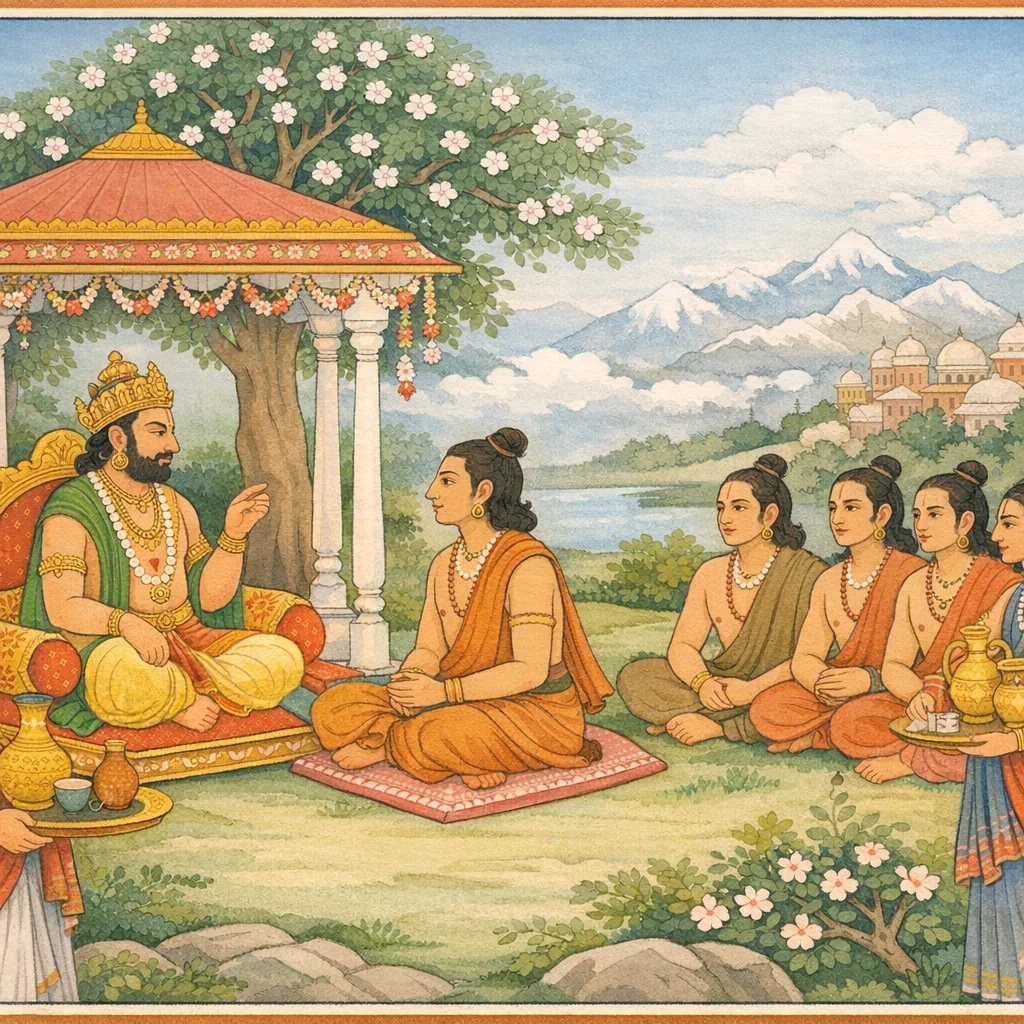
Adhyaya 163
Arjuna’s Account of Tapas and the Kirāta Test; Revelation of Maheśvara and the Grant of the Pāśupata-Astra
Upa-parva: Kairāta (Kirāta) Episode — Arjuna’s Tapas and the Pāśupata-Astra Bestowal
Vaiśaṃpāyana reports that after Indra’s departure, Arjuna reunites with his brothers and Draupadī and honors Yudhiṣṭhira. Yudhiṣṭhira, emotionally moved, asks Arjuna to explain how time passed in heaven, how the celestial weapons were obtained, and how Indra and Rudra were satisfied. Arjuna begins a structured report: following Yudhiṣṭhira’s instruction, he departs for austerity, reaches Bhṛgutunga, and meets a brāhmaṇa on the path who encourages perseverance and predicts a vision of the lord of gods. Arjuna undertakes escalating tapas—subsisting on roots and fruits, then water, then fasting, then standing with uplifted arms—until a boar-like being appears, followed by a formidable kirāta accompanied by women. A dispute over the hunt becomes a strategic engagement: arrows and multiple astras are deployed, yet the kirāta neutralizes or absorbs them, including the Brahmāstra, leading to direct hand-to-hand struggle and Arjuna’s exhaustion. The kirāta vanishes and reappears in divine form as Maheśvara (Pinākadhṛk), accompanied by Umā, declaring satisfaction. Śiva returns Arjuna’s bow and inexhaustible quivers and offers a boon. Arjuna requests knowledge of divine weapons; Śiva grants the Pāśupata weapon, with explicit restrictions: it is not to be used against humans except under extreme compulsion and as a countermeasure to overwhelming astric opposition. With permission, Arjuna remains seated; the deity disappears, concluding the chapter’s instructional frame on merit, testing, and controlled power.
Chapter Arc: यक्षों के स्वामी धनद (कुबेर) युधिष्ठिर को धैर्य और नीति का उपदेश देकर सान्त्वना देते हैं—मानो वनवास के अंधकार में राज्य-धर्म का दीपक जल उठता हो। → कुबेर कृतयुग/सत्ययुग के आदर्श मनुष्यों और आदर्श क्षत्रिय के गुण गिनाते हैं—धृति, दक्षता, देश-काल-ज्ञान, धर्म-विधान-बोध—और इसके विपरीत अज्ञान, अकाल-ज्ञान और कर्म-विभाग न जानने के विनाशकारी परिणाम बताते हैं। साथ ही पाण्डवों के लिए अलका में सत्कार, भोजन-पान और सेवकों की व्यवस्था का आश्वासन देकर उनके वर्तमान कष्ट और भविष्य की आशा को आमने-सामने रख देते हैं। → धर्म-राज्य का सार-वाक्य उभरता है: जो क्षत्रिय धैर्यवान, देश-काल-ज्ञ और धर्म-विधान-विद् है वही पृथ्वी को चिरकाल प्रशासित कर सकता है; और जो कर्म-विभाग व समय नहीं जानता, वह इह-पर दोनों में नष्ट होता है—यह उपदेश युधिष्ठिर के लिए राजधर्म का निर्णायक मानदण्ड बन जाता है। → वैशम्पायन के अनुसार कुबेर के वचन सुनकर पाण्डव हर्षित होते हैं; कुबेर उन्हें भय-शोक से रहित होकर आगे के आश्रम-गमन/व्रत-काल (कृष्णपक्ष) का निर्देश देते हैं और अलका-लोक की दिव्य संगति (गन्धर्व-यक्ष-किन्नर) का संकेत देकर आश्वस्त करते हैं। → कुबेर के निर्देशानुसार पाण्डव अब किस आश्रम-क्रम और किस अनुशासन में आगे बढ़ेंगे—और यह दिव्य संरक्षण उनके आगामी वन-प्रसंगों को कैसे मोड़ेगा?
Shlokas
Verse 1
हि न () हि २ आम द्विषष्ट्याधिकशततमो< ध्याय: कुबेरका युधिष्ठिर आदिको उपदेश और सान्त्वना देकर अपने भवनको प्रस्थान धनद उवाच युधिष्ठिर धृतिर्दाक्ष्य देशकालपराक्रमा: । लोकततन्त्रविधानानामेष पञ्चविधो विधि:,कुबेर बोले--युधिष्ठिर! धैर्य, दक्षता, देश, काल और पराक्रम--ये पाँच लौकिक कार्योंकी सिद्धिके हेतु हैं
Dhanada (Kubera) said: “Yudhiṣṭhira, steadfastness, practical skill, the right place, the right time, and decisive effort—these five constitute the method by which worldly undertakings are properly organized and brought to success.”
Verse 2
धृतिमन्तश्न दक्षाश्न स्वे स्वे कर्मणि भारत । पराक्रमविधानज्ञा नरा कृतयुगे5डभवन्,भारत! सत्ययुगमें सब मनुष्य धैर्यवान, अपने-अपने कार्यमें कुशल तथा पराक्रमविधिके ज्ञाता थे
Dhanada said: “O Bhārata, in the Kṛta (Satya) Yuga, people were steadfast and self-controlled, skilled in their respective duties, and knowledgeable of the proper methods of exertion and valor. In that age, human conduct naturally aligned with right order—competence and courage were guided by understanding rather than impulse.”
Verse 3
धृतिमान् देशकालज्ञ: सर्वधर्मविधानवित् | क्षत्रिय: क्षत्रियश्रेष्ठ प्रशास्ति पृथिवीं चिरम्,क्षत्रियश्रेष्ठ! जो क्षत्रिय धैर्यवान, देश-कालको समझनेवाला तथा सम्पूर्ण धर्मोके विधानका ज्ञाता है, वह दीर्घकालतक इस पृथ्वीका शासन कर सकता है
Dhanada said: “O best of kṣatriyas, the kṣatriya who is steadfast, who understands place and time, and who knows the ordinances of dharma in their entirety, is able to govern the earth for a long time.”
Verse 4
य एवं वर्तते पार्थ पुरुष: सर्वकर्मसु । स लोके लभते वीर यशः प्रेत्य च सद्गतिम्,वीर पार्थ! जो पुरुष इसी प्रकार सब कर्मामें प्रवृत्त होता है, वह लोकमें सुयश और परलोकमें उत्तम गति पाता है। देश-कालके अन्तरपर दृष्टि रखनेवाले वृत्रासुर-विनाशक इन्द्रने वसुओंसहित पराक्रम करके स्वर्गका राज्य प्राप्त किया है
Dhanada said: “O Pārtha, the man who conducts himself in this very manner in all his actions—O hero—wins good fame in this world, and after death attains a noble destiny. Such discerning conduct, attentive to the right place and time, is what leads to lasting honor here and well-being beyond.”
Verse 5
देशकालान्तरप्रेप्सु: कृत्वा शक्र: पराक्रमम् । सम्प्राप्तस्त्रिदिवे राज्यं वृत्रहा वसुभि: सह,वीर पार्थ! जो पुरुष इसी प्रकार सब कर्मामें प्रवृत्त होता है, वह लोकमें सुयश और परलोकमें उत्तम गति पाता है। देश-कालके अन्तरपर दृष्टि रखनेवाले वृत्रासुर-विनाशक इन्द्रने वसुओंसहित पराक्रम करके स्वर्गका राज्य प्राप्त किया है
Keeping in view the differences of place and time, Śakra (Indra), the slayer of Vṛtra, displayed his valor and—together with the Vasus—attained sovereignty in the heaven-world. In the same way, O heroic Pārtha, a man who applies himself to all duties with such discernment gains fair fame in this world and a higher course in the next.
Verse 6
यस्तु केवलसंरम्भात् प्रपातं न निरीक्षते । पापात्मा पापबुद्धिर्य: पापमेवानुवर्तते,जो केवल क्रोधके वशीभूत हो अपने पतनको नहीं देखता है, वह पापबुद्धि पापात्मा पुरुष पापका ही अनुसरण करता है
He who, driven solely by blind impulse and rage, does not look ahead to his own downfall—such a man, sinful in mind and sinful in nature, ends up following only sin.
Verse 7
कर्मणामविभागज्ञ: प्रेत्य चेह विनश्यति । अकालज्ञ: सुदुर्मेधा: कार्याणामविशेषवित्,जो कर्मोंके विभागको नहीं जानता, समयको नहीं पहचानता और कार्योंके वैशिष्ट्यूको नहीं समझता है, वह खोटी बुद्धिवाला मनुष्य इहलोक तथा परलोकमें भी नष्ट ही होता है
Dhanada said: “One who does not understand the proper distinctions among actions—who fails to recognize the right time, and who cannot discern what is special or appropriate in a given task—such a person, of misguided intellect, comes to ruin both here in this world and after death as well.”
Verse 8
वृथा55चारसमारम्भ: प्रेत्य चेह विनश्यति । साहसे वर्तमानानां निकृतीनां दुरात्मनाम्,साहसके कार्योंमें लगे हुए ठग एवं दुरात्मा पुरुषोंके उत्तम कर्मोंका अनुष्ठान इस लोक और परलोकमें भी व्यर्थ नष्टप्राय ही है
Dhanada said: “Any undertaking that begins in vain or unrighteous conduct perishes—both here in this world and after death. For deceitful, wicked-souled men who persist in reckless violence, even what appears to be ‘good conduct’ or ‘meritorious action’ comes to nothing, collapsing into futility in this life and the next.”
Verse 9
सर्वसामर्थ्यलिप्सूनां पापो भवति निश्चय: । अधर्मज्ञोडवलिप्तश्न बालबुद्धिरमर्षण:
Among those who crave complete power and capability, a sinful resolve inevitably arises. Such a person becomes one who does not understand dharma, is puffed up with pride, childish in judgment, and intolerant—unable to bear restraint or correction.
Verse 10
आर्डटिषेणस्य राजर्षे: प्राप्प भूयस्त्वमाश्रमम्
Dhanada said: “When you have once more reached the hermitage of the royal sage Ārḍatiṣeṇa, approach him again anew.”
Verse 11
महाबाहु नरश्रेष्ठ! वहाँ अलकानिवासी यक्ष तथा इस पर्वतपर रहनेवाले सभी प्राणी मेरी आज्ञाके अनुसार गन्धर्वों और किन्नरोंके साथ सदा इन श्रेष्ठ ब्राह्मणोंसहित तुम्हारी रक्षा करेंगे
Dhanada said: “O mighty-armed best of men! The Yakṣas who dwell in Alakā, and all the beings who live upon this mountain, will—by my command—together with the Gandharvas and Kinnaras, and in the company of these excellent Brahmins, continually protect you.”
Verse 12
मन्नियुक्ता मनुष्येन्द्र सर्वे च गिरिवासिन: । रक्षिष्यन्ति महाबाहो सहित द्विजसत्तमै:,महाबाहु नरश्रेष्ठ! वहाँ अलकानिवासी यक्ष तथा इस पर्वतपर रहनेवाले सभी प्राणी मेरी आज्ञाके अनुसार गन्धर्वों और किन्नरोंके साथ सदा इन श्रेष्ठ ब्राह्मणोंसहित तुम्हारी रक्षा करेंगे
Kubera said: “O lord among men, all those who dwell upon this mountain, acting under my command, will protect you, O mighty-armed one—together with the foremost of the twice-born.” In context, this is a pledge of guardianship: rightful authority is exercised not for domination but for protection, and the presence of eminent brāhmaṇas underscores that power is to be aligned with dharma and restraint.
Verse 13
साहसादनुसम्प्राप्त: प्रतिबुध्य: वृकोदर: । वार्यतां साध्वयं राजंस्त्वया धर्मभूृतां वर,धर्मात्माओंमें श्रेष्ठ नरेश! भीमसेन यहाँ दुःसाहस-पूर्वक आये हैं, यह बात समझाकर इन्हें अच्छी तरह मना कर दो (जिससे ये पुनः कोई अपराध न कर बैठें)
“Vṛkodara (Bhīma), having been roused to action, has come here in reckless daring. O King, best among upholders of dharma, you should firmly restrain him and dissuade him well—lest, driven by impulse, he commit another wrong.”
Verse 14
अतः परं च वो राजन द्रक्ष्यन्ति वनगोचरा: । उपस्थास्यथन्ति वो राजन् रक्षिष्यन्ते च व: सदा,राजन्! अबसे इस वनमें रहनेवाले सब यक्ष तुमलोगोंकी देख-भाल करेंगे, तुम्हारी सेवामें उपस्थित होंगे और सदा तुम सब लोगोंके संरक्षणमें तत्पर रहेंगे
“From this point onward, O King, the Yakṣas who dwell and move about in this forest will keep watch over you. They will attend upon you in service, and they will always remain intent on protecting you.”
Verse 15
तथैव चाज्नपानानि स्वादूनि च बहूनि च । आहरिष्यन्ति मत्प्रेष्या: सदा व: पुरुषर्षभा:,पुरुषरत्न पाण्डवो! इसी प्रकार हमारे सेवक तुम्हारे लिये वहाँ सदा स्वादिष्ट अन्न-पान प्रचुर मात्रामें प्रस्तुत करते रहेंगे
And in the same way, my attendants will always bring for you—O best of men—many kinds of pleasant foods and drinks.
Verse 16
यथा जिष्णुर्महेन्द्रस्य यथा वायोरव॑कोदर: । धर्मस्य त्वं यथा तात योगोत्पन्नो निज: सुत:,तात युधिष्ठिर! जैसे अर्जुन देवराज इन्द्रके, भीमसेन वायुदेवके और तुम धर्मराजके योगबलसे उत्पन्न किये हुए निजी पुत्र होनेके कारण उनके द्वारा रक्षणीय हो तथा ये दोनों आत्मबलसम्पन्न नकुल-सहदेव जैसे दोनों अश्विनीकुमारोंसे उत्पन्न होनेके कारण उनके पालनीय हैं, उसी प्रकार यहाँ मेरे लिये भी तुम सब लोग रक्षणीय हो
Dhanada said: “Just as Jiṣṇu (Arjuna) is to be protected by Mahendra (Indra), and Avakodara (Bhīma) by Vāyu, so too are you, dear one—Yudhiṣṭhira—being the true son of Dharma, born through yogic power, to be protected by him. In the same way, these two strong-souled brothers, Nakula and Sahadeva, being born of the Aśvin twins, are to be cared for by them. Therefore, here you all are also to be protected by me.”
Verse 17
आत्मज्ञावात्मसम्पन्नौ यमौ चोभौ यथाशद्रिनो: । रक्ष्यास्तद्वन्ममापीह यूयं सर्वे युधिष्ठिर,तात युधिष्ठिर! जैसे अर्जुन देवराज इन्द्रके, भीमसेन वायुदेवके और तुम धर्मराजके योगबलसे उत्पन्न किये हुए निजी पुत्र होनेके कारण उनके द्वारा रक्षणीय हो तथा ये दोनों आत्मबलसम्पन्न नकुल-सहदेव जैसे दोनों अश्विनीकुमारोंसे उत्पन्न होनेके कारण उनके पालनीय हैं, उसी प्रकार यहाँ मेरे लिये भी तुम सब लोग रक्षणीय हो
Dhanada said: “The twin brothers, endowed with self-knowledge and inner strength, are to be protected—just as the two Aśvin twins protect their own. In the same way, O Yudhiṣṭhira, my dear child, all of you here are to be protected by me as well.”
Verse 18
अर्थतत्त्वविधानज्ञ: सर्वधर्मविधानवित् | भीमसेनादवरज: फाल्गुन: कुशली दिवि,अर्थतत्त्वकी विधिके ज्ञाता और सम्पूर्ण धर्मोके विधानमें कुशल अर्जुन, जो भीमसेनसे छोटे हैं, इस समय कुशलपूर्वक स्वर्गलोकमें विराज रहे हैं
Dhanada said: “Arjuna—Phalguna—who is younger than Bhimasena, is skilled in the principles and proper application of artha and polity, and well-versed in the ordinances of all dharmas. He now abides safely and in well-being in the heavenly world.”
Verse 19
या: काशक्षन मता लोके स्वर्ग्या: परमसम्पद: । जन्मप्रभृति ता: सर्वाः स्थितास्तात धनंजये,तात! संसारमें जो कोई भी स्वर्गीय श्रेष्ठ सम्पत्तियाँ मानी गयी हैं, वे सब अर्जुनमें जन्मकालसे ही स्थित हैं
Dhanada said: “O dear one, Dhanañjaya! Whatever supreme, heaven-born excellences are esteemed in this world as the highest forms of prosperity—every one of them has been present in you from the very time of your birth.”
Verse 20
दमो दान बल बुद्धि्नीर्धतिस्तेज उत्तमम् । एतान्यपि महासत्त्वे स्थितान्यमिततेजसि,अमित तेजस्वी और महान् सत्त्वशाली अर्जुनमें दम (इन्द्रिय-संयम), दान, बल, बुद्धि, लज्जा, धैर्य तथा उत्तम तेज--ये सभी सदगुण विद्यमान हैं
Dhanada said: “Self-restraint, generosity, strength, intelligence, modesty, steadfast endurance, and supreme radiance—these virtues too are firmly established in Arjuna, who is of great spirit and of immeasurable splendor.”
Verse 21
न मोहात् कुरुते जिष्णु: कर्म पाण्डव गर्हितम् । न पार्थस्य मृषोक्तानि कथयन्ति नरा नृषु,पाण्डुनन्दन! तुम्हारे भाई अर्जुन कभी मोहवश निन्दित कर्म नहीं करते। मनुष्य आपसमें कभी अर्जुनके मिथ्याभाषणकी चर्चा नहीं करते हैं
Dhanada said: “Jiṣṇu (Arjuna) does not, out of delusion, commit any deed that would be censured among the Pāṇḍavas. Nor do people speak among one another of any false words ever uttered by Pārtha. O son of Pāṇḍu, his conduct is free from blame and his speech is trusted.”
Verse 22
स देवपितृगन्धर्वै: कुरूणां कीर्तिवर्धन: । मानित: कुरुते5स्त्राणि शक्रसझनि भारत,भारत! कुरुकुलकी कीर्ति बढ़ानेवाले अर्जुन इन्द्रभवनमें देवताओं, पितरों तथा गन्धर्वोंसे सम्मानित हो अस्त्रविद्याका अभ्यास करते हैं
Kubera said: “O Bhārata, Arjuna—who increases the renown of the Kurus—dwells in Indra’s celestial abode. Honoured by the gods, the Pitṛs, and the Gandharvas, he diligently practices and perfects the science of divine weapons.”
Verse 23
योडसौ सर्वान् महीपालान् धर्मेण वशमानयत् | स शान्तनुर्महातेजा: पितुस्तव पितामह:,पार्थ! जिन्होंने सब राजाओंको धर्मपूर्वक अपने अधीन कर लिया था, वे महातेजस्वी, महापराक्रमी तथा सदाचारपरायण महाराज शान्तनु, जो तुम्हारे पिताके पितामह थे, स्वर्गलोकमें कुरुकुलधुरीण गाण्डीवधारी अर्जुनसे बहुत प्रसन्न रहते हैं
Dhanada said: “That mighty and radiant king Śāntanu—your grandfather, O Pārtha—who brought all the rulers of the earth under his sway by the path of dharma.”
Verse 24
प्रीयते पार्थ पार्थेन दिवि गाण्डीवधन्चना । सम्यक् चासौ महावीर्य: कुलधुर्येण पार्थिव:,पार्थ! जिन्होंने सब राजाओंको धर्मपूर्वक अपने अधीन कर लिया था, वे महातेजस्वी, महापराक्रमी तथा सदाचारपरायण महाराज शान्तनु, जो तुम्हारे पिताके पितामह थे, स्वर्गलोकमें कुरुकुलधुरीण गाण्डीवधारी अर्जुनसे बहुत प्रसन्न रहते हैं
Dhanada said: “O Pārtha, in heaven that mighty king—foremost bearer of the Kuru lineage—takes deep delight in Pārtha Arjuna, the wielder of the Gāṇḍīva. He is rightly pleased with you, for your strength is joined to rightful conduct and to the sustaining of your family’s duty.”
Verse 25
पितृन् देवानृषीन् विप्रान् पूजयित्वा महातपा: । सप्त मुख्यान् महामेधानाहरद् यमुनां प्रति,महातपस्वी शान्तनुने देवताओं, पितरों, ऋषियों तथा ब्राह्मणोंकी पूजा करके यमुना- तटपर सात बड़े-बड़े अश्वमेधयज्ञोंका अनुष्ठान किया था। राजन! वे तुम्हारे प्रपितामह राजाधिराज शान्तनु स्वर्गलोकको जीतकर उसीमें निवास करते हैं। उन्होंने मुझसे तुम्हारी कुशल पूछी थी
Dhanada said: “That great ascetic, after honoring the Pitṛs, the gods, the Ṛṣis, and the Brahmins, performed seven foremost and mighty Aśvamedha sacrifices on the banks of the Yamunā. O king, that emperor Śāntanu—your great‑great‑grandfather—having won the heavenly world, dwells there. He asked me about your welfare.”
Verse 26
अधिराज: स राजंस्त्वां शान्तनु: प्रपितामह: । स्वर्गजिच्छक्रलोकस्थ: कुशलं परिपृच्छति,महातपस्वी शान्तनुने देवताओं, पितरों, ऋषियों तथा ब्राह्मणोंकी पूजा करके यमुना- तटपर सात बड़े-बड़े अश्वमेधयज्ञोंका अनुष्ठान किया था। राजन! वे तुम्हारे प्रपितामह राजाधिराज शान्तनु स्वर्गलोकको जीतकर उसीमें निवास करते हैं। उन्होंने मुझसे तुम्हारी कुशल पूछी थी
Dhanada said: “O king, your great‑grandfather, the imperial king Śāntanu—now dwelling in Indra’s world after conquering heaven—asks after your welfare. That great ascetic Śāntanu, having duly honored the gods, the ancestors, the seers, and the brāhmaṇas, performed seven grand Aśvamedha sacrifices on the bank of the Yamunā. O king, having won the heavenly realm, he resides there; it was he who inquired of me about your well‑being.”
Verse 27
वैशम्पायन उवाच एतच्छुत्वा तु वचन धनदेन प्रभाषितम् । पाण्डवाश्व ततस्तेन वभूवु: सम्प्रहर्षिता:
Vaiśampāyana said: Hearing these words spoken by Dhanada (Kubera), the Pāṇḍavas thereupon became filled with great joy.
Verse 28
ततः शक्ति गदां खड््गं धनुश्च॒ भरतर्षभ: । प्राध्वं कृत्वा नमश्नक्रे कुबेराय वृकोदर:
Then Vṛkodara (Bhīma), the bull among the Bharatas, set aside his weapons—his spear, mace, sword, and bow—and, having made the proper respectful gesture, bowed in reverence to Kubera.
Verse 29
वैशम्पायनजी कहते हैं--जनमेजय! कुबेरकी कही हुई ये बातें सुनकर पाण्डवोंको बड़ी प्रसन्नता हुई। तदनन्तर भरतकुल-भूषण भीमसेनने उठायी हुई शक्ति गदा, खड्ग और धनुषको नीचे करके कुबेरको नमस्कार किया ।। ततोडब्रवीद् धनाध्यक्ष: शरण्य: शरणागतम् । मानहा भव शत्रूणां सुहृदां नन्दिवर्धन:,तब शरण देनेवाले धनाध्यक्ष कुबेरने अपनी शरणमें आये हुए भीमसेनसे कहा --'पाण्डुनन्दन! तुम शत्रुओंका मान मर्दन और सुहृदोंका आनन्द वर्धन करनेवाले बनो
Vaiśampāyana said: “O Janamejaya, hearing these words spoken by Kubera, the Pāṇḍavas were greatly delighted. Then Bhīmasena, the ornament of Bharata’s line, lowered the weapons he had raised—his spear, mace, sword, and bow—and bowed to Kubera. Thereupon Kubera, the lord of wealth and a giver of refuge, addressed Bhīma who had come seeking protection: ‘O son of Pāṇḍu, become the humbler of your enemies’ pride and the increaser of your friends’ joy.’”
Verse 30
स्वेषु वेश्मसु रम्येषु वसतामित्रतापना: । कामान्न परिहास्यन्ति यक्षा वो भरतर्षभा:,'शत्रुओंको संताप देनेवाले भरतकुलभूषण पाण्डवो! तुम सब लोग अपने रमणीय आश्रमोंमें निवास करो। यक्षलोग तुम्हारी अभीष्ट वस्तुओंकी प्राप्तिमें बाधा नहीं डालेंगे
Vaiśampāyana said: “O bull-like heroes of the Bharata line, you who bring torment to your foes—dwell peacefully in your own delightful abodes. The Yakṣas will not obstruct you in obtaining the objects you desire.”
Verse 31
शीघ्रमेव गुडाकेश: कृतास्त्र: पुनरेष्यति । साक्षान्मघवता सृष्ट: सम्प्राप्स्यति धनंजय:,“निद्राविजयी अर्जुन अस्त्रविद्या सीखकर साक्षात् इन्द्रके भेजनेपर शीघ्र ही यहाँ आवेंगे और तुम सब लोगोंसे मिलेंगे”
Vaiśampāyana said: “Guḍākeśa (Arjuna), having mastered the celestial weapons, will return again very soon. Dhanañjaya, sent forth directly by Maghavat (Indra) himself, will come back here and rejoin you all.”
Verse 32
एवमुत्तमकर्माणमनुशिष्य युधिष्ठटिरम् । श्वेतं गिरिवरश्रेष्ठ प्रययौं गुह्ुकाधिप:,इस प्रकार उत्तम कर्म करनेवाले युधिष्ठिरको उपदेश देकर यक्षराज कुबेर गिरिश्रेष्ठ कैलासको चले गये
Vaiśampāyana said: Having thus instructed Yudhiṣṭhira—who was devoted to the highest forms of righteous action—the lord of the Guhyakas (Kubera), departed for Śveta, the foremost of mountains (Kailāsa).
Verse 33
त॑ परिस्तोमसंकीर्ण्नानारत्नवि भूषितै: । यानैरनुययुर्यक्षा राक्षसाश्व॒ सहस्रश:,उनके पीछे सहस्रों यक्ष और राक्षस भी अपने-अपने वाहनोंपर आरूढ़ हो चल दिये। उनके वे वाहन नाना प्रकारके रत्नोंसे विभूषित थे और उनकी पीठपर बहुरंगे कम्बल आदि कसे हुए थे
Then, in their thousands, Yakṣas and Rākṣasas followed behind, each mounted on a vehicle. Those conveyances were adorned with many kinds of jewels and were fitted with richly patterned coverings, displaying the splendor and might of these non-human attendants as they moved in procession.
Verse 34
पक्षिणामिव निर्घोष: कुबेरसदनं प्रति । बभूव परमाश्चानामैरावतपथे यथा,जैसे इन्द्रपुरीके मार्गपपर चलनेवाले विविध वाहनोंका कोलाहल सुनायी पड़ता है, उसी प्रकार कुबेरभवनके प्रति यात्रा करनेवाले उत्तम अश्वोंका शब्द ऐसा जान पड़ता था, मानो पक्षी उड़ रहे हों
As they proceeded toward Kubera’s abode, the sound made by the finest horses rose up like the cry of birds in flight—just as, on the road to Indra’s city, the bustle of many splendid conveyances is heard. Even the common noise of travel seemed refined and auspicious as it moved toward a divine dwelling.
Verse 35
ते जम्मुस्तूर्णमणाकाशं धनाधिपतिवाजिन: । प्रकर्षन्त इवा भ्राणि पिबन्त इव मारुतम्,धनाध्यक्ष कुबेरके वे घोड़े अपने साथ बादलोंको खींचते और वायुको पीते हुए-से तीत्र गतिसे आकाशमें उड़ चले
Vaiśampāyana said: Kubera’s horses, swift as Jambha, surged up into the open sky. They seemed to be dragging the clouds along and, as it were, drinking in the wind—so tremendous was their speed—bearing the Lord of Wealth onward.
Verse 36
ततस्तानि शरीराणि गतसत्त्वानि रक्षसाम् | अपाकृष्यन्त शैलाग्रादू धनाधिपतिशासनात्,तदनन्तर कुबेरकी आज्ञासे राक्षसोंके वे निर्जीव शरीर उस पर्वतशिखरसे दूर हटा दिये गये
Then, by the command of the Lord of Wealth (Kubera), those bodies of the rākṣasas—now bereft of life—were dragged away from the mountain peak.
Verse 37
तेषां हि शापकाल: स कृतो5गस्त्येन धीमता । समरे निहतास्तस्माच्छापस्यान्तो5भवत् तदा,बुद्धिमान् अगस्त्यने यक्षोंके लिये शापकी वही अवधि निश्चित की थी। जब वे युद्धमें मारे गये तब उनके शापका अन्त हो गया। महामना पाण्डव अपने उन आश्रमोंमें सम्पूर्ण राक्षसोंसे पूजित एवं उद्वेगशून्य होकर सुखसे रात्रि व्यतीत करने लगे
Vaiśampāyana said: “For them, the term of the curse had been fixed by the wise Agastya. Therefore, when they were slain in battle, the curse came to its end at that very time.”
Verse 38
पाण्डवाश्नव महात्मानस्तेषु वेश्मसु तां क्षपाम् सुखमूषुर्गतोद्वेगा: पूजिता: सर्वराक्षसै:,बुद्धिमान् अगस्त्यने यक्षोंके लिये शापकी वही अवधि निश्चित की थी। जब वे युद्धमें मारे गये तब उनके शापका अन्त हो गया। महामना पाण्डव अपने उन आश्रमोंमें सम्पूर्ण राक्षसोंसे पूजित एवं उद्वेगशून्य होकर सुखसे रात्रि व्यतीत करने लगे
Vaiśampāyana said: The great-souled Pāṇḍavas, honored by all the rākṣasas and free from anxiety, spent that night comfortably in those dwellings.
Verse 96
निर्भयो भीमसेनो<यं तं शाधि पुरुषर्षभ । सब प्रकारकी (सांसारिक) सामर्थ्यके इच्छुक मनुष्योंका निश्चय पापपूर्ण होता है। पुरुषरत्न युधिष्ठिर! ये भीमसेन धर्मको नहीं जानते, इन्हें अपने बलका बड़ा अभिमान है इनकी बुद्धि अभी बालकोंकी-सी है तथा ये अत्यन्त क्रोधी और निर्भय हैं, अतः तुम इन्हें उपदेश देकर काबूमें रखो
Dhanada said: “This Bhīmasena is fearless; restrain and instruct him, O bull among men. The resolve of those who crave every kind of worldly power tends toward sin. O jewel among men, Yudhiṣṭhira—Bhīma does not truly understand dharma; he is greatly proud of his strength. His judgment is still childlike, and he is exceedingly wrathful and without fear. Therefore, counsel him and keep him under control.”
Verse 103
तामिस्र॑ प्रथमं पक्षं वीतशोकभयो वस । नरेश्वर! अब पुनः तुम यहाँसे राजर्षि आर्डिषेणके आश्रमपर जाकर कृष्णपक्षभर शोक और भयसे रहित होकर रहो
Dhanada (Kubera) said: “O king, dwell first through the dark fortnight (kṛṣṇa-pakṣa), free from grief and fear. Then, O lord of men, go from here to the hermitage of the royal sage Ārdiṣeṇaka, and remain there for the entire dark fortnight, again without sorrow or fear.”
Verse 131
अलका: सह गन्धर्वर्यक्षाश्ष॒ सह किन्नरैः
Alakā—Kubera’s famed northern city—is inhabited in the company of Gandharvas, Yakṣas, and Kinnaras, evoking a realm of divine guardianship and celestial order rather than human society.
Verse 162
इति श्रीमहाभारते वनपर्वणि यक्षयुद्धपर्वणि कुबेरवाक्ये द्विषष्ट्यधिकशततमो<ध्याय:
Thus, in the Śrī Mahābhārata, within the Vana Parva—specifically in the section concerning the battle with the Yakṣas—this concludes the one-hundred-and-sixty-second chapter, known in connection with Kubera’s words.
Frequently Asked Questions
The chapter frames the tension between acquiring overwhelming capability and remaining ethically constrained: Arjuna seeks astric knowledge, while the narrative insists that such power must be limited by necessity, proportionality, and explicit prohibitions.
Qualification precedes empowerment: tapas, steadiness under provocation, and humility before legitimate authority are depicted as prerequisites for receiving and responsibly holding exceptional means.
Rather than a formal phalaśruti, the chapter embeds normative meta-guidance through Śiva’s conditions on the Pāśupata-astra, functioning as an internal commentary on the ethical governance of knowledge and force within the epic.