Adhyaya 49
Rāma–Jāmadagnya-janma-kāraṇa and Kṣatra-kṣaya (Paraśurāma’s origins and the depletion/restoration of kṣatriya lineages)
Upa-parva: Rāma–Jāmadagnya Upākhyāna (Paraśurāma Genealogy and Kṣatra-Kṣaya Episode)
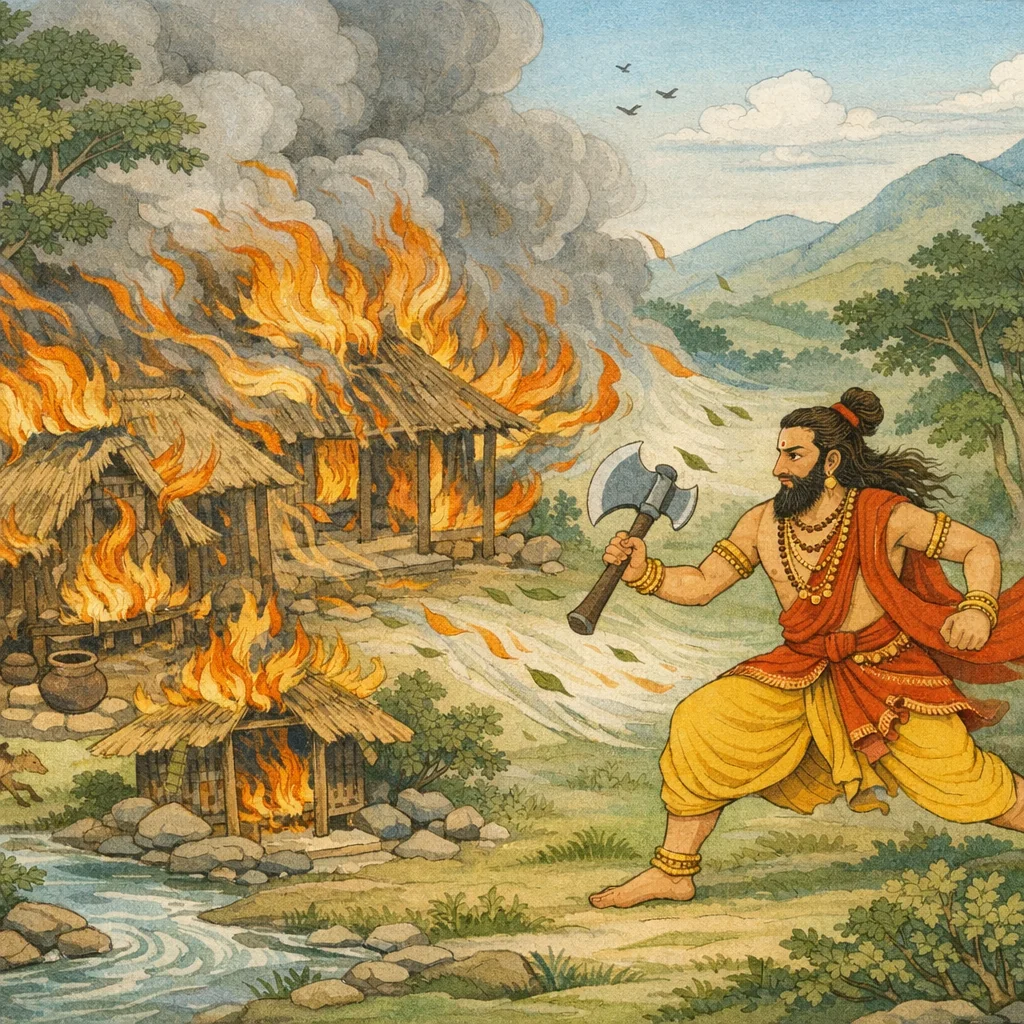
Vāsudeva recounts to Yudhiṣṭhira the origins and causal conditions surrounding Rāma Jāmadagnya (Paraśurāma). A lineage chain is outlined from Jahnu through Kuśika to Gādhi. Indra becomes Gādhi’s son through ascetic impetus, and Gādhi’s daughter Satyavatī is married to Ṛcīka Bhārgava. Ṛcīka prepares two ritual carus: one to produce a kṣatriya-heroic son for Satyavatī and another to produce a calm, ascetic, brahminic son for her mother. Due to an unrecognized exchange, Satyavatī conceives a formidable, force-oriented progeny, prompting Ṛcīka’s corrective concession: the intense disposition shifts to her grandson, while she bears Jamadagni—peaceful and tapas-oriented—whereas her brother becomes Viśvāmitra. Jamadagni fathers Rāma, described as highly trained and decisive in martial knowledge. The narrative then introduces Kārtavīrya Arjuna of the Haihaya line and an incident involving damage to an āśrama environment, leading to a curse predicting conflict. Rāma later severs Arjuna’s arms and retrieves Jamadagni’s calf, after which Arjuna’s sons kill Jamadagni in Rāma’s absence. Rāma’s retaliatory campaign results in repeated depletion of kṣatriya populations, culminating in the gifting of the earth as ritual fee to Kaśyapa and Kaśyapa’s directive that Rāma relocate beyond the southern sea; the formation of Śūrpāraka is noted. The text then emphasizes the social consequences of absent political protection and depicts the earth’s request to Kaśyapa for renewed guardians. Specific surviving or protected heirs are listed (across various lines and locales), and Kaśyapa installs them as kings, re-stabilizing dynasties. The chapter closes with Vaiśaṃpāyana’s narrative transition, describing Vāsudeva’s departure after completing the account.
Chapter Arc: वायुदेव कौन्तेय को परशुराम-जामदग्न्य के अद्भुत प्रभाव का वृत्तांत सुनाने लगते हैं—कैसे एक ब्राह्मण-तेज से दीप्त योद्धा ने क्षत्रियों के अहंकार को बार-बार धूल में मिलाया। → कथा वंश-परंपराओं और कारण-कार्य की गांठें खोलती है: प्राचीन राजवंशों का उल्लेख, ऋचीक-वंश की पृष्ठभूमि, और उसी काल में हैहयाधिप कृतवीर्यपुत्र अर्जुन (कार्तवीर्य अर्जुन) का उदय। उसके बल, राज्य-विस्तार और उद्दंडता से आश्रम-धर्म पर संकट छा जाता है; आश्रम का रम्य शून्यपन भी हिंसा की आहट से काँप उठता है। → हैहय-बल के साथ प्रज्वलित अग्नि द्वारा महात्मा के आश्रम का दहन—धर्म-स्थल पर अधर्म का सीधा आक्रमण—और उसके प्रत्युत्तर में परशुराम का क्षत्रिय-संहार का संकल्प, जो ‘कोटिशः क्षत्रिया हता’ जैसी अतिशयोक्ति-सी लगने वाली व्यापकता तक पहुँचता है। → संहार के बाद भी कथा ठहरती नहीं: पृथ्वी फिर दुरात्माओं से पीड़ित होती है; कुछ क्षत्रिय बालक समुद्र-रक्षा में, कुछ शिल्पी-सुनार आदि जातियों के आश्रय में छिपकर बचते हैं और कालांतर में पुनः पृथ्वीपति बनकर उभर आते हैं—विनाश के बाद पुनर्जन्म का चक्र स्थापित होता है। → परावसु की बात सुनकर परशुराम का पुनः शस्त्र उठाना—यह संकेत कि दमन-चक्र समाप्त नहीं, और धर्म-रक्षा के नाम पर हिंसा की पुनरावृत्ति फिर द्वार पर है।
Shlokas
Verse 1
र: अ2 एकोनपज्चाशत्तमो<5्ध्याय: परशुरामजीके उपाख्यानमें क्षत्रियोंक विनाश और पुन: उत्पन्न होनेकी कथा वायुदेव उवाच शृणु कौन्तेय रामस्य प्रभावो यो मया श्रुत: । महर्षीणां कथयतां विक्रमं तस्य जन्म च
Vāyudeva said: “Listen, O son of Kuntī. I shall relate what I have heard—told by great seers—about Rāma (Paraśurāma): his extraordinary power, his heroic deeds, and the account of his birth.”
Verse 2
यथा च जामदग्न्येन कोटिश: क्षत्रिया हता: । उद्भूता राजवंशेषु ये भूयो भारते हता:
Just as, in former times, Jāmadagnya (Paraśurāma) slew kṣatriyas by the crores, so too those very kṣatriya lines, having arisen again within royal dynasties, have once more been cut down in the Bhārata war.
Verse 3
जल्लोरजस्तु तनयो बलाकाश्चस्तु तत्सुत: । कुशिको नाम धर्मज्ञस्तस्य पुत्रो महीपते
Vāyu said: “O king, Jahnu had a son named Aja, and Aja’s son was Balākāśva. Balākāśva in turn had a son named Kuśika, renowned for his knowledge of dharma.”
Verse 4
अग्ग्रं तप: समातिष्ठत् सहस्राक्षसमो भुवि । पुत्र लभेयमजितं त्रिलोकेश्वरमित्युत
He undertook the highest austerity on earth, possessing prowess equal to Indra of the thousand eyes. With the resolve, “May I obtain a son—unconquered and sovereign over the three worlds,” he began that supreme penance, driven by ambition for an invincible, world-ruling heir.
Verse 5
तमुग्रतपसं दृष्टवा सहस्राक्ष: पुरंदर: । समर्थ पुत्रजनने स्वयमेवान्वपद्यत
Seeing the sage engaged in fierce austerities, Purandara—Indra of a thousand eyes, lord of the guardians of the worlds—recognized that he was capable of begetting a powerful son. Therefore Indra himself entered into him and took birth as his son. O King, that son of Kuśika became renowned by the name Gādhi.
Verse 6
पुत्रत्वमगमद् राजंस्तस्य लोकेश्चरेश्वर: । गाधिनामाभवत् पुत्र: कौशिक: पाकशासन:
Vāyu said: “O King, the lord of the guardians of the worlds entered into sonship for him. Indra, the chastiser of Pāka, became the son of the Kuśika-lineage sage and was renowned by the name Gādhi.”
Verse 7
तस्य कनन््याभवद् राजन् नाम्ना सत्यवती प्रभो । तां गाधिर्भगुपुत्राय सर्चीकाय ददौ प्रभु:
O King, he had a daughter named Satyavatī. That mighty ruler Gādhi gave her in marriage to Ṛcīka, the son of Bhṛgu—thus arranging a union that would shape the lineage and its dharmic responsibilities.
Verse 8
तस्या: प्रीत: स शौचेन भार्गव: कुरुनन्दन । पुत्रार्थ भ्रपयामास चर गाधेस्तथैव च
O delight of the Kurus, the Bhārgava (sage) was pleased with her purity. Seeking a son, he then offered prayers—likewise also for the welfare of Gādhi’s line—thus grounding the desired boon in the ethical power of cleanliness, self-restraint, and right conduct.
Verse 9
कुरुनन्दन! सत्यवती बड़े शुद्ध आचार-विचारसे रहती थी। उसकी शुद्धतासे प्रसन्न हो ऋचीक मुनिने उसे तथा राजा गाधिको भी पुत्र देनेके लिये चरु तैयार किया ।।
Vāyu said: “O descendant of Kuru, Satyavatī lived with exceptionally pure conduct and thought. Pleased by her purity, the sage Ṛcīka prepared a consecrated sacrificial porridge (caru) meant to grant sons—one for her and one for King Gādhi. Then Bhārgava Ṛcīka called his wife Satyavatī and said: ‘You should eat this caru yourself, and this other one should be given to your mother to eat.’”
Verse 10
तस्या जनिष्यते पुत्रो दीप्तिमान् क्षत्रियर्षभ: । अजय्य: क्षत्रियैलोकि क्षत्रियर्षभसूदन:
“The son who will be born to your mother will be radiant, a bull among Kṣatriyas. In this world the Kṣatriyas will not be able to defeat him. He will be a slayer of mighty Kṣatriyas.”
Verse 11
तवापि पुत्र कल्याणि धृतिमन्तं शमात्मकम् । तपो<न्वितं द्विजश्रेष्ठ चरुरेष विधास्यति
“O auspicious lady, for you too this sacrificial porridge (caru) has been prepared; it will bring about the birth of an excellent Brahmin son—steadfast in fortitude, composed in self-restraint, and endowed with ascetic discipline (tapas).”
Verse 12
इत्येवमुक््त्वा तां भार्या सर्चीको भृगुनन्दन: । तपस्यभिरत: श्रीमाञ्जगामारण्यमेव हि,अपनी पत्नीसे ऐसा कहकर भृगुनन्दन श्रीमान् ऋचीक मुनि तपस्यामें तत्पर हो जंगलमें चले गये
Having spoken thus to his wife, the illustrious Ṛcīka—delight of the Bhṛgu lineage—devoted to austerities, departed indeed for the forest.
Verse 13
एतस्मिन्नेव काले तु तीर्थयात्रापरो नृप: । गाधि: सदार: सम्प्राप्त: सर्चीकस्याश्रमं प्रति,इसी समय तीर्थयात्रा करते हुए राजा गाधि अपनी पत्नीके साथ ऋचीक मुनिके आश्रमपर आये
Just at that time, King Gādhi—intent on a pilgrimage to sacred fords (tīrthas)—arrived together with his queen at the hermitage (āśrama) of the sage Ṛcīka.
Verse 14
चरुद्धयं गृहीत्वा च राजन् सत्यवती तदा । भर्तुर्वाक्यं तदाव्यग्रा मात्रे हृष्टा न्यवेदयत्
O King, taking the two portions of sacrificial porridge (caru) in her hands, Satyavatī then went calmly to her mother. With joy, and without distraction, she conveyed to her mother the message spoken by her husband—acting with dutiful clarity and familial respect.
Verse 15
माता तु तस्या: कौन्तेय दुहित्रे स्वं चरुं ददौ । तस्याक्षरुमथाज्ञानादात्मसंस्थं चकार ह
Vāyu said: “O son of Kuntī, the mother of that girl gave her own consecrated oblation (caru) to her daughter. Then, through ignorance, she took the daughter’s portion and made it enter and abide within herself by eating it.” The episode underscores how a lapse in discernment regarding sacred rites can redirect their intended fruit, showing that ritual acts, when mishandled, can yield unintended moral and familial consequences.
Verse 16
अथ सत्यवती गर्भ क्षत्रियान्तकरं तदा । धारयामास दीप्तेन वपुषा घोरदर्शनम्
Then Satyavatī conceived and bore within her a fetus destined to bring about the destruction of the Kṣatriyas. It appeared terrifying to behold, radiant with blazing splendor—an ominous sign that a divinely driven correction of warrior excess and adharma was approaching.
Verse 17
तामृचीकस्तदा दृष्टवा तस्या गर्भगतं द्विजम् । अब्रवीद् भुगुशार्दूल: स्वां भार्या देवरूपिणीम्
Then Ṛcīka, seeing the brahmin child present within her womb, spoke to his own wife—who bore a divine radiance. The verse frames a moment of moral scrutiny within household life: the sage’s perception of what is hidden (the unborn) prompts speech that will shape duty, conduct, and the consequences of choices made within marriage and lineage.
Verse 18
मात्रासि व्यंसिता भद्रे चरुव्यत्यासहेतुना । भविष्यति हि ते पुत्र: क्रूरकर्मात्यमर्षण:
Vāyu said: “O gentle lady, because the sacrificial offering (caru) was exchanged, your measure has been disturbed. Therefore, a son will indeed be born to you—one whose deeds will be harsh, and whose temper will be fiercely intolerant.”
Verse 19
सत्यवतीके गर्भगत बालकको देखकर भृगुश्रेष्ठ ऋचीकने अपनी उस देवरूपिणी पत्नीसे कहा--'भद्रे! तुम्हारी माताने चर बदलकर तुम्हें ठग लिया। तुम्हारा पुत्र अत्यन्त क्रोधी और क्रूरकर्म करनेवाला होगा ।।
Seeing the child in Satyavatī’s womb, Ṛcīka, foremost of the Bhṛgus, said to his godlike wife: “O gentle lady, your mother has deceived you by exchanging the consecrated chāru. Your son will be exceedingly wrathful and given to cruel deeds. And a brother too will be born to you—one made Brahman-like by austerity, devoted to tapas; for the vast, all-pervading sacred power of Brahman has been gathered into your oblation.”
Verse 20
क्षत्रवीर्य च सकल॑ तव मात्रे समर्पितम् । विपर्ययेण ते भद्रे नैतदेव॑ भविष्यति
“All your kṣatriya prowess has been entrusted to your mother. But if matters turn contrary, O noble lady, it will not come to pass as you expect.”
Verse 21
मातुस्ते ब्राह्मणो भूयात् तव च क्षत्रिय: सुतः । परंतु तुम्हारा भाई ब्राह्मणस्वरूप एवं तपस्यापरायण होगा। तुम्हारे चरुमें मैंने सम्पूर्ण महान् तेज ब्रह्मकी प्रतिष्ठा की थी और तुम्हारी माताके लिये जो चरु था
“Let your mother’s son be a brāhmaṇa, and let your own son be a kṣatriya. Yet your brother will be Brahmin-like and devoted to austerity. Into the chāru meant for you I had established the full greatness of brahma-tejas, and into the chāru meant for your mother I had infused the complete strength and valor proper to a kṣatriya. But, O auspicious lady, because the chāru was exchanged, it will not be so: your mother’s son will be a brāhmaṇa, and your son will be a kṣatriya.”
Verse 22
पपात शिरसा तस्मै वेपन्ती चाब्रवीदिदम् नाहोंडसि भगवन्नद्य वक्तुमेवंविधं वच: । ब्राह्मणापसद ं पुत्र प्राप्स्यसीति हि मां प्रभो
Trembling, she fell at his feet with her head bowed and said: “O Lord, O Blessed One—do not speak such words to me today. Do not tell me, ‘You will bear a son who will be a disgrace among brāhmaṇas.’”
Verse 23
ऋचीक उवाच नैष संकल्पित: कामो मया भठद्रे तथा त्वयि । उग्रकर्मा समुत्पन्नश्नरुव्यत्यासहेतुना
Ṛcīka said: “O auspicious lady, this was not my intention or resolve concerning you—that such a son should be born from your womb. But because the chāru was exchanged, a child of fierce deeds must now arise.”
Verse 24
सत्यवत्युवाच इच्छल्लॉकानपि मुने सृजेथा: कि पुन: सुतम् । शमात्मकमजुं पुत्र दातुमहसि मे प्रभो
Satyavatī said: “O sage, if you so wish, you are capable of creating even worlds—how much more, then, of bringing forth a son. Therefore, O lord, please grant me a son who is peaceful in nature and simple, free from harshness.”
Verse 25
ऋचीक उवाच नोक्तपूर्वनितं भद्रे स्वैरेष्वपि कदाचन । किमुताग्निं समाधाय मन्त्रवच्चरुसाधने
Ṛcīka said: “O blessed lady, I have never spoken a falsehood—not even in jest. How, then, could the resolve I made while establishing the sacred fire and preparing the charu with mantras ever be untrue?”
Verse 26
दृष्टमेतत् पुरा भद्रे ज्ञातं च तपसा मया | ब्रह्मभूतं हि सकल॑ पितुस्तव कुल भवेत्,कल्याणि! मैंने तपस्याद्वारा पहले ही यह बात देख और जान ली है कि तुम्हारे पिताका समस्त कुल ब्राह्मण होगा
Ṛcīka said: “O auspicious lady, I had already perceived this long ago and also ascertained it through my austerities: indeed, your father’s entire lineage is destined to become Brahmin in character and status.”
Verse 27
सत्यवत्युवाच काममेवं भवेत् पौत्रो ममेह तव च प्रभो । शमात्मकमहं पुत्र॑ लभेयं जपतां वर
Satyavatī said: “Let it be so, O lord—let the grandson born in our line be as you have ordained, even if he turns out fierce in temperament. Yet as for my own son, O best among those devoted to sacred recitation, I desire to receive one whose nature is calm and self-controlled.”
Verse 28
ऋचीक उवाच पुत्रे नास्ति विशेषो मे पौत्रे च वरवर्णिनि । यथा त्वयोक्तं वचनं तथा भद्ठे भविष्यति,ऋचीक बोले--सुन्दरी! मेरे लिये पुत्र और पौत्रमें कोई अन्तर नहीं है। भद्रे! तुमने जैसा कहा है, वैसा ही होगा
Ṛcīka said: “O fair-complexioned lady, to me there is no distinction between a son and a grandson. O gentle one, it shall be exactly as you have spoken.”
Verse 29
वासुदेव उवाच ततः सत्यवती पुत्रं जनयामास भार्गवम् । तपस्यभिरतं शान्तं जमदग्निं यतव्रतम्
Vāsudeva said: “Thereafter Satyavatī gave birth to a son of the Bhṛgu lineage—Jamadagni—one devoted to austerities, tranquil in disposition, and steadfast in self-restraint.”
Verse 30
विश्वामित्रं च दायादं गाधि: कुशिकनन्दन: । यः प्राप ब्रह्मसमितं विश्वै््रह्मगुणैर्युतम्
Vāsudeva said: “Gādhi, the delight of the Kuśika line, obtained as his heir a son named Viśvāmitra—endowed with every virtue proper to a brāhmaṇa and admitted into the company of Brahmarṣis.”
Verse 31
ऋचीको जनयामास जमदर्ग्निं तपोनिधिम् | सोडपि पुत्र हूजनयज्जमदग्नि: सुदारुणम्
Vāsudeva said: “Ṛcīka begot Jamadagni, a veritable treasure-house of austerity. And Jamadagni, in turn, begot a son of exceedingly fierce and formidable nature—Paraśurāma—radiant like a blazing fire, fully accomplished in all branches of knowledge and pre-eminent in the science of archery, renowned as a slayer of oppressive kṣatriyas.”
Verse 32
सर्वविद्यान्तगं श्रेष्ठ धनुर्वेदस्य पारगम् । राम॑ क्षत्रियहन्तारं प्रदीप्तमिव पावकम्
Vāsudeva said: “He is the foremost, having reached the culmination of all branches of knowledge; a master who has crossed to the far shore of the science of archery. That Rāma—Paraśurāma—the slayer of kṣatriyas, blazes like a fire fully kindled.”
Verse 33
तोषयित्वा महादेवं पर्वते गन्धमादने । अस्त्राणि वरयामास परशुं चातितेजसम्,परशुरामजीने गन्धमादन पर्वतपर महादेवजीको संतुष्ट करके उनसे अनेक प्रकारके अस्त्र और अत्यन्त तेजस्वी कुठार प्राप्त किये
Having pleased Mahādeva on Mount Gandhamādana, he obtained a variety of divine weapons, and also an exceedingly radiant axe.
Verse 34
स तेनाकुण्ठधारेण ज्वलितानलवर्चसा । कुठारेणाप्रमेयेण लोकेष्वप्रतिमो5भवत्
With that axe whose edge never grew blunt, blazing with the radiance of a flaming fire, he became incomparable among all worlds. By means of that immeasurable, mighty axe, Paraśurāma attained unrivaled heroic eminence everywhere.
Verse 35
एतस्मिन्नेव काले तु कृतवीर्यात्मजो बली । अर्जुनो नाम तेजस्वी क्षत्रियो हैहयाधिप:,इसी समय राजा कृतवीर्यका बलवान पुत्र अर्जुन हैहयवंशका राजा हुआ, जो एक तेजस्वी क्षत्रिय था
At that very time, there arose Arjuna—mighty son of King Kṛtavīrya—an illustrious kṣatriya who became the sovereign of the Haihaya lineage. The narrative marks the emergence of a powerful ruler, setting the ethical backdrop for how royal strength and lineage-based authority can shape the course of dharma in the world.
Verse 36
दत्तात्रेयप्रसादेन राजा बाहुसहस्रवान् | चक्रवर्ती महातेजा विप्राणामाश्चमेधिके
Vāsudeva said: “By the grace of Dattātreya, that king became possessed of a thousand arms. Radiant with great splendor, he was a universal sovereign; and in the rite of the Aśvamedha he bestowed gifts upon the Brahmins.”
Verse 37
ददौ स पृथिवीं सर्वा सप्तद्वीपां सपर्वताम् स्वबाह्वस्वबलेनाजौ जित्वा परमधर्मवित्
Vāsudeva said: Having conquered in battle, by the strength of his own arms, the entire earth with its seven continents and its mountains, that supremely dharma-knowing king bestowed it in gift—giving away what he had won, in accordance with the highest law of generosity and righteousness.
Verse 38
तृषितेन च कौन्तेय भिक्षितश्रित्रभानुना । सहस्रबाहुर्विक्रान्त: प्रादाद् भिक्षामथाग्नये
Vāsudeva said: “O son of Kuntī, when Agni—radiant like a crested flame—was once tormented by hunger and thirst, the mighty, valiant Sahasrabāhu Arjuna granted him the requested alms.” The episode highlights the ethic of giving to a worthy supplicant and honoring a divine request without hesitation.
Verse 39
ग्रामान् पुराणि राष्ट्राणि घोषांश्चैव तु वीर्यवान् । जज्वाल तस्य बाणाग्राच्चित्रभानुर्दि धक्षया
Vāsudeva said: “The mighty Citrabhānu (Agni), flaring up from the very tips of his arrows, blazed with the desire to burn—reducing villages, ancient settlements, kingdoms, and cattle-stations (ghoṣa) to ashes.”
Verse 40
स तस्य पुरुषेन्द्रस्य प्रभावेण महौजस: । ददाह कार्तवीर्यस्य शैलानथ वनस्पतीन्,उन्होंने उस महापराक्रमी नरेश कार्तवीर्यके प्रभावसे पर्वतों और वनस्पतियोंको जलाना आरम्भ किया
Vāsudeva said: “Empowered by the majesty of that lion among men, the mighty one began to burn the mountains and the trees belonging to Kārtavīrya.”
Verse 41
स शून्यमाश्रमं रम्यमापवस्य महात्मन: । ददाह पवनेनेद्धश्षित्रभानु: सहैहय:
Vāsudeva said: “Citrabhānu (Agni), fanned into a blaze by the wind, burned down the deserted yet lovely hermitage of the great-souled Āpava, together with the Haihayas.”
Verse 42
आपतव्स्तु ततो रोषाच्छशापार्जुनमच्युत । दग्धे55श्रमे महाबाहो कार्तवीर्येण वीर्यवान्
Vāsudeva said: “Then the powerful sage Āpava, inflamed with anger, cursed Arjuna, O Acyuta. For when his hermitage had been burned by Kārtavīrya, the mighty-armed ascetic was seized by fierce wrath and pronounced a curse upon Kṛtavīrya’s son Arjuna.”
Verse 43
त्वया न वर्जित यस्मान्ममेदं हि महद् वनम् | दग्ध॑ तस्माद् रणे रामो बाहूंस्ते छेत्स्यतेडर्जुन
“Arjuna, since you did not refrain from burning even this vast forest of mine, therefore in battle Rāma (Paraśurāma) will cut off your arms.”
Verse 44
अर्जुनस्तु महातेजा बली नित्यं शमात्मक: । बहाण्यश्व शरण्यश्व दाता शूरश्न भारत,भारत! अर्जुन महातेजस्वी, बलवान, नित्य शान्ति-परायण, ब्राह्मण-भक्त शरणागतोंको शरण देनेवाला, दानी और शूरवीर था
Vāsudeva said: “Arjuna, radiant with great splendor, was ever strong and steadfast in inner calm. He was devoted to the Brahmins and a refuge to those who sought protection; he was generous, and he was a hero, O Bharata.”
Verse 45
नाचिन्तयत् तदा शापं तेन दत्तं महात्मना । तस्य पुत्रास्तु बलिन: शापेनासन् _पितुर्वधे
Vāsudeva said: “At that time he gave no thought to the curse pronounced by that great-souled sage. Yet, by the force of that very curse, his own mighty sons became the cause of their father’s death.”
Verse 46
निमित्तादवलिप्ता वै नृशंसाश्वैव सर्वदा । जमदग्निधेन्वास्ते वत्समानिन्युर्भरतर्षभ
Vāsudeva said: “Driven by a pretext and swollen with pride, those princes—ever cruel in conduct—once carried off the calf belonging to Jamadagni’s sacred wish-fulfilling cow, O bull of the Bharatas.”
Verse 47
अज्ञातं कार्तवीर्येण हैहयेन्द्रेण धीमता । तन्निमित्तमभूद् युद्ध जामदग्नेर्महात्मन:
This matter was unknown to the wise Haihaya sovereign Kārtavīrya. Yet, on account of that very cause, a fierce war arose between him and the great-souled Jāmadagnya (Paraśurāma).
Verse 48
ततोअर्जुनस्य बाहूंस्तांश्छित्त्वा रामो रुषान्वित: । तं॑ भ्रमन्तं ततो वत्सं जामदग्न्य: स्वमाश्रमम्
Then Rāma (Paraśurāma), filled with wrath, cut off those arms of Arjuna. Thereafter, Jāmadagnya took that bewildered youth and brought him to his own hermitage.
Verse 49
प्रत्यानयत राजेन्द्र तेषामन्तःपुरात् प्रभु: । राजेन्द्र! तब रोषमें भरे हुए प्रभावशाली जमदग्निनन्दन परशुरामने अर्जुनकी उन भुजाओंको काट डाला और इधर-उधर घूमते हुए उस बछड़ेको वे हैहयोंके अन्तःपुरसे निकालकर अपने आश्रममें ले आये ।।
Vāsudeva said: “O best of kings, the mighty lord brought it back from within their inner palace.” In the narrative setting of the Rāmopākhyāna, this line points to the restoration of what was wrongfully taken—an act framed as the reassertion of rightful order (dharma) against oppressive power, even when that power is entrenched in the private stronghold of rulers.
Verse 50
गत्वा55श्रममसम्बुद्धा जमदग्नेर्महात्मन: । अपातयन्त भल््लाग्रै: शिर: कायान्नराधिप
Having gone to the hermitage of the great-souled Jamadagni, and being devoid of right understanding, they struck off his head with the sharp points of their arrows—O king—severing it from his body. The verse underscores how delusion and unrighteous intent can drive even rulers or warriors to commit sacrilege against a venerable sage, bringing grave moral consequence.
Verse 51
समित्कुशार्थ रामस्य निर्यातस्य यशस्विन: । नरेश्वर! अर्जुनके पुत्र बुद्धिहीन और मूर्ख थे। उन्होंने संगठित हो महात्मा जमदग्निके आश्रमपर जाकर भल्लोंके अग्रभागसे उनके मस्तकको धड़से काट गिराया। उस समय यशस्वी परशुरामजी समिधा और कुशा लानेके लिये आश्रमसे दूर चले गये थे || ४९-५० $ई || ततः पितृवधामर्षादू राम: परममन्युमान्
Vāsudeva said: “O king, when the illustrious Rāma (Paraśurāma) had gone out to gather firewood and kuśa grass, the sons of Arjunaka—foolish and witless—banded together and went to the hermitage of the great sage Jamadagni. With the sharp foreparts of their arrows they severed his head from his body and cast it down. At that time the renowned Paraśurāma was away from the āśrama, having gone far to fetch fuel and kuśa. Then, burning with intolerable grief and outrage at his father’s murder, Rāma became possessed of extreme wrath.”
Verse 52
ततः स भृगुशार्दूल: कार्तवीर्यस्य वीर्यवान्
Then that tiger among the Bhṛgus—himself a man of great prowess—(spoke of/turned toward) Kārtavīrya’s heroic might, setting the narrative toward an appraisal of power and its moral consequences.
Verse 53
स हैहयसहस्राणि हत्वा परममन्युमान्
Vāsudeva said: “He, filled with the fiercest wrath, slew thousands of the Haihayas.” The line highlights how uncontrolled anger, when joined to martial power, can lead to vast slaughter—an ethical warning often raised in the Śānti discourse even while recounting heroic deeds.
Verse 54
स तथा<55शु महातेजा: कृत्वा निःक्षत्रियां महीम्
Thus that mighty, radiant one swiftly rendered the earth bereft of kṣatriyas—showing how overwhelming power, driven by vow or wrath, can overturn the social order and raise grave questions of dharma’s restraint even in the pursuit of justice.
Verse 55
कृपया परया5<विष्टो वनमेव जगाम ह । इस प्रकार शीघ्र ही पृथ्वीको क्षत्रियोंसे हीन करके महातेजस्वी परशुराम अत्यन्त दयासे द्रवित हो वनमें ही चले गये ।। ५४ $ ।। ततो वर्षसहस्रेषु समतीतेषु केषुचित्
Overwhelmed by profound compassion, he indeed went to the forest. Thus, after swiftly rendering the earth bereft of kṣatriyas, the mighty Paraśurāma—his heart melted by intense pity—departed to the wilderness. Then, when some thousands of years had passed…
Verse 56
विश्वामित्रस्य पौत्रस्तु रैभ्यपुत्रो महातपा:
Vāsudeva said: “O King! A great ascetic—Parāvasu, the grandson of Viśvāmitra and son of Raibhya—censured Rāma in the assembly, saying: ‘Rāma! When King Yayāti fell from heaven, were not Pratardana and the other noble men gathered at the sacrifice kṣatriyas? Your vow is false. You boast in vain before the people, saying, “I have ended the kṣatriyas.” I think you fled to the mountains out of fear of kṣatriya heroes. Even now, on every side of the earth, hundreds of kṣatriyas have arisen again!’”
Verse 57
परावसुर्महाराज क्षिप्त्वा55ह जनसंसदि । ये ते ययातिपतने यज्ञे सन्त: समागता:
Vāsudeva said: “O great king, Parāvasu, casting his reproach in the public assembly, declared: ‘Rāma! When King Yayāti fell from heaven, were not the virtuous men—Pratardana and others—gathered at the sacrifice kṣatriyas? Your vow is false. You boast in vain before the people, saying, “I have ended the kṣatriyas.” I think you took refuge in the mountains out of fear of kṣatriya heroes. Even now, across the earth, hundreds of kṣatriyas have again filled the land.’”
Verse 58
प्रतर्दनप्रभूतयो राम किं क्षत्रिया न ते । मिथ्याप्रतिज्ञो राम त्वं कत्थसे जनसंसदि
Vāsudeva said: “Rāma, were not Pratardana and the others kṣatriyas? Your vow is false. You boast in vain in the public assembly, claiming, ‘I have brought the kṣatriyas to an end.’”
Verse 59
भयात् क्षत्रियवीराणां पर्वतं समुपाश्रित: । सा पुन: क्षत्रियशतै: पृथिवी सर्वतः स्तृता
Vāsudeva said: “Out of fear of the heroic Kṣatriyas you took refuge in a mountain. Yet now, O great king, the earth is once again filled on every side with hundreds of Kṣatriyas.”
Verse 60
परावसोर्वच: श्रुत्वा शस्त्र जग्राह भार्गव: । ततो ये क्षत्रिया राजन् शतशस्तेन वर्जिता:
Hearing the words of Parāvasu, Bhārgava (Paraśurāma) seized his weapon. Then, O king, those Kṣatriyas—stripped of their martial power as though their strength had been cut down a hundredfold—were left exposed to his onslaught, as the balance of force turned against them.
Verse 61
स पुनस्ताञ्जघानाशु बालानपि नराधिप
But he again struck them down swiftly—those very ones—even though they were mere children, O king.
Verse 62
गर्भस्थैस्तु मही व्याप्ता पुनरेवाभवत् तदा । जात॑ जात॑ स गर्भ तु पुनरेव जघान ह
Vāsudeva said: “At that time the earth again became filled with embryos in the womb. Yet that embryo-destroying force struck them down again and again—each time they came to birth, it slew them once more.”
Verse 63
अरक्षेश्व सुतान् कांक्ष्चित् तदा क्षत्रिययोषित: । नरेश्वर! उन्होंने पुन: उन सबके छोटे-छोटे बच्चों-तकको शीघ्र ही मार डाला। जो बच्चे गर्भमें रह गये थे
Vāsudeva said: O king, at that time the Kṣatriya women managed to protect only a few sons. Yet the rest—even the very young children—were swiftly slain again. Those who remained hidden in the womb became the seed by which the whole earth was repopulated. But whenever a child was born from such a pregnancy, Paraśurāma would again put him to death. Thus, the mighty one made the earth “without Kṣatriyas” twenty-one times.
Verse 64
दक्षिणामश्वमेधान्ते कश्यपायाददत् ततः । इस प्रकार शक्तिशाली परशुरामजीने इस पृथ्वीको इक्कीस बार क्षत्रियोंसे हीन करके अश्वमेध यज्ञ किया और उसकी समाप्ति होनेपर दक्षिणाके रूपमें यह सारी पृथ्वी उन्होंने कश्यपजीको दे दी ।।
Vāsudeva said: At the conclusion of the Aśvamedha, he then gave the sacrificial fee to Kaśyapa. Thus the mighty Paraśurāma, having made the earth bereft of kṣatriyas twenty-one times, performed the horse-sacrifice; and when it was completed, he bestowed this entire earth upon Kaśyapa as the dakṣiṇā. Thereafter, Kaśyapa, intending what was to be done regarding the remaining kṣatriyas, proceeded accordingly.
Verse 65
खुक्प्रग्रहवता राजंस्ततो वाक्यमथाब्रवीत् । गच्छ तीर समुद्रस्य दक्षिणस्य महामुने
Then, addressing the king, he spoke these words: “O great sage, go to the shore of the southern ocean.”
Verse 66
न ते मद् विषये राम वस्तव्यमिह कर्हिचित् । राजन! तदनन्तर कुछ क्षत्रियोंको बचाये रखनेकी इच्छासे कश्यपजीने खुक् लिये हुए हाथसे संकेत करते हुए यह बात कही--“महामुने! अब तुम दक्षिण समुद्रके तटपर चले जाओ। अब कभी मेरे राज्यमें निवास न करना' || ६४-६५ $ || ततः शूर्पारकं देशं सागरस्तस्य निर्ममे
Vāsudeva said: “Rāma, you must never dwell here in my realm. O King!” After this, Kaśyapa—signaling with a weapon held in his hand, intent on preserving the kṣatriyas—declared: “Great sage, go now to the shore of the southern ocean. From this day onward, do not reside in my kingdom.” Thereupon the ocean fashioned for him the region called Śūrpāraka.
Verse 67
सहसा जामदग्न्यस्य सो5परान्तमहीतलम् । (यह सुनकर परशुरामजी चले गये) समुद्रने सहसा जमदग्निकुमार परशुरामजीके लिये जगह खाली करके शूर्पारक देशका निर्माण किया; जिसे अपरान्तभूमि भी कहते हैं ।।
Vāsudeva said: At once, the Ocean yielded ground for Jāmadagnya Paraśurāma. Hearing this, Paraśurāma departed. The sea quickly made space for Jamadagni’s son and brought into being the land called Śūrpāraka, also known as Aparānta. Then Kaśyapa, O king, accepted that earth.
Verse 68
ततः शृद्राश्व वैश्याश्व यथा स्वैरप्रचारिण:
Then the Śūdras and the Vaiśyas, moving about as they pleased, went on with their own occupations without restraint.
Verse 69
अवर्तन्त द्विजाग्ग्राणां दारेषु भरतर्षभ । भरतश्रेष्ठ! फिर तो स्वेच्छाचारी वैश्य और शाटद्र श्रेष्ठ द्विजोंकी स्त्रियोंके साथ अनाचार करने लगे ।। ६८ $ ।। अराजके जीवलोके दुर्बला बलवत्तरै:
Vāsudeva said: “O bull among the Bharatas, when governance collapses and law is not upheld, men of the lower orders—unrestrained—began to violate the wives of the foremost brāhmaṇas. In such lawlessness, the weak become prey to the strong, and social and moral boundaries are trampled.”
Verse 70
ततः कालेन पृथिवी पीड्यमाना दुरात्मभि:
Then, as time passed, the Earth was oppressed by wicked men through their acts of tyranny. Because of that inversion of order, she soon began to sink toward Rasātala, for at that time the kṣatriyas—appointed as guardians of dharma—were not protecting her in the prescribed way.
Verse 71
विपर्ययेण तेनाशु प्रविवेश रसातलम् । अरक्ष्यमाणा विधिवत क्षत्रियैर्धर्मरक्षिभि:
Because of that reversal of order, the Earth quickly began to sink into Rasātala. For she was not being duly protected, as prescribed, by kṣatriyas who are meant to be guardians of dharma.
Verse 72
तां दृष्टवा द्रवरतीं तत्र संत्रासात् स महामना: । ऊरुणा धारयामास कश्यप: पृथिवीं ततः,भयके मारे पृथ्वीको रसातलकी ओर भागती देख महामनस्वी कश्यपने अपने ऊरुओंका सहारा देकर उसे रोक दिया
Seeing the Earth trembling and rushing away in fear, the great-souled Kaśyapa supported and restrained her with his thighs, preventing her from fleeing toward the nether regions.
Verse 73
धृता तेनोरुणा येन तेनोर्वीति मही स्मृता । रक्षणार्थ समुद्दिश्य ययाचे पृथिवी तदा
Because the Earth was upheld by that noble one’s thighs, she came to be remembered as “Urvi”. Seeking protection, the Earth then approached him and made her petition.
Verse 74
पुथिव्युवाच सन्ति ब्रह्मन् मया गुप्ता: स्रीषु क्षत्रियपुड़वा
The Earth said: “O Brahmin, there are eminent Kshatriya heroes whom I have kept concealed among women.”
Verse 75
हैहयानां कुले जातास्ते संरक्षन्तु मां मुने । पृथ्वी बोली--ब्रह्मन! मैंने स्त्रियोंमें कई क्षत्रियशिरोमणियोंको छिपा रखा है। मुने! वे सब हैहयकुलनें उत्पन्न हुए हैं, जो मेरी रक्षा कर सकते हैं ।।
“O sage, may those born in the Haihaya lineage protect me.” The Earth said: “O Brahman! I have concealed many foremost Kshatriyas among women. O sage, all of them are born of the Haihaya clan—men who are capable of protecting me. Moreover, O lord, there exists an heir of the Pauravas, the son of Vidūratha.”
Verse 76
तथानुकम्पमानेन यज्वनाथामितौजसा
Vāsudeva said: “In the same way, the mighty sage Parāśara—compassionate and devoted to sacrifice—once saved the life of Saudāsa’s son. Though a twice-born prince, he performed all kinds of work even like a Śūdra; therefore he became renowned by the name ‘Sarvakarmā’ (‘the doer of all tasks’). May that king protect me.”
Verse 77
पराशरेण दायाद: सौदासस्याभिरक्षित: । सर्वकर्माणि कुरुते शूद्रवत् तस्य स द्विज:
Vāsudeva said: “Protected by Parāśara, the heir of Saudāsa performs every kind of work; that twice-born one lives and acts like a Śūdra.”
Verse 78
शिबिपुत्रो महातेजा गोपतिर्नाम नामतः
Vāsudeva said: “There was a son of Śibi, a man of great splendor, who was known by the name Gopati.”
Verse 79
वने संवर्धितो गोभि: सो5भिरक्षतु मां मुने । राजा शिबिका एक महातेजस्वी पुत्र बचा हुआ है
Vāsudeva said: “O sage, let him who was reared in the forest by the cows protect me. There is a certain exceedingly radiant son of King Śibikā named Gopati—saved and brought up in the wilderness, nurtured by the cows themselves. If you permit it, O muni, let that very one be my protector.” (Then the text continues:) “And Pratardana’s son, named Vatsa, was of great strength …”
Verse 80
दथधिवाहनपौत्रस्तु पुत्रो दिविरथस्य च
Vāsudeva said: “He was the grandson of Dadhivāhana, and also the son of Diviratha.”
Verse 81
बृहद्रथो महातेजा भूरिभूतिपरिष्कृत:
Vāsudeva said: “Bṛhadratha, a man of great splendor, was richly endowed with prosperity and royal magnificence.”
Verse 82
मरुत्तस्यान्ववाये च रक्षिता: क्षत्रियात्मजा:
And in the lineage of Marutta as well, the sons of the Kṣatriyas were protected—kept safe and upheld—indicating the ruler’s duty to preserve the warrior order and maintain social stability through rightful guardianship.
Verse 83
एते क्षत्रियदायादास्तत्र तत्र परिश्रुता:
Vāsudeva said: “These heirs of the Kṣatriya line are spoken of and well-known in various places.”
Verse 84
यदि मामभिरक्षन्ति तत: स्थास्यामि निश्चला
Vāsudeva said: “If they protect me, then I shall remain firm and unmoving. If these kṣatriyas truly undertake my protection, I can stand steady, without wavering. Yet these poor men’s fathers and grandfathers were, for my sake alone, slain in battle by Paraśurāma—who performed that mighty deed with effortless power.”
Verse 85
एतेषां पितरश्रैव तथैव च पितामहा: । मदर्थ निहता युद्धे रामेणाक्लिष्टकर्मणा
Vāsudeva said: “Their fathers, and likewise their grandfathers, were slain in battle for my sake by Rāma (Paraśurāma), whose deeds know no fatigue. Remembering this, one should understand the deep, inherited burden of violence and obligation that war creates—how acts done ‘for another’s cause’ can bind later generations to fear, resentment, or duty.”
Verse 86
तेषामपचितिश्लैव मया कार्या महामुने । न हाहं कामये नित्यमतिक्रान्तेन रक्षणम् । वर्तमानेन वर्तेयं तत् क्षिप्रं संविधीयताम्
O great sage, I must indeed repay my debt of gratitude to them by honoring these descendants of those kings. I do not wish, at any time, to be protected by a kṣatriya who has transgressed the bounds of dharma. Let me live under the guardianship of one who abides in the present rule of righteousness; therefore, please arrange this without delay.
Verse 87
वायुदेव उवाच ततः पृथिव्या निर्दिषप्टांस्तानू समानीय कश्यप: । अभ्यषिज्चन्महीपालान _ क्षत्रियान् वीर्यसम्मतान्
Vāyu said: Thereafter, Kaśyapa, having summoned those kings—valiant Kṣatriyas indicated by the Earth—consecrated them, installing each upon his respective realm.
Verse 88
तेषां पुत्राश्न पौत्राश्न येषां वंशा: प्रतिष्ठिता: । एवमेतत् पुरावृत्तं यन्मां पृष्छसि पाण्डव
“Their sons and grandsons have flourished—those whose lineages stand firmly established. Thus indeed is that ancient account, O Pāṇḍava, about which you have questioned me.”
Verse 89
वैशम्पायन उवाच एवं ब्रुवंस्तं च यदुप्रवीरो युधिष्ठिरं धर्मभृतां वरिष्ठम् । रथेन तेनाशु ययौ महात्मा दिश: प्रकाशन् भगवानिवार्क:
Vaiśampāyana said: Thus conversing with Yudhiṣṭhira—the foremost among the upholders of dharma—the heroic scion of the Yadus, great-souled Kṛṣṇa, swiftly drove onward in that chariot, illuminating all directions like the divine Sun.
Verse 513
निःक्षत्रियां प्रतिश्रुत्य महीं शस्त्रमगृह्नत । पिताके इस प्रकार मारे जानेसे परशुरामके क्रोधकी सीमा न रही। उन्होंने इस पृथ्वीको क्षत्रियोंसे सूनी कर देनेकी भीषण प्रतिज्ञा करके हथियार उठाया
Vāsudeva said: Having vowed to make the earth bereft of kṣatriyas, he took up his weapons. When his father was slain in this manner, Paraśurāma’s anger knew no bounds; making a dreadful vow to empty the world of the warrior class, he armed himself.
Verse 526
विक्रम्य निजघानाशु पुत्रान् पौत्रांश्व सर्वश: । भृगुकुलके सिंह पराक्रमी परशुरामने पराक्रम प्रकट करके कार्तवीर्यके सभी पुत्रों तथा पौत्रोंका शीघ्र ही संहार कर डाला
Vāsudeva said: Displaying his prowess, Paraśurāma—the lion of the Bhṛgu lineage—swiftly struck down, without exception, all the sons and grandsons of Kārtavīrya.
Verse 536
चकार भार्गवो राजन् महीं शोणितकर्दमाम् | राजन! परम क्रोधी परशुरामने सहस्रों हैहयोंका वध करके इस पृथ्वीपर रक्तकी कीच मचा दी
Vāsudeva said: “O King, the Bhārgava (Paraśurāma) turned the earth into a mire of blood—so fierce was his wrath—after slaying thousands of the Haihayas.”
Verse 553
क्षेपं सम्प्राप्तवांस्तत्र प्रकृत्या कोपन: प्रभु: । तदनन्तर कई हजार वर्ष बीत जानेपर एक दिन वहाँ स्वभावत: क्रोधी परशुरामपर आक्षेप किया गया
Vāsudeva said: There, an affront was directed at the mighty one who was by nature quick to anger.
Verse 673
कृत्वा ब्राह्मणसंस्थां वै प्रविष्ट: सुमहद् वनम् । महाराज! कश्यपने पृथ्वीको दानमें लेकर उसे ब्राह्मणोंके अधीन कर दिया और वे स्वयं विशाल वनके भीतर चले गये
Having duly established the order and authority of the Brahmins, he entered a vast forest. O great king, Kaśyapa accepted the earth as a gift, placed it under the stewardship of the Brahmins, and then himself withdrew into the great wilderness—an act that frames kingship as accountable to dharma and renunciation as the culmination of rightful rule.
Verse 696
पीड्यन्ते न हि विप्रेषु प्रभुत्वं कस्यचित् तदा । सारे जीवजगत्में अराजकता फैल गयी। बलवान मनुष्य दुर्बलोंको पीड़ा देने लगे। उस समय ब्राह्मणोंमेंसे किसीकी प्रभुता कायम न रही
Vāsudeva said: “Then, among the Brahmins, no one’s authority remained established; for they were being oppressed.” The verse evokes a breakdown of rightful order: when the learned and ethical guardians of dharma are harassed and lose standing, society slips toward lawlessness and the strong begin to torment the weak.
Verse 736
प्रसाद्य कश्यपं देवी वरयामास भूमिपम् | कश्यपजीने ऊरुसे इस पृथ्वीको धारण किया था; इसलिये यह उर्वी नामसे प्रसिद्ध हुई। उस समय पृथ्वीदेवीने कश्यपजीको प्रसन्न करके अपनी रक्षाके लिये यह वर माँगा कि मुझे भूपाल दीजिये
Having pleased the sage Kaśyapa, the Goddess (Earth) sought a boon: a protector-king. Because this Earth was borne upon Kaśyapa’s thigh, wrapped in his antelope-skin, she became renowned by the name Urvī. In that moment, Earth herself, after winning Kaśyapa’s favor, asked for her own safeguarding that a ruler be granted to her—so that order might be upheld and the world not fall into lawlessness.
Verse 753
ऋक्षै: संवर्धितो विप्र ऋक्षवत्यथ पर्वते । प्रभो! उनके सिवा पुरुवंशी विदूरथका भी एक पुत्र जीवित है, जिसे ऋक्षवान् पर्वतपर रीछोंने पालकर बड़ा किया है
Vāsudeva said: “O brāhmaṇa, he was reared and brought to maturity by bears on the mountain called Ṛkṣavat. Thus, even apart from the others, one son of the Puru line—Vidūratha’s—still survives, preserved by an unexpected guardianship in the wilderness.”
Verse 773
सर्वकर्मेत्यभिख्यात: स मां रक्षतु पार्थिव: । इसी प्रकार अमित शक्तिशाली यज्ञपरायण महर्षि पराशरने दयावश सौदासके पुत्रकी जान बचायी है
“Known by the name ‘Sarvakarmā’ (‘one who performs all kinds of work’), may that king protect me. In the same way, the immensely powerful, sacrifice-devoted sage Parāśara, out of compassion, saved the life of Saudāsa’s son. Though born a twice-born (brāhmaṇa) by status, that prince performs every kind of task like the śūdras; therefore he is famed as ‘Sarvakarmā’. May that royal protector guard me.”
Verse 793
वत्सै: संवर्धितों गोछे स मां रक्षतु पार्थिव: । प्रतर्दनका महाबली पुत्र वत्स भी राजा होकर मेरी रक्षा कर सकता है। उसे गोशालामें बछड़ोंने पाला था, इसलिये उसका नाम “वत्स” हुआ है
Vāsudeva said: “May that king protect me—the sovereign who was reared among calves in a cowshed. Because he was nurtured by calves, he came to be known as ‘Vatsa.’”
Verse 803
गुप्त: स गौतमेनासीद् गड्रगकूलेडभिरक्षित: । दथिवाहनका पौत्र और दिविरथका पुत्र भी गड़ातटपर महर्षि गौतमके द्वारा सुरक्षित है
Vāsudeva said: “He remained hidden and was protected by the sage Gautama, guarded among the people of the Gaḍraga clan. That descendant of Dadhivāhana, the son of Diviratha as well, was kept safe by Maharṣi Gautama on the bank of the Gaḍā.”
Verse 816
गोलाड्गुलैर्महा भागो गृध्रकूटेडभिरक्षित: । महातेजस्वी महा भाग बृहद्रथ महान् ऐश्वर्यसे सम्पन्न है। उसे गृध्रकूट पर्वतपर लंगूरोंने बचाया था
Vāsudeva said: “That illustrious and highly fortunate Bṛhadratha—of great splendor and endowed with vast sovereignty—was protected on Mount Gṛdhrakūṭa by the troops of monkeys.”
Verse 826
मरुत्पतिसमा वीर्ये समुद्रेणाभिरक्षिता: । राजा मरुत्तके वंशमें भी कई क्षत्रिय बालक सुरक्षित हैं, जिनकी रक्षा समुद्रने की है। उन सबका पराक्रम देवराज इन्द्रके तुल्य है
Vāsudeva said: “They are equal in prowess to the lord of the Maruts (Indra), and they are being safeguarded by the ocean. In the lineage of King Marutta, many Kṣatriya boys remain protected—kept safe under the ocean’s guardianship—so that rightful royal strength and continuity are preserved rather than destroyed.”
Verse 833
द्योकारहेमकारादिजातिं नित्यं समाश्रिता: । ये सभी क्षत्रिय बालक जहाँ-तहाँ विख्यात हैं। वे सदा शिल्पी और सुनार आदि जातियोंके आश्रित होकर रहते हैं
Vāsudeva said: “Those Kshatriya youths, known here and there, continually live dependent upon artisan and goldsmith communities and the like. Their fame is not grounded in self-reliant discipline; rather, they sustain themselves by taking shelter of craftspeople.”
Verse 6036
ते विवृद्धा महावीर्या: पृथिवीपतयो5भवन् | राजन्! परावसुकी बात सुनकर भृगुवंशी परशुरामने पुनः शस्त्र उठा लिया। पहले उन्होंने जिन सैकड़ों क्षत्रियोंको छोड़ दिया था
Vāsudeva said: “O King, those men, having grown in strength and prowess, became mighty lords of the earth.” In context, the point is that when wrongdoing is merely spared without being ethically transformed, it can return with greater power; restraint without inner reform may allow the same aggressive forces to re-emerge as dominant rulers.
Frequently Asked Questions
The chapter stages the dilemma of responding to grave wrongdoing: whether retaliatory enforcement can remain ethically bounded or inevitably escalates into broader destabilization, requiring external mediation (Kaśyapa) and re-institutionalization rather than indefinite reprisal.
Political order depends on disciplined guardianship: force without restraint corrodes legitimacy, while restoration requires calibrated authority, ritual-ethical accountability, and the re-establishment of protectors who can uphold dharma without perpetuating cycles of harm.
Yes: the closing frame (Vaiśaṃpāyana describing Vāsudeva concluding and departing) marks the account as an explanatory exemplum—an ‘evam etat purā vṛttam’ style closure—positioning the episode as an archived precedent used to answer Yudhiṣṭhira’s inquiry about lineage, violence, and social recovery.
Read Mahabharata in the Vedapath app
Scan the QR code to open this directly in the app, with audio, word-by-word meanings, and more.