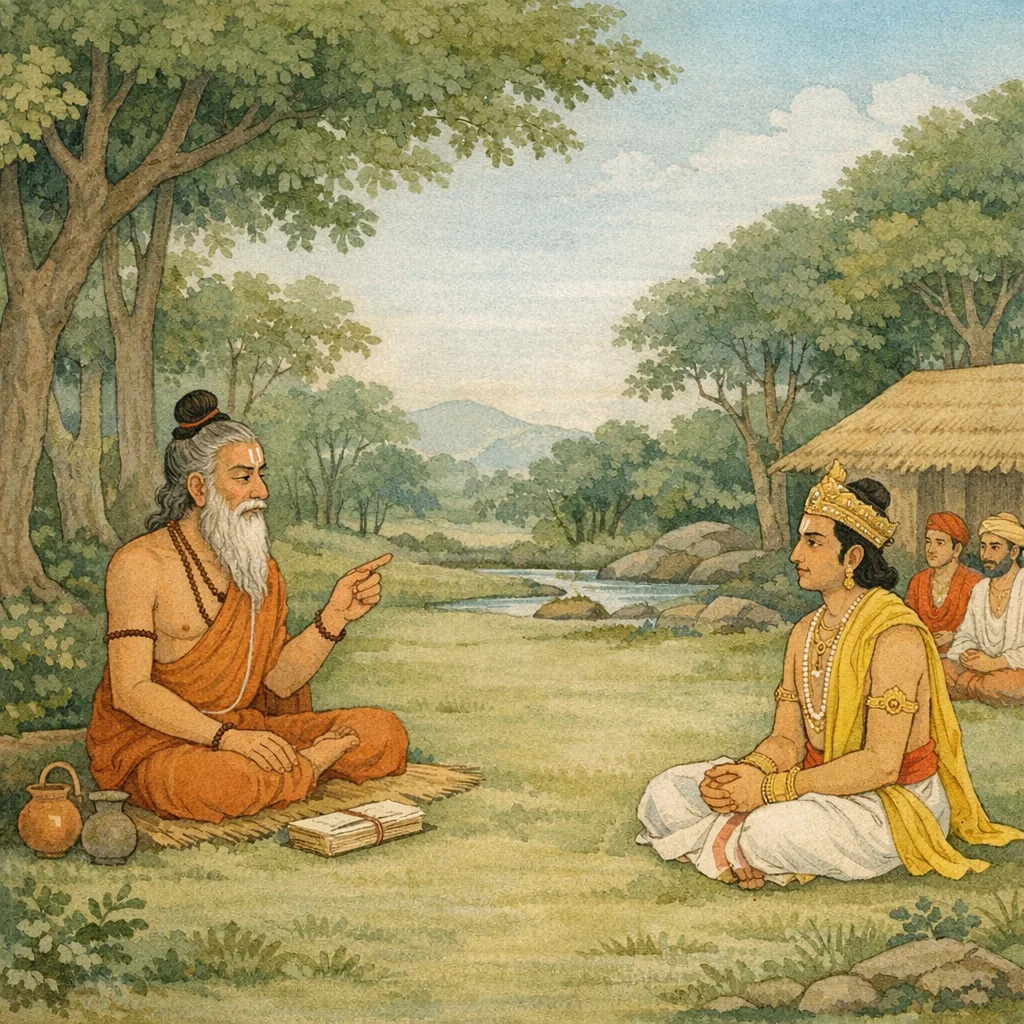
Adhyaya 305
Utkramaṇa-sthāna and Ariṣṭa-lakṣaṇa: Yājñavalkya’s Instruction on Departure Pathways and Mortality Signs
Upa-parva: Mokṣa-dharma Anuśāsana (Liberation-Doctrine Instruction)
Yājñavalkya instructs the listener (addressed as a king) on (1) utkramaṇa-sthānas—mapped ‘exit points’ of the departing life-force through bodily loci—and the corresponding cosmic destinations articulated in deva-terms: feet toward a Vaiṣṇava station; shanks toward the Vasus; knees toward the Sādhyas; anus toward a Maitra station; hips toward Earth; thighs toward Prajāpati; flanks toward the Maruts; nostrils toward the Moon; arms toward Indra; chest toward Rudra; neck toward an unsurpassed ‘Nara’ state; mouth toward the Viśvedevas; ears toward the directions; nose toward the carrier of fragrance; eyes toward the Sun; brows toward the Aśvins; forehead toward the Pitṛs; and the crown of the head toward Brahmā (the primordial). (2) ariṣṭa—foretold indicators of death within specified horizons (a year, six months, seven nights, six nights, or immediate), including altered perception of celestial markers (e.g., Arundhatī, Dhruva), seeing oneself in another’s eyes, changes in radiance or cognition, social-religious disregard, abnormal odors, bodily droop, loss of warmth or consciousness, and unusual emissions or smoke-like phenomena. The chapter concludes with prescriptive counsel: upon knowing such signs, one should yoke oneself to the paramātman day and night; through disciplined retention (dhāraṇā), sāṃkhya-informed understanding, and yoga, one ‘overcomes’ death in the sense of attaining the imperishable, unborn, stable state described as difficult for the untrained.
Chapter Arc: करालजनक (राजा जनक) एक सूक्ष्म शंका उठाते हैं—यदि जगत में स्त्री-पुरुष का संयोग ही देह-रूप की उत्पत्ति का कारण है, तो फिर ‘क्षर-अक्षर’ और ‘प्रकृति-पुरुष’ का भेद वास्तव में कैसे समझा जाए? → जनक पारस्परिक-सम्बन्ध (अन्योन्य-गुण-आश्रय) का तर्क रखते हैं—स्त्री बिना पुरुष गर्भ नहीं धारण कर सकती और पुरुष बिना स्त्री रूप नहीं रच सकता; तब कारण-कार्य की यह जटिलता आत्मा/पुरुष की स्वतंत्रता और मोक्ष की संभावना पर प्रश्नचिह्न लगाती है। → वसिष्ठ वेद-शास्त्र-सम्मत दृष्टि से निर्णायक भेद स्पष्ट करते हैं—प्रकृति के गुण-समूह और ‘पंचविंशति’ तत्त्वों की गणना (सांख्य-योग) के पार जो ‘बुद्धि से परे’ है, वही परम (अक्षर) है; अनेकत्व-परिवर्तनशीलता ‘क्षर’ है, और एकत्व-अविकार ‘अक्षर’। → वसिष्ठ जनक के तर्क को स्वीकारते हुए उसे सीमित करते हैं—देह-उत्पत्ति में प्रकृति का पारस्परिक संयोग चलता है, पर साक्षी-पुरुष/अक्षर उस परिवर्तन-धारा से अछूता है; इस प्रकार क्षर-अक्षर का निदर्शन देकर मोक्ष-मार्ग की बौद्धिक गाँठ खोलते हैं। → जनक आगे ‘पुरुष के मोक्ष का प्रत्यक्ष’ कराने वाले दृष्टान्त/अनुभव-मार्ग की याचना करते हैं—अब संवाद अगले चरण में साक्षात्कार के उपायों की ओर मुड़ने को तत्पर है।
Shlokas
Verse 1
ऑपन-आ करा (_ अ-्---क्ााज पञज्चाधिकत्रिशततमोब< ध्याय: क्षर-अक्षर एवं प्रकृति-पुरुषके विषयमें राजा जनककी शंका और उसका वसिष्ठजीद्धारा उत्तर जनक उवाच अक्षरक्षरयोरेष द्वयो: सम्बन्ध इष्यते । स्त्रीपुंसोर्वापि भगवन् सम्बन्धस्तद्वदुच्यते,राजा जनकने कहा--भगवन्! क्षर और अक्षर (प्रकृति और पुरुष) दोनोंका यह सम्बन्ध वैसा ही माना जाता है, जैसा कि नारी और पुरुषका दाम्पत्य-सम्बन्ध बताया जाता है
King Janaka said: “Revered sir, it is held that there is a relation between these two—the perishable and the imperishable (prakṛti and puruṣa). Is that relation to be understood as analogous to the marital bond between woman and man?”
Verse 2
ऋते तु पुरुष नेह स्त्री गर्भ धारयत्युत । ऋते स्त्रियं न पुरुषो रूप॑ निर्वर्त येत् तथा,इस जगतमें न तो पुरुषके बिना स्त्री गर्भ धारण कर सकती है और न स्त्रीके बिना कोई पुरुष ही किसी शरीरको उत्पन्न कर सकता है
Janaka said: “In this world, a woman cannot conceive without a man; and likewise, without a woman, a man cannot bring a bodily form into manifestation. Thus, embodied life arises through mutual dependence, not through isolated agency.”
Verse 3
अन्योन्यस्याभिसम्बन्धादन्योन्यगुणसंश्रयात् । रूप॑ निर्वर्तयत्येतदेवं सर्वासु योनिषु,दोनों पारस्परिक सम्बन्धसे एक दूसरेके गुणोंका आश्रय लेकर ही किसी शरीरका निर्माण होता है। प्रायः सभी योनियोंमें ऐसी ही स्थिति है
Janaka said: “Through mutual interconnection, and by each taking support of the other’s qualities, a bodily form comes to be produced. In this way, across all womb-born existences, embodiment generally arises from interdependent causes rather than from any single, isolated source.”
Verse 4
रत्यर्थमभिसम्बन्धादन्योन्यगुणसंश्रयात् । ऋतोौ निर्वर्त्यते रूपं तद् वक्ष्यामि निदर्शनम्,जब स्त्री ऋतुमती होती है, उस समय रतिके लिये पुरुषके साथ उसका सम्बन्ध होनेसे दोनोंके गुणोंका मिश्रण होनेपर शरीरकी उत्पत्ति होती है। शरीरमें पुरुष अर्थात् पिताके जो गुण हैं तथा माताके जो गुण हैं, उन्हें मैं दृष्टान्तके तौरपर बता रहा हूँ। हड्डी, स्नायु और मज्जा--इन््हें मैं पितासे प्राप्त हुए गुण समझता हूँ तथा त्वचा, मांस और रक्त-ये मातासे पैदा हुए गुण हैं, ऐसा मैंने सुना है। द्विजश्रेष्ठ। यही बात वेद और शास्त्रमें भी पढ़ी जाती है
Janaka said: “From the union undertaken for sexual enjoyment, and from the mutual interdependence and blending of the parents’ qualities, a bodily form is brought about when the woman is in her fertile season. I shall explain this by an illustration—how the father’s and the mother’s respective qualities are understood to appear in the body, as taught in the Veda and the śāstras.”
Verse 5
ये गुणा: पुरुषस्येह ये च मातृगुणास्तथा । अस्थि स्नायुश्न मज्जा च जानीम: पितृतो गुणा:,जब स्त्री ऋतुमती होती है, उस समय रतिके लिये पुरुषके साथ उसका सम्बन्ध होनेसे दोनोंके गुणोंका मिश्रण होनेपर शरीरकी उत्पत्ति होती है। शरीरमें पुरुष अर्थात् पिताके जो गुण हैं तथा माताके जो गुण हैं, उन्हें मैं दृष्टान्तके तौरपर बता रहा हूँ। हड्डी, स्नायु और मज्जा--इन््हें मैं पितासे प्राप्त हुए गुण समझता हूँ तथा त्वचा, मांस और रक्त-ये मातासे पैदा हुए गुण हैं, ऐसा मैंने सुना है। द्विजश्रेष्ठ। यही बात वेद और शास्त्रमें भी पढ़ी जाती है
Janaka said: “Whatever qualities belong here to the father and whatever qualities likewise belong to the mother—bone, sinew, and marrow: these we understand as the father’s contributions.”
Verse 6
त्वड्मांसं शोणितं चेति मातृजान्यपि शुश्रुम । एवमेतद् द्विजश्रेष्ठ वेदे शास्त्रे च पठ्यते,जब स्त्री ऋतुमती होती है, उस समय रतिके लिये पुरुषके साथ उसका सम्बन्ध होनेसे दोनोंके गुणोंका मिश्रण होनेपर शरीरकी उत्पत्ति होती है। शरीरमें पुरुष अर्थात् पिताके जो गुण हैं तथा माताके जो गुण हैं, उन्हें मैं दृष्टान्तके तौरपर बता रहा हूँ। हड्डी, स्नायु और मज्जा--इन््हें मैं पितासे प्राप्त हुए गुण समझता हूँ तथा त्वचा, मांस और रक्त-ये मातासे पैदा हुए गुण हैं, ऐसा मैंने सुना है। द्विजश्रेष्ठ। यही बात वेद और शास्त्रमें भी पढ़ी जाती है
Janaka said: “Skin, flesh, and blood—these too, I have heard, are derived from the mother. Thus it is, O best of the twice-born: this very doctrine is recited in the Veda and in the śāstras.”
Verse 7
प्रमाणं यत् स्ववेदोक्तं शास्त्रोक्ते यच्च पठ्यते । वेदशास्त्रद्धयं चैव प्रमाणं तत् सनातनम्,वेदोंमें जो प्रमाण बताया गया है तथा शास्त्रमें कहे हुए जिस प्रमाणको पढ़ा और सुना जाता है, वह सब ठीक है; क्योंकि वेद और शास्त्र दोनों ही सनातन प्रमाण हैं
Janaka said: “That authority declared in one’s own Veda, and that taught in the Śāstras and learned through study and hearing—all this is valid; for Veda and Śāstra together constitute the timeless standard of right knowledge and right conduct.”
Verse 8
अन्योन्यगुणसंरोधादन्योन्यगुणसंश्रयात् । एवमेवाभिसम्बद्धौ नित्यं प्रकृतिपूरुषी
King Janaka said: “Because each checks and constrains the other’s qualities, and because each depends upon the other’s qualities, Prakṛti (Nature) and Puruṣa (Conscious Self) are thus eternally bound together in mutual connection.”
Verse 9
अथवानन्तरकृतं किंचिदेव निदर्शनम्
“Or else, let there be just a small illustration drawn from what has been done immediately afterward.”
Verse 10
मोक्षकामा वयं चापि काड्क्षामो यदनामयम् । अदेहमजर नित्यमतीन्द्रियमनी श्वरम्,मैं भी मोक्षकी अभिलाषा रखता हूँ और उस परम पदको पाना चाहता हूँ, जो निर्विकार, निराकार, अजर, अमर, नित्य और इन्द्रियातीत है तथा जिसे प्राप्त हुए पुरुषका कोई शासक नहीं रहता
Janaka said: “I too long for liberation, and I seek that state which is free from all affliction—bodiless, undecaying, eternal, beyond the reach of the senses, and such that, on attaining it, one is no longer subject to any external lord or ruler.”
Verse 11
वसिष्ठ उवाच यदेतदुक्तं भवता वेदशास्त्रनिदर्शनम् एवमेतद् यथा चैततन्निगृह्लाति तथा भवान्,वसिष्ठजीने कहा--राजन्! तुमने वेद और शास्त्रोंके दृष्टान्त देकर यह जो कुछ कहा है, वह ठीक है। तुम जैसा समझते हो, वैसी ही बात है
Vasiṣṭha said: “O King, what you have stated—supported by illustrations from the Vedas and the śāstras—is indeed correct. Matters stand exactly as you understand them; and just as this principle restrains (and governs) the mind and conduct, so do you restrain it as well.”
Verse 12
धार्यते हि त्वया ग्रन्थ उभयोर्वेदशास्त्रयो: । नच ग्रन्थस्य तत्त्वज्ञो यथातत्त्व॑ नरेश्वर,नरेश्वर! इसमें संदेह नहीं कि वेद-शास्त्रोंमें जो कुछ लिखा है, वह सब तुम्हें याद है; परंतु ग्रन्थके यथार्थ तत्त्वका तुम्हें ठीक-ठीक ज्ञान नहीं है
Vasiṣṭha said: “Indeed, you have retained in memory the texts of both the Veda and the śāstras. Yet, O king, you do not truly know the scripture’s real purport—its tattva—as it actually is.”
Verse 13
यो हि वेदे च शास्त्रे च ग्रन्थधारणतत्पर: । नच ग्रन्थार्थतत्त्वज्ञस्तस्य तद्धारणं वृथा,जो वेद और शास्त्रके ग्रन्थोंको तो याद रखनेमें तत्पर है, किंतु उनके यथार्थ तत्त्वको नहीं समझता, उसका वह याद रखना व्यर्थ है
Vasiṣṭha said: “One may be eager to memorize the texts of the Veda and the śāstras; yet if one does not truly understand their real meaning and essential principle (tattva), that memorization becomes futile.”
Verse 14
भारं स वहते तस्य ग्रन्थस्यार्थ न वेत्ति यः । यस्तु ग्रन्थार्थतत्त्वज्ञो नास्य ग्रन्थागमो वृथा,जो ग्रन्थके अर्थको नहीं समझता, वह केवल रटकर मानो उन ग्रन्थोंका बोझ ढोता है; परंतु जो ग्रन्थके अर्थका तत्त्व समझता है, उसके लिये उस ग्रन्थका अध्ययन व्यर्थ नहीं है
Whoever does not understand the meaning of a scripture merely bears its weight like a burden. But one who knows the tattva—the true essence of its meaning—finds that the study of the text is not in vain.
Verse 15
ग्रन्थस्यार्थस्य पृष्ट: संस्तादृशो वक्तुमर्हति । यथा तत्त्वाभिगमनादर्थ तस्य स विन्दति
Vasiṣṭha said: “When one is questioned about the meaning of a treatise, a competent teacher should speak in a manner suited to the listener. For it is by leading the inquirer to the true principles (tattva) that one truly attains the meaning intended by the text.”
Verse 16
ऐसा पुरुष पूछनेपर तत्वज्ञानपूर्वक ग्रन्थके अर्थकों जैसा समझता है, वैसा दूसरोंको भी बता सकता है ।। न य: संसत्सु कथयेद् ग्रन्थार्थ स्थूलबुद्धिमान् । स कथं मन्दविज्ञानो ग्रन्थं वक्ष्यति निर्णयात्,जो स्थूल एवं मन्दबुद्धिसे युक्त होनेके कारण विद्वानोंकी सभामें शास्त्रग्रन्थका अर्थ नहीं बता सकता, वह निर्णयपूर्वक उस ग्रन्थका तात्पर्य कैसे कह सकता है?
Vasiṣṭha said: “Only one who has understood a text’s meaning through true knowledge of tattva can, when questioned, convey it rightly to others. But if a person, being coarse-minded and dull of understanding, cannot explain a śāstric text’s meaning in an assembly of the learned, how could such a one—of scant insight—ever state with settled certainty that text’s tātparya, its final purport?”
Verse 17
निर्णयं चापि छिद्रात्मा न तं॑ वक्ष्यति तत्त्वतः । सोपहासात्मतामेति यस्माच्चैवात्मवानपि,जिसका चित्त शास्त्रज्ञानसे शून्य है, वह ग्रन्थके तात्पर्यका ठीक-ठीक निर्णय कर ही नहीं सकता। यदि वह कुछ कहता है तो मनस्वी होनेपर भी लोगोंके उपहासका पात्र बनता है
Vasiṣṭha said: “One whose understanding is flawed cannot declare the true purport with certainty. Even if he is spirited or self-possessed, when he speaks without the foundation of śāstric knowledge he becomes an object of ridicule, for his words miss the real principle.”
Verse 18
तस्मात् त्वं शूणु राजेन्द्र यथैतदनुदृश्यते । याथातथ्येन सांख्येषु योगेषु च महात्मसु,इसलिये राजेन्द्र! सांख्य और योगके ज्ञाता महात्मा पुरुषोंके मतमें मोक्षका जैसा स्वरूप देखा जाता है, उसे मैं तुम्हें यथार्थरूपसे बताता हूँ, सुनो
Therefore, O best of kings, listen. I shall tell you truthfully how liberation is understood and directly perceived in the teachings of the great-souled sages who know Sāṅkhya and Yoga.
Verse 19
यदेव योगा: पश्यन्ति सांख्यैस्तदनुगम्यते । एकं सांख्यं च योगं च य: पश्यति स बुद्धिमान्,योगी जिस तत्त्वका साक्षात्कार करते हैं; सांख्यवेत्ता विद्वान् भी उसीका ज्ञान प्राप्त करते हैं। जो सांख्य और योगको फलकी दृष्टिसे एक समझता है, वही बुद्धिमान् है
Vasiṣṭha said: “That very Reality which the yogins directly behold is also reached by the knowers of Sāṅkhya through discernment. The truly wise person is the one who sees Sāṅkhya and Yoga as one in their fruition—different in method, yet converging upon the same highest truth.”
Verse 20
त्वड्मांसं रुधिरं मेद: पित्तं मज्जा च स्नायु च । अथ चैन्द्रियकं तात तद् भवानिदमाह माम्,तात! तुम मुझसे कह चुके हो कि शरीरमें जो त्वचा, मांस, रुधिर, मेदा, पित्त, मज्जा, सस््नायु और इन्द्रियसमुदाय हैं (वे सब माता-पिताके सम्बन्धसे प्रकट हुए हैं)
Vasiṣṭha said: “Skin, flesh, blood, fat, bile, marrow, and sinews—and also the aggregate of the senses, dear one—these you have already stated to me.”
Verse 21
द्रव्याद् द्रव्यस्य निर्वृत्तिरिन्द्रियादिन्द्रियं तथा । देहाद् देहमवाप्रोति बीजाद बीज॑ तथैव च,जैसे बीजसे बीजकी उत्पत्ति होती है, उसी प्रकार द्रव्यसे द्रव्य, इन्द्रियसे इन्द्रिय तथा देहसे देहकी प्राप्ति होती है
Vasiṣṭha said: “From substance, substance arises; from a sense-faculty, a sense-faculty likewise. From a body, one attains another body; and from a seed, a seed—just so.”
Verse 22
निरिन्द्रियस्याबीजस्य निर्द्रव्यस्याप्पयदेहिन: । कथं गुणा भविष्यन्ति निर्गुणत्वान्महात्मन:,परंतु परमात्मा तो इन्द्रिय, बीज, द्रव्य और देहसे रहित तथा निर्गुण है; अतः उसमें गुण कैसे हो सकते हैं
Vasiṣṭha said: “If the Supreme Self is without senses, without seed (cause), without material substance, and even without a body, then how could any qualities arise in that great Being—since Its very nature is beyond qualities?”
Verse 23
गुणा गुणेषु जायन्ते तत्रैव निविशन्ति च । एवं गुणा: प्रकृतितो जायन्ते निविशन्ति च,जैसे आकाश आदि गुण सत्त्व आदि गुणोंसे उत्पन्न होते और उन्हींमें लीन हो जाते हैं; उसी प्रकार सत्त्व, रज, तम-ये तीनों गुण भी प्रकृतिसे उत्पन्न होते और उसीमें लीन होते हैं
Vasiṣṭha said: “Qualities arise from qualities and dissolve back into those very qualities. In the same way, the three guṇas—sattva, rajas, and tamas—arise from Prakṛti and finally merge back into Prakṛti.”
Verse 24
त्वड्मांसं रुधिर मेद: पित्तं मज्जास्थि स्नायु च । अष्टौ तान्यथ शुक्रेण जानीहि प्राकृतानि वै,राजन! तुम यह जान लो कि त्वचा, मांस, रुधिर, मेदा, पित्त, मज्जा, अस्थि और स््नायु-ये आठों वस्तुएँ वीर्यसे उत्पन्न हुई हैं; इसलिये प्राकृत ही हैं
Vasiṣṭha said: “O king, know that skin, flesh, blood, fat, bile, marrow, bone, and sinew—these eight constituents—arise from semen; therefore they are to be understood as ‘natural’ (material, bodily) products.”
Verse 25
पुमांश्चैवापुमांश्चैव त्रैलिड्रयं प्राकृतं स््मृतम् । न वापुमान् पुमांश्चैव स लिज्लीत्यभिधीयते,पुरुष और प्रकृति--ये दो तत्त्व हैं। इनके स्वरूपको व्यक्त करनेवाले जो तीन प्रकारके सात््विक, राजस और तामस चिह्न हैं, वे सब प्राकृत माने गये हैं; परंतु जो लिंगी अर्थात् इन सबका आधार आत्मा है, वह न पुरुष कहा जा सकता है और न प्रकृति ही। वह इन दोनोंसे विलक्षण है
Vasiṣṭha said: “Both ‘male’ and ‘non-male,’ and indeed the triad of gender-marks, are remembered as belonging to Prakṛti (material nature). But the one who bears (and underlies) these marks—the Liṅgī, the Self that is their support—is neither to be called male nor non-male. He is distinct from both Puruṣa and Prakṛti, transcending their classifications.”
Verse 26
अलिज्जत् प्रकृतिर्लिज्जिरुपाल भ्यति सात्मजै: । यथा पुष्पफलैर्नित्यमृतवो 5मूर्तयस्तथा,जैसे फूलों और फलोंद्वारा सदा निराकार ऋतुओंका अनुमान हो जाता है, उसी प्रकार निराकार पुरुषका संयोग पाकर अपने द्वारा उत्पन्न किये हुए जो महत्तत्त्व आदि लिंग हैं, उन्हींके द्वारा प्रकृति अनुमानका विषय होती है
Vasiṣṭha said: “Though Prakṛti is itself without a visible mark, it is inferred through its own produced indicators (such as Mahat and the rest). Just as the formless seasons are always recognized by flowers and fruits, so too Prakṛti becomes knowable by the signs that arise from it when it comes into conjunction with the unmanifest Puruṣa.”
Verse 27
एवमप्यनुमानेन हालिड्रमुपल भ्यते । पजञ्चविंशतिमस्तात लिड्लेषु नियतात्मक:,इसी प्रकार लिंगसे भिन्न जो शुद्ध चेतनरूप आत्मा है, वह भी अनुमानसे बोधका विषय होता है अर्थात् जैसे दृश्यको प्रकाशित करनेके कारण सूर्य दृश्यसे भिन्न हैं, उसी प्रकार ज्ञान-स्वरूप आत्मा भी ज्ञेय वस्तुओंको प्रकाशित करनेके कारण उनसे भिन्न सत्ता रखता है। तात! वही पचीसवाँ तत्त्व है, जो सभी लिंगोंमें नियतरूपसे व्याप्त है
Vasiṣṭha said: “Even so, by inference one comes to apprehend the pure conscious Self, distinct from all ‘marks’ (liṅgas). Just as the sun, because it illuminates what is seen, is understood to be other than the visible objects, so too the Self—whose very nature is knowledge—stands apart from all knowable things because it reveals them. Dear one, that Self is the twenty-fifth principle, pervading all embodied conditions in a fixed and constant way.”
Verse 28
अनादिनिधनो<नन्त:ः सर्वदर्शी निरामय: । केवल त्वभिमानित्वाद् गुणेषु गुण उच्यते
Vasiṣṭha said: He is without beginning and without end, infinite, all-seeing, and free from affliction. Yet, solely because of the ego’s self-identification, He is spoken of as a ‘quality’ among the qualities—appearing conditioned only through the conceit that claims ownership and agency.
Verse 29
आत्मा तो जन्म-मृत्युसे रहित, अनन्त, सबका द्रष्टा और निर्विकार है। वह सत्त्व आदि गुणोंमें केवल अभिमान करनेके कारण ही गुणस्वरूप कहलाता है ।। गुणा गुणवत:ः सन्ति निर्गुणस्य कुतो गुणा: । तस्मादेवं विजानन्ति ये जना गुणदर्शिन:,गुण तो गुणवानमें ही रहते हैं। निर्गुण आत्मामें गुण कैसे रह सकते हैं। अतः गुणोंके स्वरूपको जाननेवाले विद्वान् पुरुषोंका यही सिद्धान्त है कि जब जीवात्मा इन गुणोंको प्रकृतिका कार्य मानकर उनमें अपनेपनका अभिमान त्याग देता है, उस समय वह देह आदिमें आत्मबुद्धिका परित्याग करके अपने विशुद्ध परमात्म-स्वरूपका साक्षात्कार करता है
Vasiṣṭha said: The Self is free from birth and death, infinite, the witness of all, and unchanging. It is called ‘of the nature of the guṇas’ only because it mistakenly identifies with sattva and the other qualities. Qualities belong only to what is qualified; how could qualities exist in what is without qualities? Therefore, those who truly discern the guṇas hold this conclusion: when the individual self understands these guṇas to be effects of Prakṛti and abandons the sense of ‘mine’ toward them, it relinquishes the notion that the body and the rest are the Self, and realizes its own pure identity as the Supreme Self.
Verse 30
यदा त्वेष गुणानेतान् प्राकृतानभिमन्यते । तदा स गुणहान्यै त॑ परमेवानुपश्यति,गुण तो गुणवानमें ही रहते हैं। निर्गुण आत्मामें गुण कैसे रह सकते हैं। अतः गुणोंके स्वरूपको जाननेवाले विद्वान् पुरुषोंका यही सिद्धान्त है कि जब जीवात्मा इन गुणोंको प्रकृतिका कार्य मानकर उनमें अपनेपनका अभिमान त्याग देता है, उस समय वह देह आदिमें आत्मबुद्धिका परित्याग करके अपने विशुद्ध परमात्म-स्वरूपका साक्षात्कार करता है
Vasiṣṭha said: When this self regards these guṇas as products of Prakṛti and abandons the notion of ‘I’ and ‘mine’ in them, then—by the very cessation of identification with the guṇas—it beholds the Supreme alone. Casting off the mistaken self-notion in body and the rest, it realizes its own pure, highest nature.
Verse 31
यत् तद् बुद्धेः परं प्राहु: सांख्या योगाश्व सर्वश: । बुद्धयमानं महाप्राज्ञमबुद्धपरिवर्जनात्,सांख्य और योगके सम्पूर्ण विद्वान् जिसको बुद्धिसे परे बताते हैं, जो परम ज्ञानसम्पन्न है, अहंकार आदि जड तत्त्वोंका परित्याग (बाध) कर देनेपर शेष रहे हुए चिन्मय तत्त्वके रूपमें जिसका बोध होता है, जो अज्ञात, अव्यक्त, सगुण ईश्वर, निर्गुण ईश्वर, नित्य और अधिष्ठाता कहा गया है, वह परमात्मा ही प्रकृति और उसके गुणों (चौबीस तत्त्वों) की अपेक्षा पचीसवा तत्त्व है, ऐसा सांख्य और योगमें कुशल तथा परमतत्त्वकी खोज करनेवाले विद्वान पुरुष समझते हैं
Vasiṣṭha said: That Reality which the Sāṅkhyas and the Yogins, in every way, declare to be beyond the intellect—supremely wise and knowable only when the non-conscious factors such as ego and the rest are set aside—this is the Supreme Self. It is spoken of as unknown, unmanifest, as the Lord with attributes and also as the attributeless Lord, as eternal and as the inner support. Thus, those skilled in Sāṅkhya and Yoga and intent on the highest truth understand the Supreme Self to be the twenty-fifth principle, beyond Prakṛti and its guṇas (the twenty-four principles).
Verse 32
अप्रबुद्धमथाव्यक्तं सगुणं प्राहुरीश्वरम् । निर्गुणं चेश्वर॑ नित्यमधिष्ठातारमेव च,सांख्य और योगके सम्पूर्ण विद्वान् जिसको बुद्धिसे परे बताते हैं, जो परम ज्ञानसम्पन्न है, अहंकार आदि जड तत्त्वोंका परित्याग (बाध) कर देनेपर शेष रहे हुए चिन्मय तत्त्वके रूपमें जिसका बोध होता है, जो अज्ञात, अव्यक्त, सगुण ईश्वर, निर्गुण ईश्वर, नित्य और अधिष्ठाता कहा गया है, वह परमात्मा ही प्रकृति और उसके गुणों (चौबीस तत्त्वों) की अपेक्षा पचीसवा तत्त्व है, ऐसा सांख्य और योगमें कुशल तथा परमतत्त्वकी खोज करनेवाले विद्वान पुरुष समझते हैं
Vasiṣṭha said: The wise speak of the Lord in many ways—unawakened and unmanifest, as the Lord with attributes; and also as the attributeless Lord, eternal, and the inner ruler who presides over all. Those skilled in Sāṅkhya and Yoga understand that this Supreme Self is known as pure consciousness when inert principles such as egoity are set aside, and that He stands beyond Prakṛti and its qualities as the twenty-fifth principle sought by seekers of the highest truth.
Verse 33
प्रकृतेश्व गुणानां च पठचविंशतिकं बुधा: । सांख्ययोगे च कुशला बुध्यन्ते परमैषिण:,सांख्य और योगके सम्पूर्ण विद्वान् जिसको बुद्धिसे परे बताते हैं, जो परम ज्ञानसम्पन्न है, अहंकार आदि जड तत्त्वोंका परित्याग (बाध) कर देनेपर शेष रहे हुए चिन्मय तत्त्वके रूपमें जिसका बोध होता है, जो अज्ञात, अव्यक्त, सगुण ईश्वर, निर्गुण ईश्वर, नित्य और अधिष्ठाता कहा गया है, वह परमात्मा ही प्रकृति और उसके गुणों (चौबीस तत्त्वों) की अपेक्षा पचीसवा तत्त्व है, ऐसा सांख्य और योगमें कुशल तथा परमतत्त्वकी खोज करनेवाले विद्वान पुरुष समझते हैं
Vasiṣṭha said: Those wise seekers who are skilled in Sāṅkhya and Yoga understand that the Supreme Self is the twenty-fifth principle—distinct from Prakṛti and its qualities. When the inert factors such as egoity are set aside, what remains to be realized is the conscious reality itself, spoken of as the unseen and unmanifest, as the Lord with attributes and beyond attributes, as eternal and as the inner ruler. Thus, the knowers declare the Self to transcend the twenty-four constituents of nature.
Verse 34
यदा प्रबुद्धा हव्यक्तमवस्थाजन्मभीरव: । बुध्यमान प्रबुध्यन्ति गमयन्ति समं तदा,जिस समय बाल्य, यौवन और वृद्धावस्था अथवा जन्म-मरणसे भयभीत हुए विवेकी पुरुष चेतन-स्वरूप अव्यक्त परमात्माके तत्त्वको ठीक-ठीक समझ लेते हैं, उस समय उन्हें परब्रह्म परमात्माके स्वरूपकी प्राप्ति हो जाती है
When discerning men—alarmed by the changing stages of life and by birth and death—truly awaken to the reality of the unmanifest, conscious Absolute, then their understanding becomes fully illumined, and they are led into the state of perfect equanimity, attaining the Supreme Brahman as it is.
Verse 35
एतन्निदर्शनं सम्यगसम्यगनिदर्शनम् । बुध्यमानाप्रबुद्धानां पृथग्पृथगरिंदम,शत्रुओंका दमन करनेवाले नरेश! ज्ञानी पुरुषोंका यह ज्ञान युक्तियुक्त होनेके कारण उत्तम और (अज्ञानियोंकी धारणासे) पृथक् है। इसके विपरीत अज्ञानी पुरुषोंका जो अप्रामाणिक ज्ञान है, वह युक्तियुक्त न होनेके कारण ठीक नहीं है। यह पूर्वोक्त सम्यक् ज्ञानसे पृथक है
This is the illustration of what is truly right understanding—and of what is not. O subduer of foes, for those who are awakening yet not fully awakened, these two appear distinct: the knowledge of the wise stands apart because it is grounded in sound reasoning and valid means of knowing; but the so-called knowledge of the ignorant is unreliable, lacking rational coherence, and therefore not correct—separate from the earlier stated right knowledge.
Verse 36
परस्परेणैतदुक्तं क्षराक्षरनिदर्शनम् । एकत्वमक्षरं प्राहुननिात्व॑ क्षरमुच्यते,क्षर और अक्षरके तत्त्वका प्रतिपादन करनेवाला यह दर्शन मैंने तुम्हें बताया है। क्षर और अक्षरमें परस्पर क्या अन्तर है? इसे इस प्रकार समझो--सदा एकरूपमें रहनेवाले परमात्मतत्त्वको अक्षर बताया गया है और नाना रूपोंमें प्रतीत होनेवाला यह प्राकृत प्रपंच क्षर कहलाता है
Vasiṣṭha said: “This illustration concerning the perishable (kṣara) and the imperishable (akṣara) has been stated in relation to one another. The sages call that which is one and unchanging ‘imperishable’; that which appears as manifold and diversified is called ‘perishable.’”
Verse 37
पजञ्चविंशतिनिष्ठो5यं यदा सम्यक् प्रवर्तते । एकत्वं दर्शन चास्य नानात्वं चाप्यदर्शनम्
When this discipline, grounded in the twenty-five principles, is properly set in motion, it yields a vision of oneness; and with that same clarity, the appearance of multiplicity is no longer seen.
Verse 38
जब यह पुरुष पचीसतवें तत्त्वस्वरूप परमात्मामें स्थित हो जाता है, तब उसकी स्थिति उत्तम बतायी जाती है--वह ठीक बर्ताव करता है, ऐसा माना जाता है। एकत्वका बोध ही ज्ञान है और नानात्वका बोध ही अज्ञान है ।। तत्त्वनिस्तत्त्वयोरेतत् पृथगेव निदर्शनम् । पज्चविंशतिसर्ग तु तत्त्वमाहुर्मनीषिण:,तत्त्व (क्षर और निस्तत्त्व (अक्षर) का यह पृथकृ-पृथक् लक्षण समझना चाहिये। कुछ मनीषी पुरुष पचीस तत्त्वोंको ही तत्त्व कहते हैं; परंतु दूसरे विद्वानोंने चौबीस जड तत्त्वोंको तो तत्त्व कहा है और पचीसवें चेतन परमात्माको निस्तत्त्व (तत्त्वसे भिन्न) बताया है। यह चैतन्य ही परमात्माका लक्षण है। महत्तत््व आदि जो विकार हैं, वे क्षरतत्त्व हैं और परम पुरुष परमात्मा उन “क्षर” तत्त्वोंसे भिन्न उनका सनातन आधार है
Vasiṣṭha said: “This is the distinct mark by which ‘tattva’ and ‘non-tattva’ are to be understood as separate. Some discerning sages declare the set of twenty-five principles to be ‘tattva’; others call the twenty-four insentient principles ‘tattva’ and regard the twenty-fifth—the conscious Supreme Self—as ‘non-tattva’, i.e., beyond and other than the perishable categories. To know oneness is knowledge; to perceive multiplicity as ultimate is ignorance. When a person abides in that twenty-fifth reality, his state is said to be excellent, and his conduct is deemed truly right.”
Verse 39
निस्तत्त्वं पज्चविंशस्य परमाहुर्निंदर्शनम् । सर्गस्य वर्गमाधारं तत्त्वं तत्वात्ू सनातनम्,तत्त्व (क्षर और निस्तत्त्व (अक्षर) का यह पृथकृ-पृथक् लक्षण समझना चाहिये। कुछ मनीषी पुरुष पचीस तत्त्वोंको ही तत्त्व कहते हैं; परंतु दूसरे विद्वानोंने चौबीस जड तत्त्वोंको तो तत्त्व कहा है और पचीसवें चेतन परमात्माको निस्तत्त्व (तत्त्वसे भिन्न) बताया है। यह चैतन्य ही परमात्माका लक्षण है। महत्तत््व आदि जो विकार हैं, वे क्षरतत्त्व हैं और परम पुरुष परमात्मा उन “क्षर” तत्त्वोंसे भिन्न उनका सनातन आधार है
Vasiṣṭha said: “Some declare that the supreme indication lies in the twenty-fifth principle, which is beyond the manifest categories. It is the eternal foundation that supports the entire array of creation, standing apart from the changing principles while sustaining them.”
Verse 83
पश्यामि भगवंस्तस्मान्मोक्षधर्मो न विद्यते । भगवन्! इस प्रकार प्रकृति और पुरुष दोनों ही एक दूसरेके गुणोंकों आच्छादित करके एक दूसरेके गुणोंका आश्रयः लेते हुए सृष्टि करते हैं। इस तरह मैं इन दोनोंको सदा एक दूसरेसे सम्बद्ध देखता हूँ। अतः पुरुषके लिये मोक्षधर्मकी सिद्धि असम्भव जान पड़ती है
Janaka said: “Venerable sir, therefore I see that the discipline leading to liberation does not exist. For, O Blessed one, in this way Prakṛti and Puruṣa—each veiling the other’s qualities and taking refuge in the other’s qualities—bring forth creation. Thus I always perceive these two as inseparably connected with one another. Hence, it appears impossible for the Puruṣa to accomplish the path of liberation.”
Verse 96
तन्ममाचक्ष्व तत्त्वेन प्रत्यक्षो ह्सि सर्वदा । अथवा पुरुषके मोक्षका साक्षात्कार करानेवाला कोई दृष्टान्त हो तो आप उसे बताइये और मुझे ठीक-ठीक समझा दीजिये; क्योंकि आपको सदा सब कुछ प्रत्यक्ष है
Janaka said: “Tell me that truth exactly as it is, for to you it is always directly evident. Or, if there is any illustrative example that can bring about a direct realization of liberation in a person, please relate it and make me understand it precisely—because for you everything is ever present as if seen face to face.”
Verse 304
इस प्रकार श्रीमह्याभारत शान्तिपर्वके अन्तर्गत मोक्षधर्मपर्वमें वसिष्ठ और करालजनकका संवादविषयक तीन सौ चारवाँ अध्याय पूरा हुआ
Thus ends the three-hundred-and-fourth chapter of the Mokṣadharma section within the Śānti Parva of the revered Mahābhārata, concerning the dialogue between Vasiṣṭha and Karāla Janaka. This colophon marks the completion of this unit of instruction, framing the exchange as guidance toward liberation through right understanding and disciplined conduct.
Verse 305
इति श्रीमहाभारते शान्तिपर्वणि मोक्षधर्मपर्वणि वसिष्ठकरालजनकसंवादे पज्चाधिकत्रिशततमो<ध्याय:
Thus ends the 305th chapter of the Mokṣadharma section within the Śānti Parva of the Śrī Mahābhārata, in the dialogue between Vasiṣṭha, Karāla, and Janaka. The colophon signals the close of a teaching-focused episode concerned with liberation-oriented dharma and the ethical vision of inner freedom taught through conversation among sages and a king.
Frequently Asked Questions
How a person should interpret bodily and perceptual change near death and respond appropriately: not with panic or fatalism, but with disciplined inward practice oriented toward liberation.
Mortality-awareness is converted into method: recognizing impermanence should intensify dhāraṇā, sāṃkhya-like discernment, and yoga so the practitioner seeks the imperishable state rather than clinging to transient conditions.
Yes in doctrinal form: it asserts that through yogic integration and inner alignment with the paramātman, one attains an ‘akṣaya/avyaya’ (imperishable) station—framed as difficult to reach for the undisciplined.