Adhyaya 6
Adhyāya 6: Śibira-dvāra-sthita Bhūta-varṇana and Aśvatthāmā’s Śaraṇāgati to Mahādeva
Upa-parva: Sauptika Parva — Śibira-dvāra Bhūta-darśana (Gate-Guardian Encounter Episode)
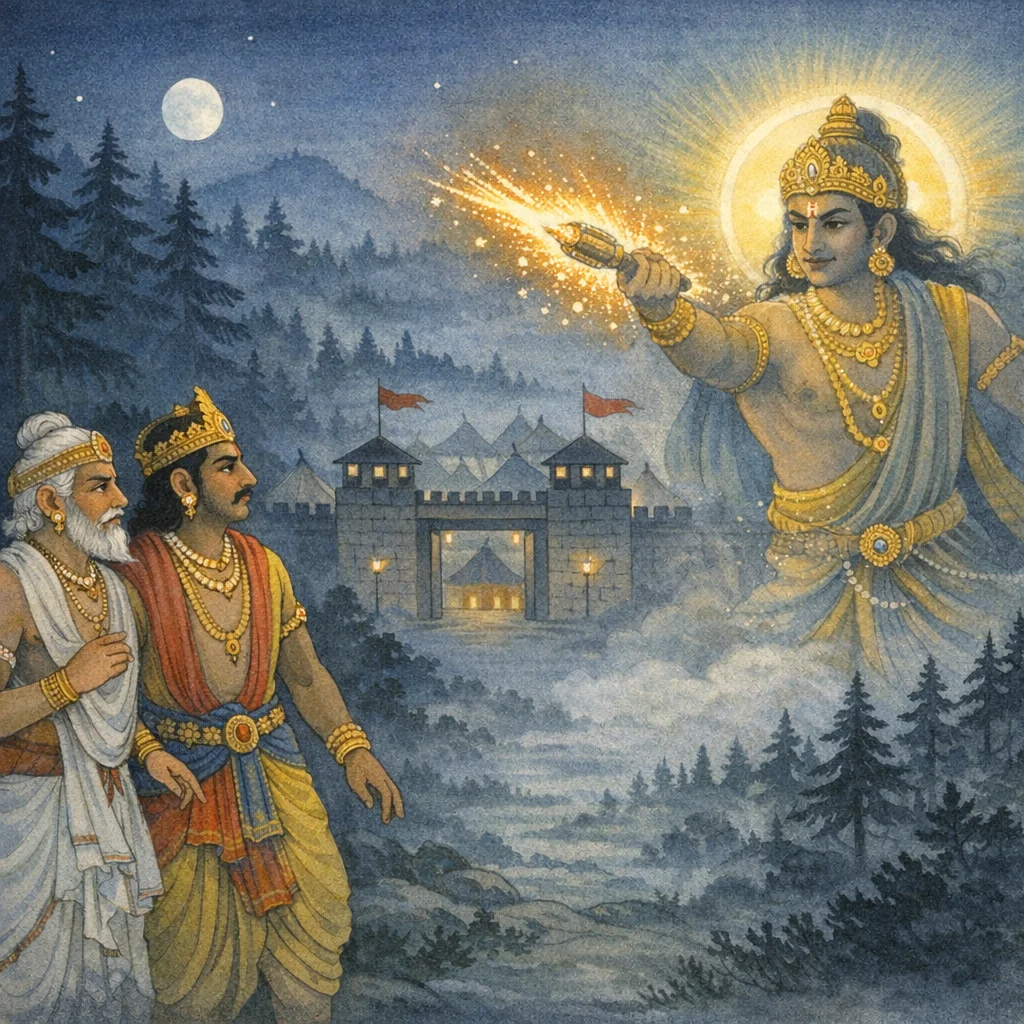
Dhṛtarāṣṭra questions Saṃjaya about Kṛtavarmā and Kṛpa as Aśvatthāmā stands at the camp gate. Saṃjaya narrates Aśvatthāmā’s approach and his sighting of a colossal, radiant, terrifying guardian being blocking entry. The being’s appearance is elaborately described—animal-skin attire, serpentine ornaments, multiple eyes, and blazing emanations—suggesting a numinous protector rather than a human sentinel. Aśvatthāmā deploys successive weapons (arrows, ratha-śakti, sword, mace), but each is neutralized or consumed, emphasizing the insufficiency of ordinary martial means against a divinely configured obstacle. Observing the inexplicable transformation of space and power, Aśvatthāmā turns inward, recalling Kṛpa’s counsel about prohibited targets and the danger of deviating from śāstra-guided conduct. He interprets his predicament as a karmic “pratighāta” (reversal/obstruction) arising from adharmic intent and acknowledges the superiority of daiva over human effort. The chapter closes with his explicit act of seeking refuge in Mahādeva (Śiva)—Kapardin, Girīśa, Śūlapāṇi—invoking divine protection to remove the fearsome impediment.
Chapter Arc: रात्रि के अंधकार में, क्रोध से उन्मत्त द्रौणि (अश्वत्थामा) कृतवर्मा और कृपाचार्य को साथ लेकर शत्रु-शिविर के द्वार पर पहुँचता है—जहाँ विजय का मार्ग नहीं, एक अलौकिक पहरेदार खड़ा है। → शिविर-द्वार पर चन्द्र-सूर्य-सम तेजस्वी, महाकाय, लोमहर्षक ‘भूत’/अद्भुत पुरुष को देखकर अश्वत्थामा उसे बाधा मानकर अस्त्र-शस्त्र चलाता है—रथ-शक्ति, खड्ग, गदा आदि; पर हर प्रहार निष्फल होकर लौटता है, और उसके भीतर ‘उपाय-शून्यता’ का भय बढ़ता जाता है। → अस्त्रों के टूटने/निष्फल होने और मार्ग रुक जाने पर अश्वत्थामा के भीतर निर्णायक मोड़ आता है—वह समझता है कि वह शास्त्रोक्त सनातन मार्ग से हटकर ‘अमार्ग’ में पड़ गया है; अब दैव-दण्ड की घोर छाया उसे घेर रही है और केवल दैव-अनुकूलता/देव-शरण ही शेष उपाय है। → वह गुरुजनों की शिक्षा का स्मरण कर कर्म-दैव के संबंध पर विचार करता है—पुरुषार्थ आवश्यक है, पर दैव-विपरीत होने पर सिद्धि नहीं; धर्म-पथ से च्युत होकर विपत्ति आती है। इस आत्मस्वीकृति के साथ वह आगे की रणनीति को ‘दैव-आश्रय’ की ओर मोड़ने लगता है। → दैव-दण्ड के भय और देव-शरण की आवश्यकता को स्वीकार कर अश्वत्थामा अगला कदम उठाने को तत्पर होता है—क्या वह शिव/दैवी शक्ति की शरण लेकर शिविर-प्रवेश का मार्ग पाएगा?
Shlokas
Verse 1
/ ऑपन-माज बक। डे षष्ठो5 ध्याय: अश्वत्थामाका शिविर-द्वारपर एक अद्भुत पुरुषको देखकर उसपर अस्त्रोंका प्रहार करना और अस्त्रोके अभावमें चिन्तित हो भगवान् शिवकी शरणमें जाना धृतराष्ट्र रवाच द्वारदेशे ततो द्रोणिमवस्थितमवेक्ष्य तौ । अकुर्वातां भोजकृपौ कि संजय वदस्व मे,धृतराष्ट्रने पूछा--संजय! अश्वत्थामाको शिविरके द्वारपर खड़ा देख कृतवर्मा और कृपाचार्यने क्या किया? यह मुझे बताओ
Dhṛtarāṣṭra said: “Sañjaya, when Kṛtavarmā and Kṛpācārya saw Aśvatthāmā, the son of Droṇa, standing stationed at the gate-area of the camp, what did the two do? Tell me.”
Verse 2
संजय उवाच कृतवर्माणमामन्त्रय कृपं च स महारथ: । द्रौणि्मन्युपरीतात्मा शिबिरद्वारमागमत्,संजयने कहा--राजन्! कृतवर्मा और कृपाचार्यको आमन्त्रित करके महारथी अश्वत्थामा क्रोधपूर्ण हृदयसे शिविरके द्वारपर आया
Sañjaya said: Having summoned Kṛtavarmā and Kṛpa, the great chariot-warrior Aśvatthāmā—Drona’s son—his mind overwhelmed by wrath, came to the gate of the camp.
Verse 3
तत्र भूतं महाकायं चन्द्रार्कसदृशद्युतिम् सो<पश्यद् द्वारमाश्रित्य तिष्ठन्तं लोमहर्षणम्,वहाँ उसने चन्द्रमा और सूर्यके समान तेजस्वी एक विशालकाय अद्धुत प्राणीको देखा, जो द्वार रोककर खड़ा था, उसे देखते ही रोंगटे खड़े हो जाते थे। उस महापुरुषने व्याप्रका ऐसा चर्म धारण कर रखा था, जिससे बहुत अधिक रक्त चू रहा था, वह काले मृगचर्मकी चादर ओढ़े और सर्पोंका यज्ञोपवीत पहने हुए था। उसकी विशाल और मोटी भुजाएँ नाना प्रकारके अस्त्र-शस्त्र लिये प्रहार करनेको उद्यत जान पड़ती थीं। उनमें बाजूबंदोंके स्थानमें बड़े-बड़े सर्प बँधे हुए थे तथा उसका मुख आगकी लपटोंसे व्याप्त दिखायी देता था। उसने मुँह फैला रखा था, जो दाढ़ोंके कारण विकराल जान पड़ता था। वह भयानक पुरुष सहस्रों विचित्र नेत्रोंसे सुशोभित था
There he beheld a colossal, uncanny being, radiant like the moon and the sun, standing at the doorway as if barring passage—so terrifying that the sight of it made one’s hair stand on end.
Verse 4
वसानं चर्म वैयाप्र॑ महारुधिरविस्रवम् । कृष्णाजिनोत्तरासड्ूं नागयज्ञोपवीतिनम्,वहाँ उसने चन्द्रमा और सूर्यके समान तेजस्वी एक विशालकाय अद्धुत प्राणीको देखा, जो द्वार रोककर खड़ा था, उसे देखते ही रोंगटे खड़े हो जाते थे। उस महापुरुषने व्याप्रका ऐसा चर्म धारण कर रखा था, जिससे बहुत अधिक रक्त चू रहा था, वह काले मृगचर्मकी चादर ओढ़े और सर्पोंका यज्ञोपवीत पहने हुए था। उसकी विशाल और मोटी भुजाएँ नाना प्रकारके अस्त्र-शस्त्र लिये प्रहार करनेको उद्यत जान पड़ती थीं। उनमें बाजूबंदोंके स्थानमें बड़े-बड़े सर्प बँधे हुए थे तथा उसका मुख आगकी लपटोंसे व्याप्त दिखायी देता था। उसने मुँह फैला रखा था, जो दाढ़ोंके कारण विकराल जान पड़ता था। वह भयानक पुरुष सहस्रों विचित्र नेत्रोंसे सुशोभित था
Sañjaya said: He was wearing a tiger-skin, from which copious blood was streaming; he was wrapped in a black antelope-hide as an upper garment, and he bore serpents as his sacrificial thread.
Verse 5
इस प्रकार श्रीमह्ाभारत सौप्तिकपर्वमें अश्वत्थामाका प्रयाणविषयक पाँचवाँ अध्याय पूरा हुआ,बाहुभि: स्वायतै: पीनैर्नानाप्रहरणोद्यतै: । बद्धाज्दमहासर्प ज्वालामालाकुलाननम् वहाँ उसने चन्द्रमा और सूर्यके समान तेजस्वी एक विशालकाय अद्धुत प्राणीको देखा, जो द्वार रोककर खड़ा था, उसे देखते ही रोंगटे खड़े हो जाते थे। उस महापुरुषने व्याप्रका ऐसा चर्म धारण कर रखा था, जिससे बहुत अधिक रक्त चू रहा था, वह काले मृगचर्मकी चादर ओढ़े और सर्पोंका यज्ञोपवीत पहने हुए था। उसकी विशाल और मोटी भुजाएँ नाना प्रकारके अस्त्र-शस्त्र लिये प्रहार करनेको उद्यत जान पड़ती थीं। उनमें बाजूबंदोंके स्थानमें बड़े-बड़े सर्प बँधे हुए थे तथा उसका मुख आगकी लपटोंसे व्याप्त दिखायी देता था। उसने मुँह फैला रखा था, जो दाढ़ोंके कारण विकराल जान पड़ता था। वह भयानक पुरुष सहस्रों विचित्र नेत्रोंसे सुशोभित था
Sañjaya said: There he beheld a vast, wondrous being, radiant like the sun and the moon, standing as a guardian at the entrance and barring the way. At the very sight, the hair stood on end. Clad in a blood-soaked hide and wrapped in a dark antelope-skin, with serpents serving as his sacred thread (yajñopavīta), he appeared terrible and awe-inspiring. His huge, thick arms—raised and ready with many kinds of weapons—were bound with great serpents in place of armlets, and his gaping mouth seemed filled with garlands of flame. With a fearsome visage made more dreadful by prominent fangs, and adorned with countless strange eyes, that formidable figure blocked the path, embodying the moral terror and cosmic consequence that shadow acts of night-time violence and vengeance.
Verse 6
दंष्टाकरालवदनं व्यादितास्यं भयानकम् | नयनानां सहसैश्न विचित्रैरभिभूषितम्,वहाँ उसने चन्द्रमा और सूर्यके समान तेजस्वी एक विशालकाय अद्धुत प्राणीको देखा, जो द्वार रोककर खड़ा था, उसे देखते ही रोंगटे खड़े हो जाते थे। उस महापुरुषने व्याप्रका ऐसा चर्म धारण कर रखा था, जिससे बहुत अधिक रक्त चू रहा था, वह काले मृगचर्मकी चादर ओढ़े और सर्पोंका यज्ञोपवीत पहने हुए था। उसकी विशाल और मोटी भुजाएँ नाना प्रकारके अस्त्र-शस्त्र लिये प्रहार करनेको उद्यत जान पड़ती थीं। उनमें बाजूबंदोंके स्थानमें बड़े-बड़े सर्प बँधे हुए थे तथा उसका मुख आगकी लपटोंसे व्याप्त दिखायी देता था। उसने मुँह फैला रखा था, जो दाढ़ोंके कारण विकराल जान पड़ता था। वह भयानक पुरुष सहस्रों विचित्र नेत्रोंसे सुशोभित था इति श्रीमहाभारते सौप्तिकपर्वणि द्रौणिचिन्तायां षष्ठोडध्याय:
Sañjaya said: “He beheld a terrifying being—its mouth gaping wide, its face made dreadful by protruding fangs. It was adorned with thousands of wondrous eyes. The sight itself struck fear, as though a guardian of the threshold had risen to bar the way, embodying the ominous moral atmosphere of the night’s violence.”
Verse 7
नैव तस्य वपु: शक््यं प्रवक्तुं वेष एव च । सर्वथा तु तदालक्ष्य स्फुटेयुरपि पर्वता:,उसके शरीर और वेषका वर्णन नहीं किया जा सकता। सर्वथा उसे देख लेनेपर पर्वत भी भयके मारे विदीर्ण हो सकते थे
Sañjaya said: His very form—and even his outward guise—could not truly be described. Indeed, merely upon beholding him, mountains themselves might have split asunder in terror.
Verse 8
तस्यास्यान्नासिका भ्यां च श्रवणाभ्यां च सर्वश:ः । तेभ्यश्वाक्षिसहस्रेभ्य: प्रादुरासन् महार्चिष:,उसके मुखसे, दोनों नासिकाओंसे, कानोंसे और हजारों नेत्रोंस भी सब ओर आगकी बड़ी-बड़ी लपटें निकल रही थीं
Sañjaya said: From its mouth, from both nostrils, and from both ears—on every side—and from those thousands of eyes, great blazing flames burst forth.
Verse 9
तथा तेजोमरीचिभ्य: शड्खचक्रगदाधरा: । प्रादुरासन् हषीकेशा: शतशो5थ सहस्रशः,उसके तेजकी किरणोंसे शंख, चक्र और गदा धारण करनेवाले सैकड़ों, हजारों विष्णु प्रकट हो रहे थे
Sañjaya said: From those rays of blazing splendor, hundreds—indeed thousands—of manifestations of Hṛṣīkeśa appeared, each bearing the conch, discus, and mace. The vision proclaimed that behind the violence of the night-war stood an overwhelming divine sovereignty, before which human pride and cruelty were rendered insignificant.
Verse 10
तदत्यद्भुतमालोक्य भूत॑ं लोकभयंकरम् । द्रौणिरव्यथितो दिव्यैरस्त्रवर्षरवाकिरत्,सम्पूर्ण जगत्को भयभीत करनेवाले उस अद्भुत प्राणीको देखकर द्रोणकुमार अश्वत्थामा भयभीत नहीं हुआ, अपितु उसके ऊपर दिव्य अस्त्रोंकी वर्षा करने लगा
Sañjaya said: Seeing that utterly wondrous being—terrifying to the whole world—Droṇa’s son (Aśvatthāmā) did not lose his composure. Instead, he showered it with volleys of divine weapons.
Verse 11
द्रौणिमुक्तान् शरांस्तांस्तु तद् भूतं॑ महदग्रसत् । उदधेरिव वार्योघान् पावको वडवामुख:,परंतु जैसे बडवानल समुद्रकी जलराशिको पी जाता है, उसी प्रकार उस महाभूतने अश्व॒ृत्थामाके छोड़े हुए सारे बाणोंको अपना ग्रास बना लिया
Sañjaya said: That mighty elemental force swallowed up all the arrows released by Droṇa’s son. Just as the submarine fire (vaḍavānala) drinks in the ocean’s rushing masses of water, so did that great power consume Aśvatthāman’s missiles.
Verse 12
अग्रसत् तांस्तथाभूतं द्रौणिना प्रहितान् शरान् । अश्वत्थामा तु सम्प्रेक्ष्य शरौघांस्तान् निरर्थकान्
Sañjaya said: He swallowed up those arrows, though discharged in that manner by the son of Droṇa. But Aśvatthāmā, seeing that his volleys of arrows were proving futile, took note of their ineffectiveness and reconsidered his course.
Verse 13
सा तमाहत्य दीप्ताग्रा रथशक्तिरदीर्यत
Sañjaya said: Having struck him, that chariot-spear—its tip blazing—was hurled onward.
Verse 14
युगान्ते सूर्यमाहत्य महोल्केव दिवद्च्युता । उसका अग्रभाग तेजसे प्रकाशित हो रहा था। वह रथ-शक्ति उस महापुरुषसे टकराकर उसी प्रकार विदीर्ण हो गयी, जैसे प्रलयकालमें आकाशसे गिरी हुई बड़ी भारी उल्का सूर्यसे टकराकर नष्ट हो जाती है ।। अथ हेमत्सरुं दिव्यं खडगमाकाशवर्चसम्
Sañjaya said: As at the end of an age, a massive meteor fallen from the sky strikes the sun and is destroyed, so too the chariot-mounted missile, blazing at its tip, collided with that great warrior and was shattered. Thereafter, a divine sword with a golden hilt, radiant like the sky, appeared/was taken up.
Verse 15
तत:ः खड्गवरं धीमान् भूताय प्राहिणोत् तदा
Then the wise one, at that very moment, hurled a choice sword at the being. In the ominous setting of the night-raid, violence is turned not only upon human foes but toward a fearsome presence, laying bare the moral darkness and the rising brutality of the Sauptika episode.
Verse 16
ततः स कुपितो द्रौणिरिन्द्रकेतुनिभां गदाम्
Then Droṇa’s son, inflamed with anger, took up a mace that shone like Indra’s banner. The image heightens the scene’s martial intensity and warns of the ethical peril when wrath drives action in the aftermath of war.
Verse 17
ततः सर्वायुधाभावे वीक्षमाणस्ततस्तत:
Then, finding himself without any weapons at all, he kept looking about—here and there—seeking some means to act amid the peril and confusion of the moment.
Verse 18
अपश्यत् कृतमाकाशमनाकाशं जनार्दनै: । इस प्रकार जब उसके सारे अस्त्र-शस्त्र समाप्त हो गये, तब वह इधर-उधर देखने लगा। उस समय उसे सारा आकाश असंख्य विष्णुओंसे भरा दिखायी दिया ।। व 5 99 द्रोणपुत्रो निरायुध:
Sañjaya said: When Droṇa’s son found himself bereft of weapons, he looked about in every direction. Then he beheld the entire sky—no longer seeming like empty space at all—filled with countless manifestations of Janārdana (Viṣṇu). The vision signals that when human force is exhausted, the moral order and the divine presence stand revealed, restraining reckless violence and reminding the warrior that power is not absolute.
Verse 19
ब्रुवतामप्रियं पथ्यं सुहदां न शूणोति यः
Sañjaya said: “He who will not listen to the wholesome counsel of well-wishing friends, even when it is unpleasant to hear…”
Verse 20
स शोचत्यापदं प्राप्प यथाहमतिवर्त्य तौ । 'जो पुरुष अप्रिय किंतु हितकर वचन बोलनेवाले अपने सुहृदोंकी सीख नहीं सुनता है, वह विपत्तिमें पड़कर उसी तरह शोक करता है, जैसे मैं अपने उन दोनों सुहृदोंकी आज्ञाका उल्लंघन करके वष्ट पा रहा हूँ ।। शास्त्रदृष्टानविद्वान् यः समतीत्य जिघांसति
Sañjaya said: “When a man falls into calamity, he grieves—just as I grieve now—because I overstepped the counsel of those two well-wishing friends. The person who refuses to listen to advice that is unpleasant yet beneficial, spoken by his own well-wishers, meets disaster and then laments. And the ignorant man, disregarding what is laid down in the śāstras, goes beyond it and seeks to harm.”
Verse 21
गोब्राह्मणनृपस्त्रीषु सख्युर्मातुर्गुरोस्तथा,'गौ, ब्राह्मण, राजा, स्त्री, मित्र, माता, गुरु, दुर्बल, जड, अन्धे, सोये हुए, डरे हुए, मतवाले, उन्मत्त और असावधान पुरुषोंपर मनुष्य शस्त्र न चलाये
Sañjaya said: A man should not strike with weapons those who are cows, brāhmaṇas, kings, or women; nor one’s friend, mother, or teacher. Likewise, one should not attack the weak, the dull-witted, the blind, those who are asleep or frightened, those overcome by intoxication, the deranged, or the heedless. This is stated as a restraint of dharma even amid the violence of war, marking who must be protected and who must not be exploited in moments of vulnerability.
Verse 22
हीनप्राणजडान्धेषु सुप्तभीतोत्थितेषु च । मत्तोन्मत्तप्रमत्तेषु न शस्त्राणि च पातयेत्,'गौ, ब्राह्मण, राजा, स्त्री, मित्र, माता, गुरु, दुर्बल, जड, अन्धे, सोये हुए, डरे हुए, मतवाले, उन्मत्त और असावधान पुरुषोंपर मनुष्य शस्त्र न चलाये
Sañjaya said: One should not strike with weapons those who are weak in life-force, dull-witted, or blind; nor those who are asleep, frightened, or just awakened; nor those who are intoxicated, deranged, or heedless. The verse frames a restraint in warfare: even amid violence, dharma forbids attacking the helpless or those incapable of fair defense.
Verse 23
इत्येवं गुरुभि: पूर्वमुपदिष्टं नृणां सदा । सो>हमुत्क्रम्य पन्थानं शास्त्रदिष्टं सनातनम्
Sañjaya said: “Thus, from of old, this has always been taught to men by their teachers. Yet I have overstepped that path—the eternal course prescribed by the śāstras.”
Verse 24
तां चापदं घोरतरां प्रवदन्ति मनीषिण:,“मनीषी पुरुष उसीको अत्यन्त भयंकर आपत्ति बताते हैं, जब कि मनुष्य किसी महान् कार्यका आरम्भ करके भयके कारण भी उससे पीछे हट जाता है और शक्ति-बलसे यहाँ उस कर्मको करनेमें असमर्थ हो जाता है
Sañjaya said: The wise declare that to be an even more dreadful calamity—when a man, having begun some great undertaking, recoils from it out of fear and, lacking strength and resolve, proves unable to carry the deed through. In such a failure, the loss is not only of the work itself but of courage and moral steadiness.
Verse 25
यदुद्यम्य महत् कृत्यं भयादपि निवर्तते । अशक्तिश्चैव तत् कर्तु कर्म शक्तिबलादिह,“मनीषी पुरुष उसीको अत्यन्त भयंकर आपत्ति बताते हैं, जब कि मनुष्य किसी महान् कार्यका आरम्भ करके भयके कारण भी उससे पीछे हट जाता है और शक्ति-बलसे यहाँ उस कर्मको करनेमें असमर्थ हो जाता है
When a man raises his hand to begin a great undertaking, yet turns back from it out of fear, and here proves unable to accomplish that deed by the strength and power he possesses—the wise declare this to be the most dreadful calamity.
Verse 26
न हि दैवाद गरीयो वै मानुषं कर्म कथ्यते । मानुष्यं कुर्वतः कर्म यदि दैवान्न सिध्यति
Sañjaya said: “Human effort is not spoken of as superior to destiny. Even when a person undertakes action by human means, if it is not supported by fate, it does not succeed.”
Verse 27
प्रतिज्ञानं हुविज्ञानं प्रवदन्ति मनीषिण:
Sañjaya said: “The wise declare that a vow (pratijñā) is not a mere utterance but a deliberate, well-considered commitment—one that must be understood in its true intent and consequences.”
Verse 28
यदारभ्य क्रियां काज्चिद् भयादिह निवर्तते । “यदि मनुष्य किसी कार्यको आरम्भ करके यहाँ भयके कारण उससे निवृत्त हो जाता है तो ज्ञानी पुरुष उसकी उस कार्यको करनेकी प्रतिज्ञाको अज्ञान या मूर्खता बताते हैं || २७३ || तदिदं दुष्प्रणीतेन भयं मां समुपस्थितम्,“इस समय अपने ही दुष्कर्मके कारण मुझपर यह भय आ पहुँचा है। द्रोणाचार्यका पुत्र किसी प्रकार भी युद्धसे पीछे नहीं हट सकता; परंतु क्या करूँ, यह महाभूत मेरे मार्ममें विघ्न डालनेके लिये दैवदण्डके समान उठ खड़ा हुआ है
Sañjaya said: “If a man begins some undertaking and then, here and now, withdraws from it out of fear, the wise declare that very resolve to act to be ignorance—indeed, folly. Yet at this moment fear has come upon me, born of my own ill-guided conduct. The son of Droṇa cannot, by any means, turn back from battle; and still—what am I to do? This mighty portent has risen up like a divine rod of punishment, as though to strike at my vital points and obstruct my purpose.”
Verse 29
न हि द्रोणसुत: संख्ये निवर्तेत कथंचन । इदं च सुमहद् भूतं दैवदण्डमिवोद्यतम्,“इस समय अपने ही दुष्कर्मके कारण मुझपर यह भय आ पहुँचा है। द्रोणाचार्यका पुत्र किसी प्रकार भी युद्धसे पीछे नहीं हट सकता; परंतु क्या करूँ, यह महाभूत मेरे मार्ममें विघ्न डालनेके लिये दैवदण्डके समान उठ खड़ा हुआ है
Sañjaya said: “Indeed, Droṇa’s son would never, under any circumstance, turn back from battle. And now this immense, ominous presence stands raised like a rod of divine punishment—poised to obstruct me at my very vital point.”
Verse 30
न चैतदभिजानामि चिन्तयन्नपि सर्वथा । ध्रुवं येयमधर्मे मे प्रवृत्ता कलुषा मति:,“मैं सब प्रकारसे सोचने-विचारनेपर भी नहीं समझ पाता कि यह कौन है? निश्चय ही जो मेरी यह कलुषित बुद्धि अधर्ममें प्रवृत्त हुई है, उसीका विधात करनेके लिये यह भयंकर परिणाम सामने आया है, अतः आज युद्धसे मेरा पीछे हटना दैवके विधानसे ही सम्भव हुआ है
Sañjaya said: “Even after thinking in every possible way, I cannot recognize who this is. Surely, this defiled mind of mine, which turned toward adharma, has brought about this dreadful consequence as its ordained result.”
Verse 31
तस्या: फलमिदं घोर प्रतिघाताय कल्पते । तदिदं दैवविहितं मम संख्ये निवर्तनम्,“मैं सब प्रकारसे सोचने-विचारनेपर भी नहीं समझ पाता कि यह कौन है? निश्चय ही जो मेरी यह कलुषित बुद्धि अधर्ममें प्रवृत्त हुई है, उसीका विधात करनेके लिये यह भयंकर परिणाम सामने आया है, अतः आज युद्धसे मेरा पीछे हटना दैवके विधानसे ही सम्भव हुआ है
Sañjaya said: “This is the dreadful fruit of that (misguided course); it has come to strike back in terrible retribution. Thus my withdrawal from the battle has been ordained by fate itself.”
Verse 32
नान्यत्र दैवादुद्यन्तुमिह शक््यं कथंचन । सो5हमद्य महादेवं प्रपद्ये शरणं विभुम्
Sañjaya said: “Here, no effort can truly succeed in any way except by the will of fate. Therefore, today I take refuge in the mighty Mahādeva, the all-pervading Lord, seeking his protection.”
Verse 33
कपर्दिनं देवदेवमुमापतिमनामयम्,“भगवान् शंकर तपस्या और पराक्रममें सब देवताओंसे बढ़कर हैं; अतः मैं उन्हीं रोग- शोकसे रहित, जटाजूटधारी, देवताओंके भी देवता, भगवती उमाके प्राणवल्लभ, कपाल- मालाधारी, भगनेत्र-विनाशक, पापहारी, त्रिशूलधारी एवं पर्वतपर शयन करनेवाले रुद्रदेवकी शरणमें जाता हूँ
Sañjaya said: “I take refuge in Kapardin—Śiva, the God of gods, the stainless Lord, the beloved of Umā. For Śaṅkara surpasses all the deities in austerity and in heroic power. Therefore I seek shelter in that Rudra who is free from disease and sorrow, who bears matted locks, who wears a garland of skulls, who destroyed Bhaga’s eye, who removes sin, who holds the trident, and who lies upon the mountain.”
Verse 34
कपालमालिन रुद्रं भगनेत्रहरं हरम् । स हि देवो>त्यगाद् देवांस्तपसा विक्रमेण च । तस्माच्छरणमभ्येमि गिरिशं शूलपघाणिनम्,“भगवान् शंकर तपस्या और पराक्रममें सब देवताओंसे बढ़कर हैं; अतः मैं उन्हीं रोग- शोकसे रहित, जटाजूटधारी, देवताओंके भी देवता, भगवती उमाके प्राणवल्लभ, कपाल- मालाधारी, भगनेत्र-विनाशक, पापहारी, त्रिशूलधारी एवं पर्वतपर शयन करनेवाले रुद्रदेवकी शरणमें जाता हूँ
Sañjaya said: “I seek refuge in Rudra—Hara—who wears a garland of skulls and who destroyed Bhaga’s eye. For that God surpasses the other gods by austerity and by heroic power. Therefore I go for shelter to Giriśa, the wielder of the trident.”
Verse 126
रथशक्तिं मुमोचासौ दीप्तामग्निशिखामिव । अश्वत्थामाने जो-जो बाण छोड़े, उन सबको वह महाभूत निगल गया। अपने बाण- समूहोंको व्यर्थ हुआ देख अभश्रवत्थामाने प्रज्वलित अग्निशिखाके समान देदीप्यमान रथशक्ति छोड़ी
Sañjaya said: Seeing his volleys of arrows rendered futile, he released a blazing ratha-śakti, radiant like a tongue of fire. The scene underscores how, in the frenzy of war, frustration at thwarted effort drives combatants to ever more destructive weapons, escalating violence beyond restraint.
Verse 143
कोशात् समुद्वरर्हाशु बिलाद् दीप्तमिवोरगम् । तब अभश्व॒त्थामाने सोनेकी मूठसे सुशोभित तथा आकाशके समान निर्मल कान्तिवाली अपनी दिव्य तलवार तुरंत ही म्यानसे बाहर निकाली, मानो प्रज्वलित सर्पको बिलसे बाहर निकाला गया हो
Sañjaya said: Then Aśvatthāmā swiftly drew his divine sword from its scabbard—bright, spotless, and gleaming like the sky, its hilt adorned for a firm grip—just as one might pull a blazing serpent out from its hole. The image underscores the sudden, dangerous unleashing of violence in the night’s aftermath, where wrath and resolve eclipse restraint.
Verse 153
स तदासाद्य भूतं वै बिलं नकुलवद् ययौ । फिर बुद्धिमान् द्रोणपुत्रने वह अच्छी-सी तलवार तत्काल ही उस महाभूतपर चला दी; परंतु वह उसके शरीरमें लगकर उसी तरह विलीन हो गयी, जैसे कोई नेवला बिलमें घुस गया हो
Sañjaya said: Having reached that being, it slipped away into a cavern, like a mongoose darting into its burrow. The scene underscores the futility of brute force against a mysterious, superhuman presence and hints at the moral disarray of the night-raid—where violence meets forces beyond ordinary control.
Verse 166
ज्वलन्तीं प्राहिणोत् तस्मै भूतं तामपि चाग्रसत् । तदनन्तर कुपित हुए अश्वत्थामाने उसके ऊपर अपनी इन्द्रध्वजके समान प्रकाशित होनेवाली गदा चलायी; परंतु वह भूत उसे भी लील गया
Sanjaya said: He hurled a blazing weapon at him, but that very being swallowed it. Then, enraged, Ashvatthama cast at it a mace shining like Indra’s banner; yet that spirit effortlessly devoured even the mace. The scene underscores the moral inversion of the night-raid: when violence is unmoored from dharma, human prowess and weapons lose their rightful efficacy before darker, uncanny forces.
Verse 183
तप्त: कृपवाक्यमनुस्मरन् । अस्त्रहीन अश्वत्थामा यह अत्यन्त अद्भुत दृश्य देखकर कृपाचार्यके वचनोंको बारंबार स्मरण करता हुआ अत्यन्त संतप्त हो उठा और मन-ही-मन इस प्रकार कहने लगा --
Sañjaya said: Weaponless and burning with anguish, Aśvatthāmā—having witnessed an exceedingly astonishing sight—kept recalling again and again the words of Ācārya Kṛpa. Overwhelmed by remorse and inner torment, he began to speak to himself, as if weighing the moral consequence of what he was about to do.
Verse 206
स पथ: प्रच्युतो धर्मात् कुपथे प्रतिहन्यते । 'जो मूर्ख शास्त्रदर्शी पुरुषोंकी आज्ञाका उल्लंघन करके दूसरोंकी हिंसा करना चाहता है, वह धर्ममार्गसे भ्रष्ट हो कुमार्गमें पड़कर स्वयं ही मारा जाता है
Sañjaya said: One who has fallen away from dharma strays from the true path; entering a wrongful course, he is struck down there—destroyed by the very violence and lawlessness he chooses. The fool who defies the commands of wise men, grounded in the scriptures, and seeks to harm others, slips from the way of righteousness, falls into the evil road, and is slain by his own deed.
Verse 236
अमार्गेणैवमार भ्य घोरामापदमागत: । “इस प्रकार गुरुजनोंने पहले-से ही सब लोगोंको सदाके लिये यह शिक्षा दे रखी है। परंतु मैं उस शास्त्रोक्त सनातन मार्गका उल्लंघन करके बिना रास्तेके ही चलकर इस प्रकार अनुचित कर्मका आरम्भ करके भयंकर आपत्तिमें पड़ गया हूँ
Sañjaya said: “By setting out on a pathless course—beginning an undertaking outside the sanctioned way—I have fallen into a dreadful calamity. Though the elders had long ago taught everyone the enduring, scriptural path for all time, I violated that eternal rule and, acting without a proper way, initiated an improper deed and thus entered terrible distress.”
Verse 263
स पथ: प्रच्युतो धर्माद् विपदं प्रतिपद्यते । “मानव-कर्म (पुरुषार्थ)-को दैवसे बढ़कर नहीं बताया गया है। पुरुषार्थ करते समय यदि दैववश सिद्धि नहीं प्राप्त हुई तो मनुष्य धर्ममार्गसे भ्रष्ट होकर विपत्तिमें फँस जाता है
Sañjaya said: When a man slips from the path of dharma, he falls into calamity. Even though human effort (puruṣārtha) is praised, if success does not come due to fate, a person—losing steadiness in righteous conduct—may stray from the moral way and become trapped in misfortune.
Verse 323
दैवदण्डमिमं घोरं स हि मे नाशयिष्यति । 'दैवकी अनुकूलताके सिवा दूसरा कोई उपाय नहीं है, जिससे किसी प्रकार फिर यहाँ युद्धविषयक उद्योग किया जा सके; इसलिये आज मैं सर्वव्यापी भगवान् महादेवजीकी शरण लेता हूँ। वे ही मेरे सामने आये हुए इस भयानक दैवदण्डका नाश करेंगे
Sañjaya said: “This dreadful rod of fate—this divine punishment—will surely destroy me.”
Frequently Asked Questions
Aśvatthāmā confronts the tension between retaliatory intent and śāstra-defined restraints—especially the impropriety of targeting protected or vulnerable categories—while recognizing that transgressive motivation can invite immediate obstruction (pratighāta).
The narrative teaches that force is not universally efficacious: when action departs from dharmic alignment, agency encounters limits; discernment, accountability, and recourse to higher order (daiva/īśvara) become the corrective frame.
No formal phalaśruti is stated here; the meta-commentary functions implicitly through Aśvatthāmā’s self-diagnosis—linking adharmic resolve to karmic reversal—and through the theological pivot toward Mahādeva as the narrative’s interpretive key.