Adhyaya 103
भीमसेन-द्रोण-संग्रामः (Bhīmasena and Droṇa: Containment, Advance, and Recognition)
Upa-parva: Droṇa Parva (War-Day Episode: Bhīmasena–Droṇa Encounter amid the Jayadratha-vadha campaign)
Saṃjaya reports Bhīmasena emerging from dense chariot ranks “like the sun from darkness,” prompting Droṇa to attempt restraint through intense arrow-showers. Bhīma, described as difficult to approach in battle, disperses surrounding fighters and hurls a formidable gadā whose impact terrifies and scatters units. Droṇa advances to meet him, checks him with waves of arrows, and the duel is characterized as vast and severe, comparable to divine–asuric conflict. Under heavy missile pressure, Bhīma dismounts and closes on foot, seemingly absorbing the arrow-rain; he seizes and throws Droṇa’s chariot, forcing Droṇa to remount another chariot and move toward the formation’s gate, aided by swift driving. Bhīma returns to his own chariot and continues breaking through multiple contingents (including Bhoja and Kāmboja forces), seeking Arjuna, who is engaged with the Jayadratha objective. Bhīma’s roar is heard by Arjuna and Vāsudeva, who respond with their own calls and move to see him. Hearing these sounds, Yudhiṣṭhira’s anxiety eases; he internally reflects on Arjuna’s survival and capacity, enumerating prior feats as grounds for confidence, while the broader battle remains intense.
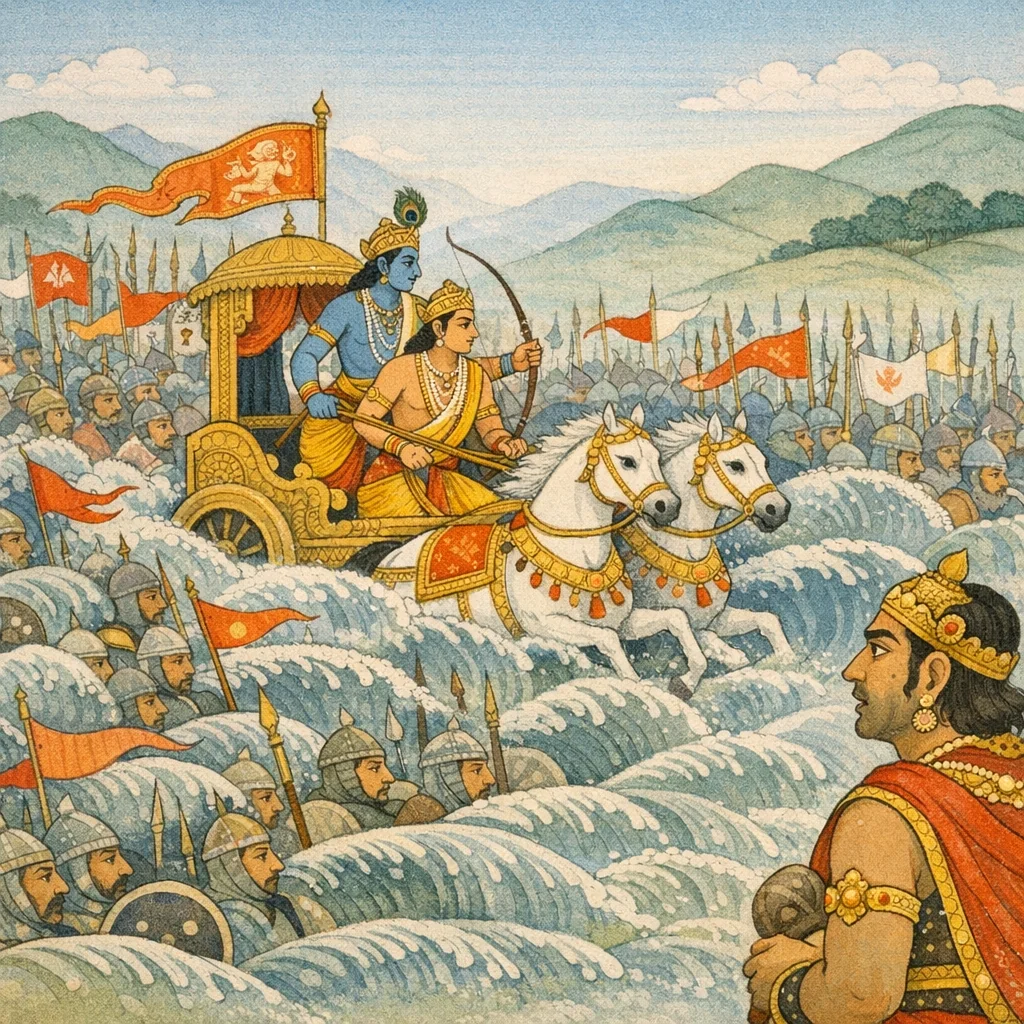
Chapter Arc: श्रीकृष्ण सारथि और धनुर्धर अर्जुन द्रोणाचार्य की समुद्र-सी सेना को चीरते हुए आगे बढ़ते हैं; यह दृश्य देखकर कौरव-सैनिकों के हृदय में निराशा और लज्जा एक साथ उठती है। → कौरवों के महात्मा योद्धा साहस बटोरकर धनंजय की ओर लौटते हैं, पर जो-जो क्रोध और अमर्ष से अर्जुन के सामने गया, वह समुद्र-धारा की तरह फिर-फिर उसी ओर खिंचता चला आता है; उधर कृष्ण-अर्जुन द्रोणानीक को पार कर ऐसे दिखते हैं मानो हिंस्र पशुओं से भरे पर्वत लाँघकर दो व्यापारी निकल आए हों। → जब दोनों तेजस्वी वीर द्रोणसेना को लाँघ जाते हैं, तब कौरव पक्ष जयद्रथ के जीवन के लिए अनिष्ट शंका करता है; उसी क्षण दुर्योधन अपने अनुचरों सहित सामने आकर मार्ग रोकता है और कृष्ण अर्जुन से ‘प्राप्तकाल’ वचन कहने को उद्यत होते हैं। → अध्याय का निष्कर्ष इस बोध में ठहरता है कि द्रोणानीक से ‘मुक्त’ होकर कृष्ण-अर्जुन का तेज सूर्य और अग्नि के समान दहक रहा है—वे मानो मगर के मुख से छूटकर पार उतर आए हों; कौरवों की आशा अब दुर्योधन के प्रतिरोध पर टिक जाती है। → दुर्योधन के सामने आने पर कृष्ण अर्जुन को जो निर्णायक ‘प्राप्तकाल’ उपदेश/आदेश देने वाले हैं, वही अगले प्रसंग का द्वार बनता है।
Shlokas
Verse 1
(दाक्षिणात्य अधिक पाठका १ श्लोक मिलाकर कुल ३८ श्लोक हैं) हि ही बक। हि मा एकाधिकशततमो< ध्याय: श्रीकृष्ण और अर्जुनको आगे बढ़ा देख कौरव-सैनिकोंकी निराशा तथा दुर्योधनका युद्धके लिये आना संजय उवाच स्रंसन्त इव मज्जानस्तावकानां भयान्नूप । तौ दृष्टवा समतिक्रान्तो वासुदेवधनंजयौ,संजय कहते हैं--नरेश्वर! भगवान् श्रीकृष्ण और अर्जुनको सबको लाँघकर आगे बढ़ा हुआ देख भयके कारण आपके सैनिकोंकी मज्जा खिसकने लगी
Sañjaya said: O king, when your warriors saw Vāsudeva (Kṛṣṇa) and Dhanañjaya (Arjuna) pressing forward, having overpassed all others, fear made their very marrow seem to slip away—as though their strength and resolve were draining from within. The scene marks a moral and psychological turning point: the righteous momentum of Kṛṣṇa and Arjuna unsettles the Kaurava host, revealing how inner confidence collapses when one confronts superior purpose and prowess in war.
Verse 2
सर्वे तु प्रतिसंरब्धा हीमन्त: सत्त्वचोदिता: । स्थिरीभूता महात्मान: प्रत्यगच्छन् धनंजयम्,फिर वे लज्जित हुए समस्त महामनस्वी सैनिक धैर्य और साहससे प्रेरित हो युद्धके लिये स्थिरचित्त होकर रोषपूर्वक अर्जुनकी ओर जाने लगे
Sañjaya said: Then all those great-souled warriors, roused and bristling for combat, driven by courage and inner resolve, steadied their minds and advanced in wrath toward Dhanañjaya (Arjuna).
Verse 3
ये गता: पाण्डवं युद्धे रोषामर्षसमन्विता: । तेडद्यापि न निवर्तन्ते सिन्धव: सागरादिव,जो लोग युद्धमें रोष और अमर्षसे भरकर पाण्डुनन्दन अर्जुनके सामने गये, वे समुद्रतक गयी हुई नदियोंके समान आजतक नहीं लौटे
Sañjaya said: Those who, filled with wrath and wounded pride, went forth in battle against Arjuna, the son of Pāṇḍu, have not returned even now—like rivers that, once they have reached the ocean, do not turn back.
Verse 4
असन्तस्तु न्यवर्तन्त वेदेभ्य इव नास्तिका: । नरकं भजमानास्ते प्रत्यपद्यन्त किल्बिषम्,जैसे नास्तिक पुरुष वेदोंसे (उनकी बतायी हुई विधियोंसे) दूर रहते हैं, उसी प्रकार जो अधम मनुष्य थे, वे ही अर्जुनके सामने जाकर भी लौट आये (पीठ दिखाकर भाग खड़े हुए)। वे नरकमें पड़कर अपने पापका फल भोग रहे होंगे
Sañjaya said: “But the ignoble turned back—just as unbelievers keep away from the Vedas. Having chosen the path that leads to hell, they only incurred sin and returned in disgrace.”
Verse 5
तावतीत्य रथानीकं विमुक्तौ पुरुषर्षभौ । ददृशाते यथा राहोरास्यान्मुक्तौ प्रभाकरी,रथियोंकी सेनाको लाँधकर उनके घेरेसे मुक्त हुए पुरुषश्रेष्ठ श्रीकृष्ण और अर्जुन राहुके मुँहसे छूटे हुए सूर्य और चन्द्रमाके समान दिखायी दिये
Sañjaya said: Having crossed beyond that massed formation of chariots and freed themselves from the encirclement, the two best of men—Kṛṣṇa and Arjuna—appeared like the Sun and the Moon released from the mouth of Rāhu.
Verse 6
मत्स्याविव महाजालं विदार्य विगतक्लमौ । तथा कृष्णावदृश्येतां सेनाजालं विदार्य तत्,जैसे दो मत्स्य किसी महाजालको फाड़कर निकल जानेपर क्लैशशून्य हो जाते हैं, उसी प्रकार उस सेनासमूहको विदीर्ण करके श्रीकृष्ण और अर्जुन क्लेशरहित दिखायी देते थे
Sañjaya said: Just as two fish, tearing through a vast net, emerge without fatigue, so too Kṛṣṇa and Arjuna were seen—having ripped apart that net-like mass of the army—appearing unwearied.
Verse 7
विमुक्तौ शस्त्रसम्बाधाद् द्रोणानीकात् सुदुर्भिदात् | अदृश्येतां महात्मानौ कालसूर्याविवोदितौ,शस्त्रोंसे भरे हुए आचार्य द्रोणके दुर्भद्य सैन्यव्यूहसे छुटकारा पाकर महात्मा श्रीकृष्ण और अर्जुन उदित हुए प्रलयकालके सूर्यके समान दृष्टिगोचर हो रहे थे
Sañjaya said: Freed from the crush of weapons and escaped from Droṇa’s battle-formation—hard indeed to break—those two great-souled ones, Kṛṣṇa and Arjuna, came into view like the sun risen at the time of cosmic dissolution. The image underscores their awe-inspiring, almost world-ending martial radiance, while also marking a decisive turn in the battle’s moral and strategic momentum.
Verse 8
अस्त्रसम्बाधनिर्मुक्तौ विमुक्तौ शस्त्रसंकटात् | अदृश्येतां महात्मानौ शत्रुसम्बाधकारिणौ
Sañjaya said: Freed from the crush of missiles and released from the peril of close-pressing weapons, those two great-souled warriors vanished from sight—men who themselves were the cause of such crushing pressure upon their enemies. The verse underscores how, amid the moral chaos of war, exceptional fighters can momentarily transcend the visible battlefield, turning the very mechanics of violence back upon those who wield it.
Verse 9
अक्षोभयेतां सेनां तौ समुद्र मकराविव,जैसे दो मगर समुद्रको क्षुब्ध कर देते हैं, उसी प्रकार उन दोनोंने सारी सेनाको व्याकुल कर दिया। आपके सैनिकों तथा पुत्रोंने उस समय द्रोणाचार्यके सैन्यव्यूहमें घुसे हुए श्रीकृष्ण और अर्जुनके सम्बन्धमें यह विचार किया था कि ये दोनों द्रोणको नहीं लाँघ सकेंगे
Sañjaya said: Those two—like sea-monsters stirring up the ocean—threw the entire army into turmoil. At that moment, your soldiers and sons, seeing Śrī Kṛṣṇa and Arjuna enter Droṇācārya’s battle-formation, judged that the pair would not be able to overstep (break through) Droṇa.
Verse 10
तावकास्तव पुत्रा श्च द्रोणानीकस्थयोस्तयो: । नैतौ तरिष्यतो द्रोणमिति चक़ुस्तदा मतिम्,जैसे दो मगर समुद्रको क्षुब्ध कर देते हैं, उसी प्रकार उन दोनोंने सारी सेनाको व्याकुल कर दिया। आपके सैनिकों तथा पुत्रोंने उस समय द्रोणाचार्यके सैन्यव्यूहमें घुसे हुए श्रीकृष्ण और अर्जुनके सम्बन्धमें यह विचार किया था कि ये दोनों द्रोणको नहीं लाँघ सकेंगे
Sanjaya said: Your warriors and your sons, seeing those two—Kṛṣṇa and Arjuna—who had entered the battle-array of Droṇa, then formed this judgment: “These two will not be able to cross beyond Droṇa.” The verse highlights the moral tension of war: confidence rooted in reliance on a single mighty commander, and the underestimation of resolve and divine-guided skill on the opposing side.
Verse 11
तौतु दृष्टवा व्यतिक्रान्तौ द्रोणानीकं महाद्युती । नाशशंसुर्महाराज सिन्धुराजस्य जीवितम्,परंतु महाराज! जब वे दोनों महातेजस्वी वीर द्रोणाचार्यके सैन्यव्यूहको लाँध गये, तब उन्हें देखकर आपके पुत्रोंको सिन्धुराजके जीवित रहनेकी आशा नहीं रह गयी
Sañjaya said: “But when they saw those two heroes of great splendor break through Droṇa’s battle-array, O King, your sons no longer held out any hope for the life of the King of Sindhu.”
Verse 12
आशा बलवती राजन् सिन्धुराजस्य जीविते । द्रोणहार्दिक्ययो: कृष्णौ न मोक्ष्येते इति प्रभो,राजन! प्रभो! सब लोगोंको यह सोचकर कि श्रीकृष्ण और अर्जुन द्रोणाचार्य तथा कृतवर्मके हाथसे नहीं छूट सकेंगे, सिन्धुराजके जीवनकी आशा प्रबल हो उठी थी
Sañjaya said: “O King, the hope for the Sindhu king’s survival grew strong, for people believed, ‘Kṛṣṇa and Arjuna will not escape from Droṇa and Hārdikya (Kṛtavarman), O lord.’”
Verse 13
तामाशां विफलीकृत्य संतीर्णो तौ परंतपौ । द्रोणानीक॑ महाराज भोजानीकं च दुस्तरम्,महाराज! शत्रुओंको संताप देनेवाले वे दोनों वीर श्रीकृष्ण और अर्जुन लोगोंकी उस आशाको विफल करके द्रोणाचार्य तथा कृतवर्माकी दुस्तर सेनाको लाँघ गये
Sañjaya said: “O King, those two scorchers of foes—Kṛṣṇa and Arjuna—having rendered the enemy’s hope futile, forced their way through, crossing beyond the formidable battle-array of Droṇa and also the hard-to-pass Bhoja contingent.”
Verse 14
अथ दृष्टवा व्यतिक्रान्ती ज्वलिताविव पावकौ । निराशा: सिन्धुराजस्य जीवितं न शशंसिरे,दो प्रज्वलित अग्नियोंके समान सारी सेनाको लाँधकर खड़े हुए उन दोनों वीरोंको सकुशल देख आपके सैनिकोंने निराश होकर सिन्धुराजके जीवनकी आशा त्याग दी
Sañjaya said: “Then, seeing those two heroes who had overpassed the whole host, blazing like two fires, your warriors lost hope and no longer held out any expectation for the Sindhu king’s survival.”
Verse 15
मिथश्ल समभाषेतामभीतौ भयवर्धनौ । जयद्रथवधे वाचस्तास्ता: कृष्णधनंजयौ,दूसरोंका भय बढ़ाने और स्वयं निर्भय रहनेवाले श्रीकृष्ण और अर्जुन आपसमें जयद्रथवधके विषयमें इस प्रकार बातें करने लगे--
Sañjaya said: “Fearless themselves and increasing fear in their foes, Krishna and Arjuna spoke together, exchanging various words about the slaying of Jayadratha.”
Verse 16
असौ मध्ये कृत: षड्भिर्धार्तराष्ट्र॑महारथै: । चक्षुविषयसम्प्राप्तो न मे मोक्ष्यति सैन्धव:,यद्यपि धृतराष्ट्रके छः महारथी पुत्रोंने जयद्रथको अपने बीचमें छिपा रखा है, तथापि यदि वह मेरी आँखोंको दीख गया तो मेरे हाथसे जीवित नहीं बच सकेगा
Sañjaya said: “Though the Saindhava has been placed in the very midst of six great chariot-warriors of Dhṛtarāṣṭra’s line, if he comes within the range of my sight, he will not escape alive from my hands.”
Verse 17
यद्यस्य समरे गोप्ता शक्रो देवगणै: सह । तथाप्येनं निहंस्थाव इति कृष्णावभाषताम्,“यदि देवताओंसहित साक्षात् इन्द्र भी समरांगणमें इसकी रक्षा करें, तो भी हम दोनों इसे अवश्य मार डालेंगे।” इस प्रकार दोनों कृष्ण आपसमें बात कर रहे थे
Sañjaya said: “Even if Śakra (Indra), together with the hosts of gods, were to protect him on the battlefield, still we two will surely strike him down.” Thus the two Krishnas spoke to one another, voicing an unshaken resolve amid the moral pressure of war.
Verse 18
इति कृष्णा महाबाहू मिथो5कथयतां तदा | सिन्धुराजमवेक्षन्तौ त्वत्पुत्रा बहु चुक्रुशु:,सिन्धुराज जयद्रथकी खोज करते हुए महाबाहु श्रीकृष्ण और अर्जुनने उस समय जब आपसमें उपर्युक्त बातें कहीं, तब आपके पुत्र बहुत कोलाहल करने लगे
Sañjaya said: “While Kṛṣṇa and the mighty-armed Arjuna were thus speaking with one another, keeping their eyes on the king of Sindhu (Jayadratha), your sons raised a great outcry.”
Verse 19
अतीत्य मरुधन्वानं प्रयान्तौ तृषितो गजौ । पीत्वा वारि समाश्र्स्तौ तथैवास्तामरिंदमौ,जैसे मरुभूमिको लाँघकर जाते हुए दो प्यासे हाथी पानी पीकर तृप्त एवं संतुष्ट हो गये हों, उसी प्रकार शत्रुओंका दमन करनेवाले श्रीकृष्ण और अर्जुन भी शत्रुसेनाको लाँधचकर अत्यन्त प्रसन्न हुए थे
Sañjaya said: “Just as two thirsty elephants, having crossed a desert tract, drink water and become soothed and satisfied, so too did Kṛṣṇa and Arjuna—subduers of foes—after breaking through the enemy host, feel a surge of relief and glad confidence.”
Verse 20
व्याप्रसिंहणजाकीर्णानतिक्रम्य च पर्वतान् । वणिजाविव दृश्येतां हीनमृत्यू जरातिगौ,जैसे व्याप्र, सिंह और हाथियोंसे भरे हुए पर्वतोंको लाँधकर दो व्यापारी प्रसन्न दिखायी देते हों, उसी प्रकार मृत्यु और जरासे रहित श्रीकृष्ण और अर्जुन भी उस सेनाको लाँधकर संतुष्ट दीखते थे
Sañjaya said: Having crossed over those mountain-like ranks teeming with tigers, lions, and elephants, Kṛṣṇa and Arjuna appeared like two merchants who, after passing beyond perilous mountains crowded with wild beasts, are seen safe and satisfied—so too did those two, untouched by death and old age, look content after surmounting that army.
Verse 21
तथा हि मुखवर्णो5यमनयोरिति मेनिरे । तावका वीक्ष्य मुक्त तौ विक्रोशन्ति सम सर्वश:,इन दोनोंके मुखकी कान्ति वैसी ही थी, ऐसा सभी सैनिक मान रहे थे। विषधर सर्प और प्रज्वलित अग्निके समान भयंकर द्रोणाचार्य तथा अन्य नरेशोंके हाथसे छूटे हुए दो प्रकाशमान सूर्योके सदृश श्रीकृष्ण और अर्जुनको वहाँ देखकर आपके समस्त सैनिक सब ओरसे कोलाहल मचा रहे थे
Sañjaya said: “Indeed, the radiance of their faces is the same”—so the warriors judged. Seeing those two set free, your troops raised a tumult on every side, as they beheld Kṛṣṇa and Arjuna shining like two suns released from the hands of the dreadful Droṇa and the other kings—terrifying as a venomous serpent and as blazing fire.
Verse 22
द्रोणादाशीविषाकाराज्ज्वलितादिव पावकात् । अन्येभ्य: पार्थिवेभ्यक्षु भास्वन्ताविव भास्करौ,इन दोनोंके मुखकी कान्ति वैसी ही थी, ऐसा सभी सैनिक मान रहे थे। विषधर सर्प और प्रज्वलित अग्निके समान भयंकर द्रोणाचार्य तथा अन्य नरेशोंके हाथसे छूटे हुए दो प्रकाशमान सूर्योके सदृश श्रीकृष्ण और अर्जुनको वहाँ देखकर आपके समस्त सैनिक सब ओरसे कोलाहल मचा रहे थे
Sañjaya said: “Like two radiant suns, they seemed to have slipped free from the hands of Droṇa—terrible as a venomous serpent—and from the blazing fire of the other kings. Seeing Śrī Kṛṣṇa and Arjuna there, shining with such splendor, all your soldiers raised a tumult on every side.”
Verse 23
विमुक्तौ सागरप्रख्याद् द्रोणानीकादरिंदमौ । अदृश्येतां मुदा युक्तौ समुत्तीर्यार्णवं यथा,समुद्रके समान विशाल द्रोणसेनासे मुक्त हुए वे दोनों शत्रुदमन वीर श्रीकृष्ण और अर्जुन ऐसे प्रसन्न दिखायी देते थे, मानो महासागर लाँघ गये हों
Sañjaya said: “Freed from Droṇa’s host—vast as the ocean—the two enemy-subduing heroes, Kṛṣṇa and Arjuna, appeared filled with joy, as though they had crossed a mighty sea.”
Verse 24
अस्त्रौघान्महतो मुक्तौ द्रोणहार्दिक्यरक्षितात् । रोचमानावदृश्येतामिन्द्राग्न्यो: सदृशौ रणे,द्रोणाचार्य और कृतवर्मद्वारा सुरक्षित महान् अस्त्रसमुदायसे छूटकर वे दोनों वीर समरांगणमें इन्द्र और अग्निके समान प्रकाशमान दिखायी देते थे
Sañjaya said: “Released from that vast barrage of weapons, and protected by Droṇa and Hārdikya (Kṛtavarman), the two warriors were seen on the battlefield shining brilliantly—like Indra and Agni themselves.”
Verse 25
उद्धिन्नरुधिरी कृष्णौ भारद्वाजस्य सायकै: । शितैश्नितौ व्यरोचेतां कर्णिकारैरिवाचलौ,द्रोणाचार्यके तीखे बाणोंसे श्रीकृष्ण और अर्जुनके शरीर छिदे हुए थे और उनसे रक्तकी धारा बह रही थी। उस समय वे लाल कनेरसे भरे हुए दो पर्वतोंके समान सुशोभित होते थे
Sañjaya said: “Kṛṣṇa and Arjuna, their bodies pierced by the sharp arrows of Bhāradvāja’s son (Droṇa) and streaming with blood, shone forth like two mountains covered with red karṇikāra blossoms.”
Verse 26
द्रोणग्राहह्नदान्मुक्ती शक्त्याशीविषसंकटात् । अयःशरोग्रमकरात् क्षत्रियप्रवराम्भस:,द्रोणाचार्य जिस सैन्य-सरोवरके ग्राहतुल्य जन्तु थे, जो शक्तिरूपी विषधर सर्पोंसे भरा था, लोहेके बाण जिसके भीतर भयंकर मगरका भय उत्पन्न करते थे, बड़े-बड़े क्षत्रिय जिसमें जलके समान शोभा पाते थे, धनुषकी टंकार जहाँ मेघगर्जनाके समान सुनायी पड़ती थी, गदा और खड़्ग जहाँ विद्युतके समान चमक रहे थे और द्रोणाचार्यके बाण ही जहाँ मेघ बनकर बरस रहे थे, उससे मुक्त हुए श्रीकृष्ण और अर्जुन राहुसे छूटे हुए सूर्य और चन्द्रमाके समान प्रकाशित हो रहे थे
Sañjaya said: “Released from that lake-like battle-formation of Droṇa—haunted by crocodile-like foes, choked with venomous serpents in the form of deadly spears, and made perilous by iron arrows that struck like the jaws of fierce makaras—Kṛṣṇa and Arjuna shone forth again, as the sun and moon blaze when freed from Rāhu’s grasp.”
Verse 27
ज्याघोषतलनिर्हादाद् गदानिस्त्रिंशविद्युत: । द्रोणास्त्रमेघान्निर्मुक्तौ सूर्येन्दू तिमिरादिव,द्रोणाचार्य जिस सैन्य-सरोवरके ग्राहतुल्य जन्तु थे, जो शक्तिरूपी विषधर सर्पोंसे भरा था, लोहेके बाण जिसके भीतर भयंकर मगरका भय उत्पन्न करते थे, बड़े-बड़े क्षत्रिय जिसमें जलके समान शोभा पाते थे, धनुषकी टंकार जहाँ मेघगर्जनाके समान सुनायी पड़ती थी, गदा और खड़्ग जहाँ विद्युतके समान चमक रहे थे और द्रोणाचार्यके बाण ही जहाँ मेघ बनकर बरस रहे थे, उससे मुक्त हुए श्रीकृष्ण और अर्जुन राहुसे छूटे हुए सूर्य और चन्द्रमाके समान प्रकाशित हो रहे थे
Sañjaya said: Released from that thunderous din of bowstrings—where maces and swords flashed like lightning, and where Droṇa’s weapon poured down like a rain-cloud—Kṛṣṇa and Arjuna shone forth, as the sun and the moon appear when freed from darkness.
Verse 28
बाहुभ्यामिव संतीर्णो सिन्धुषष्ठा: समुद्रगा: । तपान्ते सरितः पूर्णा महाग्राहसमाकुला:,उस समय ऐसा जान पड़ता था, मानो वर्षा-ऋतुमें जलसे लबालब भरी हुई बड़े-बड़े ग्राहोंसे व्याप्त समुद्रगामिनी इरावती (रावी), विपाशा (ब्यास), वितस्ता (झेलम), शतद्भू (शतलज) और चन्द्रभागा (चनाव)--इन पाँचों नदियोंके साथ छठी सिंधु नदीको श्रीकृष्ण और अर्जुनने अपनी भुजाओंसे तैरकर पार किया हो
Sañjaya said: It appeared as though, by the sheer strength of their arms, they had swum across the sea-bound rivers—five of them together with the Sindhu as the sixth—rivers swollen at the end of the hot season and crowded with great crocodiles.
Verse 29
इति कृष्णौ महेष्वासौ प्रशस्तौ लोकविश्रुतौ । सर्वभूतान्यमन्यन्त द्रोणास्त्रबलवारणात्
Sañjaya said: Thus those two Kṛṣṇas—mighty archers, celebrated and renowned throughout the world—were regarded by all beings as having been checked and held back by the overpowering force of Droṇa’s weapon.
Verse 30
इस प्रकार द्रोणाचार्यके अस्त्र-बलका निवारण करनेके कारण समस्त प्राणी श्रीकृष्ण और अर्जुनको लोकविख्यात प्रशस्त गुणयुक्त महाधनुर्धर मानने लगे ।। जयद्रथं समीपस्थमवेक्षन्ती जिघांसया । रुरुं निपाने लिप्सन्तौ व्यात्राविव व्यतिष्ठताम्,जैसे पानी पीनेके घाटपर आये हुए रुरुमृगको दबोच लेनेकी इच्छासे दो व्याप्र खड़े हों, उसी प्रकार निकटवर्ती जयद्रथको मार डालनेकी इच्छासे उसकी ओर देखते हुए वे दोनों वीर खड़े थे
Sañjaya said: Having checked the force of Droṇa’s weapon, all beings came to regard Kṛṣṇa and Arjuna as world-renowned, highly praised, mighty archers. Then, intent on killing, the two heroes fixed their gaze on Jayadratha who stood nearby—like two tigers at a watering-place, eager to seize a ruru-deer that has come to drink—so did they stand, poised to strike.
Verse 31
यथा हि मुखवर्णोडयमनयोरिति मेनिरे । तव योधा महाराज हतमेव जयद्रथम्,महाराज! उस समय उन दोनोंके मुखपर जैसी समुज्ज्वल कान्ति थी, उसके अनुसार आपके योद्धाओंने जयद्रथको मरा हुआ ही माना
Sañjaya said: “Judging from the radiant brilliance that rose upon the faces of those two, your warriors, O King, concluded that Jayadratha had indeed been slain.”
Verse 32
लोहिताक्षौ महाबाहू संयुक्तौ कृष्णपाण्डवौ | सिन्धुराजमभिप्रेक्ष्य हृष्टो व्यनदतां मुहुः,एक साथ बैठे हुए लाल नेत्रोंवाले महाबाहु श्रीकृष्ण और अर्जुन सिन्धुराज जयद्रथको देखकर हर्षसे उललसित हो बारंबार गर्जना करने लगे
Sañjaya said: The two mighty-armed heroes, Kṛṣṇa and Pāṇḍava (Arjuna), their eyes reddened with battle-fervor, sat together. Seeing the king of Sindhu (Jayadratha) before them, they were filled with exultation and again and again roared aloud—signaling resolve and righteous urgency in the midst of war.
Verse 33
शौरेरभीषुहस्तस्य पार्थस्य च धनुष्मत: । तयोरासीत् प्रभा राजन् सूर्यपावकयोरिव,राजन! हाथोंमें बागडोर लिये श्रीकृष्ण और धनुष धारण किये अर्जुन--इन दोनोंकी प्रभा सूर्य और अग्निके समान जान पड़ती थी
Sañjaya said: O King, the radiance of Śauri (Kṛṣṇa), holding the reins, and of Pārtha (Arjuna), bearing his bow, shone together like the sun and fire. In the midst of war, their combined splendor signals not mere martial prowess but the moral force of rightful purpose guided by clear counsel and disciplined action.
Verse 34
हर्ष एव तयोरासीद् द्रोणानीकप्रमुक्तयो: । समीपे सैन्धवं दृष्टवा श्येनयोरामिषं यथा,जैसे मांसका टुकड़ा देखकर दो बाजोंको प्रसन्नता होती है, उसी प्रकार द्रोणाचार्यकी सेनासे मुक्त हुए उन दोनों वीरोंको अपने पास ही जयद्रथको देखकर सब प्रकारसे हर्ष ही हुआ
Sañjaya said: Those two heroes, having broken free from Droṇa’s battle-array, felt nothing but exhilaration when they saw Jayadratha close at hand—like two hawks rejoicing at the sight of flesh. The image underscores how, in the heat of war, a long-sought target can ignite fierce, almost instinctive resolve, raising ethical tension between righteous purpose and predatory zeal.
Verse 35
तौ तु सैन्धवमालोक्य वर्तमानमिवान्तिके । सहसा पेततुः क्रुद्धौ क्षिप्रं श्येनाविवामिषम्,अपने समीप ही खड़े हुए-से सिन्धुराज जयद्रथको देखकर तत्काल वे दोनों वीर कुपित हो उसी प्रकार सहसा उसपर टूट पड़े, जैसे दो बाज मांसपर झपट रहे हों
Sañjaya said: Seeing Jayadratha, the king of Sindhu, as though he were standing right before them, the two warriors—suddenly inflamed with anger—swiftly fell upon him at once, like two hawks swooping down on flesh. The verse underscores how wrath and urgency in battle can drive immediate, predatory action, where the enemy is perceived not as a person but as a target to be seized.
Verse 36
तौ दृष्टवा तु व्यतिक्रान्ती हृषीकेशधनंजयौ । सिन्धुराजस्य रक्षार्थ पराक्रान्त: सुतस्तव,श्रीकृष्ण और अर्जुन सारी सेनाको लाँधकर आगे बढ़ते चले जा रहे हैं, यह देखकर आपके पुत्र दुर्योधनने सिन्धुराजकी रक्षाके लिये पराक्रम दिखाना आरम्भ किया
Sañjaya said: Seeing Kṛṣṇa (Hṛṣīkeśa) and Arjuna (Dhanañjaya) pressing forward, having overpassed the opposing forces, your son Duryodhana began to display great valor in order to protect the king of Sindhu. The scene underscores how, amid the chaos of war, personal resolve and loyalty to allies drive decisive action—even when the broader conflict is ethically fraught.
Verse 37
द्रोणेनाबद्धकवचो राजा दुर्योधनस्तत: । ययावेकरथेनाजौ हयसंस्कारवित् प्रभो,प्रभो! घोड़ोंके संस्कारको जाननेवाला राजा दुर्योधन उस समय द्रोणाचार्यके बाँधे हुए कवचको धारण करके एकमात्र रथकी सहायतासे युद्धभूमिमें गया था
Sañjaya said: Then King Duryodhana, wearing the armor fastened upon him by Droṇa, went forth onto the battlefield with a single chariot. Skilled in the training and management of horses, he advanced—an image of royal resolve sustained by martial expertise and the protective authority of his teacher, even as the war’s moral weight presses upon every such act.
Verse 38
कृष्णपार्थो महेष्वासौ व्यतिक्रम्याथ ते सुत: । अग्रतः पुण्डरीकाक्षं प्रतीयाय नराधिप,नरेश्वर! महाधनुर्धर श्रीकृष्ण और अर्जुनको लाँधचकर आपका पुत्र कमलनयन श्रीकृष्णके सामने जा पहुँचा
Sañjaya said: Your son, O king—having passed beyond the mighty bowmen Kṛṣṇa and Pārtha—advanced to the very front and came face to face with the lotus-eyed Kṛṣṇa. The moment underscores a warrior’s daring initiative in battle, yet also hints at the ethical tension of confronting the charioteer-guide who embodies strategic restraint and dharmic counsel amid violence.
Verse 39
ततः सर्वेषु सैन्येषु वादित्राणि प्रहृष्टवत् । प्रावाद्यन्त व्यतिक्रान्ते तव पुत्रे धनंजयम्,तदनन्तर आपका पुत्र दुर्योधन जब अर्जुनको भी लाँधकर आगे बढ़ गया, तब सारी सेनाओंमें हर्षपूर्ण बाजे बजने लगे
Sañjaya said: Then, throughout all the armies, musical instruments were sounded in jubilant celebration. For your son had surged ahead, having outstripped Dhanañjaya (Arjuna). The moment marks the Kaurava host’s exultation at Duryodhana’s bold advance, revealing how quickly the din of war turns tactical movement into moral-psychological triumph in the eyes of the troops.
Verse 40
सिंहनादरवाश्वासन् शड्खशब्दविमिश्रिता: । दृष्टवा दुर्योधन तत्र कृष्णयो: प्रमुखे स्थितम्,दुर्योधनको वहाँ श्रीकृष्ण और अर्जुनके सामने खड़ा देख शंखोंकी ध्वनिसे मिले हुए सिंहनादके शब्द सब ओर गूँजने लगे
Sañjaya said: When they saw Duryodhana standing there at the very front, facing Kṛṣṇa and Arjuna, the battlefield resounded on all sides with lion-like roars mingled with the blare of conches—an outward surge of martial confidence and challenge as the confrontation tightened around the leaders.
Verse 41
ये च ते सिन्धुराजस्य गोप्तार: पावकोपमा: । ते प्राह्ष्पन्त समरे दृष्ट्वा पुत्र॑ं तव प्रभो,प्रभो! सिन्धुराजकी रक्षा करनेवाले जो अग्निके समान तेजस्वी वीर थे, वे आपके पुत्रको समरांगणमें डटा हुआ देख बड़े प्रसन्न हुए
Sañjaya said: “And those guardians of the Sindhu king—warriors blazing like fire—were filled with joy on the battlefield when they saw your son standing firm. Their delight reflects renewed confidence and loyalty in the midst of peril, as protectors rally around a steadfast leader in war.”
Verse 42
दृष्टवा दुर्योधन कृष्णो व्यतिक्रान्तं सहानुगम् । अब्रवीदर्जुनं राजन् प्राप्तकालमिदं वच:,राजन! सेवकोंसहित दुर्योधन सबको लाँधचकर सामने आ गया--यह देखकर श्रीकृष्णने अर्जुनसे यह समयोचित बात कही
Sañjaya said: Seeing Duryodhana, together with his followers, having overstepped and come forward, Kṛṣṇa addressed Arjuna, O King, with words timely to the moment—signaling that the situation now demanded decisive action in accordance with duty amid the pressures of war.
Verse 86
विमुक्तौ ज्वलनस्पर्शान्मकरास्याज्ञषाविव । शत्रुओंको संतप्त करनेवाले वे दोनों महात्मा श्रीकृष्ण और अर्जुन अग्निके समान दाहक स्पर्शवाले मगरके मुखसे छूटे हुए दो मत्स्योंके समान अस्त्र-शस्त्रोंकी बाधाओं तथा संकटोंसे मुक्त दिखायी दे रहे थे
Sañjaya said: Those two great-souled heroes—Śrī Kṛṣṇa and Arjuna—appeared freed from the obstructions of weapons and from peril, like two fish released from the jaws of a makara. Their touch was burning like fire, and they were tormentors of their enemies, emerging unscathed from dangers that sought to bind and consume them.
Verse 101
इति श्रीमहाभारते द्रोणपर्वणि जयद्रथवधपर्वणि दुर्योधनागमे एकाधिकशततमो<ध्याय:
Sanjaya said: Thus, in the revered Mahabharata, within the Drona Parva—specifically in the section concerning the slaying of Jayadratha—this concludes the one-hundred-and-first chapter, describing the arrival of Duryodhana. The colophon signals a transition in the war narrative, marking the close of an episode centered on retribution and the moral weight of vows and consequences on the battlefield.
Frequently Asked Questions
The chapter frames a pressure point between obligation to the campaign’s strategic objective (supporting Arjuna’s vow-driven pursuit) and the immediate duty to protect allies against a teacher-commander’s containment tactics, requiring rapid choices under uncertainty.
Endurance and clarity of purpose operate alongside restraint: the text depicts how resolve (to reach and support Arjuna) must be paired with adaptive tactics (dismounting, re-mounting, re-routing through units) rather than fixation on a single mode of combat.
No explicit phalaśruti is stated here; the chapter’s meta-level function is narrative-structural, using sound recognition and Yudhiṣṭhira’s internal appraisal to orient the listener within the larger vow-and-countermeasure arc.