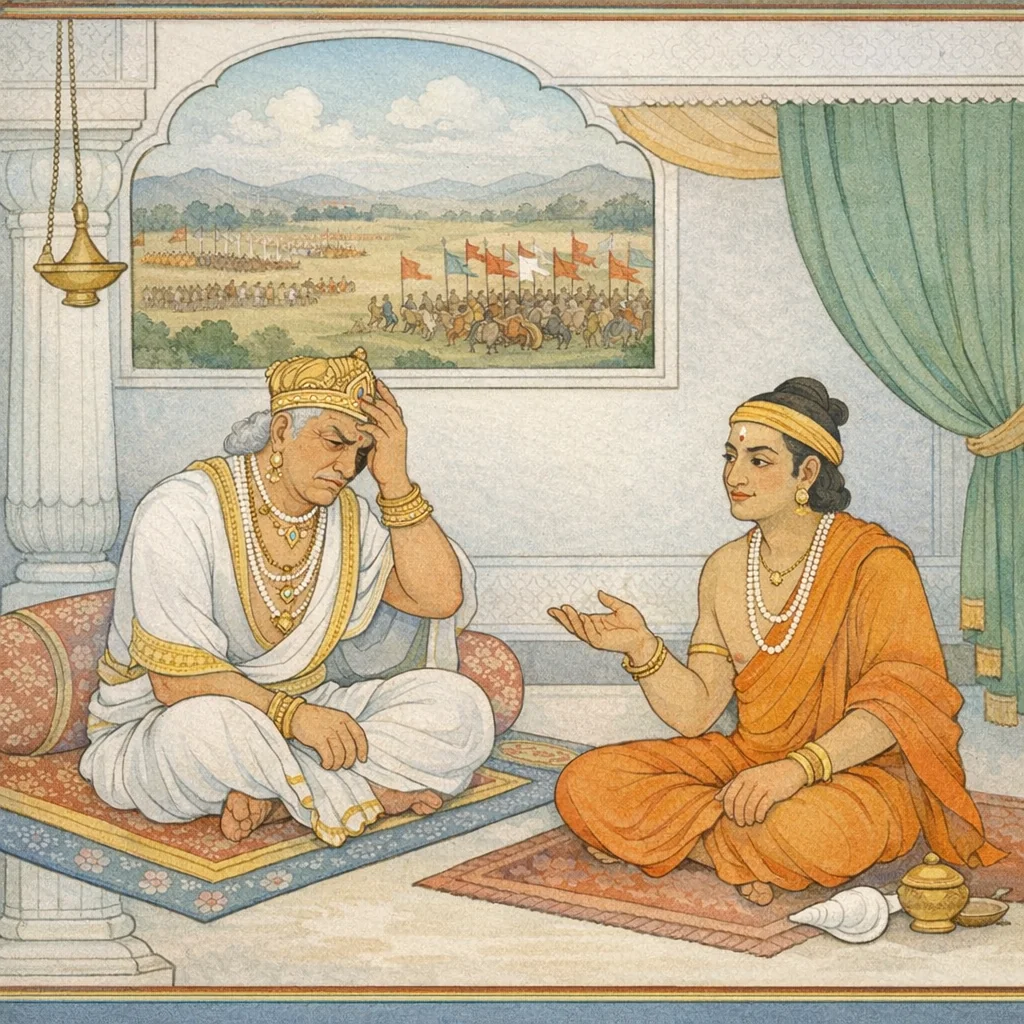
Adhyaya 68
भीष्मस्य भीमसेन-निरोधः (Bhīṣma checks Bhīmasena; matched engagements intensify)
Upa-parva: Bhīṣma-vadha-prastāva (Engagements under Bhīṣma’s command)
Saṃjaya reports to Dhṛtarāṣṭra the coordinated onset of engagements as key Pandava and allied fighters advance toward designated Kaurava opponents. Śikhaṇḍī with Matsya-Virāṭa closes upon Bhīṣma; Dhanaṃjaya (Arjuna) presses multiple senior bowmen; Bhīmasena moves against Duryodhana and Duḥśāsana; Sahadeva advances on Śakuni and Ulūka; Nakula engages the Trigartas; allied commanders (Sātyaki, Cekitāna, Saubhadra) confront Śālvas and Kekayas; Dhṛṣṭaketu and Ghaṭotkaca oppose the Kaurava chariot divisions; and Dhṛṣṭadyumna meets Droṇa. The chapter then shifts from pairing to atmosphere: midday dust and volleys obscure sky and directions; the field gleams with armor and weapons; chariots appear like celestial bodies. A tactical inflection follows: Bhīṣma, observing the army, blocks Bhīmasena, showers him with sharpened arrows, cuts down Bhīma’s thrown spear, and then severs Bhīma’s bow. Sātyaki rapidly counters by attacking Bhīṣma, but Bhīṣma strikes down Sātyaki’s charioteer, causing the horses to bolt and generating alarm and regrouping cries among the Pandava side. Bhīṣma then renews pressure on the Pandava host, prompting Panchalas and Somakas to concentrate their effort against him; both armies surge forward, and the engagement expands into a general clash.
Chapter Arc: धृतराष्ट्र, संजय से युद्ध-समाचार सुनकर पुत्रों की पराजय का बोध पाते ही भीतर-भीतर जल उठता है—उसे लगता है कि विदुर की पुरानी चेतावनियाँ अब हृदय को दग्ध करने आई हैं। → धृतराष्ट्र की चिन्ता क्रमशः निश्चित भय में बदलती है: वह किसी ऐसे वीर को नहीं देखता जो रणभूमि में उसके पुत्रों की रक्षा कर सके। वह पराजय के कारण पूछता है; संजय उत्तर देने को उठता है और पाण्डवों की ‘अवध्यता’ का हेतु धर्म में स्थापित करता है—जबकि कौरव-पक्ष अधर्म और पाप-प्रवृत्ति से क्षीण हो रहा है। → संजय का निर्णायक कथन कि पाण्डव धर्म-बल से युद्ध में अवध्य और विजयी हैं, और धृतराष्ट्र का यह भय-घोष कि ‘भीम निश्चय ही मेरे पुत्रों का संहार करेगा’—यहीं अध्याय का शिखर बनता है। → संजय धृतराष्ट्र को कारण-व्याख्या देकर स्थिर करता है: विजय-पराजय का मूल दैव-योग नहीं, धर्म-अधर्म का संचय है। धृतराष्ट्र फिर भी महासागर-तुल्य शोक के पार न जा पाने की असहायता स्वीकार करता है। → भीम के हाथों कौरव-पुत्रों के विनाश की आशंका एक अनिवार्य भविष्य की तरह लटकती रहती है—अगले समाचार उसी भय को ठोस रूप देने वाले हैं।
Shlokas
Verse 1
/ [दाक्षिणात्य अधिक पाठका इं श्लोक मिलाकर कुल ८७६ “लोक हैं।] नीफजशार (0) आज असन- पञज्चषष्टितमो< ध्याय: धृतराष्ट्र-संजय-संवादके प्रसंगमें दुर्योधनके द्वारा पाण्डवोंकी विजयका कारण पूछनेपर भीष्मका ब्रह्माजीके द्वारा की हुई भगवत्-स्तुतिका कथन धृतराष्ट उवाच भयं मे सुमहज्जातं विस्मयश्वैव संजय । श्रुत्वा पाण्डुकुमाराणां कर्म देवै: सुदुष्करम्,धृतराष्ट्र बोले--संजय! पाण्डवोंका देवताओंके लिये भी दुष्कर पराक्रम सुनकर मुझे बड़ा भारी भय और विस्मय हो रहा है
Dhṛtarāṣṭra said: “Sañjaya, a very great fear has arisen in me, and astonishment as well, on hearing of the deeds of Pāṇḍu’s sons—feats so difficult that even the gods would find them hard to accomplish.”
Verse 2
पुत्राणां च पराभावं श्रुत्वा संजय सर्वश: । चिन्ता मे महती सूत भविष्यति कथं त्विति,सूत संजय! अपने पुत्रोंकी सब प्रकारसे पराजयका हाल सुनकर मेरी चिन्ता बढ़ती ही जा रही है। सोचता हूँ कैसे उनकी विजय होगी
Dhṛtarāṣṭra said: “O Sañjaya, having heard in every way of my sons’ defeat, my anxiety grows great. O charioteer, I keep wondering: how will victory ever come to them?”
Verse 3
ध्रुवं विदुरवाक्यानि धक्ष्यन्ति हृदयं मम । यथा हि दृश्यते सर्व दैवयोगेन संजय,संजय! निश्चय ही विदुरके वाक्य मेरे हृदयको जलाकर भस्म कर डालेंगे, क्योंकि उन्होंने जैसा कहा था, दैवयोगसे वह सब वैसा ही होता दिखायी देता है
Dhṛtarāṣṭra said: “Surely Vidura’s words will burn my heart to ashes. For, Saṃjaya—indeed, Saṃjaya—everything is now seen to be unfolding exactly as he foretold, by the force of destiny.”
Verse 4
यत्र भीष्ममुखान् सर्वान् शस्त्रज्ञान् योधसत्तमान् । पाण्डवानामनीकेषु योधयन्ति प्रहारिण:
Dhṛtarāṣṭra said: “Where are our foremost warriors—led by Bhīṣma, all masters of the science of weapons and the best among fighters—being set to engage the Pāṇḍavas’ divisions, striking and counterstriking in the press of war?”
Verse 5
पाण्डवोंकी सेनाओंमें ऐसे-ऐसे प्रहारकुशल योद्धा हैं, जो शस्त्रविद्याके ज्ञाता एवं योद्धाओंमें श्रेष्ठ भीष्म आदि समस्त महारथियोंके साथ भी युद्ध कर लेते हैं ।। केनावध्या महात्मान: पाण्डुपुत्रा महाबला: | केन दत्तवरास्तात किं वा ज्ञानं विदन्ति ते,तात! महाबली महात्मा पाण्डव किस कारणसे अवध्य हैं? किसने उन्हें वर दिया है अथवा कौन-सा ज्ञान वे जानते हैं?
Dhṛtarāṣṭra said: “In the Pāṇḍavas’ armies there are warriors skilled in the art of striking, versed in the lore of weapons, who can contend even with all the great chariot-fighters such as Bhīṣma and the rest. By what cause, then, are the mighty, noble sons of Pāṇḍu unassailable? By whom have they been granted boons, my son? Or what special knowledge do they possess?”
Verse 6
येन क्षयं न गच्छन्ति दिवि तारागणा इव । पुनः पुनर्न मृष्यामि हतं सैन्यं तु पाण्डवै:,जिससे आकाशके तारोंके समान वे नष्ट नहीं हो रहे हैं। मैं पाण्डवोंके द्वारा बारंबार अपनी सेनाके मारे जानेकी बात सुनकर सहन नहीं कर पाता हूँ
Dhṛtarāṣṭra said: “By what means do they not fall into destruction—like the hosts of stars in the sky? I cannot bear it, again and again, to hear that my army has been slain by the Pāṇḍavas.”
Verse 7
मय्येव दण्ड: पतति दैवात् परमदारुण: । यथावध्या: पाण्डुसुता यथा वध्याश्व मे सुता:
Dhṛtarāṣṭra said: “By fate, a most dreadful punishment is falling upon me alone—so that the sons of Pāṇḍu are treated as if they were not to be slain, while my own sons are treated as if they are to be slain.”
Verse 8
एतन्मे सर्वमाचक्ष्व याथातथ्येन संजय । दैववश मेरे ही ऊपर अत्यन्त भयंकर दण्ड पड़ रहा है। संजय! क्यों पाण्डव अवध्य हैं और क्यों मेरे पुत्र मारे जा रहे हैं? यह सब यथार्थरूपसे मुझे बताओ ।। न हि पारं प्रपश्यामि दुःखस्यास्थ कथंचन
Dhṛtarāṣṭra said: “Tell me all this, Sañjaya, exactly as it truly is. By the force of fate a most dreadful punishment has fallen upon me. Sañjaya—why are the Pāṇḍavas unassailable, and why are my sons being slain? Explain all of it to me in its real form. For I can see no end to this sorrow in any way.”
Verse 9
पुत्राणां व्यसन मन्ये ध्रुवं प्राप्त सुदारुणम्
Dhṛtarāṣṭra laments: “I think a fixed and terribly harsh calamity has surely befallen my sons”—an anxious recognition that the path they chose has ripened into inevitable suffering.
Verse 10
न हि पश्यामि त॑ वीरं यो मे रक्षेत् सुतान् रणे
Dhṛtarāṣṭra said: “Indeed, I do not see that hero who could protect my sons in battle.” In this anxious confession, the blind king’s attachment to his sons and fear of the war’s moral and practical consequences surface together, hinting at the fragility of power when rooted in partiality rather than dharma.
Verse 11
ध्रुवं विनाश: सम्प्राप्त: पुत्राणां मम संजय । मैं ऐसे किसी वीरको नहीं देखता, जो रणक्षेत्रमें मेरे पुत्रोंकी रक्षा कर सके। संजय! अवश्य ही मेरे पुत्रोंक विनाशकी घड़ी आ पहुँची है || १० इ ।। तस्मान्मे कारणं सूत शक्ति चैव विशेषत:
Dhṛtarāṣṭra said: “Sañjaya, the ruin of my sons has surely arrived. I see no warrior of such power who could protect my sons on the battlefield. Therefore, Sañjaya, the hour of their destruction has certainly come. So tell me, O charioteer, the cause of this—and especially, the true strength behind it.”
Verse 12
पृच्छतो वै यथातत्त्वं सर्वमाख्यातुमरहसि । अतः सूत! मैं तुमसे शक्तिः और कारणकेः विषयमें जो विशेष प्रश्न कर रहा हूँ, वह सब यथार्थरूपसे बताओ ।। दुर्योधनश्व यच्चक्रे दृष्टवा स्वान् विमुखान् रणे,युद्धमें अपने सैनिकोंको विमुख हुआ देख दुर्योधनने क्या किया? भीष्म, द्रोण, कृपाचार्य, शकुनि, जयद्रथ, महाधनुर्धर अश्वत्थामा और महाबली विकर्णने भी क्या किया? महाप्राज्ञ संजय! मेरे पुत्रोंके विमुख होनेपर उन महामना महारथियोंने उस समय क्या निश्चय किया?
Dhṛtarāṣṭra said: “You must relate everything to me exactly as it truly happened. Therefore, O Sūta, tell me in full and truthfully what I ask—especially concerning the power at play and the causes behind it. When Duryodhana saw his own men turning away in battle, what did he do? And what did Bhīṣma, Droṇa, Kṛpa, Śakuni, Jayadratha, the great archer Aśvatthāmā, and the mighty Vikarṇa do? O wise Sañjaya, when my sons lost heart, what resolve did those noble great chariot-warriors then form?”
Verse 13
भीष्मद्रोणौ कृपश्चैव सौबलश्न जयद्रथ: । द्रौणिवापि महेष्वासो विकर्णो वा महाबल:,युद्धमें अपने सैनिकोंको विमुख हुआ देख दुर्योधनने क्या किया? भीष्म, द्रोण, कृपाचार्य, शकुनि, जयद्रथ, महाधनुर्धर अश्वत्थामा और महाबली विकर्णने भी क्या किया? महाप्राज्ञ संजय! मेरे पुत्रोंके विमुख होनेपर उन महामना महारथियोंने उस समय क्या निश्चय किया?
Dhṛtarāṣṭra said: “What did Duryodhana do when he saw his troops turning away in battle? And what did Bhīṣma, Droṇa, Kṛpa, Śakuni (son of Subala), Jayadratha, the great archer Aśvatthāmā (son of Droṇa), and the mighty Vikarṇa do? O Sanjaya of great wisdom—when my sons were seen to falter, what resolve did those high-minded, foremost chariot-warriors form at that moment?”
Verse 14
निश्चयो वापि कस्तेषां तदा ह्वासीन्महात्मनाम् | विमुखेषु महाप्राज्ञ मम पुत्रेषु संजय,युद्धमें अपने सैनिकोंको विमुख हुआ देख दुर्योधनने क्या किया? भीष्म, द्रोण, कृपाचार्य, शकुनि, जयद्रथ, महाधनुर्धर अश्वत्थामा और महाबली विकर्णने भी क्या किया? महाप्राज्ञ संजय! मेरे पुत्रोंके विमुख होनेपर उन महामना महारथियोंने उस समय क्या निश्चय किया?
Dhṛtarāṣṭra said: “O wise Saṃjaya, when my sons turned back and lost heart in battle, what resolve did those great-souled leaders then form? What did Duryodhana do on seeing his army falter, and what course did Bhīṣma, Droṇa, Kṛpa, Śakuni, Jayadratha, the great archer Aśvatthāmā, and the mighty Vikarṇa adopt? When my sons wavered, what decision did those noble maharathas make at that time?”
Verse 15
संजय उवाच शृणु राजन्नवहित: श्रुत्वा चैवावधारय । नैव मन्त्रकृतं किंचिन्नैव मायां तथाविधाम्,संजयने कहा--महाराज! सावधान होकर सुनिये और सुनकर स्वयं ही पाण्डवोंकी शक्ति और अपनी पराजयके कारणके विषयमें निश्चय कीजिये। पाण्डवोंमें न कोई मन्त्रका प्रभाव है और न कोई वैसी माया ही वे करते हैं
Sañjaya said: “Listen, O King, with full attention; and having heard, reflect and decide for yourself. In the Pāṇḍavas there is no spell-wrought power, nor do they employ any such deceptive sorcery. Their strength—and your defeats—arise from causes other than occult tricks.”
Verse 16
न वै विभीषिकां कांचिदू राजन् कुर्वन्ति पाण्डवा: । युध्यन्ति ते यथान्यायं शक्तिमन्तश्न संयुगे,राजन! पाण्डवलोग युद्धमें किसी विभीषिकाका प्रदर्शन नहीं करते। अर्थात् किसी भी प्रकारसे भयभीत नहीं होते। वे न्यायपूर्वक युद्ध करते हैं। शक्तिशाली तो वे हैं ही
Sañjaya said: “O King, the Pāṇḍavas do not create any spectacle of terror; they show no fear. They fight in accordance with what is right and lawful, and in battle they are truly powerful.”
Verse 17
धर्मेण सर्वकार्याणि जीवितादीनि भारत । आरभमन्ते सदा पार्था: प्रार्थथाना महद् यश:,भारत! कुन्तीके पुत्र जीवन-निर्वाह आदिके सभी कार्य सदा धर्मपूर्वक ही आरम्भ करते हैं। कारण कि वे जगत्में अपना महान् यश फैलाना चाहते हैं
Sañjaya said: “O Bhārata, the sons of Pṛthā always undertake every duty—beginning with the very means of living—only in accordance with dharma, for they seek to win and spread great renown in the world through righteous conduct.”
Verse 18
नते युद्धान्निवर्तन्ते धर्मोपेता महाबला: । श्रिया परमया युक्ता यतो धर्मस्ततो जय:,वे युद्धसे कभी पीछे नहीं हटते हैं। धर्मबलसे सम्पन्न होनेके कारण ही वे महाबली और उत्तम समृद्धिसे युक्त हैं। जहाँ धर्म होता है, उसी पक्षकी विजय होती है
Sañjaya said: “Such mighty men, grounded in dharma, do not turn back from battle. Because they are sustained by the power of righteousness, they are truly great in strength and endowed with the highest prosperity. For where dharma stands, there victory follows.”
Verse 19
तेनावध्या रणे पार्था जययुक्ताश्च पार्थिव । तव पुत्रा दुरात्मान: पापेष्वभिरता: सदा
Sañjaya said: “Therefore, O king, the sons of Pṛthā are invincible in battle and steadfastly aligned with victory. But your sons are of wicked intent, ever delighting in sinful courses.”
Verse 20
सुबहूनि नृशंसानि पुत्रैस्तव जनेश्वर,जनेश्वर! आपके पुत्रोंने नीच मनुष्योंकी भाँति पाण्डवोंके प्रति बहुत-से क्रूरतापूर्ण बर्ताव तथा छल-कपट किये हैं, परंतु आपके पुत्रोंका वह सारा अपराध भुलाकर पाण्डव सदा उन दोषोंपर पर्दा ही डालते आये हैं। पाण्डुके बड़े भाई महाराज! इसपर भी आपके पुत्र इन पाण्डवोंको अधिक आदर नहीं देते हैं
Sañjaya said: “O lord of men—O king! Your sons, behaving like base men, have committed many cruel acts and deceptions against the Pandavas. Yet the Pandavas, setting aside and as though forgetting all those offenses, have long continued to cover those faults rather than expose them. Even so, O great king, elder brother of Pandu, your sons do not show these Pandavas the respect they deserve.”
Verse 21
निकृतानीह पाण्डूनां नीचैरिव यथा नरै: । सर्व च तदनादृत्य पुत्राणां तव किल्बिषम्,जनेश्वर! आपके पुत्रोंने नीच मनुष्योंकी भाँति पाण्डवोंके प्रति बहुत-से क्रूरतापूर्ण बर्ताव तथा छल-कपट किये हैं, परंतु आपके पुत्रोंका वह सारा अपराध भुलाकर पाण्डव सदा उन दोषोंपर पर्दा ही डालते आये हैं। पाण्डुके बड़े भाई महाराज! इसपर भी आपके पुत्र इन पाण्डवोंको अधिक आदर नहीं देते हैं
Sañjaya said: “Here, your sons have committed many acts of cruelty and deceit against the Pāṇḍavas—like base men would. Yet the Pāṇḍavas, setting aside all those offenses of your sons, have long endured them and even covered over those faults. Even so, O lord of men, your sons do not show the Pāṇḍavas due respect.”
Verse 22
सापद्नवा: सदैवासन् पाण्डवा: पाण्डुपूर्वज । न चैतान् बहु मन्यन्ते पुत्रास्तव विशाम्पते,जनेश्वर! आपके पुत्रोंने नीच मनुष्योंकी भाँति पाण्डवोंके प्रति बहुत-से क्रूरतापूर्ण बर्ताव तथा छल-कपट किये हैं, परंतु आपके पुत्रोंका वह सारा अपराध भुलाकर पाण्डव सदा उन दोषोंपर पर्दा ही डालते आये हैं। पाण्डुके बड़े भाई महाराज! इसपर भी आपके पुत्र इन पाण्डवोंको अधिक आदर नहीं देते हैं
Sañjaya said: “O elder brother of Pāṇḍu, the Pāṇḍavas have always been forbearing and free from malice. Yet your sons, O lord of the people, do not hold them in due regard.”
Verse 23
तस्य पापस्य सततं क्रियमाणस्य कर्मण: । साम्प्रतं सुमहद् घोरं फल प्राप्तं जनेश्वर,जनेश्वर! निरन्तर किये जानेवाले उसी पाप-कर्मका इस समय यह अत्यन्त भयंकर फल प्राप्त हुआ है
Sañjaya said: O lord of men, for that sinful deed—persistently committed again and again—there has now been obtained a very great and dreadful consequence. The terrible fruit of sustained wrongdoing has at last ripened in the present moment.
Verse 24
स त्वं भुड़क्ष्य महाराज सपुत्र: ससुहृज्जन: । नावबुध्यसि यद् राजन् वार्यमाण: सुहृज्जनै:,महाराज! आप सुहृदोंके मना करनेपर भी जो ध्यान नहीं देते हैं, इससे अब स्वयं ही पुत्रों और सुहदोंसहित अपनी अनीतिका फल भोगिये
Sañjaya said: “Therefore, O great king, you will have to endure the consequences—together with your sons and your circle of well-wishers—because, O king, you do not understand even when you are restrained and warned by those who truly care for you.”
Verse 25
विदुरेणाथ भीष्मेण द्रोणेन च महात्मना | तथा मया चाप्यसकृद् वार्यमाणो न बुध्यसे,विदुर, भीष्म तथा महात्मा द्रोणने और मैंने भी बारंबार आपको मना किया है; किंतु आप कभी समझ नहीं पाते थे
Sañjaya said: “You were repeatedly restrained—by Vidura, by Bhishma, by the great-souled Drona, and also by me—yet, though warned again and again, you did not come to understanding.”
Verse 26
वाक्यं हित॑ च पथ्यं च मर्त्या: पथ्यमिवौषधम् । पुत्राणां मतमाज्ञाय जितान् मन्यसि पाण्डवान्,जैसे मरणासन्न मनुष्य हितकारी औषधको भी फेंक देते हैं, उसी प्रकार आपने हमलोगोंके कहे हुए लाभकारी और हितकर वचनोंको भी ठुकरा दिया एवं अब अपने पुत्रोंकी बातमें आकर यह मान रहे हैं कि हमने पाण्डवोंको जीत लिया
Sañjaya said: “Just as mortals, when near death, cast away even a wholesome medicine, so too you have rejected our beneficial and well-meant counsel. Now, having taken up your sons’ opinion, you imagine that the Pāṇḍavas have been conquered.”
Verse 27
शृणु भूयो यथातत्त्वं यन्मां त्वं परिपृच्छसि । कारणं भरतमश्रेष्ठ पाण्डवानां जयं प्रति
Sañjaya said: “Listen again, exactly as it truly is, to what you are asking me. O best of the Bharatas, I shall tell you the reason that bears upon the Pāṇḍavas’ victory.”
Verse 28
तत् ते5हं कथयिष्यामि यथाश्रुतमरिंदम । भरतश्रेष्ठी आप पाण्डवोंकी विजय और अपनी पराजयका जो कारण पूछते हैं, उसके विषयमें यथार्थ बातें सुनिये। शत्रुदमन! मैंने जैसा सुन रखा है, वह आपको बताऊँगा ।। २७ - दुर्योधनेन सम्पृष्ट एतमर्थ पितामह:,दुर्योधनने यही बात पितामह भीष्मसे पूछी थी। महाराज! युद्धमें अपने समस्त महारथी भाइयोंको पराजित हुआ देख आपके पुत्र कुरुराज दुर्योधनका हृदय शोकसे मोहित हो गया। उसने रातमें महाज्ञानी पितामह भीष्मके पास विनयपूर्वक जाकर जो कुछ पूछा था, वह बताता हूँ, मुझसे सुनिये
Sañjaya said: “I shall tell you exactly as I have heard it, O subduer of foes. O best of the Bharatas, listen to the true account of what you ask—the cause of the Pāṇḍavas’ victory and of your defeat. I will relate it to you just as it was reported. This very matter had been asked by Duryodhana of the grandsire Bhīṣma: when he saw all his foremost warriors and brothers being overcome in battle, the Kuru king’s son Duryodhana was overwhelmed by grief. In the night he approached the wise grandsire Bhīṣma with humility and questioned him; that is what I shall now recount—hear it from me.”
Verse 29
दृष्टवा भ्रातृन् रणे सर्वान् निर्जितांस्तु महारथान् । शोकसम्मूढहदयो निशाकाले सम कौरव:,दुर्योधनने यही बात पितामह भीष्मसे पूछी थी। महाराज! युद्धमें अपने समस्त महारथी भाइयोंको पराजित हुआ देख आपके पुत्र कुरुराज दुर्योधनका हृदय शोकसे मोहित हो गया। उसने रातमें महाज्ञानी पितामह भीष्मके पास विनयपूर्वक जाकर जो कुछ पूछा था, वह बताता हूँ, मुझसे सुनिये
Sañjaya said: Seeing all his brothers—those great chariot-warriors—defeated in battle, Duryodhana, the Kuru prince, was inwardly overwhelmed by grief. In the night, his mind clouded by sorrow, he approached the supremely wise grandsire Bhīṣma with humility and questioned him; listen, O King, as I relate what he asked.
Verse 30
पितामहं महाप्राज्ञं विनयेनोपगम्य ह । यदब्रवीत् सुतस्ते5सौ तन्मे शृणु जनेश्वर,दुर्योधनने यही बात पितामह भीष्मसे पूछी थी। महाराज! युद्धमें अपने समस्त महारथी भाइयोंको पराजित हुआ देख आपके पुत्र कुरुराज दुर्योधनका हृदय शोकसे मोहित हो गया। उसने रातमें महाज्ञानी पितामह भीष्मके पास विनयपूर्वक जाकर जो कुछ पूछा था, वह बताता हूँ, मुझसे सुनिये
Sañjaya said: Having approached the grandsire Bhīṣma—of great wisdom—with humility, your son spoke certain words. O lord of men, hear from me what he said.
Verse 31
दुर्योधन उवाच द्रोणश्न त्वं च शल्यश्न कृपो द्रोणिस्तथैव च | कृतवर्मा च हार्दिक्य: काम्बोजश्न सुदक्षिण:,दुर्योधनने पूछा--पितामह! आप, द्रोणाचार्य, शल्य, कृपाचार्य, अश्वत्थामा, हृदिकपुत्र कृतवर्मा, कम्बोजराज सुदक्षिण, भूरिश्रवा, विकर्ण तथा पराक्रमी भगदत्त--ये सब महारथी कहे जाते हैं। सभी कुलीन और युद्धमें मेरे लिये अपना शरीर निछावर करनेको तैयार हैं
Duryodhana said: “There are Droṇa, and you as well, O grandsire; Śalya; Kṛpa; and Droṇi (Aśvatthāmā) too; Kṛtavarmā the son of Hṛdīka; and Sudakṣiṇa of the Kāmbojas—these are the foremost warriors on our side.”
Verse 32
भूरिश्रवा विकर्णश्र भगदत्तश्न वीर्यवान् । महारथा: समाख्याता: कुलपुत्रास्तनुत्यज:,दुर्योधनने पूछा--पितामह! आप, द्रोणाचार्य, शल्य, कृपाचार्य, अश्वत्थामा, हृदिकपुत्र कृतवर्मा, कम्बोजराज सुदक्षिण, भूरिश्रवा, विकर्ण तथा पराक्रमी भगदत्त--ये सब महारथी कहे जाते हैं। सभी कुलीन और युद्धमें मेरे लिये अपना शरीर निछावर करनेको तैयार हैं
Duryodhana said: “Bhūriśravas, Vikarna, and the valiant Bhagadatta are all proclaimed to be great chariot-warriors (mahārathas). They are high-born sons of noble lineages, ready to lay down their bodies for my cause.”
Verse 33
त्रयाणामपि लोकानां पर्याप्ता इति मे मति: । पाण्डवानां समस्ताश्न नातिष्ठन्त पराक्रमे,मेरा तो ऐसा विश्वास है कि आप सब लोग मिल जायाँ तो तीनों लोकोंपर भी विजय पानेमें समर्थ हो सकते हैं, परंतु पाण्डवोंके पराक्रमके सामने आप सब लोग टिक नहीं पाते हैं। इसका क्या कारण है?
“It is my conviction that, were you all to unite, you would be able to conquer even the three worlds; yet before the prowess of the Pāṇḍavas you cannot hold your ground. What is the reason for this?”
Verse 34
तत्र मे संशयो जातस्तन्ममाचक्ष्व पृच्छत: । यं समाश्रित्य कौन्तेया जयन्त्यस्मान् क्षणे क्षणे,इस विषयमें मुझे बड़ा भारी संदेह है; अतः मेरे प्रश्नके अनुसार आप उसका उत्तर दीजिये। किसका आश्रय लेकर ये कुन्तीके पुत्र क्षण-क्षणमें हमलोगोंपर विजय पा रहे हैं
A grave doubt has arisen in my mind; therefore, answer me as I ask. Relying on whom is it that the sons of Kuntī keep defeating us, moment after moment?
Verse 35
भीष्म उवाच शृणु राजन् वचो महां यथा वक्ष्यामि कौरव । बहुशश्न मयोक्तोडसि न च मे तत् त्वया कृतम्,भीष्मजीने कहा--कुरुनन्दन! नरेश्वर! मेरी बात सुनो। इस विषयमें जो यथार्थ बात है, उसे बताता हूँ। मैंने अनेक बार पहले भी तुमसे ये बातें कही हैं, परंतु तुमने उन्हें माना नहीं है
Bhīṣma said: “Listen, O king, O Kaurava. I shall tell you the truth as it is. Many times have I spoken of this to you before, yet you did not heed my words.”
Verse 36
क्रियतां पाण्डवै: सार्थ शमो भरतसत्तम । एतत् क्षेममहं मन्ये पृथिव्यास्तव वा विभो,भरतश्रेष्ठ। तुम पाण्डवोंके साथ संधि कर लो। प्रभो! इसीमें मैं तुम्हारा और भूमण्डलका कल्याण समझता हूँ
Bhīṣma said: “O best of the Bharatas, make peace with the Pāṇḍavas, O king. I consider this course to be the true welfare—both for you, O mighty one, and for the earth itself.”
Verse 37
भुड्क्ष्वेमां पृथिवीं राजन् भ्रातृभि: सहित: सुखी । दुर्हदस्तापयन् सर्वान् नन्दयंश्वापि बान्धवान्,राजन! तुम अपने सभी शत्रुओंको संताप और बन्धु-बान्धवोंको आनन्द प्रदान करते हुए भाइयोंके साथ मिलकर सुखी रहो और इस पृथ्वीका राज्य भोगो
Bhīṣma said: “O King, enjoy and govern this earth, living happily together with your brothers—afflicting all hostile foes, while gladdening your kinsmen and allies.”
Verse 38
न च मे क्रोशतस्तात श्रुतवानसि वै पुरा । तदिदं समनुप्राप्तं यत् पाण्डूनवमन्यसे,तात! इस तरहकी बातें मैंने पहले पुकार-पुकारकर कही हैं, परंतु तुमने उन सबको अनसुनी कर दिया है। तुम जो पाण्डवोंका अपमान करते आये हो, आज उसीका यह फल प्राप्त हुआ है
Bhīṣma said: “And you did not listen to me earlier, my son, even when I cried out in warning. Now this very consequence has come upon you: because you have long dishonored the sons of Pandu, you are reaping the fruit of that contempt.”
Verse 39
यश्च हेतुरवध्यत्वे तेषामक्लिष्टकर्मणाम् । तं शृुणुष्व महाबाहो मम कीर्तयतः प्रभो,महाबाहो! प्रभो! अनायास ही महान् कर्म करनेवाले पाण्डवोंके अवध्य होनेमें जो हेतु है, उसे बताता हूँ, सुनो
Bhīṣma said: “O mighty-armed lord, listen as I declare the reason why those Pāṇḍavas—whose deeds are accomplished without strain or moral taint—cannot be slain. Hear from me the cause of their inviolability.”
Verse 40
नास्ति लोकेषु तद् भूतं भविता नो भविष्यति । यो जयेत् पाण्डवान् सर्वान् पालिताउ्छार्ड्र्धन्वना,(ससुरासुरमर्त्येषु यो विद्यात् तत्त्वतो हरिम् ।) लोकमें ऐसा कोई प्राणी न हुआ है, न है और न होगा, जो शार्ज्ू-धनुष धारण करनेवाले भगवान् श्रीकृष्णके द्वारा सुरक्षित इन सब पाण्डवोंपर विजय पा सके तथा देवता, असुर और मनुष्योंमें ऐसा भी कोई नहीं है, जो उन भगवान् श्रीहरिको यथार्थरूपसे जान सके
Bhishma said: In all the worlds there has never been, nor is there now, nor will there ever be, any being who could conquer all the Pandavas—protected as they are by Krishna, the wielder of the Sharnga bow. And among gods, asuras, and humans, there is likewise none who can truly know Hari in His real nature.
Verse 41
यत् तु मे कथितं तात मुनिभिर्भावितात्मभि: । पुराणगीतं धर्मज्ञ तच्छुणुष्व यथातथम्,तात धर्मज्ञ! पवित्र अन्तःकरणवाले मुनियोंने मुझसे जो पुराणप्रतिपादित यथार्थ बातें कही हैं, उन्हें बताता हूँ, सुनो
But now, dear one, listen exactly as it is to what was told to me by sages of purified inner discipline—an ancient teaching sung in the Purāṇic tradition. O knower of dharma, hear it in its true and proper form.
Verse 42
पुरा किल सुरा: सर्वे ऋषयश्न समागता: । पितामहमुपासेदु: पर्वते गन्धमादने,पहलेकी बात है, समस्त देवता और महर्षि गन्धमादन पर्वतपर आकर पितामह ब्रह्माजीके पास बैठे
Bhīṣma said: Long ago, all the gods and the great seers assembled together. They approached and attended upon Pitāmaha Brahmā on Mount Gandhamādana—seeking his presence and guidance in a matter of sacred importance.
Verse 43
तेषां मध्ये समासीन: प्रजापतिरपश्यत । विमान प्रज्वलद् भासा स्थितं प्रवरमम्बरे,उस समय उनके बीचमें बैठे हुए प्रजापति ब्रह्माने आकाशमें खड़ा हुआ एक श्रेष्ठ विमान देखा, जो अपने तेजसे प्रज्वलित हो रहा था
Seated among them, Prajāpati (Brahmā) beheld in the sky a foremost celestial chariot, standing aloft and blazing with radiant splendor.
Verse 44
ध्यानेनावेद्य तद् ब्रह्मा कृत्वा च नियतो55जलिम् । नमश्नकार हद्ृष्टात्मा पुरुषं परमेश्वरम्,अपने मनको संयममें रखनेवाले ब्रह्माजीने ध्यानसे यथार्थ बात जानकर हाथ जोड़ लिये और प्रसन्नचित्त होकर उन परम पुरुष परमेश्वरको नमस्कार किया
Having realized that truth through meditation, Brahmā—self-controlled—joined his palms in reverence; with a heart filled with joy, he bowed to the Supreme Person, the Lord of all.
Verse 45
ऋषयस्त्वथ देवाश्न दृष्टवा ब्रह्माणमुत्थितम् स्थिता: प्राउजलय: सर्वे पश्यन्तो महदद््भुतम्,ऋषि तथा देवता ब्रह्माजीको खड़े (और हाथ जोड़े) हुए देख स्वयं भी उस परम अद्भुत तेजका दर्शन करते हुए हाथ जोड़कर खड़े हो गये
Bhīṣma said: Then the sages and the gods, seeing Brahmā rise and stand, all stood with folded hands. Beholding that great and wondrous manifestation, they remained reverently attentive.
Verse 46
यथावच्च तम भ्यर्च्य ब्रह्मा ब्रह्मविदां वर: । जगाद जगत: स्त्रष्टा परं परमधर्मवित्,ब्रह्मवेत्ताओंमें श्रेष्ठ, परम धर्मज्ञ, जगत्स्रष्टा ब्रह्माजीनी उन तेजोमय परम पुरुषका यथावत् पूजन करके उनकी स्तुति की
Bhīṣma said: Having duly worshipped Him, Brahmā—foremost among the knowers of Brahman, the creator of the worlds, and the supreme knower of dharma—then spoke, offering praise to that radiant Supreme Person.
Verse 47
विश्वावसुर्विश्वमूर्ति वि श्लेशो विष्वक्सेनो विश्वकर्मा वशी च । विश्वेश्वरो वासुदेवो$सि तस्माद् योगात्मान दैवतं त्वामुपैमि,प्रभो! आप सम्पूर्ण विश्वको आच्छादित करनेवाले, विश्वस्वरूप और विश्वके स्वामी हैं। विश्वमें सब ओर आपकी सेना है। यह विश्व आपका कार्य है। आप सबको अपने वशमें रखनेवाले हैं। इसीलिये आपको विश्वेश्वर और वासुदेव कहते हैं। आप योगस्वरूप देवता हैं, मैं आपकी शरणमें आया हूँ
Bhishma said: “You are the all-pervading presence, the very form of the universe; the one who separates and dissolves; the Lord whose forces are everywhere; the cosmic maker and the sovereign controller. Therefore you are called the Lord of the universe and Vāsudeva. O Lord, you are the divinity whose essence is Yoga; I take refuge in you.”
Verse 48
जय विश्व महादेव जय लोकहिते रत । जय योगीश्वर विभो जय योगपरावर,विश्वरूप महादेव! आपकी जय हो, लोकहितमें लगे रहनेवाले परमेश्वर! आपकी जय हो। सर्वत्र व्याप्त रहनेवाले योगीश्वर! आपकी जय हो। योगके आदि और अन्त! आपकी जय हो
Bhishma said: “Victory to you, Mahadeva who pervades the whole universe. Victory to you, ever devoted to the welfare of the worlds. Victory to you, O Lord of yogins, all-powerful and all-pervading. Victory to you, whose nature is the beginning and the end of yoga, O Mahadeva of the universal form.”
Verse 49
पद्मगर्भ विशालाक्ष जय लोकेश्ररेश्वर । भूतभव्यभवन्नाथ जय सौम्यात्मजात्मज,आपकी नाभिसे आदि कमलकी उत्पत्ति हुई है, आपके नेत्र विशाल हैं, आप लोकेश्वरोंके भी ईश्वर हैं; आपकी जय हो। भूत, भविष्य और वर्तमानके स्वामी! आपकी जय हो। आपका स्वरूप सौम्य है, मैं स्वयम्भू ब्रह्मा आपका पुत्र हूँ। आप असंख्य गुणोंके आधार और सबको शरण देनेवाले हैं, आपकी जय हो। शार्ज््धनुष धारण करनेवाले नारायण! आपकी महिमाका पार पाना बहुत ही कठिन है, आपकी जय हो
Bhishma praises the Supreme Lord in a hymn of surrender: “Victory to You, O One from whose navel the primal lotus arises; O wide-eyed Lord; O Sovereign even over the rulers of the worlds. Victory to You, Master of past, future, and present. Your form is gentle and auspicious; and I—Brahmā, the Self-born—am Your son. You are the support of countless excellences and the refuge of all. O Nārāyaṇa who bears the Śārṅga bow, Your greatness is exceedingly hard to fathom—victory to You.”
Verse 50
असंख्येयगुणाधार जय सर्वपरायण । नारायण सुदुष्पार जय शार्ज्ुधनुर्धर,आपकी नाभिसे आदि कमलकी उत्पत्ति हुई है, आपके नेत्र विशाल हैं, आप लोकेश्वरोंके भी ईश्वर हैं; आपकी जय हो। भूत, भविष्य और वर्तमानके स्वामी! आपकी जय हो। आपका स्वरूप सौम्य है, मैं स्वयम्भू ब्रह्मा आपका पुत्र हूँ। आप असंख्य गुणोंके आधार और सबको शरण देनेवाले हैं, आपकी जय हो। शार्ज््धनुष धारण करनेवाले नारायण! आपकी महिमाका पार पाना बहुत ही कठिन है, आपकी जय हो
Bhīṣma praises Nārāyaṇa as the inexhaustible foundation of countless virtues and the final refuge of all beings. From His navel arose the primordial lotus; His eyes are vast, and He is the Lord even of the world-rulers. He is master of past, future, and present, gentle in form, and the source from whom even the self-born Brahmā is said to arise as a son. Declaring that His greatness is exceedingly hard to fathom, Bhīṣma repeatedly hails Him as the bearer of the Śārṅga bow—an act of devotion that frames the war not merely as violence, but as a field where ultimate sovereignty, protection, and dharma are invoked.
Verse 51
जय सर्वगुणोपेत विश्वमूर्ते निरामय । विश्वेश्वर महाबाहो जय लोकार्थतत्पर,आप समस्त कल्याणमय गुणोंसे सम्पन्न, विश्वमूर्ति और निरामय हैं; आपकी जय हो। जगत्का अभीष्ट साधन करनेवाले महाबाहु विश्वेश्वरर! आपकी जय हो
Bhishma said: “Victory to You—endowed with every auspicious excellence, the universal-formed One, free from all affliction. Victory to You, O Lord of the universe, O mighty-armed One, ever intent on accomplishing the true welfare and rightful aims of the worlds.”
Verse 52
महोरग वराहाद्य हरिकेश विभो जय । हरिवास दिशामीश विश्ववासामिताव्यय,आप महान् शेषनाग और महावाराह-रूप धारण करनेवाले हैं, सबके आदि कारण हैं। हरिकेश! प्रभो! आपकी जय हो, आप पीताम्बरधारी, दिशाओंके स्वामी, विश्वके आधार, अप्रमेय और अविनाशी हैं
Bhīṣma praises the Supreme Lord: “Victory to You, O Hari-keśa, all-pervading Master—You who assume the forms of the great serpent (Śeṣa) and the mighty boar (Varāha), the primal cause of all. O Lord clad in yellow garments, ruler of the directions, support of the universe—immeasurable and imperishable.” In the midst of war, the hymn frames dharma as grounded in devotion to the eternal source who upholds cosmic order beyond changing forms.
Verse 53
व्यक्ताव्यक्तामितस्थान नियतेन्द्रिय सत्क्रिय । असंख्येयात्मभावज्ञ जय गम्भीर कामद,व्यक्त और अव्यक्त--सब आपहीका स्वरूप है, आपके रहनेका स्थान असीम-अनन्त है, आप इन्द्रियोंके नियन्ता हैं। आपके सभी कर्म शुभ-ही-शुभ हैं। आपकी कोई इयत्ता नहीं है, आप आत्मस्वरूपके ज्ञाता, स्वभावतः गम्भीर और भक्तोंकी कामनाएँ पूर्ण करनेवाले हैं; आपकी जय हो
Bhishma said: You are yourself both the manifest and the unmanifest. Your abode and expanse are immeasurable and limitless. You are the governor of the senses, and all your actions are wholly auspicious. You are beyond all counting and measure; you know the truth of the Self and the inner nature of beings. By your very nature you are profound, and you fulfill the desires of your devotees. Victory to you.
Verse 54
अनन्तविदित ब्रह्मन् नित्य भूतविभावन । कृतकार्य कृतप्रज्ञ धर्मज्ञ विजयावह,ब्रह्म! आप अनन्तबोधस्वरूप हैं, नित्य हैं और सम्पूर्ण भूतोंको उत्पन्न करनेवाले हैं। आपको कुछ करना बाकी नहीं है, आपकी बुद्धि पवित्र है, आप धर्मका तत्त्व जाननेवाले और विजयप्रदाता हैं
O Brahman of infinite, all-known wisdom—eternal Sustainer who brings forth all beings! Nothing remains for You to accomplish; Your intellect is pure. You know the very essence of Dharma and You bestow victory.
Verse 55
गुह्मात्मन् सर्वयोगात्मन् स्फुटं सम्भूतसम्भव । भूताद्य लोकतत्त्वेश जय भूतविभावन,पूर्णयोगस्वरूप परमात्मन्! आपका स्वरूप गूढ होता हुआ भी स्पष्ट है। अबतक जो हो चुका है और जो हो रहा है, सब आपका ही रूप है। आप सम्पूर्ण भूतोंक आदि कारण और लोकतत्त्वके स्वामी हैं। भूतभावन! आपकी जय हो
O Hidden Self, O Soul of all yogas—though subtle, You stand manifest as the very source of all that comes to be. O Lord of the world’s principles, first cause of beings—victory to You, O Sustainer of creatures. O Supreme Self, embodiment of perfect Yoga: whatever has occurred and whatever is occurring is Your own form. You are the first cause of all beings and the sovereign of the world’s true order. Glory to You.
Verse 56
आत्मयोने महाभाग कल्पसंक्षेप तत्पर । उद्भावनमनोभाव जय ब्रह्म जनप्रिय,आप स्वयम्भू हैं, आपका सौभाग्य महान् है। आप इस कल्पका संहार करनेवाले एवं विशुद्ध परब्रह्म हैं। ध्यान करनेसे अन्तःकरणमें आपका आविर्भाव होता है, आप जीवमात्रके प्रियतम परब्रह्म हैं, आपकी जय हो
You are Svayambhu, self-born, and Your blessed fortune is great. You bring this kalpa to its end, and You are the pure Parabrahman. Through meditation You arise within the inner heart. O Brahman, dearest to all living beings—victory to You.
Verse 57
निसर्गसर्गनिरत कामेश परमेश्वर । अमृतोद्धव सद्भाव मुक्तात्मन् विजयप्रद,आप स्वभावतः: संसारकी सृष्टिमें प्रवृत्त रहते हैं, आप ही सम्पूर्ण कामनाओंके स्वामी परमेश्वर हैं। अमृतकी उत्पत्तिके स्थान, सत्यस्वरूप, मुक्तात्मा और विजय देनेवाले आप ही हैं
By Your very nature You are ever engaged in the unfolding and ordering of the world—its spontaneous arising and its structured creation. You are the sovereign of all desires, the highest Lord. You are the source from which immortality is obtained, the embodiment of truth and real being, the liberated Self, and the giver of victory.
Verse 58
प्रजापतिपते देव पद्मनाभ महाबल । आत्मभूत महाभूत सत्त्वात्मन् जय सर्वदा,देव! आप ही प्रजापतियोंके भी पति, पद्मनाभ और महाबली हैं। आत्मा और महाभूत भी आप ही हैं। सत्त्वस्वरूप परमेश्वर! सदा आपकी जय हो
O God, Lord of the Prajapatis, O Padmanabha, O mighty one! You are the indwelling Self, and You are also the great elements that constitute the world. O Lord whose essence is pure being (sattva), may victory ever be Yours.
Verse 59
पादौ तव धरा देवी दिशो बाहू दिवं शिर: । मूर्तिस्ते5हं सुरा: कायश्नन्द्रादित्यौ च चक्षुषी,पृथ्वीदेवी आपके चरण हैं, दिशाएँ बाहु हैं और द्युलोक मस्तक है। मैं ब्रह्मा आपका शरीर, देवता अंग-प्रत्यंग और चन्द्रमा तथा सूर्य नेत्र हैं
Bhīṣma said: “O Lord, the Earth-goddess is Your feet; the directions are Your arms; and heaven is Your head. I am Your embodied form; the gods are Your limbs and members; and the Moon and the Sun are Your two eyes.”
Verse 60
बल॑ तपश्न सत्यं च कर्म धर्मात्मकं तव । तेजोडग्नि: पवन: श्वास आपस्ते स्वेदसम्भवा:,तप और सत्य आपका बल है तथा धर्म और कर्म आपका स्वरूप है। अग्नि आपका तेज, वायु साँस और जल पसीना है
Bhīṣma said: “Austerity and truth are your strength, and dharma and righteous action are your very nature. Your radiance is fire; your breath is the wind; and the waters are born from your sweat.”
Verse 61
अश्रिनौ श्रवणाौ नित्यं देवी जिह्नला सरस्वती । वेदा: संस्कारनिष्ठा हि त्वयीदं जगदाश्रितम्,अश्विनीकुमार आपके कान और सरस्वती देवी आपकी जिह्ढा हैं। वेद आपकी संस्कारनिष्ठा हैं। यह जगत् सदा आपहीके आधारपर टिका हुआ है
Bhīṣma said: “The twin Ashvins are ever your ears, and the goddess Sarasvatī is your tongue. The Vedas are your steadfast foundation of sacred discipline and consecrated order. Upon you alone this entire world continually rests for its support.”
Verse 62
न संख्यानं परीमाणं न तेजो न पराक्रमम् । न बल॑ योगयोगीश जानीमस्ते न सम्भवम्,योग-योगीश्वर! हम न तो आपकी संख्या जानते हैं, न परिमाण। आपके तेज, पराक्रम और बलका भी हमें पता नहीं है। हम यह भी नहीं जानते कि आपका आविर्भाव कैसे होता है
Bhīṣma said: “O Lord of Yoga, we do not know Your number nor can we measure You. We cannot fathom Your radiance, Your valor, or Your strength; nor do we comprehend the manner of Your manifestation.”
Verse 63
त्वद्धक्तिनिरता देव नियमैस्त्वां समाश्रिता: । अर्चयाम: सदा विष्णो परमेशं महेश्वरम्
Bhīṣma said: “O Lord, devoted to you and disciplined by sacred observances, we take refuge in you. O Viṣṇu, we continually worship you—the Supreme Lord, the Great Sovereign.”
Verse 64
इस प्रकार श्रीमहाभारत भीष्मपर्वके अन्तर्गत भीष्मवधपर्वमें चौथे दिनका युद्धविरामविषयक चौसठवाँ अध्याय पूरा हुआ,ऋषयो देवगन्धर्वा यक्षराक्षसपन्नगा: । पिशाचा मानुषाश्वैव मृगपक्षिसरीसूपा:
Sañjaya continues, noting the vast range of beings present and touched by these events—sages, Gandharvas the divine musicians, Yakṣas and Rākṣasas, serpent‑kind such as the Nāgas, Piśācas, and human beings—together with beasts, birds, and creeping creatures. The verse declares that the upheaval of war is not confined to kings and warriors alone; it reverberates through the whole moral and cosmic order, reminding all of the universal consequences of adharma and violence.
Verse 65
एवमादि मया सृष्टं पृथिव्यां त्वत्प्रसादजम् | देव! हम तो आपकी उपासनामें लगे रहते हैं। आपके नियमोंका पालन करते हुए आपके ही शरण हैं। विष्णो! हम सदा आप परमेश्वर एवं महेश्वरका पूजन ही करते हैं। आपकी ही कृपासे हमने पृथ्वीपर ऋषि, देवता, गन्धर्व, यक्ष, राक्षस, सर्प, पिशाच, मनुष्य, मृग, पक्षी तथा कीड़े-मकोड़े आदिकी सृष्टि की है ।। ६३-६४ ह ।। पद्मनाभ विशालाक्ष कृष्ण दु:खप्रणाशन,पद्मनाभ! विशाललोचन! दुःखहारी श्रीकृष्ण! आप ही सम्पूर्ण प्राणियोंके आश्रय और नेता हैं, आप ही संसारके गुरु हैं। देवेश्वरर! आपकी कृपादृष्टि होनेसे ही सब देवता सदा सुखी रहते हैं इति श्रीमहाभारते भीष्मपर्वणि भीष्मवधपर्वणि विश्वोपाख्याने पजचषष्टितमो< ध्याय: इस प्रकार श्रीमहाभारत भीष्मपर्वके अन्तर्गत भीष्मवधपर्वनें विश्वोपाख्यानविषयक पैंसठवाँ अध्याय पूरा हुआ
Bhīṣma said: “All this—beginning with the creation of beings—has come into existence upon the earth only through your grace. O Lord, we remain ever engaged in your worship; keeping to your ordinances, we take refuge in you alone. O Viṣṇu, we continually adore you as the Supreme Lord and as the Great Lord. By your compassion we have brought forth upon the earth the orders of existence—seers, gods, Gandharvas, Yakṣas, Rākṣasas, Nāga‑serpents, Piśācas, human beings, beasts, birds, and even the smallest creeping creatures. O Padmanābha, wide‑eyed Kṛṣṇa, destroyer of sorrow: you are the support and guide of all living beings; you are the teacher of the world. O Lord of the gods, only when your gracious glance rests upon them do the gods remain ever in happiness.”
Verse 66
त्वं गति: सर्वभूतानां त्वं नेता त्वं जगदगुरु: । त्वत्प्रसादेन देवेश सुखिनो विबुधा: सदा,पद्मनाभ! विशाललोचन! दुःखहारी श्रीकृष्ण! आप ही सम्पूर्ण प्राणियोंके आश्रय और नेता हैं, आप ही संसारके गुरु हैं। देवेश्वरर! आपकी कृपादृष्टि होनेसे ही सब देवता सदा सुखी रहते हैं
“You are the refuge of all beings; you are the leader; you are the teacher of the world. O Lord of the gods, by your grace the celestials are ever happy. O Padmanābha, wide‑eyed Kṛṣṇa, destroyer of sorrow: you are the support and guide of all living beings; you are the world’s guru. O Lord of the gods, by your gracious glance the gods remain always in bliss.”
Verse 67
पृथिवी निर्भया देव त्वत्प्रसादात्ू सदाभवत् । तस्माद् भव विशालाक्ष यदुवंशविवर्धन:,देव! आपके ही प्रसादसे पृथ्वी सदा निर्भय रही है, इसलिये विशाललोचन! आप पुनः पृथ्वीपर यदुवंशमें अवतार लेकर उसकी कीर्ति बढ़ाइये
Bhīṣma said: “O Lord, by your grace the earth has always remained free from fear. Therefore, O wide‑eyed one, become again the increaser of the Yadu line—take birth on earth once more and augment its renown.”
Verse 68
धर्मसंस्थापनार्थाय दैत्यानां च वधाय च । जगतो धारणार्थाय विज्ञाप्यं कुरु मे विभो
Bhīṣma said: “O Lord, act in a way that may be proclaimed as serving three ends: the re‑establishment of dharma, the destruction of the Daityas, and the sustaining of the world. Let your purpose be made known, for the welfare of all.”
Verse 69
प्रभो! धर्मकी स्थापना, दैत्योंके वध और जगतकी रक्षाके लिये हमारी प्रार्थना अवश्य स्वीकार कीजिये ।। यत् तत् परमकं गुहां त्वत्प्रसादादिदं विभो । वासुदेव तदेतत् ते मयोद्गीत॑ यथातथम्,वासुदेव! आप ही पूर्णतम परमेश्वर हैं। आपका जो परम गुहाय यथार्थस्वरूप है, उसीका यहाँ इस रूपमें आपकी कृपासे ही गान किया गया है
Bhishma said: “O Lord, for the establishment of dharma, for the destruction of the Daityas, and for the protection of the world, please accept our prayer. O all-pervading One, O Vāsudeva—by Your grace that supreme and most secret truth about You has been sung here by me, just as it truly is.”
Verse 70
सृष्टवा संकर्षणं देवं स्वयमात्मानमात्मना । कृष्ण त्वमात्मनासाक्षी: प्रद्मुम्नं चात्मसम्भवम्,श्रीकृष्ण! आपने आत्माद्वारा स्वयं अपने-आपको ही संकर्षणदेवके रूपमें प्रकट करके अपने ही द्वारा आत्मजस्वरूप प्रद्युम्नकी सृष्टि की है
Bhīṣma said: “O Kṛṣṇa, by your own Self you manifested your very Self as the divine Saṅkarṣaṇa; and again, from yourself you brought forth Pradyumna, who is born of your own essence. Thus you stand as the inner witness—self-caused, self-revealing, and the source of your own emanations.”
Verse 71
प्रद्युम्नादनिरुद्ध त्वं यं विदुर्विष्णुमव्ययम् । अनिरुद्धो$सृजन्मां वै ब्रह्माणं लोकधारिणम्,प्रद्यम्नसे आपने ही उन अनिरुद्धको प्रकट किया है जिन्हें ज्ञानाजन अविनाशी विष्णुरूपसे जानते हैं। उन विष्णुरूप अनिरुद्धने ही मुझ लोकधाता ब्रह्माकी सृष्टि की है
“From Pradyumna you manifested Aniruddha, whom the wise know as Viṣṇu, the imperishable. And that Aniruddha, in the form of Viṣṇu, created me—Brahmā, the sustainer of the worlds.”
Verse 72
वासुदेवमय: सोऊहं त्वयैवास्मि विनिर्मित: । (तस्माद् याचामि लोकेश चतुरात्मानमात्मना ।) विभज्य भागशो&5त्मानं व्रज मानुषतां विभो,प्रभो! इस प्रकार आपने ही मेरी सृष्टि की है। आपसे अभिन्न होनेके कारण मैं भी वासुदेवमय हूँ। लोकेश्वर! इसलिये याचना करता हूँ कि आप अपने-आपको स्वयं ही (वासुदेव, संकर्षण, प्रद्युम्म और अनिरुद्ध)--इन चार रूपोंमें विभक्त करके मानव-शरीर ग्रहण कीजिये
Bhīṣma said: “I am wholly pervaded by Vāsudeva, for it is you alone who fashioned me. Therefore, O Lord of the worlds, I beseech you: divide your own Self into four aspects and, portion by portion, enter human existence. O all-pervading Master—assume humanity in those four forms (Vāsudeva, Saṅkarṣaṇa, Pradyumna, and Aniruddha).”
Verse 73
तत्रासुरवधं कृत्वा सर्वलोकसुखाय वै । धर्म प्राप्प यश: प्राप्य योगं प्राप्स्पसि तत्त्वत:,वहाँ सब लोगोंके सुखके लिये असुरोंका वध करके धर्म और यशका विस्तार कीजिये। अन्तमें अवतारका उद्देश्य पूर्ण करके आप पुनः अपने पारमार्थिक स्वरूपसे संयुक्त हो जायूँगे
“There, for the happiness of all beings, slay the Asuras and cause dharma and renown to spread. In the end, when the purpose of your descent (avatāra) is fulfilled, you will again unite with your supreme, ultimate nature, in accordance with truth.”
Verse 74
त्वां हि ब्रह्मर्षयो लोके देवाश्षामितविक्रम । तैस्तैहिं नामभिर्युक्ता गायन्ति परमात्मकम्,अमित पराक्रमी परमेश्वर! संसारमें महर्षि और देवगण एकाग्रचित्त हो उन-उन लीलानुसारी नामोंद्वारा आपके परमात्मस्वरूपका गान करते रहते हैं
Bhīṣma said: “O one of immeasurable prowess, the Brahmarṣis and the gods in this world, with minds gathered into single-pointed devotion, continually sing of You as the Supreme Self—praising You through those many names that correspond to Your diverse divine acts and manifestations.”
Verse 75
स्थिताश्च सर्वे त्वयि भूतसंघा: कृत्वा55श्रयं त्वां वरदं सुबाहो । अनादिमध्यान्तमपारयोगं लोकस्य सेतु प्रवदन्ति विप्रा:,सुबाहो! आप वरदायक प्रभुका ही आश्रय लेकर समस्त प्राणिसमुदाय आपमें ही स्थित हैं। ब्राह्गणलोग आपको आदि, मध्य और अन्तसे रहित, किसी सीमाके सम्बन्धसे शून्य (असीम) तथा लोकमर्यादाकी रक्षाके लिये सेतुस्वरूप बताते हैं
Bhīṣma said: “All hosts of beings abide in you alone, having taken refuge in you—the giver of boons, O mighty-armed one. The sages declare you to be without beginning, middle, or end; beyond all limiting measure; and a ‘bridge’ that upholds the moral order of the world.”
Verse 86
समुद्रस्पेव महतो भुजाभ्यां प्रतरन् नर: । जैसे अपनी भुजाओंसे तैरनेवाला मनुष्य महासागरका पार नहीं पा सकता, उसी प्रकार मैं इस दुःखका अन्त किसी प्रकार नहीं देखता हूँ
Dhṛtarāṣṭra said: “Just as a man, trying to swim with only his own arms, cannot reach the far shore of the vast ocean, so too I can see no end at all to this sorrow.”
Verse 93
घातयिष्यति मे सर्वान् पुत्रान् भीमो न संशय: । निश्चय ही मेरे पुत्रोंपर अत्यन्त भयंकर संकट प्राप्त हो गया है। मेरा विश्वास है कि भीमसेन मेरे सभी पुत्रोंकोी मार डालेंगे, इसमें संशय नहीं है
Dhṛtarāṣṭra said: “Bhīma will surely have all my sons slain—of this there is no doubt.”
Verse 196
निष्ठरा हीनकर्माणस्तेन हीयन्ति संयुगे । महाराज! धर्मके ही कारण दुन्तीके पुत्र युद्धमें अवध्य और विजयी हो रहे हैं। इधर आपके दुरात्मा पुत्र सदा पापोंमें ही तत्पर रहते हैं। निर्दय होनेके साथ ही निकृष्ट कर्ममें लगे रहते हैं। इसीलिये युद्धस्थलमें उन्हें हानि उठानी पड़ती है
Sañjaya said: “O great king, those who are harsh and given to base deeds are diminished in battle by that very conduct. It is on account of dharma that the sons of Kuntī prove unassailable and victorious in war. But your wicked-minded sons are ever intent on sin; cruel and engaged in ignoble actions, they therefore suffer loss on the battlefield.”
Frequently Asked Questions
The chapter implicitly stages duty versus attachment: warriors execute assigned roles against relatives and allies, where obedience to command and protection of the host compete with personal bonds and individual rivalries.
Operational discipline matters: decisive containment of a high-impact opponent (Bhīmasena) and disruption of enemy mobility (Sātyaki’s chariot) can alter collective morale and local outcomes more than isolated heroics.
No explicit phalaśruti appears in this unit; its significance is contextual—documenting how tactical decisions and battlefield perception (dust, obscured directions) shape consequence within the epic’s dharma-and-karma framework.