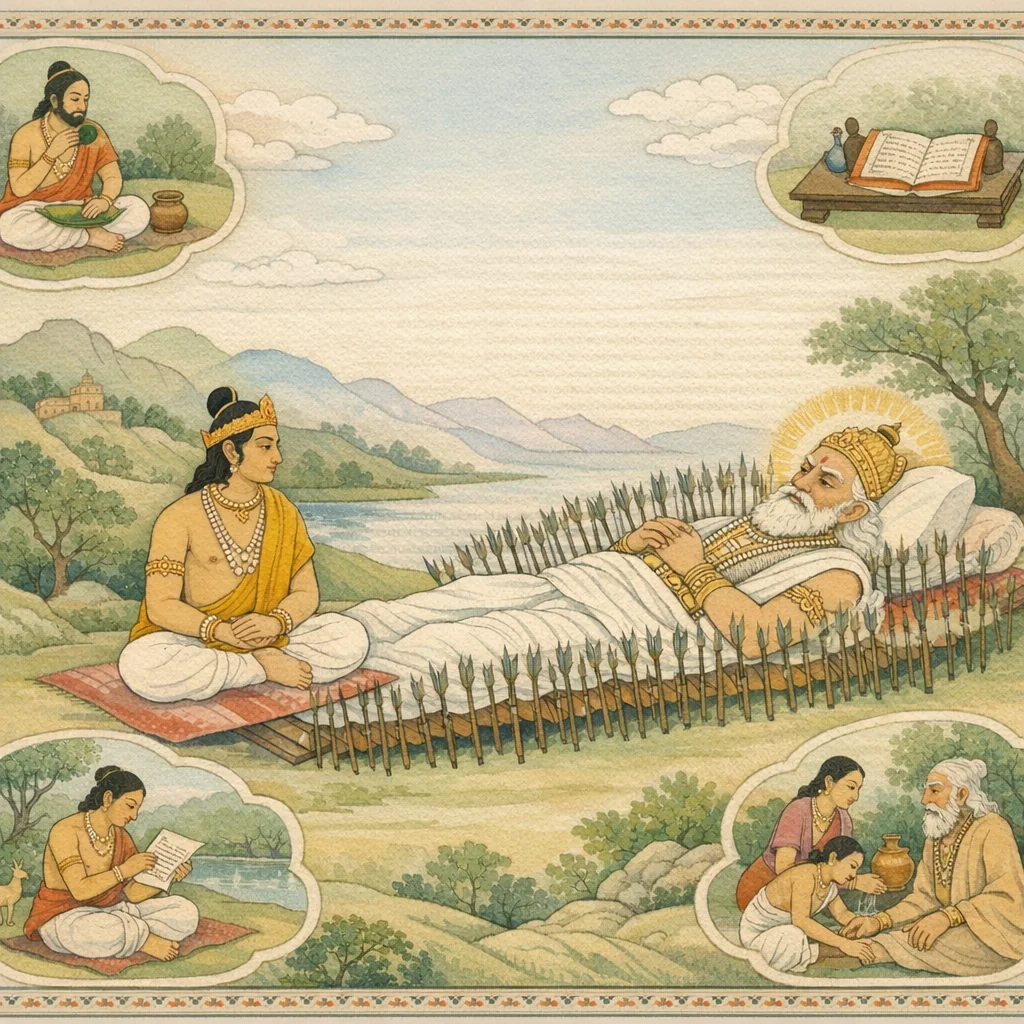
Adhyaya 148
धर्मनिन्दा–धर्मोपासनाफलम् तथा साध्वाचारलक्षणम् (Fruits of Disparaging vs. Observing Dharma; Marks of Good Conduct)
Upa-parva: Ācāra–Dharma Anuśāsana (Conduct and the Destinies of Dharmic/Anti-dharmic Persons)
Yudhiṣṭhira asks where those who disparage dharma and those who continually observe it ultimately go. Bhīṣma replies with a polarity of outcomes: dharma-haters, whose minds are overlaid by rajas and tamas, attain naraka, while those devoted to dharma—characterized by truth (satya) and straightforwardness (ārjava)—enjoy svarga and devaloka. The chapter then shifts to a behavioral taxonomy: asādhus are described as ill-conducted and harsh, whereas sādhus are identified by śīla and adherence to refined norms (śiṣṭācāra). Bhīṣma lists concrete practices: avoiding indecorous bodily acts in public spaces; feeding others before oneself; restraint in speech while eating; circumambulating sacred and socially revered loci (deity, caitya, brāhmaṇa, crossroads, cowshed); yielding way to vulnerable persons and respected groups; hospitality without making guests fast; honoring gurus with seats, salutations, and worship; respectful speech to elders; sexual restraint framed as timing and exclusivity; valuing knowledge and contentment; daily listening to elders; bodily and verbal discipline; and observances around offerings and honoring seniors. A moral psychology of wrongdoing follows: hidden sin grows; confession to sādhus pacifies it; prāyaścitta dissolves sin like salt in water. The chapter cautions against hypocritical virtue-signaling (dharmadhvaja) and urges unpretentious worship and sincere service, treating dharma as lived conduct rather than social display.
Chapter Arc: धर्मपरायण श्रोता के मन में प्रश्न उठता है—स्वयम्भू ब्रह्मा द्वारा रचित चातुर्वर्ण्य में कोई मनुष्य अपने जन्म-वर्ण से कैसे गिरता या ऊपर उठता है; कर्म का विपाक किसे किस स्थिति तक ले जाता है? → प्रश्न तीखे होते जाते हैं: वैश्य किस कर्म से शूद्रता को प्राप्त होता है, क्षत्रिय कैसे वैश्य बनता है, और द्विज कैसे प्रतिलोम अवस्था में गिरता है—और यदि वर्ण-व्यवस्था बिगड़ जाए तो धर्म का निवर्तन कैसे सम्भव है? → निर्णायक वचन आता है—दुष्कृत कर्म से द्विज अपने स्थान से भ्रंश होता है; ब्राह्मण, क्षत्रिय, वैश्य—तीनों अपने-अपने स्वधर्म से च्युत होकर वर्णसंकरता और शूद्रत्व की ओर ढल सकते हैं; वहीं शूद्र भी विधिपूर्वक कर्म, ज्येष्ठ-वर्ण-सेवा, संयमित आहार-विहार से वैश्यत्व की ओर उन्नति पा सकता है। → अध्याय आचार-संहिता में उतरता है: ऋतुकाल-गमन, नियत आहार, शेषान्न-भोजन, वृथामांस-त्याग, सत्पथ का आश्रय, गृहस्थ के लिए संहिता-अध्ययन और नित्य स्वाध्याय—परन्तु ‘अध्ययन-जीविका’ को लक्ष्य न बनाना; ब्राह्मण को ‘महान क्षेत्र’ कहकर उसके आचरण को बीज-वपन जैसा बताया जाता है, जिसका फल परलोक में पकता है।
Shlokas
Verse 1
(दाक्षिणात्य अधिक पाठके ३७६ श्लोक मिलाकर कुल ९६६ “लोक हैं) #स्निमलज (2) आज मनना त्रिचत्वारिशर्दाधिकशततमो< ध्याय: ब्राह्मणादि वर्णोकी प्राप्तिमें ४ २४३३५३ कर्मोंकी प्रधानताका उमोवाच भगवन् भगनेत्रघ्न पूष्णो दन्तनिपातन । दक्षक्रतुहर त्रयक्ष संशयो मे महानयम्,पार्वतीजीने पूछा--भगदेवताकी आँख फोड़कर पूषाके दाँत तोड़ डालनेवाले दक्षयज्ञविध्वंसी भगवान् त्रिलोचन! मेरे मनमें यह एक महान् संशय है
Umā said: “O Lord—who struck out Bhaga’s eye, who broke Pūṣan’s teeth, who destroyed Dakṣa’s sacrifice—O three-eyed One! A great doubt has arisen in my mind.”
Verse 2
चातुर्वर्ण्य भगवता पूर्व सृष्टे स्वयम्भुवा । केन कर्मविपाकेन वैश्यो गच्छति शूद्रताम्,भगवान् ब्रह्माजीने पूर्वकालमें जिन चार वर्णोंकी सृष्टि की है, उनमेंसे वैश्य किस कर्मके परिणामसे शूद्रत्वको प्राप्त हो जाता है?
Maheśvara asked: “In the ancient beginning, when the Self-born Lord created the four social orders, by what ripening of deeds does a Vaiśya come to attain the condition of a Śūdra?”
Verse 3
वैश्यो वा क्षत्रिय: केन द्विजो वा क्षत्रियो भवेत् प्रतिलोम: कथं देव शक््यो धर्मो निवर्तितुम्,अथवा क्षत्रिय किस कर्मसे वैश्य होता है और ब्राह्मण किस कर्मसे क्षत्रिय हो जाता है? देव! प्रतिलोम धर्मको कैसे निवृत्त किया जा सकता है?
Śrī Maheśvara said: “By what conduct or means does a Vaiśya become a Kṣatriya, or a twice-born become a Kṣatriya? And, O Deva, how can the practice of pratiloma—an inversion against the proper order—be checked and brought to an end?”
Verse 4
केन वा कर्मणा विप्र: शूद्रयोनौ प्रजायते । क्षत्रिय: शूद्रतामेति केन वा कर्मणा विभो,प्रभो! कौन-सा कर्म करनेसे ब्राह्मण शूद्र-योनिमें जन्म लेता है अथवा किस कर्मसे क्षत्रिय शूद्र हो जाता है?
Mahādeva asks: “By what kind of action does a brāhmaṇa come to be born in a śūdra womb? And by what action does a kṣatriya fall into the state of a śūdra? O mighty one, O lord—tell me the karmic cause behind such decline.”
Verse 5
एतन्मे संशयं देव वद भूतपतेडनघ । त्रयो वर्णा: प्रकृत्येह कथं ब्राह्माण्यमाप्रुयु:,देव! पापरहित भूतनाथ! मेरे इस संशयका समाधान कीजिये। शूद्र, वैश्य और क्षत्रिय --इन तीन वर्णोंके लोग किस प्रकार स्वभावतः ब्राह्मणत्वको प्राप्त हो सकते हैं?
Maheśvara said: “O God, O Lord of beings, O sinless one—please resolve this doubt of mine. How, in this world, can the three varṇas—Śūdra, Vaiśya, and Kṣatriya—by their own natural disposition and conduct, come to attain the state of Brahminhood?”
Verse 6
श्रीमहेश्वर उवाच ब्राह्माण्यं देवि दुष्प्रापं निसर्गाद् ब्राह्मण: शुभे । क्षत्रियो वैश्यशूद्रौ वा निसर्गादिति मे मति:,श्रीमहेश्वरने कहा--देवि! ब्राह्मणत्व दुर्लभ है। शुभे! ब्राह्मण, क्षत्रिय, वैश्य और शाद्र --ये चारों वर्ण मेरे विचारसे नैसर्गिक (प्राकृतिक या स्वभावसिद्ध) हैं, ऐसा मेरा विचार है
Śrī Maheśvara said: “O Goddess, true Brahminhood is difficult to attain. O auspicious one, in my view the Brahmin is so by nature; likewise the Kṣatriya, the Vaiśya, and the Śūdra are also, by nature—such is my considered opinion.”
Verse 7
कर्मणा दुष्कृतेनेह स्थानादू भ्रश्यति वै द्विज: । ज्येष्ठ॑ वर्णमनुप्राप्प तस्माद् रक्षेत वै द्विज:,इतना अवश्य है कि यहाँ पापकर्म करनेसे द्विज अपने स्थानसे-अपनी महत्तासे नीचे गिर जाता है। अत: द्विजको उत्तम वर्णमें जन्म पाकर अपनी मर्यादाकी रक्षा करनी चाहिये
Śrī Maheśvara said: “By committing sinful deeds in this very life, a twice-born person surely falls from his proper station and dignity. Therefore, having attained birth in the highest social order, a dvija should carefully protect his rightful conduct and boundaries.”
Verse 8
स्थितो ब्राह्मणधर्मेण ब्राह्मण्यमुपजीवति । क्षत्रियों वाथ वैश्यो वा ब्रह्म॒भूयं स गच्छति,यदि क्षत्रिय अथवा वैश्य ब्राह्मण-धर्मका पालन करते हुए ब्राह्मणत्वका सहारा लेता है तो वह ब्रह्मभावको प्राप्त हो जाता है
Mahādeva said: “Established in the dharma of a brāhmaṇa and living by the brāhmaṇa way of life, even if one is a kṣatriya or a vaiśya, one attains the state of Brahman.”
Verse 9
यस्तु विप्रत्वमुत्सृज्य क्षात्रं धर्म निषेवते । ब्राह्मण्यात् स परिभ्रष्ट: क्षत्रयोनौ प्रजायते,जो ब्राह्मण ब्राह्मणत्वका त्याग करके क्षत्रिय-धर्मका सेवन करता है, वह अपने धर्मसे भ्रष्ट होकर क्षत्रिय योनिमें जन्म लेता है
Maheshvara said: “But if a man abandons the state and duties of a brāhmaṇa and instead practices the dharma of the kṣatriya, he falls away from brāhmaṇa-hood; having deviated from his proper discipline, he is born in a kṣatriya lineage.”
Verse 10
वैश्यकर्म च यो विप्रो लोभमोहव्यपाश्रय: । ब्राह्माण्यं दुर्लभं प्राप्प करोत्यल्पमति: सदा,जो विप्र दुर्लभ ब्राह्मणत्वको पाकर लोभ और मोहके वशीभूत हो अपनी मन्दबुद्धिताके कारण वैश्यका कर्म करता है, वह वैश्ययोनिमें जन्म लेता है। अथवा यदि वैश्य शूद्रके कर्मको अपनाता है, तो वह भी शाूद्रत्वको प्राप्त होता है। शूद्रोचित कर्म करके अपने धर्मसे भ्रष्ट हुआ ब्राह्मण शूद्रत्वको प्राप्त हो जाता है
Mahādeva said: “A brāhmaṇa who, having attained the rare state of brāhmaṇahood, becomes dependent on greed and delusion and—through constant small-mindedness—takes up the work proper to a vaiśya, falls into a vaiśya birth. Likewise, if a vaiśya adopts the conduct and work of a śūdra, he attains śūdra-status. A brāhmaṇa who performs śūdra-like acts and thus deviates from his own dharma comes to śūdra-status.”
Verse 11
स द्विजो वैश्यतामेति वैश्यो वा शूद्रतामियात् । स्वधर्मात् प्रच्युतो विप्रस्तत: शूद्रत्वमाप्तुते,जो विप्र दुर्लभ ब्राह्मणत्वको पाकर लोभ और मोहके वशीभूत हो अपनी मन्दबुद्धिताके कारण वैश्यका कर्म करता है, वह वैश्ययोनिमें जन्म लेता है। अथवा यदि वैश्य शूद्रके कर्मको अपनाता है, तो वह भी शाूद्रत्वको प्राप्त होता है। शूद्रोचित कर्म करके अपने धर्मसे भ्रष्ट हुआ ब्राह्मण शूद्रत्वको प्राप्त हो जाता है
Mahādeva said: A twice-born man who abandons his own ordained duty and takes up the work proper to a vaiśya falls into the state of a vaiśya. Likewise, a vaiśya who adopts the conduct and occupations of a śūdra falls into śūdra-hood. In the same way, a brāhmaṇa who has slipped from his own dharma by performing śūdra-like work comes to attain śūdra status. The ethical point is that one’s inner discipline and social responsibility are meant to align; when greed, delusion, or negligence drives a person to forsake svadharma, it is treated as moral and spiritual decline with consequences extending even to future birth.
Verse 12
तत्रासौ निरयं प्राप्तो वर्णभ्रष्टो बहिष्कृत: | ब्रह्मलोकात् परिश्रष्ट: शूद्र: समुपजायते,ब्राह्मण-जातिका पुरुष शूद्र-कर्म करनेके कारण अपने वर्णसे भ्रष्ट होकर जातिसे बहिष्कृत हो जाता है और मृत्युके पश्चात् वह ब्रह्मलोककी प्राप्तिसे वंचित होकर नरकमें पड़ता है। इसके बाद वह शूद्रकी योनिमें जन्म ग्रहण करता है
There, having fallen into hell, he becomes one who has slipped from his ordained social order and is cast out. Deprived of access to Brahmaloka, he is thereafter born again as a Śūdra. The verse frames this as the ethical consequence of abandoning one’s prescribed duties and conduct, presenting moral causality (karma and rebirth) as the regulator of social and spiritual standing.
Verse 13
क्षत्रियो वा महाभागे वैश्यो वा धर्मचारिणि । स्वानि कर्माण्यपाहाय शूद्रकर्म निषेवते,महाभागे! धर्मचारिणि! क्षत्रिय अथवा वैश्य भी अपने-अपने कर्मोको छोड़कर यदि शूद्रका काम करने लगता है तो वह अपनी जातिसे भ्रष्ट होकर वर्णसंकर हो जाता है और दूसरे जन्ममें शूद्रकी योनिमें जन्म पाता है। ऐसा व्यक्ति ब्राह्मण, क्षत्रिय एवं वैश्य कोई भी क्यों न हो, वह शूद्रभावको प्राप्त होता है
Maheshvara said: “O noble lady, O follower of dharma—whether one is a Kshatriya or a Vaishya, if he abandons his own prescribed duties and takes up the work proper to a Shudra, he falls away from his social order and becomes a cause of varṇa-mixture; and in a later birth he is born in a Shudra womb. Whoever he may be—Brahmin, Kshatriya, or Vaishya—by such conduct he comes to the condition and disposition of a Shudra.”
Verse 14
स्वस्थानात् स परिग्रष्टो वर्णसंकरतां गतः । ब्राह्मण: क्षत्रियो वैश्य: शूद्रत्वं याति तादृश:,महाभागे! धर्मचारिणि! क्षत्रिय अथवा वैश्य भी अपने-अपने कर्मोको छोड़कर यदि शूद्रका काम करने लगता है तो वह अपनी जातिसे भ्रष्ट होकर वर्णसंकर हो जाता है और दूसरे जन्ममें शूद्रकी योनिमें जन्म पाता है। ऐसा व्यक्ति ब्राह्मण, क्षत्रिय एवं वैश्य कोई भी क्यों न हो, वह शूद्रभावको प्राप्त होता है
Cast down from his proper station, he falls into the condition of varṇa-mixture. A brāhmaṇa, a kshatriya, or a vaiśya—whoever is of such conduct comes to śūdra status.
Verse 15
यस्तु बुद्ध: स्वधर्मेण ज्ञानविज्ञानवान् शुचि: । धर्मज्ञो धर्मनिरत: स धर्मफलमश्चुते,जो पुरुष अपने वर्णधर्मका पालन करते हुए बोध प्राप्त करता है और ज्ञान-विज्ञानसे सम्पन्न, पवित्र तथा धर्मज्ञ होकर धर्ममें ही लगा रहता है, वही धर्मके वास्तविक फलका उपभोग करता है
Maheshvara said: The man who, while faithfully observing his own prescribed duty, attains true awakening—endowed with knowledge and realized discernment, purified in conduct, understanding what dharma is, and steadfastly devoted to it—he alone truly partakes of the genuine fruit of dharma.
Verse 16
इदं चैवापरं देवि ब्रह्मणा समुदाह्नतम् । अध्यात्मं नैछ्िकं सद्धिर्धर्मकामैनिषिव्यते,देवि! ब्रह्माजीनी यह एक बात और बतायी है--धर्मकी इच्छा रखनेवाले सत्पुरुषोंको आजीवन अध्यात्म-तत्त्वका ही सेवन करना चाहिये
And, O Goddess, Brahmā has also declared this further point: those good and disciplined persons who truly desire dharma should devote themselves, throughout life, to steadfast inner spiritual practice (adhyātma). The teaching places ethical living on a foundation of sustained self-cultivation rather than mere outward observance.
Verse 17
उग्रान्नं गर्हितं देवि गणान्न॑ श्राद्धसूतकम् । दुष्टान्न नैव भोक्तव्यं शूद्रान्नं नैव कर्हिचित्,देवि! उग्रस्वभावके मनुष्यका अन्न निन्दित माना गया है। किसी समुदायका, श्राद्धका, जननाशौचका, दुष्ट पुरुषका और शूद्रका अन्न भी निषिद्ध है--उसे कभी नहीं खाना चाहिये
Mahādeśvara said: “O Goddess, food obtained from a person of fierce and harmful disposition is censured. Likewise, one should not eat food connected with a (certain) group’s impurity, with śrāddha rites, with birth-impurity, or food belonging to a wicked person; and one should never at any time eat food from a Śūdra.” The instruction is framed as a rule of purity and ethical caution: what one consumes is treated as morally and ritually consequential, and therefore to be accepted only from sources deemed pure and trustworthy within the text’s dharma-code.
Verse 18
शूद्रान्न गहितं देवि सदा देवैर्महात्मभि: । पितामहमुखोत्सृष्ट प्रमाणमिति मे मति:,देवताओं और महात्मा पुरुषोंने शूद्रके अन्नकी सदा ही निन््दा की है। इस विषयमें पितामह ब्रह्माजीके श्रीमुखका वचन प्रमाण है, ऐसा मेरा विश्वास है
Maheshvara said: “O Goddess, the food associated with a Śūdra has always been censured by the gods and by great-souled sages. In this matter, I hold the utterance that issued from the mouth of Pitāmaha Brahmā to be authoritative proof.”
Verse 19
शूद्रान्नेनावशेषेण जठरे यो म्रियेद् द्विज: । आहिताग्निस्तथा यज्वा स शूद्रगतिभाग् भवेत्,जो ब्राह्मण पेटमें शूद्रका अन्न लिये मर जाता है, वह अग्निहोत्री अथवा यज्ञ करनेवाला ही क्यों न रहा हो, उसे शूद्रकी योनिमें जन्म लेना पड़ता है
Mahādeva said: “If a twice-born man dies with the remainder of Śūdra-provided food still in his stomach, then—even if he has maintained the sacred fires and performed sacrifices—he becomes a sharer in the Śūdra’s destiny, i.e., he must attain a Śūdra state of rebirth.”
Verse 20
तेन शूद्रान्नशेषेण ब्रह्म॒स्थानादपाकृत: । ब्राह्मण: शूद्रतामेति नास्ति तत्र विचारणा,उदरमें शूद्रात्नरक शेषभाग स्थित होनेके कारण ब्राह्मण ब्रह्मलोकसे वंचित हो शूद्रभावको प्राप्त होता है; इसमें कोई अन्यथा विचार करनेकी आवश्यकता नहीं है
Therefore, by subsisting on the leftover food of a Śūdra, a Brāhmaṇa is cast away from the Brahmanic state and loses access to the Brahma-world; he falls into the condition of a Śūdra. On this point, no alternative interpretation is to be entertained.
Verse 21
यस्यान्नेनावशेषेण जठरटरे यो म्रियेद् द्विज: । तांतांयोनिं व्रजेद् विप्रो यस्यान्नमुपजीवति,उदरमें जिसके अन्नका अवशेष लेकर जो ब्राह्मण मृत्युको प्राप्त होता है, वह उसीकी योनिमें जाता है। जिसके अन्नसे जीवन-निर्वाह करता है, उसीकी योनिमें जन्म ग्रहण करता है
Maheshvara declares that if a brahmin dies with another person’s leftover food remaining in his stomach, he is reborn in the very yoni—the womb-species—associated with the one whose food he consumed. Thus, living by another’s sustenance, especially by remnants, forges a binding dependence that shapes one’s next birth, revealing the ethical gravity of food, patronage, and purity of livelihood.
Verse 22
ब्राह्मणत्वं शुभ॑ प्राप्य दुर्लभ॑ यो&वमन्यते । अभोज्यान्नानि चाश्राति स द्विजत्वात् पतेत वै,जो शुभ एवं दुर्लभ ब्राह्मणत्वको पाकर उसकी अवहेलना करता है और नहीं खानेयोग्य अन्न खाता है, वह निश्चय ही ब्राह्मणत्वसे गिर जाता है
O auspicious one, whoever attains the rare state of true Brahminhood yet treats it with contempt, and consumes food that ought not to be eaten, surely falls away from the status of a twice-born (dvija). The teaching stresses that spiritual rank is preserved not by birth alone but by reverence for one’s dharma and disciplined purity in conduct, especially in matters of food and restraint.
Verse 23
सुरापो ब्रह्दाहा क्षुद्रचोरो भग्नव्रतो 5शुचि: । स्वाध्यायवर्जित: पापो लुब्धो नैकृतिक: शठ:,शराबी, ब्रह्महत्यारा, नीच, चोर, व्रतभंग करनेवाला, अपवित्र, स्वाध्यायहीन, पापी, लोभी, कपटी, शठ, व्रतका पालन न करनेवाला, शूद्रजातिकी स्त्रीका स्वामी, कुण्डाशी (पतिके जीते-जी उत्पन्न किये हुए जारज पुत्रके घरमें खानेवाला अथवा पाकपात्रमें ही भोजन करनेवाला), सोमरस बेचनेवाला और नीचसेवी ब्राह्मण ब्राह्मणकी योनिसे भ्रष्ट हो जाता है
Śrī Maheśvara said: “A drinker of intoxicants, a slayer of a brāhmaṇa, a petty thief, one who has broken his vows, and one who is impure; one who has abandoned Vedic study (svādhyāya), who is sinful, greedy, deceitful, and treacherous—such a brāhmaṇa falls away from the sanctity of brāhmaṇa birth.”
Verse 24
अव्रती वृषलीभर्ता कुण्डाशी सोमविक्रयी । निहीनसेवी विप्रो हि पतति ब्रह्मययोनित:,शराबी, ब्रह्महत्यारा, नीच, चोर, व्रतभंग करनेवाला, अपवित्र, स्वाध्यायहीन, पापी, लोभी, कपटी, शठ, व्रतका पालन न करनेवाला, शूद्रजातिकी स्त्रीका स्वामी, कुण्डाशी (पतिके जीते-जी उत्पन्न किये हुए जारज पुत्रके घरमें खानेवाला अथवा पाकपात्रमें ही भोजन करनेवाला), सोमरस बेचनेवाला और नीचसेवी ब्राह्मण ब्राह्मणकी योनिसे भ्रष्ट हो जाता है
Śrī Maheśvara said: “A brāhmaṇa who is without vows and discipline, who keeps a Śūdra woman as his wife, who eats in a ‘kuṇḍāśī’ manner (a censured/impure way), who sells soma, and who serves the base and ignoble—such a man falls away from the very status of being born in the brāhmaṇa yoni.”
Verse 25
गुरुतल्पी गुरुद्रोही गुरुकुत्सारतिश्न यः । ब्रह्म॒विच्चापि पतति ब्राह्मणो ब्रह्मयोनित:,जो गुरुकी शैय्यापर सोनेवाला, गुरुद्रोही और गुरुनिन्दामें अनुरक्त है, वह ब्राह्मण वेदवेत्ता होनेपर भी ब्रह्मयोनिसे नीचे गिर जाता है
Maheshvara said: Even a Brahmin who knows Brahman falls from his Brahmin birth if he violates his teacher’s bed (gurutaḷpī), betrays his teacher, or is devoted to reviling his teacher. The verse warns that learning and spiritual knowledge do not protect one who commits grave offenses against the guru; ethical conduct toward the teacher is treated as foundational to dharma.
Verse 26
एभिस्तु कर्मभिददेवि शुभैराचरितैस्तथा । शूद्रो ब्राह्मणतां याति वैश्य: क्षत्रियतां व्रजेत्
Mahādeva said: “O Goddess, by such deeds—auspicious actions duly performed—a Śūdra may attain the state of a Brāhmaṇa, and a Vaiśya may rise to the status of a Kṣatriya.”
Verse 27
देवि! इन्हीं शुभ कर्मों और आचरणोंसे शूद्र ब्राह्मणत्वको प्राप्त होता है और वैश्य क्षत्रियत्वको ।। शूद्रकर्माणि सर्वाणि यथान्यायं यथाविधि । शुश्रूषां परिचर्या च ज्येछ्ठे वर्णे प्रयत्नत:
Maheshvara said: “Goddess, by these auspicious deeds and disciplined modes of conduct, a Śūdra may attain the status of a Brāhmaṇa, and a Vaiśya may attain the status of a Kṣatriya. Let all the duties of a Śūdra be performed in accordance with justice and in the prescribed manner—especially attentive service and devoted attendance upon the senior (higher) varṇa, undertaken with earnest effort.”
Verse 28
कुर्यादविमना: शूद्र: सततं सत्पथे स्थित: । देवद्विजातिसत्कर्ता सर्वातिथ्यकृतब्रत:
Maheshvara said: “Let a Shudra act without resentment, remaining constantly established on the path of the good—one who honors the gods and the twice-born, and who has taken up the vow of welcoming and serving every guest.”
Verse 29
ऋतुकालाभिगामी च नियतो नियताशन: । चोक्षश्नोक्षजनान्वेषी शेषान्नकृतभोजन:
Śrī Maheśvara said: “He should approach his wife only in the proper season, remain disciplined, and eat in a regulated manner. He should avoid indulgence in sensual pleasures, not go seeking women, and take his meal only after ensuring that the remaining food (after due offerings and others’ portions) is what he consumes.”
Verse 30
वृथामांसं न भुञ्जीत शूद्रो वैश्यत्वमृच्छति । शूद्र अपने सभी कर्मोको न्यायानुसार विधिपूर्वक सम्पन्न करे। अपनेसे ज्येष्ठ वर्णकी सेवा और परिचर्यामें प्रयत्नपूर्वक लगा रहे। अपने कर्तव्यपालनसे कभी ऊबे नहीं। सदा सन्मार्गपर स्थित रहे। देवताओं और द्विजोंका सत्कार करे। सबके आतिथ्यका व्रत लिये रहे। ऋतुकालमें ही स्त्रीके साथ समागम करे। नियमपूर्वक रहकर नियमित भोजन करे। स्वयं शुद्ध रहकर शुद्ध पुरुषोंका ही अन्वेषण करे। अतिथि-सत्कार और कुट॒म्बीजनोंके भोजनसे बचे हुए अन्नका ही आहार करे और मांस न खाय। इस नियमसे रहनेवाला शूद्र (मृत्युके पश्चात् पुण्यकर्मोंका फल भोगकर) वैश्ययोनिमें जन्म लेता है ।। ऋतवागनहंवादी निर्दन्न्दधः शमकोविद:,वैश्य सत्यवादी, अहंकारशून्य, निर्द्धन्द्, शान्तिके साधनोंका ज्ञाता, स्वाध्यायपरायण और पवित्र होकर नित्य यज्ञोंद्वारा यजन करे। जितेन्द्रिय होकर ब्राह्म॒णोंका सत्कार करते हुए समस्त वर्णोकी उन्नति चाहे। गृहस्थके व्रतका पालन करते हुए प्रतिदिन दो ही समय भोजन करे। यज्ञशेष अन्नका ही आहार करे। आहारपर काबू रखे। सम्पूर्ण कामनाओंको त्याग दे। अहंकारशून्य होकर विधिपूर्वक आहुति देते हुए अग्निहोत्र कर्मका सम्पादन करे। सबका आतिथ्य-सत्कार करके अवशिष्ट अन्नका स्वयं भोजन करे। त्रिविध अग्नियोंकी मन्त्रोच्चारणपूर्वक परिचर्या करे। ऐसा करनेवाला वैश्य द्विज होता है। वह वैश्य पवित्र एवं महान क्षत्रियकुलमें जन्म लेता है
Mahādeva declares that a Śūdra should not eat meat obtained without proper cause or purpose; by living with disciplined conduct and restraint, he attains the status of a Vaiśya. The teaching frames social uplift not as a matter of birth alone but as the ethical fruit of regulated livelihood, purity, service, hospitality, and self-control.
Verse 31
यजते नित्ययज्ञैश्व स्वाध्यायपरम: शुचि: । दान्तो ब्राह्मणसत्कर्ता सर्ववर्णबुभूषक:,वैश्य सत्यवादी, अहंकारशून्य, निर्द्धन्द्, शान्तिके साधनोंका ज्ञाता, स्वाध्यायपरायण और पवित्र होकर नित्य यज्ञोंद्वारा यजन करे। जितेन्द्रिय होकर ब्राह्म॒णोंका सत्कार करते हुए समस्त वर्णोकी उन्नति चाहे। गृहस्थके व्रतका पालन करते हुए प्रतिदिन दो ही समय भोजन करे। यज्ञशेष अन्नका ही आहार करे। आहारपर काबू रखे। सम्पूर्ण कामनाओंको त्याग दे। अहंकारशून्य होकर विधिपूर्वक आहुति देते हुए अग्निहोत्र कर्मका सम्पादन करे। सबका आतिथ्य-सत्कार करके अवशिष्ट अन्नका स्वयं भोजन करे। त्रिविध अग्नियोंकी मन्त्रोच्चारणपूर्वक परिचर्या करे। ऐसा करनेवाला वैश्य द्विज होता है। वह वैश्य पवित्र एवं महान क्षत्रियकुलमें जन्म लेता है
Śrī Maheśvara said: “Let the Vaiśya, being pure and devoted to svādhyāya (sacred study), worship continually through the regular daily sacrifices. Self-controlled, he should honor and serve the Brāhmaṇas, and he should desire the welfare and uplift of all the varṇas. By such disciplined household dharma—rooted in study, restraint, and sacrificial duty—he becomes worthy of the status of a ‘twice-born’ (dvija) and attains purity and elevated birth.”
Verse 32
गृहस्थव्रतमातिष्ठन् द्वेिकालकृतभोजन: । शेषाशी विजिताहारो निष्कामो निरहंवद:,वैश्य सत्यवादी, अहंकारशून्य, निर्द्धन्द्, शान्तिके साधनोंका ज्ञाता, स्वाध्यायपरायण और पवित्र होकर नित्य यज्ञोंद्वारा यजन करे। जितेन्द्रिय होकर ब्राह्म॒णोंका सत्कार करते हुए समस्त वर्णोकी उन्नति चाहे। गृहस्थके व्रतका पालन करते हुए प्रतिदिन दो ही समय भोजन करे। यज्ञशेष अन्नका ही आहार करे। आहारपर काबू रखे। सम्पूर्ण कामनाओंको त्याग दे। अहंकारशून्य होकर विधिपूर्वक आहुति देते हुए अग्निहोत्र कर्मका सम्पादन करे। सबका आतिथ्य-सत्कार करके अवशिष्ट अन्नका स्वयं भोजन करे। त्रिविध अग्नियोंकी मन्त्रोच्चारणपूर्वक परिचर्या करे। ऐसा करनेवाला वैश्य द्विज होता है। वह वैश्य पवित्र एवं महान क्षत्रियकुलमें जन्म लेता है
Mahādeva said: “Abiding by the householder’s vow, let him take food only twice a day. Let him eat only what remains after offerings, keep his appetite under control, be free from desire, and speak without ego. Thus disciplined, he should perform the household sacrifices in due form, honor guests and especially the learned, tend the sacred fires with mantra-recitation, and seek the welfare and uplift of all the varṇas. One who lives in this way becomes purified and attains higher standing and auspicious birth.”
Verse 33
अन्निहोत्रमुपासं श्व जुद्दानश्व॒ यथाविधि । सर्वातिथ्यमुपातिष्ठन् शेषान्नकृतभोजन:,वैश्य सत्यवादी, अहंकारशून्य, निर्द्धन्द्, शान्तिके साधनोंका ज्ञाता, स्वाध्यायपरायण और पवित्र होकर नित्य यज्ञोंद्वारा यजन करे। जितेन्द्रिय होकर ब्राह्म॒णोंका सत्कार करते हुए समस्त वर्णोकी उन्नति चाहे। गृहस्थके व्रतका पालन करते हुए प्रतिदिन दो ही समय भोजन करे। यज्ञशेष अन्नका ही आहार करे। आहारपर काबू रखे। सम्पूर्ण कामनाओंको त्याग दे। अहंकारशून्य होकर विधिपूर्वक आहुति देते हुए अग्निहोत्र कर्मका सम्पादन करे। सबका आतिथ्य-सत्कार करके अवशिष्ट अन्नका स्वयं भोजन करे। त्रिविध अग्नियोंकी मन्त्रोच्चारणपूर्वक परिचर्या करे। ऐसा करनेवाला वैश्य द्विज होता है। वह वैश्य पवित्र एवं महान क्षत्रियकुलमें जन्म लेता है
Mahādeva said: “Let him regularly maintain the Agnihotra and, according to rule, offer oblations into the sacred fire. Honouring every guest with due hospitality, he should eat only after others have been served, taking as his own food the remainder left from the offerings. Thus disciplined in household duty—restrained, humble, and faithful to prescribed rites—he upholds dharma through sacrifice, self-control, and service.”
Verse 34
त्रेताग्निमन्त्रविहितो वैश्यो भवति वै द्विज: । स वैश्य: क्षत्रियकुले शुचौ महति जायते,वैश्य सत्यवादी, अहंकारशून्य, निर्द्धन्द्, शान्तिके साधनोंका ज्ञाता, स्वाध्यायपरायण और पवित्र होकर नित्य यज्ञोंद्वारा यजन करे। जितेन्द्रिय होकर ब्राह्म॒णोंका सत्कार करते हुए समस्त वर्णोकी उन्नति चाहे। गृहस्थके व्रतका पालन करते हुए प्रतिदिन दो ही समय भोजन करे। यज्ञशेष अन्नका ही आहार करे। आहारपर काबू रखे। सम्पूर्ण कामनाओंको त्याग दे। अहंकारशून्य होकर विधिपूर्वक आहुति देते हुए अग्निहोत्र कर्मका सम्पादन करे। सबका आतिथ्य-सत्कार करके अवशिष्ट अन्नका स्वयं भोजन करे। त्रिविध अग्नियोंकी मन्त्रोच्चारणपूर्वक परिचर्या करे। ऐसा करनेवाला वैश्य द्विज होता है। वह वैश्य पवित्र एवं महान क्षत्रियकुलमें जन्म लेता है
Maheshvara said: “A Vaiśya who is duly consecrated by the mantras for tending the three sacred fires becomes a ‘twice-born’ (dvija). Such a Vaiśya is then born in a pure and eminent Kṣatriya lineage.”
Verse 35
स वैश्य: क्षत्रियो जातो जन्मप्रभृति संस्कृत: । उपनीतो व्रतपरो द्विजो भवति सत्कृतः,क्षत्रियकुलमें उत्पन्न हुआ वह वैश्य जन्मसे ही क्षत्रियोचित संस्कारसे सम्पन्न हो उपनयनके पश्चात् ब्रह्मचर्यव्रतके पालनमें तत्पर हो सर्वसम्मानित द्विज होता है। वह दान देता है, पर्याप्त दक्षिणावाले समृद्धिशाली यज्ञोंद्वारा भगवानका यजन करता है, वेदोंका अध्ययन करके स्वर्गकी इच्छा रखकर सदा त्रिविध अग्नियोंकी शरण ले उनकी आराधना करता है, दुःखी एवं पीड़ित मनुष्योंको हाथका सहारा देता है, प्रतिदिन प्रजाका धर्मपूर्वक पालन करता है, स्वयं सत्यपरायण होकर सत्यपूर्ण व्यवहार करता है तथा दर्शनसे ही सबके लिये सुखद होता है, वही श्रेष्ठ क्षत्रिय अथवा राजा है
Mahādeva said: “A man who is by birth a Vaiśya, yet is born into the status of a Kṣatriya and is refined from the very beginning by Kṣatriya-appropriate saṃskāras (formative rites and discipline)—once he has undergone upanayana and becomes devoted to the observance of vows (especially brahmacarya)—becomes a respected ‘twice-born’ (dvija).”
Verse 36
ददाति यजते यज्जैः समृद्धैराप्तदक्षिणै: । अधीत्य स्वर्गमन्विच्छंस्त्रेताग्निशरण: सदा,क्षत्रियकुलमें उत्पन्न हुआ वह वैश्य जन्मसे ही क्षत्रियोचित संस्कारसे सम्पन्न हो उपनयनके पश्चात् ब्रह्मचर्यव्रतके पालनमें तत्पर हो सर्वसम्मानित द्विज होता है। वह दान देता है, पर्याप्त दक्षिणावाले समृद्धिशाली यज्ञोंद्वारा भगवानका यजन करता है, वेदोंका अध्ययन करके स्वर्गकी इच्छा रखकर सदा त्रिविध अग्नियोंकी शरण ले उनकी आराधना करता है, दुःखी एवं पीड़ित मनुष्योंको हाथका सहारा देता है, प्रतिदिन प्रजाका धर्मपूर्वक पालन करता है, स्वयं सत्यपरायण होकर सत्यपूर्ण व्यवहार करता है तथा दर्शनसे ही सबके लिये सुखद होता है, वही श्रेष्ठ क्षत्रिय अथवा राजा है
Maheshvara said: He gives in charity; he worships through prosperous sacrifices, furnished with due and fitting dakshina (priestly fees). Having studied the Vedas and desiring heaven, he constantly takes refuge in the three sacred fires and maintains their worship. Such conduct is declared the mark of a truly excellent kshatriya/king—one whose rule and self-discipline are grounded in Vedic learning, generosity, and steady ritual responsibility.
Verse 37
आर्तहस्तप्रदो नित्यं प्रजा धर्मेण पालयन् । सत्य: सत्यानि कुरुते नित्यं यः सुखदर्शन:,क्षत्रियकुलमें उत्पन्न हुआ वह वैश्य जन्मसे ही क्षत्रियोचित संस्कारसे सम्पन्न हो उपनयनके पश्चात् ब्रह्मचर्यव्रतके पालनमें तत्पर हो सर्वसम्मानित द्विज होता है। वह दान देता है, पर्याप्त दक्षिणावाले समृद्धिशाली यज्ञोंद्वारा भगवानका यजन करता है, वेदोंका अध्ययन करके स्वर्गकी इच्छा रखकर सदा त्रिविध अग्नियोंकी शरण ले उनकी आराधना करता है, दुःखी एवं पीड़ित मनुष्योंको हाथका सहारा देता है, प्रतिदिन प्रजाका धर्मपूर्वक पालन करता है, स्वयं सत्यपरायण होकर सत्यपूर्ण व्यवहार करता है तथा दर्शनसे ही सबके लिये सुखद होता है, वही श्रेष्ठ क्षत्रिय अथवा राजा है
He is ever ready to extend a helping hand to the distressed; he protects his subjects in accordance with dharma; steadfast in truth, he continually speaks and acts truthfully; and by his very presence he becomes a source of comfort to all who behold him. Such conduct marks the ideal kshatriya—fit to be a ruler.
Verse 38
धर्मदण्डो न निर्दण्डो धर्मकार्यानुशासक: । यन्त्रित: कार्यकरणै: षड़भागकृतलक्षण:,धर्मानुसार अपराधीको दण्ड दे। दण्डका त्याग न करे। प्रजाको धर्मकार्यका उपदेश दे। राजकार्य करनेके लिये नियम और विधानसे बँधा रहे। प्रजासे उसकी आयका छठा भाग करके रूपमें ग्रहण करे
Mahadeva said: “Let the king’s punishment be a rod of dharma, not the absence of punishment. Let him instruct and regulate the people in the performance of righteous duties. Bound by rules and procedures in carrying out royal business, let him bear the recognized mark of taking a sixth share (of produce/revenue) from the subjects.”
Verse 39
ग्राम्यधर्म न सेवेत स्वच्छन्देनार्थकोविद: । ऋतुकाले तु धर्मात्मा पत्नीमुपशयेत् सदा,कार्यकुशल धर्मात्मा क्षत्रिय स्वच्छन्दतापूर्वक ग्राम्य धर्म (मैथुन) का सेवन न करे। केवल ऋतुकालमें ही सदा पत्नीके निकट शयन करे
Maheshvara said: “A man skilled in discerning true benefit should not indulge, of his own whim, in ‘worldly’ sexual conduct. Rather, being devoted to dharma, he should approach and lie with his wife only in her proper season (fertile period), consistently observing this restraint.”
Verse 40
सदोपवासी नियत: स्वाध्यायनिरत: शुचि: । बहिष्कान्तरिते नित्यं शयानो5ग्निगृहे सदा,सदा उपवास करे अर्थात् एकादशी आदिके दिन उपवास करे और दूसरे दिन भी सदा दो ही समय भोजन करे। बीचमें कुछ न खाय। नियमपूर्वक रहे, वेद-शास्त्रोंके स्वाध्यायमें तत्पर रहे, पवित्र हो प्रतिदिन अग्निशालामें कुशकी चटाईपर शयन करे
Maheshvara said: “Let him regularly observe fasts, be disciplined, devoted to svadhyaya (sacred self-study), and pure. Let him ever lie down in a secluded place, and always sleep in the fire-sanctuary (agni-griha).” The verse commends a life of restraint, cleanliness, and Vedic self-cultivation, presenting ascetic routine as a foundation for steadiness of mind and dharmic conduct.
Verse 41
सर्वातिथ्यं त्रिवर्गस्य कुर्वाण: सुमना: सदा । शूद्राणां चान्नकामानां नित्यं सिद्धमिति ब्रुवन्,क्षत्रिय सदा प्रसन्नतापूर्वक सबका आतिथ्य-सत्कार करते हुए धर्म, अर्थ और कामका सेवन करें। शूद्र भी यदि अन्नकी इच्छा रखकर उसके लिये प्रार्थना करे तो क्षत्रिय उनके लिये सदा यही उत्तर दे कि तुम्हारे लिये भोजन तैयार है, चलो कर लो
Mahādeva said: “Let a kṣatriya, ever cheerful in mind, continually practice universal hospitality, and while doing so pursue the three aims of life—dharma, artha, and kāma—in proper measure. And when śūdras who desire food come and ask for it, he should always reply, ‘It is ready (prepared) for you’—inviting them to eat without delay.”
Verse 42
अर्थाद् वा यदि वा कामान्न किंचिदुपलक्षयेत् पितृदेवातिथिकृते साधनं कुरुते च यः,वह स्वार्थ या कामनावश किसी वस्तुका प्रदर्शन न करे। जो पितरों, देवताओं तथा अतिथियोंकी सेवाके लिये चेष्टा करता है, वही श्रेष्ठ क्षत्रिय है
Mahādeva said: Whether for gain or out of desire, one should not make a display of anything. He who strives to provide the proper means for serving the Pitṛs, the gods, and guests—such a man is the truly excellent kṣatriya.
Verse 43
स्ववेश्मनि यथान्यायमुपास्ते भैक्ष्यमेव च । त्रिकालमन्निहोत्रं च जुह्दानो वै यथाविधि,क्षत्रिय अपने ही घरमें न््यायपूर्वक भिक्षा (भोजन) करे। तीनों समय विधिवत् अग्निहोत्र करता रहे
In his own household, he should accept alms-food only in a manner consistent with justice and propriety. And, at the three appointed times each day, he should duly maintain the Agnihotra, offering into the sacred fire according to the prescribed rite.
Verse 44
गोब्राह्मणहितार्थाय रणे चाभिमुखो हत: । त्रेताग्निमन्त्रपूतात्मा समाविश्य द्विजो भवेत्,वह धर्ममें स्थित हो त्रिविध अग्नियोंकी मन्त्रपूर्वक परिचरयसि पवित्रचित्त हो यदि गौओं तथा ब्राह्मणोंके हितके लिये समरमें शत्रुका सामना करते हुए मारा जाय तो दूसरे जन्ममें ब्राह्मण होता है
If a man, with a mind purified by the mantra-guided tending of the three sacred fires, is slain in battle while facing the enemy for the welfare of cows and Brahmins, then, entering into that merit, he is born again as a twice-born (a Brahmin).
Verse 45
ज्ञानविज्ञानसम्पन्न: संस्कृतो वेदपारग: । विप्रो भवति धर्मात्मा क्षत्रिय: स्वेन कर्मणा,इस प्रकार धर्मात्मा क्षत्रिय अपने कर्मसे जन्मान्तरमें ज्ञानविज्ञानसम्पन्न, संस्कारयुक्त तथा वेदोंका पारंगत विद्वान ब्राह्मण होता है
Śrī Maheśvara said: By his own righteous conduct, a dharma-souled kṣatriya becomes—in a later birth—a brāhmaṇa: endowed with knowledge and realized understanding, refined by proper saṃskāra-s, and fully versed in the Vedas.
Verse 46
एतै: कर्मफलैदेवि न्यूनजातिकुलोद्धव: । शूद्रो5प्यागमसम्पन्नो द्विजो भवति संस्कृत:,देवि! इन कर्मफलोंके प्रभावसे नीच जाति एवं हीन कुलमें उत्पन्न हुआ शूद्र भी जन्मान्तरमें शास्त्रज्ञान-सम्पन्न और संस्कारयुक्त ब्राह्मण होता है
Maheshvara said: “O Goddess, by the force of these fruits of action, even a Śūdra—though born in a low rank and humble family—may, in another birth, become a ‘twice-born’ (dvija): endowed with scriptural knowledge and refined by proper saṃskāras (sacraments).”
Verse 47
ब्राह्मणो वाप्यसद्वृत्त: सर्वसंकरभोजन: । ब्राह्मण्यं स समुत्सृज्य शूद्रो भवति तादृश:,ब्राह्मण भी यदि दुराचारी होकर सम्पूर्ण संकर जातियोंके घर भोजन करने लगे तो वह ब्राह्मणत्वका परित्याग करके वैसा ही शूद्र बन जाता है
Mahādeva said: “Even a brāhmaṇa, if he lives in corrupt conduct and makes a habit of eating in the houses of all mixed-varṇa communities, casts away the status and discipline of brāhmaṇahood; becoming such, he turns into a śūdra.”
Verse 48
कर्मभि: शुचिभिर्देवि शुद्धात्मा विजितेन्द्रिय: । शूद्रो5पि द्विजवत् सेव्य इति ब्रह्माब्रवीत् स््वयम्,देवि! शूद्र भी यदि जितेन्द्रिय होकर पवित्र कर्मोके अनुष्ठानसे अपने अन्तःकरणको शुद्ध बना लेता है, वह द्विजकी ही भाँति सेव्य होता है--यह साक्षात् ब्रह्माजीका कथन है
Maheshvara said: “O Goddess, even a Śūdra—if, through pure deeds, he purifies his inner self and conquers his senses—becomes worthy of being honored and served just like a twice-born. This, O Devi, was declared directly by Brahmā himself.”
Verse 49
स्वभाव: कर्म च शुभं॑ यत्र शूद्रेडपि तिष्ठति । विशिष्ट: स द्विजातेवें विज्ञेय इति मे मति:,मेरा तो ऐसा विचार है कि यदि शूद्रके स्वभाव और कर्म दोनों ही उत्तम हों तो वह द्विजातिसे भी बढ़कर माननेयोग्य है
Śrī Maheśvara said: “Wherever a Śūdra is found to possess a noble disposition and noble conduct, he should be recognized as superior even to the twice-born—this is my considered view.”
Verse 50
न योनिर्नापि संस्कारो न श्रुतं न च संतति: । कारणानि द्विजत्वस्य वृत्तमेव तु कारणम्,ब्राह्मणत्वकी प्राप्तिमें न तो केवल योनि, न संस्कार, न शास्त्रज्ञान और न संतति ही कारण है। ब्राह्मणत्वका प्रधान हेतु तो सदाचार ही है
Śrī Maheśvara said: “Neither birth, nor the saṃskāras, nor learning of the Śruti (Veda), nor lineage are the true causes of being ‘twice-born’. The real cause is conduct alone.”
Verse 51
सर्वो<यं ब्राह्मणो लोके वृत्तेन तु विधीयते । वृत्ते स्थितस्तु शूद्रो5पि ब्राह्मणत्वं नियच्छति,लोकमें यह सारा ब्राह्मणसमुदाय सदाचारसे ही अपने पदपर बना हुआ है। सदाचारमें स्थित रहनेवाला शाद्र भी ब्राह्मणत्वको प्राप्त हो सकता है
Śrī Maheśvara said: “In this world, the standing of the Brahmin community is upheld by conduct (vṛtta) alone. Even a Śūdra, if firmly established in right conduct, can attain the state of Brahminhood.”
Verse 52
ब्राह्मः स्वभाव: सुश्रोणि सम: सर्वत्र मे मति: । निर्गुणं निर्मल ब्रह्म यत्र तिष्ठति स द्विज:,सुश्रोणि! ब्रह्मका स्वभाव सर्वत्र समान है। जिसके भीतर उस निर्गुण और निर्मल ब्रह्मका ज्ञान है, वही वास्तवमें ब्राह्मण है, ऐसा मेरा विचार है
Maheshvara said: “O fair-hipped one, my view is impartial everywhere: the true ‘brahmin’ nature is the same in all. The person in whom the attributeless and stainless Brahman abides—through realized knowledge of That—he alone is truly a brahmin.”
Verse 53
एते योनिफला देवि स्थानभागनिदर्शका: । स्वयं च वरदेनोक्ता ब्रह्मणा सृजता प्रजा:,देवि! ये जो चारों वर्णोंके स्थान और विभाग बतलाये गये हैं, ये उस-उस जातिमें जन्म ग्रहण करनेके फल हैं। प्रजाकी सृष्टि करते समय वरदाता ब्रह्माजीने स्वयं ही यह बात कही है
O Devī, these designations that indicate the rank and division of the four varṇas are the fruit of being born in their respective wombs (yonis). When creating the creatures, Brahmā himself—the bestower of boons—declared this.
Verse 54
ब्राह्मणो5पि महत् क्षेत्र लोके चरति पादवत् | यत् तत्र बीज॑ं वपति सा कृषि: प्रेत्य भाविनि,भामिनि! ब्राह्मण संसारमें एक महान क्षेत्र है। दूसरे क्षेत्रोंकी अपेक्षा इसमें विशेषता इतनी ही है कि यह पैरोंसे युक्त चलता-फिरता खेत है। इस क्षेत्रमें जो बीज डाला जाता है, वह परलोकके लिये जीविकाकी साधनरूप खेतीके रूपमें परिणत हो जाता है
Mahādeva said: “A brāhmaṇa, too, is a great ‘field’ moving about in the world—indeed a field endowed with feet. Whatever seed one sows into that field becomes, after death, a harvest: a form of cultivation that yields one’s livelihood and destiny in the world to come, O fair lady.”
Verse 55
विघसाशिना सदा भाव्यं सत्पथालम्बिना तथा | बाद्दां हि मार्गमाक्रम्य वर्तितव्यं बुभूषता,अपना कल्याण चाहनेवाले ब्राह्मणको उचित है कि वह सज्जनोंके मार्गका अवलम्बन करके सदा अतिथि और पोष्यवर्गको भोजन करानेके बाद अन्न ग्रहण करे, वेदोक्त पथका आश्रय लेकर उत्तम बर्ताव करे
Mahādeva said: “One who seeks his own welfare should always live as a vighasāśin—taking food only after first feeding guests and those who depend on him—and should likewise rely on the path of the good. Having set foot upon the ordained (Vedic) way, he must conduct himself with disciplined and noble behavior.”
Verse 56
संहिताध्यायिना भाव्य॑ गृहे वै गृहमेधिना । नित्यं स्वाध्यायिना भाव्यं न चाध्ययनजीविना
Maheshvara said: “A householder, dwelling in his home, should study the Saṃhitās and keep disciplined learning. Let him be devoted to daily self-study, yet let him not make learning a mere livelihood.”
Frequently Asked Questions
Yudhiṣṭhira asks for a moral classification with consequences: the posthumous destinies of those who resent dharma versus those who continually practice it, and the observable traits that distinguish sādhus from asādhus.
Dharma is presented as a stable habitus of conduct—truthfulness, restraint, hospitality, reverence, and non-ostentation—while contempt for dharma is linked to guṇa-driven moral decline; ethical life is validated by practice rather than display.
Yes: it asserts that concealed wrongdoing increases, whereas disclosed wrongdoing can be pacified by the good; prāyaścitta is portrayed as rapidly dissolving sin, using the analogy of salt dissolving in water.