Chapter 17: Chapter 17 — Aphorisms on Conduct, Learning, and Social Observation
अध्याय १७
The Ultimate Goal of Human Life
Adhyaya 17 presents a heterogeneous cluster of subhāṣita-style maxims characteristic of Nītiśāstra anthologies: compact moral-psychological observations, pragmatic social typologies, and ritualized domestic norms. Several verses contrast book-learning with disciplined instruction under a teacher, framing education as a performative social credential. Others articulate reciprocity and retaliation as a historically recognized strategy of dealing with hostility, alongside the claim that austerity (tapas) can accomplish what seems distant or difficult. The chapter includes paradoxical valuation statements (e.g., purity, status, ornamentation) that prioritize internal qualities such as truth, knowledge, and noble disposition over external markers. A set of verses functions as social taxonomy—depicting “dangerous” persons, insensitive agents (king, fire, thief, etc.), and the generalized toxicity of the wicked as metaphor. The material also preserves archaic gendered and household-religious claims (fasting, purity, marital authority), which are best read as historical social observations embedded in premodern normative discourse rather than modern ethical guidance.
Key Concepts
Key Principles
Strategic Themes
Shlokas in Chapter 17
Verse 1
पुस्तकप्रत्ययाधीतं नाधीतं गुरुसन्निधौ । सभामध्ये न शोभन्ते जारगर्भा इव स्त्रियः ॥
Learning gained by relying only on books, not by studying in a teacher’s presence, does not shine in an assembly—like a woman pregnant by a lover.
Verse 2
कृते प्रतिकृतिं कुर्याद्धिंसने प्रतिहिंसनम् । तत्र दोषो न पतति दुष्टे दुष्टं समाचरेत् ॥
Repay a good deed with a good deed; answer violence with counter-violence. No fault falls there: toward the wicked, act as the wicked do.
Verse 3
यद्दूरं यद्दुराराध्यं यच्च दूरे व्यवस्थितम् । तत्सर्वं तपसा साध्यं तपो हि दुरतिक्रमम् ॥
Whatever is far, hard to obtain, or set at a distance—everything is achievable through tapas (austere effort), for tapas is hard to surpass.
Verse 4
लोभश्चेदगुणेन किं पिशुनता यद्यस्ति किं पातकैः सत्यं चेत्तपसा च किं शुचि मनो यद्यस्ति तीर्थेन किम्। सौजन्यं यदि किं गुणैः सुमहिमा यद्यस्ति किं मण्डनैः सद्विद्या यदि किं धनैरपयशो यद्यस्ति किं मृत्युना ॥
If greed is present, what use are virtues? If backbiting is present, what use is counting sins? If truth is present, what need is austerity? If the mind is pure, what need is pilgrimage? If civility is present, what need are other qualities? If innate greatness is present, what need are ornaments? If true learning is present, what need is wealth? If disgrace is present, what use is death?
Verse 5
पिता रत्नाकरो यस्य लक्ष्मीर्यस्य सहोदरा । शङ्खो भिक्षाटनं कुर्यान्न दत्तमुपतिष्ठते ॥
Even if one’s father were the jewel-bearing ocean (Ratnākara) and Lakṣmī were one’s own sister, one would still have to go begging; what has not been given does not come to one’s aid.
Verse 6
अशक्तस्तु भवेत्साधुर्ब्रह्मचारी वा निर्धनः । व्याधितो देवभक्तश्च वृद्धा नारी पतिव्रता ॥
The powerless are deemed ‘sādhu’; so too a celibate student (brahmacārin) or the poor—likewise the sick, the god-devotee, and the elderly wife devoted to her husband.
Verse 7
नान्नोदकसमं दानं न तिथिर्द्वादशी समा । न गायत्र्याः परो मन्त्रो न मातुर्दैवतं परम् ॥
No gift equals giving food and water; no lunar day matches Dvādaśī; no mantra surpasses the Gāyatrī; and no deity is higher than one’s mother.
Verse 8
तक्षकस्य विषं दन्ते मक्षिकायास्तु मस्तके । वृश्चिकस्य विषं पुच्छे सर्वाङ्गे दुर्जने विषम् ॥
A snake’s poison is in its fangs, a fly/bee’s in its head, a scorpion’s in its tail; but a wicked person’s poison pervades the whole body.
Verse 9
पत्युराज्ञां विना नारी ह्युपोष्य व्रतचारिणी । आयुष्यं हरते भर्तुः सा नारी नरकं व्रजेत् ॥
If a woman fasts and keeps vows without her husband’s consent, it is said she diminishes his lifespan; such a woman is destined for hell.
Verse 10
न दानैः शुध्यते नारी नोपवासशतैरपि । न तीर्थसेवया तद्वद्भर्तुः पदोदकैर्यथा ॥
A woman is not said to be purified by gifts, not even by a hundred fasts, nor likewise by serving at pilgrimage places; rather, in this tradition, by the water that has washed her husband’s feet.
Verse 11
पादशेषं पीतशेषं सन्ध्याशेषं तथैव च । श्वानमूत्रसमं तोयं पीत्वा चान्द्रायणं चरेत् ॥
Water left after washing the feet, after drinking, and after the twilight rite is deemed like a dog’s urine; whoever drinks it should undertake the Cāndrāyaṇa penance.
Verse 12
दानेन पाणिर्न तु कङ्कणेन स्नानेन शुद्धिर्न तु चन्दनेन । मानेन तृप्तिर्न तु भोजनेन ज्ञानेन मुक्तिर्न तु मुण्डनेन ॥
A hand is known by giving, not by a bracelet; purity comes from bathing, not from sandal paste; contentment from honor, not from food; liberation from knowledge, not from shaving the head.
Verse 13
नापितस्य गृहे क्षौरं पाषाणे गन्धलेपनम् । आत्मरूपं जले पश्यन् शक्रस्यापि श्रियं हरेत् ॥
In a barber’s house one finds no ‘shaving’; perfume-ointment does not cling to stone; and one who beholds one’s own form in water is said to be able to steal even Indra’s prosperity.
Verse 14
सद्यः प्रज्ञाहरा तुण्डी सद्यः प्रज्ञाकरी वचा । सद्यः शक्तिहरा नारी सद्यः शक्तिकरं पयः ॥
Tuṇḍī quickly steals discernment; vacā quickly brings discernment. A woman quickly drains strength; milk quickly builds strength.
Verse 15
परोपकरणं येषां जागर्ति हृदये सताम् । नश्यन्ति विपदस्तेषां सम्पदः स्युः पदे पदे ॥
For the virtuous, in whose hearts the impulse to help others stays awake, misfortunes perish and prosperity arises at every step.
Verse 16
यदि रामा यदि च रमा यदि तनयो विनयगुणोपेतः । तनये तनयोत्पत्तिः सुरवरनगरे किमाधिक्यम् ॥
If there is a virtuous wife (Rāmā), if there is prosperity (Ramā/Śrī), and a son endowed with discipline and good qualities—and that son too begets offspring—what greater advantage could there be, even in the city of the gods?
Verse 17
आहारनिद्राभयमैथुनानि समानि चैतानि नृणां पशूनाम् । ज्ञानं नराणामधिको विशेषो ज्ञानेन हीनाः पशुभिः समानाः ॥
Food, sleep, fear, and sex are the same in humans and animals. Knowledge alone is man’s distinguishing surplus; without knowledge, one is equal to beasts.
Verse 18
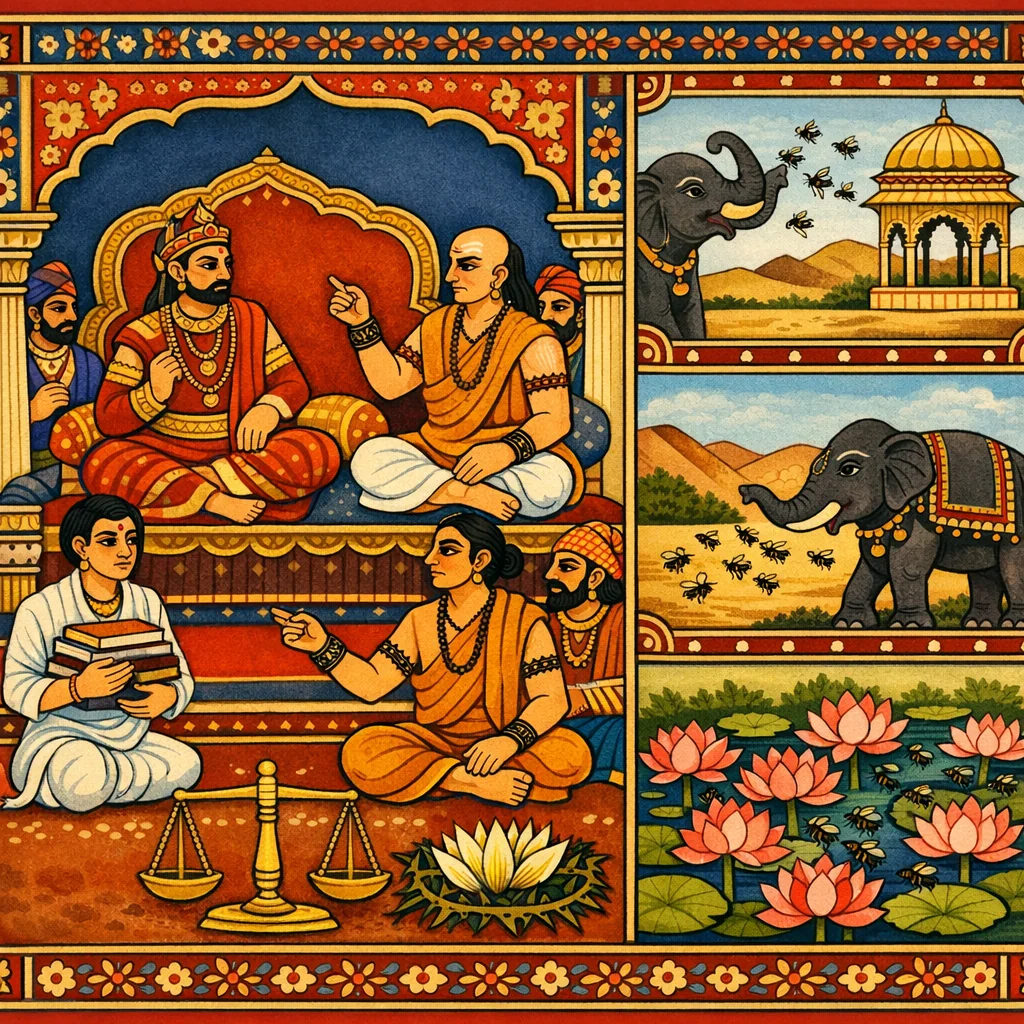
दानार्थिनो मधुकरा यदि कर्णतालैर्दूरीकृताः दूरीकृताः करिवरेण मदान्धबुद्ध्या । तस्यैव गण्डयुग्ममण्डनहानिरेषा भृंगाः पुनर्विकचपद्मवने वसन्ति ॥
If honey-seeking bees are driven off by the ear-flapping of a great elephant, whose judgment is blinded by intoxication, the loss is his alone: the ornament of his two cheeks is diminished, while the bees return to dwell among fully-bloomed lotus groves.
Verse 19
राजा वेश्या यमश्चाग्निस्तस्करो बालयाचकौ । परदुःखं न जानन्ति अष्टमो ग्रामकण्टकः ॥
A king, a courtesan, Yama, fire, a thief, and a child-beggar do not recognize others’ suffering; the eighth is the “village-thorn”—the person who harms the village from within.
Verse 20
पश्यसि किं बाले पतितं तव किं भुवि । रे रे मूर्ख न जानासि गतं तारुण्यमौक्तिकम् ॥
Child, what do you see fallen to the ground? O fool—do you not know that the “pearl of youth” has already departed?
Verse 21
व्यालाश्रयापि विकलापि सकण्टकापि वक्रापि पङ्किलभवापि दुरासदापि । गन्धेन बन्धुरसि केतकि सर्वजन्ता रेको गुणः खलु निहन्ति समस्तदोषान् ॥
The ketakī flower, though it grows among wild creatures—imperfect, thorny, crooked, born of mire, and hard to approach—wins all hearts by its fragrance. One outstanding virtue can eclipse a host of faults.
Frequently Asked Questions
The chapter repeatedly frames “nīti” as practical discernment: learned authority is tied to disciplined training (not merely textual acquisition), inner qualities (knowledge, truth, noble disposition) are treated as more fundamental than external signs, and social action is evaluated through reciprocity (including retaliatory symmetry) and risk-awareness toward harmful actors.
Interpersonal life is mapped through types rather than narratives: the text contrasts the learned vs superficially educated, the virtuous benefactor whose heart is set on helping others, and the “wicked” person represented via poison metaphors. It also lists agents portrayed as indifferent to others’ suffering (e.g., ruler, fire, thief), functioning as a taxonomy of social risk and asymmetrical power.
The aphorisms resemble broader South Asian strategic-moral discourse found in the Panchatantra and the Arthashastra’s pragmatic tone, especially in their attention to credibility, deterrence/retaliation, and identifying dangerous actors. At the same time, the chapter preserves household-ritual and gendered norms typical of premodern dharma-inflected social ethics, illustrating how political prudence and domestic ideology often coexist in Nīti compilations.