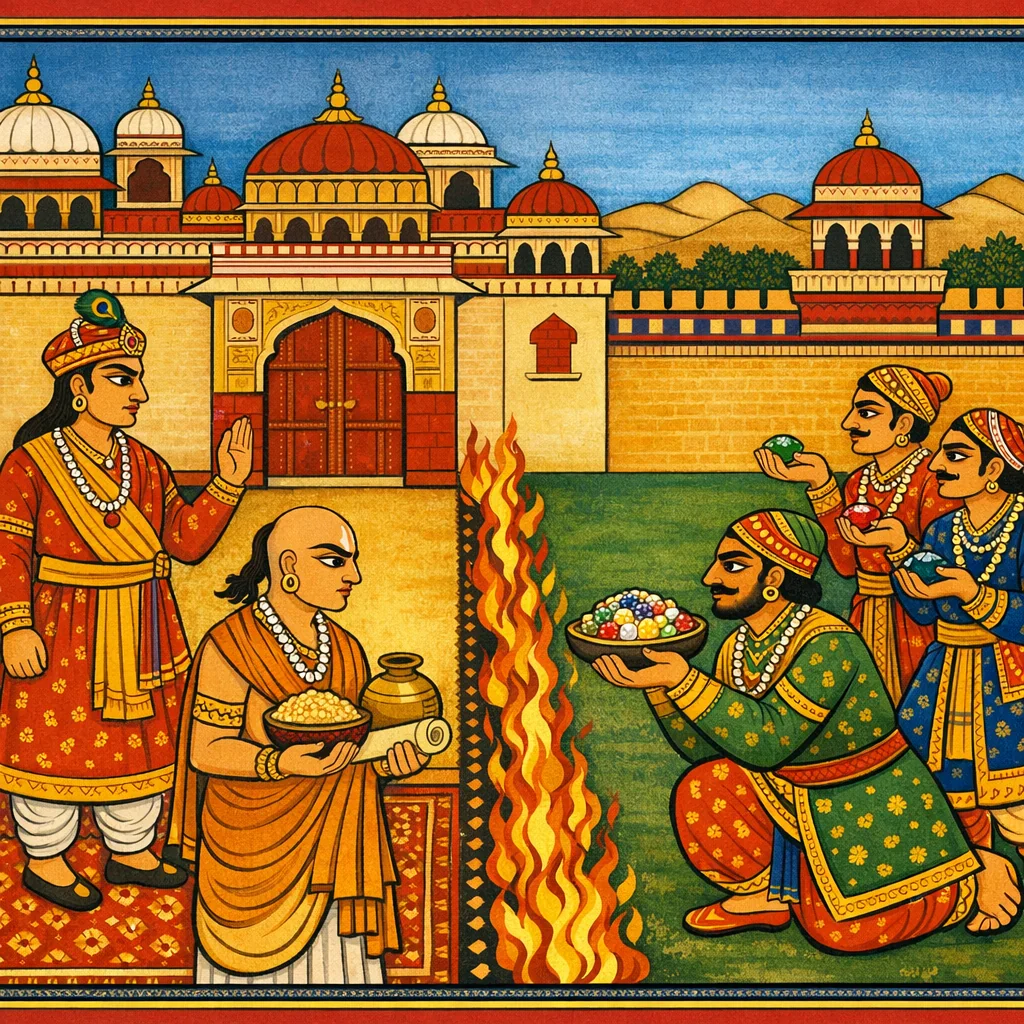
Chapter 14: Chapter 14 (Pragmatic Ethics and Social Discernment)
अध्याय १४
Principles of Statecraft and Leadership
Adhyaya 14 presents a compact set of didactic aphorisms typical of Nītiśāstra and the Subhāṣita tradition, framing ethical life through pragmatic observation. The verses juxtapose material and moral “treasures” (water, food, good speech), interpret suffering as consequences of personal error, and emphasize the irrecoverability of the body against recoverable assets such as wealth or friends. Social strategy appears through warnings about proximity to power (king, fire, teacher, women) and the depiction of dangerous domains requiring constant caution (fire, water, serpents, royal households). The chapter also maps communication as a strategic tool: speech aligned to context, pleasing words as instruments, and timing of expression. Psychological and sociological motifs recur—memory and intimacy defined by mental presence, collective strength overcoming a stronger adversary, and the idea that wisdom expands naturally in a fit receptacle. Several verses preserve archaic social observations and metaphors (e.g., gendered cautions) that reflect historical normative environments rather than modern ethical frameworks. Overall, the chapter functions as an archival window into classical Indian practical reasoning about conduct, risk, reputation, and governance-adjacent life.
Key Concepts
Key Principles
Strategic Themes
Shlokas in Chapter 14
Verse 1
पृथिव्यां त्रीणि रत्नानि जलमन्नं सुभाषितम् । मूढैः पाषाणखण्डेषु रत्नसंज्ञा विधीयते ॥
On earth there are three gems: water, food, and well-spoken words; the foolish, however, bestow the name “gem” on mere fragments of stone.
Verse 2
आत्मापराधवृक्षस्य फलान्येतानि देहिनाम् । दारिद्र्यदुःखरोगाणि बन्धनव्यसनानि च ॥
Poverty, suffering, and disease—along with bondage and calamity—are the fruits embodied beings reap from the “tree” of their own wrongdoing.
Verse 3
पुनर्वित्तं पुनर्मित्रं पुनर्भार्या पुनर्मही । एतत्सर्वं पुनर्लभ्यं न शरीरं पुनः पुनः ॥
Wealth can be regained, friends regained, a wife regained, and land regained; but the body cannot be regained again and again.
Verse 4
बहूनां चैव सत्त्वानां समवायो रिपुञ्जयः । वर्षाधाराधरो मेघस्तृणैरपि निवार्यते ॥
The union of many beings is a power that overcomes enemies; even a rain-bearing cloud can be checked by mere blades of grass.
Verse 5
जले तैलं खले गुह्यं पात्रे दानं मनागपि । प्राज्ञे शास्त्रं स्वयं याति विस्तारं वस्तुशक्तितः ॥
Oil spreads on water; a secret entrusted to a wicked man spreads; even a small gift, given to the worthy, grows in effect. Likewise, śāstra in an intelligent person expands of itself, by the power of the recipient’s capacity.
Verse 6
धर्माख्याने श्मशाने च रोगिणां या मतिर्भवेत् । सा सर्वदैव तिष्ठेच्चेत्को न मुच्येत बन्धनात् ॥
The mindset that arises during dharma teaching, at the cremation ground, and before the sick—if it stayed with us always, who would not be freed from bondage?
Verse 7
उत्पन्नपश्चात्तापस्य बुद्धिर्भवति यादृशी । तादृशी यदि पूर्वं स्यात्कस्य न स्यान्महोदयः ॥
Such is the discernment that arises after regret; if that discernment were present beforehand, for whom would great success not arise?
Verse 8
दाने तपसि शौर्ये वा विज्ञाने विनये नये । विस्मयो नहि कर्तव्यो बहुरत्ना वसुन्धरा ॥
Do not marvel at generosity, austerity, valor, learning, humility, or prudent conduct; the earth is rich with many gems—many kinds of excellence.
Verse 9
दूरस्थोऽपि न दूरस्थो यो यस्य मनसि स्थितः । यो यस्य हृदये नास्ति समीपस्थोऽपि दूरतः ॥
One who dwells in your mind is not distant even when far away; one who is not in your heart is distant even when close by.
Verse 10
यस्माच्च प्रियमिच्छेत्तु तस्य ब्रूयात्सदा प्रियम् । व्याधो मृगवधं कर्तुं गीतं गायति सुस्वरम् ॥
Whoever seeks what is pleasing from another should always speak what is pleasing to that person; like a hunter who, to kill a deer, sings in a sweet voice.
Verse 11
अत्यासन्ना विनाशाय दूरस्था न फलप्रदा । सेव्यतां मध्यभावेन राजा वह्निर्गुरुः स्त्रियः ॥
Too much closeness leads to ruin; too much distance yields no result. Therefore keep a middle stance toward the king, fire, the teacher, and women.
Verse 12
अग्निरापः स्त्रियो मूर्खाः सर्पा राजकुलानि च । नित्यं यत्नेन सेव्यानि सद्यः प्राणहराणि षट् ॥
Fire, water, women, fools, snakes, and royal households—these six must always be approached with care, for they can swiftly take life.
Verse 13
स जीवति गुणा यस्य यस्य धर्मः स जीवति । गुणधर्मविहीनस्य जीवितं निष्प्रयोजनम् ॥
He truly lives who has virtues; he truly lives who has dharma. The life of one without virtue and dharma is purposeless.
Verse 14
यदीच्छसि वशीकर्तुं जगदेकेन कर्मणा । पुरा पञ्चदशास्येभ्यो गां चरन्ती निवारय ॥
If you wish to bring the world under control by a single act, first restrain the grazing cow—from the fifteen mouths.
Verse 15
प्रस्तावसदृशं वाक्यं प्रभावसदृशं प्रियम् । आत्मशक्तिसमं कोपं यो जानाति स पण्डितः ॥
A learned person knows speech fit for the occasion, pleasing words proportionate to their effect, and anger proportionate to one’s own strength.
Verse 16
एक एव पदार्थस्तु त्रिधा भवति वीक्षितः । कुणपं कामिनी मांसं योगिभिः कामिभिः श्वभिः ॥
One and the same object is seen in three ways: as a corpse by ascetics, as a beloved woman by the lustful, and as meat by dogs.
Verse 17
सुसिद्धमौषधं धर्मं गृहच्छिद्रं च मैथुनम् । कुभुक्तं कुश्रुतं चैव मतिमान्न प्रकाशयेत् ॥
A prudent person should not disclose: a well-proven remedy, one’s own dharma-practice, weaknesses within the household, sexual relations, improper eating, and what has been poorly heard or learned.
Verse 18
तावन्मौनेन नीयन्ते कोकिलैश्चैव वासराः । यावत्सर्वजनानन्ददायिनी वाक्प्रवर्तते ॥
Days pass in silence, and so too with the cuckoo, until speech that delights all people begins to flow.
Verse 19
धर्मं धनं च धान्यं च गुरोर्वचनमौषधम् । सुगृहीतं च कर्तव्यमन्यथा तु न जीवति ॥
Dharma, wealth, provisions, and a teacher’s instruction as “medicine” must be carefully kept and rightly taken up; otherwise one cannot survive.
Verse 20
त्यज दुर्जनसंसर्गं भज साधुसमागमम् । कुरु पुण्यमहोरात्रं स्मर नित्यमनित्यतः ॥
Abandon the company of the wicked; seek the company of the virtuous. Do meritorious deeds day and night, and always remember the world’s impermanence.
Frequently Asked Questions
The text foregrounds a historically pragmatic conception of nīti: prudent self-governance, careful speech, and risk-aware social conduct. It frames outcomes such as suffering and constraint as linked to personal misjudgment, while presenting disciplined discretion and context-sensitive communication as stabilizing virtues within a worldly (vyavahāra) ethical horizon.
Relationships are described through functional criteria rather than sentiment: closeness is defined by mental presence (remembered and held in the heart), while physical proximity without regard is treated as distance. The chapter also treats interaction with authority and socially powerful figures as inherently risky, recommending a moderated “middle distance” model as a strategic stance.
The aphorisms align with wider South Asian didactic and strategic literature (e.g., Arthashastra-associated pragmatism and Panchatantra-style social reasoning) by emphasizing counsel on speech, caution near power, and coalition strength. Rather than formal statecraft, it preserves vernacular strategic heuristics that likely circulated as portable maxims for courtly, mercantile, and household contexts.