Adhyaya 7
Steya-doṣa-nirūpaṇa (On the Nature and Gravity of Theft) — within the Hayagrīva–Agastya Saṃvāda frame
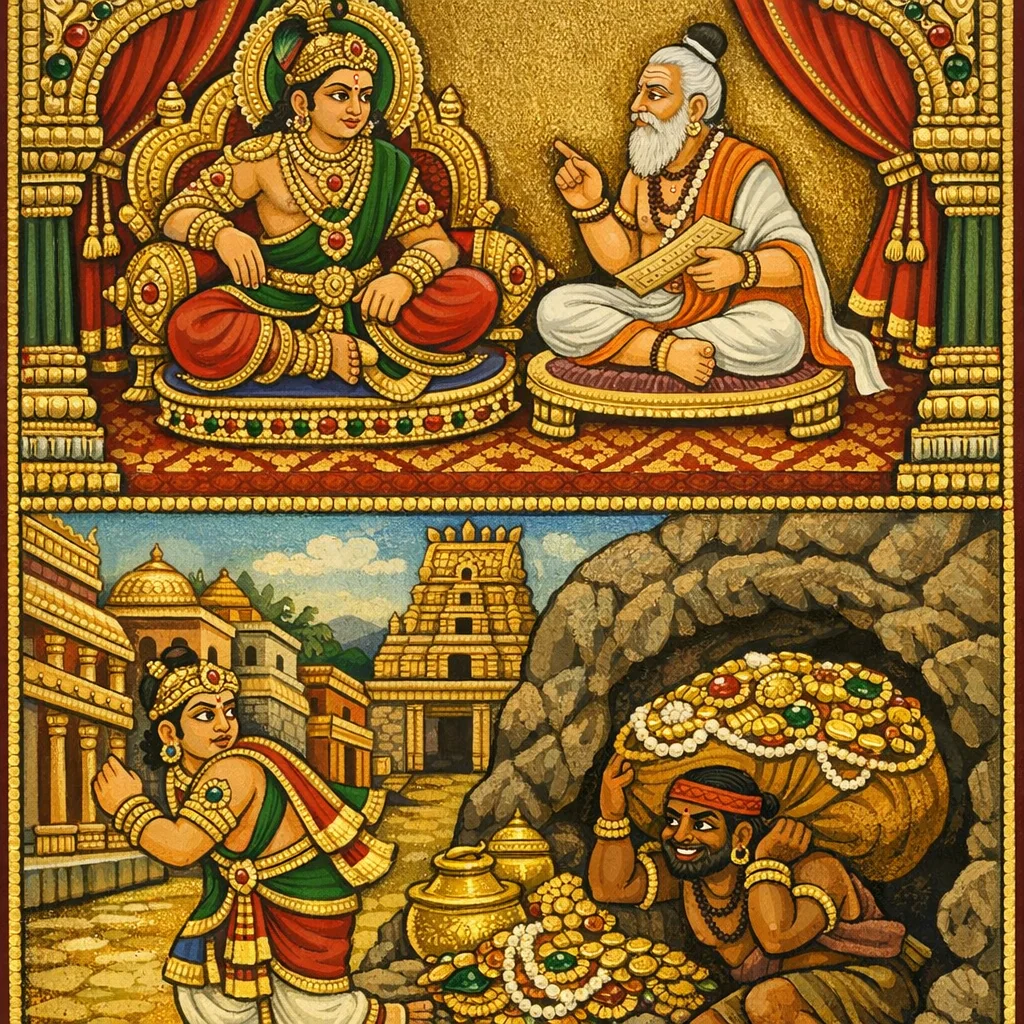
This chapter offers an ethical‑legal teaching within a dialogue. After hearing earlier definitions of hiṃsā (violence) and related faults, Indra asks Bṛhaspati to explain the marks and gradations of steya (theft). Bṛhaspati ranks theft among the great pāpas and stresses aggravated cases: stealing from one who has sought refuge or placed trust (viśvasta) is a betrayal that greatly increases guilt; most grievous is taking wealth from a learned yet poor person who supports dependents, described as nearly beyond expiation. An ancient exemplum then illustrates the point: in Kāñcīpura a thief named Vajra amasses stolen riches and hides them; a forest‑dweller (Kirāta) discovers the cache and removes a portion, setting in motion a moral chain of appropriation, concealment, and consequence. The chapter is chiefly normative—definitions, severity multipliers, and protected categories of persons and property—made practical through the Kāñcī narrative so that dharma functions as actionable social guidance.
Shlokas
Verse 1
इति श्रीब्रह्माण्डे महापुराणे उत्तरभागे हयग्रीवागस्त्यसंवादे ललितोपाख्याने हिंसाद्यस्वरूपकथनं नाम षष्ठो ऽध्यायः इन्द्र उवाच भगवन्सर्वमाख्यातं हिंसाद्यस्य तु लक्षणम् / स्तेयस्य लक्षणं किं वा तन्मे विस्तरतो वद
Thus, in the Śrī Brahmāṇḍa Mahāpurāṇa, in the latter section, in the dialogue of Hayagrīva and Agastya, within the Lalitopākhyāna, is the sixth chapter called “The description of the true nature of violence and the like.” Indra said: “O Bhagavan, you have explained fully the marks of violence and the rest; what, then, is the mark of theft (steya)? Tell me in detail.”
Verse 2
बृहस्पतिरुवाच पापानामधिकं पापं हननं जीवजातिनाम् / एतस्मादधिकं पापं विश्वस्ते शरणं गते
Bṛhaspati said: “Among sins, a greater sin is the killing of living beings; yet greater than this is the sin of betraying one who, trusting, has come seeking refuge.”
Verse 3
विश्वस्य हत्वा पापिष्ठं शूद्रं वाप्यन्त्यजातिजम् / ब्रह्महत्याधिकं पापं तस्मान्नास्त्यस्य निष्कृतिः
To slay one who has trusted you and come for refuge—even if he be a most sinful śūdra or an antyaja—is a sin greater than brahmahatyā; therefore there is no expiation for it.
Verse 4
ब्रह्मज्ञस्य दरिद्रस्य कृच्छ्रार्जितधनस्य च / बहुपुत्रकलत्रस्य तेन जीवितुमिच्छतः / तद्द्रव्यस्तेयदोषस्य प्रायश्चित्तं न विद्यते
For the sin of stealing the wealth of a brahmajña who is poor, whose money is earned with hardship, who has many children and a wife and wishes to live by that very wealth—no prāyaścitta (expiation) is found.
Verse 5
विश्वस्तद्रव्यहरणं तस्याप्यधिकमुच्यते / विश्वस्ते वाप्यविश्वस्ते न दरिद्रधनं हरेत्
To steal the wealth entrusted in confidence is said to be an even greater sin. Whether one is trusted or not, one should never take the riches of the poor.
Verse 6
ततो देवद्विजातीनां हेमरत्नापहारकम् / यो हन्यादविचारेण सो ऽश्वमेधफलं लभेत्
Thereafter, whoever, without hesitation, slays the thief who steals gold and jewels belonging to the Devas and the twice-born, attains the fruit of the Aśvamedha sacrifice.
Verse 7
गुरुदेवद्विजसुहृत्पुत्रस्वात्मसुखेषु च / स्तेयादधःक्रमेणैव दशोत्तरगुणं त्वघम्
With regard to the Guru, the Deva, the twice-born, a friend, a son, and even one’s own happiness—through theft the sin increases, in descending order, by more than tenfold.
Verse 8
अन्त्यजात्पादजाद्वैश्यात्क्षत्रियाद्ब्राह्मणादपि / दशोत्तरगुणैः पापैर्लिप्यते धनहारकः
He who steals wealth from an antyaja, a śūdra, a vaiśya, a kṣatriya, or even a brāhmaṇa becomes tainted by sins that increase, in order, by more than tenfold.
Verse 9
अत्रैवोदाहरन्तीममितिहासं पुरातनम् / रहस्यातिरहस्यं च सर्वपापप्रणाशनम्
Here itself they relate an ancient itihāsa as an example— a secret beyond secrets, the destroyer of all sins.
Verse 10
पुरा काञ्चीपुरे जातो वज्राख्यो नाम चोरकः / तस्मिन्पुरवरे रम्ये सर्वैश्वर्यसमन्विताः / सर्वे नीरोगिणो दान्ताः सुखिनो दययाञ्चिताः
Long ago in Kāñcīpura there was born a thief named Vajra. In that lovely city all were endowed with every prosperity; all were healthy, self-restrained, happy, and filled with compassion.
Verse 11
सर्वैश्वर्यसमृद्धे ऽस्मिन्नगरे स तु तस्करः / स्तोकास्तोकक्रमेणैव बहुद्रव्यमपाहरत्
In that city abounding in every prosperity, the thief stole little by little, and in due course carried off much wealth.
Verse 12
तदरण्ये ऽवटं कृत्वा स्थापयामास लोभतः / तद्गोपनं निशार्धायां तस्मिन्दूरं गते सति
Driven by greed, he dug a pit in the forest and placed (his hoard) there; and at midnight, when he had gone far away, that hiding place remained concealed.
Verse 13
किरातः कश्चिदागत्य तं दृष्ट्वा तु दशांशतः / जहाराविदितस्तेन काष्ठभारं वहन्ययौ
A certain Kirāta (forest-dweller) came, saw it, and carried off a tenth part. Unnoticed by Vajra, he went away bearing a load of firewood.
Verse 14
सो ऽपि तच्छिलयाच्छाद्य मृद्भिरापूर्ययत्नतः / पुनश्च तत्पुरं प्रायाद्वज्रो ऽपि धनतृष्मया
He too covered it with a stone and carefully filled it in with earth, hiding it with effort; and Vajra as well, thirsting for wealth, went again toward that city.
Verse 15
एवं बहुधनं त्दृत्वा निश्चिक्षेप महीतले / किरातो ऽपि गृहं प्राप्य बभाषे मुदितः प्रियाम्
Thus, seeing abundant wealth, he set it down upon the ground. Then the Kirāta reached his home and, rejoicing, spoke to his beloved.
Verse 16
मया काष्ठं समाहर्तुं गच्छता पथि निर्जने / लब्धं धनमिदं भीरु समाधत्स्व धनार्थिनि
O timid one, as I went to gather firewood along a lonely path, I found this wealth. O seeker of riches, keep it safely stored.
Verse 17
तच्छ्रुत्वा तत्समादाय निधायाभ्यन्तरे ततः / चिन्तयन्ती ततो वाक्यमिदं स्वपतिमब्रवीत्
Hearing this, she took up that wealth and stored it within. Then, pondering, she spoke these words to her husband.
Verse 18
नित्यं संचरते विप्रो मामकानां गृहेषु यः / मां विलोक्यैवमचिराद्बहुभाग्यवती भवेत्
The brāhmaṇa who daily moves about among my households—by merely beholding me—will soon become greatly fortunate.
Verse 19
चातुर्वर्ण्यासु नरीषु स्थेयं चेद्राजवल्लभा / किं तु भिल्ले किराते च शैलूषे चान्त्यजातिजे / लक्ष्मीर्न तिष्ठति चिरं शापाद्वल्मीकजन्मनः
Though Lakṣmī, beloved of kings, may be meant to abide among women of the four varṇas, yet among the Bhillas, Kirātas, Śailūṣas, and those of the last-born castes she does not remain long—because of the curse tied to Vālmīki’s birth.
Verse 20
तथापि बहुभाग्यानां पुण्यानामपि पात्रिणे / दृष्टपूर्वं तु तद्वाक्यं न कदाचिद्वृथा भवेत्
Yet even so, for the worthy recipient—fortunate and meritorious—those words, proven true before, are never at any time in vain.
Verse 21
अथ वात्मप्रयासेन कृच्छ्राद्यल्लभ्यते धनम् / तदेव तिष्ठति चिरादन्यद्गच्छति कालतः
Wealth gained with one’s own striving, won through hardship, alone endures for long; other wealth departs in the course of time.
Verse 22
स्वयमागतवित्तं तु धर्मार्थैर्विनियोजयेत् / कुरुष्वैतेन तस्मात्त्वं वापीकूपादिकाञ्छुभान्
Wealth that comes of itself should be devoted to the purposes of dharma; therefore, with it, build auspicious wells, tanks, and the like.
Verse 23
इति तद्वचनं श्रुत्वा भाविभाग्यप्रबोधितम् / बहूदकसमं देशं तत्र तत्र व्यलोकयत्
Hearing those words, awakened by fortune yet to come, he looked about here and there for a fitting land, rich in water.
Verse 24
निर्ममे ऽथ महेन्द्रस्य दिग्भागे विमलोदकम् / सुबहुद्रव्यसं साध्यं तटाकं चाक्षयोदकम्
Then, in the quarter of Mahendra, he built a lake of pure water—accomplished with abundant wealth—whose waters were unfailing and inexhaustible.
Verse 25
दत्तेषु कर्मकारिभ्यो निखिलेषु धनेषु च / असंबूर्णं तु तत्कर्म दृष्ट्वा चिन्ताकुलो ऽभवत्
Though he had given all wealth to the workmen, seeing the task still unfinished, he became troubled with anxious thought.
Verse 26
तं चोर वज्रनामानमज्ञातो ऽनुचराम्यहम् / तेनैव बहुधा क्षिप्तं धनं भूरि महीतले
Unrecognized, I followed that thief named Vajra; he himself, again and again, cast abundant treasure upon the ground.
Verse 27
स्तोकंस्तोकं हरिष्यामि तत्रतत्र धनं बहु / इति निश्चित्य मनसा तेनाज्ञातस्तमन्वगात्
Resolving in his mind, “Little by little I shall take much wealth from place to place,” he followed him, remaining unknown.
Verse 28
तथैवात्दृत्य तद्द्रव्यं तेन सेतुमपूरयत् / मध्ये जलावृतस्तेन प्रासादश्चापि शार्ङ्गिणः
In the same way, gathering that wealth, he completed the causeway (setu); and in its midst even the palace of Śārṅgin (Viṣṇu) was enclosed by water.
Verse 29
तत्तटाकमभूद्दिव्यमशोषितजलं महत् / सेतुमध्ये चकारासौ शङ्करायतनं महत्
That lake became divine—vast, with waters that never ran dry; and in the midst of the causeway he built a great shrine of Śaṅkara (Śiva).
Verse 30
काननं च क्षयं नीतं बहुसत्त्वसमाकुलम् / तेनाग्र्याणि महार्हाणि क्षेत्राण्यपि चकार सः
The forest, teeming with many creatures, he brought to ruin; and by that very means he also established foremost, most precious sacred kṣetras.
Verse 31
देवताभ्यो द्विजेभ्यश्च पदत्तानि विभज्य वै / ब्राह्मणांश्च समामन्त्र्य देवव्रातमुखान्बहून्
He duly apportioned the gifts offered to the Devas and to the twice-born; then he summoned many Brahmins, with Devavrāta at their head.
Verse 32
संतोष्य हेमवस्त्राद्यैरिदं वचनमब्रवीत् / क्व चाहं वीरदत्ताख्यः किरातः काष्ठविक्रयी
Having gratified them with gold, garments, and the like, he spoke: “Where am I—Vīradatta by name, a Kirāta who sells firewood?”
Verse 33
क्व वा महासेतुबन्धः क्व देवालयकल्पना / क्व वा क्षेत्राणि कॢप्तानि ब्राह्मणायतनानि च
Where is the mighty setubandha, where the founding of temples for the Devas; where the established kṣetras and the dwellings for Brahmins?
Verse 34
कृपयैव कृतं सर्वं भवतां भूसुरोत्तमाः / प्रतिगृह्य तथैवैतद्देवव्रातमुखा द्विजाः
O foremost bhūsuras, all this was done solely through your compassion; therefore, O twice-born led by Devavrāta, accept this just as it is.
Verse 35
द्विजवर्मेति नामास्मै तस्यै शीलवतीति च / चक्रुः संतुष्टमनसो महात्मानो महौजसः
Then the great-souled, mighty twice-born, their hearts well pleased, named him “Dvijavarmā” and her “Śīlavatī”.
Verse 36
तेषां संरक्षणार्थाय बन्धुमिः सहितो वशी / तत्रैव वसतिं चक्रे मुदितो भार्यया सह
To safeguard them, the self-controlled man, accompanied by his kinsmen, settled there itself, gladly dwelling together with his wife.
Verse 37
पुरोहिताभिधानेन देवरातपुरन्त्विति / नाम चक्रे पुरस्यास्य तोष यन्नखिलान्द्विजान्
In honor of the purohita, he named that city “Devarātapura”, thereby pleasing all the twice-born.
Verse 38
ततः कालवशं प्राप्तो द्विजवर्मा मृतस्तदा / यमस्य ब्रह्मणो विष्णोर्दूता रुद्रस्य चागताः
Then, overtaken by the sway of Time, Dvijavarmā died; and the messengers of Yama, of Brahmā, of Viṣṇu, and of Rudra arrived.
Verse 39
अन्यो ऽन्यमभवत्तेषां युद्धं देवासुरोपमम् / अत्रान्तरे समागत्य नारदो मुनिरब्रवीत्
A battle then arose among them, like the war of devas and asuras; just then the sage Nārada arrived and spoke.
Verse 40
मा कुर्वन्तु मिथो युद्धं शृण्वन्तु वचनं मम / अयं किरातश्चैर्येण सेतुबन्धं पुराकरोत्
Do not wage war among yourselves; hear my words. This Kirata once built the Setubandha by the power of what he stole.
Verse 41
वायुभूतस्चरेदेको यावद्द्रव्यवतो मृतिः / स बहुभ्यो हरेद्द्रव्यं तेषां यावत्तथा मृतिः
Let him roam alone as a spirit of wind until the wealthy man dies. Then let him seize wealth from many, until they too meet the same death.
Verse 42
गतेष्वखिलदूतेषु श्रुत्वा नारदभाषितम् / चचार द्वादशाब्दं तु वायुभूतोंऽतरिक्षगः
When all the messengers had departed, having heard Narada’s words, he—become a spirit of wind—wandered through the sky for twelve years.
Verse 43
भार्यां तस्याह स मुनिस्तव दोषो न किञ्चन / त्वया कृतेन पुण्येन ब्रह्मलोकमितो व्रज
The sage said to his wife: “There is no fault in you. By the merit you have earned, depart from here and go to Brahmaloka.”
Verse 44
वायुभूतं पतिं दृष्ट्वा नेच्छति ब्रह्ममन्दिरम् / निर्वेदं परमापन्ना मुनिमेवमभाषत
Seeing her husband become a spirit of wind, she did not wish to go to Brahma’s abode. Fallen into profound dispassion, she spoke thus to the sage.
Verse 45
विना पतिमहं तेन न गच्छेयं पितामहम् / हहैवास्ते पतिर्यावत्स्वदेहं लभते तथा
Without him, without my husband, I shall not go to Pitāmaha. Alas! Until my husband regains his own body, I will remain here.
Verse 46
ततस्तु या गतिस्तस्य तामेवानुचराम्यहम् / परिहारो ऽथवा किं तु मया कार्यस्तु तेन वा
Thereafter, whatever course of destiny is his, that alone I shall follow. What avoidance is there? What is left for me—or for him—to do?
Verse 47
इति तस्या वचः श्रुत्वा प्रीतः प्राह तपोधनः / भोगात्मकं शरीरं तु कर्म कार्यकरं तव
Hearing her words, the sage rich in austerity spoke with delight: “This body, fashioned for experience and enjoyment, is the instrument of your karma, the doer that brings deeds to fruition.”
Verse 48
मम प्रभावाद्भविता परिहारं वदामि ते / निराहारो महातीर्थेस्नात्वा नित्यं हि सांबिकम्
By my power, a remedy shall be found; I tell you the means. Remain fasting, bathe daily at the great tīrtha, and worship Sāmbikā each day.
Verse 49
पूजयित्वा शिवं भक्त्या कन्दमूलफलाशनः / ध्यात्वा हृदि महेशानं शतरुद्रमनुं जपेत्
Worship Śiva with devotion, living on bulbs, roots, and fruits. Meditate on Maheśāna within the heart, and recite the Śatarudra mantra.
Verse 50
ब्रह्महा मुच्यते पापैरष्टोत्तरसहस्रतः / पापैरन्यैश्च सकलैर्मुच्यते नात्र संशयः
Even a slayer of a Brahmin is freed from one thousand and eight hundred sins; and from all other sins as well—of this there is no doubt.
Verse 51
इत्यादिश्य ददौ तस्यै रुद्राध्यायं तपोधनः / अनुगृह्येति तां नारीं तत्रैवान्तर्द्धिमागमत्
Thus instructing her, the ascetic rich in penance bestowed upon her the Rudrādhyāya; saying “I have shown you grace,” he favored that woman and vanished there itself.
Verse 52
भर्तुः प्रियार्थे संकल्प्य जजाप परमं जपम् / विमुक्तस्तेयदोषेण स्वशरीरमवाप सः
Resolving to please her husband, he performed the supreme japa; freed from the fault of theft, he regained his own body.
Verse 53
ततो वज्राभिधश्चौरः कालधर्ममुपागतः / अन्ये तद्द्रव्यवन्तो ऽपि कालधर्ममुपागताः
Then the thief named Vajra met the law of Kāla, that is, death; and the others who held that wealth also met the law of Kāla.
Verse 54
यमस्तु तान्समाहूय वाक्यं चैतदुवाच ह
Then Yama summoned them and spoke these words.
Verse 55
भवद्भिस्तु कृतं पापं दैवात्सुकृतमप्युत / किमिच्छथ फलं भोक्तुं दुष्कृतस्य शुभस्य वा
You have committed sin, and by divine dispensation some merit too has arisen. Tell me: which fruit do you wish to partake of—the fruit of evil deeds or of auspicious deeds?
Verse 56
इति तस्य वचः श्रुत्वा प्रोचुर्वज्रादिकास्ततः / सुकृतस्य फलं त्वादौ पश्चात्पापस्य भुज्यते
Hearing his words, Vajra and the others replied: “First the fruit of merit is enjoyed; afterward the fruit of sin is undergone.”
Verse 57
पुनराह यमो यूयं पुत्रमित्र कलत्रकैः / एतस्यैव बलात्सर्वे त्रिदिवं गच्छत द्रुतम्
Yama spoke again: “All of you, together with sons, friends, and wives, by the power of this man, go swiftly to Tridiva, the heavenly realm.”
Verse 58
ते ऽधिरुह्य विमानाग्र्यं द्विजवर्माणमाश्रिताः / यथोचितफलोपेतास्त्रिदिवं जग्मुरञ्जसा
They mounted the finest celestial chariot, taking refuge in Dvijavarma; endowed with the fruits due to them, they went with ease to Tridiva, the heavenly world.
Verse 59
द्विजवर्माखिलांल्लोकानतीत्य प्रमदासखः / गाणपत्यमनुप्राप्य कैलासे ऽद्यापि मोदते
Dvijavarma, companion of the Pramadas, passed beyond all worlds; attaining the rank of Gāṇapatya, he even now rejoices upon Kailasa.
Verse 60
इन्द्र उवाच तारतम्यविभागं च कथय त्वं महामते / सेतुबन्धादिकानां च पुण्यानां पुण्यवर्धनम्
Indra said: “O great-souled sage, tell me the gradation of merits; and explain how holy acts such as the building of the Setu and the like increase sacred merit.”
Verse 61
बृहस्पतिरुवाच पुण्यस्यार्द्धफलं प्राप्य द्विजवर्मा महायशाः / वज्रः प्राप्य तदर्धं तु तदर्धेन युताः परे
Bṛhaspati said: “The greatly renowned Dwijavarmā obtained half the fruit of merit; Vajra obtained half of that; and the others partook only of half of that half.”
Verse 62
मनोवाक्कायचेष्टाभिश्चतुर्धाक्रियते कृतिः / विनश्येत्तेन तेनैव कृतैस्तत्परिहारकैः
Action is performed in four ways—by mind, speech, body, and conduct; and it is destroyed by those very means, through remedial acts of expiation that counter it.
Verse 63
इन्द्र उवाच आसवस्य तु किं रूपं को दोषः कश्चवा गुणः / अन्नं दोषकरं किं तु तन्मे विस्तरतो वद
Indra said: “What is the nature of āsava? What is its fault, and what its merit? And what kind of food becomes a cause of fault? Tell me in full detail.”
Verse 64
बृहस्पतिरुवाच पैष्टिकं तालजं कैरं माधूकं गुडसंभवम् / क्रमान्न्यूनतरं पापं तदर्द्धार्द्धार्द्धतस्तथा
Bṛhaspati said: “Āsava made from flour, from the palm, from kaira, from madhūka, and that produced from jaggery (guḍa)—in this order the sin grows progressively less, diminishing by half, and again by half, and again by half.”
Verse 65
क्षत्रियादित्रिवर्णानामासवं पेयमुच्यते / स्त्रीणामपि तृतीयादि पेयं स्याद्ब्राह्मणीं विना
For the three varṇas beginning with the Kṣatriya, āsava is declared a drink that may be taken. For women too, drinks of the third kind and the like are allowed—except for the Brāhmaṇī.
Verse 66
पतिहीना च कन्या च त्यजेदृतुमती तथा / अभर्तृसन्निधौ नारी मद्यं पिबति लोलुपा
A woman without a husband, a maiden, and one in her monthly course—these should be avoided. Without the husband’s presence, a woman driven by craving drinks intoxicants.
Verse 67
उन्मादिनीति साख्याता तां त्यजेदन्त्यजामिव
She is known as “unmādinī,” a woman gone mad; she should be cast off as one would an antyajā.
Verse 68
दशाष्टषट्चतस्रस्तु द्विजातीनामयं भवेत् / स्त्रीणां मद्यं तदर्द्धं स्यात्पादं स्याद्भर्तृसङ्गमे
For the twice-born, the measure is ten, eight, six, and four. For women, intoxicants are half of that; and in union with the husband, only a quarter.
Verse 69
मद्यं पीत्वा द्विजो मोहात्कृच्छ्रचान्द्रायमं चरेत् / जपेच्चायुतगायत्रीं जातवेदसमेव वा
If a twice-born, through delusion, drinks intoxicants, he should undertake the Kṛcchra-Cāndrāyaṇa penance. And he should recite ten thousand Gāyatrīs, or else the Jātavedas mantra.
Verse 70
अम्बिका हृदयं वापि जपेच्छुद्धो भवेन्नरः / क्षत्रियो ऽपि त्रिवर्णानां द्विजादर्धोर्ऽधतः क्रमात्
Whoever, being pure, recites in japa the “Heart of Ambikā” becomes purified. Even for a kṣatriya among the three varṇas, the count is prescribed in order as half of a dvija’s, or half of that.
Verse 71
स्त्रीणामर्धार्धकॢप्तिः स्यात्कारयेद्वा द्विजैरपि / अन्तर्जले सहस्रं वा जपेच्छुद्धिमवाप्नुयात्
For women, the measure is set as half of a half; or it may be performed even by dvijas on their behalf. Standing within water and reciting a thousand times, one attains purification.
Verse 72
लक्ष्मीः सरस्वती गौरी चण्डिका त्रिपुरांबिका / भैरवो भैरवी काली महाशास्त्री च मातरः
Lakṣmī, Sarasvatī, Gaurī, Caṇḍikā, and Tripurāmbikā; Bhairava, Bhairavī, Kālī, and Mahāśāstrī—these are the Motherly divine powers.
Verse 73
अन्याश्च शक्तयस्तासां पूजने मधु शस्यते / ब्राह्मणस्तु विना तेन यजेद्वेदाङ्गपारगः
There are other śaktis of these Goddesses as well; in their worship, madhu (honey) is praised. Yet a brāhmaṇa skilled in the Vedāṅgas may perform the rite even without it.
Verse 74
तन्निवेदितमश्नन्तस्तदनन्यास्तदात्मकाः / तासां प्रवाहा गच्छन्ति निर्लेपास्ते परां गतिम्
Those who partake of what has been offered to Them, who are devoted to none but Them and become one with Their very being—enter Their sacred stream; stainless, they attain the supreme goal.
Verse 75
कृतस्याखिलपापस्य ज्ञानतो ऽज्ञानतो ऽपि वा / प्रायश्चित्तमिदं प्रोक्तं पराशक्तेः पदस्मृतिः
For all sins committed—whether knowingly or unknowingly—this is declared as the atonement: remembrance of the sacred feet of Parāśakti.
Verse 76
अनभ्यर्च्य परां शक्तिं पिबेन्मद्यं तु यो ऽधमः / रौरवे नरके ऽब्दं तु निवसेद्ब्रिन्दुसंख्यया
The wretch who drinks liquor without worshipping Parāśakti dwells in the Raurava hell for as many years as there are drops.
Verse 77
भोगेच्छया तु यो मद्यं पिबेत्स मानुषाधमः / प्रायश्चितं न चैवास्य शिलाग्निपतनादृते
He who drinks liquor out of craving for pleasure is the lowest among men; for him there is no atonement, save falling upon rock and fire.
Verse 78
द्विजो मोहान्न तु पिबेत्स्नेहाद्वा कामतो ऽपि वा / अनुग्रहाच्च महतामनुतापाच्च कर्मणः
A dvija should not drink liquor out of delusion, affection, or desire; nor under the pretext of the grace of the great, nor from remorse over his deed.
Verse 79
अर्चनाच्च पराशक्तेर्यमैश्च नियमैरपि / चान्द्रायणेन कृच्छ्रेण दिनसंख्याकृतेन च / शुद्ध्येच्च ब्राह्मणो दोषाद्द्विगुणाद्बुद्धिपूर्वतः
By worship of Parāśakti, by the observance of yama and niyama, by the cāndrāyaṇa vow, and by kṛcchra austerity measured by a count of days, a brāhmaṇa is purified even from a double fault committed knowingly.
Frequently Asked Questions
It defines steya (theft), ranks its severity across contexts (especially breach-of-trust theft), and uses an itihāsa set in Kāñcīpura to demonstrate moral causality and social harm.
Indra questions and Bṛhaspati answers; the material is situated within the broader Hayagrīva–Agastya transmission frame indicated by the chapter colophon style.
Not primarily; it is normative-ethical. Its ‘map data’ is instead social-moral metadata: protected persons/wealth categories, severity multipliers, and exemplar narrative anchors (Kāñcīpura, Vajra, Kirāta).