Adhyaya 30
भण्डासुरवधोत्तरकृत्य-देवस्तुति (Aftermath of Bhaṇḍāsura’s Slaying and the Gods’ Hymn to Lalitā)
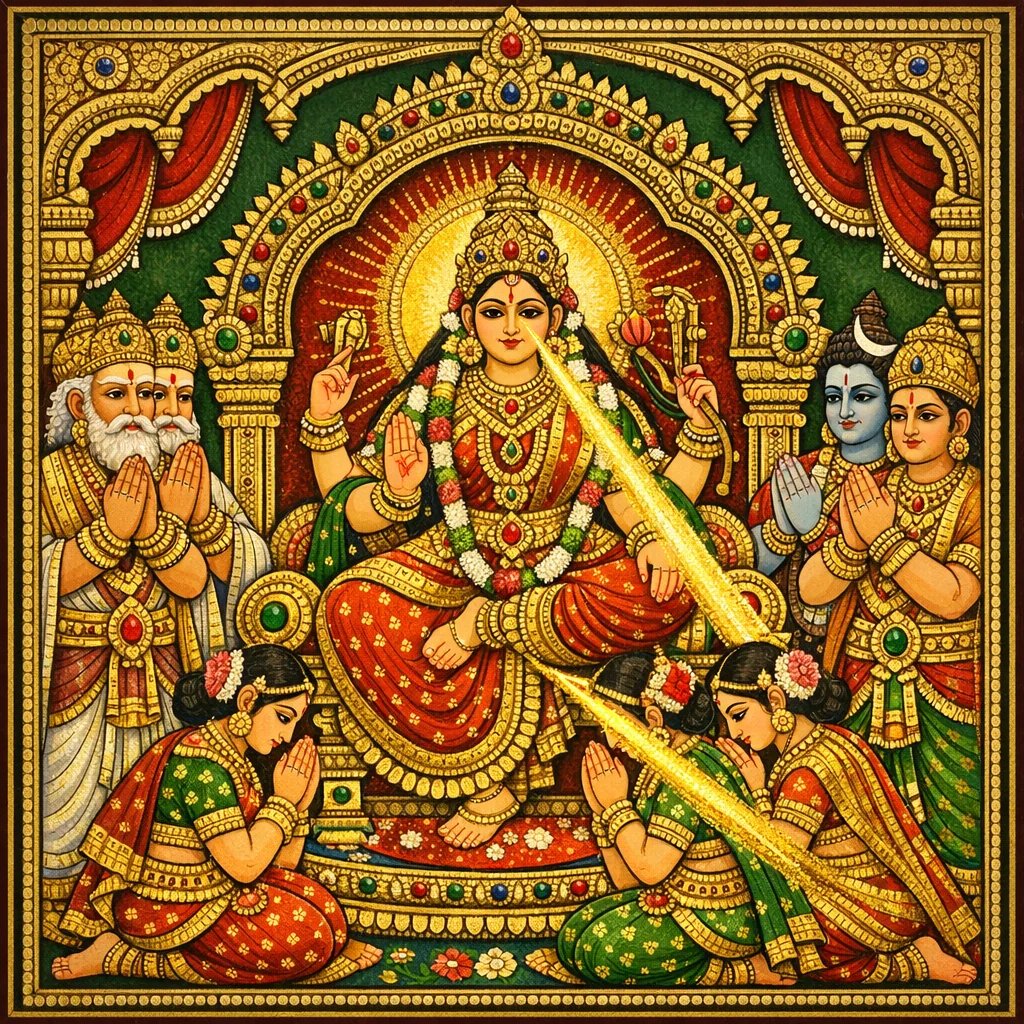
Adhyāya 30, within the Hayagrīva–Agastya dialogue of the Lalitopākhyāna cycle, asks what Lalitā did after defeating and slaying Bhaṇḍāsura. Hayagrīva describes the immediate restoration: the Śakti-forces, exhausted and wounded by countless demonic weapons, are revived by Lalitā-Parameśvarī’s “nectar-like glance” (kaṭākṣa-amṛta), a Shākta image of grace that repairs being itself. Then the devas—led by Brahmā, Viṣṇu, and Rudra, with Indra and the divine classes (Ādityas, Vasus, Rudras, Maruts, Sādhyas), along with siddhas, yakṣas, kimpuruṣas, and even notable daityas—arrive to serve and praise. The chapter culminates in a formal stuti, a litany of epithets proclaiming Lalitā as supreme sovereign, bestower of boons, giver of liberation (mokṣapradā), and the transcendent Tripurā/Kāmeśvarī, turning battlefield victory into theological affirmation and cosmic re-harmonization.
Shlokas
Verse 1
इति श्रीब्रह्माण्डपुराणे उत्तरभागे हयग्रीवागस्त्यसंवादे ललितोपाख्याने भण्डासुरवधो नामैकोनत्रिंशो ऽध्यायः अगस्त्य उवाच अश्वानन महाप्राज्ञ श्रुतमाख्यानमुत्तमम् / विक्रमो ललितादेव्या विशिष्टो वर्णितस्त्वया
Thus, in the Śrī Brahmāṇḍa Purāṇa, in the latter section, in the dialogue of Hayagrīva and Agastya, in the sacred tale of Lalitā, is the twenty-ninth chapter called “The Slaying of Bhaṇḍāsura.” Agastya said: “O Hayānana, great sage of vast wisdom, I have heard this supreme narration; you have described with distinction the extraordinary valor of Goddess Lalitā.”
Verse 2
चरितैरनघैर्देव्याः सुप्रीतो ऽस्मि हयानन / श्रुता सा महतीशक्तिर्मन्त्रिणीदण्डनाथयोः
O Hayānana, I am greatly delighted by the Goddess’s stainless deeds. I have also heard of the mighty power of Mantriṇī and Daṇḍanātha.
Verse 3
पश्चात्किमकरोत्तत्र युद्धानन्तरमंबिका / चतुर्थदिनशर्वर्यां विभातायां हयानन
Afterward, when the battle was over, what did Ambikā do there, O Hayānana, as dawn broke on the fourth night?
Verse 4
हयग्रीव उवाच शृणु कुम्भज तत्प्राज्ञ यत्तया जगदंबया / पश्चादाचरितं कर्म निहते भण्डदानवे
Hayagrīva said: “Listen, O Kumbhaja, wise one: I shall tell of the deed performed by Jagadambā, the Mother of the worlds, after the dānava Bhaṇḍa was slain.”
Verse 5
शक्तीनामखिलं सैन्यं दैत्ययुधशतार्दितम् / मुहुराह्लादयामास लोचनैरमृताप्लुतैः
The entire host of the Śaktis, wounded by hundreds of weapons of the daityas, she again and again gladdened with her eyes, as though flooded with amṛta, the nectar of immortality.
Verse 6
ललितापरमेशान्याः कटाक्षामृतधारया / जहुर्युद्धपरिश्रान्तिं शक्तयः प्रीतिमानसाः
By the nectar-stream of Lalitā Parameśānī’s gracious glance, the Śaktis, their hearts filled with joy, cast off the weariness of battle.
Verse 7
अस्मिन्नवसरे देवा भण्डमर्दनतोषिताः / सर्वे ऽपि सेवितुं प्राप्ता ब्रह्मविष्णुपुरोगमाः
At that time the Devas, delighted by the crushing of Bhaṇḍa, all arrived to render service, with Brahmā and Viṣṇu at their head.
Verse 8
ब्रह्मा विष्णुश्च रुद्रश्च शक्राद्यास्त्रिदशास्तथा / आदित्या वसवो रुद्रा मरुतः साध्यदेवताः
Brahmā, Viṣṇu, and Rudra; Śakra (Indra) and the other Tridaśa; the Ādityas, Vasus, Rudras, Maruts, and the Sādhya deities.
Verse 9
सिद्धाः किंपुरुषा यक्षा निरृत्याद्या निशाचराः / प्रह्लादाद्या महादैत्याः सर्वे ऽप्यण्डनिवासिनः
The Siddhas, Kiṃpuruṣas, Yakṣas, Nirṛti and other night-roaming beings; the great Daityas such as Prahlāda—all were dwellers within the cosmic Egg (aṇḍa).
Verse 10
आगत्य तुष्टुवुः प्रीत्या सिंहासनमहेश्वरीम्
They came and, with hearts of loving joy, praised Maheśvarī seated upon the lion-throne.
Verse 11
ब्रह्माद्या ऊचुः नमोनमस्ते जगदेकनाथे नमोनमः श्रीत्रिपुराभिधाने / नमोनमो भण्डमहासुरघ्ने नमो ऽस्तु कामेश्वरि वामकेशि
Brahmā and the others said: Homage, homage to You, the sole Lord of the whole universe; homage to the auspicious Śrī Tripurā. Homage, homage to You, slayer of the great asura Bhaṇḍa; salutations to You, O Kāmeśvarī, O Vāmakeśī.
Verse 12
चिन्तामणे चिन्तितदानदक्षे ऽचिन्तये चिराकारतरङ्गमाले / चित्राम्बरे चित्रजगत्प्रसूते चित्राख्यनित्ये सुखदे नमस्ते
Homage to You, O Cintāmaṇi, adept at granting what is sought and giving the desired; homage to You, the Inconceivable, a garland of waves of timeless forms. Homage to You, robed in wondrous splendor, who brings forth the marvelous universe; homage to You, the ever-abiding Citrā, bestower of bliss.
Verse 13
मोक्षप्रदे मुग्धशशाङ्कचूडे मुग्धस्मिते मोहनभेददक्षे / मुद्रेश्वरीचर्चितराजतन्त्रे मुद्राप्रिये देवि नमोनमस्ते
Homage to You, bestower of liberation, whose crown is the gentle moon; homage to You, with an enchanting smile, skilled in breaking the bonds of delusion. Homage to You, praised by Mudreśvarī in the royal Tantra; O Devī, lover of the mudrās, homage, homage to You.
Verse 14
क्रूरान्तकध्वंसिनि कोमलाङ्गे कोपेषु कालीं तनुमादधाने / क्रोडानने पालितसैन्यचक्रे क्रोडीकृताशेषभये नमस्ते
Homage to You, destroyer of the cruel slayer; though tender-limbed, in wrath You assume the form of Kālī. Homage to You, boar-faced Varāhī, protector of the wheel of armies; homage to You, who crushes every fear.
Verse 15
षडङ्गदेवीपरिवारकृष्णे षडङ्गयुक्तश्रुतिवाक्यमृग्ये / षट्चक्रसंस्थे च षडूर्मियुक्ते षड्भावरूपे ललिते नमस्ते
Homage to Lalitā, dark-hued, attended by the retinue of the six-limbed Devīs; homage to You whom the words of Śruti, endowed with six limbs, seek. Homage to You who abide in the six cakras and are joined with the six waves (ūrmīs); homage to You, whose form is the six bhāvas—O Lalitā, homage.
Verse 16
कामे शिवे मुख्यसमस्तनित्ये कान्तासनान्ते कमलायताक्षि / कामप्रदे कामिनि कामशंभोः काम्ये कलानामधिपे नमस्ते
O Kāme, O Śive, the foremost, the all-eternal; lotus-long-eyed, seated upon the lovely throne. Bestower of desires, O Kāminī, desired of Kāma-Śambhu; O sovereign of the kalās, to You I bow.
Verse 17
दिव्यौषधाद्ये नगरौघरूपे दिव्ये दिनाधीशसहस्रकान्ते / देदीप्यमाने दयया सनाथे देवाधिदेवप्रमदे नमस्ते
O origin of the divine herbs, whose form is like a multitude of cities; radiant with the splendor of a thousand suns. Ever shining, making the world secure by Your compassion—O beloved of the God of gods, I bow to You.
Verse 18
सदाणिमाद्यष्टकसेवनीये सदाशिवात्मोज्ज्वलमञ्चवासे / सभ्ये सदेकाल यपादपूज्ये सवित्रि लोकस्य नमोनमस्ते
Ever served by Aṇimā and the eightfold siddhis; dwelling upon the radiant dais illumined by the very Self of Sadāśiva. Honored in the sacred assembly, worshiped at the feet of the One Time—O Savitrī of the worlds, homage upon homage to You.
Verse 19
ब्राह्मीमुखैर्मातृगणैर्निषेव्ये ब्रह्मप्रिये ब्राह्मणबन्धमेत्रि / ब्रह्मामृतस्रोतसि राजहंसिब्रह्मेश्वरि श्रीललिते नमस्ते
Served by the host of Mothers beginning with Brāhmī; beloved of Brahmā, friend and protector of the brāhmaṇas. O royal Swan upon the stream of Brahman’s amṛta—O Brahmeśvarī, Śrī Lalitā, I bow to You.
Verse 20
संक्षोभिणीमुख्यसमस्तमुद्रासंसेविते संसरणप्रहन्त्रि / संसारलीलाकृतिसारसाक्षि सदा नमस्ते ललिते ऽधिनाथे / नित्ये कलाषोडशकेन नामाकर्षिण्यधीशि प्रमथेन सेव्ये
Served by all the mudrās, led by Saṃkṣobhiṇī; destroyer of the wandering of saṃsāra. Witness to the very essence of the world’s divine play—O Lalitā, supreme Adhinātha, ever to You my homage. O Nityā, sovereign of Nāmākarṣiṇī among the sixteen kalās, worshiped by the Pramathas, I bow to You.
Verse 21
नित्ये निरातङ्कदयाप्रपञ्चे नीलालकश्रेणि नमोनमस्ते / अनङ्गपुष्पादिभिरुन्नदाभिरनङ्गदेवीभिरजस्रसेव्ये / अभव्यहन्त्र्यक्षरराशिरूपे हतारिवर्गे ललिते नमस्ते
O Eternal Goddess, who unfolds the realm of compassion free from all peril; O Lady with rows of blue‑black tresses, again and again I bow to You. Ever are You served by the Goddesses of Ananga, who exalt You with Kāma’s flowers and other adornments. O destroyer of all inauspiciousness, whose form is the imperishable host of sacred syllables; O Lalitā, who has slain the ranks of foes—salutations to You.
Verse 22
संक्षोभिणीमुख्यचतुर्दशार्चिर्मालावृतोदारमहाप्रदीप्ते / आत्मानमाबिभ्रति विभ्रमाढ्ये शुभ्राश्रये शुभ्रपदे नमस्ते
O Greatly blazing One, encircled by the garland of fourteen flames, with Saṃkṣobhiṇī foremost; You shine like a mighty lamp. You who bear the Ātman within Yourself, abounding in wondrous grace and divine play; O pure refuge, O pure-footed One—salutations to You.
Verse 23
सशर्वसिद्धादि कशक्तिवन्द्ये सर्वज्ञविज्ञातपदारविन्दे / सर्वाधिके सर्वगते समस्तसिद्धिप्रदे श्रीललिते नमस्ते
O You whom the Siddhas and all Śaktis revere, even the exalted Siddhis; O You whose lotus-feet are known to the all-knowing. O Supreme One, all-pervading; bestower of every attainment—O Śrī Lalitā, salutations to You.
Verse 24
सर्वज्ञजातप्रथमाभिरन्यदेवी भिरप्याश्रितचक्रभूमे / सर्वामराकाङ्क्षितपूरयित्रि सर्वस्य लोकस्य सवित्रि पाहि
O Goddess, first among the Goddesses born of the All-knowing; even other Goddesses take refuge in the ground of Your Cakra. Fulfiller of what all the Devas long for—O Savitrī, Mother of the whole world, protect us.
Verse 25
वन्दे वशिन्यादिकवाग्विभूते वर्द्धिष्णुचक्र द्युतिवाहवाहे / बलाहकश्यामकचे वचो ऽब्धे वरप्रदे सुंदरि पाहि विश्वम्
I adore You, the majesty of sacred Speech, with Vaśinī and the rest at the fore. O bearer of the radiance of the ever-expanding Cakra. O You whose hair is dark as rain-clouds, ocean of holy utterance. O giver of boons—O Sundarī, protect the whole world.
Verse 26
बाणादिदिव्यायुधसार्वभौमे भण्डासुरानीकवनान्तदावे / अत्युग्रतेजोज्ज्वलितांबुराशे प्रसेव्यमाने परितो नमस्ते
Homage to You, sovereign of the divine weapons such as the arrow; the fire that burns the forest of Bhaṇḍāsura’s hosts; an ocean of radiance blazing with exceedingly fierce tejas, served and adored on every side.
Verse 27
कामेशि वज्रेशि भगेश्यरूपे कन्ये कले कालविलोपदक्षे / कथाविशेषीकृतदैत्यसैन्ये कामेशयान्ते कमले नमस्ते
Homage to You, Kāmeśī, Vajreśī, appearing as Bhageśī; O Maiden, O Kalā, skilled in dissolving Kāla (Time); You who shatter the Daitya hosts by the sacred utterance; O Kamalā, the final refuge of Kāmeśa—salutations to You.
Verse 28
बिन्दुस्थिते बिन्दुकलैकरूपे बिन्द्वात्मिके बृंहितचित्प्रकाशे / बृहत्कुचंभोजविलोलहारे बृहत्प्रभावे ललिते नमस्ते
Salutations to Lalitā, abiding in the Bindu, the single form of Bindu-kalā; Bindu in essence, radiant with the expanded light of consciousness; whose necklace sways upon the lotus of her ample bosom; O One of vast majesty, homage to You.
Verse 29
कामेश्वरोत्संगसदानिवासे कालात्मिके देवि कृतानुकंपे / कल्पावसानोत्थित कालिरूपे कामप्रदे कल्पलते नमस्ते
Homage to the Devi who dwells forever upon Kāmeśvara’s lap; O embodiment of Kāla (Time), compassionate One; at the ending of the kalpa You arise as the form of Kālī; O Kalpalatā, granter of desire, salutations to You.
Verse 30
सवारुणे सांद्रसुधांशुशीते सारङ्गशावाक्षि सरोजवक्त्रे / सारस्य सारस्य सदैकभूमे समस्तविद्येश्वरि संनतिस्ते
I bow to Savāruṇā, cool as the dense moonlight; with eyes like a young sāraṅga deer and a lotus face; the single ground of the essence of all essence; O Lady of all vidyās, accept my reverent salutation.
Verse 31
तव प्रभावेण चिदग्निजायां श्रीशंभुनाथप्रकडीकृतायाः / भण्डासुराद्याः समरे प्रचण्डा हता जगत्कण्टकतां प्रयाताः
By your sacred power, in the fire of pure consciousness revealed by Śrī Śaṃbhunātha, Bhaṇḍāsura and the rest—fierce in battle—were slain, and their thorn-like torment of the world was ended.
Verse 32
नव्यानि सर्वाणि वपूंषि कृत्वा हि सांद्रकारुण्यसुधाप्लवैर्न्नः / त्वया समस्तं भुवनं सहर्षं सुजीवितं सुंदरि सभ्यलभ्ये
O Beautiful One, worthy of the praise of the noble: making all bodies anew, and with surging floods of dense nectar-like compassion, you revived the whole world in gladness, granting it blessed life.
Verse 33
श्रीशंभुनाथस्य महाशयस्य द्वितीयतेजः प्रसरात्मके यः / स्थाण्वाश्रमे कॢप्ततया विरक्तः सतीवियोगेन विरस्तभोगः
Śrī Śaṃbhunātha, of great resolve: his second radiance, expansive in nature, dwelt in Sthāṇu’s hermitage, established in renunciation; through separation from Satī, all pleasures were cast aside.
Verse 34
तेनाद्रिवंशे धृतजन्मलाभां कन्यामुमां योजयितुं प्रवृत्ताः / एवं स्मरं प्रेरितवन्त एव तस्यान्तिकं घोर तपःस्थितस्य
Therefore they set about joining to him the maiden Umā, born into the mountain lineage; and thus they urged Kāma-deva to draw near to him, who stood in dreadful austerity.
Verse 35
तेनाथ वैराग्यतपोविघातक्रोधेन लालाटकृशानुदग्धः / भस्मावशेषो मदनस्ततो ऽभूत्ततो हि भण्डासुर एष जातः
Then, in wrath at the disruption of his renunciant austerity, a fire from his forehead burned Madana (Kāma) to mere ash; and from that, this Bhaṇḍāsura was born.
Verse 36
ततो वधस्तस्य दुराशयस्य कृतो भवत्या रणदुर्मदस्य / अथास्मदर्थे त्वतनुस्सजातस्त्वं कामसंजीवनमाशुकुर्याः
You have slain that evil-minded demon arrogant in battle. Now, for our sake, please quickly revive the Bodiless One (Kama).
Verse 37
इयं रतिर्भर्तृवियोगखिन्ना वैधव्यमत्यन्तमभव्यमाप / पुनस्त्वदुत्पादितकामसंगाद्भविष्यति श्रीललिते सनाथा
Rati, distressed by separation from her husband, suffers terrible widowhood. O Sri Lalita, through the reunion with Kama revived by you, she will regain her protector.
Verse 38
तया तु दृष्टेन मनोभवेन संमोहितः पूर्ववदिन्दुमौलिः / चिरं कृतात्यन्तमहासपर्या तां पार्वतीं द्राक्परिणेष्यतीशः
Enchanted by the God of Love as before, the Moon-crested Lord Shiva will quickly marry Parvati, who has long performed great penance.
Verse 39
तयोश्च संगाद्भविता कुमारः समस्तगीर्वाणचमूविनेता / तेनैव वीरेण रणे निरस्य स तारको नाम सुरारिराजः
From their union, Kumara will be born, the leader of all celestial armies. By that hero alone, the demon king Taraka will be destroyed in battle.
Verse 40
यो भण्डदैत्यस्य दुराशयस्य मित्रं स लोकत्रयधूमकेतुः / श्रीकण्ठपुत्रैण रणे हतश्चेत्प्राणप्रतिष्ठैव तदा भवेन्नः
That Taraka, friend of the evil Bhanda, is a scourge to the three worlds. Only if he is slain in battle by Shiva's son will our lives be secure.
Verse 41
तस्मात्त्वमंबत्रिपुरे जनानां मानापहं मन्मथवीरवर्यम् / उत्पाद्यरत्या विधवात्वदुःखमपाकुरु व्याकुलकुन्तलायाः
Therefore, O Mother Tripurā, remover of the pride of beings, bring forth the foremost hero of Manmatha to be Ratī’s husband, and drive away the sorrow of widowhood from Kuntalā, whose hair is disheveled in distress.
Verse 42
एषा त्वनाथा भवतीं प्रपन्ना भर्तृप्रणाशेन कृशाङ्गयष्टिः / नमस्करोति त्रिपुराभिधाने तदत्र कारुण्यकलां विधेहि
She is helpless and has sought refuge in you; by the loss of her husband her body has grown thin. She bows in reverence to you who are called Tripurā—therefore, bestow here a measure of compassion.
Verse 43
हयग्रीव उवाच इति स्तुत्वा महेशानी ब्रह्माद्या विबुधोत्तमाः / तां रतिं दर्शयमासुर्मलिनां शोककर्शितम्
Hayagrīva said: Having thus praised Maheśānī, the foremost of the gods—Brahmā and the rest—then caused Ratī to appear, her radiance dulled and her body worn away by grief.
Verse 44
सा पर्यश्रुमुखी कीर्णकुन्तला धूलिधूसरा / ननाम जगदंबां वै वैधव्यत्यक्तभूषणा
Her face was wet with tears, her hair strewn about, her body grey with dust; having cast off her ornaments in widowhood, she bowed to Jagadambā, the Mother of the world.
Verse 45
अथ तद्दर्शनोत्पन्नकारुण्या परमेश्वरी / ततः कटाक्षादुत्पन्नः स्मयमानसुखांबुजः
Seeing her, the Supreme Goddess was moved to compassion; then, from her sidelong glance, there arose a lotus of bliss, gently smiling.
Verse 46
पूर्वदेहाधिकरुचिर्मन्मथो मदमेदुरः / द्विभुजः सर्वभूषाढ्यः पुष्पेषुः पुष्पकार्मुकः
Manmatha, the sacred Kāma, more radiant than his former body and swollen with proud intoxication—two-armed, adorned with every ornament—bore flower-arrows and a flower-bow.
Verse 47
आनन्दयन्कटाक्षेण पूर्वजन्मप्रियां रतिम् / अथ सापि रतिर्देवी महत्यानन्दसागरे / मज्जन्ती निजभर्तारमवरोक्य मुदं गता
With a single sidelong glance he delighted Rati, the beloved from a former birth. Then the goddess Rati too, as though sinking into a vast ocean of bliss, beheld her own husband and was filled with joy.
Verse 48
आनन्दयन्कटाक्षेण पूर्वजन्मप्रियां रतिम् / अथ सापि रतिर्देवी महत्यानन्दसागरे / मज्जन्ती निजभर्तारमवलोक्य मुदं गता
With a single sidelong glance he delighted Rati, the beloved from a former birth. Then the goddess Rati too, as though sinking into a vast ocean of bliss, beheld her own husband and was filled with joy.
Verse 49
श्यामले स्नापयित्वैनां वस्त्रकाञ्च्यादिभूषणैः / अलङ्कृत्य यथापूर्वं शीघ्रमानीयतामिह
“O Śyāmale, bathe her, clothe her with garments, girdle and ornaments; adorn her as before, and bring her here at once.”
Verse 50
तदाज्ञां शिरसा धृत्वा श्यामा सर्वं तथाकरोत / ब्रह्मर्षिभिर्वसिष्ठाद्यैर्वैवाहि कविधानतः
Śyāmā, placing that command upon her head in reverence, carried out everything accordingly. And the Brahmarṣis—Vasiṣṭha and others—performed the wedding rites in due prescribed order.
Verse 51
कारयामास दंपत्योः पाणिग्रहणमङ्गलम् / अप्सरोभिश्च सर्वाभिर्नृत्यगीतादिसंयुतम्
She caused the auspicious rite of pāṇigrahaṇa—the taking of hands in marriage—of the couple to be performed, with all the Apsarases joining in with dance, song, and the like.
Verse 52
एतद्दृष्ट्वा महेन्द्राद्या ऋषयश्च तपोधनाः / साधुसाध्विति शंसंतस्तुष्टुवुर्ललितांबिकाम्
Seeing this, Mahendra and the other gods, along with the sages rich in austerity, cried “Well done, well done!” and praised Lalitāmbikā.
Verse 53
पुष्पवृष्टिं विमुञ्चन्तः सर्वे सन्तुष्टमानसाः / बभूवुस्तौ महाभक्त्या प्रणम्य ललितेश्वरीम्
All of them, their hearts delighted, released a shower of flowers; and with great devotion they bowed down to Laliteśvarī.
Verse 54
तत्पार्श्वे तु समागत्य बद्धाञ्जलिपुटौ स्थितौ / अथ कन्दर्पवीरो ऽपि नमस्कृत्य महेश्वरीम् / व्यज्ञापयदिदं वाक्यं भक्तिनिर्भरमानसः
Coming to her side, they stood with hands joined in añjali. Then Kandarpavīra too, having bowed to Mahēśvarī, spoke these words, his mind overflowing with devotion.
Verse 55
यद्दग्धमीशनेत्रेण वपुर्मे ललितांबिके / तत्त्वदीयकटाक्षस्य प्रसादात्पुनरागतम्
O Lalitāmbikā, my body, burned by the eye of Īśa, has returned again through the grace of your compassionate glance.
Verse 56
तव पुत्रो ऽस्मि दासो ऽस्मि क्वापि कृत्ये नियुङ्क्ष्व माम् / इत्युक्ता परमेशानी तमाह मकरध्वजम्
“I am your son; I am your servant. Appoint me to any task whatsoever.” Thus addressed, the Supreme Lady, Parameśānī, spoke to Makaradhvaja.
Verse 57
श्रीदेव्युवाच वत्सागच्छ मनोजन्मन्न भयं तव विद्यते / मत्प्रसादाज्जगत्सर्वं मोहयाव्याहताशुग
Śrī Devī said: “Child, come forth, O Manojanman; there is no fear for you. By my grace you shall bewilder the whole world, with unimpeded swiftness.”
Verse 58
तद्बाणपातनाज्जातधैर्यविप्लव ईश्वरः / पर्वतस्य सुतां गौरीं परिणेष्यति सत्वरम्
By the descent of that arrow, the Lord’s steadfast courage was shaken; and swiftly he shall wed Gaurī, the daughter of the Mountain.
Verse 59
सहस्रकोटयः कामा मत्प्रसादात्त्वदुद्भवाः / सर्वेषां देहमाविश्य दास्यन्ति रतिमुत्तमाम्
By my grace, thousands of koṭis of Kāmās shall arise from you; entering the bodies of all, they shall bestow the highest rati, the supreme delight of love.
Verse 60
मत्प्रसादेन वैराग्यात्संक्रुद्धो ऽपि स ईश्वरः / देहदाहं विधातुं ते न समर्थो भविष्यति
By my grace, through vairāgya—holy dispassion—even if that Lord is enraged, he shall not be able to burn your body.
Verse 61
अदृश्यमूर्तिः सर्वेषां प्राणिनां भवमोहनः / स्वभार्याविरहाशङ्की देहस्यार्धं प्रदास्यति / प्रयातो ऽसौ कातरात्मा त्वद्बाणाहतमानसः
Kandarpa, of unseen form, the deluder of worldly becoming for all creatures—fearing separation from his own wife—will offer half his body. Thus he departed with a trembling soul, his mind wounded by your arrows.
Verse 62
अद्य प्रभृति कन्दर्प मत्प्रसादान्महीयसः / त्वन्निन्दां ये करिष्यन्ति त्वयि वा विमुखाशयाः / अवश्यं क्लीबतैव स्यात्तेषां जन्मनिजन्मनि
From this day forth, O Kandarpa, by my most exalted grace: those who revile you, or turn away from you with a hostile heart, shall surely suffer emasculation, birth after birth.
Verse 63
ये पापिष्ठा दुरात्मानो मद्भक्तद्रोहिणश्च हि / तानगम्यासु नारीषु पातयित्वा विनाशय
Those most steeped in sin, of wicked soul, and betrayers of my devotees—cast them down into women whom one must not approach, and, having made them fall, bring them to ruin.
Verse 64
येषां मदीय पूजासु मद्भक्तेष्वादृतं मनः / तेषां कामसुखं सर्वं संपादय समीप्सितम्
But for those whose hearts are reverent in my worship and honor my devotees, bring to fulfillment every joy of love and all that they desire.
Verse 65
इति श्रीललितादेव्या कृताज्ञावचनं स्मरः / तथेति शिरसा बिभ्रत्सांजलिर्निर्ययौ ततः
Thus Smara (the God of Love) received the command of Śrī Lalitādevī. Saying, “So be it,” he bowed his head with palms joined, and then departed.
Verse 66
तस्यानङ्गस्य सर्वेभ्यो रोमकूपेभ्य उत्थिताः / बहवः शोभनाकारा मदना विश्वमोहनाः
From every pore of Ananga arose many Madanas, fair in form, who bewildered the whole universe.
Verse 67
तैर्विमोह्य समस्तं च जगच्चक्रं मनोभवः / पुनः स्थाण्वाश्रमं प्राप चन्द्रमौलेर्जिगीषया
With them Manobhava bewildered the entire wheel of the world; then he returned to Sthanu’s hermitage, intent on conquering Candramauli, the Moon-crested Lord.
Verse 68
वसंतेन च मित्रेण सेनान्या शीतरोचिषा / रागेण पीठमर्देन मन्दानिलरयेण च
With his friend Vasanta, with the commander Śītarociṣā, with Rāga who presses upon the throne, and with Mandānilaraya, the gentle-moving breeze.
Verse 69
पुंस्कोकिलगलत्स्वानकाहलीभिश्च संयुतः / शृङ्गारवीरसंपन्नो रत्यालिङ्गितविग्रहः
Joined with trumpet-like calls from the male kokila’s throat, endowed with the rasas of love and heroism, his form was embraced by Rati.
Verse 70
जैत्र शरासनं धुन्वन्प्रवीराणां पुरोगमः / मदनारेरभिमुखं प्राप्य निभय आस्थितः
Leading the foremost heroes, he shook his triumphant bow; reaching the foe of Madana, he stood before him, fearless and steadfast.
Verse 71
तपोनिष्ठं चन्द्रचूडं ताडयामास सायकैः / अथ कन्दर्पबाणौधैस्ताडितश्चन्द्रशेखरः / दूरीचकार वैराग्यं तपस्तत्त्याज दुष्करम्
Chandracūḍa, steadfast in austerity, was struck by arrows; then Chandrasekhara, smitten by volleys of Kandarpa’s shafts, cast away detachment and abandoned that arduous tapas.
Verse 72
नियमानखिलांस्त्यक्त्वा त्यक्तधैर्यः शिवः कृतः / तामेव पार्वतीं ध्यात्वा भूयोभूयः स्मरातुरः
Casting aside all observances, Śiva was made to lose his steadfastness; brooding only on Pārvatī, he became again and again afflicted by Smara.
Verse 73
निशश्वास वहञ्शर्वः पाण्डुरं गण्डमण्डलम् / बाष्पायमाणो विरही संतप्तो धैर्यविप्लवात् / भूयोभूयो गिरिसुतां पूर्वदृष्टामनुस्मरन्
Śarva heaved deep sighs, his cheeks turning pale; the lover in separation, eyes brimming with tears, burned as his fortitude collapsed, and again and again remembered the mountain’s daughter whom he had seen before.
Verse 74
अनङ्गबाणदहनैस्तप्यमानस्य शूलिनः / न चन्द्ररेखा नो गङ्गा देहतापच्छिदे ऽभवत्
For the Trident-bearer, scorched by the burning of Anaṅga’s arrows, neither the crescent moon nor the Gaṅgā could cut away the fever of his body.
Verse 75
नन्दिभृङ्गिमहाकालप्रमुखैर्गणमण्डलैः / आहृते पुष्पशयने विलुलोठ मुहुर्मुहुः
The gaṇa hosts—led by Nandin, Bhṛṅgī, Mahākāla and others—brought a bed of flowers; yet upon it he rolled about again and again.
Verse 76
नन्दिनो हस्तमालंब्य पुष्पतल्पान्तरात्पुनः / पुष्पतल्पान्तरं गत्वा व्यचेष्टत मुहुर्मुहुः
Śiva, taking Nandin by the hand, went again from one bed of flowers to another, restlessly stirring again and again.
Verse 77
न पुष्पशयनेनेन्दुखण्डनिर्गलितामृते / न हिमानीपयसि वा निवृत्तस्तद्वपुर्ज्वरः
The fevered heat of that body did not subside—neither on a bed of flowers, nor by the nectar (amṛta) dripping from a fragment of the moon, nor even by milk chilled like snow.
Verse 78
स तनेरतनुज्वालां शमयिष्यन्मुहुर्मुहुः / शिलीभूतान्हिमपयः पट्टानध्यवसच्छिवः / भूयः शैलसुतारूपं चित्रपट्टे नखैर्लिखत्
Seeking again and again to quell the subtle flame within his body, Śiva pressed upon himself cloths soaked in water cold as snow; then once more, with his nails, he traced upon a painted cloth the form of the Mountain’s Daughter (Pārvatī).
Verse 79
तदालोकनतो ऽदूरमनङ्गार्तिमवर्धयत् / तामालिख्य ह्रिया नम्रां वीक्षमाणां कटाक्षतः
At the sight of it, close at hand, the anguish wrought by Ananga (the god of desire) only grew. Having drawn her, he beheld her as if bowed in modesty, gazing by a sidelong glance from the corner of her eye.
Verse 80
तच्चित्रपट्टमङ्गेषु रोमहर्षेषु चाक्षिपत् / चिन्तासंगेन महता महात्या रतिसंपदा / भूयसा स्मरतापेन विव्यथे विषमेक्षणः
He pressed that painted cloth upon his limbs, and his hairs stood on end. Bound by great, weighty thoughts and by the fullness of rati (love’s delight), the heat of Smara (Kāma) grew stronger still, and Viṣamekṣaṇa was wracked with pain.
Verse 81
तामेव सर्वतः पश्यंस्तस्यामेव मनो दिशन् / तथैव संल्लपन्सार्धमुन्मादेनोपपन्नया
Seeing her alone on every side and fixing his mind on her alone, he likewise spoke with her, as she was seized by love-maddened frenzy.
Verse 82
तन्मात्रभूतहृदयस्तच्चित्तस्तत्परायणः / तत्कथासुधया नीतसमस्तरजनीदिनः
His heart was made of her alone, his mind fixed on her, and to her he turned as his sole refuge; all his nights and days were carried away by the nectar of tales about her.
Verse 83
तच्छीलवर्णन रतस्तद्रूपालोकनोत्सुकः / तच्चारुभोगसंकल्पमालाकरसुमालिकः / तन्मयत्वमनुप्राप्तस्ततापातितरां शिवः
Delighting in praising her conduct and virtues, ever eager to behold her beauty, he wove garlands of intent for lovely enjoyments like a maker of flower-wreaths; and Śiva, more and more, attained oneness with her, almost wholly absorbed into her being.
Verse 84
इमां मनोभव रुजमचिकित्स्यां स धूर्जटिः / अवलोक्य विवाहाय भृशमुद्यमवानभूत्
Dhūrjaṭi (Śiva), seeing that this wound of Manobhava—the sickness of love—was beyond cure, bestirred himself greatly to bring about the marriage.
Verse 85
इत्थं विमोह्य तं देवं कन्दर्पो ललिताज्ञया / अथ तां पर्वतसुतामाशुगैरभ्यतापयत्
Thus, at Lalitā’s command, Kandarpa (Kāmadeva) bewildered that god; then with swift arrows he inflamed the Mountain’s Daughter (Pārvatī) with the heat of love.
Verse 86
प्रभूतविरहज्वालामलिनैः श्वसितानलैः / शुष्यमाणाधरदलो भृशं पाण्डुकपोलभूः
Her lips withered from the hot breath of separation's intense fire, and her cheeks turned exceedingly pale.
Verse 87
नाहारे वा न शयने न स्वापे धृतिमिच्छति / मखीसहस्रैः सिषिचे नित्यं शीतोपचारकैः
She found no comfort in food, rest, or sleep, though constantly sprinkled with cooling remedies by thousands of attendants.
Verse 88
पुनः पुनस्तप्यमाना पुनरेव च विह्वला / न जगाम रुजाशान्ति मन्मथाग्नेर्महीयसः
Burning again and again, and repeatedly overwhelmed, she found no relief from the pain caused by the mighty fire of the God of Love.
Verse 89
न निद्रां पार्वती भेजे विरहेणोपतापिता / स्वतनोस्तापनेनासौ पितुः खेदमवर्धयत्
Parvati obtained no sleep, tormented by separation; by the heating of her own body, she increased the distress of her father.
Verse 90
अप्रतीकारपुरुषं विरहं तुहितुः शिवे / अवलोक्य स शैलेन्द्रो महादुःखमवाप्तवान्
Seeing his daughter's separation from Shiva, for which there was no remedy, the Lord of Mountains was filled with great sorrow.
Verse 91
भद्रे त्वं तपसा देवं तोषयित्वा महेश्वरम् / भार्तारं तं समृच्छेति पित्रा सम्प्रेरिताथ सा
O Bhadre, by your austerities you pleased the god Maheshvara (Shiva); then, urged on by your father, you went forth to attain Him as your husband.
Verse 92
हिमवच्छैलशिखरे गौरीशिखरनामनि / वकार पतिलाभाय पार्वती दुष्करं तपः
On the summit of Himavat, on the peak called Gaurī-śikhara, Pārvatī undertook arduous austerities to obtain a husband.
Verse 93
शिशिरेषु जलावासा ग्रीष्मे दहनमध्यगा / अर्के निविष्टदृष्टिश्च सुघोरं तप आस्थिता
In winter she dwelt in water; in summer she stood amid fire; and with her gaze fixed upon the sun, she maintained a most dreadful austerity.
Verse 94
तेनैव तपसा तुष्टः सान्निध्यं दत्तवाञ्छिवः / अङ्गीचकार तां भार्यां वैवाहिकविधानतः
Pleased by that very austerity, Shiva granted her His near presence; and, according to the rites of marriage, He accepted her as His wife.
Verse 95
अथाद्रिपतिना दत्तां तनयां नलिनेक्षणाम् / सप्तर्षिद्वारतः पूर्वं प्रार्थितामुदवोढ सः
Then he wedded the lotus-eyed daughter given by the Lord of the Mountains—she who had earlier been sought in marriage at the gate of the Saptarishis (Seven Sages).
Verse 96
तया च रममाणो ऽसौ बहुकालं महेश्वरः / ओषधीप्रस्थनगरे श्वशुरस्य गृहे ऽवसत्
Maheshvara, delighting with her for a long time, dwelt in the house of his father-in-law in the city of Oṣadhīprastha.
Verse 97
पुनः कैलासमागत्य समस्तैः प्रमथैः सह / पार्वतीमानिनायाद्रिनाथस्य प्रीतिमावहत्
Then, returning to Kailasa with all the Pramathas, he brought back Pārvatī, still in displeasure, and gladdened the Lord of the Mountain.
Verse 98
रममाणस्तया सार्थं कैलासे मन्दरे तथा / विन्ध्याद्रौ हेमशैले च मलये पारियात्रके
Rejoicing with her, he sported on Kailasa and on Mandara as well—on the Vindhya range, on Hemaśaila, on Malaya, and on Pāriyātraka.
Verse 99
नानाविधेषु स्थानेषु रतिं प्राप महेश्वरः / अथ तस्यां ससर्जोग्रं वीर्यं सा सोढुमक्षमा
In many places Maheshvara attained the rapture of love; then he released into her a fierce vīrya, which she was unable to bear.
Verse 100
भुव्यत्यजत्सापि वह्नौ कृत्तिकासु स चाक्षिपत् / ताश्च गङ्गाजले ऽमुञ्चन्सा चैव शरकानने
She cast it upon the earth, and it fell into the fire; he then hurled it to the Kṛttikās. They released it into the waters of the Gaṅgā, and Gaṅgā in turn set it down in the reed-forest of Śara.
Verse 101
तत्रोद्भूतो महावीरो महासेनः षडाननः / गङ्गायाश्चान्तिकं नीतो धूर्जटिर्वृद्धि मागमत्
There arose the great hero Mahāsena, Skanda of six faces; and Dhūrjaṭi (Śiva) led him to the banks of the Gaṅgā, that he might grow and flourish.
Verse 102
स वर्धमानो दिवसेदिवसे तीव्रविक्रमः / शिक्षितो निजतातेन सर्वा विद्या अवाप्तवान्
Growing day by day, fierce in valor, he was trained by his own father and attained every branch of knowledge.
Verse 103
अथ तातकृतानुज्ञः सुरसैन्यपतिर्भवन् / तारकं मारयामास समस्तैः सह दानवैः
Then, with his father’s consent, becoming commander of the gods’ host, he slew Tāraka together with all the Dānava who stood with him.
Verse 104
ततस्तारकदैत्येन्द्रवधसन्तोषशालिना / शक्रेण दत्तां स गुहो देवसेनामुपानयत्
Thereafter, Śakra (Indra), rejoicing in the slaying of Tāraka, lord of the Daityas, bestowed Devasenā; and Guha (Skanda) brought her to his side.
Verse 105
सा शक्रतनया देवसेना नाम यशस्विनी / आसाद्यरमणं स्कन्दमानन्दं मृशमादधौ
She was Śakra’s daughter, the renowned Devasenā; and upon meeting Skanda, the beloved bridegroom, she was truly filled with joy.
Verse 106
इत्थं संमोहिताशेषविश्वचक्रो मनोभवः / देवकार्यं सुसम्पाद्य जगाम श्रीपुरं पुनः
Thus Manobhava (Kāmadeva) deluded the entire wheel of the universe; and, having flawlessly fulfilled the gods’ commission, he returned once more to Śrīpura.
Verse 107
यत्र श्रीनगरे पुण्ये ललिता परमेश्वरी / वर्तते जगतामृद्ध्यै तत्र तां सेवितुं ययौ
In the holy city of Śrīnagara, where Lalitā Parameśvarī abides for the prosperity of all worlds, there he went to serve Her.
Frequently Asked Questions
This chapter is not primarily a vamśa-catalog; its metadata is theological and liturgical—framing Lalitā’s victory within the witness-assembly of devas and other cosmic beings rather than enumerating royal successions.
Instead of measurements (bhuvana-kośa), it presents a cosmological social-map: enumerated classes of devas and beings (Ādityas, Vasus, Rudras, Maruts, Sādhyas, siddhas, yakṣas, etc.) converging to acknowledge the Goddess’ sovereignty after cosmic disorder (daitya threat) is removed.
Kaṭākṣa-amṛta functions as Śākta restoration theology—grace that heals fatigue and reconstitutes power—while the devas’ stuti canonizes Lalitā’s identity (Tripurā/Kāmeśvarī, mokṣapradā) and converts military victory into a doctrinal affirmation of supreme Śakti.