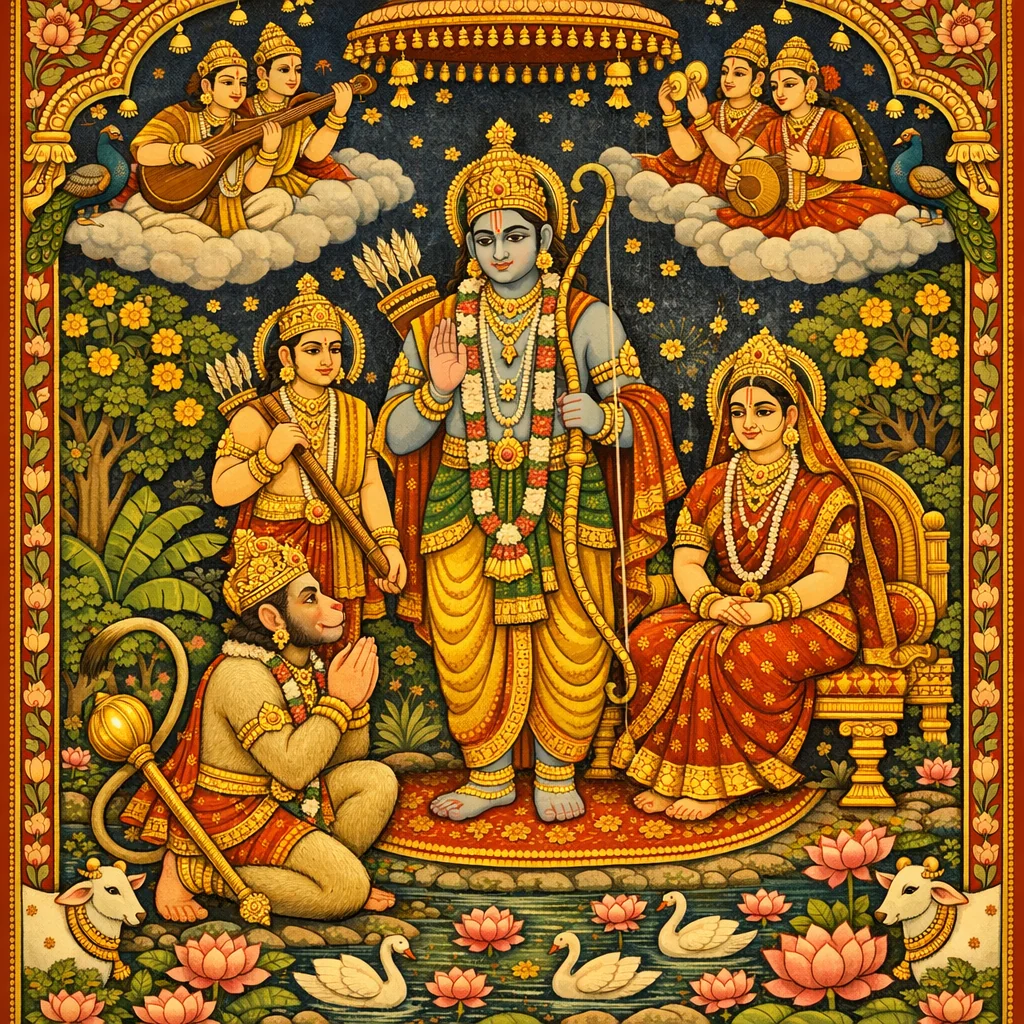
Adhyaya 19
Devotion in Kimpuruṣa-varṣa and the Glory of Bhārata-varṣa (Rāmacandra & Nara-Nārāyaṇa; Rivers, Varṇāśrama, and Liberation)
Continuing the survey of Jambūdvīpa’s varṣas and their devotional ways, Śukadeva describes Kimpuruṣa-varṣa, where Hanumān leads unceasing worship of Lord Rāmacandra amid Gandharva kīrtana. Hanumān’s prayers affirm Rāma as the transcendental Supreme Person who adopts human-like conduct to teach dharma, revealing the misery of material attachment while remaining untouched by it. The narration then turns to Bhārata-varṣa, where the Lord appears as Nara-Nārāyaṇa at Badarikāśrama, teaching religion, knowledge, renunciation, and yogic perfection; Nārada’s Pañcarātra is cited as a systematic guide to devotion through jñāna and yoga. The chapter lists Bhārata-varṣa’s mountains and purifying rivers, explains birth according to guṇas and karma, and presents varṇāśrama’s purpose as Viṣṇu-sevā under a bona fide guru. It culminates in the devas’ praise of human birth in Bhārata-varṣa as superior even to heaven, since bhakti and surrender here can swiftly grant Vaikuṇṭha. It closes by noting traditions of eight islands around Jambūdvīpa, linking to the canto’s continuing geographic-cosmological exposition.
Shlokas
Verse 1
श्रीशुक उवाच किम्पुरुषे वर्षे भगवन्तमादिपुरुषं लक्ष्मणाग्रजं सीताभिरामं रामं तच्चरणसन्निकर्षाभिरत: परमभागवतो हनुमान् सह किम्पुरुषैरविरतभक्तिरुपास्ते ॥ १ ॥
Śrīla Śukadeva Gosvāmī said: O King, in Kimpuruṣa-varṣa the great devotee Hanumān, together with the inhabitants of that land, is always engaged in bhakti-service to Lord Rāmacandra—the elder brother of Lakṣmaṇa, the beloved husband of Sītādevī, and the Ādi-Puruṣa. Delighting in the nearness of His lotus feet, he worships Him without cease.
Verse 2
आर्ष्टिषेणेन सह गन्धर्वैरनुगीयमानां परमकल्याणीं भर्तृभगवत्कथां समुपशृणोति स्वयं चेदं गायति ॥ २ ॥
Along with Arṣṭiṣeṇa, the Gandharvas constantly sing the supremely auspicious glories of Lord Rāmacandra. Hanumān and Arṣṭiṣeṇa, the chief of Kimpuruṣa-varṣa, always hear those praises with full attention, and Hanumān himself chants the following mantras.
Verse 3
ॐ नमो भगवते उत्तमश्लोकाय नम आर्यलक्षणशीलव्रताय नम उपशिक्षितात्मन उपासितलोकाय नम: साधुवादनिकषणाय नमो ब्रह्मण्यदेवाय महापुरुषाय महाराजाय नम इति ॥ ३ ॥
Oṁ—my obeisances to Bhagavān, the Uttamaśloka. Obeisances to You, the treasure of the Āryas’ noble marks, character, and vows. Obeisances to You, whose self is trained and controlled, the exemplar worshiped by the world. Obeisances to You, the touchstone that tests the virtues of the sādhus. Obeisances to You, Brahmaṇya-deva, Mahāpuruṣa, Mahārāja.
Verse 4
यत्तद्विशुद्धानुभवमात्रमेकं स्वतेजसा ध्वस्तगुणव्यवस्थम् । प्रत्यक्प्रशान्तं सुधियोपलम्भनं ह्यनामरूपं निरहं प्रपद्ये ॥ ४ ॥
That Supreme Lord—one alone, pure as undivided spiritual realization—by His own effulgence has dispelled the order of the material modes; inwardly tranquil, known only to the purified intelligence; beyond name, form, and ego. I take refuge at the lotus feet of Lord Śrī Rāmacandra.
Verse 5
मर्त्यावतारस्त्विह मर्त्यशिक्षणं रक्षोवधायैव न केवलं विभो: । कुतोऽन्यथा स्याद्रमत: स्व आत्मन: सीताकृतानि व्यसनानीश्वरस्य ॥ ५ ॥
O mighty Lord, Your human descent was not only to slay the Rākṣasa, but also to instruct mortals that happiness centered on woman or wife becomes the cause of many miseries. Since You, the self-sufficient Īśvara, delight in Your own Self, how could tribulation arise for You from Mother Sītā’s abduction?
Verse 6
न वै स आत्मात्मवतां सुहृत्तम: सक्तस्त्रिलोक्यां भगवान् वासुदेव: । न स्त्रीकृतं कश्मलमश्नुवीत न लक्ष्मणं चापि विहातुमर्हति ॥ ६ ॥
Śrī Rāmacandra, Bhagavān Vāsudeva, is attached to nothing within the three worlds; He is the dearest well-wisher and intimate friend of the self-realized. Therefore He could not be afflicted by separation from His wife, nor could He abandon either Sītā or Lakṣmaṇa—such a thing is utterly impossible.
Verse 7
न जन्म नूनं महतो न सौभगं न वाङ्न बुद्धिर्नाकृतिस्तोषहेतु: । तैर्यद्विसृष्टानपि नो वनौकस- श्चकार सख्ये बत लक्ष्मणाग्रज: ॥ ७ ॥
Friendship with the Supreme Lord Śrī Rāmacandra is not gained by noble birth, beauty, eloquence, keen intelligence, or race and outward form. Otherwise, how could we—uncultured dwellers of the forest, lacking all these—have been accepted as friends by the elder brother of Lakṣmaṇa?
Verse 8
सुरोऽसुरो वाप्यथ वानरो नर: सर्वात्मना य: सुकृतज्ञमुत्तमम् । भजेत रामं मनुजाकृतिं हरिं य उत्तराननयत्कोसलान्दिवमिति ॥ ८ ॥
Therefore, whether one is a deva or an asura, a vānara or a human, let all worship with their whole being Śrī Rāma—Hari in human form—the supreme Lord who gratefully accepts even a small service from His devotee. Indeed, He led the people of Kosala to the divine abode in the north, Vaikuṇṭha.
Verse 9
भारतेऽपि वर्षे भगवान्नरनारायणाख्य आकल्पान्तमुपचितधर्मज्ञानवैराग्यैश्वर्योपशमोपरमात्मोपलम्भनमनुग्रहायात्मवतामनुकम्पया तपोऽव्यक्तगतिश्चरति ॥ ९ ॥
In Bhārata-varṣa the Supreme Lord, known as Nara-Nārāyaṇa, appears at Badarikāśrama to show mercy to His devotees, teaching dharma, spiritual knowledge, renunciation, divine opulence, control of the senses, and the pacification of false ego; He performs austerities until the end of the age, revealing the path of self-realization.
Verse 10
तं भगवान्नारदो वर्णाश्रमवतीभिर्भारतीभि: प्रजाभिर्भगवत्प्रोक्ताभ्यां साङ्ख्ययोगाभ्यां भगवदनुभावोपवर्णनं सावर्णेरुपदेक्ष्यमाण: परमभक्तिभावेनोपसरति इदं चाभिगृणाति ॥ १० ॥
Bhagavān Nārada, together with the people of Bhārata-varṣa who uphold varṇāśrama-dharma, approaches Nara-Nārāyaṇa in the mood of supreme devotion. By the Lord’s own teachings of Sāṅkhya and Yoga he describes the Lord’s glories, instructs Sāvarṇi Manu in this transcendental doctrine, and then chants the following prayer.
Verse 11
ॐ नमो भगवते उपशमशीलायोपरतानात्म्याय नमोऽकिञ्चनवित्ताय ऋषिऋषभाय नरनारायणाय परमहंसपरमगुरवे आत्मारामाधिपतये नमो नम इति ॥ ११ ॥
Oṁ, again and again I offer obeisances to Bhagavān Nara-Nārāyaṇa—peaceful and self-controlled, fully self-realized, free from false pride; the true wealth of the materially destitute; the best of sages, the supreme guru of the paramahaṁsas, and the Lord of the ātmārāmas. Namo namah.
Verse 12
गायति चेदम्— कर्तास्य सर्गादिषु यो न बध्यते न हन्यते देहगतोऽपि दैहिकै: । द्रष्टुर्न दृग्यस्य गुणैर्विदूष्यते तस्मै नमोऽसक्तविविक्तसाक्षिणे ॥ १२ ॥
Nārada sings: Though He is the doer of creation, maintenance, and dissolution, He is never bound and never destroyed. Though He appears to dwell in a body, He is untouched by bodily troubles like hunger, thirst, and fatigue. Though He is the all-seeing Witness, His senses are not tainted by the qualities of what is seen. Obeisances to that unattached, pure Witness, the Supreme Lord.
Verse 13
इदं हि योगेश्वर योगनैपुणं हिरण्यगर्भो भगवाञ्जगाद यत् । यदन्तकाले त्वयि निर्गुणे मनो भक्त्या दधीतोज्झितदुष्कलेवर: ॥ १३ ॥
O Lord, master of all yoga, this is the true skill of the yogic path spoken by Hiraṇyagarbha (Brahmā), the self-realized: at the final moment, yogīs abandon the material body and, with bhakti, fix the mind upon You, who are beyond the guṇas. This is the perfection of yoga.
Verse 14
यथैहिकामुष्मिककामलम्पट: सुतेषु दारेषु धनेषु चिन्तयन् । शङ्केत विद्वान् कुकलेवरात्ययाद् यस्तस्य यत्न: श्रम एव केवलम् ॥ १४ ॥
Materialists are generally very attached to their present bodily comforts and to the bodily comforts they expect in the future. Therefore they are always absorbed in thoughts of their wives, children and wealth and are afraid of giving up their bodies. If a person engaged in Kṛṣṇa consciousness, however, is also afraid of giving up his body, what is the use of his having labored to study the śāstras? It was simply a waste of time.
Verse 15
तन्न: प्रभो त्वं कुकलेवरार्पितां त्वन्माययाहंममतामधोक्षज । भिन्द्याम येनाशु वयं सुदुर्भिदां विधेहि योगं त्वयि न: स्वभावमिति ॥ १५ ॥
Therefore, O Lord, O Transcendence, kindly help us by giving us the power to execute bhakti-yoga so that we can control our restless minds and fix them upon You. We are all infected by Your illusory energy; therefore we are very attached to the body, which is full of stool and urine, and to anything related with the body. Except for devotional service, there is no way to give up this attachment. Therefore kindly bestow upon us this benediction.
Verse 16
भारतेऽप्यस्मिन्वर्षे सरिच्छैला: सन्ति बहवो मलयो मङ्गलप्रस्थो मैनाकस्त्रिकूट ऋषभ: कूटक: कोल्लक: सह्यो देवगिरिऋर्ष्यमूक: श्रीशैलो वेङ्कटो महेन्द्रो वारिधारो विन्ध्य: शुक्तिमानृक्षगिरि: पारियात्रो द्रोणश्चित्रकूटो गोवर्धनो रैवतक: ककुभो नीलो गोकामुख इन्द्रकील: कामगिरिरिति चान्ये च शतसहस्रश: शैलास्तेषां नितम्बप्रभवा नदा नद्यश्च सन्त्यसङ्ख्याता: ॥ १६ ॥
In the tract of land known as Bhārata-varṣa, as in Ilāvṛta-varṣa, there are many mountains and rivers. Some of the mountains are known as Malaya, Maṅgala-prastha, Maināka, Trikūṭa, Ṛṣabha, Kūṭaka, Kollaka, Sahya, Devagiri, Ṛṣyamūka, Śrī-śaila, Veṅkaṭa, Mahendra, Vāridhāra, Vindhya, Śuktimān, Ṛkṣagiri, Pāriyātra, Droṇa, Citrakūṭa, Govardhana, Raivataka, Kakubha, Nīla, Gokāmukha, Indrakīla and Kāmagiri. Besides these, there are many other hills, with many large and small rivers flowing from their slopes.
Verse 17
एतासामपो भारत्य: प्रजा नामभिरेव पुनन्तीनामात्मना चोपस्पृशन्ति ॥ १७ ॥ चन्द्रवसा ताम्रपर्णी अवटोदा कृतमाला वैहायसी कावेरी वेणी पयस्विनी शर्करावर्ता तुङ्गभद्रा कृष्णा वेण्या भीमरथी गोदावरी निर्विन्ध्या पयोष्णी तापी रेवा सुरसा नर्मदा चर्मण्वती सिन्धुरन्ध: शोणश्च नदौ महानदी वेदस्मृतिऋर्षिकुल्या त्रिसामा कौशिकी मन्दाकिनी यमुना सरस्वती दृषद्वती गोमती सरयू रोधस्वती सप्तवती सुषोमा शतद्रूश्चन्द्रभागा मरुद्वृधा वितस्ता असिक्नी विश्वेति महानद्य: ॥ १८ ॥
Two of the rivers — the Brahmaputra and the Śoṇa — are called nadas, or main rivers. These are other great rivers that are very prominent: Candravasā, Tāmraparṇī, Avaṭodā, Kṛtamālā, Vaihāyasī, Kāverī, Veṇī, Payasvinī, Śarkarāvartā, Tuṅgabhadrā, Kṛṣṇāveṇyā, Bhīmarathī, Godāvarī, Nirvindhyā, Payoṣṇī, Tāpī, Revā, Surasā, Narmadā, Carmaṇvatī, Mahānadī, Vedasmṛti, Ṛṣikulyā, Trisāmā, Kauśikī, Mandākinī, Yamunā, Sarasvatī, Dṛṣadvatī, Gomatī, Sarayū, Rodhasvatī, Saptavatī, Suṣomā, Śatadrū, Candrabhāgā, Marudvṛdhā, Vitastā, Asiknī and Viśvā. The inhabitants of Bhārata-varṣa are purified because they always remember these rivers. Sometimes they chant the names of these rivers as mantras, and sometimes they go directly to the rivers to touch them and bathe in them. Thus the inhabitants of Bhārata-varṣa become purified.
Verse 18
एतासामपो भारत्य: प्रजा नामभिरेव पुनन्तीनामात्मना चोपस्पृशन्ति ॥ १७ ॥ चन्द्रवसा ताम्रपर्णी अवटोदा कृतमाला वैहायसी कावेरी वेणी पयस्विनी शर्करावर्ता तुङ्गभद्रा कृष्णा वेण्या भीमरथी गोदावरी निर्विन्ध्या पयोष्णी तापी रेवा सुरसा नर्मदा चर्मण्वती सिन्धुरन्ध: शोणश्च नदौ महानदी वेदस्मृतिऋर्षिकुल्या त्रिसामा कौशिकी मन्दाकिनी यमुना सरस्वती दृषद्वती गोमती सरयू रोधस्वती सप्तवती सुषोमा शतद्रूश्चन्द्रभागा मरुद्वृधा वितस्ता असिक्नी विश्वेति महानद्य: ॥ १८ ॥
Two of the rivers — the Brahmaputra and the Śoṇa — are called nadas, or main rivers. These are other great rivers that are very prominent: Candravasā, Tāmraparṇī, Avaṭodā, Kṛtamālā, Vaihāyasī, Kāverī, Veṇī, Payasvinī, Śarkarāvartā, Tuṅgabhadrā, Kṛṣṇāveṇyā, Bhīmarathī, Godāvarī, Nirvindhyā, Payoṣṇī, Tāpī, Revā, Surasā, Narmadā, Carmaṇvatī, Mahānadī, Vedasmṛti, Ṛṣikulyā, Trisāmā, Kauśikī, Mandākinī, Yamunā, Sarasvatī, Dṛṣadvatī, Gomatī, Sarayū, Rodhasvatī, Saptavatī, Suṣomā, Śatadrū, Candrabhāgā, Marudvṛdhā, Vitastā, Asiknī and Viśvā. The inhabitants of Bhārata-varṣa are purified because they always remember these rivers. Sometimes they chant the names of these rivers as mantras, and sometimes they go directly to the rivers to touch them and bathe in them. Thus the inhabitants of Bhārata-varṣa become purified.
Verse 19
अस्मिन्नेव वर्षे पुरुषैर्लब्धजन्मभि: शुक्ललोहितकृष्णवर्णेन स्वारब्धेन कर्मणा दिव्यमानुषनारकगतयो बह्व्य: आत्मन आनुपूर्व्येण सर्वा ह्येव सर्वेषां विधीयन्ते यथावर्णविधानमपवर्गश्चापि भवति ॥ १९ ॥
In this very Bhārata-varṣa, those who attain human birth are allotted diverse destinies—divine, human, or hellish—according to their past karma and the three guṇas, sattva, rajas, and tamas, symbolized as white, red, and black. When a bona fide spiritual master ascertains one’s proper station and trains one to serve Lord Viṣṇu in harmony with the four varṇas and the four āśramas, one’s life becomes perfected and liberation is attained.
Verse 20
योऽसौ भगवति सर्वभूतात्मन्यनात्म्येऽनिरुक्तेऽनिलयने परमात्मनि वासुदेवेऽनन्यनिमित्तभक्तियोगलक्षणो नानागतिनिमित्ताविद्याग्रन्थिरन्धनद्वारेण यदा हि महापुरुषपुरुषप्रसङ्ग: ॥ २० ॥
Devotional service—bhakti-yoga with no other motive—unto Lord Vāsudeva, the Paramātmā, the Soul of all beings, beyond mind and speech, inexpressible and unattached, is the true path of liberation. When, after many births, one gains the association of pure devotees, the knot of ignorance formed by varied fruitive pursuits is cut, and one gradually engages in the Lord’s service and attains emancipation.
Verse 21
एतदेव हि देवा गायन्ति— अहो अमीषां किमकारि शोभनं प्रसन्न एषां स्विदुत स्वयं हरि: । यैर्जन्म लब्धं नृषु भारताजिरे मुकुन्दसेवौपयिकं स्पृहा हि न: ॥ २१ ॥
The demigods sing: How wondrous it is! Surely these people performed splendid pious deeds, or else Lord Hari Himself has become pleased with them; therefore they have obtained human birth in the courtyard of Bhārata, so fit for serving Mukunda. We devas can only yearn to gain a human birth in Bhārata-varṣa to practice devotion, but they are already engaged there in the Lord’s service.
Verse 22
किं दुष्करैर्न: क्रतुभिस्तपोव्रतै- र्दानादिभिर्वा द्युजयेन फल्गुना । न यत्र नारायणपादपङ्कज- स्मृति: प्रमुष्टातिशयेन्द्रियोत्सवात् ॥ २२ ॥
The demigods continue: By arduous Vedic sacrifices, austerities, vows, and charity we have attained residence in heaven—yet what is its worth? Here we are absorbed in excessive sense enjoyment, and thus remembrance of the lotus feet of Lord Nārāyaṇa is nearly stolen away; by the very abundance of pleasure we have almost forgotten Him.
Verse 23
कल्पायुषां स्थानजयात्पुनर्भवात् क्षणायुषां भारतभूजयो वरम् । क्षणेन मर्त्येन कृतं मनस्विन: सन्न्यस्य संयान्त्यभयं पदं हरे: ॥ २३ ॥
A brief life on the soil of Bhārata is better than attaining Brahmaloka for kalpas, for even in Brahmaloka one must return to repeated birth. In Bhārata, within a short span, a resolute mortal can renounce all and fully surrender to the lotus feet of Hari, thus reaching the fearless abode—Vaikuṇṭha—where there is neither anxiety nor rebirth in a material body.
Verse 24
न यत्र वैकुण्ठकथासुधापगा न साधवो भागवतास्तदाश्रया: । न यत्र यज्ञेशमखा महोत्सवा: सुरेशलोकोऽपि न वै स सेव्यताम् ॥ २४ ॥
A wise person finds no delight in a place—even the highest heaven—where the nectar-river of Vaikuṇṭha narrations does not flow, where saintly Bhāgavata devotees do not dwell upon its banks, and where there are no great festivals of saṅkīrtana-yajña to please the Lord of sacrifice.
Verse 25
प्राप्ता नृजातिं त्विह ये च जन्तवो ज्ञानक्रियाद्रव्यकलापसम्भृताम् । न वै यतेरन्नपुनर्भवाय ते भूयो वनौका इव यान्ति बन्धनम् ॥ २५ ॥
Those who attain a human birth here, furnished with the means of knowledge and action, yet do not strive for freedom from rebirth through bhakti, fall again into bondage—like heedless forest beasts and birds caught once more.
Verse 26
यै: श्रद्धया बर्हिषि भागशो हवि- र्निरुप्तमिष्टं विधिमन्त्रवस्तुत: । एक: पृथङ्नामभिराहुतो मुदा गृह्णाति पूर्ण: स्वयमाशिषां प्रभु: ॥ २६ ॥
Those who, with faith, place their oblations upon the sacrificial altar according to proper rite, mantra, and substance—worshiping various devas by different names as parts of the Whole—actually worship the one complete Lord. Called by many names, He gladly accepts those offerings and Himself grants the desired blessings.
Verse 27
सत्यं दिशत्यर्थितमर्थितो नृणां नैवार्थदो यत्पुनरर्थिता यत: । स्वयं विधत्ते भजतामनिच्छता- मिच्छापिधानं निजपादपल्लवम् ॥ २७ ॥
The Supreme Lord grants what people ask of Him, yet He does not bestow a boon that would make them ask again and again. Rather, even when the devotee does not seek it, the Lord willingly gives shelter at His own lotus feet—shelter that fulfills all desires. This is His special mercy.
Verse 28
यद्यत्र न: स्वर्गसुखावशेषितं स्विष्टस्य सूक्तस्य कृतस्य शोभनम् । तेनाजनाभे स्मृतिमज्जन्म न: स्याद् वर्षे हरिर्यद्भजतां शं तनोति ॥ २८ ॥
O Ajanābha, by the fruits of sacrifices, pious deeds, and Vedic study we now enjoy heavenly happiness, yet this life too will one day end. If any merit remains, may we be born again in Bhārata-varṣa as human beings able to remember the Lord’s lotus feet, for Hari personally comes there and expands the welfare and good fortune of His worshipers.
Verse 29
श्रीशुक उवाच जम्बूद्वीपस्य च राजन्नुपद्वीपानष्टौ हैक उपदिशन्ति सगरात्मजैरश्वान्वेषण इमां महीं परितो निखनद्भिरुपकल्पितान् ॥ २९ ॥ तद्यथा स्वर्णप्रस्थश्चन्द्रशुक्ल आवर्तनो रमणको मन्दरहरिण: पाञ्चजन्य: सिंहलो लङ्केति ॥ ३० ॥
Śrī Śukadeva Gosvāmī said: O King, some learned authorities describe eight smaller islands encircling Jambūdvīpa. When the sons of Mahārāja Sagara searched everywhere for the lost horse, they dug up the earth on all sides, and thus these eight adjoining islands came into being. Their names are Svarṇaprastha, Candraśukla, Āvartana, Ramaṇaka, Mandara-hariṇa, Pāñcajanya, Siṁhala, and Laṅkā.
Verse 30
श्रीशुक उवाच जम्बूद्वीपस्य च राजन्नुपद्वीपानष्टौ हैक उपदिशन्ति सगरात्मजैरश्वान्वेषण इमां महीं परितो निखनद्भिरुपकल्पितान् ॥ २९ ॥ तद्यथा स्वर्णप्रस्थश्चन्द्रशुक्ल आवर्तनो रमणको मन्दरहरिण: पाञ्चजन्य: सिंहलो लङ्केति ॥ ३० ॥
They are named Svarṇaprastha, Candraśukla, Āvartana, Ramaṇaka, Mandara-hariṇa, Pāñcajanya, Siṁhala, and Laṅkā—these are said to be the surrounding sub-islands of Jambūdvīpa.
Verse 31
एवं तव भारतोत्तम जम्बूद्वीपवर्षविभागो यथोपदेशमुपवर्णित इति ॥ ३१ ॥
O King Parīkṣit, best of Bharata’s descendants, I have thus described—exactly as I was instructed—the divisions of Bhārata-varṣa and the adjoining islands that together constitute Jambūdvīpa.
Frequently Asked Questions
The Bhāgavata uses varṣa-specific devotion to illustrate poṣaṇa and īśānukathā: Hanumān’s unbroken service and mantra-glorification show that the highest perfection is not status, birth, or learning, but surrendered devotion. Kimpuruṣa-varṣa becomes a theological tableau where Rāma’s supremacy and the devotee’s single-minded bhakti are publicly celebrated through constant kīrtana.
Hanumān’s prayer frames Rāma as Vāsudeva, the self-sufficient Supreme Lord, untouched by material attachment. The narrative presents His human-like tribulations as purposeful līlā—meant to teach mortals the dangers of material happiness centered on sex and possessiveness—rather than evidence of divine limitation.
Nara-Nārāyaṇa is Bhagavān’s manifestation in Bhārata-varṣa at Badarikāśrama, exemplifying the path of self-realization through austerity, sense control, and freedom from false ego, ultimately oriented to devotion. The site symbolizes disciplined spirituality that matures into bhakti, and it anchors the canto’s teaching that the Lord actively instructs and favors devotees within human history.
The devas admit that heavenly life, though earned by yajña and Vedic merit, intensifies sense enjoyment and weakens remembrance of Nārāyaṇa. Bhārata-varṣa, despite its brevity and hardship, uniquely facilitates surrender and saṅkīrtana-centered devotion, enabling attainment of Vaikuṇṭha—something even long celestial lifespans cannot guarantee.
Varṇāśrama is presented as a divinely calibrated social-spiritual system based on guṇa and karma, to be confirmed by a bona fide guru and used to train one’s life toward service of Lord Viṣṇu. Its success criterion is not mere social order but perfection of life through regulated devotion culminating in bhakti to Vāsudeva.