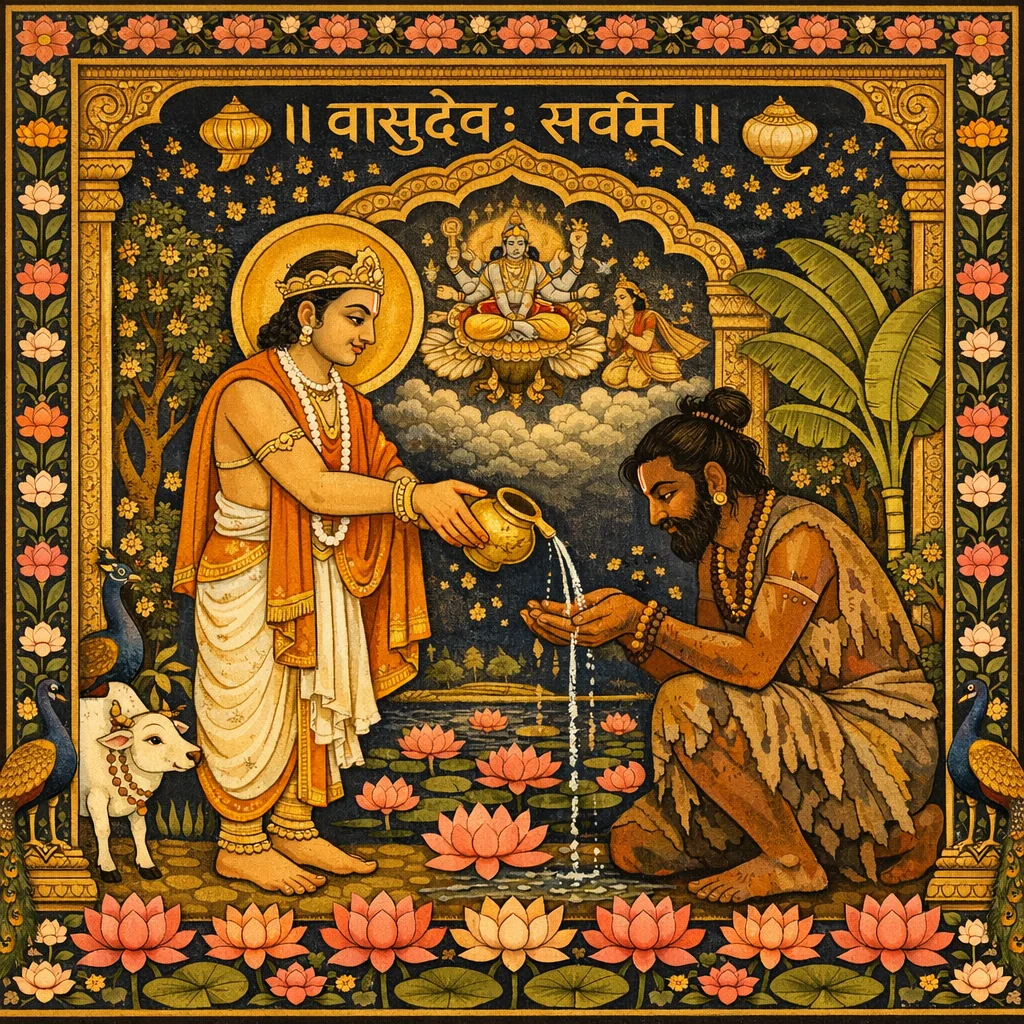
Adhyaya 21
Rantideva’s Supreme Charity and the Hastī Lineage (Hastināpura and Pañcāla Origins)
This chapter continues the vaṁśānucarita, tracing Bharadvāja—known as Vitatha—through Manyu and his sons to Saṅkṛti, son of Nara, and then to King Rantideva. The focus shifts from lineage to lived dharma: sustained only by divine providence, Rantideva fasts for forty-eight days and, upon receiving food and water, gives them away in turn to a brāhmaṇa, a śūdra, a guest with dogs, and finally a caṇḍāla, seeing Vāsudeva present in all beings. In prayer he rejects siddhis and even mokṣa, choosing instead to bear others’ suffering—compassion rooted in bhakti. The demigods reveal they were testing him, yet he remains fixed at Viṣṇu’s lotus feet, untouched by māyā, and his followers become pure devotees. The chapter then returns to dynastic mapping: the lines of Garga and Mahāvīrya yield descendants with brāhmaṇa status; Hastī, son of Bṛhatkṣatra, founds Hastināpura; and Hastī’s descendants branch toward the Pañcālas, the Maudgalya brāhmaṇas, and the birth of Kṛpa and Kṛpī, preparing later Mahābhārata-linked figures and regions.
Shlokas
Verse 1
श्रीशुक उवाच वितथस्य सुतान् मन्योर्बृहत्क्षत्रो जयस्तत: । महावीर्यो नरो गर्ग: सङ्कृतिस्तु नरात्मज: ॥ १ ॥
Śukadeva Gosvāmī said: Because Bharadvāja was maintained by the Marut demigods, he became known as Vitatha. Vitatha’s son was Manyu, and from Manyu came five sons—Bṛhatkṣatra, Jaya, Mahāvīrya, Nara, and Garga. Among them, Nara had a son named Saṅkṛti.
Verse 2
गुरुश्च रन्तिदेवश्च सङ्कृते: पाण्डुनन्दन । रन्तिदेवस्य महिमा इहामुत्र च गीयते ॥ २ ॥
O Mahārāja Parīkṣit, descendant of Pāṇḍu, Saṅkṛti had two sons, Guru and Rantideva. The glory of Rantideva is sung in this world and the next; he is praised not only among men but also among the demigods.
Verse 3
वियद्वित्तस्य ददतो लब्धं लब्धं बुभुक्षत: । निष्किञ्चनस्य धीरस्य सकुटुम्बस्य सीदत: ॥ ३ ॥ व्यतीयुरष्टचत्वारिंशदहान्यपिबत: किल । घृतपायससंयावं तोयं प्रातरुपस्थितम् ॥ ४ ॥ कृच्छ्रप्राप्तकुटुम्बस्य क्षुत्तृड्भ्यां जातवेपथो: । अतिथिर्ब्राह्मण: काले भोक्तुकामस्य चागमत् ॥ ५ ॥
Rantideva never strove to earn wealth. He lived on whatever came by the Lord’s providence, yet when guests arrived he gave away everything. Thus, with his family, he endured great hardship; though they trembled for lack of food and water, he remained sober and steady.
Verse 4
वियद्वित्तस्य ददतो लब्धं लब्धं बुभुक्षत: । निष्किञ्चनस्य धीरस्य सकुटुम्बस्य सीदत: ॥ ३ ॥ व्यतीयुरष्टचत्वारिंशदहान्यपिबत: किल । घृतपायससंयावं तोयं प्रातरुपस्थितम् ॥ ४ ॥ कृच्छ्रप्राप्तकुटुम्बस्य क्षुत्तृड्भ्यां जातवेपथो: । अतिथिर्ब्राह्मण: काले भोक्तुकामस्य चागमत् ॥ ५ ॥
Indeed, he passed forty-eight days fasting without food or water. Then one morning he received some water and dishes such as payasa prepared with milk and ghee. Just as he and his family were about to eat,
Verse 5
वियद्वित्तस्य ददतो लब्धं लब्धं बुभुक्षत: । निष्किञ्चनस्य धीरस्य सकुटुम्बस्य सीदत: ॥ ३ ॥ व्यतीयुरष्टचत्वारिंशदहान्यपिबत: किल । घृतपायससंयावं तोयं प्रातरुपस्थितम् ॥ ४ ॥ कृच्छ्रप्राप्तकुटुम्बस्य क्षुत्तृड्भ्यां जातवेपथो: । अतिथिर्ब्राह्मण: काले भोक्तुकामस्य चागमत् ॥ ५ ॥
At that very time, when Rantideva and his family—trembling from hunger and thirst—were about to eat the hard-won meal, a brāhmaṇa guest arrived.
Verse 6
तस्मै संव्यभजत् सोऽन्नमादृत्य श्रद्धयान्वित: । हरिं सर्वत्र संपश्यन् स भुक्त्वा प्रययौ द्विज: ॥ ६ ॥
Seeing Hari, the Supreme Lord, present everywhere and within every being, Rantideva welcomed the guest with faith and reverence and gave him a share of the food. The brāhmaṇa ate his portion and then departed.
Verse 7
अथान्यो भोक्ष्यमाणस्य विभक्तस्य महीपते: । विभक्तं व्यभजत् तस्मै वृषलाय हरिं स्मरन् ॥ ७ ॥
Thereafter, having shared the remaining food among his relatives, King Rantideva was about to eat his own portion when a śūdra guest arrived. Remembering Hari in him, the king gave him as well a share of the food.
Verse 8
याते शूद्रे तमन्योऽगादतिथि: श्वभिरावृत: । राजन् मे दीयतामन्नं सगणाय बुभुक्षते ॥ ८ ॥
When the śūdra had departed, another guest arrived, surrounded by dogs, and said, “O King, I and my company of dogs are greatly hungry. Please give us food.”
Verse 9
स आदृत्यावशिष्टं यद्म बहुमानपुरस्कृतम् । तच्च दत्त्वा नमश्चक्रे श्वभ्य: श्वपतये विभु: ॥ ९ ॥
With great respect, King Rantideva gave the remaining food, honoring them, to the dogs and to the master of the dogs who had come as guests. He offered them reverence and obeisances.
Verse 10
पानीयमात्रमुच्छेषं तच्चैकपरितर्पणम् । पास्यत: पुल्कसोऽभ्यागादपो देह्यशुभाय मे ॥ १० ॥
Thereafter only drinking water remained—just enough to satisfy one person. As the King was about to drink, a caṇḍāla appeared and said, “O King, though I am lowborn, kindly give me some water.”
Verse 11
तस्य तां करुणां वाचं निशम्य विपुलश्रमाम् । कृपया भृशसन्तप्त इदमाहामृतं वच: ॥ ११ ॥
Hearing the pitiable words of the poor, greatly fatigued caṇḍāla, Mahārāja Rantideva was deeply pained with compassion and spoke the following nectarean words.
Verse 12
न कामयेऽहं गतिमीश्वरात् परा- मष्टर्द्धियुक्तामपुनर्भवं वा । आर्तिं प्रपद्येऽखिलदेहभाजा- मन्त:स्थितो येन भवन्त्यदु:खा: ॥ १२ ॥
I do not pray to the Supreme Lord for the eight mystic perfections, nor for liberation from repeated birth and death. I desire only to remain among all living beings and accept distress on their behalf, so that they may become free from suffering.
Verse 13
क्षुत्तृट्श्रमो गात्रपरिभ्रमश्च दैन्यं क्लम: शोकविषादमोहा: । सर्वे निवृत्ता: कृपणस्य जन्तो- र्जिजीविषोर्जीवजलार्पणान्मे ॥ १३ ॥
By offering my own water to sustain the life of this poor caṇḍāla struggling to live, I became freed from hunger and thirst, fatigue and bodily trembling, and from wretchedness, distress, lamentation, despondency, and illusion.
Verse 14
इति प्रभाष्य पानीयं म्रियमाण: पिपासया । पुल्कसायाददाद्धीरो निसर्गकरुणो नृप: ॥ १४ ॥
Thus speaking, King Rantideva—steady and compassionate by nature—though on the verge of death from thirst, unhesitatingly gave his own portion of water to the pulkasa (caṇḍāla).
Verse 15
तस्य त्रिभुवनाधीशा: फलदा: फलमिच्छताम् । आत्मानं दर्शयां चक्रुर्माया विष्णुविनिर्मिता: ॥ १५ ॥
Then the rulers of the three worlds—such as Lord Brahmā and Lord Śiva, who grant desired rewards to those seeking fruits—revealed their true identities before King Rantideva, for it was they who, by the māyā arranged by Viṣṇu, had appeared as the brāhmaṇa, the śūdra, the caṇḍāla, and so on.
Verse 16
स वै तेभ्यो नमस्कृत्य नि:सङ्गो विगतस्पृह: । वासुदेवे भगवति भक्त्या चक्रे मन: परम् ॥ १६ ॥
King Rantideva offered them obeisances, yet he was detached and free from desire; with devotion to Bhagavān Vāsudeva, he fixed his mind upon the lotus feet of Śrī Viṣṇu.
Verse 17
ईश्वरालम्बनं चित्तं कुर्वतोऽनन्यराधस: । माया गुणमयी राजन्स्वप्नवत् प्रत्यलीयत ॥ १७ ॥
O Mahārāja Parīkṣit, for one who is a single-minded devotee and rests his consciousness solely upon the Lord, māyā—woven of the guṇas—vanishes like a dream.
Verse 18
तत्प्रसङ्गानुभावेन रन्तिदेवानुवर्तिन: । अभवन् योगिन: सर्वे नारायणपरायणा: ॥ १८ ॥
By the power of association with King Rantideva and by his mercy, all who followed him became the best of yogīs—pure devotees wholly devoted to Śrī Nārāyaṇa, the Supreme Personality of Godhead.
Verse 19
गर्गाच्छिनिस्ततो गार्ग्य: क्षत्राद् ब्रह्म ह्यवर्तत । दुरितक्षयो महावीर्यात् तस्य त्रय्यारुणि: कवि: ॥ १९ ॥ पुष्करारुणिरित्यत्र ये ब्राह्मणगतिं गता: । बृहत्क्षत्रस्य पुत्रोऽभूद्धस्ती यद्धस्तिनापुरम् ॥ २० ॥
From Garga came Śini, and from Śini came Gārgya. Though Gārgya was a kṣatriya, from him arose a line of brāhmaṇas. From Mahāvīrya came Duritakṣaya, whose sons were Trayyāruṇi, Kavi, and Puṣkarāruṇi; though born in a kṣatriya dynasty, they too attained the status of brāhmaṇas. Bṛhatkṣatra had a son named Hastī, who founded the city of Hastināpura.
Verse 20
गर्गाच्छिनिस्ततो गार्ग्य: क्षत्राद् ब्रह्म ह्यवर्तत । दुरितक्षयो महावीर्यात् तस्य त्रय्यारुणि: कवि: ॥ १९ ॥ पुष्करारुणिरित्यत्र ये ब्राह्मणगतिं गता: । बृहत्क्षत्रस्य पुत्रोऽभूद्धस्ती यद्धस्तिनापुरम् ॥ २० ॥
From Garga came Śini, and from Śini came Gārgya. Though Gārgya was a kṣatriya, from him arose a line of brāhmaṇas. From Mahāvīrya came Duritakṣaya, whose sons were Trayyāruṇi, Kavi, and Puṣkarāruṇi; though born in a kṣatriya dynasty, they too attained the status of brāhmaṇas. Bṛhatkṣatra had a son named Hastī, who founded the city of Hastināpura.
Verse 21
अजमीढो द्विमीढश्च पुरुमीढश्च हस्तिन: । अजमीढस्य वंश्या: स्यु: प्रियमेधादयो द्विजा: ॥ २१ ॥
King Hastī had three sons—Ajamīḍha, Dvimīḍha, and Purumīḍha. The descendants of Ajamīḍha, headed by Priyamedha, all attained the status of brāhmaṇas.
Verse 22
अजमीढाद् बृहदिषुस्तस्य पुत्रो बृहद्धनु: । बृहत्कायस्ततस्तस्य पुत्र आसीज्जयद्रथ: ॥ २२ ॥
From Ajamīḍha came Bṛhadiṣu; from Bṛhadiṣu came Bṛhaddhanu; from Bṛhaddhanu came Bṛhatkāya; and from Bṛhatkāya came Jayadratha.
Verse 23
तत्सुतो विशदस्तस्य स्येनजित् समजायत । रुचिराश्वो दृढहनु: काश्यो वत्सश्च तत्सुता: ॥ २३ ॥
Jayadratha’s son was Viśada, and his son was Syenajit. Syenajit’s sons were Rucirāśva, Dṛḍhahanu, Kāśya, and Vatsa.
Verse 24
रुचिराश्वसुत: पार: पृथुसेनस्तदात्मज: । पारस्य तनयो नीपस्तस्य पुत्रशतं त्वभूत् ॥ २४ ॥
Rucirāśva’s son was Pāra, and his son was Pṛthusena. Pāra also had a son named Nīpa, and Nīpa had one hundred sons.
Verse 25
स कृत्व्यां शुककन्यायां ब्रह्मदत्तमजीजनत् । योगी स गवि भार्यायां विष्वक्सेनमधात् सुतम् ॥ २५ ॥
King Nīpa begot a son named Brahmadatta through his wife Kṛtvī, the daughter of Śuka. Brahmadatta, a great yogī, then begot a son named Viṣvaksena through his wife Sarasvatī (Gavī).
Verse 26
जैगीषव्योपदेशेन योगतन्त्रं चकार ह । उदक्सेनस्ततस्तस्माद् भल्लाटो बार्हदीषवा: ॥ २६ ॥
Following the instructions of the great sage Jaigīṣavya, Viṣvaksena composed an extensive treatise on the mystic system of yoga. From Viṣvaksena was born Udaksena, and from Udaksena, Bhallāṭa; all are known as descendants of Bṛhadiṣu.
Verse 27
यवीनरो द्विमीढस्य कृतिमांस्तत्सुत: स्मृत: । नाम्ना सत्यधृतिस्तस्य दृढनेमि: सुपार्श्वकृत् ॥ २७ ॥
Dvimīḍha’s son was Yavīnara, whose son was known as Kṛtimān. Kṛtimān’s son was the renowned Satyadhṛti. From Satyadhṛti came Dṛḍhanemi, who became the father of Supārśva.
Verse 28
सुपार्श्वात् सुमतिस्तस्य पुत्र: सन्नतिमांस्तत: । कृती हिरण्यनाभाद् यो योगं प्राप्य जगौ स्म षट् ॥ २८ ॥ संहिता: प्राच्यसाम्नां वै नीपो ह्युद्ग्रायुधस्तत: । तस्य क्षेम्य: सुवीरोऽथ सुवीरस्य रिपुञ्जय: ॥ २९ ॥
From Supārśva came a son named Sumati; from Sumati came Sannatimān; and from Sannatimān came Kṛtī. Kṛtī, having attained yogic perfection by the grace of Hiraṇyanābha (Brahmā), taught six saṁhitās of the Prācyasāma hymns of the Sāma Veda. Kṛtī’s son was Nīpa; Nīpa’s son was Udgrāyudha; his son was Kṣemya; his son was Suvīra; and Suvīra’s son was Ripuñjaya.
Verse 29
सुपार्श्वात् सुमतिस्तस्य पुत्र: सन्नतिमांस्तत: । कृती हिरण्यनाभाद् यो योगं प्राप्य जगौ स्म षट् ॥ २८ ॥ संहिता: प्राच्यसाम्नां वै नीपो ह्युद्ग्रायुधस्तत: । तस्य क्षेम्य: सुवीरोऽथ सुवीरस्य रिपुञ्जय: ॥ २९ ॥
From Supārśva came a son named Sumati; from Sumati came Sannatimān; and from Sannatimān came Kṛtī. Kṛtī, having attained yogic perfection by the grace of Hiraṇyanābha (Brahmā), taught six saṁhitās of the Prācyasāma hymns of the Sāma Veda. Kṛtī’s son was Nīpa; Nīpa’s son was Udgrāyudha; his son was Kṣemya; his son was Suvīra; and Suvīra’s son was Ripuñjaya.
Verse 30
ततो बहुरथो नाम पुरुमीढोऽप्रजोऽभवत् । नलिन्यामजमीढस्य नील: शान्तिस्तु तत्सुत: ॥ ३० ॥
From Ripuñjaya came a son named Bahuratha. Purumīḍha remained without offspring. Ajamīḍha had a son named Nīla by his wife Nalinī, and Nīla’s son was Śānti.
Verse 31
शान्ते: सुशान्तिस्तत्पुत्र: पुरुजोऽर्कस्ततोऽभवत् । भर्म्याश्वस्तनयस्तस्य पञ्चासन्मुद्गलादय: ॥ ३१ ॥ यवीनरो बृहद्विश्व: काम्पिल्ल: सञ्जय: सुता: । भर्म्याश्व: प्राह पुत्रा मे पञ्चानां रक्षणाय हि ॥ ३२ ॥ विषयाणामलमिमे इति पञ्चालसंज्ञिता: । मुद्गलाद् ब्रह्मनिर्वृत्तं गोत्रं मौद्गल्यसंज्ञितम् ॥ ३३ ॥
Śānti’s son was Suśānti; Suśānti’s son was Puruja; and Puruja’s son was Arka. From Arka came Bharmyāśva, and Bharmyāśva had five sons—Mudgala, Yavīnara, Bṛhadviśva, Kāmpilla, and Sañjaya. Bharmyāśva said to them, “My sons, take up the guardianship of my five realms, for you are fully capable.” Thus they became known as the Pañcālas. From Mudgala arose the brāhmaṇa lineage known as the Maudgalya gotra.
Verse 32
शान्ते: सुशान्तिस्तत्पुत्र: पुरुजोऽर्कस्ततोऽभवत् । भर्म्याश्वस्तनयस्तस्य पञ्चासन्मुद्गलादय: ॥ ३१ ॥ यवीनरो बृहद्विश्व: काम्पिल्ल: सञ्जय: सुता: । भर्म्याश्व: प्राह पुत्रा मे पञ्चानां रक्षणाय हि ॥ ३२ ॥ विषयाणामलमिमे इति पञ्चालसंज्ञिता: । मुद्गलाद् ब्रह्मनिर्वृत्तं गोत्रं मौद्गल्यसंज्ञितम् ॥ ३३ ॥
Śānti’s son was Suśānti; Suśānti’s son was Puruja; and Puruja’s son was Arka. From Arka came Bharmyāśva, and Bharmyāśva had five sons—Mudgala, Yavīnara, Bṛhadviśva, Kāmpilla, and Sañjaya. Bharmyāśva said to them, “My sons, take up the guardianship of my five realms, for you are fully capable.” Thus they became known as the Pañcālas. From Mudgala arose the brāhmaṇa lineage known as the Maudgalya gotra.
Verse 33
शान्ते: सुशान्तिस्तत्पुत्र: पुरुजोऽर्कस्ततोऽभवत् । भर्म्याश्वस्तनयस्तस्य पञ्चासन्मुद्गलादय: ॥ ३१ ॥ यवीनरो बृहद्विश्व: काम्पिल्ल: सञ्जय: सुता: । भर्म्याश्व: प्राह पुत्रा मे पञ्चानां रक्षणाय हि ॥ ३२ ॥ विषयाणामलमिमे इति पञ्चालसंज्ञिता: । मुद्गलाद् ब्रह्मनिर्वृत्तं गोत्रं मौद्गल्यसंज्ञितम् ॥ ३३ ॥
The son of Śānti was Suśānti; the son of Suśānti was Puruja; and the son of Puruja was Arka. From Arka was born Bharmyāśva, and Bharmyāśva had five sons—Mudgala, Yavīnara, Bṛhadviśva, Kāmpilla, and Sañjaya. Bharmyāśva entreated them, “O my sons, take up the protection of my five realms, for you are fully capable.” Thus they became renowned as the Pañcālas. From Mudgala arose a brāhmaṇa lineage known as the Maudgalya gotra.
Verse 34
मिथुनं मुद्गलाद् भार्म्याद् दिवोदास: पुमानभूत् । अहल्या कन्यका यस्यां शतानन्दस्तु गौतमात् ॥ ३४ ॥
Mudgala, the son of Bharmyāśva, had twins: a son named Divodāsa and a daughter named Ahalyā. From Ahalyā’s womb, by the seed of her husband Gautama, a son was born named Śatānanda.
Verse 35
तस्य सत्यधृति: पुत्रो धनुर्वेदविशारद: । शरद्वांस्तत्सुतो यस्मादुर्वशीदर्शनात् किल । शरस्तम्बेऽपतद् रेतो मिथुनं तदभूच्छुभम् ॥ ३५ ॥
Śatānanda’s son was Satyadhṛti, renowned for mastery of archery, and Satyadhṛti’s son was Śaradvān. It is said that upon beholding Urvaśī, Śaradvān discharged semen, which fell upon a clump of śara grass. From that were born two most auspicious infants—one male and one female.
Verse 36
तद् दृष्ट्वा कृपयागृह्णाच्छान्तनुर्मृगयां चरन् । कृप: कुमार: कन्या च द्रोणपत्न्यभवत्कृपी ॥ ३६ ॥
While Mahārāja Śāntanu was roaming on a hunting expedition, he saw the two infants lying in the forest and, moved by compassion, brought them to his home. Thus the boy became known as Kṛpa and the girl as Kṛpī. In time, Kṛpī became the wife of Droṇācārya.
Frequently Asked Questions
Rantideva’s act is grounded in sarva-bhūteṣu Hari-darśana: he recognizes the Supreme Lord’s presence within every living being, regardless of social designation. Therefore, atithi-sevā becomes worship, and compassion becomes devotion in action. His choice shows that bhakti is not sentiment but a disciplined perception that prioritizes another’s life over one’s own comfort, embodying the Bhāgavata ethic that service to beings, when rooted in seeing Vāsudeva, is service to Vāsudeva.
The brāhmaṇa, śūdra, dog-associated guest, and caṇḍāla were manifestations of demigods (including great devas like Brahmā and Śiva) who came to test his generosity and steadiness. The lesson is that virtue pursued for reward is unstable, but devotion without material ambition is unshakable: even when offered boons by powerful devas, Rantideva remains attached only to Viṣṇu. This illustrates poṣaṇa—divine arrangement that ultimately glorifies and protects the pure devotee.
The chapter states that because Rantideva is a pure devotee—always Kṛṣṇa conscious and free from material desire—māyā cannot display her influence before him; she vanishes like a dream. In Bhāgavata theology, māyā binds through desire and false identification, but when the mind is fixed at the Lord’s lotus feet and one sees the Lord everywhere, the usual triggers for illusion lose their footing.
Hastī’s founding of Hastināpura anchors later epic history in Purāṇic genealogy, linking regional polities to sacred lineage memory. It also shows how the Bhāgavata integrates geography with vaṁśānucarita: cities, clans, and future protagonists (connected to the Kuru-Pāṇḍava world) arise through a providential dynastic flow, reinforcing the canto’s theme that history is a stage for dharma and devotion.