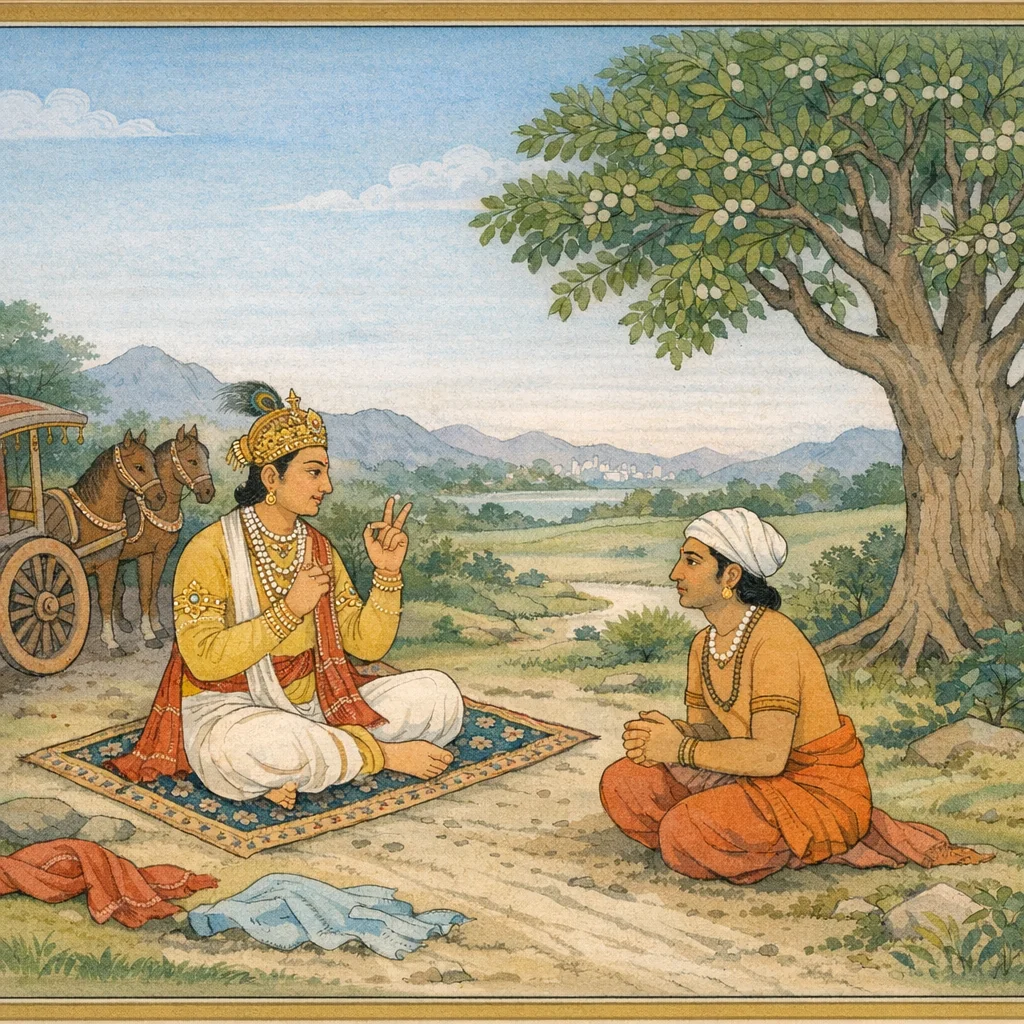
Adhyaya 72
Keśinī’s Inquiry to Bāhuka and the Emotional Signs of Concealed Identity (केशिन्याः बाहुकपरीक्षा)
Upa-parva: Nalopākhyāna (Tale of Nala and Damayantī)
Damayantī, observing a physically altered charioteer seated on a chariot, instructs her attendant Keśinī to approach with gentleness and ask precise questions to determine who he is, suspecting he may be Nala. Keśinī greets the man respectfully and conveys Damayantī’s questions: when the party departed, why they came, and who the third companion is. Bāhuka explains that King Ṛtuparṇa, having heard of Damayantī’s second svayaṃvara, set out swiftly with exceptional horses, and that Bāhuka serves as his charioteer and cook. He identifies the other companion as Vārṣṇeya, Nala’s well-known charioteer, and states that Nala left his children behind and now moves hidden in the world, unrecognized in altered form. Keśinī then recites the earlier lament voiced by Damayantī (as carried by a brāhmaṇa messenger), requesting the same reply again. Hearing it, Nala’s heart is distressed; he restrains himself, speaks in praise of steadfast women who do not become angry even in adversity, and then breaks into tears. Keśinī returns and reports both the content and Bāhuka’s visible emotional transformation to Damayantī.
Chapter Arc: तीव्र वेग से दौड़ते रथ में ऋतुपर्ण का उत्तरीय वस्त्र गिर पड़ता है—और उसी क्षण ‘बाहुक’ बने नल की असाधारण चपलता व नियंत्रण पर राजा की दृष्टि टिक जाती है। → ऋतुपर्ण, नल की रथ-विद्या से चकित होकर उसे परखने लगता है: मार्ग में खड़े बहेड़े (विभीतक) के वृक्ष के फलों और पत्तों की संख्या बताने की चुनौती उठती है। नल के भीतर छिपा हुआ ‘कली’ भी जलन और पीड़ा से तड़पता है—मानो विषधर नाग का दाह दिन-रात दे रहा हो। → ऋतुपर्ण गणना-विद्या का अद्भुत प्रदर्शन करता है—एक-एक शाखा, प्रशाखा, पत्ते और फल तक का सूक्ष्म हिसाब (पंचकोटि पत्तों जैसी अतिशयोक्त संख्या-छवियों सहित) सुनाकर नल को स्तब्ध कर देता है; नल के भीतर कली का दाह तीव्रतम हो उठता है, क्योंकि यह विद्या आगे चलकर ‘कली-निर्गमन’ का द्वार बनने वाली है। → ऋतुपर्ण नल से वचन लेता है कि वह उसे उसी दिन विदर्भ पहुँचा देगा ताकि सूर्य-दर्शन से पहले दमयंती तक पहुँचा जा सके; बदले में वह नल को अपनी ‘अक्षहृदय-ज्ञान’ और ‘संख्यान-कौशल’ की झलक/प्रतिज्ञा देता है। नल के मन में आशा और भय साथ-साथ जागते हैं—दमयंती के निकट पहुँचने की आशा, और कली के दाह से मुक्ति की अनकही आकांक्षा। → कली का दाह भीतर-भीतर बढ़ रहा है; ऋतुपर्ण की विद्या नल के भाग्य को पलटने वाली है—क्या यह ज्ञान नल को कली से मुक्त कर पाएगा और दमयंती से पुनर्मिलन का मार्ग खोलेगा?
Shlokas
Verse 1
हि आय >> () हि २ 7 द्विसप्ततितमो< ध्याय: ऋतुपर्णके उत्तरीय वस्त्र गिरने और बहेड़ेके वृक्षके फलोंको गिननेके विषयमें नलके साथ ऋतुपर्णकी बातचीत, ऋतुपर्णसे नलको द्यूतविद्याके रहस्यकी प्राप्ति और उनके शरीरसे कलियुगका निकलना बृहदश्च उवाच स नदी: पर्वतांश्षैव वनानि च सरांसि च | अचिरेणातिचक्राम खेचर: खे चरजन्निव,बृहदश्व मुनि कहते हैं--युधिष्ठिर! जैसे पक्षी आकाशमें उड़ता है, उसी प्रकार बाहुक (बड़े वेगसे) शीघ्रतापूर्वक कितनी ही नदियों, पर्वतों, वनों और सरोवरोंको लाँचघता हुआ आगे बढ़ने लगा
Bṛhadaśva said: Like a bird moving through the sky, Bāhuka sped swiftly onward, in a short time crossing rivers, mountains, forests, and lakes. The passage underscores purposeful endurance and disciplined effort in the midst of hardship, as the journey continues without delay or complaint.
Verse 2
तथा प्रयाते तु रथे तदा भाज़सुरिनृप: । उत्तरीयमधो<पश्यद् भ्रष्ट परपुरंजय:,जब रथ इस प्रकार तीव्र गतिसे दौड़ रहा था, उसी समय शत्रुओंके नगरोंको जीतनेवाले राजा ऋतुपर्णने देखा, उनका उत्तरीय वस्त्र नीचे गिर गया है
As the chariot sped on in that manner, the king—conqueror of hostile cities—noticed that his upper garment had slipped and fallen down. The moment underscores how, even amid urgent action, a ruler’s attention turns to propriety and self-control, reflecting the courtly ethic of maintaining decorum while pursuing one’s purpose.
Verse 3
ततः स त्वरमाणस्तु पटे निपतिते तदा । ग्रहीष्यामीति तं राजा नलमाह महामना:,उस समय वस्त्र गिर जानेपर उन महामना नरेशने बड़ी उतावलीके साथ नलसे कहा --“महामते! इस वेगशाली घोड़ोंको (थोड़ी देरके लिये) रोक लो। मैं अपनी गिरी हुई चादर लूँगा। जबतक यह वार्ष्णेय उतरकर मेरे उत्तरीय वस्त्रको ला दे, तबतक रथको रोके रहो”
Then, when his cloak had fallen, the noble king—hastening—addressed Nala: “I will pick it up. O wise one, hold these swift horses for a moment. Until Vārṣṇeya gets down and brings my upper garment, keep the chariot halted.” The scene underscores how urgency and practical need can momentarily interrupt a journey, while still relying on trust and duty among companions.
Verse 4
निगृह्लीष्व महाबुद्धे हपानेतान् महाजवान् । वार्ष्णेयो यावदेनं मे पटमानयतामिह,उस समय वस्त्र गिर जानेपर उन महामना नरेशने बड़ी उतावलीके साथ नलसे कहा --“महामते! इस वेगशाली घोड़ोंको (थोड़ी देरके लिये) रोक लो। मैं अपनी गिरी हुई चादर लूँगा। जबतक यह वार्ष्णेय उतरकर मेरे उत्तरीय वस्त्रको ला दे, तबतक रथको रोके रहो”
Bṛhadaśva said: “O great-minded one, restrain these swift horses for a moment. Let Vārṣṇeya get down and bring my fallen cloth here.” In the narrative, the king’s sudden concern for a dropped garment becomes the pretext for a brief halt—an opening that will be exploited, showing how small lapses of attention and haste can invite misfortune and test one’s steadiness and discernment (buddhi).
Verse 5
नलस्तं प्रत्युवाचाथ दूरे भ्रष्ट: पटस्तव । योजनं समतिक्रान्तो नाहतु शक््यते पुन:,यह सुनकर नलने उसे उत्तर दिया--“महाराज! आपका वस्त्र बहुत दूर गिरा है। मैं उस स्थानसे चार कोस आगे आ गया हूँ। अब फिर वह नहीं लाया जा सकता”
Hearing this, Nala replied, “O king, your garment has fallen far behind. I have already gone beyond it by a yojana; it cannot now be brought back again.” The reply underscores the practical limits of action once time and distance have intervened, and hints at the ethical tension between a request and what is realistically possible to fulfill.
Verse 6
एवमुक्तो नलेनाथ तदा भाज़सुरिरनप: । आससाद वने राजन् फलवन्तं बिभीतकम्,राजन्! नलके ऐसा कहनेपर राजा ऋतुपर्ण चुप हो गये। अब वे एक वनमें एक बहेड़ेके वृक्षेके पास आ पहुँचे, जिसमें बहुत-से फल लगे थे
Bṛhadaśva said: When Nala had spoken thus, then Bhājasuri—silent and without reply—came upon, in the forest, O king, a bibhītaka tree laden with fruit. The scene underscores restrained speech and attentive action: instead of argument, the king proceeds, letting deeds answer words.
Verse 7
तं दृष्टवा बाहुक॑ राजा त्वरमाणो5भ्यभाषत । ममापि सूत पश्य त्वं संख्याने परमं बलम्,उस वृक्षको देखकर राजा ऋतुपर्णने तुरंत ही बाहुकसे कहा--'सूत! तुम देखो, मुझमें भी गणना करने (हिसाब लगाने) की कितनी अद्भुत शक्ति है
Seeing that, King Ṛtupārṇa—Bāhuka’s master—spoke in haste: “Charioteer, look! I too possess extraordinary power in calculation.” In the narrative, the king’s boast is not mere vanity; it signals a specialized skill that will soon become ethically significant, as knowledge and competence are shown to have real consequences for trust, service, and the unfolding of events.
Verse 8
सर्व: सर्व न जानाति सर्वज्ञो नास्ति कश्षन | नैकत्र परिनिष्ठास्ति ज्ञानस्य पुरुषे क्वचित्,“सब लोग सभी बातें नहीं जानते। संसारमें कोई भी सर्वज्ञ नहीं है तथा एक ही पुरुषमें सम्पूर्ण ज्ञानकी प्रतिष्ठा नहीं है
Bṛhadaśva said: Not everyone knows everything. In this world there is no one who is truly omniscient, and complete knowledge is not firmly established in any single person. Therefore one should remain humble, learn from others, and avoid pride in one’s own understanding.
Verse 9
वृक्षेडस्मिन् यानि पर्णानि फलान्यपि च बाहुक | पतितान्यपि यान्यत्र तत्रैकमधिकं शतम्
Bṛhadaśva said: “O Bāhuka, the leaves and the fruits that belong to this tree—counting even those that have fallen here—amount to a hundred and one.”
Verse 10
एकपत्राधिकं चात्र फलमेकं॑ च बाहुक । पञ्चकोट्यो<5थ पत्राणां द्ायोरपि च शाखयो:
Bṛhadaśva said: “Here, O Bāhuka, there is one fruit more and one leaf more. Indeed, the two branches together bear five koṭis of leaves.” The statement underscores careful observation and exact reckoning—an ethical reminder that in matters of duty and decision, one should attend even to small differences, for they can reveal the true measure of a situation.
Verse 12
“बाहुक! इस वृक्षपर जितने पत्ते और फल हैं, उन सबको मैं बताता हूँ। पेड़के नीचे जो पत्ते और फल गिरे हुए हैं, उनकी संख्या एक सौ अधिक है, इसके सिवा एक पत्र तथा एक फल और भी अधिक है; अर्थात् नीचे गिरे हुए पत्तों और फलोंकी संख्या वृक्षमें लगे हुए पत्तों और फलोंसे एक सौ दो अधिक है। इस वृक्षकी दोनों शाखाओंमें पाँच करोड़ पत्ते हैं। तुम्हारी इच्छा हो तो इन दोनों शाखाओं तथा इसकी अन्य प्रशाखाओं (को काटकर उन)-के पत्ते गिन लो। इसी प्रकार इन शाखाओंमें दो हजार पंचानबे फल लगे हुए हैं ।। ततो रथमवस्थाप्य राजानं बाहुको<ब्रवीत् । परोक्षमिव मे राजन् कत्थसे शत्रुकर्शन,यह सुनकर बाहुकने रथ खड़ा करके राजासे कहा--“शत्रुसूदन नरेश! आप जो कह रहे हैं, वह संख्या परोक्ष है। मैं इस बहेड़ेके वृक्षको काटकर उसके फलोंकी संख्याको प्रत्यक्ष करूँगा। महाराज! आपकी आँखोंके सामने इस बहेड़ेको का्टूँगा। इस प्रकार गणना कर लेनेपर वह संख्या परोक्ष नहीं रह जायगी। बिना ऐसा किये मैं तो नहीं समझ सकता कि (फलोंकी) संख्या इतनी है या नहीं
Bṛhadaśva said: “Bāhuka, I can tell you the count of every leaf and fruit on this tree. The leaves and fruits that have fallen beneath it are a hundred more—and beyond that, one leaf and one fruit more still; in other words, what lies below exceeds what remains on the tree by one hundred and two. On the two main branches there are fifty million leaves. If you wish, cut these two branches and the other offshoots and count the leaves. Likewise, on these branches there are two thousand ninety-five fruits.” Hearing this, Bāhuka halted the chariot and said to the king: “O enemy-subduing ruler, what you claim is as though known only indirectly. I will cut down this bibhītaka tree and make the number of its fruits directly evident. Before your very eyes I shall fell it; once the counting is done, it will no longer be a matter of conjecture. Without doing so, I cannot accept whether the number is truly as you say.”
Verse 13
प्रत्यक्षमेतत् कर्तास्मि शातयित्वा बिभीतकम् | अथात्र गणिते राजन् विद्यते न परोक्षता,यह सुनकर बाहुकने रथ खड़ा करके राजासे कहा--“शत्रुसूदन नरेश! आप जो कह रहे हैं, वह संख्या परोक्ष है। मैं इस बहेड़ेके वृक्षको काटकर उसके फलोंकी संख्याको प्रत्यक्ष करूँगा। महाराज! आपकी आँखोंके सामने इस बहेड़ेको का्टूँगा। इस प्रकार गणना कर लेनेपर वह संख्या परोक्ष नहीं रह जायगी। बिना ऐसा किये मैं तो नहीं समझ सकता कि (फलोंकी) संख्या इतनी है या नहीं
Bṛhadaśva said: “I will make this matter directly evident by striking down the bibhītaka tree. Then, O king, in this calculation there will be nothing hidden or merely inferred. Once it is computed here before your eyes, the number will no longer remain ‘indirect’.”
Verse 14
प्रत्यक्ष ते महाराज शातयिष्ये बिभीतकम् | अहं हि नाभिजानामि भवेदेवं न वेति वा,यह सुनकर बाहुकने रथ खड़ा करके राजासे कहा--“शत्रुसूदन नरेश! आप जो कह रहे हैं, वह संख्या परोक्ष है। मैं इस बहेड़ेके वृक्षको काटकर उसके फलोंकी संख्याको प्रत्यक्ष करूँगा। महाराज! आपकी आँखोंके सामने इस बहेड़ेको का्टूँगा। इस प्रकार गणना कर लेनेपर वह संख्या परोक्ष नहीं रह जायगी। बिना ऐसा किये मैं तो नहीं समझ सकता कि (फलोंकी) संख्या इतनी है या नहीं
Bṛhadaśva said: “O great king, I shall make this bibhītaka tree’s count evident before your very eyes by striking it down. For without doing so, I cannot truly know whether the number is indeed so or not.”
Verse 15
संख्यास्थामि फलान्यस्य पश्यतस्ते जनाधिप । मुहूर्तमपि वार्ष्णेयो रश्मीन् यच्छतु वाजिनाम्,'जनेश्वर! यदि वारष्णेय दो घड़ीतक भी इन घोड़ोंकी लगाम सँभाले तो मैं आपके देखते-देखते इसके फलोंको गिन लूँगा”
Bṛhadaśva said: “O lord of men, while you look on, I shall count the fruits of this (tree). Let the Vārṣṇeya hold the reins of the horses even for a single muhūrta.”
Verse 16
तमब्रवीन्नप: सूतं नायं कालो विलम्बितुम् । बाहुकस्त्वब्रवीदेनं परं यत्न॑ं समास्थित:,तब राजाने सारथिसे कहा--“यह विलम्ब करनेका समय नहीं है।” बाहुक बोला--मैं प्रयत्नपूर्वक शीघ्र ही गणना समाप्त कर दूँगा। आप दो ही घड़ीतक प्रतीक्षा कीजिये। अथवा यदि आपको बड़ी जल्दी हो तो यह विदर्भदेशका मंगलमय मार्ग है, वाष्णेयको सारथि बनाकर चले जाइये'
Then the king addressed the charioteer: “This is not the time to delay.” But Bāhuka replied to him, having undertaken the utmost effort: “I will complete the reckoning swiftly—wait only for a short while. Or, if you are in great haste, this is the auspicious road to Vidarbha; set out with Vāṣṇeya as your charioteer.” The exchange highlights urgency balanced with disciplined competence: haste is acknowledged, yet right action requires measured, responsible execution.
Verse 17
प्रतीक्षस्व मुहूर्त त्वमथवा त्वरते भवान् । एष याति शिव: पन्था याहि वार्ष्णेयसारथि:,तब राजाने सारथिसे कहा--“यह विलम्ब करनेका समय नहीं है।” बाहुक बोला--मैं प्रयत्नपूर्वक शीघ्र ही गणना समाप्त कर दूँगा। आप दो ही घड़ीतक प्रतीक्षा कीजिये। अथवा यदि आपको बड़ी जल्दी हो तो यह विदर्भदेशका मंगलमय मार्ग है, वाष्णेयको सारथि बनाकर चले जाइये'
Bṛhadaśva said: “Wait for a moment—or, if you are in haste: this is an auspicious road. Go on, with the Vārṣṇeya as your charioteer.” The line conveys practical counsel in a time-sensitive situation: patience is offered as one option, but if urgency demands, one should proceed by a safe and ‘fortunate’ route with a capable guide.
Verse 18
अब्रवीदृतुपर्णस्तु सान्त्वयन् कुरुनन्दन । त्वमेव यन्ता नान्यो<5स्ति पृथिव्यामपि बाहुक,कुरुनन्दन! तब ऋतुपर्णने उसे सान्त्वना देते हुए कहा--“बाहुक! तुम्हीं इन घोड़ोंको हॉँक सकते हो। इस कलामें पृथ्वीपर तुम्हारे जैसा दूसरा कोई नहीं है
Bṛhadaśva said: Then King Ṛtuparṇa, consoling the son of Kuru, spoke: “Bāhuka, you alone can drive these horses. On this earth there is no other equal to you in this skill.”
Verse 19
त्वत्कृते यातुमिच्छामि विदर्भान् हयकोविद । शरणं त्वां प्रपन्नो5स्मि न विघ्नं कर्तुमहसि,'घोड़ोंके रहस्यको जाननेवाले बाहुक! तुम्हारे ही प्रयत्नसे मैं विदर्भदेशकी राजधानीमें पहुँचना चाहता हूँ। देखो, तुम्हारी शरणमें आया हूँ। इस कार्यमें विघ्न न डालो
For your sake and through your effort, O Bāhuka, knower of horses, I wish to travel to Vidarbha. See—I have come to you for refuge; you ought not to place any obstacle in this undertaking.
Verse 20
कामं च ते करिष्यामि यन्मां वक्ष्यसि बाहुक | विदर्भान् यदि यात्वाद्य सूर्य दर्शयितासि मे,“बाहुक! यदि आज विदर्भदेशमें पहुँचकर तुम मुझे सूर्यका दर्शन करा सको तो तुम जो कहोगे, तुम्हारी वही इच्छा पूर्ण करूँगा”
Bṛhadāśva said: “I will grant whatever you ask of me, O Bāhuka. If, having gone to Vidarbha today, you can show me the sun there, then whatever you say—your wish shall be fulfilled.”
Verse 21
अथाब्रवीद् बाहुकस्तं संख्याय च बिभीतकम् । ततो विदर्भान् यास्यामि कुरुष्वैवं वचो मम,यह सुनकर बाहुकने कहा--“मैं बहेड़ेके फलोंको गिनकर विदर्भदेशको चलूँगा। आप मेरी यह बात मान लीजिये”
Then Bāhuka said to him: “After counting the bibhītaka fruits, I shall set out for Vidarbha. Please act in accordance with my words.” The line underscores a practical ethic of orderly duty—finishing the task at hand and then proceeding with one’s intended course—spoken with calm resolve despite the speaker’s concealed identity.
Verse 22
अकाम इव तं राजा गणयस्वेत्युवाच ह | एकदेशं च शाखाया: समादिष्ट॑ मयानघ,राजाने मानो अनिच्छासे कहा--“अच्छा, गिन लो। अश्वविद्याके तत्त्वको जाननेवाले निष्पाप बाहुक! मेरे बताये अनुसार तुम शाखाके एक ही भागको गिनो। इससे तुम्हें बड़ी प्रसन्नता होगी'। बाहुकने रथसे उतरकर तुरंत ही उस वृक्षको काट डाला
Bṛhadaśva said: The king, as though unwilling, told him, “Go on—count it.” Then, O sinless one, he instructed him to count only a single portion of the branch as he had directed. The king added, “Very well, count it. O blameless Bāhuka, knower of the principles of horsemanship, count just that part of the branch according to my instruction; it will bring you great satisfaction.” Thereupon Bāhuka quickly descended from the chariot and at once cut down that tree.
Verse 23
गणयस्वाश्रृतत्त्वज्ञ ततस्त्वं प्रीतिमावह । सो<वतीर्य रथात् तूर्ण शातयामास त॑ टद्रुमम्,राजाने मानो अनिच्छासे कहा--“अच्छा, गिन लो। अश्वविद्याके तत्त्वको जाननेवाले निष्पाप बाहुक! मेरे बताये अनुसार तुम शाखाके एक ही भागको गिनो। इससे तुम्हें बड़ी प्रसन्नता होगी'। बाहुकने रथसे उतरकर तुरंत ही उस वृक्षको काट डाला
Bṛhadaśva said, “Count it, O sinless Bāhuka, knower of the principles of horsemanship and of what has been duly learned; by doing so you will bring me great satisfaction.” Then Bāhuka quickly descended from the chariot and at once cut down that tree—showing decisive skill and obedience to the instruction, and turning a test of knowledge into an act that proves competence in action.
Verse 24
ततः स विस्मयाविष्टो राजानमिदमत्रवीत् । गणयित्वा यथोक्तानि तावन्त्येव फलानि तु,गिननेसे उसे उतने ही फल मिले। तब उसने विस्मित होकर राजा ऋतुपर्णसे कहा --
Then, struck with astonishment, he said this to the king: “Having counted them exactly as you stated, the fruits are indeed just that many.” In the narrative, the line highlights truthful speech verified by careful reckoning, and the ethical force of accuracy and integrity in word and deed.
Verse 25
अत्यद्भुतमिदं राजन् दृष्टवानस्मि ते बलम् | श्रोतुमिच्छामि तां विद्यां ययैतज्ज्ञायते नूप,“राजन्! आपमें गणितकी यह अद्भुत शक्ति मैंने देखी है। नराधिप! जिस विद्यासे यह गिनती जान ली जाती है, उसे मैं सुनना चाहता हूँ।' राजा तुरंत जानेके लिये उत्सुक थे, अतः उन्होंने बाहुकसे कहा--“तुम मुझे द्यूत-विद्याका मर्मज्ञ और गणितमें अत्यन्त निपुण समझो'
Bṛhadaśva said: “O King, I have witnessed an astonishing power in you—your strength in calculation. O ruler of men, I wish to hear of that knowledge by which such counting is understood.”
Verse 26
तमुवाच ततो राजा त्वरितो गमने नृप । विद्धयक्षहृददयज्ञं मां संख्याने च विशारदम्,“राजन्! आपमें गणितकी यह अद्भुत शक्ति मैंने देखी है। नराधिप! जिस विद्यासे यह गिनती जान ली जाती है, उसे मैं सुनना चाहता हूँ।' राजा तुरंत जानेके लिये उत्सुक थे, अतः उन्होंने बाहुकसे कहा--“तुम मुझे द्यूत-विद्याका मर्मज्ञ और गणितमें अत्यन्त निपुण समझो'
Then the king, eager to depart, said: “Know me to be one who understands the very heart of dice-play, and one highly skilled in calculation.” In context, the statement signals a practical competence being asserted for a specific purpose, while also hinting at the moral tension in the epic between skill (vidyā) and the ethical risks of gambling (dyūta).
Verse 27
बाहुकस्तमुवाचाथ देहि विद्यामिमां मम । मत्तोडपि चाश्वह्नदयं गृहाण पुरुषर्षभ,बाहुकने कहा--'पुरुषश्रेष्ठ) तुम यह विद्या मुझे बतला दो और बदलेमें मुझसे भी अश्व-विद्याका रहस्य ग्रहण कर लो”
Then Bāhuka said to him: “Teach me this knowledge of yours. And in return, O best of men, accept from me as well the secret lore of horses (the science of horsemanship).” The verse frames learning as an ethical exchange—knowledge is sought with humility and offered with reciprocity rather than coercion.
Verse 28
ऋतुपर्णस्ततो राजा बाहुक॑ कार्यगौरवात् । हयज्ञानस्य लोभाच्च तं तथेत्यब्रवीद् वच:,तब राजा ऋतुपर्णने कार्यकी गुरुता और अश्व-विज्ञानके लोभसे बाहुकको आश्वासन देते हुए कहा--“तथास्तु”
Then King Ṛtuparṇa, weighing the urgency of his own business and tempted by the prospect of learning the secret of horsemanship, reassured Bāhuka and said, “So be it.”
Verse 29
यथोक्तं त्वं गृहाणेदमक्षाणां हृदयं परम् निक्षेपो मे5श्वह्दयं त्वयि तिष्ठतु बाहुक । एवमुकक््त्वा ददौ विद्यामृतुपर्णो नलाय वै,“बाहुक! तुम मुझसे द्यूत-विद्याका गूढ़ रहस्य ग्रहण करो और अभश्वविज्ञानको मेरे लिये अपने ही पास धरोहरके रूपमें रहने दो।” ऐसा कहकर ऋतुपर्णने नलको अपनी विद्या दे दी
Bṛhadaśva said: “As I have stated, accept from me this supreme ‘heart’—the innermost secret—of the dice. And let my deposit, the knowledge called Aśvahṛdaya (the science of horses), remain with you, O Bāhuka.” Having spoken thus, King Ṛtupārṇa indeed bestowed his knowledge upon Nala. In the narrative, this is an exchange of specialized skills: mastery over gambling is transmitted, while the horse-lore is held in trust—highlighting how knowledge can be treated as a moral obligation and a pledged responsibility rather than mere possession.
Verse 30
तस्याक्षहृददयज्ञस्य शरीरान्नि:सृत: कलि: । कर्कोटकविषं तीक्ष्णं मुखात् सततमुद्धमन्,द्यूत-विद्याका रहस्य जाननेके अनन्तर नलके शरीरसे कलियुग निकला। तब कर्कोटक नागके तीखे विषको अपने मुखसे बार-बार उगल रहा था। उस समय कष्टमें पड़े हुए कलियुगकी वह शापाग्नि भी दूर हो गयी। राजा नलको उसने दीर्घकालतक कष्ट दिया था और उसीके कारण वे किंकर्तव्यविमूढ हो रहे थे
Bṛhadaśva said: From the body of Kali—who had been the very heart of the dice-game sacrifice—there issued forth Kali himself. As he emerged, he kept repeatedly spewing from his mouth the sharp poison of the serpent Karkoṭaka. In that moment, the burning force of the curse that had clung to the afflicted Kali was driven away. For a long time he had tormented King Nala, and because of him Nala had been thrown into bewilderment about what ought to be done.
Verse 31
कलेस्तस्य तदार्तस्य शापाग्नि: स विनि:सृत: । स तेन कर्शितो राजा दीर्घकालमनात्मवान्,द्यूत-विद्याका रहस्य जाननेके अनन्तर नलके शरीरसे कलियुग निकला। तब कर्कोटक नागके तीखे विषको अपने मुखसे बार-बार उगल रहा था। उस समय कष्टमें पड़े हुए कलियुगकी वह शापाग्नि भी दूर हो गयी। राजा नलको उसने दीर्घकालतक कष्ट दिया था और उसीके कारण वे किंकर्तव्यविमूढ हो रहे थे
Bṛhadaśva said: From that afflicted Kali, the fire of the curse then issued forth and departed. King Nala, long tormented by him, had for a great while lost mastery of himself—bewildered in mind and driven from his proper discernment. The episode underscores how destructive influences and wrongdoing can eclipse self-control, yet also how such affliction can be expelled when the hidden cause is brought to light and countered.
Verse 32
ततो विषविमुक्तात्मा स्वं रूपमकरोत् कलि: । त॑ शप्तुमैच्छत् कुपितो निषधाधिपतिर्नलः,तदनन्तर विषके प्रभावसे मुक्त होकर कलियुगने अपने स्वरूपको प्रकट किया। उस समय निषधनरेश नलने कुपित हो कलियुगको शाप देनेकी इच्छा की
Then Kali, his being freed from the poison’s influence, revealed his own true form. At that moment Nala, the lord of Niṣadha, angered by what had occurred, wished to curse Kali—an impulse that underscores how righteous indignation can arise, yet must be weighed against restraint and discernment.
Verse 33
तमुवाच कलिभ्भीतो वेपमान: कृताञज्जलि: । कोपं॑ संयच्छ नृपते कीर्ति दास्यामि ते पराम्,तब कलियुग भयभीत हो काँपता हुआ हाथ जोड़कर उनसे बोला--“महाराज! अपने क्रोधको रोकिये। मैं आपको उत्तम कीर्ति प्रदान करूँगा
Trembling in fear of Kali, with palms joined in supplication, he addressed the king: “O ruler, restrain your anger. I shall bestow upon you the highest renown.” The moment frames a moral appeal—self-control in the face of provocation—linking royal conduct to lasting fame.
Verse 34
इन्द्रसेनस्थ जननी कुपिता माशपत् पुरा । यदा त्वया परित्यक्ता ततो5हं भूशपीडितः,“इन्द्रसेनकी माता दमयन्तीने, पहले जब उसे आपने वनमें त्याग दिया था, कुपित होकर मुझे शाप दे दिया। उससे मैं बड़ा कष्ट पाता रहा हूँ
Bṛhadaśva said: “Indrasena’s mother, Damayantī, once in anger pronounced a curse. From the time you abandoned her in the forest, I have been tormented by that curse and have suffered greatly.”
Verse 35
अवसं त्वयि राजेन्द्र सुदुः:खमपराजित । विषेण नागराजस्य दहा[मानो दिवानिशम्,“किसीसे पराजित न होनेवाले महाराज! मैं आपके शरीरमें अत्यन्त दु:खित होकर रहता था। नागराज कर्कोटकके विषसे मैं दिन-रात झुलसता जा रहा था (इस प्रकार मुझे अपने कियेका कठोर दण्ड मिल गया है)
Bṛhadaśva said: “O king of men, unconquered one, I dwelt within you in extreme misery. Burned day and night by the venom of the serpent-king, I was being scorched—thus receiving a harsh recompense for my own deed.”
Verse 36
शरणं त्वां प्रपन्नो5स्मि शृणु चेदं॑ वचो मम । येच त्वां मनुजा लोके कीर्तयिष्यन्त्यतन्द्रिता: । मत्प्रसूतं भयं तेषां न कदाचिद् भविष्यति,“अब मैं आपकी शरणमें हूँ। आप मेरी यह बात सुनिये। यदि भयसे पीड़ित और शरणमें आये हुए मुझको आप शाप नहीं देंगे तो संसारमें जो मनुष्य आलस्यरहित हो आपकी कीर्ति-कथाका कीर्तन करेंगे, उन्हें मुझसे कभी भय नहीं होगा।” कलियुगके ऐसा कहनेपर राजा नलने अपने क्रोधको रोक लिया
“I have come to you for refuge; please listen to what I say. If you do not curse me—though I am frightened and have sought your protection—then those people in the world who, without negligence, proclaim your fame will never at any time be afraid of the danger that arises from me.”
Verse 37
भयार्त शरणं यात॑ यदि मां त्वं न शप्स्यसे । एवमुक्तो नलो राजा न्ययच्छत् कोपमात्मन:,“अब मैं आपकी शरणमें हूँ। आप मेरी यह बात सुनिये। यदि भयसे पीड़ित और शरणमें आये हुए मुझको आप शाप नहीं देंगे तो संसारमें जो मनुष्य आलस्यरहित हो आपकी कीर्ति-कथाका कीर्तन करेंगे, उन्हें मुझसे कभी भय नहीं होगा।” कलियुगके ऐसा कहनेपर राजा नलने अपने क्रोधको रोक लिया
Bṛhadaśva said: “If, when I have come to you in fear and seeking refuge, you will not curse me, then those in the world who are free from sloth and who recite the account of your fame will never have cause to fear me.” When Kali spoke thus, King Nala restrained the anger within himself.
Verse 38
ततो भीत: कलि: क्षिप्रं प्रविवेश बिभीतकम् | कलिस्त्वन्यैस्तदादृश्य: कथयन् नैषधेन वै,तदनन्तर कलियुग भयभीत हो तुरंत ही बहेड़ेके वृक्षमें समा गया। वह जिस समय निषधराज नलके साथ बात कर रहा था, उस समय दूसरे लोग उसे नहीं देख पाते थे
Then Kali, frightened, quickly entered the bibhītaka tree to hide. And while he was speaking with Nala, the king of Niṣadha, Kali could not be seen by anyone else—his presence remained concealed from all others.
Verse 39
ततो गतज्वरो राजा नैषध: परवीरहा । सम्प्रणष्टे कलौ राजा संख्यायास्य फलान्युत,तदनन्तर कलियुगके अदृश्य हो जानेपर शत्रुवीरोंका संहार करनेवाले निषधनरेश राजा नल सारी चिन्ताओंसे मुक्त हो गये। बहेड़ेके फलोंको गिनकर उन्हें बड़ी प्रसन्नता हुई। वे उत्तम तेजसे युत्ह तेजस्वी रूप धारण करके रथपर चढ़े और वेगशाली घोड़ोंको हाँकते हुए विदर्भदेशको चल दिये
Then King Nala of Niṣadha—slayer of hostile heroes—was freed from his feverish distress. When Kali had vanished, the king, counting those fruits, felt renewed satisfaction and relief, as his mind returned to clarity after the departure of the evil influence.
Verse 40
मुदा परमया युक्तस्तेजसाथ परेण वै । रथमारुह् तेजस्वी प्रययौं जवनैर्हयै:,तदनन्तर कलियुगके अदृश्य हो जानेपर शत्रुवीरोंका संहार करनेवाले निषधनरेश राजा नल सारी चिन्ताओंसे मुक्त हो गये। बहेड़ेके फलोंको गिनकर उन्हें बड़ी प्रसन्नता हुई। वे उत्तम तेजसे युत्ह तेजस्वी रूप धारण करके रथपर चढ़े और वेगशाली घोड़ोंको हाँकते हुए विदर्भदेशको चल दिये
Bṛhadaśva said: Filled with supreme joy and endowed with extraordinary splendor, the radiant king mounted his chariot and set out, driving his swift horses onward. In the narrative flow, this marks Nala’s release from anxiety after the malign influence has vanished, and his renewed resolve to return to Vidarbha with restored confidence and dignity.
Verse 41
बिभीतकश्षाप्रशस्त: संवृत्त: कलिसंश्रयात् । हयोत्तमानुत्पततो द्विजानिव पुन: पुन:,कलियुगके आश्रय लेनेसे बहेड़ेका वृक्ष निन्दित हो गया। तदनन्तर राजा नलने प्रसन्नचित्तसे पुनः घोड़ोंको हाँकना आरम्भ किया। वे उत्तम अश्व पक्षियोंकी तरह बार-बार उड़ते हुए-से प्रतीत हो रहे थे। अब महायशस्वी राजा नल विदर्भदेशकी ओर (बड़े वेगसे बढ़े) जा रहे थे
Bṛhadaśva said: “Because it had become a refuge of Kali, the bibhītaka tree came to be spoken of with reproach. Thereafter King Nala, his mind restored to cheerfulness, again began to urge on the horses. Those excellent steeds seemed to leap again and again like birds taking flight. Thus the illustrious King Nala sped swiftly toward the land of Vidarbha.”
Verse 42
नल: संचोदयामास प्रहृष्टेनान्तरात्मना । विदर्भाभिमुखो राजा प्रययौ स महायशा:,कलियुगके आश्रय लेनेसे बहेड़ेका वृक्ष निन्दित हो गया। तदनन्तर राजा नलने प्रसन्नचित्तसे पुनः घोड़ोंको हाँकना आरम्भ किया। वे उत्तम अश्व पक्षियोंकी तरह बार-बार उड़ते हुए-से प्रतीत हो रहे थे। अब महायशस्वी राजा नल विदर्भदेशकी ओर (बड़े वेगसे बढ़े) जा रहे थे
Nala, his inner self filled with joy, urged the horses onward again. The illustrious king set out, facing toward Vidarbha, pressing ahead with renewed resolve—signaling a moral turning point after the shadow of Kali’s influence begins to lift and the path back to rightful order opens before him.
Verse 43
नले तु समतिक्रान्ते कलिरप्यगमद् गृहम् । ततो गतज्वरो राजा नलो<भूत् पृथिवीपति: । विमुक्त: कलिना राजन् रूपमात्रवियोजित:,नलके चले जानेपर कलि अपने घर चले गये। राजन्! कलिसे मुक्त हो भूमिपाल राजा नल सारी चिन्ताओंसे छुटकारा पा गये; किंतु अभीतक उन्हें अपना पहला रूप नहीं प्राप्त हुआ था। उनमें केवल इतनी ही कमी रह गयी थी
When Nala had passed beyond (that condition), Kali too departed for his own abode. Then King Nala, freed from his burning affliction, again became a sovereign of the earth. Released from Kali’s grip, O king, he was separated only from his former appearance—this alone still remained lacking.
Verse 71
इस प्रकार श्रीमह्याभारत वनपर्वके अन्तर्गत नलोपाख्यानपर्वमें ऋतुपर्णका विदर्भदिशमें गमनविषयक इकहतत्तरवाँ अध्याय पूरा हुआ
Thus ends the seventy-first chapter of the Nala episode within the Vana Parva of the Mahābhārata, describing King Ṛtūparṇa’s journey toward the land of Vidarbha. The colophon signals a narrative transition: the king’s purposeful movement sets the stage for the next turn of events, where resolve, duty, and the consequences of past choices continue to unfold.
Verse 72
इति श्रीमहाभारते वनपर्वणि नलोपाख्यानपर्वणि कलिनिर्गमे द्विसप्ततितमो< ध्याय:,इस प्रकार श्रीमह्याभारत वनपर्वके अन्तर्गत नलोपाख्यानपर्वमें कलियुगनिर्गगनविषयक बहत्तरवाँ अध्याय पूरा हुआ
Thus, in the Śrī Mahābhārata, within the Vana Parva, in the section known as the Tale of Nala, the seventy-second chapter—describing the departure (withdrawal) of Kali—comes to an end. The colophon marks the close of this unit, signaling that the moral disorder personified by Kali has receded from the narrative at this point, and the episode’s arc moves toward restoration and resolution.
Verse 131
प्रचिनुह्मास्य शाखे द्वे याश्चाप्यन्या: प्रशाखिका: । आशभ्यां फलसहसे द्वे पज्चोनं शतमेव च
Bṛhadaśva said: “Let us gather its two main branches, and also whatever other offshoot-branches there are. From these two branches, we may hope to obtain two thousand bundles of fruit, and a hundred less by five as well.”
Frequently Asked Questions
The dilemma is how to balance truth, privacy, and safety when identity is concealed: Damayantī seeks certainty without rash accusation, while Nala (as Bāhuka) navigates truthful speech without self-exposure.
The passage foregrounds endurance and self-governance: exemplary persons restrain reactive anger in hardship, preserve integrity, and respond to suffering with disciplined speech rather than escalation.
No explicit phalaśruti appears here; the meta-function is evidentiary and pedagogical—showing how inner truth surfaces through controlled dialogue and involuntary affect within the epic’s ethical case-study format.