Adhyaya 21
Dvārakā’s Distress and the Saubha Engagement (द्वारकाव्यग्रता तथा सौभयुद्धम्)
Upa-parva: Dvārikā–Śālva-yuddha Upākhyāna (Vāsudeva’s account of Śālva and Saubha)
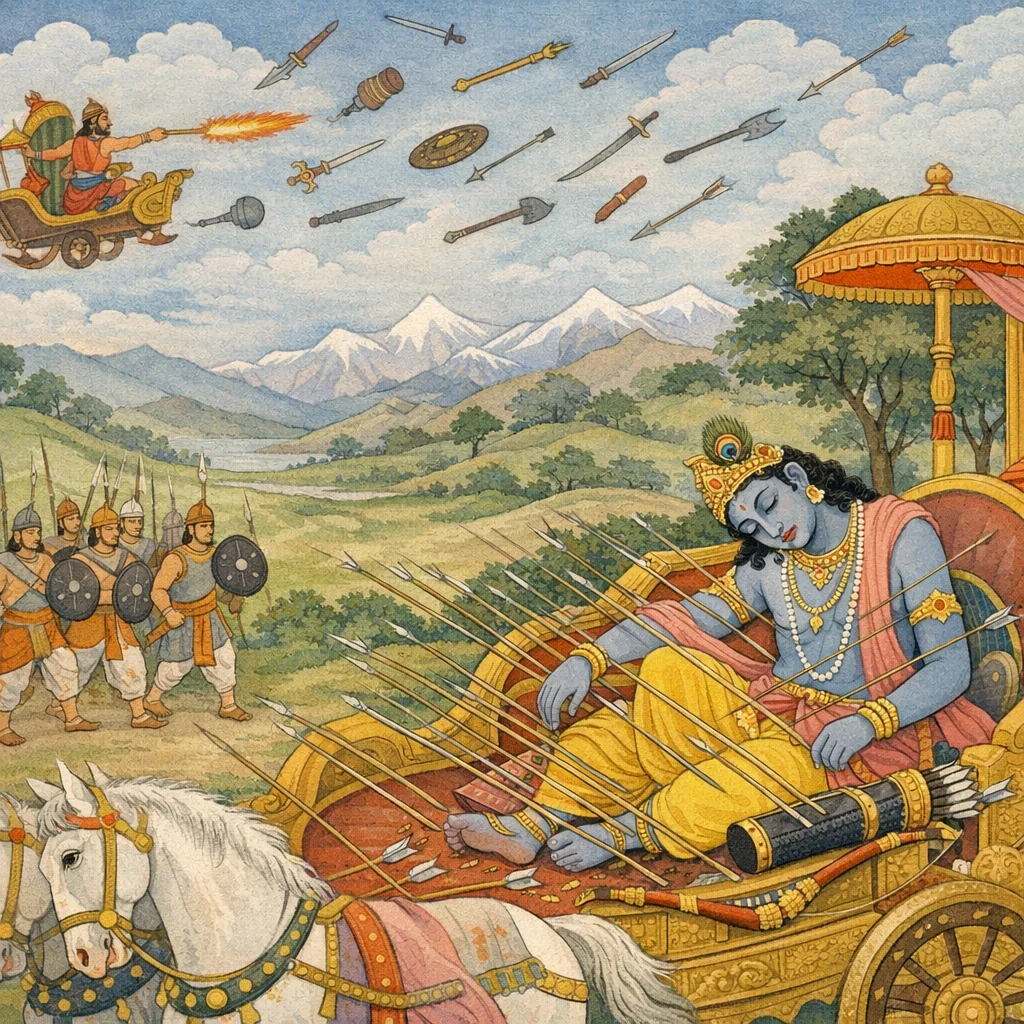
Vāsudeva reports that after departing Ānarta and following the completion of the Rājasūya, he arrives at Dvārakā and observes signs of civic decline and anxiety: disrupted recitation and ritual calls, and a cityscape rendered unfamiliar. He questions Hārdikya (Kṛtavarmā), who explains Śālva’s earlier blockade and release. Having heard the full account, Krishna resolves upon Śālva’s destruction, reassures the populace and senior Yādava authorities (including Āhuka and Ānakadundubhi), and issues a standing directive of vigilance. He departs with a prepared fourfold force, sounds the Pāñcajanya conch, traverses multiple regions, and learns that Śālva has taken to Saubha. The pursuit reaches the sea where Saubha remains sky-bound; Śālva repeatedly challenges Krishna. A high-volume exchange follows: Śālva’s forces obscure Krishna’s chariot, horses, and charioteer Dāruka with dense missile volleys; Krishna counters with consecrated/divine missiles. Observers respond as if at a spectacle, while Saubha’s defenders suffer heavy losses. Śālva then escalates to māyā-yuddha, projecting confusing alternations of darkness and light and multiplying celestial appearances so that directions and time become indistinct. Krishna, momentarily affected, deploys a prajñā-astra to restore discernment, disperses the illusion, and resumes the engagement with regained clarity.
Chapter Arc: सौभ-वध की कथा आगे बढ़ती है—शाल्व क्रोध में अन्धाधुन्ध अस्त्रों की वर्षा करता है और कृष्ण के रथ पर भीषण आघात पड़ता है। → शाल्व शतघ्नियाँ, गदाएँ, शूल, मुसल और असि फेंकता है; कृष्ण आकाश में ही तीव्र बाणों से उन्हें काट-काटकर निष्फल करते हैं। फिर शाल्व लाखों झुकी-गाँठ वाले बाणों से दारुक, घोड़ों और रथ को ढँक देता है; घावों से रक्त बहता है और रण का कोलाहल बढ़ता जाता है। → माया-प्रयोग से कृष्ण पर मोह छा जाता है—उनका शार्ङ्ग धनुष हाथ से गिर पड़ता है और वे रथोपस्थ पर बैठ जाते हैं; शत्रु-सैनिक शूल-पट्टिश लिए झपटते हैं, और क्षण भर को विजय का पलड़ा शाल्व की ओर झुकता दिखता है। → कुछ ही समय बाद कृष्ण को संज्ञा लौटती है; वे समझ जाते हैं कि यह माया है। जाग्रत होकर वे पुनः शतशः बाणों की वर्षा करते हैं और शाल्व की छल-छाया को भेदने का संकल्प दृढ़ करते हैं। → माया का आवरण हटते ही कृष्ण का प्रत्याघात आरम्भ होता है—अब शाल्व और सौभ-नगर पर निर्णायक प्रहार किस रूप में पड़ेगा?
Shlokas
Verse 1
इस प्रकार श्रीमह्याभारत वनपर्वके अन्तर्गत अ्जुनाभिगमनपर्वमें सौभवधोपाख्यानविषयक बीसवाँ अध्याय पूरा हुआ ॥/ २० ॥। हि मय ० (0) है 7 एकविशो< ध्याय: श्रीकृष्णका शाल्वकी ला मोहित होकर पुन: सजग ना वायुदेव उवाच एवं स पुरुषव्यात्र शाल्वराजो महारिपु: । युध्यमानो मया संख्ये वियदभ्यगमत् पुनः,भगवान् श्रीकृष्ण कहते हैं--पुरुषसिंह! इस प्रकार मेरे साथ युद्ध करनेवाला महाशत्रु शाल्वराज पुनः: आकाशमें चला गया
Vāyudeva said: “Thus, O tiger among men, that king Śālva—my great enemy—though engaged in battle with me in the thick of combat, once again rose up and withdrew into the sky.”
Verse 2
ततः शतघ्नीश्ष महागदाश्ष दीप्तांक्ष शूलान् मुसलानसीं श्व॒ चिक्षेप रोषान्मयि मन्दबुद्धि: शाल्वो महाराज जयाभिकाडुक्षी,महाराज! वहाँसे विजयकी इच्छा रखनेवाले मन्दबुद्धि शाल्वने क्रोधमें भरकर मेरे ऊपर शतघ्नियाँ, बड़ी-बड़ी गदाएँ, प्रजजलित शूल, मुसल और खड्ग फेंके
Verse 3
तानाशुगैरापततो5हमाशु निवार्य हन्तुं खगमान् ख एव । द्विधा त्रिधा चाच्छिदमाशुमुक्ति- स्ततो<न्तरिक्षे निनदो बभूव,उनके आते ही मैंने तुरंत शीघ्रगामी बाणोंद्वारा उन्हें रोककर उन गगनचारी शत्रुओंको आकाशमें ही मार डालनेका निश्चय किया और शीघ्र छोड़े हुए बाणोंद्वारा उन सबके दो-दो तीन-तीन टुकड़े कर डाले। इससे अन्तरिक्षमें बड़ा भारी आर्त्तनाद हुआ
Vāyu said: “As those swift-flying foes came rushing in, I quickly checked them with rapid arrows, resolved to slay those sky-ranging adversaries right there in the air. With my swiftly released shafts I cut them into two and three pieces; and from that, a great clamour arose throughout the mid-sky.”
Verse 4
तत:ः शतसहस्तरेण शराणां नतपर्वणाम् । दारुकं वाजिनश्लैव रथं च समवाकिरत्,तदनन्तर शाल्वने झुकी हुई गाँठोंवाले लाखों बाणोंका प्रहार करके मेरे सारथि दारुक, घोड़ों तथा रथको आच्छादित कर दिया
Then, with a hundred thousand arrows whose joints were bent (i.e., barbed and hard to extract), he completely showered and covered Dāruka, the horses, and the chariot. The scene underscores how, in the fury of battle, even the charioteer and steeds—supports of a warrior’s duty—become targets, intensifying the trial of steadiness and righteous conduct amid violence.
Verse 5
ततो मामब्रवीद् वीर दारुको विह्वलन्निव । स्थातव्यमिति तिष्ठामि शाल्वबाणप्रपीडित: । अवस्थातुं न शकनोमि अज्ुू मे व्यवसीदति,वीरवर! तब दारुक व्याकुल-सा होकर मुझसे बोला--'प्रभो! युद्धमें डटे रहना चाहिये” इस कर्तव्यका स्मरण करके ही मैं यहाँ ठहरा हुआ हूँ; किंतु शाल्वके बाणोंसे अत्यन्त पीड़ित होनेके कारण मुझमें खड़े रहनेकी भी शक्ति नहीं रह गयी है। मेरा अंग शिथिल होता जा रहा है!
Then Dāruka, as if overcome with confusion, spoke to me: “O hero, one must stand firm in battle—remembering this duty alone I remain here. Yet, tormented by Śālva’s arrows, I no longer have the strength even to keep standing; my limbs are failing and sinking into weakness.”
Verse 6
इति तस्य निशम्याहं सारथे: करुणं वच: । अवेक्षमाणो यन्तारमपश्यं शरपीडितम्,सारथिका यह करुण वचन सुनकर मैंने उसकी ओर देखा। उसे बाणोंद्वारा बड़ी पीड़ा हो रही थी
Hearing those pitiful words of the charioteer, I looked toward the driver. As I watched, I saw him grievously afflicted—tormented by arrows. The scene underscores the moral weight of violence: even those who serve and do not seek combat become unintended sufferers, calling forth compassion and a sense of responsibility in the witness.
Verse 7
न तस्योरसि नो मूर्थ्नि न काये न भुजद्धये । अन्तरं पाण्डवश्रेष्ठ पश्याम्यनिचितं शरै:,पाण्डवश्रेष्ठ! उसकी छातीमें, मस्तकपर, शरीरके अन्य अवयवोंमें तथा दोनों भुजाओंमें थोड़ा-सा भी ऐसा स्थान नहीं दिखायी देता था, जिसमें बाण न चुभे हुए हों। जैसे मेघके वर्षा करनेपर गेरू आदि धातुओंसे युक्त पर्वत लाल पानीकी धारा बहाने लगता है, वैसे ही वह बाणोंसे छिदे हुए अपने अंगोंसे भयंकर रक्तकी धारा बहा रहा था
Vāyu said: “O best of the Pāṇḍavas, I see no space—on his chest, on his head, on his body, or on either arm—that is not pierced by arrows. Like a mountain rich in red minerals that, when drenched by rainclouds, begins to pour forth crimson streams, so he—his limbs riddled with shafts—was letting loose a dreadful torrent of blood.”
Verse 8
स तु बाणवरोत्पीडाद् विस््रवत्यसृगुल्बणम् | अभिवृष्टे यथा मेघे गिरिगैरिकधातुमान्,पाण्डवश्रेष्ठ! उसकी छातीमें, मस्तकपर, शरीरके अन्य अवयवोंमें तथा दोनों भुजाओंमें थोड़ा-सा भी ऐसा स्थान नहीं दिखायी देता था, जिसमें बाण न चुभे हुए हों। जैसे मेघके वर्षा करनेपर गेरू आदि धातुओंसे युक्त पर्वत लाल पानीकी धारा बहाने लगता है, वैसे ही वह बाणोंसे छिदे हुए अपने अंगोंसे भयंकर रक्तकी धारा बहा रहा था
Vāyu said: “But, tormented by the pressure of the arrows, he began to pour forth a dreadful stream of blood. Just as, when a cloud rains heavily, a mountain rich in red ochre and mineral pigments sends down reddish torrents of water, so too did he—his limbs pierced through by arrows—let loose fearsome flows of blood.”
Verse 9
अभीषु हस्तं त॑ं दृष्टवा सीदन्तं सारथिं रणे | अस्तम्भयं महाबाहो शाल्वबाणप्रपीडितम्,महाबाहो! उस युद्धमें हाथमें बागडोर लिये सारथिको शाल्वके बाणोंसे पीड़ित होकर वष्ट पाते देख मैंने उसे ढाढ़स बँधाया
Vāyu said: Seeing that charioteer on the battlefield—his hand still holding the reins—sinking in spirit and crushed by Śālva’s arrows, I steadied him and restored his courage, O mighty-armed one. In the midst of war, the duty to uphold a comrade’s resolve becomes itself an act of dharma, for the chariot and its cause cannot stand when the guide loses heart.
Verse 10
अथ मां पुरुष: कश्रिद् द्वारकानिलयोडब्रवीत् | त्वरितो रथमभ्येत्य सौहदादिव भारत,भरतवंशी वीरवर! इतनेमें ही कोई द्वारकावासी पुरुष आकर तुरंत मेरे रथपर चढ़ गया और सौहार्द दिखाता हुआ-सा बोला। वह राजा उमग्रसेनका सेवक था और दुःखी होकर उसने गद्गदकण्ठसे उनका जो संदेश सुनाया, उसे बताता हूँ, सुनिये
Then a certain man, a resident of Dvārakā, addressed me. Hastening up to my chariot, he spoke as though out of friendly concern, O Bhārata. The scene conveys the urgency of duty-bound communication: a messenger, moved by distress, brings word that must be heard without delay, reminding the listener that timely counsel and loyal service are themselves forms of dharma.
Verse 11
आहुकस्य वचो वीर तस्यैव परिचारक: । विषण्ण: सन्नकण्ठेन तन्निबोध युधिछिर,भरतवंशी वीरवर! इतनेमें ही कोई द्वारकावासी पुरुष आकर तुरंत मेरे रथपर चढ़ गया और सौहार्द दिखाता हुआ-सा बोला। वह राजा उमग्रसेनका सेवक था और दुःखी होकर उसने गद्गदकण्ठसे उनका जो संदेश सुनाया, उसे बताता हूँ, सुनिये
O hero, a servant of Āhuka (Ugrasena) came, distressed and with a choked voice. O Yudhiṣṭhira, listen carefully to the message he conveyed. The scene underscores how truthful reporting of grave news, even when painful, is a duty, and how a righteous king must receive such words with steadiness and discernment.
Verse 12
द्वारकाधिपतिर्वीर आह त्वामाहुको वच: । केशवैहि विजानीष्व यत् त्वां पितृसखो<ब्रवीत्,(दूत बोला--) “वीर! द्वारकानरेश उग्रसेनने आपको यह एक संदेश दिया है। केशव! वे आपके पिताके सखा हैं; उन्होंने आपसे कहा है कि यहाँ आ जाओ और जान लो
Vāyu said: “O hero, the lord of Dvārakā—Āhuka—has sent you this message. O Keśava, he is a friend of your father; therefore come here and learn what he has spoken to you.” The verse frames a summons grounded in kinship and duty: a trusted elder’s word, carried by a messenger, calls Kṛṣṇa to respond responsibly within the bonds of family alliance and righteous conduct.
Verse 13
उपायायाद्य शाल्वेन द्वारकां वृष्णिनन्दन । विषक्ते त्वयि दुर्धर्ष हतः शूरसुतो बलात्,“दुर्धर्ष वृष्णिनन्दन! आपके युद्धमें आसक्त होनेपर शाल्वने अभी द्वारकापुरीमें आकर शूरनन्दन वसुदेवजीको बलपूर्वक मार डाला है
Vāyu said: “O descendant of the Vṛṣṇis, O invincible one—while you were absorbed in battle, Śālva has now come to Dvārakā and, by force, has slain Śūra’s son (Vasudeva).” The message is meant to shake the hero from single-minded martial focus and remind him of his wider dharmic responsibility: protecting one’s people and elders is also a duty, and war without vigilance can invite calamity at home.
Verse 14
तदलं साधु युद्धेन निवर्तस्व जनार्दन | द्वारकामेव रक्षस्व कार्यमेतन्महत् तव,“जनार्दन! अब युद्ध करके क्या लेना है? लौट आओ। द्वारकाकी ही रक्षा करो। तुम्हारे लिये यही सबसे महान् कार्य है”
Vāyu said: “Enough, O Janārdana—what is to be gained by fighting now? Turn back. Protect Dvārakā alone; for you, this is the greatest duty at present.” The counsel shifts Kṛṣṇa’s focus from immediate combat to the higher responsibility of safeguarding his people and realm, implying that righteous action depends on context and the larger welfare one is entrusted with.
Verse 15
इत्यहं तस्य वचन श्रुत्वा परमदुर्मना: । निशक्ष॒यं नाधिगच्छामि कर्तव्यस्येतरस्य च,दूतका यह वचन सुनकर मेरा मन उदास हो गया। मैं कर्तव्य और अकर्तव्यके विषयमें कोई निश्चय नहीं कर पाता था
Hearing his words, I became deeply despondent. I could not arrive at any firm resolve about what ought to be done and what ought not to be done—my judgment about duty and its opposite was thrown into doubt.
Verse 16
सात्यकिं बलदेवं च प्रद्युम्नं च महारथम् । जगहें मनसा वीर तच्छुत्वा महदप्रियम्,वीर युधिष्ठिर! वह महान् अप्रिय वृत्तान्त सुनकर मैं मन-ही-मन सात्यकि, बलरामजी तथा महारथी प्रद्युम्नकी निन्दा करने लगा
Vāyu said: “O hero, having heard that deeply distressing report, I reproached—within my own mind—Sātyaki, Baladeva, and the great chariot-warrior Pradyumna.” The line conveys an ethical tension: even revered allies may become objects of inner censure when their conduct (or perceived failure) is thought to have enabled harm or injustice.
Verse 17
अहं हि द्वारकायाश्न पितुश्न कुरुनन्दन । तेषु रक्षां समाधाय प्रयातः सौभपातने,कुरुनन्दन! मैं द्वारका तथा पिताजीकी रक्षाका भार उन्हीं लोगोंपर रखकर सौभविमानका नाश करनेके लिये चला था
Vāyu said: “O delight of the Kurus, I entrusted the protection of Dvārakā and of my father to those very guardians, and then set out to bring about the destruction of the Saubha aerial city. The point is that even a mighty undertaking should be preceded by responsible delegation of protection and duty, so that one’s larger mission does not become an excuse for neglecting immediate obligations.”
Verse 18
बलदेवो महाबाहुः कच्चिज्जीवति शत्रुहा । सात्यकी रौक्मिणेयश्व चारुदेष्णश्न वीर्यवान्,क्या शत्रुहन्ता महाबली बलरामजी जीवित हैं? क्या सात्यकि, रुक्मिणीनन्दन प्रद्युम्न, महाबली चारुदेष्ण तथा साम्ब आदि जीवन धारण करते हैं? इन बातोंका विचार करते- करते मेरा मन बहुत उदास हो गया। नरश्रेष्ठ! इन वीरोंके जीते-जी साक्षात् इन्द्र भी मेरे पिता वसुदेवजीको किसी प्रकार मार नहीं सकते थे। अवश्य ही शूरनन्दन वसुदेवजी मारे गये और यह भी स्पष्ट है कि बलरामजी आदि सभी प्रमुख वीर प्राणत्याग कर चुके हैं--यह मेरा निश्चित विचार हो गया। महाराज! इस प्रकार सबके विनाशका बारंबार चिन्तन करके भी मैं व्याकुल न होकर राजा शाल्वसे पुन: युद्ध करने लगा
Vāyu said: “Does mighty-armed Baladeva, the slayer of foes, still live? And do Sātyaki, Rukmiṇī’s son (Pradyumna), and the valiant Cārudeṣṇa yet sustain their lives?” As he turned these thoughts over and over, his mind grew heavy with grief. For while such heroes lived, not even Indra himself could have found a way to kill my father Vasudeva. Therefore I have come to a grim certainty: surely Vasudeva, the son of Śūra, has been slain—and it is plain that Baladeva and the other foremost warriors have also abandoned their lives. Yet, O King, even while repeatedly contemplating this ruin of all, I did not collapse into helpless agitation; I returned again to battle against King Śālva.
Verse 19
साम्बप्रभृतयश्चैवेत्यहमासं सुदुर्मना: । एतेषु हि नरव्याप्र जीवत्सु न कथंचन,क्या शत्रुहन्ता महाबली बलरामजी जीवित हैं? क्या सात्यकि, रुक्मिणीनन्दन प्रद्युम्न, महाबली चारुदेष्ण तथा साम्ब आदि जीवन धारण करते हैं? इन बातोंका विचार करते- करते मेरा मन बहुत उदास हो गया। नरश्रेष्ठ! इन वीरोंके जीते-जी साक्षात् इन्द्र भी मेरे पिता वसुदेवजीको किसी प्रकार मार नहीं सकते थे। अवश्य ही शूरनन्दन वसुदेवजी मारे गये और यह भी स्पष्ट है कि बलरामजी आदि सभी प्रमुख वीर प्राणत्याग कर चुके हैं--यह मेरा निश्चित विचार हो गया। महाराज! इस प्रकार सबके विनाशका बारंबार चिन्तन करके भी मैं व्याकुल न होकर राजा शाल्वसे पुन: युद्ध करने लगा
Vāyu said: “Thinking of Sāmba and the others, my heart sank into deep dejection. For, O tiger among men, so long as those heroes were alive, it could never be that my father Vasudeva would be slain—indeed, not even Indra himself could have killed him while they yet lived. I began to ask within myself: Is the mighty enemy-slayer Balarāma still alive? Do Sātyaki, Pradyumna the son of Rukmiṇī, the powerful Cārudeṣṇa, and Sāmba and the rest still draw breath? As these thoughts turned again and again in my mind, I grew exceedingly sorrowful. Therefore I concluded with certainty: Vasudeva, the son of Śūra, has been killed; and it is plain that Balarāma and the other foremost warriors have also laid down their lives. Yet, even while repeatedly contemplating this ruin of all, I did not collapse into helpless agitation; rather, O king, I returned once more to battle against King Śālva.”
Verse 20
शक्य: शूरसुतो हन्तुमपि वज्ञभूता स्वयम् । हतः शूरसुतो व्यक्त व्यक्ते चैते परासव:,क्या शत्रुहन्ता महाबली बलरामजी जीवित हैं? क्या सात्यकि, रुक्मिणीनन्दन प्रद्युम्न, महाबली चारुदेष्ण तथा साम्ब आदि जीवन धारण करते हैं? इन बातोंका विचार करते- करते मेरा मन बहुत उदास हो गया। नरश्रेष्ठ! इन वीरोंके जीते-जी साक्षात् इन्द्र भी मेरे पिता वसुदेवजीको किसी प्रकार मार नहीं सकते थे। अवश्य ही शूरनन्दन वसुदेवजी मारे गये और यह भी स्पष्ट है कि बलरामजी आदि सभी प्रमुख वीर प्राणत्याग कर चुके हैं--यह मेरा निश्चित विचार हो गया। महाराज! इस प्रकार सबके विनाशका बारंबार चिन्तन करके भी मैं व्याकुल न होकर राजा शाल्वसे पुन: युद्ध करने लगा
Vāyu said: “Even if he were himself become a thunderbolt, the son of Śūra could not be slain. Yet the son of Śūra has indeed been killed—this is plain; and it is equally plain that these heroes too have given up their lives. Reflecting again and again on these destructions, my mind grew heavy with grief. O best of men, while those mighty warriors—Balarāma and the rest—were alive, even Indra himself could not have found any means to kill my father Vasudeva. Therefore Vasudeva, the delight of the Śūras, must have been slain; and it is my settled conclusion that Balarāma and all the foremost heroes have also departed. Still, though I kept turning these thoughts over, I did not collapse in confusion; I returned once more to fight King Śālva.”
Verse 21
बलदेवमुखा: सर्व इति मे निश्चिता मति: । सो&हं सर्वविनाशं त॑ं चिन्तयानो मुहुर्मुहु: । अविद्दलो महाराज पुन: शाल्वमयोधयम्,क्या शत्रुहन्ता महाबली बलरामजी जीवित हैं? क्या सात्यकि, रुक्मिणीनन्दन प्रद्युम्न, महाबली चारुदेष्ण तथा साम्ब आदि जीवन धारण करते हैं? इन बातोंका विचार करते- करते मेरा मन बहुत उदास हो गया। नरश्रेष्ठ! इन वीरोंके जीते-जी साक्षात् इन्द्र भी मेरे पिता वसुदेवजीको किसी प्रकार मार नहीं सकते थे। अवश्य ही शूरनन्दन वसुदेवजी मारे गये और यह भी स्पष्ट है कि बलरामजी आदि सभी प्रमुख वीर प्राणत्याग कर चुके हैं--यह मेरा निश्चित विचार हो गया। महाराज! इस प्रकार सबके विनाशका बारंबार चिन्तन करके भी मैं व्याकुल न होकर राजा शाल्वसे पुन: युद्ध करने लगा
Vāyu said: “My conviction became fixed: ‘All of them—beginning with Balarāma—are gone.’ Thinking again and again on that total destruction, I was repeatedly overwhelmed by grief. Yet, O great king, without losing my composure, I once more fought King Śālva.”
Verse 22
ततो<पश्यं महाराज प्रपतन्तमहं तदा । सौभाच्छूरसुतं वीर ततो मां मोह आविशत्,वीर महाराज! इसी समय मैंने देखा, सौभविमानसे मेरे पिता वसुदेवजी नीचे गिर रहे हैं। इससे शाल्वकी मायासे मुझे मूर्च्छा-सी आ गयी
Then, O great king, at that moment I saw him falling down. From the Saubha aerial palace I beheld the heroic son of Śūra (Vasudeva) plunging downward; and on seeing this, delusion and a swoon-like bewilderment seized me. The passage underscores how even the mighty can be shaken when confronted with the apparent downfall of a revered elder, and how māyā (deceptive appearance) can cloud discernment in moments of crisis.
Verse 23
तस्य रूपं॑ प्रपतत: पितुर्मम नराधिप । ययाते: क्षीणपुण्यस्य स्वर्गादिव महीतलम्,नरेश्वरर! उस विमानसे गिरते हुए मेरे पिताका स्वरूप ऐसा जान पड़ता था, मानो पुण्यक्षय होनेपर स्वर्गसे पृथ्वीतलपर गिरनेवाले राजा ययातिका शरीर हो
Vāyu said: “O king of men, as my father was falling, his appearance seemed like that of King Yayāti—whose merit had been exhausted—falling from heaven down to the earth. The scene underscores that even celestial attainments are impermanent when sustained only by finite merit.”
Verse 24
विशीर्णमलिनोष्णीष: प्रकीर्णाम्बरमूर्धज: । प्रपतन् दृश्यते ह सम क्षीणपुण्य इव ग्रह:,उनकी मलिन पगड़ी बिखर गयी थी, शरीरके वस्त्र अस्त-व्यस्त हो गये थे और बाल बिखर गये थे। वे गिरते समय पुण्यहीन ग्रहकी भाँति दिखायी देते थे
Vāyu said: “His turban, soiled and loosened, had fallen apart; his garments and hair were scattered in disarray. As he plunged downward, he appeared like a star bereft of merit—its radiance spent—falling from its station.”
Verse 25
ततः शार्ज्र धनुःश्रेष्ठ करात् प्रपतितं मम । मोहापन्नश्न कौन्तेय रथोपस्थ उपाविशम्,कुन्तीनन्दन! उनकी यह अवस्था देख धनुषोंमें श्रेष्ठ शार्ड मेरे हाथसे छूटकर गिर गया और मैं शाल्वकी मायासे मोहित-सा होकर रथके पिछले भागमें चुपचाप बैठ गया
Then the Śārṅga—my finest bow—slipped and fell from my hand. O son of Kuntī, overcome by delusion through Śalva’s illusory power, I sat down silently on the rear part of the chariot, as if stunned.
Verse 26
ततो हाहाकृतं सर्व सैन्यं मे गतचेतनम् । मां दृष्टवा रथनीडस्थं गतासुमिव भारत,भारत! फिर तो मुझे रथके पिछले भागमें प्राणरहितके समान पड़ा देख मेरी सारी सेना हाहाकार कर उठी। सबकी चेतना लुप्त-सी हो गयी
Then my entire army broke into cries of alarm; their senses seemed to fail them. Seeing me lying in the rear of the chariot, O Bhārata, as though bereft of life, they were struck with shock and confusion—an image that momentarily unmade their courage and order.
Verse 27
प्रसार्य बाहू पतत: प्रसार्य चरणावपि । रूप॑ं पितुर्मे विबभौ शकुने: पततो यथा,हाथों और पैरोंको फैलाकर गिरते हुए मेरे पिताका शरीर मरकर गिरनेवाले पक्षीके समान जान पड़ता था
Vāyu said: “As he fell, with his arms outstretched and even his feet extended, my father’s form appeared like that of a bird dropping lifeless from the sky.”
Verse 28
तं॑ पतन्तं महाबाहो शूलपट्टिशपाणय: । अभिष्नन्तो भृशं वीर मम चेतो हाकम्पयन्,वीरवर महाबाहो! गिरते समय शत्रु-सैनिक हाथोंमें शूल और पट्टिश लिये उनके ऊपर बारंबार प्रहार कर रहे थे। उनके इस क्रूर कृत्यने मेरे हृदयको कम्पित-सा कर दिया
O mighty-armed hero, as he was falling, the enemy soldiers—bearing spears and battle-axes in their hands—struck at him again and again with brutal force. That merciless assault, delivered even as he went down, made my heart tremble.
Verse 29
ततो मुहूर्तात् प्रतिलभ्य संज्ञा- महं तदा वीर महाविमर्दे | न तत्र सौभं न रिपुं च शाल्वं पश्यामि वृद्ध पितरं न चापि,वीरवर! तदनन्तर दो घड़ीके बाद जब मैं सचेत होकर देखता हूँ, तब उस महासमरमें न तो सौभविमानका पता है, न मेरा शत्रु शाल्व ही दिखायी देता है और न मेरे बूढ़े पिता ही दृष्टिगोचर होते हैं
Then, after a short while, regaining consciousness amid that terrible clash, I looked about, O hero. But there I could see neither the Saubha aerial city nor my enemy Śālva; nor could I see my aged father. The verse underscores the disorienting moral and psychological aftermath of violence—how, when awareness returns, one confronts absence, loss, and uncertainty rather than triumph.
Verse 30
ततो ममासीन्मनसि मायेयमिति निश्चितम् । प्रबुद्धोडस्मि ततो भूय: शतशो<5वाकिरं शरान्,तब मेरे मनमें यह निश्चय हो गया कि यह वास्तवमें माया ही थी। तब मैंने सजग होकर सैकड़ों बाणोंकी वर्षा प्रारम्भ की
Then it became firmly settled in my mind: 'This is indeed an illusion (māyā).' Thereafter, fully alert once more, I began again to shower hundreds of arrows. The passage highlights the ethical necessity of discernment—recognizing deception—and the disciplined readiness to respond without confusion when one’s judgment becomes clear.
Verse 231
इति श्रीमहाभारते वनपर्वणि अर्जुनाभिगमनपर्वणि सौभवधोपाख्याने एकविंशो<5ध्याय:
Thus ends the twenty-first chapter in the Vana Parva of the Śrī Mahābhārata, within the section titled “Arjuna’s Approach/Arrival,” in the sub-narrative known as “The Slaying of Saubha.” This is a colophon marking the close of the chapter, situating the episode within its larger narrative frame.
Frequently Asked Questions
The episode frames the tension between maintaining civic-ritual stability and initiating forceful preventive action: a protector must secure the city without allowing fear, rumor, or deception to erode public order.
Perceptual disruption can be an instrument of conflict; the recommended countermeasure is cultivated discernment (prajñā) and methodical response rather than reactive confusion.
No explicit phalaśruti is presented here; the chapter functions primarily as narrative documentation of strategic leadership, emphasizing vigilance and clarity as interpretive lessons within the broader epic.