Adhyaya 179
प्रावृट्-शरत्-वर्णनम् — Description of the Monsoon and Autumn; Sarasvatī in the Pāṇḍavas’ Exile
Upa-parva: Kāmyaka-vana & Sarasvatī-tīrtha Context (Seasonal Transition Episode)
Vaiśaṃpāyana describes the seasonal turn as the Pāṇḍavas remain in the forest: the heat-ending time gives way to prāvṛṭ, with dense, thunderous clouds covering sky and directions and continuous rain obscuring terrain markers. Rivers swell and roar; forests resound with the calls and movements of animals and birds affected by the rains. The narrative then shifts into śarat: skies become clear, stars visible, waters settle, and lotuses and lilies ornament rivers and ponds. Sarasvatī is presented as a pleasing, sanctified landscape—lush banks and abundant growth—bringing joy to the traveling heroes. A particularly auspicious autumn night at the junction of lunar phases is noted (Kārttikī), and the Pāṇḍavas associate with meritorious ascetics, gathering “excellent yoga” (yogam uttamam) as a marker of disciplined practice and instruction. At the rise of darkness, they depart with Dhaumya, charioteers, and attendants toward Kāmyaka forest, closing the chapter as a transitional movement between locales and narrative units.
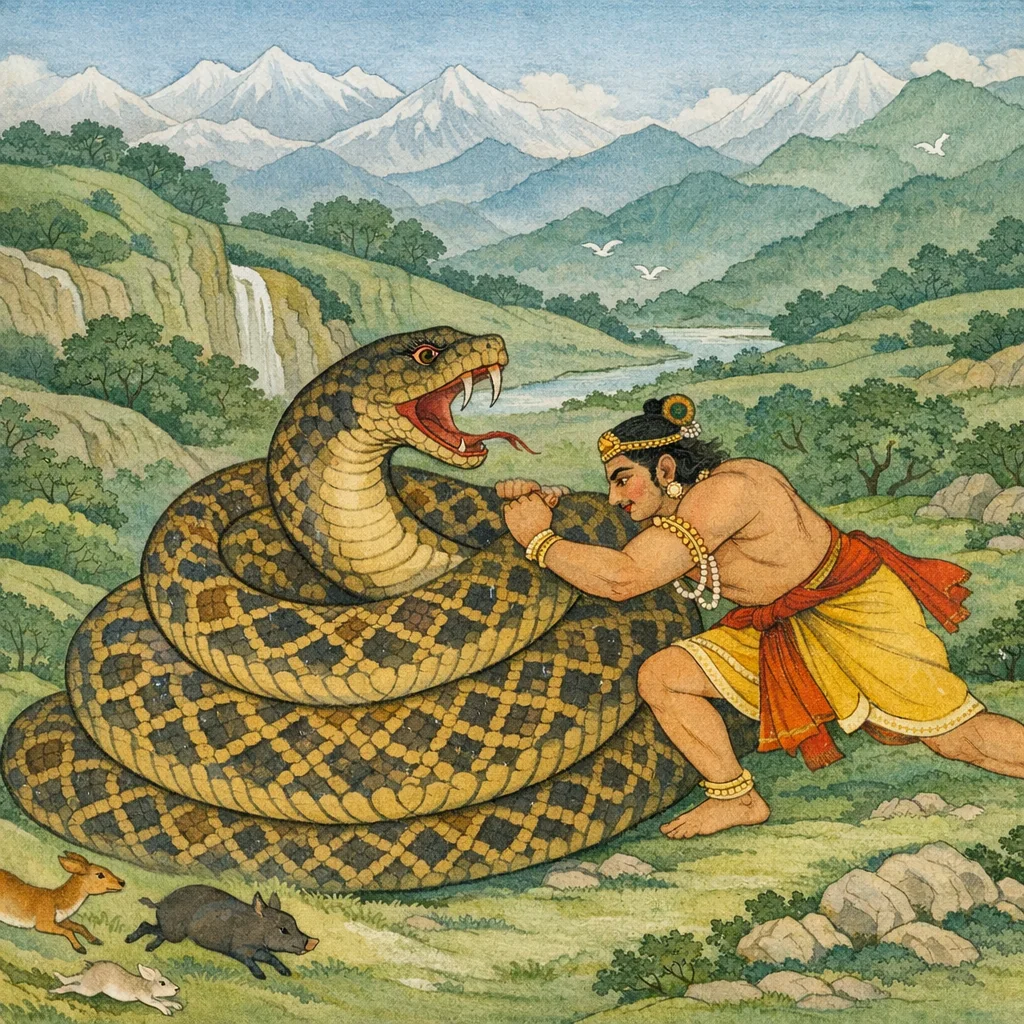
Chapter Arc: Janamejaya’s curiosity is kindled: how could Bhima—whose life-force seems equal to “ten thousand nāgas”—ever be overpowered? → Bhima, swollen with the pride of strength (so bold he would even challenge Kubera), roams the auspicious Himalayan tracts—haunts of devas, ṛṣis, siddhas, and apsarās—yet turns that sacred wilderness into a hunting-ground, felling boars, buffaloes, and deer with fearless ferocity, his lion-roar shaking caves and scattering beasts. → In the deep forest, the earth itself seems to rise as an enormous ajagara appears—mountain-bodied, massive, strangely hued—and in a sudden, inexorable coil it seizes Bhima, arresting the very arm that had never known restraint. → Bhima’s rampage is halted; the chapter closes on the fact of his capture—strength checked by a greater, older power—setting the stage for the ensuing dialogue and the unraveling of the serpent’s true nature. → With Bhima bound in the ajagara’s grip, the question hangs: what force—fate, curse, or dharma—has taken the mighty Pandava prisoner, and how will he be freed?
Shlokas
Verse 1
हि आय ० (0) है 2 अष्टस प्तरत्याधेकशततमो< ध्याय: महाबली भीमसेनका हिंसक पशुओंको मारना और अजगरद्वारा पकड़ा जाना जनमेजय उवाच कथं नागायुतप्राणो भीमो भीमपराक्रम: भयमाहारयत तीव्र तस्मादजगरान्मुने,जनमेजयने पूछा--मुने! भयानक पराक्रमी भीमसेनमें ते दस हजार हाथियोंका बल थ। फिर उन्हें उस अजगरसे इतना तीव्र भय कैसे प्राप्त हुअ?
Janamejaya said: “O sage, how did Bhīma—of dreadful prowess and possessing the strength of ten thousand elephants—come to feel such intense fear because of that python?”
Verse 2
पौलस्त्यं धनदं युद्धे य आह्वयति दर्पित: नलिन्यां कदनं कृत्वा निहन्ता यक्षरक्षसाम्,जो बलके घमंडमें आकर पुलस्त्यनन्दन कुबेरको भी युद्धके लिये ललकारते थे, जिन्होंने कुबेरकी पुष्करिणीके तटपर कितने ही यक्षों तथा राक्षसोंका संहार कर डाला था, उन्हीं शत्रुसूदन भीमसेनको आप भयभीत (और विपत्तिग्रस्त) बताते हैं। अतः मैं इस प्रसंगको विस्तारसे सुनना चाहता हूँ। इसके लिये मेरे मनमें बड़ा कौतूहल हो रहा है
Janamejaya said: “How can you describe Bhīmasena—who, swollen with pride, once challenged Paulastya’s son Dhanada (Kubera) to battle, and who, after wreaking slaughter at the lotus-pond, became the killer of Yakṣas and Rākṣasas—as fearful and overwhelmed by calamity? I wish to hear this episode in detail, for my curiosity about it is great.”
Verse 3
त॑ं शंससि भयाविष्टमापन्नमरिसूदनम् एतदिच्छाम्यहं श्रीतुं परं कौतूहलं हि मे,जो बलके घमंडमें आकर पुलस्त्यनन्दन कुबेरको भी युद्धके लिये ललकारते थे, जिन्होंने कुबेरकी पुष्करिणीके तटपर कितने ही यक्षों तथा राक्षसोंका संहार कर डाला था, उन्हीं शत्रुसूदन भीमसेनको आप भयभीत (और विपत्तिग्रस्त) बताते हैं। अतः मैं इस प्रसंगको विस्तारसे सुनना चाहता हूँ। इसके लिये मेरे मनमें बड़ा कौतूहल हो रहा है
Janamejaya said: “You describe that foe-slaying Bhīmasena as seized by fear and fallen into distress. I wish to hear this matter in full, for it greatly stirs my curiosity—how could the very hero who, in the pride of his strength, even challenged Kubera, the son of Pulastya, and who slaughtered many Yakṣas and Rākṣasas on the bank of Kubera’s lake Puṣkariṇī, now be spoken of as terrified and afflicted?”
Verse 4
वैशम्पायन उवाच बन्नाश्चयें वने तेषां वसतामुग्रधन्विनाम् प्राप्तानामाश्रमाद् राजन् राजर्षे्वृषपर्वण:,वैशम्पायनजीने कहा--राजन्! राजर्षि वृषप्वकि आश्रमसे आकर उग्र धनुर्धर पाण्डव अनेक आश्रर्योंसे भरे हुए उस द्वैतवनमें निवास करते थे
Vaiśampāyana said: O King, while those fierce bowmen (the Pāṇḍavas) were living in the forest, there came to them—arriving from the hermitage—the royal sage Vṛṣaparvan. Thus, in the course of their forest-dwelling, a significant visitor approached them from an ascetic retreat, setting the stage for counsel and testing of conduct amid exile.
Verse 5
यदृच्छया धनुष्पाणिरबद्धखड्गो वृकोदर: ददर्श तद् वन रम्यं देवगन्धर्वसेवितम्,भीमसेन तलवार बाँधकर हाथमें धनुष लिये अकस्मात् घूमने निकल जाते और देवताओं तथा गन्धर्वोंसे सेवित उस रमणीय वनकी शोभा निहारते थे
Vaiśampāyana said: By chance, Vṛkodara (Bhīma), holding a bow in his hand and with his sword left unfastened, came upon that delightful forest—frequented by gods and Gandharvas—and beheld its beauty. The scene underscores the exile-wanderer’s alertness and self-restraint: even amid hardship, he observes the world without needless aggression, remaining ready yet not seeking conflict.
Verse 6
स ददर्श शुभान् देशान् गिरेहिमवतस्तदा देवर्षिसिद्धचरितानप्सरोगणसेवितान्,उन्होंने हिमालय पर्वतके उन शुभ प्रदेशोंका अवलोकन किया जहाँ देवर्षि और सिद्ध पुरुष विचरण करते थे तथा अप्सराएँ जिनका सदा सेवन करती थीं
Vaiśampāyana said: Then he beheld the auspicious regions of the Himālaya—lands frequented by divine seers and perfected sages, and continually graced by companies of Apsarases. The passage frames the Himalaya as a sanctified moral landscape, where purity, tapas, and elevated conduct naturally prevail.
Verse 7
चकोरैरुपचक्रैश्व पक्षिभिर्जीवजीवकै: कोकिलेभ्भड्गराजैश्व तत्र तत्र निनादितान्,वहाँ भिन्न-भिन्न स्थानोंमें चकोर, उपचक्र, जीव-जीवक, कोकिल और भृंगराज आदि पक्षी कलरव करते थे
Vaiśampāyana said: In that woodland, different places resounded with the calls of many birds—cakoras, upacakras, jīva-jīvakas, cuckoos, and bhr̥ṅgarājas—filling the scene with lively, auspicious sound and underscoring the calm, life-affirming atmosphere of the forest setting.
Verse 8
नित्यपुष्पफलैव॑क्षैर्हिमसंस्पर्शकोमलै: उपेतान् बहुलच्छायैर्मनोनयननन्दनै:,वहाँके वृक्ष सदा फ़ूल और फल देते थे। हिमके स्पर्शसे उनमें कोमलता आ गयी थी। उनकी छाया बहुत घनी थी और वे दर्शनमात्रसे मन एवं नेत्रोंकी आनन्द प्रदान करते थे
Vaiśaṃpāyana said: The trees there were ever laden with blossoms and fruits. Softened by the touch of snow, they spread abundant, dense shade, delighting both mind and eyes by their very sight—an image of a place where nature itself offers effortless nourishment and calm.
Verse 9
स सम्पश्यन् गिरिनदीर्वैदूर्यमणिसंनिभै: सलिलैहिमसंकाशै्हँसकारण्डवायुतै:
Vaiśampāyana said: As he journeyed on, he beheld mountain-born rivers whose waters gleamed like vaidūrya gems—clear and cool as snow—alive with swans and kāraṇḍava ducks. The scene underscores how the forest, though a place of hardship and exile, also offers purity and quiet order, inviting steadiness of mind and restraint amid trial.
Verse 10
उन वृक्षोंसे सुशोभित प्रदेशों तथा वैदूर्यमणिके समान रंगवाले, हिमसदृश स्वच्छ, शीतल सलिल-समूहसे संयुक्त पर्वतीय नदियोंकी शोभा निहारते हुए वे सब ओर घूमते थे। नदियोंकी उस जलराशिमें हंस और कारण्डव आदि सहसौरों पक्षी किलोलें करते थे ।। वनानि देवदारूणां मेघानामिव वागुरा: हरिचन्दनमिश्राणि तुड़कालीयकान्यपि,हरिचन्दन, तुंग और कालीयक आदि वृक्षोंसे युक्त ऊँचे-ऊँचे देवदारुक वन ऐसे जान पड़ते थे मानो बादलोंको फँसानेके लिये फंदे हों
Vaiśampāyana said: They wandered in every direction, gazing upon mountain rivers joined to clear, cool masses of water—pure as snow and gleaming with a hue like the vaidūrya gem—flowing through regions made beautiful by trees. In those stretches of water, thousands upon thousands of birds—swans and kāraṇḍavas and others—made lively calls and sported. And the lofty forests of deodāra, mixed with fragrant haricandana and with tuṅga and kālīyaka trees as well, appeared like nets set to catch the clouds—so dense and high were they.
Verse 11
मृगयां परिधावन् स समेषु मरुधन्वसु विध्यन् मृगान् शरै: शुद्ध क्षचार स महाबल:,महाबली भीम सारे मरु प्रदेशमें शिकारके लिये दौड़ते और केवल बाणोंद्वारा हिंसक पशुओंको घायल करते हुए विचरा करते थे
Vaiśampāyana said: Mighty Bhīma ranged about the level stretches of the desert, running in pursuit of the hunt. He struck down wild animals with his arrows, moving through the arid land with disciplined force—an image of controlled violence directed toward survival and protection rather than wanton cruelty.
Verse 12
भीमसेनस्तु विख्यातो महान्तं दंष्टिणं बलात् निघ्नन् नागशतप्राणो वने तस्मिन् महाबल:,भीमसेन अपने महान् बलके लिये विख्यात थे। उनमें सैकड़ों हाथियोंकी शक्ति थी। वे उस वनमें विकराल दाढ़ोंवाले बड़े-से-बड़े सिंहको भी पछाड़ देते थे
Vaiśaṃpāyana said: Bhīmasena, renowned for his immense strength, would by sheer force strike down even a huge, tusked beast in that forest. Endowed with the power of a hundred elephants, the mighty one dominated the wilderness through irresistible physical prowess.
Verse 13
मृगाणां स वराहाणां महिषाणां महाभुज: विनिष्नंस्तत्र तत्रेव भीमो भीमपराक्रम:,भीमसेनका पराक्रम भी उनके नामके अनुसार ही भयानक था। उनकी भुजाएँ विशाल थीं। वे मृगयामें प्रवृत्त होकर जहाँ-तहाँ हिंसक पशुओं, वराहों और भैंसोंको भी मारा करते थे
Vaiśampāyana said: Mighty-armed Bhīma—whose prowess was truly fearsome—went about hunting, and here and there he struck down deer, boars, and even wild buffaloes. The passage underscores Bhīma’s formidable strength and the harsh, survival-driven tone of forest life, where hunting becomes both a display of power and a means of sustaining those living in exile.
Verse 14
स मातज्गशतप्राणो मनुष्पशतवारण: सिंहशार्दूलविक्रान्तो वने तस्मिन् महाबल:,उनमें सैकड़ों मतवाले गजराजोंके समान बल था। वे एक साथ सौ-सौ मनुष्योंका वेग रोक सकते थे। उनका पराक्रम सिंह और शार्दूलके समान था महाबली भीम उस वनमें वृक्षोंको उखाड़ते और उन्हें वेगपूर्वक पुनः तोड़ डालते थे। वे अपनी गर्जनासे उस वन्य भूमिके प्रदेशों तथा समूचे वनको गुँजाते रहते थे
Vaiśampāyana said: In that forest stood the mighty one, endowed with the life-force of a hundred rutting elephants, capable of checking the rush of a hundred men at once, and advancing with the prowess of a lion and a tiger. The verse underscores Bhīma’s overwhelming strength as a protective power—an energy that, when aligned with dharma, becomes a shield for the vulnerable and a deterrent to wrongdoing in the wilderness of exile.
Verse 15
वृक्षानुत्पाटपामास तरसा वै बभज्ज च पृथिव्याश्व प्रदेशान् वै नादयंस्तु वनानि च,उनमें सैकड़ों मतवाले गजराजोंके समान बल था। वे एक साथ सौ-सौ मनुष्योंका वेग रोक सकते थे। उनका पराक्रम सिंह और शार्दूलके समान था महाबली भीम उस वनमें वृक्षोंको उखाड़ते और उन्हें वेगपूर्वक पुनः तोड़ डालते थे। वे अपनी गर्जनासे उस वन्य भूमिके प्रदेशों तथा समूचे वनको गुँजाते रहते थे
Vaiśampāyana said: With impetuous force Bhīma kept wrenching up trees and smashing them apart. By his roaring he made the tracts of that wild land and the entire forest resound—displaying a strength likened to intoxicated lordly elephants and a valor like a lion or tiger, capable of checking the rush of many men at once.
Verse 16
पर्वताग्राणि वै मृदूनन् नादयानश्न विज्वर: प्रक्षिपन् पादपांश्चापि नादेनापूरयन् महीम्,वे पर्वतशिखरोंको रौंदते, वृक्षोंको तोड़कर इधर-उधर बिखेरते और निश्चिन्त होकर अपने सिंहनादसे भूमण्डलको प्रतिध्वनित किया करते थे
Vaiśampāyana said: Untroubled and fearless, they trampled the mountain-peaks, tore up trees and flung them about, and with their lion-like roar made the whole earth resound—an image of overwhelming, untamed power that signals the approach of formidable beings and heightens the moral tension of the episode.
Verse 17
वेगेन न््यपतद् भीमो निर्भयश्व पुनः पुनः आस्फोटयन क्ष्वेडयंश्व॒ तलतालांश्व वादयन्,वे निर्भय होकर बार-बार वेगपूर्वक कूदते-फाँदते, ताल ठोंकते, सिंहनाद करते और तालियाँ बजाते थे
Vaiśampāyana said: Fearless, Bhīma kept leaping and bounding again and again with great speed—clapping and striking his palms, raising loud battle-cries, and making resounding slaps—displaying his dauntless spirit and readiness to confront danger.
Verse 18
चिरसम्बद्धदर्पस्तु भीमसेनो वने तदा गजेन्द्राश्न महासत्त्वा मृगेन्द्राश्ष महाबला:
Vaiśampāyana said: At that time, in the forest, Bhīmasena—his pride long held in check—encountered mighty beings: lordly elephants of great spirit and powerful kings of beasts. The scene underscores how the wilderness tests human strength and self-control, confronting a warrior with forces that demand restraint as much as valor.
Verse 19
क्वचित् प्रधावंस्तिष्ठ॑श्न॒ क्वचिच्चोपविशंस्तथा,त्रासयन् सर्वभूतानि महासत्त्वपराक्रम: वे कहीं दौड़ते, कहीं खड़े होते और कहीं बैठते हुए शिकार पानेकी अभिलाषासे उस महाभयंकर वनमें निर्भय विचरते रहते थे। वे नरश्रेष्ठ महाबली भीम उस वनमें वनचर भीलोंकी भाँति पैदल ही चलते थे, उनका साहस और पराक्रम महान् था। वे गहन वनमें प्रवेश करके समस्त प्राणियोंको डराते हुए अद्भुत गर्जना करते थे
Vaiśampāyana said: At times he would run, at times stand still, and at times sit down; driven by the desire to obtain game, that hero of great courage and prowess moved about fearlessly in the dreadful forest, terrifying all living beings.
Verse 20
मृगप्रेप्सुर्महारौद्रे वने चरति निर्भय: स तत्र मनुजव्याप्रो वने वनचरोपम:
Vaiśampāyana said: Eager to hunt deer, he moved fearlessly through that dread forest. There, intent on his human purpose, he ranged within the woods, resembling a true denizen of the wilderness—suggesting both resolve and the moral tension of pursuing desire or duty amid peril.
Verse 21
पदभ्यामभिसमापेदे भीमसेनो महाबल: स प्रविष्टो महारण्ये नादान् नदति चाद्भुतान्
Vaiśampāyana said: Mighty Bhīmasena advanced swiftly on foot. Entering deep into the great forest, he began to roar with astonishing cries—an assertion of strength meant to overawe whatever dangers lay within and to press forward in the task before him.
Verse 22
ततो भीमस्य शब्देन भीता: सर्पा गुहाशया:,तदनन्तर एक दिनकी बात है, भीमसेनके सिंहनादसे भयभीत हो गुफाओंमें रहनेवाले सारे सर्प बड़े वेगसे भागने लगे और भीमसेन धीरे-धीरे उन्हींका पीछा करने लगे। श्रेष्ठ देवताओंके समान कान्तिमान् महाबली भीमसेनने आगे जाकर एक विशालकाय अजगर देखा, जो रोंगटे खड़े कर देनेवाला था। वह अपने शरीरसे एक (विशाल) कन्दराको घेरकर पर्वतके एक दुर्गम स्थानमें रहता था
Then, terrified by Bhīma’s thunderous cry, the serpents that dwelt in the caves fled in great haste. Bhīmasena, moving steadily onward, began to follow after them. Radiant like the foremost of the gods and mighty in strength, he soon came upon a colossal python—so dreadful that it made one’s hair stand on end—coiled around a vast cavern and residing in a hard-to-reach part of the mountain. The episode frames Bhīma’s power as a force that drives hidden dangers into the open, preparing the ground for a moral encounter rather than mere violence.
Verse 23
अतकिक्रान्तास्तु वेगेन जगामानुसूत: शनै: ततो5मरवरप्रख्यो भीमसेनो महाबल:,तदनन्तर एक दिनकी बात है, भीमसेनके सिंहनादसे भयभीत हो गुफाओंमें रहनेवाले सारे सर्प बड़े वेगसे भागने लगे और भीमसेन धीरे-धीरे उन्हींका पीछा करने लगे। श्रेष्ठ देवताओंके समान कान्तिमान् महाबली भीमसेनने आगे जाकर एक विशालकाय अजगर देखा, जो रोंगटे खड़े कर देनेवाला था। वह अपने शरीरसे एक (विशाल) कन्दराको घेरकर पर्वतके एक दुर्गम स्थानमें रहता था
Vaiśampāyana said: The serpents, driven past their limits by fear, fled swiftly; and Bhīmasena followed after them, moving slowly and steadily. Then that mighty Bhīmasena—radiant like the foremost of the gods—went on ahead and beheld a colossal python, hair-raising to see, dwelling in a hard-to-reach mountain spot, its huge body coiled around a vast cavern.
Verse 24
स ददर्श महाकायं भुजज़्ं लोमहर्षणम् गिरिदुर्गे समापन्नं कायेनावृत्य कन्दरम्,तदनन्तर एक दिनकी बात है, भीमसेनके सिंहनादसे भयभीत हो गुफाओंमें रहनेवाले सारे सर्प बड़े वेगसे भागने लगे और भीमसेन धीरे-धीरे उन्हींका पीछा करने लगे। श्रेष्ठ देवताओंके समान कान्तिमान् महाबली भीमसेनने आगे जाकर एक विशालकाय अजगर देखा, जो रोंगटे खड़े कर देनेवाला था। वह अपने शरीरसे एक (विशाल) कन्दराको घेरकर पर्वतके एक दुर्गम स्थानमें रहता था
Vaiśampāyana said: Bhīma then beheld a gigantic serpent, terrifying enough to make one’s hair stand on end. In a rugged mountain fastness it had coiled itself, covering a cavern with its body. The scene underscores how raw strength meets hidden peril in the wilderness, and how courage must be joined with vigilance when confronting forces that overwhelm ordinary beings.
Verse 25
पर्वताभोगवर्ष्माणमतिकायं महाबलम् चित्राड़मड़जैश्षित्रैर्हरिद्रासद्शच्छविम्,उसका शरीर पर्वतके समान विशाल था। वह महाकाय होनेके साथ ही अत्यन्त बलवान् भी था। उसका प्रत्येक अंग शारीरिक विचित्र चिह्नोंसे चिह्नित होनेके कारण विचित्र दिखायी देता था। उसका रंग हल्दीके समान पीला था। प्रकाशमान चारों दाढ़ोंसे युक्त उसका मुख गुफा-सा जान पड़ता था। उसकी आँखें अत्यन्त लाल और आग उगलती-सी प्रतीत होती थीं। वह बार-बार अपने दोनों गलफरोंको चाट रहा था। कालान्तक तथा यमके समान समस्त प्राणियोंको भयभीत करनेवाला वह भयानक भुजंग अपने उच्छवास और सिंहनादसे दूसरोंकी भर्त्सना करता-सा प्रतीत होता था
Vaiśaṃpāyana said: “He was vast-bodied like a mountain range—enormous in size and possessed of tremendous strength. His limbs appeared strange, marked all over with unusual bodily signs, and his complexion was yellow like turmeric. With four shining fangs his mouth looked like a cavern; his eyes were intensely red, as if spitting fire. Again and again he licked both sides of his jaws. That dreadful serpent, terrifying all creatures like Kālāntaka and Yama, seemed to rebuke others with his hissing breath and lion-like roar.”
Verse 26
गुहाकारेण वक््त्रेण चतुर्दष्टेण राजता दीप्ताक्षेणातिताम्रेण लिहानं सृक्किणी मुहुः,उसका शरीर पर्वतके समान विशाल था। वह महाकाय होनेके साथ ही अत्यन्त बलवान् भी था। उसका प्रत्येक अंग शारीरिक विचित्र चिह्नोंसे चिह्नित होनेके कारण विचित्र दिखायी देता था। उसका रंग हल्दीके समान पीला था। प्रकाशमान चारों दाढ़ोंसे युक्त उसका मुख गुफा-सा जान पड़ता था। उसकी आँखें अत्यन्त लाल और आग उगलती-सी प्रतीत होती थीं। वह बार-बार अपने दोनों गलफरोंको चाट रहा था। कालान्तक तथा यमके समान समस्त प्राणियोंको भयभीत करनेवाला वह भयानक भुजंग अपने उच्छवास और सिंहनादसे दूसरोंकी भर्त्सना करता-सा प्रतीत होता था
Vaiśampāyana said: With a cavern-like mouth, splendid with four fangs, and with blazing eyes, intensely red, it kept licking the corners of its mouth again and again. The dreadful serpent—like Kālāntaka and Yama in its power to terrify all beings—seemed to rebuke others by its hissing breath and lion-like roar, embodying the fear that arises when brute force is unrestrained by dharma.
Verse 27
त्रासनं सर्वभूतानां कालान्तकयमोपमम् निःश्वासक्ष्वेडनादेन भर्त्सयन्तमिव स्थितम,उसका शरीर पर्वतके समान विशाल था। वह महाकाय होनेके साथ ही अत्यन्त बलवान् भी था। उसका प्रत्येक अंग शारीरिक विचित्र चिह्नोंसे चिह्नित होनेके कारण विचित्र दिखायी देता था। उसका रंग हल्दीके समान पीला था। प्रकाशमान चारों दाढ़ोंसे युक्त उसका मुख गुफा-सा जान पड़ता था। उसकी आँखें अत्यन्त लाल और आग उगलती-सी प्रतीत होती थीं। वह बार-बार अपने दोनों गलफरोंको चाट रहा था। कालान्तक तथा यमके समान समस्त प्राणियोंको भयभीत करनेवाला वह भयानक भुजंग अपने उच्छवास और सिंहनादसे दूसरोंकी भर्त्सना करता-सा प्रतीत होता था
Vaiśampāyana said: There stood that dreadful serpent, terrifying all creatures—like Kālāntaka and Yama themselves—seeming to rebuke and cow others by the thunder of its breath and its hissing roar. The passage underscores how fear can arise from sheer force and appearance, testing the steadiness and discernment of those who face it.
Verse 28
स भीम॑ सहसाभ्येत्य पृदाकु: कुपितो भृशम् जग्राहाजगरो ग्राहो भुजयोरुभयोरबलात्,वह अजगर अत्यन्त क्रोधमें भरा हुआ था। (मनुष्योंकोी) जकड़नेवाले उस सर्पने सहसा भीमसेनके निकट पहुँचकर उनकी दोनों बाँहोंको बलपूर्वक जकड़ लिया
Then the mighty Bhīma—like a sudden onrush—was confronted by the serpent Pṛdāku, who was fiercely enraged. That constricting nāga, like a crocodile’s grip, rushed up and seized Bhīma with force, clamping down upon both his arms. The episode underscores how unchecked anger and sudden violence can bind even the strongest, setting the stage for reflection on restraint, right conduct, and the limits of mere physical power.
Verse 29
तेन संस्पृष्टगात्रस्य भीमसेनस्य वै तदा संज्ञा मुमोह सहसा वरदानेन तस्य हि,उस समय भीमसेनके शरीरका उससे स्पर्श होते ही वे भीमसेन सहसा अचेत हो गये। ऐसा इसलिये हुआ कि उस सर्पको वैसा ही वरदान मिला था
Vaiśampāyana said: When Bhīmasena’s body was touched by him (the serpent), Bhīma suddenly lost consciousness. This happened because that serpent had been granted a boon that made his touch produce such an effect.
Verse 30
दशनागसहस््राणि धारयन्ति हि यद् बलम् तद् बलं भीमसेनस्य भुजयोरसमं परै:,दस हजार गजराज जितना बल धारण करते हैं, उतना ही बल भीमसेनकी भुजाओंमें विद्यमान था। उनके बलकी और कहीं समता नहीं थी
Vaiśampāyana said: The strength that ten thousand mighty elephants can bear—such strength resided in Bhīmasena’s arms. No one else could match his power, underscoring his exceptional capacity to protect his brothers and confront adversity when dharma is threatened.
Verse 31
स तेजस्वी तथा तेन भुजगेन वशीकृतः विस्फुरन् शनकैर्भीमो न शशाक विचेष्टितुम्,ऐसे तेजस्वी भीम भी उस अजगरके वशमें पड़ गये। वे धीरे-धीरे छटपटाते रहे, परंतु छूटनेकी अधिक चेष्टा करनेमें सफल न हो सके
Vaiśampāyana said: Thus the radiant Bhīma too was brought under the control of that serpent. Though he writhed and struggled little by little, he could not manage to make any effective effort to free himself. The episode underscores how sheer physical power can be checked by a superior force and how restraint and discernment become necessary when strength alone fails.
Verse 32
नागायुतसमप्राण: सिंहस्कन्धो महाभुज: गृहीतो व्यजहात् सत्त्वं वरदानविमोहितः,उनकी प्राणशक्ति दस सहस्र हाथियोंके समान थी। दोनों कंधे सिंहके कंधोंके समान थे और भुजाएँ बहुत बड़ी थीं। फिर भी सर्पको मिले हुए वरदानके प्रभावसे मोहित हो जानेके कारण सर्पकी पकड़में आकर वे अपना साहस खो बैठे
Vaiśampāyana said: Though his vital strength was like that of ten thousand elephants, with shoulders like a lion’s and mighty arms, once seized he lost his courage—his mind deluded by the boon granted to the serpent. The passage underscores how even great physical power can be undone when one is overpowered by a divinely sanctioned constraint and by inner bewilderment.
Verse 33
स हि प्रयत्नमकरोत् तीव्रमात्मविमोक्षणे न चैनमशकद् वीर: कथंचित् प्रतिबाधितुम्,उन्होंने अपनेको छुड़ानेके लिये घोर प्रयत्न किया, किंतु वीरवर भीमसेन किसी प्रकार भी उस सर्पको पराजित करनेमें सफलता नहीं प्राप्त कर सके
Vaiśampāyana said: He exerted himself fiercely to free his own body, yet the heroic Bhīmasena could not, by any means, check or overpower that serpent. The episode underscores that sheer strength and effort do not always prevail; when one is caught in a binding consequence, restraint and right understanding may be required beyond physical force.
Verse 177
इस प्रकार श्रीमह्याभारत वनपर्वके अन्तर्गत आजगरपर्वमें पाण्डवोंका पुन: द्वैतवनमें प्रवेशविषयक एक सौ सतहतत्तरवाँ अध्याय पूरा हुआ
Thus ends the one hundred and seventy-seventh chapter of the Ājagara section within the Vana Parva of the Śrī Mahābhārata, describing the Pāṇḍavas’ return and re-entry into the Dvaita forest. This closing colophon signals a transition in the exile narrative, emphasizing endurance, disciplined conduct in adversity, and continued movement through hardship without abandoning dharma.
Verse 178
इति श्रीमहाभारते वनपर्वणि आजगरपर्वणि अजगरग्रहणे अष्टसप्तत्यधिकशततमो< ध्याय:,इस प्रकार श्रीमह्या भारत वनपर्वके अन्तर्गत आजगरपर्वमें भीमयेनका अजगरद्वारा ग्रहणसम्बन्धी एक सौ अठहत्तरवाँ अध्याय पूरा हुआ
Thus, in the Śrī Mahābhārata, within the Vana Parva—specifically the Ājagara episode concerning the serpent’s seizure—ends the one-hundred-and-seventy-eighth chapter. Here the narrative closure marks the completion of the account in which Bhīma is seized by the great serpent (ājagara), framing the episode as a moral inquiry into restraint, right understanding, and the power of discerning speech to resolve peril without violence.
Verse 183
भीमसेनस्य नादेन व्यमुठ्जन्त गुहा भयात् वनमें घूमते हुए भीमसेनका बलाभिमान दीर्घकालसे बहुत बढ़ा हुआ था। उस समय उनकी सिंह-गर्जनासे महान् बलशाली गजराज और मृगराज भी भयसे अपना स्थान छोड़कर भाग गये
Vaiśampāyana said: At the thunderous roar of Bhīmasena, the caves were abandoned in fear. For a long time Bhīma’s pride in his own strength had been swelling as he wandered in the forest; and at that moment, even mighty lordly elephants and the king of beasts fled their places, shaken by his lion-like bellow—showing how unchecked power can overawe the natural world and how fear arises when force is displayed without restraint.
Verse 213
त्रासयन् सर्वभूतानि महासत्त्वपराक्रम: वे कहीं दौड़ते, कहीं खड़े होते और कहीं बैठते हुए शिकार पानेकी अभिलाषासे उस महाभयंकर वनमें निर्भय विचरते रहते थे। वे नरश्रेष्ठ महाबली भीम उस वनमें वनचर भीलोंकी भाँति पैदल ही चलते थे, उनका साहस और पराक्रम महान् था। वे गहन वनमें प्रवेश करके समस्त प्राणियोंको डराते हुए अद्भुत गर्जना करते थे
Vaiśampāyana said: Possessed of immense courage and heroic might, he moved about in that dreadful forest with fearless resolve, intent on securing game—at times running, at times standing still, and at times sitting. Entering the dense woodland, he terrified the creatures there and let out a wondrous, thunderous roar, like a forest-dwelling hunter on foot, his valor and strength unmistakable.
Frequently Asked Questions
No explicit dilemma is staged as debate; the ethical pressure is ambient: sustaining disciplined conduct and purposeful movement during exile amid environmental uncertainty (flooded terrain, obscured landmarks) and social vulnerability.
The chapter models how external cycles (seasons, rivers, night-sky clarity) can be read as supports for inner regulation—endurance in disruption (monsoon) and reflective clarity in stability (autumn), reinforced through association with tapasvins and yogic discipline.
A formal phalaśruti is not stated; the meta-signal is the explicit valuation of ‘yogam uttamam’ gathered with ascetics and the designation of Sarasvatī as ‘puṇya-tīrtha,’ framing the episode as ethically and ritually significant within the exile narrative.