Adhyaya 180
Chapter Arc: रात्रि-युद्ध की धधकती अराजकता में भीम को पुकार सुनाई देती है—सब सेनाओं के देखते-देखते एक राक्षस-वीर भीम को ग्रसने-सा बढ़ रहा है; दृष्टि अलायुध पर टिकती है। → कौरव-पक्ष की ओर से कर्ण रणभूमि में धृष्टद्युम्न, शिखण्डी और पंचाल महारथियों को तितर-बितर करता है, जबकि दूसरी ओर घटोत्कच और अलायुध का टकराव पर्वत-शिखरों की भाँति गूँजता है। भीम के लिए संकट और सेना के लिए भय एक साथ बढ़ते हैं; सलाह आती है कि कर्ण को छोड़ पहले अलायुध का वध किया जाए। → घटोत्कच और अलायुध का घोर द्वंद्व चरम पर पहुँचता है—वृक्षों, पुष्पित शाखाओं और विविध अस्त्र-शस्त्रों की वर्षा के बीच, बकासुर के विशालकाय भ्राता अलायुध अंततः मारा जाता है; पाण्डव-पंचाल सिंहनाद करते हैं और रणभूमि में शंख-भेरी गूँज उठते हैं। → अलायुध-वध का समाचार देखते ही दुर्योधन सेना सहित अत्यन्त उद्विग्न हो उठता है; पाण्डव-पक्ष का उत्साह बढ़ता है और रात्रि-युद्ध में क्षणिक बढ़त उनके हाथ आती है। → कर्ण अभी भी रण में सक्रिय है और रात्रि-युद्ध की दिशा बदलने को तत्पर—अलायुध के पतन के बाद अगला प्रहार किस पर पड़ेगा, यह अनिश्चितता बनी रहती है।
Shlokas
Verse 1
(दाक्षिणात्य अधिक पाठका १ श्लोक मिलाकर कुल ४८ “लोक हैं।) भीकम (2 अमान अष्टस प्तरत्याधेकशततमो< ध्याय: दोनों सेनाओंमें परस्पर घोर युद्ध और घटोत्कचके द्वारा अलायुधका वध एवं दुर्योधनका पश्चात्ताप संजय उवाच संदृश्य समरे भीम॑ रक्षसा ग्रस्तमन्तिकात् । वासुदेवो<ब्रवीद् राजन् घटोत्कचमिदं वच:,संजय कहते हैं--राजन्! समरभूमिमें राक्षसके चंगुलमें फँसे हुए भीमसेनको निकटसे देखकर भगवान् श्रीकृष्णने घटोत्कचसे यह बात कही-- इस प्रकार श्रीमह्माभारत द्रोणपर्वके अन्तर्गत घटोत्कचवधपर्वमें रात्रियुद्धके समय अलायुधका वधविषयक एक सौ अठठ्ठत्तरवाँ अध्याय पूरा हुआ ॥/ १७८ ॥/ ऑपनआ प्रा छा अ-काज जा एकोनाशीरत्याधेकशततमो< ध्याय: घटोत्कचका घोर युद्ध तथा कर्णके द्वारा चलायी हुई इन्द्रप्रदत्त शक्तिसे उसका वध संजय उवाच निहत्यालायुध॑ रक्ष: प्रह्ष्टात्मा घटोत्कच: । ननाद विविधान् नादान् वाहिन्या: प्रमुखे तव
Sanjaya said: After slaying the rākṣasa Ālāyudha, Ghaṭotkaca—his spirit exultant—roared out many kinds of battle-cries at the very front of your army. The moment marks a surge of confidence and terror on the night battlefield, where prowess and morale become decisive forces amid the ethical tragedy of fratricidal war.
Verse 2
पश्य भीम॑ महाबाहो रक्षसा ग्रस्तमाहवे । पश्यतां सर्वसैन्यानां तव चैव महाद्युते,“महातेजस्वी महाबाहु वीर! देखो, युद्धस्थलमें उस राक्षसने सम्पूर्ण सेनाके और तुम्हारे देखते-देखते भीमसेनको वशमें कर लिया है
Sañjaya said: “Behold, O mighty-armed one—Bhīma has been seized in the midst of battle by a rākṣasa. Behold, O radiant hero: in full view of all the armies, and even before your very eyes, that rākṣasa has brought Bhīmasena under his power.”
Verse 3
स कर्ण त्वं समुत्सृज्य राक्षसेन्द्रमलायुधम् । जहि क्षिप्रं महाबाहो पश्चात् कर्ण वधिष्यसि,“महाबाहो! अतः तुम कर्णको छोड़कर पहले राक्षसराज अलायुधको शीघ्रतापूर्वक मार डालो। पीछे कर्णका वध करना”
Sañjaya said: “O mighty-armed one, set Karṇa aside for the moment and swiftly strike down Alāyudha, the lord of the Rākṣasas. After that, you may slay Karṇa.” The counsel reflects battlefield prudence: remove the immediate, disruptive threat first, then return to the principal adversary—so that duty in war is carried out effectively rather than impulsively.
Verse 4
स वार्ष्णेयवच: श्रुत्वा कर्णमुत्सज्य वीर्यवान् युयुधे राक्षसेन्द्रेण वकभ्रात्रा घटोत्कच:,भगवान् श्रीकृष्णका यह वचन सुनकर पराक्रमी वीर घटोत्कचने कर्णको छोड़कर वकके भाई राक्षसराज अलायुधके साथ युद्ध आरम्भ कर दिया
Sañjaya said: Hearing the words of Vārṣṇeya (Śrī Kṛṣṇa), the mighty Ghaṭotkaca withdrew from engaging Karṇa and instead began battle with the lord of the Rākṣasas, Alāyudha, the brother of Baka. The episode underscores disciplined obedience to wise counsel in the midst of war—redirecting one’s force toward the more immediate and fitting adversary rather than persisting out of pride or fixation.
Verse 5
तयो: सुतुमुलं युद्ध बभूव निशि रक्षसो: । अलायुधस्य चैवोग्रं हैडिम्बेश्वापि भारत,भरतनन्दन! उस रात्रिके समय अलायुध और हिडिम्बाकुमार घटोत्कच दोनों राक्षसोंमें अत्यन्त भयंकर एवं घमासान युद्ध होने लगा
Sanjaya said: In the night, a fiercely tumultuous battle erupted between those two rākṣasas. O Bhārata, O joy of the Bharatas, the combat became especially dreadful between Alāyudha and the son of Hiḍimbā (Ghaṭotkaca), intensifying the night’s terror and the moral weight of war’s violence.
Verse 6
अलायुधस्य योधांश्व राक्षसान् भीमदर्शनान् । वेगेनापतत: शूरान् प्रगृहीतशरासनान्,अलायुधके सैनिक राक्षस देखनेमें बड़े भयंकर और शूरवीर थे। वे हाथमें धनुष लेकर बड़े वेगसे आक्रमण करते थे। परंतु अस्त्र-शस्त्रोंसे सुसज्जित हो अत्यन्त क्रोधमें भरे हुए महारथी युयुधान, नकुल और सहदेवने उन सबको अपने पैने बाणोंसे काट डाला
Sañjaya said: “The warriors of Alāyudha—those rākṣasas of terrifying appearance—charged forward with great speed, heroic and fierce, their bows already raised and arrows ready. In the press of battle, such demonic might is met not by hesitation but by disciplined counter-force, as the Pāṇḍava champions strike down the onrushing assailants to protect their line and uphold their duty in war.”
Verse 7
आत्तायुथ: सुसंक़्रुद्धों युयुधानो महारथ: । नकुल: सहदेवश्न चिच्छिदुर्निशितै: शरै:,अलायुधके सैनिक राक्षस देखनेमें बड़े भयंकर और शूरवीर थे। वे हाथमें धनुष लेकर बड़े वेगसे आक्रमण करते थे। परंतु अस्त्र-शस्त्रोंसे सुसज्जित हो अत्यन्त क्रोधमें भरे हुए महारथी युयुधान, नकुल और सहदेवने उन सबको अपने पैने बाणोंसे काट डाला
Sañjaya said: Armed and fiercely enraged, the great chariot-warrior Yuyudhāna, together with Nakula and Sahadeva, cut them down with their razor-sharp arrows. The scene underscores the relentless momentum of battle: when terrifying, weapon-bearing foes surge forward, the Pandava champions respond with disciplined martial force, turning wrath and skill into decisive action amid the moral weight of war.
Verse 8
सर्वाश्न समरे राजन् किरीटी क्षत्रियर्षभान् । परिचिक्षेप बीभत्सु: सर्वतः प्रकिरन् शरान्,राजन! किरीटधारी अर्जुनने समरांगणमें सब ओर बाणोंकी वर्षा करके कौरवपक्षके समस्त क्षत्रिय-शिरोमणियोंको मार भगाया
Sañjaya said: O King, in the thick of battle the diadem-wearing Arjuna (Bībhatsu) scattered and drove back all those bull-like warriors among the Kṣatriyas, showering arrows in every direction. The scene underscores how disciplined martial prowess, when yoked to a chosen cause, can decisively turn the tide—yet it also reminds us that victory in war is purchased through the suffering and displacement of many.
Verse 9
कर्णश्न समरे राजन व्यद्रावयत पार्थिवान् | धृष्टद्युम्नशिखण्ड्यादीन् पञज्चालानां महारथान्,नरेश्वर! कर्णने भी रणभूमिमें धृष्टद्यम्म और शिखण्डी आदि पांचाल महारथी नरेशोंको दूर भगा दिया
Sañjaya said: O king, in the midst of battle Karṇa put the kings to flight. He drove away the great chariot-warriors of the Pāñcālas—Dhṛṣṭadyumna, Śikhaṇḍī, and others—O lord of men. The verse underscores the relentless momentum of war, where prowess and strategy can scatter even renowned champions, intensifying the moral weight of the conflict’s escalating violence.
Verse 10
तान् वध्यमानान् दृष्टवाथ भीमो भीमपराक्रम: । अभ्ययात् त्वरित: कर्ण विशिखान् प्रकिरन् रणे
Sañjaya said: Seeing those warriors being cut down, Bhīma—of dreadful prowess—rushed forward without delay, scattering arrows at Karṇa amid the clash of battle. The moment underscores Bhīma’s protective fury in war: when allies are being slain, he answers with swift, forceful intervention rather than hesitation.
Verse 11
उन सबको बाणोंकी मारसे पीड़ित होते देख भयंकर पराक्रमी भीमसेनने युद्धस्थलमें अपने बाणोंकी वर्षा करते हुए वहाँ तुरंत ही कर्णपर आक्रमण किया ।। ततस्ते<प्याययुर्हत्वा राक्षसान् यत्र सूतज: । नकुल: सहदेवश्न सात्यकिश्न॒ महारथ:,तत्पश्चात् वे नकुल, सहदेव और महारथी सात्यकि भी राक्षसोंको मारकर वहीं आ पहुँचे, जहाँ सूतपुत्र कर्ण था
Sañjaya said: Seeing them all afflicted by the deadly strikes of arrows, the dreadfully powerful Bhīmasena, showering the battlefield with his own arrows, at once rushed to attack Karṇa. Then Nakula, Sahadeva, and the great chariot-warrior Sātyaki also arrived there—after slaying the Rākṣasa fighters—at the place where Karṇa, the son of the charioteer, stood. The scene underscores the relentless momentum of war: courage and loyalty draw allies together, even as violence escalates and the ethical weight of killing remains ever-present.
Verse 12
ते कर्ण योधयामासु: पज्चाला द्रोणमेव तु । अलायुधस्तु संक्रुद्धो घटोत्कचमरिंदमम् । परिघेणातिकायेन ताडयामास मूर्थनि,वे तीनों योद्धा कर्णके साथ युद्ध करने लगे और पांचालदेशीय वीरोंने द्रोणाचार्यका सामना किया। उधर क्रोधमें भरे हुए अलायुधने एक विशाल परिषके द्वारा शत्रुदमन घटोत्कचके मस्तकपर आघात किया
Sañjaya said: Then those warriors engaged Karṇa in battle, while the Pāñcāla heroes confronted Droṇa himself. Meanwhile, Alāyudha, inflamed with wrath, struck the enemy-subduing Ghaṭotkaca on the head with a massive iron club—an image of war’s escalating fury, where anger drives combatants to ever more brutal blows.
Verse 13
स तु तेन प्रहारेण भैमसेनिर्महाबल: । ईषन्मूर्च्छितमात्मानमस्तम्भयत वीर्यवान्,उस प्रहारसे भीमसेनपुत्र घटोत्कचको कुछ मूर्छा आ गयी। परंतु उस महाबली और पराक्रमी वीरने पुन: अपने-आपको सँभाल लिया
Sañjaya said: Struck by that blow, the mighty son of Bhīmasena was momentarily dazed; yet, being a hero of great prowess, he quickly steadied himself again. In the midst of war, the verse highlights resilience and self-mastery—meeting violence without surrendering one’s inner control.
Verse 14
ततो दीप्ताग्निसंकाशां शतघण्टामलंकृताम् | चिक्षेप तस्मै समरे गदां काड्चनभूषिताम्,तदनन्तर घटोत्कचने समरांगणमें प्रज्वलित अग्निके समान तेजस्विनी, एक सौ घंटियोंसे अलंकृत और सुवर्णभूषित अपनी गदा उसके ऊपर चलायी
Sañjaya said: Then, in the midst of battle, he hurled at him a mace that blazed like a flaming fire—adorned with a hundred bells and ornamented with gold. The scene underscores how, in the fury of war, warriors deploy terrifying, richly fashioned weapons not for display but for decisive harm, intensifying the moral weight of violence on the battlefield.
Verse 15
सा हयांश्ष रथं चास्य सारथिं च महास्वना । चूर्णयामास वेगेन विसृष्टा भीमकर्मणा,भयंकर कर्म करनेवाले उस राक्षसद्वारा वेगपूर्वक फेंकी गयी उस भारी आवाज करनेवाली गदाने अलायुधके रथ, सारथि और घोड़ोंको चूर-चूर कर दिया
Sañjaya said: Hurled with tremendous speed by that fearsome, mighty-doer, the heavy mace that roared like thunder smashed to pieces his horses, his chariot, and his charioteer. In the brutal logic of war, skill and ferocity here eclipse all protection, showing how swiftly life-supporting instruments—mounts, vehicle, and driver—can be annihilated when violence is unleashed without restraint.
Verse 16
स भग्नहयचक्राक्षाद् विशीर्णध्वजकूबरात् । उत्पपात रथात् तूर्ण मायामास्थाय राक्षसीम्,जिसके घोड़े, पहिये और धुरे नष्ट हो गये थे, ध्वज और कूबर बिखर गये थे, उस रथसे अलायुध राक्षसी मायाका आश्रय लेकर तुरंत ही ऊपरको उड़ गया
Sañjaya said: When his chariot had been ruined—its horses, wheels, and axle broken, and its banner and yoke shattered—Alāyudha swiftly leapt up from it, taking refuge in a rākṣasa’s illusory power. The scene underscores how, amid the collapse of martial supports, one may turn to deception and sorcery rather than steadfast valor, revealing the moral contrast between righteous combat and reliance on delusive means.
Verse 17
स समास्थाय मायां तु ववर्ष रुधिरं बहु । विद्युद्वधिभ्राजितं चासीत् तुमुलाभ्राकुलं नभ:,उसने मायाका आश्रय लेकर बहुत रक्तकी वर्षा की। उस समय आकाशमें भयंकर मेघोंकी घटा घिर आयी थी और बिजली चमक रही थी
Sañjaya said: Resorting to illusion and deceptive power, he caused a heavy rain of blood to fall. At that moment the sky was choked with roaring masses of clouds, and it flashed like lightning—an ominous sign intensifying the moral darkness of the battle through fear and delusion rather than righteous combat.
Verse 18
ततो वज्जनिपाताश्ष साशनिस्तनयित्नव: । महांक्षट्चटाशब्दस्तत्रासीच्च महाहवे,तत्पश्चात् उस महासमरमें वज्भरपात, मेघगर्जनाके साथ विद्युतकी गड़गड़ाहट तथा महान् चट-चट शब्द होने लगे
Sañjaya said: Then, in that great battle, there arose thunderbolt-like crashes together with lightning and peals of thunder; and there, amid the mighty combat, a tremendous crackling “caṭ-caṭ” sound was heard—portents and battle-noise swelling as the slaughter intensified.
Verse 19
तां प्रेक्ष्य महतीं मायां राक्षसो राक्षसस्य च । ऊर्ध्वमुत्पत्य हैडिम्बिस्तां मायां माययावधीत्,राक्षसकी उस विशाल मायाको देखकर राक्षसजातीय हिडिम्बाकुमार घटोत्कचने ऊपर उड़कर अपनी मायासे उस मायाको नष्ट कर दिया
Sañjaya said: Seeing that vast illusion conjured by the rākṣasa, the rākṣasa-born son of Hiḍimbā (Ghaṭotkaca) sprang upward and, by counter-illusion of his own, destroyed that illusion. In the moral texture of the battle, the episode shows how deceptive force (māyā) is met not by naïve valor but by alert discernment and an equal strategic response to protect one’s side.
Verse 20
सो5भिवीक्ष्य हतां मायां मायावी माययैव हि । अभ्मवर्ष सुतुमुलं विससर्ज घटोत्कचे,अपनी मायाको मायासे ही नष्ट हुई देखकर मायावी अलायुध घटोत्कचपर पत्थरोंकी भयंकर वर्षा करने लगा
Sañjaya said: Seeing that his own illusion had been destroyed by illusion itself, the sorcerer Alāyudha—skilled in deceptive arts—unleashed upon Ghaṭotkaca a terrifying storm of stones. In the brutal ethics of war, counter-magic answers magic, and violence escalates when pride in one’s power is thwarted.
Verse 21
किंतु पराक्रमी घटोत्कचने बाणोंकी वृष्टि करके उस भयंकर प्रस्तरवर्षाका उन-उन दिशाओंमें ही विध्वंस कर दिया। वह अद्भुत-सा कार्य हुआ
Sañjaya said: Yet the mighty Ghaṭotkaca, showering volleys of arrows, shattered that dreadful hail of rocks in those very directions from which it came. It was a wondrous feat—an instance of martial prowess used to neutralize indiscriminate destruction amid the chaos of war.
Verse 22
ततो नानाप्रहरणैरन्योन्यमभिवर्षताम् । आयसै: परिघै: शूलैर्गदामुसलमुद्गरै:,भारत! तत्पश्चात् वे एक-दूसरेपर नाना प्रकारके अस्त्र-शस्त्रोंकी वर्षा करने लगे। लोहेके परिघ, शूल, गदा, मुसल, मुद्गर, पिनाक, खड्ग, तोमर, प्रास, कम्पन, तीखे नाराच, भलल, बाण, चक्र, फरसे, लोहेकी गोली, भिन्दिपाल, गोशीर्ष, उलूखल, बड़ी-बड़ी शाखाओंवाले उखाड़े हुए नाना प्रकारके वृक्ष--शमी, पीलु, कदम्ब, चम्पा, इंगुद, बेर, विकसित कोविदार, पलाश, अरिमेद, बड़े-बड़े पाकड़, बरगद और पीपल--इन सबके द्वारा उस महासमरमें वे एक-दूसरेपर चोट करने लगे। नाना प्रकारकी धातुओंसे व्याप्त विशाल पर्वतशिखरोंद्वारा भी वे परस्पर आघात करते थे
Sañjaya said: Then, O Bhārata, they began to shower one another with weapons of many kinds—striking with iron clubs and bars, with spears, and with maces, pestles, and hammers. The scene conveys the war’s escalating ferocity, where combatants abandon restraint and press on through sheer violence, illustrating how conflict can overwhelm ethical limits once rage and survival take command.
Verse 23
अश्मवर्ष स तं॑ घोरं शरवर्षेण वीर्यवान् । दिक्षु विध्वेंसयामास तदद्भुतमिवा भवत्,पिनाकै: करवालैक्षू तोमरप्रासकम्पनै: । नाराचैनिशि तैर्भल्लै: शरैश्षक्रै: परश्वघै: । अयोगुडैर्भिन्दिपालैगोशीषोलूखलैरपि भारत! तत्पश्चात् वे एक-दूसरेपर नाना प्रकारके अस्त्र-शस्त्रोंकी वर्षा करने लगे। लोहेके परिघ, शूल, गदा, मुसल, मुद्गर, पिनाक, खड्ग, तोमर, प्रास, कम्पन, तीखे नाराच, भलल, बाण, चक्र, फरसे, लोहेकी गोली, भिन्दिपाल, गोशीर्ष, उलूखल, बड़ी-बड़ी शाखाओंवाले उखाड़े हुए नाना प्रकारके वृक्ष--शमी, पीलु, कदम्ब, चम्पा, इंगुद, बेर, विकसित कोविदार, पलाश, अरिमेद, बड़े-बड़े पाकड़, बरगद और पीपल--इन सबके द्वारा उस महासमरमें वे एक-दूसरेपर चोट करने लगे। नाना प्रकारकी धातुओंसे व्याप्त विशाल पर्वतशिखरोंद्वारा भी वे परस्पर आघात करते थे
Sañjaya said: The mighty warrior shattered that dreadful hail of stones with a counter‑shower of arrows, scattering it in all directions—an astonishing sight. Then they began to rain upon one another a bewildering variety of weapons: bows, swords, javelins, spears, and heavy missiles; razor‑sharp nārācas, bhallas, arrows, discus‑like weapons, and axes; iron pellets, bhindipālas, gośīrṣa missiles, and even mortar‑like projectiles. Thus, in that great battle, the combatants struck each other with every kind of arm, displaying the terrible momentum of war where prowess overwhelms restraint and the field becomes a theatre of relentless violence.
Verse 24
उत्पाटितैर्महाशाखीरविविधैर्जगतीरुहै: । शमीपीलुकगम्बैश्व॒ चम्पकैश्वनैव भारत,भारत! तत्पश्चात् वे एक-दूसरेपर नाना प्रकारके अस्त्र-शस्त्रोंकी वर्षा करने लगे। लोहेके परिघ, शूल, गदा, मुसल, मुद्गर, पिनाक, खड्ग, तोमर, प्रास, कम्पन, तीखे नाराच, भलल, बाण, चक्र, फरसे, लोहेकी गोली, भिन्दिपाल, गोशीर्ष, उलूखल, बड़ी-बड़ी शाखाओंवाले उखाड़े हुए नाना प्रकारके वृक्ष--शमी, पीलु, कदम्ब, चम्पा, इंगुद, बेर, विकसित कोविदार, पलाश, अरिमेद, बड़े-बड़े पाकड़, बरगद और पीपल--इन सबके द्वारा उस महासमरमें वे एक-दूसरेपर चोट करने लगे। नाना प्रकारकी धातुओंसे व्याप्त विशाल पर्वतशिखरोंद्वारा भी वे परस्पर आघात करते थे
Sañjaya said: Then, O Bhārata, they began to shower one another with many kinds of weapons and missiles. Uprooting great, many-branched trees of diverse sorts—śamī, pīlu, kadamba, and campaka—they struck each other in that vast battle, as the fury of combat overwhelmed restraint and the field became a spectacle of unchecked violence rather than measured, dharmic warfare.
Verse 25
इड्गुदैर्बदरीभिश्न कोविदारैश्न पुष्पितै: । पलाशैक्षारिमेदैश्व प्लक्षन्यग्रोधपिप्पलै:,भारत! तत्पश्चात् वे एक-दूसरेपर नाना प्रकारके अस्त्र-शस्त्रोंकी वर्षा करने लगे। लोहेके परिघ, शूल, गदा, मुसल, मुद्गर, पिनाक, खड्ग, तोमर, प्रास, कम्पन, तीखे नाराच, भलल, बाण, चक्र, फरसे, लोहेकी गोली, भिन्दिपाल, गोशीर्ष, उलूखल, बड़ी-बड़ी शाखाओंवाले उखाड़े हुए नाना प्रकारके वृक्ष--शमी, पीलु, कदम्ब, चम्पा, इंगुद, बेर, विकसित कोविदार, पलाश, अरिमेद, बड़े-बड़े पाकड़, बरगद और पीपल--इन सबके द्वारा उस महासमरमें वे एक-दूसरेपर चोट करने लगे। नाना प्रकारकी धातुओंसे व्याप्त विशाल पर्वतशिखरोंद्वारा भी वे परस्पर आघात करते थे
Sañjaya said: “O Bhārata, thereafter they began to shower one another with a bewildering variety of weapons. With iron clubs and bars, tridents, maces, pestles and hammers, swords, spears and lances, sharp nārācas, bhallas and arrows, discs, axes, iron balls, bhindipālas, gośīrṣa missiles, mortars, and even uprooted trees with great branches—śamī, pīlu, kadamba, campaka, iṅguda, jujube, flowering kovidāra, palāśa, arimeda, and huge plakṣa, nyagrodha and pippala—they struck each other in that great battle. They also battered one another with massive mountain-peaks filled with many kinds of minerals.”
Verse 26
महद्िः समरे तस्मिन्नन्योन्यमभिजषघ्नतु: । विपुलै: पर्वताग्रैश्न नानाधातुभिराचितै:,भारत! तत्पश्चात् वे एक-दूसरेपर नाना प्रकारके अस्त्र-शस्त्रोंकी वर्षा करने लगे। लोहेके परिघ, शूल, गदा, मुसल, मुद्गर, पिनाक, खड्ग, तोमर, प्रास, कम्पन, तीखे नाराच, भलल, बाण, चक्र, फरसे, लोहेकी गोली, भिन्दिपाल, गोशीर्ष, उलूखल, बड़ी-बड़ी शाखाओंवाले उखाड़े हुए नाना प्रकारके वृक्ष--शमी, पीलु, कदम्ब, चम्पा, इंगुद, बेर, विकसित कोविदार, पलाश, अरिमेद, बड़े-बड़े पाकड़, बरगद और पीपल--इन सबके द्वारा उस महासमरमें वे एक-दूसरेपर चोट करने लगे। नाना प्रकारकी धातुओंसे व्याप्त विशाल पर्वतशिखरोंद्वारा भी वे परस्पर आघात करते थे
Sañjaya said: In that great battle, the two struck each other fiercely, and they even battered one another with massive mountain-peaks, thickly veined with many kinds of minerals. The scene conveys the war’s escalating ferocity—where restraint and proportion are abandoned, and the combatants, driven by wrath and survival, turn the very landscape into weapons.
Verse 27
तेषां शब्दो महानासीद् वज्ञाणां भिद्यतामिव | युद्ध समभवद् घोरं भैम्यलायुधयोनूप
Sañjaya said: “A tremendous roar arose from them, like the cracking of thunderbolts. Then a dreadful battle broke out—an encounter marked by Bhīma’s mighty weapons and the tumult of war.”
Verse 28
तौ युद्ध्वा विविधैघोरिरायुधैर्विशिखैस्तथा । प्रगृह्दा च शितो खड्गावन्योन्यमभिपेततु:,नाना प्रकारके भयंकर आयुधों और बाणोंसे युद्ध करके वे दोनों राक्षस तीखी तलवारें लेकर एक-दूसरेपर टूट पड़े
Sañjaya said: After fighting with many kinds of dreadful weapons and with arrows, those two rākṣasas then seized their sharp swords and rushed upon one another, intent on close combat. The scene underscores how, when wrath and martial resolve overtake warriors, the battle descends from ranged engagement into a perilous, personal clash where restraint and dharmic limits are most severely tested.
Verse 29
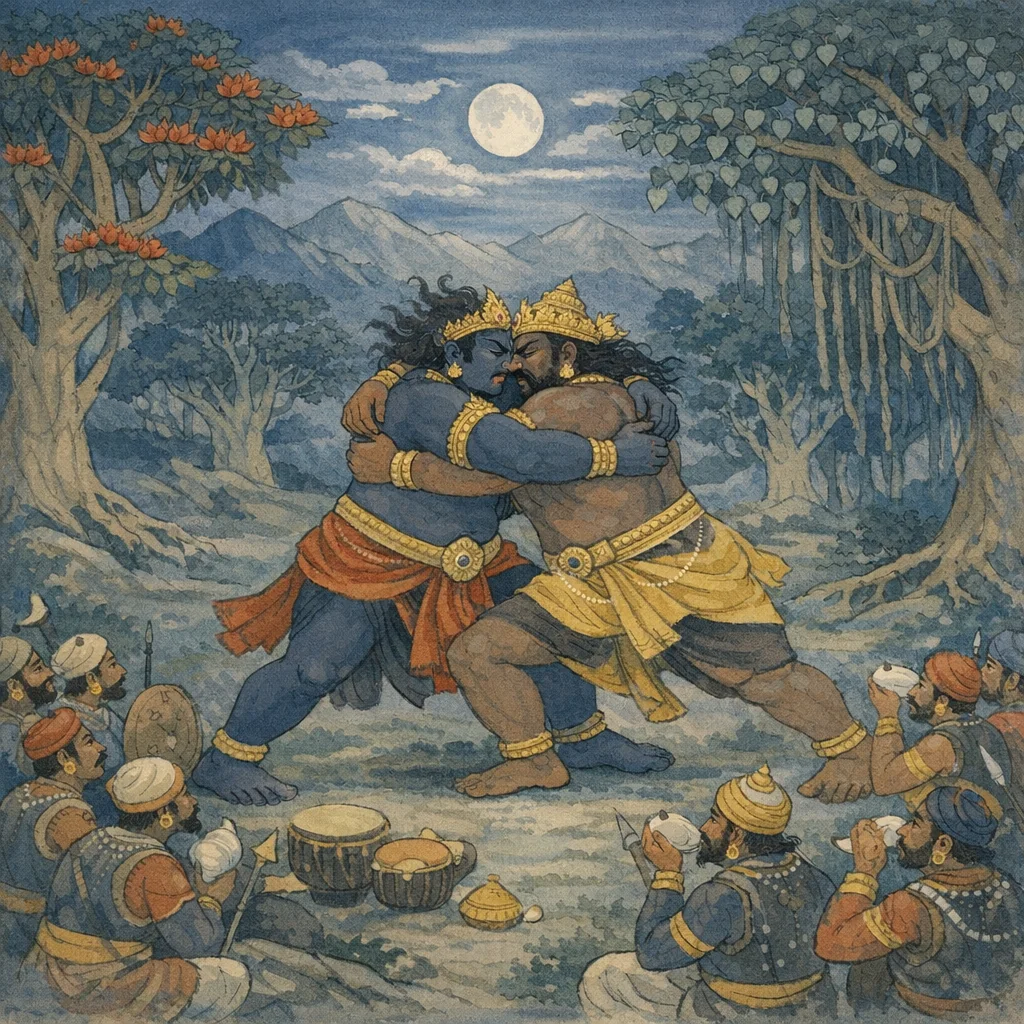
तावन्योन्यमभिद्रुत्य केशेषु सुमहाबलौ । भुजाभ्यां पर्यगृह्नीतां महाकायौ महाबलौ
Sañjaya said: The two, possessed of tremendous strength, rushed at one another and, seizing each other by the hair, grappled tightly with their arms—both huge of frame and mighty in power. The scene underscores how, in the fury of war, valor can descend into raw, bodily struggle where pride and rage eclipse restraint.
Verse 30
उन दोनों महाबली और विशालकाय राक्षसोंने परस्पर आक्रमण करके दोनों हाथोंसे दोनोंके केश पकड़ लिये ।। तौ स्थिन्नगात्रौ प्रस्वेदं सुखुवाते जनाधिप । रुधिरं च महाकायावतिवृष्टाविवाम्बुदौ
Sañjaya said: O king, those two mighty, gigantic rākṣasas closed upon one another and, grappling hand to hand, each seized the other’s hair with both hands. Their bodies grew rigid with strain and they panted in sweat; and blood streamed from those huge frames, as if two rain-clouds were pouring down in a violent downpour—an image of war’s brute fury where strength, not righteousness, seems to rule the moment.
Verse 31
नरेश्वर! अत्यन्त वर्षा करनेवाले दो मेघोंके समान उन विशालकाय राक्षसोंके शरीर पसीनेसे तर हो रहे थे। वे अपने अंगोंसे पसीनोंके साथ-साथ खून भी बहा रहे थे ।। अथाभिपत्य वेगेन समुदभ्राम्य च राक्षसम् | बलेनाक्षिप्य हैडिम्बिश्लकर्तास्य शिरो महत्,तदनन्तर बड़े वेगसे झपटकर हिडिम्बाकुमार घटोत्कचने उस राक्षसको पकड़ लिया और उसे घुमाकर बलपूर्वक पटक दिया। फिर उसके विशाल मस्तकको उसने काट डाला
Sanjaya said: “O king, those huge-bodied rākṣasas, like two clouds pouring torrential rain, were drenched in sweat; and from their limbs, along with sweat, blood too was streaming. Then, rushing in with great speed, Ghaṭotkaca—the son of Hiḍimbā—seized that rākṣasa, whirled him around, and hurled him down by sheer force; thereafter he cut off his massive head.”
Verse 32
सो<पहत्य शिरस्तस्य कुण्डलाभ्यां विभूषितम् । तदा सुतुमुलं नादं ननाद सुमहाबलः,इस प्रकार महाबली घटोत्कचने उसके कुण्डलमण्डित मस्तकको काटकर उस समय बड़ी भयानक गर्जना की
Sañjaya said: Having struck and severed his head—adorned with earrings—the exceedingly mighty one then let out a thunderous, tumultuous roar. The scene underscores the brutal momentum of battle, where prowess and fury eclipse restraint, and victory is marked not by celebration of dharma but by the terrifying spectacle of violence.
Verse 33
हतं दृष्टवा महाकायं वकज्ञातिमरिंदमम् | पज्चाला: पाण्डवाश्वैव सिंहनादान् विनेदिरे
Sañjaya said: Seeing that mighty, huge-bodied warrior—an indomitable crusher of foes, famed among his own kin—slain, the Pāñcālas and the Pāṇḍavas together raised lion-like roars. In the harsh moral landscape of war, their exultation marks both the release from a formidable threat and the grim normalization of victory through death.
Verse 34
बकासुरके विशालकाय भ्राता शत्रुमन अलायुधको मारा गया देख पांचाल और पाण्डव सिंहनाद करने लगे ।। ततो भेरीसहस्राणि शड्खानामयुतानि च । अवादयन् पाण्डवेया राक्षसे निहते युधि,युद्धस्थलमें उस राक्षसके मारे जानेपर पाण्डवदलके सैनिकोंने सहस्रों नगाड़े और हजारों शंख बजाये
Sañjaya said: Then, when that rākṣasa had been slain on the battlefield, the warriors of the Pāṇḍavas sounded thousands of kettle-drums and tens of thousands of conches—raising a lion-like roar of triumph that proclaimed the fall of a fearsome foe and strengthened the morale of their side amid the harsh demands of war.
Verse 35
अतीव सा निशा तेषां बभूव विजयावहा । विद्योतमाना विबभौ समन्ताद् दीपमालिनी,चारों ओरसे दीपावलियोंद्वारा प्रकाशित होनेवाली वह रात्रि उनके लिये विजयदायिनी होकर अत्यन्त शोभा पाने लगी
Sañjaya said: That night proved exceedingly victory-bringing for them. Shining on every side with rows of lamps, it appeared resplendent—an auspicious illumination amid the grim setting of war, strengthening resolve and signaling confidence in their cause and outcome.
Verse 36
अलायुधस्य तु शिरो भैमसेनिर्महाबल: । दुर्योधनस्य प्रमुखे चिक्षेप गतचेतस:,उस समय दुर्योधन अचेत-सा हो रहा था। महाबली घटोत्कचने अलायुधका वह मस्तक दुर्योधनके सामने फेंक दिया
Sañjaya said: Then the mighty son of Bhīmasena hurled the severed head of Alāyudha right before Duryodhana, who had fallen into a stunned, senseless state. The act is a grim proclamation of victory meant to break the enemy’s resolve and display the terrible momentum of war.
Verse 37
अथ दुर्योधनो राजा दृष्टवा हतमलायुधम् । बभूव परमोद्विग्न: सह सैन्येन भारत,भारत! अलायुधको मारा गया देख सेनासहित राजा दुर्योधन अत्यन्त उद्विग्न हो उठा
Sañjaya said: Then King Duryodhana, seeing Alāyudha slain, became intensely shaken and anxious—he and his forces alike, O descendant of Bharata. The fall of a powerful ally in the midst of battle signals a moral and strategic crisis: fear spreads through an army when its champions fall, and the king’s agitation reveals how fragile confidence becomes when violence turns back upon one’s own side.
Verse 38
तेन हास्य प्रतिज्ञातं भीमसेनमहं युधि । हन्तेति स्वयमागम्य स्मरता वैरमुत्तमम्,अलायुधने अपने भारी वैरीको याद करते हुए स्वयं आकर दुर्योधनके सामने यह प्रतिज्ञा की थी कि मैं युद्धमें भीमसेनको मार डालूँगा
Sañjaya said: Remembering his intense enmity, he himself came forward and made this vow: “In battle, I will slay Bhīmasena.” The statement highlights how personal hatred can harden into a public pledge, binding one’s conduct in war to private vengeance rather than to restraint and righteousness.
Verse 39
ध्रुवं स तेन हन्तव्य इत्यमन्यत पार्थिव: । जीवितं चिरकालं हि भ्रातृणां चाप्यमन्यत,इससे राजा दुर्योधन यह मान बैठा था कि अलायुध निश्चय ही भीमसेनको मार डालेगा और यही सोचकर उसने यह भी समझ लिया था कि अभी मेरे भाइयोंका जीवन चिरस्थायी है
Sañjaya said: The king (Duryodhana) became convinced, “Surely Bhīmasena will be slain by him (Alāyudha).” Thinking thus, he also imagined that the lives of his brothers would therefore be secure for a long time—an ethically revealing moment of wishful certainty amid the moral uncertainty of war.
Verse 40
सतं दृष्टवा विनिहतं भीमसेनात्मजेन वै । प्रतिज्ञां भीमसेनस्य पूर्णामेवाभ्यमन्यत,परंतु भीमसेनपुत्र घटोत्कचके द्वारा अलायुधको मारा गया देख उसने यह निश्चित रूपसे मान लिया कि अब भीमसेनकी प्रतिज्ञा पूरी होकर ही रहेगी
Sañjaya said: Seeing Śata (i.e., the foe so named) slain indeed by Bhīmasena’s son, he became convinced that Bhīmasena’s vow would now be fulfilled in full. In the moral atmosphere of the war, the fall of a key opponent is read not merely as a tactical gain but as a decisive step toward the completion of a pledged duty—an oath whose fulfillment is treated as a matter of honor and accountability amid the chaos of battle.
Verse 177
इस प्रकार श्रीमह्याभारत द्रोणपर्वके अन्तर्गत घटोत्कचवधपर्वमें रात्रियुद्धके प्रसंगमें अलायुधयुद्धविषयक एक सौ सतहत्तरवाँ अध्याय पूरा हुआ
Sañjaya said: Thus, in the Śrī Mahābhārata, within the Droṇa Parva—under the section concerning the slaying of Ghaṭotkaca—on the occasion of the night-battle, the one-hundred-and-seventy-seventh chapter, dealing with the combat involving Alāyudha, is concluded. The narration marks a grim turning point in the ethics of war, as the struggle continues under the cover of night and extraordinary warriors and weapons are brought to bear.
Verse 178
इति श्रीमहाभारते द्रोणपर्वणि घटोत्कचवधपर्वणि रात्रियुद्धेबलायुधवधे5ष्टसप्तत्यधिकशततमो< ध्याय:
Thus, in the Śrī Mahābhārata, within the Droṇa Parva—specifically in the section on the slaying of Ghaṭotkaca—this concludes the one-hundred-and-seventy-eighth chapter, describing the night-battle and the killing of Balāyudha. The colophon marks the close of a narrative unit, underscoring how the war’s moral order deteriorates further in nocturnal combat, where deception and extraordinary weapons increasingly replace open, dharma-aligned fighting.
Verse 273
हरीन्द्रयोर्यथा राजन् वालिसुग्रीवयो: पुरा । उन पर्वत-शिखरोंके टकरानेसे ऐसा महान् शब्द होता था, मानो वज्र फट पड़े हों। नरेश्वर! घटोत्कव और अलायुधका वह भयंकर युद्ध वैसा ही हो रहा था, जैसे पहले त्रेतायुगमें वानरराज बाली और सुग्रीवका युद्ध सुना गया है
Sañjaya said: “O King, just as in ancient times the clash between the two mighty lords among monkeys—Vāli and Sugrīva—was heard of, so too was this. From the striking together of mountain-peaks there arises a tremendous roar, as though a thunderbolt had split; in the same manner, O ruler of men, the dreadful combat between Ghaṭotkaca and Alāyudha was unfolding—echoing that famed battle of the Tretā age.”