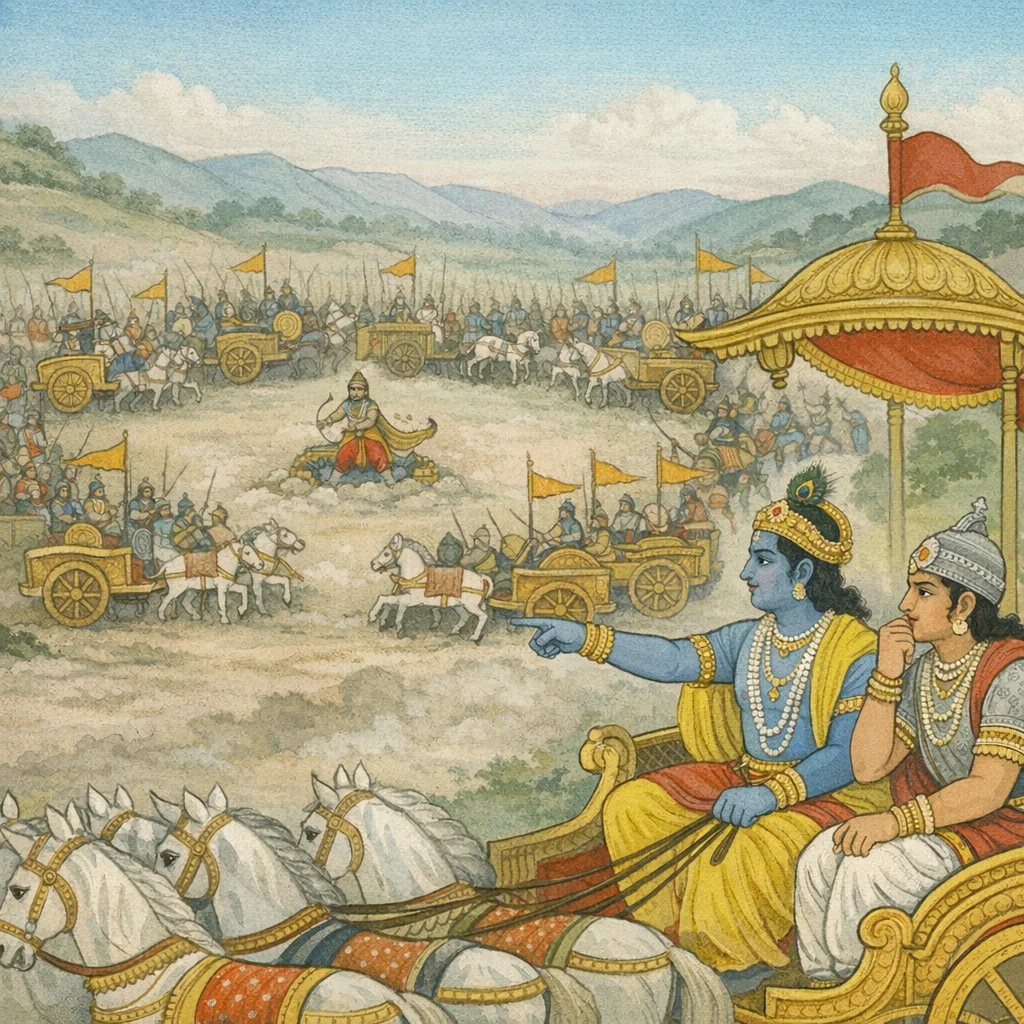
Adhyaya 143
Adhyāya 143: Nocturnal duels—Nākuli and Citraseṇa; Vṛṣasena’s assault; Duḥśāsana vs Prativindhya
Upa-parva: Night Engagements and Multi-front Duels (Droṇa-parva context unit)
Saṃjaya reports a sequence of concurrent engagements. First, Citraseṇa (son of Śatānīka) attempts to check Śatānīka’s opponent, but Nākuli (Nakula’s son) strikes Citraseṇa with heavy missiles; Citraseṇa counters and wounds Śatānīka again. Nākuli then disrupts Citraseṇa’s combat capability by stripping armor and cutting the standard and bow; Citraseṇa, though disarmed and de-horsed, secures another bow and continues, later remounting onto Hārdikya’s chariot after his own chariot is disabled. In a parallel front, Vṛṣasena (Karna’s son) advances against Drupada and the Somaka contingent aiming at Droṇa, exchanging dense volleys with Yajñasena/Drupada; the Somakas, pressured, retreat amid lamp-lit night imagery and battlefield debris. Vṛṣasena is described as standing out among many kings, then moving toward Yudhiṣṭhira’s position after defeating Somaka heroes. Another duel follows: Duḥśāsana meets Prativindhya; both exchange precise strikes, with Duḥśāsana disabling horses, charioteer, and standard, while Prativindhya continues fighting even when temporarily without a chariot by taking another conveyance. The chapter closes by emphasizing the harshness of the night battle and its escalating lethality as a systemic condition rather than a single contest.
Chapter Arc: संजय धृतराष्ट्र को सुनाते हैं कि रण-सागर में त्रिगर्तों के सुवर्ण-ध्वजों के बीच सात्यकि अद्भुत वेग से आगे बढ़ रहा है—मानो अकेला ही एक धारा को चीरता हुआ प्रवाह। → त्रिगर्त महाधनुर्धर रथ-समूह बनाकर सात्यकि को चारों ओर से घेर लेते हैं और शर-वृष्टि से उसे दबाने लगते हैं। उधर कृष्ण-अर्जुन की दृष्टि में सात्यकि का आगमन एक साथ आशा और चिंता जगाता है—क्योंकि वह धर्मराज की खोज में निकला था, फिर यहाँ क्यों? → सात्यकि को आते देख केशव अर्जुन से कहते हैं—‘देखो, शैनेय तुम्हारे पदचिह्नों का अनुसरण करता हुआ आ रहा है।’ सात्यकि अर्जुन को बताता है कि वह धर्मराज की कुशल-खोज में अनेक श्रेष्ठ योद्धाओं को मारकर यहाँ पहुँचा है; पर साथ ही यह संकेत भी देता है कि पीछे धर्मराज की सुरक्षा और द्रोण का भय—दोनों का संकट बना हुआ है। → अर्जुन के भीतर द्वंद्व तीव्र होता है: जयद्रथ-वध का संकल्प, सूर्यास्त की दौड़, थके घोड़े-रथ, और पीछे धर्मराज पर द्रोण का दबाव—इन सबके बीच सात्यकि का लौट आना एक चेतावनी बन जाता है। संवाद से स्पष्ट होता है कि युद्ध-योजना में एक दरार पड़ चुकी है और निर्णय का भार अर्जुन-कृष्ण पर आ गया है। → क्या अर्जुन सात्यकि को फिर धर्मराज की ओर भेजेगा या उसे अपने साथ रखकर जयद्रथ-वध की घड़ी में शक्ति बढ़ाएगा—और इस बीच द्रोण धर्मराज को बंदी बनाने में सफल तो नहीं हो जाएगा?
Shlokas
Verse 1
है २ बछ। है २ >> एकचत्वारिंशर्दाधिकशततमो< ध्याय: सात्यकिका अद्भुत पराक्रम, श्रीकृष्णका अर्जुनको सात्यकिके आगमनकी सूचना देना और अर्जुनकी चिन्ता संजय उवाच तमुद्यतं महाबाहुं दुःशासनरथं प्रति । त्वरितं त्वरणीयेषु धनंजयजयैषिणम्,संजय कहते हैं--राजन्! महाबाहु सात्यकि जल्दी करनेयोग्य कार्योमें बड़ी फुर्ती दिखाते थे। वे अर्जुनकी विजय चाहते थे। उन्हें अनन्त सैन्य-सागरमें प्रविष्ट होकर दुःशासनके रथपर आक्रमण करनेके लिये उद्यत देख सोनेकी ध्वजा धारण करनेवाले त्रिगर्तदेशीय महाथनुर्धर योद्धाओंने सब ओरसे घेर लिया
Sanjaya said: “O King, seeing the mighty-armed Sātyaki poised to strike toward Duḥśāsana’s chariot—swift in deeds that demanded haste, intent on securing Dhanañjaya (Arjuna)’s victory—(the warriors) surrounded him on all sides as he plunged into the vast ocean of the enemy host.”
Verse 2
त्रिगर्तानां महेष्वासा: सुवर्णविकृतध्वजा: । सेनासमुद्रमाविष्टमनन्तं पर्यवारयन्,संजय कहते हैं--राजन्! महाबाहु सात्यकि जल्दी करनेयोग्य कार्योमें बड़ी फुर्ती दिखाते थे। वे अर्जुनकी विजय चाहते थे। उन्हें अनन्त सैन्य-सागरमें प्रविष्ट होकर दुःशासनके रथपर आक्रमण करनेके लिये उद्यत देख सोनेकी ध्वजा धारण करनेवाले त्रिगर्तदेशीय महाथनुर्धर योद्धाओंने सब ओरसे घेर लिया
Sanjaya said: O King, the great bowmen of the Trigartas, bearing banners adorned with gold, surrounded him on every side—him who had plunged into the boundless ocean of armies. The scene underscores how, in the press of war, a single warrior’s bold advance invites immediate collective resistance, and how courage and loyalty are tested amid overwhelming odds.
Verse 3
अथैनं रथवंशेन सर्वतः संनिवार्य ते । अवाकिरन् शरव्रातै: क्रुद्धा: परमधन्विन:,रथसमूहद्वारा सब ओरसे सात्यकिको अवरुद्ध करके उन परम धनुर्धर योद्धाओंने उनपर क्रोधपूर्वक बाणसमूहोंकी वर्षा आरम्भ कर दी
Sañjaya said: Then those foremost archers, hemming him in on every side with a barrier of chariots, angrily showered him with volleys of arrows. The scene underscores how, in the fury of war, collective force and encirclement are used to overpower a single warrior, intensifying the moral tension between valor and ruthless advantage.
Verse 4
अजयदू राजपुत्रांस्तान् भ्राजमानान् महारणे । एक: पज्चाशतं शत्रून् सात्यकि: सत्यविक्रम:,परंतु उस महासमरमें शोभा पानेवाले अपने शत्रुरूप उन पचास राजकुमारोंको सत्यपराक्रमी सात्यकिने अकेले ही परास्त कर दिया
Sañjaya said: In that great battle, those princes who were shining with martial splendor were nevertheless overcome—Sātyaki, whose valor never swerves from truth, single-handedly defeated fifty enemy warriors. The verse underscores how steadfast courage and disciplined prowess can prevail even amid the dazzling pageantry of war.
Verse 5
सम्प्राप्प भारतीमध्यं तलघोषसमाकुलम् । असिशक्तिगदापूर्णमप्लवं सलिलं यथा
Sañjaya said: Having entered the very midst of the Bharata host—thick with the thunder of palm-like claps and battle-cries—he found it packed with swords, spears, and maces, like a flood of water without any raft or means of crossing. The image underscores the moral peril of war: once one is plunged into its center, it becomes a hard-to-cross current where survival depends on steadiness, skill, and righteous resolve rather than mere force.
Verse 6
तत्राद्भुतमपश्याम शैनेयचरितं रणे | कौरव-सेनाका वह मध्यभाग हथेलियोंके चट-चट शब्दसे गूँज उठा था। खड्ग, शक्ति तथा गदा आदि अस्त्र-शस्त्रोंसे व्याप्त था और नौकारहित अगाध जलके समान दुस्तर प्रतीत होता था। वहाँ पहुँचकर हमलोगोंने रणभूमिमें सात्यकिका अद्भुत चरित्र देखा ।। ५६ || प्रतीच्यां दिशि तं दृष्टवा प्राच्यां पश्यामि लाघवात्,वे इतनी फुर्तीसे इधर-उधर जाते थे कि मैं उन्हें पश्चिम दिशामें देखकर तुरंत ही पूर्व दिशामें भी उपस्थित देखता था, सैकड़ों रथियोंके समान वे शूरवीर सात्यकि उत्तर, दक्षिण, पूर्व और पश्चिम तथा कोणवर्ती दिशाओंमें भी नाचते हुए-से विचर रहे थे
Sañjaya said: There we witnessed something astonishing on the battlefield—the wondrous exploits of Śaineya (Sātyaki). The very middle of the Kaurava host resounded with the sharp clatter like palms striking together; it was crowded with swords, spears, maces, and every kind of weapon, and it seemed as hard to cross as deep, boatless waters. Reaching that place, we saw on the field the extraordinary prowess of Sātyaki. So swift was he that, having seen him in the western quarter, I would at once behold him in the east; like a warrior equal to hundreds of charioteers, Sātyaki moved as if dancing through the north, south, east, west, and even the intermediate directions—everywhere at once, overwhelming the enemy line.
Verse 7
उदीची दक्षिणां प्राचीं प्रतीचीं विदिशस्तथा । नृत्यन्निवाचरच्छूरो यथा रथशतं तथा,वे इतनी फुर्तीसे इधर-उधर जाते थे कि मैं उन्हें पश्चिम दिशामें देखकर तुरंत ही पूर्व दिशामें भी उपस्थित देखता था, सैकड़ों रथियोंके समान वे शूरवीर सात्यकि उत्तर, दक्षिण, पूर्व और पश्चिम तथा कोणवर्ती दिशाओंमें भी नाचते हुए-से विचर रहे थे
Sañjaya said: That heroic Sātyaki moved as if dancing—ranging through the northern, southern, eastern, and western quarters, and likewise through the intermediate directions—so swiftly that he seemed like a hundred charioteers at once, appearing in one direction and then immediately in another amid the press of battle.
Verse 8
तद् दृष्टवा चरितं तस्य सिंहविक्रान्तगामिन: । त्रिगर्ता: संन्यवर्तन्त संतप्ता: स्वजनं प्रति,सिंहके समान पराक्रमसूचक गतिसे चलनेवाले सात्यकिके उस चरित्रको देखकर त्रिगर्तदेशीय योद्धा अपने स्वजनोंके लिये शोक-संताप करते हुए पीछे लौट गये
Sañjaya said: Seeing his conduct—he who moved forward with the lion-like stride of a fearless warrior—the Trigarta fighters turned back, burning with grief and anguish for their own kinsmen.
Verse 9
तमन्ये शूरसेनानां शूरा: संख्ये न््यवारयन् । नियच्छन्त: शरव्रातैर्मत्तं द्विपमिवाड्कुशै:,तदनन्तर युद्धस्थलमें दूसरे शूरसेनदेशीय शूरवीर सैनिकोंने अपने शरसमूहोंद्वारा उनपर नियन्त्रण करते हुए उन्हें उसी प्रकार रोका, जैसे महावत मतवाले हाथीको अंकुशोंद्वारा रोकते हैं
Sanjaya said: Then other valiant warriors of the Śūrasena host checked him in the thick of battle, restraining him with volleys of arrows—just as a mahout restrains a maddened elephant with goads. The image underscores disciplined control amid chaos: force is met not merely with force, but with coordinated restraint to prevent greater devastation.
Verse 10
तैर्व्यवाहरदार्यात्मा मुहूतदिव सात्यकि: । ततः कलिड्रैर्युयुधे सोडचिन्त्यबलविक्रम:,तब अचिन्त्य बल और पराक्रमसे सम्पन्न महामना सात्यकिने उनके साथ युद्ध करके दो ही घड़ीमें उन्हें हा दिया और फिर वे कलिंगदेशीय सैनिकोंके साथ युद्ध करने लगे
Sañjaya said: Noble-souled Sātyaki engaged them in combat and, as it were within a mere moment, struck them down. Thereafter, that high-minded warrior—endowed with unimaginable strength and prowess—fought against the Kaliṅga troops. The passage underscores the relentless momentum of battle and the warrior’s steadfast execution of his martial duty amid escalating opposition.
Verse 11
तां च सेनामतिक्रम्य कलिड्ानां दुरत्ययाम् । अथ पार्थ महाबाहुर्धनंजयमुपासदत्,कलिंगोंकी उस दुर्जय सेनाओंको लाँधकर महाबाहु सात्यकि कुन्तीकुमार अर्जुनके निकट जा पहुँचे
Sañjaya said: Having overpassed that hard-to-cross, formidable army of the Kaliṅgas, the mighty-armed warrior then drew near to Dhanañjaya (Arjuna). The verse highlights resolute effort amid the moral gravity of war—pressing through a daunting force not for personal gain, but to reach and support the central champion of one’s cause.
Verse 12
तरन्निव जले श्रान्तो यथा स्थलमुपेयिवान् | त॑ दृष्टवा पुरुषव्याप्र॑ं युयुधान: समाश्चसत्,जैसे जलमें तैरते-तैरते थका हुआ मनुष्य स्थलमें पहुँच जाय, उसी प्रकार पुरुषसिंह अर्जुनको देखकर युयुधानको बड़ा आश्वासन मिला
Sañjaya said: Just as a man, exhausted from swimming in water, gains relief on reaching firm ground, so too did Yuyudhāna (Sātyaki) feel a great reassurance upon seeing Arjuna, the tiger among men. In the turmoil of war, the sight of a righteous and capable ally becomes a moral and strategic refuge, restoring courage and steadiness of purpose.
Verse 13
तमायान्तमभिप्रेक्ष्य केशव: पार्थमब्रवीत् । असावायाति शैनेयस्तव पार्थ पदानुग:,सात्यकिको आते देख भगवान् श्रीकृष्णने अर्जुनसे कहा--'पार्थ! देखो, यह तुम्हारे चरणोंका अनुगामी शिनिपौत्र सात्यकि आ रहा है
Sañjaya said: Seeing him approaching, Keśava spoke to Pārtha: “O Pārtha, look—here comes Śaineya Sātyaki, following in your very footsteps.” The line underscores loyal companionship in the midst of war: even amid chaos, steadfast adherence to one’s chosen leader and cause is presented as a valued martial and ethical virtue.
Verse 14
८ 000 0 कप पाप प्र कक 2276 ५ ७ पा कद एष शिष्य: सखा चैव तव सत्यपराक्रम: । सर्वान् योधांस्तृणीकृत्य विजिग्ये पुरुषर्षभ:,“यह सत्यपराक्रमी वीर तुम्हारा शिष्प और सखा भी है। इस पुरुषसिंहने समस्त योद्धाओंको तिनकोंके समान समझकर परास्त कर दिया है
Sañjaya said: “This one—your own disciple and also your companion—is a hero of unfailing prowess. That bull among men has conquered, treating all the warriors as mere blades of grass.”
Verse 15
एष कौरवयोधानां कृत्वा घोरमुपद्रवम् । तव प्राणै: प्रियतम: किरीटिन्नेति सात्यकि:,“किरीटधारी अर्जुन! जो तुम्हें प्राणोंके समान अत्यन्त प्रिय है, वही यह सात्यकि कौरव योद्धाओंमें घोर उपद्रव मचाकर आ रहा है
Sanjaya said: “Behold—Sātyaki, who is as dear to you as your very life, is advancing, O Kirīṭin (Arjuna), after causing a dreadful upheaval among the Kaurava warriors.”
Verse 16
एष द्रोणं तथा भोजं॑ कृतवर्माणमेव च । कदर्थीकृत्य विशिखै: फाल्गुनाभ्येति सात्यकि:,'फाल्गुन! यह सात्यकि अपने बाणोंद्वारा द्रोणाचार्य तथा भोजवंशी कृतवर्माका भी तिरस्कार करके तुम्हारे पास आ रहा है
Sañjaya said: “Behold—Sātyaki, having harried Droṇa and also the Bhoja warrior Kṛtavarman with his sharp arrows, now comes swiftly toward Phālguna (Arjuna).” In the ethical atmosphere of the battle, the line highlights loyal support in crisis: a devoted ally breaks through formidable opponents to reach and reinforce the righteous cause he has chosen to uphold.
Verse 17
धर्मराजप्रियान्वेषी हत्वा योधान् वरान् वरान् । शूरश्चैव कृतास्त्रश्न फाल्गुनाभ्येति सात्यकि:,'फाल्गुन! यह शूरवीर एवं उत्तम अस्त्रोंका ज्ञाता सात्यकि धर्मराजके प्रिय तुम्हारे समाचार लेनेके लिये बड़े-बड़े योद्धाओंको मारकर यहाँ आ रहा है
Sañjaya said: Seeking news of you, who are dear to King Dharma (Yudhiṣṭhira), Sātyaki—heroic and skilled in the use of weapons—has slain many eminent warriors and is now coming here to Arjuna. The line underscores loyal service amid the moral strain of war: devotion to one’s allies and duty to protect them drives even righteous fighters into fierce, consequential violence.
Verse 18
कृत्वा सुदुष्करं कर्म सैन्यमध्ये महाबल: । तव दर्शनमन्विच्छन् पाण्डवाभ्येति सात्यकि:,'पाण्डुनन्दन! महाबली सात्यकि कौरव-सेनाके भीतर अत्यन्त दुष्कर पराक्रम करके तुम्हें देखनेकी इच्छासे यहाँ आ रहा है
Sañjaya said: Having accomplished a deed exceedingly difficult to perform in the midst of the army, the mighty Sātyaki—seeking the sight of you—now comes toward the Pāṇḍavas. The verse highlights valor directed by loyalty: heroic effort is undertaken not for mere slaughter, but to reach and support one’s rightful side and the person one is devoted to see and aid.
Verse 19
बहूनेकरथेनाजौ योधयित्वा महारथान् | आचार्यप्रमुखान् पार्थ प्रयात्येष स सात्यकि:,'पार्थ! युद्धस्थलमें द्रोणाचार्य आदि बहुत-से महारथियोंके साथ एकमात्र रथकी सहायतासे युद्ध करके यह सात्यकि इधर आ रहा है
Sanjaya said: “O Partha, having fought in the battle against many great chariot-warriors—chief among them the preceptor (Drona)—with only a single chariot as his support, that Satyaki is now coming this way.”
Verse 20
स्वबाहुबलमाश्रित्य विदार्य च वरूथिनीम् । प्रेषितो धर्मराजेन पार्थैषो5भ्येति सात्यकि:,“कुन्तीकुमार! अपने बाहुबलका आश्रय ले कौरव-सेनाको विदीर्ण करके धर्मराजका भेजा हुआ यह सात्यकि यहाँ आ रहा है
Sañjaya said: “Relying on the strength of his own arms, and having torn through the enemy battle-array, this Sātyaki—sent by Dharmarāja—now comes toward you, O son of Pṛthā (Arjuna).”
Verse 21
यस्य नास्ति समो योध: कौरवेषु कथंचन । सो<5यमायाति कौन्तेय सात्यकिर्युद्धदुर्मद:,“कुन्तीनन्दन! कौरव-सेनामें किसी प्रकार भी जिसकी समता करनेवाला एक भी योद्धा नहीं है, वही यह रणदुर्मद सात्यकि यहाँ आ रहा है
Sañjaya said: “O son of Kuntī, that warrior among the Kauravas who has no equal whatsoever—he, Sātyaki, intoxicated with the ardor of battle, is now advancing here.”
Verse 22
कुरुसैन्याद् विमुक्तो वै सिंहो मध्याद् गवामिव । निहत्य बहुला: सेना: पार्थषो5भ्येति सात्यकि:,'पार्थ! जैसे सिंह गायोंके बीचसे अनायास ही निकल जाता है, उसी प्रकार कौरव- सेनाके घेरेसे छूटकर निकला हुआ यह सात्यकि बहुत-सी शत्रु-सेनाओंका संहार करके इधर आ रहा है
Sanjaya said: “Freed from the Kuru army’s encirclement—like a lion slipping out from the midst of cattle—Sātyaki, after cutting down many enemy forces, is now advancing toward Pārtha (Arjuna).” The verse highlights fearless prowess joined with steadfast loyalty: Sātyaki’s violent passage through the enemy host is framed not as mere bloodlust, but as determined protection and support of his ally amid the moral pressures of war.
Verse 23
एष राजसहस्राणां वक्त्रै: पड़कजसंनिभै: । आस्तीर्य वसुधां पार्थ क्षिप्रमायाति सात्यकि:,'कुन्तीनन्दर! यह सात्यकि सहस्रों राजाओंके कमलसदृश मस्तकोंद्वारा इस रणभूमिको पाटकर शीघ्रतापूर्वक इधर आ रहा है
Sañjaya said: “O Pārtha, Sātyaki is coming here swiftly—having strewn the earth with the lotus-like faces of thousands of kings.” The line underscores the grim moral weight of war: heroic speed and prowess are narrated through the stark image of fallen rulers, reminding the listener that victory is purchased by widespread destruction among the mighty.
Verse 24
एष दुर्योधन जित्वा भ्रातृभि: सहितं रणे । निहत्य जलसंध॑ च क्षिप्रमायाति सात्यकि:,“यह सात्यकि रणभूमिमें भाइयोंसहित दुर्योधनको जीतकर और जलसंधका वध करके शीघ्र यहाँ आ रहा है
Sañjaya said: “Behold—Sātyaki is coming here swiftly, having overcome Duryodhana in battle even as he stood with his brothers, and having slain Jalasaṃdha. The report signals a decisive turn in the fighting: a warrior’s success is measured not only by personal valor but by the immediate moral and strategic consequence—clearing the way for his side amid the chaos of dharma-contested war.”
Verse 25
रुधिरौघवतीं कृत्वा नदीं शोणितकर्दमाम् | तृणवद् व्यस्य कौरव्यानेष हवायाति सात्यकि:,“शोणित और मांसरूपी कीचड़से युक्त खूनकी नदी बहाकर और कौरव-सैनिकोंको तिनकोंके समान उड़ाकर यह सात्यकि इधर आ रहा है”
Sañjaya said: “He has turned the battlefield into a river of blood, thick with the mire of gore; scattering the Kaurava warriors like blades of grass, Sātyaki now advances this way.” The line underscores the moral horror of war even as it reports martial prowess: victory is narrated through images of devastation, reminding the listener that triumph in battle is purchased by immense suffering.
Verse 26
ततः प्रहृष्ट: कौन्तेय: केशवं वाक्यमतब्रवीत् । न मे प्रियं महाबाहो यन्मामभ्येति सात्यकि:,तब हर्षमें भरे हुए कुन्तीकुमार अर्जुनने केशवसे कहा--“महाबाहो! सात्यकि जो मेरे पास आ रहे हैं, यह मुझे प्रिय नहीं है
Sañjaya said: Then the son of Kuntī, Arjuna—his spirits stirred—spoke to Keśava: “O mighty-armed one, it is not pleasing to me that Sātyaki is coming toward me.”
Verse 27
न हि जानामि वृत्तान्तं धर्मराजस्य केशव । सात्वतेन विहीन: स यदि जीवति वा न वा,“केशव! पता नहीं, धर्मराजका क्या हाल है? सात्यकिसे रहित होकर वे जीवित हैं या नहीं?
Sañjaya said: “Keśava, I do not know what has become of Dharmarāja. Deprived of Sātvata (Sātyaki), is he still alive—or not?”
Verse 28
एतेन हि महाबाहो रक्षितव्य: स पार्थिव: । तमेष कथमुत्सूज्य मम कृष्ण पदानुग:,“महाबाहो! सात्यकिको तो उन्हींकी रक्षा करनी चाहिये थी। श्रीकृष्ण! उन्हें छोड़कर ये मेरे पीछे कैसे चले आये?
Sañjaya said: “O mighty-armed one, it was by this man that the king ought to have been protected. O Kṛṣṇa, how could he abandon him and come following after me—he who is devoted to your very footsteps?”
Verse 29
राजा द्रोणाय चोत्सृष्ट: सैन्धवश्चानिपातित: । प्रत्युध्याति च शैनेयमेष भूरिश्रवा रणे,“इन्होंने राजा युधिष्ठिरको द्रोणाचार्यके लिये छोड़ दिया और सिन्धुराज जयद्रथ भी अभी मारा नहीं गया। इसके सिवा ये भूरिश्रवा रणमें शिनिपौत्र सात्यकिकी ओर अग्रसर हो रहे हैं
Verse 30
सो<यं गुरुतरो भार: सैन्धवार्थे समाहित: । ज्ञातव्यक्ष हि मे राजा रक्षितव्यश्ष॒ सात्यकि:,“इस समय सिन्धुराज जयद्रथके कारण यह मुझपर बहुत बड़ा भार आ गया। एक तो मुझे राजाका कुशल-समाचार जानना है, दूसरे सात्यकिकी भी रक्षा करनी है
Sanjaya said: “Because of the affair concerning the king of Sindhu (Jayadratha), a heavier burden has now fallen upon me. For I must learn the welfare of the king, and I must also ensure the protection of Satyaki.”
Verse 31
जयद्रथश्न हन्तव्यो लम्बते च दिवाकर: । श्रान्तश्नैष महाबाहुरल्पप्राणश्न साम्प्रतम्,“इसके सिवा जयद्रथका भी वध करना है। इधर सूर्यदेव अस्ताचलपर जा रहे हैं। माधव! ये महाबाहु सात्यकि इस समय थककर अल्पप्राण हो रहे हैं। इनके घोड़े और सारथि भी थक गये हैं। किंतु केशव! भूरिश्रवा और उनके सहायक थके नहीं हैं
Sanjaya said: “Jayadratha too must be slain, and the Sun is already sinking toward the horizon. This mighty-armed Sātyaki is now exhausted and short of breath.”
Verse 32
परिश्रान्ता हयाश्वास्य हययन्ता च माधव । न च भूरिश्रवा: श्रान्त: ससहायश्व केशव,“इसके सिवा जयद्रथका भी वध करना है। इधर सूर्यदेव अस्ताचलपर जा रहे हैं। माधव! ये महाबाहु सात्यकि इस समय थककर अल्पप्राण हो रहे हैं। इनके घोड़े और सारथि भी थक गये हैं। किंतु केशव! भूरिश्रवा और उनके सहायक थके नहीं हैं
Sanjaya said: “Madhava, Satyaki’s horses and his charioteer are exhausted; he himself is worn out and breathing faintly. Yet, O Keshava, Bhurishravas—together with his supporters—shows no fatigue. And besides this, Jayadratha too must be slain, even as the Sun is already moving toward the western horizon.”
Verse 33
अपीदानीं भवेदस्य क्षेममस्मिन् समागमे । कच्चिन्न सागर तीर्त्वा सात्यकि: सत्यविक्रम:
Sañjaya said: “Might there yet be safety for him in this encounter? Has Sātyaki—whose valor is true and proven—surely not perished after crossing that sea-like peril?”
Verse 34
गोष्पदं प्राप्प सीदेत महौजा: शिनिपुड्भव: । “क्या इन दोनोंके इस संघर्षमें इस समय सात्यकि सकुशल विजयी हो सकेंगे? कहीं ऐसा तो नहीं होगा कि सत्यपराक्रमी शिनिप्रवर महाबली सात्यकि समुद्रको पार करके गायकी खुरीके बराबर जलमें डूबने लगे || ३३ $ || अपि कौरवमुख्येन कृतास्त्रेण महात्मना
Verse 35
समेत्य भूरिश्रवसा स्वस्तिमान् सात्यकिर्भवेत् । “कौरवकुलके मुख्य वीर अस्त्रवेत्ता महामना भूरिश्रवासे भिड़कर क्या सात्यकि सकुशल रह सकेंगे ।। ३३ $ ।। व्यतिक्रममिमं मन्ये धर्मराजस्य केशव
Sañjaya said: “If Sātyaki comes face to face with Bhūriśravas, will he truly remain safe and unharmed? O Keśava, I fear this will become a grave transgression against the righteous king (Yudhiṣṭhira)—a moment where the pressures of war may drive men beyond the bounds of dharma.”
Verse 36
ग्रहणं धर्मराजस्य खग: श्येन इवामिषम्,'जैसे बाजपक्षी मांसपर झपट्टा मारता है, उसी प्रकार द्रोणाचार्य प्रतिदिन धर्मराजको बंदी बनाना चाहते हैं। क्या राजा युधिष्ठिर सकुशल होंगे?”
Sañjaya said: “As a hawk swoops down upon flesh, so does Droṇācārya, day after day, seek to seize Dharmarāja (Yudhiṣṭhira) and take him captive. Will King Yudhiṣṭhira remain safe and unharmed?”
Verse 37
नित्यमाशंसते द्रोण: कच्चित् स्थात् कुशली नृप:,'जैसे बाजपक्षी मांसपर झपट्टा मारता है, उसी प्रकार द्रोणाचार्य प्रतिदिन धर्मराजको बंदी बनाना चाहते हैं। क्या राजा युधिष्ठिर सकुशल होंगे?”
Sañjaya said: “Droṇa constantly longs to seize Dharmarāja—swooping upon him like a hawk upon flesh. Will King Yudhiṣṭhira remain safe and unharmed?”
Verse 141
इति श्रीमहाभारते द्रोणपर्वणि जयद्रथवधपर्वणि सात्यक्यर्जुनदर्शने एकचत्वारिंशदधिकशततमो<ध्याय:
Thus ends the one hundred and forty-first chapter in the Droṇa Parva of the Śrī Mahābhārata, within the section concerning the slaying of Jayadratha, in the episode titled “The Meeting of Sātyaki and Arjuna.” This colophon marks the close of a narrative unit in which the momentum of war is framed by purpose and consequence—victory pursued not as mere conquest, but as the fulfillment of a vowed duty amid the moral weight of battlefield choices.
Verse 353
आचार्याद् भयमुत्सृज्य यः प्रैषयत् सात्यकिम् । “केशव! मैं तो धर्मराजके इस कार्यको विपरीत समझता हूँ, जिन्होंने द्रोणाचार्यका भय छोड़कर सात्यकिको इधर भेज दिया
Sañjaya said: “He who, casting aside fear of the Ācārya (Droṇa), dispatched Sātyaki here—O Keśava, I consider this act of Dharmarāja to be contrary to sound judgment and propriety.”
Frequently Asked Questions
The chapter foregrounds the tension between valor-based ideals (face-to-face contest) and outcome-driven tactics (disabling horses, charioteers, and bows). It raises the question of how kṣatra-dharma is interpreted when operational necessity prioritizes incapacitation over ritualized symmetry.
Agency persists amid disruption: the narrative repeatedly shows continuity of effort after loss of armor, bow, or chariot, implying that dharma in crisis is measured by steadiness, adaptability, and accountability within one’s role rather than by uninterrupted advantage.
No explicit phalaśruti is stated here; the meta-commentary is conveyed through similes and framing—night, lamps, and storm-like volleys—serving as interpretive signals about impermanence, systemic violence, and the limits of control in embodied action.