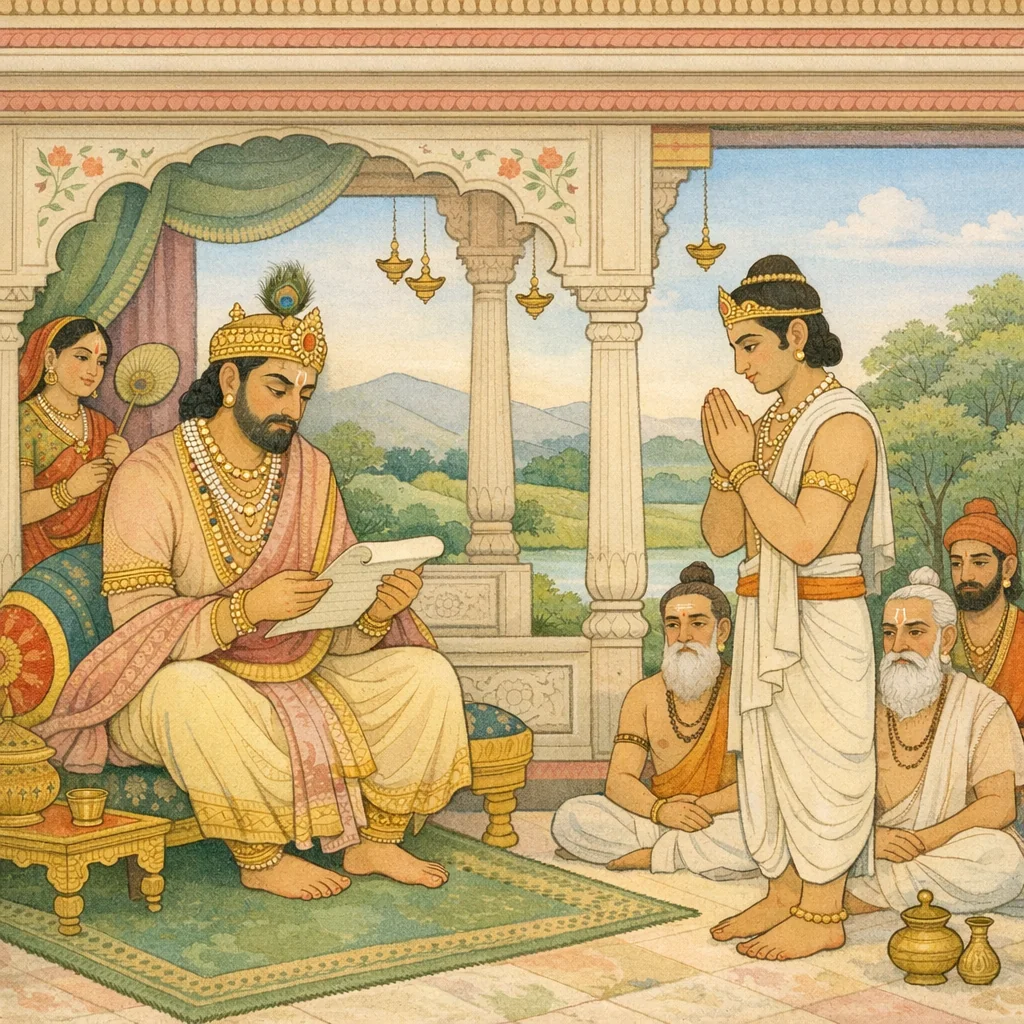
Adhyaya 86
Āśramadharma and the Marks of the Muni (Yayāti–Aṣṭaka Saṃvāda)
Upa-parva: Āśramadharma–Muni-Mauna Saṃvāda (Yayāti–Aṣṭaka Dialogue)
Aṣṭaka asks how different life-stages attain the divine or higher goals: the householder, the mendicant, the one devoted to the teacher’s work, and the forest-dweller established on the good path. Yayāti answers with a structured typology. (1) The brahmacārin succeeds through promptness in study when summoned, self-motivated service to the teacher, early rising and disciplined rest, gentleness, self-control, steadiness, vigilance, and commitment to svādhyāya. (2) The gṛhastha ideal is articulated as an ‘ancient upaniṣad’ of household life: earn wealth by dharma, perform offerings, give gifts, feed guests, and avoid taking what is not given. (3) The vānaprastha/forest-ascetic is described as living by one’s own effort, avoiding harmful conduct, giving to others, practicing regulated diet and activity, and thereby approaching a principal attainment; additional verses connect forest discipline with conquest over desire and the timing of spiritual effort. (4) The bhikṣu is characterized by non-dependence on crafts for livelihood, homelessness, sense-restraint, freedom from entanglements, wandering, lightness, and minimal conduct. Aṣṭaka then asks about munis and forms of mauna; Yayāti defines the muni paradoxically: one for whom the village is ‘behind’ while in the forest, and for whom the forest is ‘behind’ while in the village—explained as non-indulgence in village-ways, minimal clothing, minimal food sufficient for sustaining life, and radical reduction of wants. The chapter concludes with the ideal of renouncing desires, establishing mauna, enduring austerity, becoming free from dualities, and thereby attaining higher worlds; a final image depicts the muni seeking food ‘like a cow’ (non-aggressive, modest foraging), with resulting orientation toward immortality.
Chapter Arc: सिंह-विक्रान्त, नवयुवक-सा तेजस्वी राजा ययाति—यज्ञ, श्राद्ध और दान से देव, पितृ और द्विजों को तृप्त करता हुआ—फिर भी भीतर एक अदृश्य आग: भोग की तृष्णा। → हजार वर्षों तक विषयासक्ति में डूबे रहने पर भी तृष्णा घटती नहीं; धर्मात्मा राजा ‘काल’ को देखता है और समझता है कि भोग-सम्पदा पूर्ण होकर भी मन अपूर्ण है—अब उत्तराधिकारी और वंश-धर्म का प्रश्न सामने आता है। → ययाति पूरु को संबोधित कर निर्णायक वचन कहता है—राज्य-भार और वंश-परम्परा का केन्द्र पूरु बनेगा; यहीं से ‘पौरव’ वंश की धुरी स्थिर होती है, और जनमेजय के अपने कुल का स्रोत उजागर होता है। → यदु, तुर्वसु, द्रुह्यु, अनु और पूरु—इनसे जातियों/वंशों का विस्तार बताया जाता है: यदु से यादव, तुर्वसु से यवन, द्रुह्यु से भोज, अनु से म्लेच्छ-जातियाँ; और पूरु से पौरव वंश, जिसमें जनमेजय जन्मा। → पौरव-वंश की दीर्घ राज-परम्परा का संकेत देकर कथा आगे के राजाओं और घटनाओं की ओर मोड़ लेती है।
Shlokas
Verse 1
इस प्रकार श्रीमहाभारत आदिपर्वके अन्तर्गत सम्भवपर्वमें ययात्युपाख्यानविषयक चौरासीवाँ अध्याय प्रा हुआ ॥/ ८४ ॥। (दाक्षिणात्य अधिक पाठके १६३ “लोक मिलाकर कुल ३५३ लोक हैं) #द-2ल्5 >> श््यु #* पञ्चाशीतितमोब<् ध्याय: राजा ययातिका विषय-सेवन और वैराग्य तथा पूरुका राज्याभिषेक करके वनमें जाना वैशम्पायन उवाच पौरवेणाथ वयसा ययातिर्नहुषात्मज: । प्रीतियुक्तो नृपश्रेष्ठक्षचार विषयान् प्रियान्,वैशम्पायनजी कहते हैं--जनमेजय! नहुषके पुत्र नृपश्रेष्ठ ययातिने पूरुकी युवावस्थासे अत्यन्त प्रसन्न होकर अभीष्ट विषयभोगोंका सेवन आरम्भ किया
Vaiśampāyana said: Then Yayāti, the son of Nahuṣa, having obtained Puru’s youth, joyfully indulged in the pleasures he desired. The verse frames a moral tension: the king’s satisfaction is rooted in borrowed vitality, foreshadowing the ethical reckoning between sensual enjoyment and the awakening of dispassion that the Yayāti episode is meant to teach.
Verse 2
यथाकामं यथोत्साहं यथाकालं यथासुखम् । धर्माविरुद्धं राजेन्द्र यथाहति स एव हि,राजेन्द्र! उनकी जैसी कामना होती, जैसा उत्साह होता और जैसा समय होता, उसके अनुसार वे सुखपूर्वक धर्मानुकूल भोगोंका उपभोग करते थे। वास्तवमें उसके योग्य वे ही थे
Vaiśampāyana said: “O best of kings, in accordance with their desire, their energy, the proper time, and their comfort, they enjoyed pleasures that were not opposed to dharma. Indeed, it was fitting—only they were truly worthy of such enjoyment.”
Verse 3
देवानतर्पयद् यज्ञ: श्राद्धैस्तद्धत्ू पितृनपि । दीनाननुग्रहैरिष्टै: कामैश्न द्विजसत्तमान्,उन्होंने यज्ञोंद्वारा देवताओंको, श्राद्धोंसे पितरोंको, इच्छाके अनुसार अनुग्रह करके दीन-दुःखियोंको और मुहमाँगी भोग्य वस्तुएँ देकर श्रेष्ठ ब्राह्मणोंको तृप्त किया
Vaiśampāyana said: By means of sacrifices he satisfied the gods; by śrāddha rites he satisfied the ancestors as well. Through acts of compassionate support he relieved the poor and distressed, and by granting desired enjoyments he contented the foremost of the twice-born. The passage presents generosity and ritual duty as complementary forms of dharma—honoring the divine and ancestral order while also sustaining society through charity and hospitality.
Verse 4
अतिथीनन्नपानैश्न विशश्व परिपालनै: । आनृशंस्येन शूद्रांश्व दस्यून् संनिग्रहेण च,वे अतिथियोंको अन्न और जल देकर, वैश्योंको उनके धन-वैभवकी रक्षा करके, शूद्रोंको दयाभावसे, लुटेरोंको कैद करके तथा सम्पूर्ण प्रजाको धर्मपूर्वक संरक्षणद्वारा प्रसन्न रखते थे। इस प्रकार साक्षात् दूसरे इन्द्रके समान राजा ययातिने समस्त प्रजाका पालन किया
Vaiśampāyana said: He kept the people content by acting rightly—honouring guests with food and drink, safeguarding the prosperity of the Vaiśyas, treating the Śūdras with compassion, and restraining robbers through confinement and firm control. Thus King Yayāti, like a second Indra in visible form, protected and maintained all his subjects.
Verse 5
धर्मेण च प्रजा: सर्वा यथावदनुरञ्जयन् । ययाति: पालयामास साक्षादिन्द्र इवापर:,वे अतिथियोंको अन्न और जल देकर, वैश्योंको उनके धन-वैभवकी रक्षा करके, शूद्रोंको दयाभावसे, लुटेरोंको कैद करके तथा सम्पूर्ण प्रजाको धर्मपूर्वक संरक्षणद्वारा प्रसन्न रखते थे। इस प्रकार साक्षात् दूसरे इन्द्रके समान राजा ययातिने समस्त प्रजाका पालन किया
By upholding dharma, King Yayāti pleased all his subjects in the proper way and protected them—like Indra himself, as it were, a second Indra among men. The verse portrays ideal kingship: governance that wins the people’s goodwill through righteous protection rather than mere power.
Verse 6
स राजा सिंहविक्रान्तो युवा विषयगोचर: । अविरोधेन धर्मस्य चचार सुखमुत्तमम्,वे राजा सिंहके समान पराक्रमी और नवयुवक थे। सम्पूर्ण विषय उनके अधीन थे और वे धर्मका विरोध न करते हुए उत्तम सुखका उपभोग करते थे
Vaiśampāyana said: That king, lion-like in valor and still in the vigor of youth, held the whole realm within his effective control. Without ever setting himself against dharma, he lived and enjoyed the highest well-being—prosperity grounded in righteous conduct rather than in transgression.
Verse 7
स सम्प्राप्य शुभान् कामांस्तृप्त: खिन्नश्न पार्थिव: । काल वर्षसहस्रान्तं सस्मार मनुजाधिप:,वे नरेश शुभ भोगोंको प्राप्त करके पहले तो तृप्त एवं आनन्दित होते थे; परंतु जब यह बात ध्यानमें आती कि ये हजार वर्ष भी पूरे हो जायँगे, तब उन्हें बड़ा खेद होता था। कालतत्त्वको जाननेवाले पराक्रमी राजा ययाति एक-एक कला और काष्ठाकी गिनती करके एक हजार वर्षके समयकी अवधिका स्मरण रखते थे। राजर्षि ययाति हजार वर्षोकी जवानी पाकर नन्दनवनमें विश्वाची अप्सराके साथ रमण करते और प्रकाशित होते थे। वे अलकापुरीमें तथा उत्तर दिशावर्ती मेरशिखरपर भी इच्छानुसार विहार करते थे। धर्मात्मा नरेशने जब देखा कि समय अब पूरा हो गया, तब वे अपने पुत्र पुरुके पास आकर बोले --
Vaiśampāyana said: Having attained auspicious pleasures, the king was at first satisfied; yet he also grew weary. The lord of men kept recalling the end-point of time—when a thousand years would be completed. Thus, even amid enjoyment, the awareness of time’s limit brought him inner regret, for pleasure proved unable to remove the anxiety born of impermanence.
Verse 8
परिसंख्याय कालज्ञ: कला: काष्छाश्न वीर्यवान् | यौवन प्राप्य राजर्षि: सहस्रपरिवत्सरान्,वे नरेश शुभ भोगोंको प्राप्त करके पहले तो तृप्त एवं आनन्दित होते थे; परंतु जब यह बात ध्यानमें आती कि ये हजार वर्ष भी पूरे हो जायँगे, तब उन्हें बड़ा खेद होता था। कालतत्त्वको जाननेवाले पराक्रमी राजा ययाति एक-एक कला और काष्ठाकी गिनती करके एक हजार वर्षके समयकी अवधिका स्मरण रखते थे। राजर्षि ययाति हजार वर्षोकी जवानी पाकर नन्दनवनमें विश्वाची अप्सराके साथ रमण करते और प्रकाशित होते थे। वे अलकापुरीमें तथा उत्तर दिशावर्ती मेरशिखरपर भी इच्छानुसार विहार करते थे। धर्मात्मा नरेशने जब देखा कि समय अब पूरा हो गया, तब वे अपने पुत्र पुरुके पास आकर बोले --
Vaiśampāyana said: The mighty royal sage (Yayāti), skilled in understanding time, kept the measure of his thousand years of youth by counting each kalā and each kāṣṭhā (minute divisions of time). Though he enjoyed splendid royal pleasures and felt satisfied and delighted, whenever he reflected that even those thousand years would inevitably be completed, he was seized by deep regret—revealing the ethical truth that worldly enjoyment, however vast, remains bounded by time and therefore cannot finally satisfy desire.
Verse 9
विश्वाच्या सहितो रेमे व्यभ्राजन्नन्दने वने | अलकायां स काल तु मेरुशज़े तथोत्तरे,वे नरेश शुभ भोगोंको प्राप्त करके पहले तो तृप्त एवं आनन्दित होते थे; परंतु जब यह बात ध्यानमें आती कि ये हजार वर्ष भी पूरे हो जायँगे, तब उन्हें बड़ा खेद होता था। कालतत्त्वको जाननेवाले पराक्रमी राजा ययाति एक-एक कला और काष्ठाकी गिनती करके एक हजार वर्षके समयकी अवधिका स्मरण रखते थे। राजर्षि ययाति हजार वर्षोकी जवानी पाकर नन्दनवनमें विश्वाची अप्सराके साथ रमण करते और प्रकाशित होते थे। वे अलकापुरीमें तथा उत्तर दिशावर्ती मेरशिखरपर भी इच्छानुसार विहार करते थे। धर्मात्मा नरेशने जब देखा कि समय अब पूरा हो गया, तब वे अपने पुत्र पुरुके पास आकर बोले --
Vaiśampāyana said: Accompanied by the apsaras Viśvācā, King Yayāti delighted in pleasure and shone resplendent in Indra’s Nandana grove. For a time he also wandered at will in Alakā and upon the northern peaks of Mount Meru. Yet even amid celestial enjoyments, the awareness of time’s limit—of the thousand years that must inevitably be exhausted—cast a shadow of regret, reminding him that pleasure without restraint is bound to end and that one who knows Time cannot escape its law.
Verse 10
यदा स पश्यते काल धर्मात्मा त॑ं महीपति: । पूर्ण मत्वा तत: काल पूरुं पुत्रमुवाच ह,वे नरेश शुभ भोगोंको प्राप्त करके पहले तो तृप्त एवं आनन्दित होते थे; परंतु जब यह बात ध्यानमें आती कि ये हजार वर्ष भी पूरे हो जायँगे, तब उन्हें बड़ा खेद होता था। कालतत्त्वको जाननेवाले पराक्रमी राजा ययाति एक-एक कला और काष्ठाकी गिनती करके एक हजार वर्षके समयकी अवधिका स्मरण रखते थे। राजर्षि ययाति हजार वर्षोकी जवानी पाकर नन्दनवनमें विश्वाची अप्सराके साथ रमण करते और प्रकाशित होते थे। वे अलकापुरीमें तथा उत्तर दिशावर्ती मेरशिखरपर भी इच्छानुसार विहार करते थे। धर्मात्मा नरेशने जब देखा कि समय अब पूरा हो गया, तब वे अपने पुत्र पुरुके पास आकर बोले --
Vaiśaṃpāyana said: When that righteous king perceived that Time had arrived—judging that the allotted period was now complete—he then addressed his son Pūru. The verse marks the ethical turning-point: enjoyment granted for a fixed term must yield to the law of Time, and the king, mindful of dharma, turns from pleasure back to responsibility and rightful order.
Verse 11
यथाकामं यथोत्साहं यथाकालमरिंदम । सेविता विषया: पुत्र यौवनेन मया तव,शत्रुदमन पुत्र! मैंने तुम्हारी जवानीके द्वारा अपनी रुचि, उत्साह और समयके अनुसार विषयोंका सेवन किया है
Vaiśampāyana said: “O subduer of foes, my son, in accordance with my desire, my energy, and the proper time, I have enjoyed the objects of sense through your youth.”
Verse 12
न जातु काम: कामानामुपभोगेन शाम्यति । हविषा कृष्णवर्त्मेव भूय एवाभिवर्धते,“परंतु विषयोंकी कामना उन विषयोंके उपभोगसे कभी शान्त नहीं होती; अपितु घीकी आहुति पड़नेसे अग्निकी भाँति वह अधिकाधिक बढ़ती ही जाती है
Vaiśampāyana said: Desire for sense-objects is never truly pacified by indulging in those very objects. Rather, like a fire fed with oblations of ghee, it only flares up again and grows ever stronger—an ethical warning that gratification multiplies craving instead of ending it.
Verse 13
यत् पृथिव्यां ब्रीहियवं हिरण्यं पशव: स्त्रिय: । एकस्यापि न पर्याप्तं तस्मात् तृष्णां परित्यजेत्,“इस पृथ्वीपर जितने भी धान, जौ, स्वर्ण, पशु और स्त्रियाँ हैं, वे सब एक मनुष्यके लिये भी पर्याप्त नहीं हैं। अतः तृष्णाका त्याग कर देना चाहिये
Vaiśampāyana said: “All the rice and barley on this earth, all the gold, cattle, and women—none of it is sufficient even for a single person. Therefore one should renounce craving.”
Verse 14
या दुस्त्यजा दुर्मतिभिर्या न जीर्य॑ति जीर्यत: । योडसौ प्राणान्तिको रोगस्तां तृष्णां त्यजत: सुखम्,“खोटी बुद्धिवाले लोगोंके लिये जिसका त्याग करना अत्यन्त कठिन है, जो मनुष्यके बूढ़े होनेपर भी स्वयं बूढ़ी नहीं होती तथा जो एक प्राणान्तक रोग है, उस तृष्णाको त्याग देनेवाले पुरुषको ही सुख मिलता है
Vaiśaṃpāyana said: “That craving which is exceedingly hard for the misguided to abandon, which does not grow old even as a man grows old, and which is a life-ending disease—only for the person who casts off that thirst does true happiness arise.”
Verse 15
पूर्ण वर्षमहस्नं मे विषयासक्तचेतस: । तथाप्यनुदिनं तृष्णा ममैतेष्वभिजायते,“देखो, विषयभोगमें आसक्तचित्त हुए मेरे एक हजार वर्ष बीत गये, तो भी प्रतिदिन उन विषयोंके लिये ही तृष्णा पैदा होती है
Vaiśampāyana said: “Though a full thousand years have passed for me with my mind absorbed in sense-objects, still, day after day, craving for those very pleasures is born anew within me.”
Verse 16
तस्मादेनामहं त्यक्त्वा ब्रह्म॒ण्याधाय मानसम् । निर्दन्दो निर्ममो भूत्वा चरिष्यामि मृगै:ः सह,“अतः मैं इस तृष्णाको छोड़कर परब्रह्म परमात्मामें मन लगा द्वन्ध और ममतासे रहित हो वनमें मृगोंके साथ विचरूँगा
“Therefore, abandoning this craving, I shall fix my mind upon Brahman. Free from the pairs of opposites and without possessiveness, I will live in the forest, wandering in the company of the deer.”
Verse 17
पूरो प्रीतो5स्मि भद्रं ते गृहाणेदं स््वयौवनम् । राज्यं चेदं गृहाण त्वं त्वं हि मे प्रियकृत् सुत:,'पूरो! तुम्हारा भला हो, मैं प्रसन्न हूँ। अपनी यह जवानी ले लो। साथ ही यह राज्य भी अपने अधिकारमें कर लो; क्योंकि तुम मेरा प्रिय करनेवाले पुत्र हो”
Vaiśampāyana said: “Pūru, blessings upon you. I am pleased. Take back this youth of mine. And take this kingdom as well—rightfully assume it—for you are the son who has done what is dear to me.”
Verse 18
वैशम्पायन उवाच प्रतिपेदे जरां राजा ययातिर्नाहुषस्तदा । यौवन प्रतिपेदे च पूरु: स्वं पुनरात्मन:,वैशम्पायनजी कहते हैं--जनमेजय! उस समय नहुषनन्दन राजा ययातिने अपनी वृद्धावस्था वापस ले ली और पूरुने पुन: अपनी युवावस्था प्राप्त कर ली
Vaiśampāyana said: At that time King Yayāti, the son of Nahuṣa, took back old age; and Pūru, in turn, regained his own youth again. Thus the exchange of conditions was effected—an episode that foregrounds the ethical weight of filial duty and the consequences of desire, as youth and age become transferable through consent and sacrifice.
Verse 19
अभिषेक्तुकामं नृपतिं पूरुं पुत्र कनीयसम् । ब्राह्मणप्रमुखा वर्णा इदं वचनमनब्लुवन्,जब ब्राह्मण आदि वर्णोने देखा कि महाराज ययाति अपने छोटे पुत्र पूरको राजाके पदपर अभिषिक्त करना चाहते हैं, तब उनके पास आकर इस प्रकार बोले--
Vaiśampāyana said: When the leading members of society—headed by the Brāhmaṇas—saw that King Yayāti wished to consecrate his younger son Pūru as king, they approached and spoke these words, seeking to guide the succession in accordance with accepted norms of dharma and social order.
Verse 20
कथं शुक्रस्य नप्तारं देवयान्या: सुतं प्रभो । ज्येष्ठ यदुमतिक्रम्य राज्यं पूरो: प्रयच्छसि,'प्रभो! शुक्राचार्यके नाती और देवयानीके ज्येष्ठ पुत्र यदुके होते हुए उन्हें लाँघकर आप पूरुको राज्य क्यों देते हैं?
Vaiśampāyana said: “O lord, how is it that, passing over Yadu—the eldest son of Devayānī and the grandson of Śukra—you bestow the kingship upon Pūru? What is the reason for setting aside the firstborn and granting the realm to the younger?”
Verse 21
यदुर्ज्येष्ठस्तव सुतो जातस्तमनु तुर्वसु: । शर्मिष्ठाया: सुतो द्रह्मुस्ततो5नु: पूरुरेव च,“यदु आपके उज्येष्ठ पुत्र हैं। उनके बाद तुर्वसु उत्पन्न हुए हैं। तदनन्तर शर्मिष्ठाके पुत्र क्रमशः ट्रह्यु, अनु और पूरु हैं
Vaiśampāyana said: “Your eldest son is Yadu; after him was born Turvasu. Thereafter, from Śarmiṣṭhā were born her sons—Druhyu, then Anu, and also Puru.” In this genealogical account, the succession of sons establishes the lines of descent that later shape royal legitimacy and the unfolding of dynastic duty (dharma) in the epic’s history.
Verse 22
कथं ज्येष्ठानतिक्रम्प कनीयान् राज्यमर्हति । एतत् सम्बोधयामस्त्वां धर्म त्वं प्रतिपालय,'ज्येष्ठ पुत्रोंका उल्लंघन करके छोटा पुत्र राज्यका अधिकारी कैसे हो सकता है? हम आपको इस बातका स्मरण दिला रहे हैं। आप धर्मका पालन कीजिये”
Vaiśampāyana said: “How can the younger son be entitled to the kingdom by bypassing the elder sons? We are reminding you of this very point—uphold dharma and act in accordance with rightful order.”
Verse 23
ययातिरुवाच ब्राह्मणप्रमुखा वर्णा: सर्वे शृण्वन्तु मे वच: । ज्येष्ठं प्रति यथा राज्यं न देयं मे कथंचन,ययातिने कहा--ब्राह्मण आदि सब वर्णके लोग मेरी बात सुनें, मुझे ज्येष्ठ पुत्रको किसी तरह राज्य नहीं देना है
Yayāti said: “Let all the social orders, with the Brāhmaṇas foremost, listen to my words. Under no circumstance shall I grant the kingdom to the eldest (son).”
Verse 24
मम ज्येछेन यदुना नियोगो नानुपालित: । प्रतिकूल: पितुर्यश्ष न स पुत्र: सतां मत:,मेरे ज्येष्ठ पुत्र यदुने मेरी आज्ञाका पालन नहीं किया है। जो पिताके प्रतिकूल हो, वह सत्पुरुषोंकी दृष्टिमें पुत्र नहीं माना गया है
Vaiśaṃpāyana said: “My eldest son, Yadu, did not carry out the command entrusted to him. One who acts in opposition to his father is, in the judgment of the virtuous, not regarded as a true son.”
Verse 25
मातापित्रोर्वचनकृद्धित: पथ्यश्च यः सुतः । स पुत्र: पुत्रवद् यश्न वर्तते पितृमातृषु,जो माता और पिताकी आज्ञा मानता है, उनका हित चाहता है, उनके अनुकूल चलता है तथा माता-पिताके प्रति पुत्रोचित बर्ताव करता है, वही वास्तवमें पुत्र है
Vaiśampāyana said: The one who, as a son, carries out the words of his mother and father, seeks what is beneficial and wholesome for them, and conducts himself toward his parents with the proper affection and duty of a son—he alone is truly to be called a ‘son’.
Verse 26
(पुदिति नरकस्याख्या दु:ःखं हि नरकं विदु: । पुतस्त्राणात् ततः पुत्त्रमिहेच्छन्ति परत्र च ।। आत्मन: सदृशः पुत्र: पितृदेवर्षिपूजने । यो बहूनां गुणकर: स पुत्रो ज्येष्ठ उच्यते ।। ज्येष्ठांशभाक् स गुणकृदिह लोके परत्र च | श्रेयान् पुत्रो गुणोपेत:ः स पुत्रो नेतरो वृथा ।। वदन्ति धर्म धर्मज्ञा: पितृणां पुत्रकारणात् ।) 'पुत' यह नरकका नाम है। नरकको दुःखरूप ही मानते हैं पुत नामक नरकसे त्राण (रक्षा) करनेके कारण ही लोग इहलोक और परलोकमें पुत्रकी इच्छा करते हैं। अपने अनुरूप पुत्र देवताओं, ऋषियों और पितरोंके पूजनका अधिकारी होता है। जो बहुत-से मनुष्योंके लिये गुणकारक (लाभदायक) हो, उसीको ज्येष्ठ पुत्र कहते हैं। वह गुणकारक पुत्र ही इहलोक और परलोकमें ज्येष्ठके अंशका भागी होता है। जो उत्तम गुणोंसे सम्पन्न है, वही पुत्र श्रेष्ठ माना गया है, दूसरा नहीं। गुणहीन पुत्र व्यर्थ कहा गया है। धर्मज्ञ पुरुष पुत्रके ही कारण पितरोंके धर्मका बखान करते हैं। यदुनाहमवज्ञातस्तथा तुर्वसुनापि च । न चानुना चैव मय्यवज्ञा कृता भृशम्,बाद मेरी अवहेलना की है; तुर्वसु, द्रह्मु तथा अनुने भी मेरा बड़ा तिरस्कार किया है
Vaiśampāyana said: ‘“Put” is the name of a hell; hell is indeed understood as the very form of suffering. Because a son delivers (his forefathers) from the hell called Put, people desire a son both in this world and in the next. A son who is like his father is fit to perform worship of the Pitṛs, the gods, and the Ṛṣis. He who becomes a source of benefit and excellence for many is called the eldest (jyeṣṭha) son. That beneficent son partakes of the elder’s share here in this world and also in the world beyond. The son endowed with noble qualities is the truly superior son; the other is a son only in name, in vain. Thus do the knowers of dharma speak, praising the dharma of the ancestors on account of the son.’
Verse 27
पूरुणा तु कृतं वाक्यं मानितं च विशेषत:ः । कनीयान् मम दायादो धृता येन जरा मम,पूरने मेरी आज्ञाका पालन किया; मेरी बातको अधिक आदर दिया है, इसीने मेरा बुढ़ापा ले रखा था। अतः मेरा यह छोटा पुत्र ही वास्तवमें मेरे राज्य और धनको पानेका अधिकारी है
Vaiśaṃpāyana said: “Pūru has carried out my command and has honored my word with exceptional respect. It is he who has taken upon himself my old age. Therefore this younger son of mine is truly the rightful heir to my kingdom and wealth.”
Verse 28
मम काम: स च कृत: पूरुणा मित्ररूपिणा | शुक्रेण च वरो दत्त: काव्येनोशनसा स्वयम्,पूरने मित्ररूप होकर मेरी कामनाएँ पूर्ण की हैं। स्वयं शुक्राचार्यने मुझे वर दिया है कि 'जो पुत्र तुम्हारा अनुसरण करे, वही राजा एवं समस्त भूमण्डलका पालक हो”। अतः मैं आपलोगोंसे विनयपूर्ण आग्रह करता हूँ कि पूरुको ही राज्यपर अभिषिक्त करें
Vaiśampāyana said: “My desire has been fulfilled by Pūru, who acted in the guise of a friend. And Śukra—Kāvya Uśanas himself—has granted me a boon: ‘Whichever son follows your command, he alone shall be king and protector of the entire earth.’ Therefore I respectfully request you all to anoint Pūru to the sovereignty.”
Verse 29
पुत्रो यस्त्वानुवर्तेत स राजा पृथिवीपति: । भवतो<नुनयाम्येवं पूरू राज्येडभिषिच्यताम्,पूरने मित्ररूप होकर मेरी कामनाएँ पूर्ण की हैं। स्वयं शुक्राचार्यने मुझे वर दिया है कि 'जो पुत्र तुम्हारा अनुसरण करे, वही राजा एवं समस्त भूमण्डलका पालक हो”। अतः मैं आपलोगोंसे विनयपूर्ण आग्रह करता हूँ कि पूरुको ही राज्यपर अभिषिक्त करें
Vaiśampāyana said: “That son who follows you faithfully—he shall be the king, the lord and protector of the earth. Therefore I respectfully entreat you all: let Pūru be consecrated to the kingship.”
Verse 30
प्रकृतय ऊचु: यः पुत्रो गुणसम्पन्नो मातापित्रोर्हित: सदा । सर्वमरहति कल्याणं कनीयानपि सत्तम:,प्रजावर्गके लोग बोले--जो पुत्र गुणवान् और सदा माता-पिताका हितैषी हो, वह छोटा होनेपर भी श्रेष्ठतम है। वही सम्पूर्ण कल्याणका भागी होनेयोग्य है
The leading citizens said: “That son who is endowed with virtues and is ever devoted to the welfare of his mother and father—though he be the younger— is the best among the good. He alone deserves every kind of well-being and auspicious fortune.”
Verse 31
अर्ह: पूरुरिदं राज्यं यः सुत: प्रियकृत् तव । वरदानेन शुक्रस्प न शक््यं वक्तुमुत्तरम्,पूरु आपका प्रिय करनेवाले पुत्र हैं, अत: शुक्राचार्यके वरदानके अनुसार ये ही इस राज्यको पानेके अधिकारी हैं। इस निश्चयके विरुद्ध कुछ भी उत्तर नहीं दिया जा सकता
Vaiśampāyana said: “Pūru is the rightful heir to this kingdom, for he is the son who has acted to please you. And in accordance with Śukra’s boon, no counter-argument can be offered against this settled decision.”
Verse 32
वैशम्पायन उवाच पौरजानपदैस्तुष्टरित्युक्तो नाहुषस्तदा । अभ्यषिज्चत् तत: पूरुं राज्ये स्वे सुतमात्मन:,वैशम्पायनजी कहते हैं--नगर और राज्यके लोगोंने संतुष्ट होकर जब इस प्रकार कहा, तब नहुषनन्दन ययातिने अपने पुत्र पूरको ही अपने राज्यपर अभिषिक्त किया
Vaiśampāyana said: When the townsmen and the people of the countryside, satisfied, spoke thus, then the descendant of Nahuṣa (Yayāti) thereupon installed Pūru—his own son—upon his own kingdom. The episode underscores a king’s duty to secure orderly succession in harmony with the consent and welfare of the realm.
Verse 33
दत्त्वा च पूरवे राज्यं वनवासाय दीक्षित: । पुरात् स निर्ययौ राजा ब्राह्मणैस्तापसै: सह,इस प्रकार पूरुको राज्य दे वनवासकी दीक्षा लेकर राजा ययाति तपस्वी ब्राह्मणोंके साथ नगरसे बाहर निकल गये
Having bestowed the kingdom upon Pūru, King Yayāti formally undertook the vow of dwelling in the forest. Then, leaving the city behind, the king departed in the company of ascetic brāhmaṇas—an act that frames kingship as accountable to dharma: power is relinquished when duty calls, and renunciation is embraced under the guidance of the spiritually disciplined.
Verse 34
यदोस्तु यादवा जातास्तुर्वसोर्यवना: स्मृता: । द्रह्मो: सुतास्तु वै भोजा अनोस्तु म्लेच्छजातय:,यदुसे यादव क्षत्रिय उत्पन्न हुए, तुर्वसुकी संतान यवन कहलायी, द्रुह्मुके पुत्र भोज नामसे प्रसिद्ध हुए और अनुसे म्लेच्छजातियाँ उत्पन्न हुईं
Vaiśampāyana narrates a genealogical account: from Yadu arose the Yādavas, a Kṣatriya lineage; from Turvasu were remembered the Yavanas; from Druhyu came the people known as Bhojas; and from Anu arose groups described as mleccha-jātis. The passage situates later communities within the epic’s ancestral framework, emphasizing how identity and social memory are traced through descent.
Verse 35
पूरोस्तु पौरवो वंशो यत्र जातो5सि पार्थिव | इदं वर्षसहस््राणि राज्यं कारयितुं वशी,राजा जनमेजय! पूरुसे पौरव वंश चला; जिसमें तुम उत्पन्न हुए हो। तुम्हें इन्द्रिय- संयमपूर्वक एक हजार वर्षोतक यह राज्य करना है
Vaiśampāyana said: “O king Janamejaya, you are born in the Paurava line that descends from Pūru. Therefore, exercising self-mastery, you are to cause this kingdom to be governed for a thousand years.”
Verse 85
इति श्रीमहाभारते आदिपर्वणि सम्भवपर्वणि ययात्युपाख्याने पूर्वयायातसमाप्तौ पज्चाशीतितमो<ध्याय:
Thus, in the Śrī Mahābhārata, within the Ādi Parva and its Sambhava section, in the episode concerning King Yayāti, the earlier portion of the Yayāti narrative comes to an end; here concludes the eighty-fifth chapter. This colophon signals a formal pause in the story, marking a completed unit of instruction and reflection before the narrative proceeds further.
Frequently Asked Questions
The chapter addresses a practical dharma-sankat of prioritization: how to reconcile social duty (earning, ritual, hospitality) with renunciant aims (restraint, non-attachment), and which disciplines validate each life-stage without collapsing them into a single model.
Dharma is operationalized as disciplined conduct appropriate to one’s station: study and service cultivate character, household generosity sanctifies wealth, forest restraint trains desire, and mendicant minimalism dissolves attachment; the muni is defined less by location than by non-indulgence and reduced needs.
While not a formal phalaśruti formula, the chapter repeatedly links restraint, mauna, and nirdvandva to ‘siddhi’ and higher worlds, culminating in the claim that conquering this world through ascetic discipline enables attainment of a superior state oriented toward immortality.