Sukta 2
Rishi: Atharvanic tradition (gaṇa/devasenā-propitiation section; specific r̥ṣi not supplied in the input)
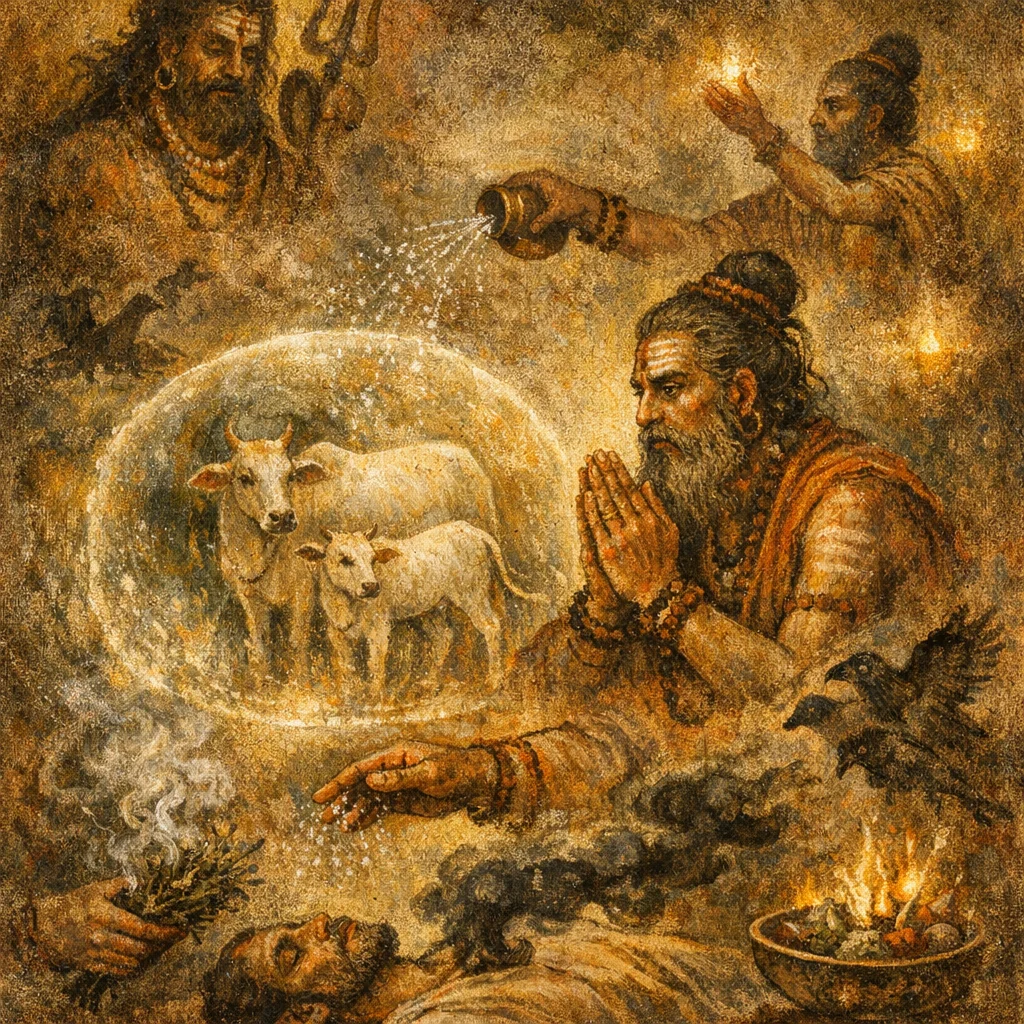
Devata: Deva-senā (divine hosts) and allied gaṇas (ghoṣiṇī-, keśinī- classes)
Chandas: Mixed/Anuṣṭubh-like cadence (prose-like enumerative namas style)
Mantras
Mantra 1
रुद्रः। भवाशर्वौ मृडतं माभि यातं भूतपती पशुपती नमो वाम्। प्रतिहितामायतां मा वि स्राष्टं मा नो हिंसिष्टं द्विपदो मा चतुष्पदः
Rudra—Bhava and Śarva—be gracious; come not against us. O Lords of beings, Lords of cattle, to you be reverence. Let what is held in check remain stretched forth (in restraint); loose not (your shaft), harm us not—neither the two-footed nor the four-footed.
Mantra 2
शुने क्रोष्ट्रे मा शरीराणि कर्तमलिक्लवेभ्यो गृध्रेभ्यो ये च कृष्णा अविष्यवः । मक्षिकास्ते पशुपते वयांसि ते विघसे मा विदन्त
Let not the dog, let not the jackal, rend our bodies; nor the clamorous ones, nor the vultures, nor those black and venomous (creatures). Thy flies, O Lord of cattle, thy birds—let them not find (us) for their eating.
Mantra 3
क्रन्दाय ते प्राणाय याश्च ते भव रोपयः । नमस्ते रुद्र कृण्मः सहस्राक्षायामर्त्य
To thee, the Roarer; to thy life-breath; and to those thy healing powers, O Bhava—to thee we make obeisance, O Rudra, thousand-eyed, immortal.
Mantra 4
पुरस्तात् ते नमः कृण्म उत्तरादधरादुत। अभीवर्गाद् दिवस्पर्यन्तरिक्षाय ते नमः
From before we make to thee obeisance; from the north and from below also; from the onrush (of peril), from heaven all around—to the mid-air, to thee be reverence.
Mantra 5
मुखाय ते पशुपते यानि चक्षूंषि ते भव । त्वचे रूपाय संदृशे प्रतीचीनाय ते नमः
To thy mouth, O Lord of cattle; to those eyes of thine, O Bhava; to thy skin, to thy form, to thy beholding—to the aspect turned away (from us), to thee be reverence.
Mantra 6
अङ्गेभ्यस्त उदराय जिह्वाया आस्याऽय ते । दद्भ्यो गन्धाय ते नमः
Homage to thee from the limbs; to thy belly homage; to thy tongue and to thy mouth. From the teeth, to thy smell, to thee be reverence.
Mantra 7
अस्त्रा नीलशिखण्डेन सहस्राक्षेण वाजिना । रुद्रेणार्धकघातिना तेन मा समरामहि
With weapons—with the blue-crested, the thousand-eyed, the swift— with Rudra, the half-slayer: with him may we confront (the peril) for my defence.
Mantra 8
स नो भवः परि वृणक्तु विश्वत आप इवाग्निः परि वृणक्तु नो भवः । मा नोऽभि मांस्त नमो अस्त्वस्मै
May Bhava encompass us on every side, as waters (encompass), as fire (encompasses): may Bhava encompass us. Smite us not; to him be reverence.
Mantra 9
चतुर्नमो अष्टकृत्वो भवाय दश कृत्वः पशुपते नमस्ते । तवेमे पञ्च पशवो विभक्ता गावो अश्वाः पुरुषा अजावयः
Fourfold homage, eight times, to Bhava; ten times, O Lord of creatures, homage to thee. Thine are these five kinds of cattle, apportioned—cows, horses, men, goats, and sheep.
Mantra 10
तव चतस्रः प्रदिशस्तव द्यौस्तव पृथिवी तवेदमुग्रोर्व१न्तरिक्षम्। तवेदं सर्वमात्मन्वद् यत् प्राणत् पृथिवीमनु
Thine are the four quarters; thine the heaven; thine the earth; thine is this mid-air of the fierce One. Thine is all this that is ensouled—whatsoever breathes, spread abroad upon the earth.
Mantra 11
उरुः कोशो वसुधानस्तवायं यस्मिन्निमा विश्वा भुवनान्यन्तः । स नो मृड पशुपते नमस्ते परः क्रोष्टारो अभिभाः श्वानः परो यन्त्वघरुदो विकेश्यःऽ
Wide is this thy treasury, wealth-containing, wherein are lodged within all these worlds. Be gracious unto us, O Lord of creatures; homage be to thee. Far hence—away—let the howlers go, the assailants, the dogs; away depart the evil-yelpers, the loose-haired.
Mantra 12
धनुर्बिभर्षि हरितं हिरण्ययं सहस्रघ्नि शतवधं शिखण्डिनम्। रुद्रस्येषुश्चरति देवहेतिस्तस्यै नमो यतमस्यां दिशी३तः
Thou bearest the bow, green-hued and golden, thousand-slaying, hundred-killing, crested. Rudra’s arrow goeth abroad—the god-sent missile: to her be homage, in whatsoever quarter she is, from hence away.
Mantra 13
यो३भियातो निलयते त्वां रुद्र निचिकीर्षति । पश्चादनुप्रयुङ्क्षे तं विद्धस्य पदनीरिव
Whoso, in fear, hideth him, and would work thee harm, O Rudra—him dost thou pursue from behind, as one followeth the footprints of a man that hath been pierced.
Mantra 14
भवारुद्रौ सयुजा संविदानावुभावुग्रौ चरतो वीर्याऽय । तभ्यां नमो यतमस्यां दिशी३तः
Bhava and Rudra, yoked together, of one accord—both fierce—go forth in might. To those twain be homage, in whatsoever quarter they be: from hence away.
Mantra 15
नमस्ते ऽस्त्वायते नमो अस्तु परायते। नमस्ते रुद्र तिष्ठत आसीनायोत ते नमः
Homage be to thee as thou comest; homage be as thou departest. Homage to thee, O Rudra, standing; and seated—homage to thee.
Mantra 16
नमः सायं नमः प्रातर्नमो रात्र्या नमो दिवा । भवाय च शर्वाय चोभाभ्यामकरं नमः
Homage at even, homage at morn; homage to Night, homage by Day. To Bhava and to Śarva—unto both together—have I made mine homage.
Mantra 17
सहस्राक्षमतिपश्यं पुरस्ताद् रुद्रमस्यन्तं बहुधा विपश्चितम्। मोपाराम जिह्वयेयमानम्
Thousand-eyed, I saw him looming in the fore—Rudra, hurling (his shafts) in many a fashion, keenly wise. Let me not draw near unto him as he licks (to consume).
Mantra 18
श्यावाश्वं कृष्णमसितं मृणन्तं भीमं रथं केशिनः पादयन्तम्। पूर्वे प्रतीमो नमो अस्त्वस्मै
His dark-horsed, black, sable chariot—crushing, dreadful—of the Long-haired, that makes men fall beneath it: as men of old we meet it; be homage unto him.
Mantra 19
मा नोऽभि स्रा मत्यं देवहेतिं मा नः क्रुधः पशुपते नमस्ते । अन्यत्रास्मद् दिव्यां शाखां वि धूनु
Shoot not against us, against the mortal, thy god-sent missile; be not wroth with us, O Lord of cattle—homage to thee. Elsewhere than from us shake off the heavenly branch.
Mantra 20
मा नो हिंसीरधि नो ब्रूहि परि णो वृङ्ग्धि मा क्रुधः । मा त्वया समरामहि
Harm us not; speak over us (a kindly word). Encompass us; ward (ill) away—be not wroth. Let us not come into conflict with thee.
Mantra 21
मा नो गोषु पुरुषेषु मा गृधो नो अजाविषु । अन्यत्रोग्र वि वर्तय पियारूणां प्रजां जहि
Prey not on us among our kine, nor among our men; be not thou greedy against us among goats and sheep. Elsewhere, O fierce one, turn thee away: smite thou the progeny of the Pi(y)ārūs.
Mantra 22
यस्य तक्मा कासिका हेतिरेकमश्वस्येव वृषणः क्रन्द एति । अभिपूर्वं निर्णयते नमो अस्त्वस्मै
Whose Fever, coughing, as a weapon—one stroke—advanceth with the neighing, as of a stallion-horse; driven forth in onset and encounter—homage be to him.
Mantra 23
यो३न्तरिक्षे तिष्ठति विष्टभितोऽयज्वनः प्रमृणन् देवपीयून्। तस्मै नमो दशभिः शक्वरीभिः
Who in the mid-air standeth, firmly propped, crushing the non-sacrificers, the god-drinkers; to him be homage with ten Śakvarī-verses.
Mantra 24
तुभ्यमारण्याः पशवो मृगा वने हिता हंसाः सुपर्णाः शकुना वयांसि । तव यक्षं पशुपते अप्स्व१न्तस्तुभ्यं क्षरन्ति दिव्या आपो वृधे
To thee belong the forest’s beasts, the wild game set in the wood; the geese, the fair-winged, the birds, the fliers. Thy wondrous power, O Lord of beasts, within the waters—unto thee the heavenly Waters flow, for thine increase.
Mantra 25
शिशुमारा अजगराः पुरीकया जषा मत्स्या रजसा येभ्यो अस्यसि । न ते दूरं न परिष्ठास्ति ते भव सद्यः सर्वान् परि पश्यसि भूमिं पूर्वस्माद्धंस्युत्तरस्मिन्समुद्रे
The śiśumāras, the great serpents, the purīkayas, the devourers, the fishes—against whom thou hurlest (thy force) through the expanse: for thee there is no far, no boundary. Be thou (so): straightway thou beholdest all the earth around; from the eastern side thou smitest, in the northern sea.
Mantra 26
मा नो रुद्र तक्मना मा विषेण मा नः सं स्रा दिव्येनाग्निना । अन्यत्रास्मद् विद्युतं पातयैताम्
Smite us not, O Rudra, with Fever; smite us not with Poison; consume us not with the heavenly Fire. Hurl thou this lightning elsewhere, away from us.
Mantra 27
भवो दिवो भव ईशे पृथिव्या भव आ पप्र उर्वन्तरिक्षम्। तस्मै नमो यतमस्यां दिशी३तः
Bhava is lord of heaven; Bhava rules the earth; Bhava hath filled the broad mid-air. To him be reverence—whichever quarter here he cometh from.
Mantra 28
भव राजन् यजमानाय मृड पशूनां हि पशुपतिर्बभूथ । यः श्रद्दधाति सन्ति देवा इति चतुष्पदे द्विपदेऽस्य मृड
Be gracious, O Bhava King, unto the sacrificer; for thou hast verily become the Lord of cattle. He who hath faith—‘the Gods exist’—be gracious unto him in four-footed and in two-footed kind.
Mantra 29
मा नो महान्तमुत मा नो अर्भकं मा नो वहन्तमुत मा नो वक्ष्यतः । मा नो हिंसीः पितरं मातरं च स्वां तन्वंऽ रुद्र मा रीरिषो नः
Harm not our great one, nor yet our little one; harm not our bearer, nor our leader. Injure not our father and our mother; our own body, O Rudra—do not thou wound us.
Mantra 30
रुद्रस्यैलबकारेभ्योऽसंसूक्तगिलेभ्यः । इदं महास्येभ्यः श्वभ्यो अकरं नमः
To Rudra’s howlers, to the swallowers of ill-uttered speech—to the great-mouthed Dogs—this reverence have I made.
Mantra 31
नमस्ते घोषिणीभ्यो नमस्ते केशिनीभ्यः । नमो नमस्कृताभ्यो नमः संभुञ्जतीभ्यः । नमस्ते देव सेनाभ्यः स्वस्ति नो अभयं च नः
Homage to thee, unto the clamorous bands; homage to thee, unto the long-haired. Homage to those made venerable by our obeisance; homage to those that feast and share together. Homage to thee, unto the godly armies: bring us welfare, and fearlessness for us.
Frequently Asked Questions
They are named classes of roaming divine/liminal hosts (gaṇas). The hymn treats them as powerful companies who can become protective when honored with respectful namas rather than feared as hostile presences.
Its dominant method is appeasement and reconciliation: repeated homage, requests for non-harm, and a shift from conflict to guardianship. The aim is to neutralize danger by converting roaming forces into allies.
No. The sukta is primarily verbal and works through invocation and pacification. If following common Atharvanic practice, simple water for purification or boundary-sprinkling can be added, but it is optional.