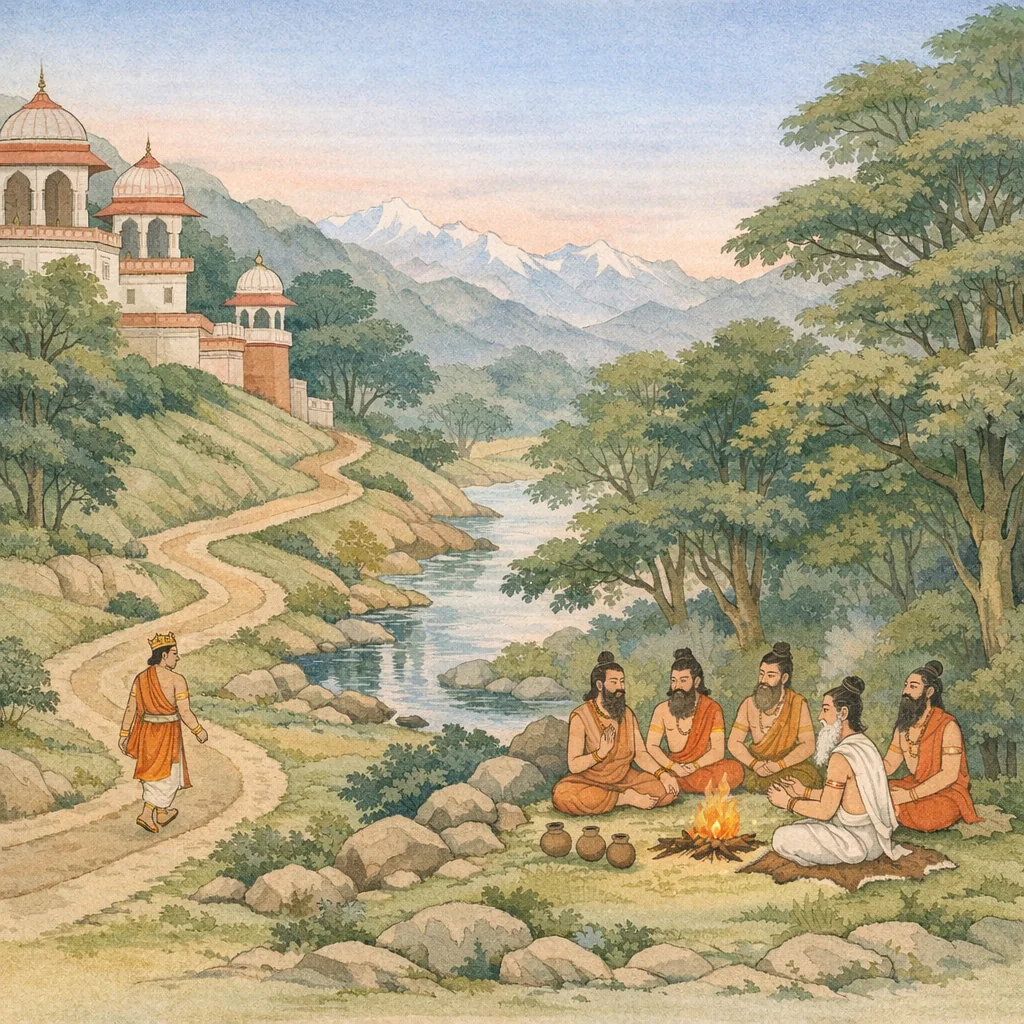
वैभ्राजवन-प्रसङ्गः / The Episode of Vaibhrāja and the Yogic Forest (Vibhrāja-vana)
This chapter is cast as a dialogue: Bhīṣma asks the sage Mārkaṇḍeya about what happened next. Mārkaṇḍeya describes seven austere practitioners, mind-controlled and devoted to dharma and yoga, sustaining themselves through extreme tapas—living as if on air and water—and drying the body by constant restraint. The narrative then turns to King Vaibhrāja, prosperous like Indra in Nandana, who returns home, installs his highly righteous son Anūha as ruler, and departs to the forest to perform tapas in the region of those ascetics. Because of his presence the forest becomes famed as “Vibhrāja-vana,” a sacred place said to grant yogic attainments (siddhi). A teaching contrast follows: some remain established in yogic dharma, while others fall from yoga (yogabhraṣṭa) and abandon the body; the text distinguishes those endowed with smṛti (spiritual memory) from the deluded. Genealogical and identity details then appear, including figures such as Svatantra, Brahmadatta, Chidradarśī, and Sunetra, learned in Veda and Vedāṅga and linked to continuity from prior births. The esoteric lesson emphasizes steadiness versus lapse in yoga, the role of smṛti in spiritual continuity, and the sacral geography of a tapas-field that produces siddhi and moral differentiation.
Shlokas
Verse 1
भीष्म उवाच । मार्कण्डेय महाप्राज्ञ पितृभक्तिभृतां वर । किं जातं तु ततो ब्रूहि कृपया मुनिसत्तम
Bhīṣma said: “O Mārkaṇḍeya, greatly wise—best among those who bear devotion to the Pitṛs—out of compassion, O foremost of sages, tell me: what happened after that?”
Verse 2
मार्कण्डेय उवाच । ते धर्मयोगनिरतास्सप्त मानसचारिणः । वाय्वंबुभक्षास्सततं शरीरमुपशोषयन्
Mārkaṇḍeya said: Those seven sages, ever intent on dharma and yoga, moved chiefly within the mind (inwardly absorbed). Living constantly on air and water alone, by such austerity they made their bodies exceedingly lean and dried.
Verse 3
स राजांतःपुरवृतो नन्दने मघवा इव । क्रीडित्वा सुचिरं तत्र सभार्य्यस्स्वपुरं ययौ
Surrounded by the women of his inner palace, that king—like Maghavā (Indra) sporting in Nandana—played there for a long time; then, together with his queen, he returned to his own city.
Verse 4
अनूहो नाम तस्यासीत्पुत्रः परमधार्मिकः । तं वैभ्राजः सुतं राज्ये स्थापयित्वा वनं ययौ
He had a son named Anūha, supremely righteous. Vaibhrāja, having installed that son upon the throne, departed for the forest—turning from kingship toward the life of renunciation.
Verse 5
तपः कर्तुं समारेभे यत्र ते सहचारिणः । स वै तत्र निराहारो वायुभक्षो महातपाः
There, where his companions were, he began to undertake austerities. In that very place the great ascetic lived without food, sustaining himself on air alone.
Verse 6
ततो विभ्राजितं तेन विभ्राजं नाम तद्वनम् । बभूव सुप्रसिद्धं हि योगसिद्धिप्रदायकम्
Thereupon, illumined by him, that forest came to be called “Vibhrāja.” Indeed, it became widely renowned as a place that bestows the yogic attainments (siddhis).
Verse 7
तत्रैव ते हि शकुनाश्चत्वारो योगधर्मिणः । योगभ्रष्टास्त्रयश्चैव देहत्यागकृतोऽभवन्
Right there, among those birds, four were established in the discipline of Yoga; but three, having fallen away from Yoga, met their end by abandoning the body.
Verse 9
स्मृतिमंतोऽत्र चत्वारस्त्रयस्तु परिमोहिताः । स्वतन्त्रस्याह्वयो जातो ब्रह्मदत्तो महौजसः
Here, four among them were mindful and clear in remembrance, while three were thoroughly deluded. From the independent one, there arose a powerful son named Brahmadatta.
Verse 10
छिद्रदर्शी सुनेत्रस्तु वेदवेदांगपारगौ । जातौ श्रोत्रियदायादौ पूर्वजातिसहाषितौ
Chidradarśī and Sunetra—both well-versed in the Vedas and the Vedāṅgas—were born as heirs of learned brāhmaṇas, and they spoke together as if recalling their former births.
Verse 11
पंचालो बह्वृचस्त्वासीदाचार्यत्वं चकार ह । द्विवेदः पुंडरीकश्च छंदोगोऽध्वर्युरेव च
Pañcāla was a Bahvṛca, a master of the Ṛg-veda, and indeed served as an ācārya, a sacred preceptor. Likewise there were Dviveda and Puṇḍarīka, and also one skilled in the Chāndoga tradition of the Sāma-veda, and an Adhvaryu, the officiant of the Yajur-veda.
Verse 12
ततो राजा सुतं दृष्ट्वा ब्रह्मदत्तमकल्मषम् । अभिषिच्य स्वराज्ये तु परां गतिमवाप्तवान्
Then the king, beholding his son Brahmadatta—stainless and free from sin—consecrated him by abhiṣeka to his own sovereignty; and thereafter he attained the supreme state, the highest spiritual goal.
Verse 13
पंचालः पुण्डरीकस्तु पुत्रौ संस्थाप्य मन्दिरे । विविशतुर्वनं तत्र गतौ परमिकां गतिम्
Pañcāla and Puṇḍarīka, having duly installed their two sons in the temple as caretakers and successors, entered the forest. There, by the grace of Lord Śiva and the ripening of their devotion, they attained the supreme state—the highest goal.
Verse 14
ब्रह्मदत्तस्य भार्य्या तु सन्नितिर्माम भारत । सा त्वेकभावसंयुक्ता रेमे भर्त्रा सहैव तु
O Bhārata, Brahmadatta’s wife, named Sanniti, was devoted to me. United in single-minded fidelity, she lived joyfully together with her husband.
Verse 15
शेषास्तु चक्रवाका वै कांपिल्ये सहचारिणः । जाताः श्रोत्रियदायादा दरिद्रस्य कुले नृप
But the remaining cakravāka birds, O king, were born at Kāṃpilya together with their mates—indeed, as heirs of Vedic brāhmaṇas—yet in the lineage of a poor man.
Verse 16
धृतिमान्सुमहात्मा च तत्त्वदर्शीं निरुत्सुकः । वेदाध्ययन सम्पन्नाश्चत्वारश्छिद्रदर्शिनः
Steadfast and truly great-souled, seers of Reality and free from restless craving—there were four, accomplished in Vedic study and skilled at discerning flaws in conduct and doctrine.
Verse 17
ते योगनिरतास्सिद्धाः प्रस्थितास्सर्व एव हि । आमंत्र्य च मिथः शंभोः पदाम्भोजं प्रणम्य तु
Those perfected ones, ever absorbed in yoga, all indeed set forth; and, taking leave of one another, they bowed down in reverence to Śambhu’s lotus-feet.
Verse 18
शूरा ये सम्प्रपद्यन्ते अपुनर्भवकांक्षिणः । पापम्प्रणाशयन्त्वद्य तच्छम्भोः परमम्पदम्
May those heroic devotees who take complete refuge—longing for the state of no return, freedom from rebirth—have their sins destroyed today, and may they attain the supreme abode of Śambhu, Lord Śiva.
Verse 19
शारीरे मानसे चैव पापे वाग्जे महामुने । कृते सम्यगिदम्भक्त्या पठेच्छ्रद्धासमन्वितः
O great sage, when sins arise through body, mind, and speech, one should recite this with proper devotion and with faith; thereby those faults are rightly remedied.
Verse 20
मुच्यते सर्वपापेभ्यश्शिवनामानुकीर्तनात् । उच्चार्यमाण एतस्मिन्देवदेवस्य तस्य वै
By the repeated glorification of Śiva’s Name, one is released from all sins. For when this Name of that Lord of Lords is uttered, it truly bestows purity and liberation.
Verse 21
विलयं पापमायाति ह्यामभाण्डमिवाम्भसि । तस्मात्तत्संचिते पापे समनंतरमेव च
Sin swiftly dissolves, like an unbaked clay vessel that breaks down in water. Therefore, when sin has accumulated, it should be addressed and removed at once through Śaiva purification and devotion.
Verse 22
जप्तव्यमेतत्पापस्य प्रशमाय महामुने । नरैः श्रद्धालुभिभूर्यस्सर्वकामफलाप्तये
O great sage, the faithful should recite this again and again, to pacify sin and to attain the fruits of all rightful desires.
Verse 23
पुष्ट्यर्थमिममध्यायं पठेदेनं शृणोति वा । मुच्यते सर्वपापेभ्यो मोक्षं याति न संशयः
Whoever recites this chapter for spiritual nourishment and well-being—or even listens to it—becomes freed from all sins and attains liberation; of this there is no doubt.
Verse 42
इति श्रीशिवमहापुराणे पञ्चम्यामुमासंहितायां पितृकल्पे पितृभाववर्णनं नाम द्विचत्वारिंशोऽध्यायः
Thus ends the forty-second chapter, called “Description of the Nature of the Pitṛs,” in the Pitṛkalpa of the fifth section—the Umāsaṃhitā—of the Śrī Śiva Mahāpurāṇa.
Frequently Asked Questions
It narrates Vaibhrāja’s transition from royal life to forest austerity, establishing Vibhrāja-vana as a renowned siddhi-producing tapas-field, while arguing—through narrative contrast—that yogic attainment depends on steadiness and clarity rather than mere austerity alone.
The text encodes a yogic taxonomy: smṛti functions as the stabilizer of identity and practice across changing conditions, whereas moha destabilizes discipline, leading to yogic lapse (yogabhraṃśa). The forest motif externalizes an inner field where discrimination either consolidates practice into siddhi or collapses it into delusion.
No explicit named manifestation (svarūpa) of Śiva or Umā is foregrounded in the sampled verses; the chapter instead advances Śaiva yogic pedagogy indirectly through exemplars of tapas, renunciation, and the siddhi-bearing sacred landscape.