Sukta 29
Sukta 5.29
Indra (with Maruts in attendance; Aryaman mentioned as principle of order)
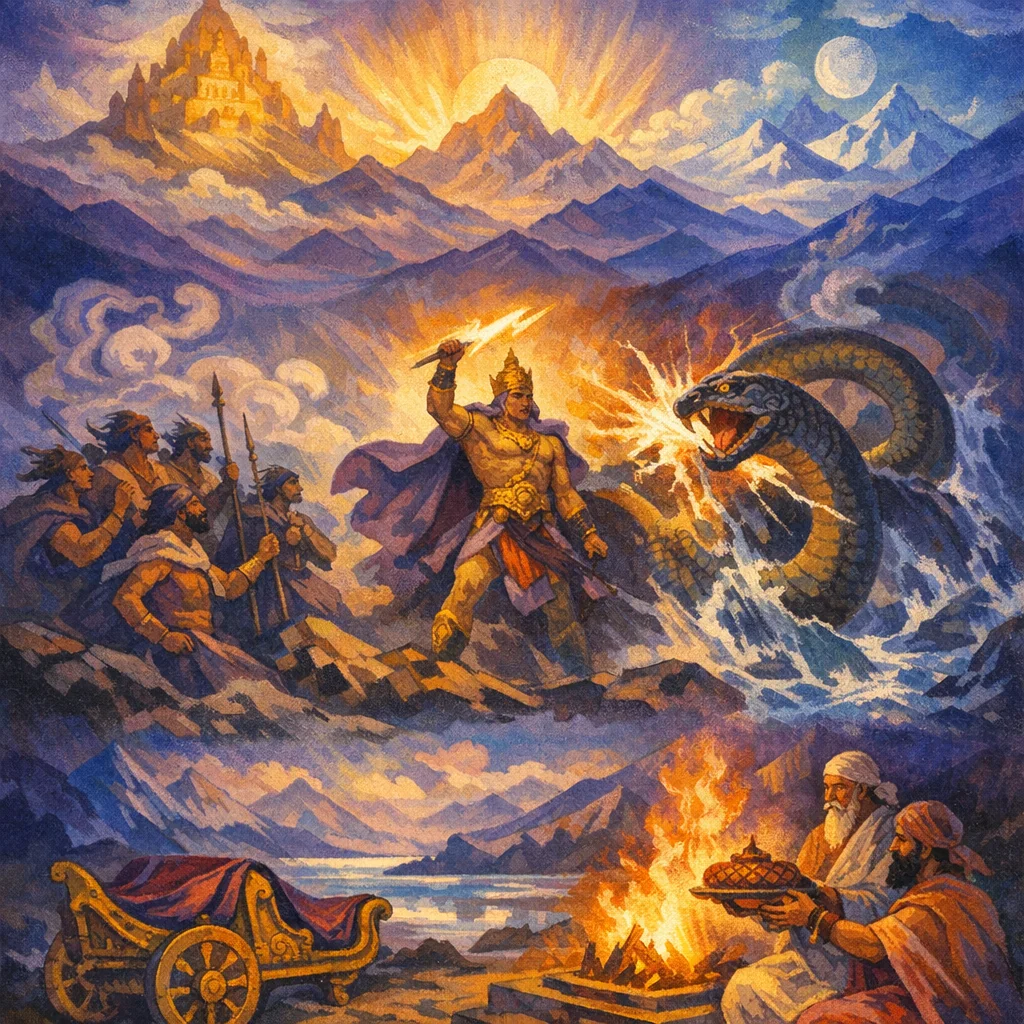
This hymn praises Indra as the steadfast, all-knowing leader of the Maruts, celebrating his world-ordering power and his decisive victory over the Serpent (Ahi), the archetype of obstruction. It repeatedly uses the motif of “three” (Aryaman’s ordinance, the luminous realms, streams/waters) to frame Indra’s triumph as a restoration of cosmic order and the release of life-giving waters and light. The seer closes by offering newly fashioned brahman (hymnic craft) to Indra, likening the prayer to a well-made garment and a finely built chariot.
Mantras
Mantra 1
त्र्यर्यमा मनुषो देवताता त्री रोचना दिव्या धारयन्त । अर्चन्ति त्वा मरुतः पूतदक्षास्त्वमेषामृषिरिन्द्रासि धीरः ॥
Triple is Aryaman, the divine ordinance for man; triple are the luminous worlds the gods uphold. The Maruts of purified power sing to you; you are their seer, O Indra, the steadfast knower.
Mantra 2
अनु यदीं मरुतो मन्दसानमार्चन्निन्द्रं पपिवांसं सुतस्य । आदत्त वज्रमभि यदहिं हन्नपो यह्वीरसृजत्सर्तवा उ ॥
When the Maruts, exulting, sang to Indra who had drunk the pressed Soma, then he took up the thunderbolt; when he struck the Serpent of obstruction, he released the mighty waters to flow.
Mantra 3
उत ब्रह्माणो मरुतो मे अस्येन्द्रः सोमस्य सुषुतस्य पेयाः । तद्धि हव्यं मनुषे गा अविन्ददहन्नहिं पपिवाँ इन्द्रो अस्य ॥
And also the inspired powers, the Maruts, are with me for this work: Indra is to drink of the well-pressed Soma. For this indeed is the offering—he found for the human the rays of Light (the Cows); having drunk, Indra smote the Serpent that held them back.
Mantra 4
आद्रोदसी वितरं वि ष्कभायत्संविव्यानश्चिद्भियसे मृगं कः । जिगर्तिमिन्द्रो अपजर्गुराणः प्रति श्वसन्तमव दानवं हन् ॥
He widened and propped apart the two worlds, and even what was wrapped in fear became like a trembling creature. Indra, roaring forth, struck down the Dānava who came breathing against him—he turned back the assault of darkness.
Mantra 5
अध क्रत्वा मघवन्तुभ्यं देवा अनु विश्वे अददुः सोमपेयम् । यत्सूर्यस्य हरितः पतन्तीः पुरः सतीरुपरा एतशे कः ॥
Then, O Maghavan, by thy will and power all the gods consented and gave thee the draught of Soma. When the Sun’s bright steeds fly in front, above—who is there that can overtake that rushing movement of light?
Mantra 6
नव यदस्य नवतिं च भोगान्त्साकं वज्रेण मघवा विवृश्चत् । अर्चन्तीन्द्रं मरुतः सधस्थे त्रैष्टुभेन वचसा बाधत द्याम् ॥
When the bountiful One hewed down, with the thunderbolt together, the nine-and-ninety enjoyments of the adversary, the Maruts in their common seat sang Indra; with the Triṣṭubh word they smote open the heaven—making room for the higher light.
Mantra 7
सखा सख्ये अपचत्तूयमग्निरस्य क्रत्वा महिषा त्री शतानि । त्री साकमिन्द्रो मनुषः सरांसि सुतं पिबद्वृत्रहत्याय सोमम् ॥
As a friend in friendship, swift Agni cooked (prepared) for him by the power of will the mighty three hundreds. And Indra, with the human, won together the three streams; drinking the pressed Soma, he went to the slaying of Vṛtra—toward the liberation of the waters of being.
Mantra 8
त्री यच्छता महिषाणामघो मास्त्री सरांसि मघवा सोम्यापाः । कारं न विश्वे अह्वन्त देवा भरमिन्द्राय यदहिं जघान ॥
Three hundreds of mighty forces, three streams, and the Soma-waters—these did the bountiful One win. Then all the gods called out, as to a singer’s cry, the triumph for Indra when he slew the Serpent: the universal powers acclaim the victory of light over obstruction.
Mantra 9
उशना यत्सहस्यैरयातं गृहमिन्द्र जूजुवानेभिरश्वैः । वन्वानो अत्र सरथं ययाथ कुत्सेन देवैरवनोर्ह शुष्णम् ॥
When, O Indra, thou camest to the house with strong companions and steeds eager for the journey, then striving, thou didst go here with the chariot; with Kutsa and the gods thou didst truly help to overcome Śuṣṇa—the withering power that dries the soul’s waters.
Mantra 10
प्रान्यच्चक्रमवृहः सूर्यस्य कुत्सायान्यद्वरिवो यातवेऽकः । अनासो दस्यूँरमृणो वधेन नि दुर्योण आवृणङ्मृध्रवाचः ॥
Thou didst draw forth one wheel of the Sun, and for Kutsa thou didst make another wide path for the journey. The noseless Dasyus thou didst crush by thy blow; thou didst shut them into the evil womb of darkness, those whose speech is perverse—so that the true way of light might go forward.
Mantra 11
स्तोमासस्त्वा गौरिवीतेरवर्धन्नरन्धयो वैदथिनाय पिप्रुम् । आ त्वामृजिश्वा सख्याय चक्रे पचन्पक्तीरपिबः सोममस्य ॥
The chants increased thee in the Gaurivīti’s offering; thou didst subdue Pipru for the one who seeks the right distribution (Vaidathina). Ṛjiśvā made thee a comrade; cooking the portions, thou didst drink of this Soma—taking up the work as friend and champion.
Mantra 12
नवग्वासः सुतसोमास इन्द्रं दशग्वासो अभ्यर्चन्त्यर्कैः । गव्यं चिदूर्वमपिधानवन्तं तं चिन्नरः शशमाना अप व्रन् ॥
The Navagvas with pressed Soma, the Daśagvas with their hymns, sing forth to Indra. Even the cow-pen that was covered and shut, that too the men, striving and toiling, broke open—so the hidden light could be released from concealment.
Mantra 13
कथो नु ते परि चराणि विद्वान्वीर्या मघवन्या चकर्थ । या चो नु नव्या कृणवः शविष्ठ प्रेदु ता ते विदथेषु ब्रवाम ॥
How indeed shall the knower trace out your circlings—your heroic workings, O Maghavan, that you have accomplished? And what new acts you now bring forth, O most mighty—those very powers of yours we will proclaim in the gatherings of illumination.
Mantra 14
एता विश्वा चकृवाँ इन्द्र भूर्यपरीतो जनुषा वीर्येण । या चिन्नु वज्रिन्कृणवो दधृष्वान्न ते वर्ता तविष्या अस्ति तस्याः ॥
All these you have accomplished, O Indra—many, unbounded—by your very birth and by your hero-force. Whatever you yet do, O Vajrin, daring in power—there is no limit, no turning-point that contains that might of yours.
Mantra 15
इन्द्र ब्रह्म क्रियमाणा जुषस्व या ते शविष्ठ नव्या अकर्म । वस्त्रेव भद्रा सुकृता वसूयू रथं न धीरः स्वपा अतक्षम् ॥
Indra, accept the brahman that is being fashioned—those new works we have made for you, O most strong. Like a fine garment—auspicious, well-made, desiring the riches of being—like a chariot, the wise and skilful have fashioned it.
Frequently Asked Questions
It praises Indra as the great victor who breaks obstruction (Ahi) and releases waters and light, with the Maruts singing alongside him. It also links this victory to cosmic and social order through Aryaman.
The “three” points to a structured cosmos—three luminous realms and a threefold sense of ordinance/order (Aryaman). It frames Indra’s victory as restoring a stable, well-arranged world.
It means the poet’s hymn itself is a carefully made sacred work. Like a well-made garment or chariot, the prayer is presented as a ritual vehicle meant to carry blessings and strength from Indra.