Sukta 16
Sukta 10.16
Funerary hymn seer of RV 10.16 (Anukramaṇī attribution varies across recensions).
Agni (especially Jātavedas) as the psychopomp-transformer in the funeral rite.
Triṣṭubh.
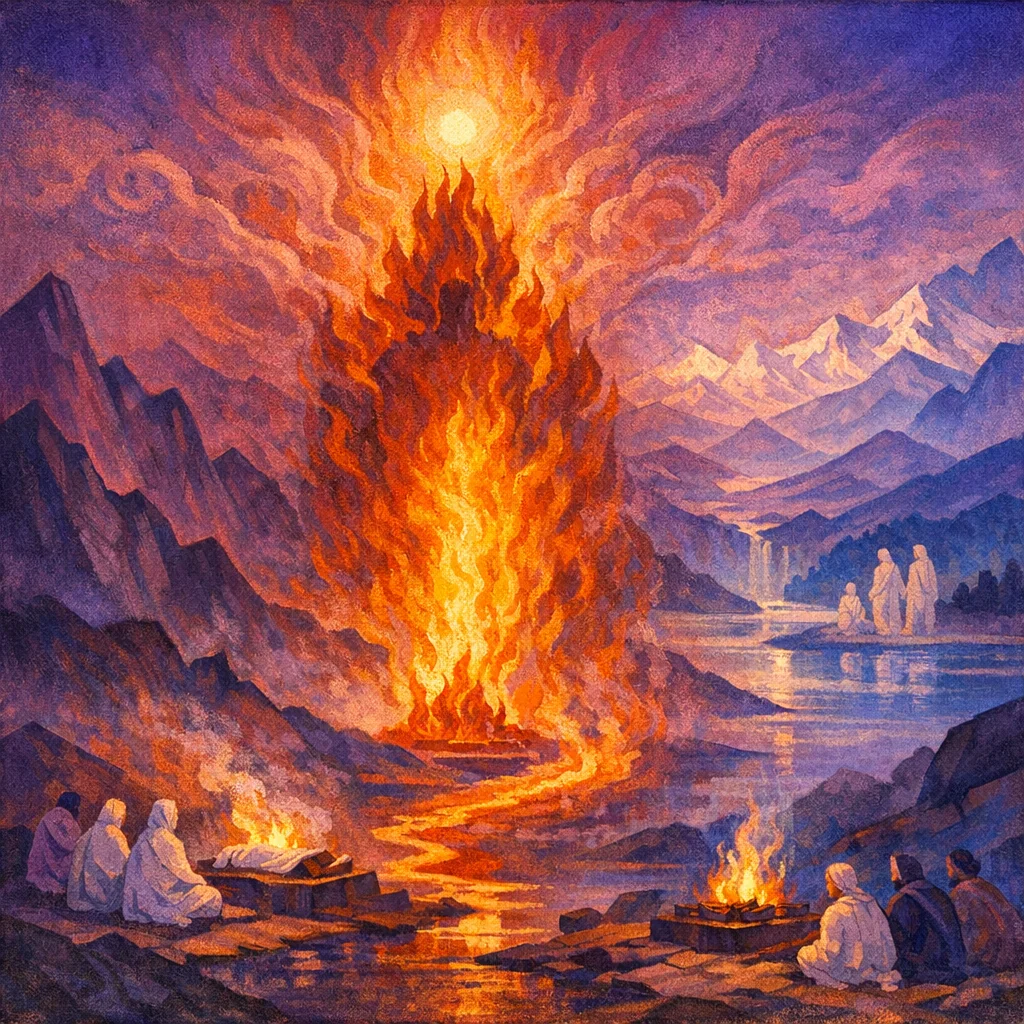
RV 10.16 is a funerary hymn to Agni Jātavedas, asking the cremation-fire to transform the deceased without violent “scattering,” and to convey the person onward to the Pitṛs (Fathers/ancestors). It frames Agni as a careful psychopomp: cooking/ripening the body for passage, safeguarding what should not be harmed, and opening a way into the ancestral realm. The hymn also contains ritual imagery of vessels/offerings and a closing pacification that cools and brightens the fire so the rite is completed in auspiciousness.
Mantras
Mantra 1
मैनमग्ने वि दहो माभि शोचो मास्य त्वचं चिक्षिपो मा शरीरम् । यदा शृतं कृणवो जातवेदोऽथेमेनं प्र हिणुतात्पितृभ्यः ॥
O Agni, do not scatter him, do not burn him away; do not scorch him, do not cast off his skin, do not rend the body. When you have made him ‘well-prepared’ (ripened for the passage), then send him forth, forward, to the Fathers.
Mantra 2
शृतं यदा करसि जातवेदोऽथेमेनं परि दत्तात्पितृभ्यः । यदा गच्छात्यसुनीतिमेतामथा देवानां वशनीर्भवाति ॥
When, O Jātavedas, you have ripened him into readiness, then place him fully into the keeping of the Fathers. When he goes on this leading of the life-breath, then he becomes one who can be guided by the gods’ harmonizing will.
Mantra 3
सूर्यं चक्षुर्गच्छतु वातमात्मा द्यां च गच्छ पृथिवीं च धर्मणा । अपो वा गच्छ यदि तत्र ते हितमोषधीषु प्रति तिष्ठा शरीरैः ॥
Let the seeing go to the Sun; let the life-breath go to the Wind. Go, by the law of your truth, to Heaven and to Earth. Or go to the Waters if there your placing is; in the plants take your stand again with the powers of embodiment.
Mantra 4
अजो भागस्तपसा तं तपस्व तं ते शोचिस्तपतु तं ते अर्चिः । यास्ते शिवास्तन्वो जातवेदस्ताभिर्वहैनं सुकृतामु लोकम् ॥
The unaging portion—by tapas, kindle and intensify it; let your flame and your radiant ray heat it into purity. O Jātavedas, by those your gracious forms of force, carry him to the world of the well-made (the true doers).
Mantra 5
अव सृज पुनरग्ने पितृभ्यो यस्त आहुतश्चरति स्वधाभिः । आयुर्वसान उप वेतु शेषः सं गच्छतां तन्वा जातवेदः ॥
Release him again, O Agni, downward and onward to the Fathers—him who, offered to you, moves in the powers of svadhā. Let the remaining life-force come near, clothing itself again; let the embodiment come together in harmony, O Jātavedas.
Mantra 6
यत्ते कृष्णः शकुन आतुतोद पिपीलः सर्प उत वा श्वापदः । अग्निष्टद्विश्वादगदं कृणोतु सोमश्च यो ब्राह्मणाँ आविवेश ॥
Whatever dark bird has struck you, whatever ant, serpent, or wild-beast—may Agni make that wholly a non-poison, and Soma too, who enters into the Brahman-force: let the assault of the obscure be annulled into harmlessness.
Mantra 7
अग्नेर्वर्म परि गोभिर्व्ययस्व सं प्रोर्णुष्व पीवसा मेदसा च । नेत्त्वा धृष्णुर्हरसा जर्हृषाणो दधृग्विधक्ष्यन्पर्यङ्खयाते ॥
Spread around you Agni’s armor with the rays; wrap it close with richness and with strength-substance. Let not the fierce one, exulting in violence, tear you down and consume you by encircling assault.
Mantra 8
इममग्ने चमसं मा वि जिह्वरः प्रियो देवानामुत सोम्यानाम् । एष यश्चमसो देवपानस्तस्मिन्देवा अमृता मादयन्ते ॥
O Agni, do not overturn this chalice; it is dear to the gods and dear to the Soma-powers. This is the cup of divine drinking; in it the immortal gods find their delight.
Mantra 9
क्रव्यादमग्निं प्र हिणोमि दूरं यमराज्ञो गच्छतु रिप्रवाहः । इहैवायमितरो जातवेदा देवेभ्यो हव्यं वहतु प्रजानन् ॥
I send far away the flesh-eating fire; let it go to the realm of King Yama, bearing away impurity. Here let this other Jātavedas remain, who knows, and carry the offering to the gods.
Mantra 10
यो अग्निः क्रव्यात्प्रविवेश वो गृहमिमं पश्यन्नितरं जातवेदसम् । तं हरामि पितृयज्ञाय देवं स घर्ममिन्वात्परमे सधस्थे ॥
That Fire who has entered your house as the eater of mortal substance—beholding the other, Jātavedas, the knower of all births—him I set apart for the offering to the Fathers. May he urge on the warmth and ripening in the highest seat of the being.
Mantra 11
यो अग्निः क्रव्यवाहनः पितॄन्यक्षदृतावृधः । प्रेदु हव्यानि वोचति देवेभ्यश्च पितृभ्य आ ॥
That Agni who bears the mortal offering, increaser of the Right, shall sacrifice to the Fathers; and he proclaims the oblations forward—to the Gods and also to the Fathers, calling them hither.
Mantra 12
उशन्तस्त्वा नि धीमह्युशन्तः समिधीमहि । उशन्नुशत आ वह पितॄन्हविषे अत्तवे ॥
With aspiration we place you; with aspiration we kindle you. Aspiring, and with the aspiring powers, bring the Fathers here to partake of the offering—so that the inner exchange may be fulfilled.
Mantra 13
यं त्वमग्ने समदहस्तमु निर्वापया पुनः । कियाम्ब्वत्र रोहतु पाकदूर्वा व्यल्कशा ॥
Whom you have burned wholly, O Agni, that one release again—let him be laid down anew. Let the waters here arise; let the healing grasses grow, unwithering—so the being may recover its wholeness after the passage.
Mantra 14
शीतिके शीतिकावति ह्लादिके ह्लादिकावति । मण्डूक्या सु सं गम इमं स्वग्निं हर्षय ॥
O Cooling One, O richly-cooling; O gladdening One, O richly-gladdening—O Maṇḍūkyā, come together well: delight and brighten this good Fire, so the passage may be soothed and made luminous.
Frequently Asked Questions
It is a Rig Vedic funerary hymn used in cremation-related rites, asking Agni to conduct the burning correctly and to guide the departed onward to the Pitṛs (ancestors).
The language emphasizes a ritually proper, non-violent transformation: Agni should ‘prepare’ the person for passage, not destroy in a chaotic way. It reflects a concern for order (ṛta) and safe transition.
The Pitṛs are the ancestral Fathers—those who have gone before. The hymn asks Agni to send the departed to join that ancestral community in its proper realm.