Sarga 72
कबन्धमोक्षः—सुग्रीवमैत्र्युपदेशः (Kabandha’s Release and Counsel to Befriend Sugriva)
अरण्यकाण्ड
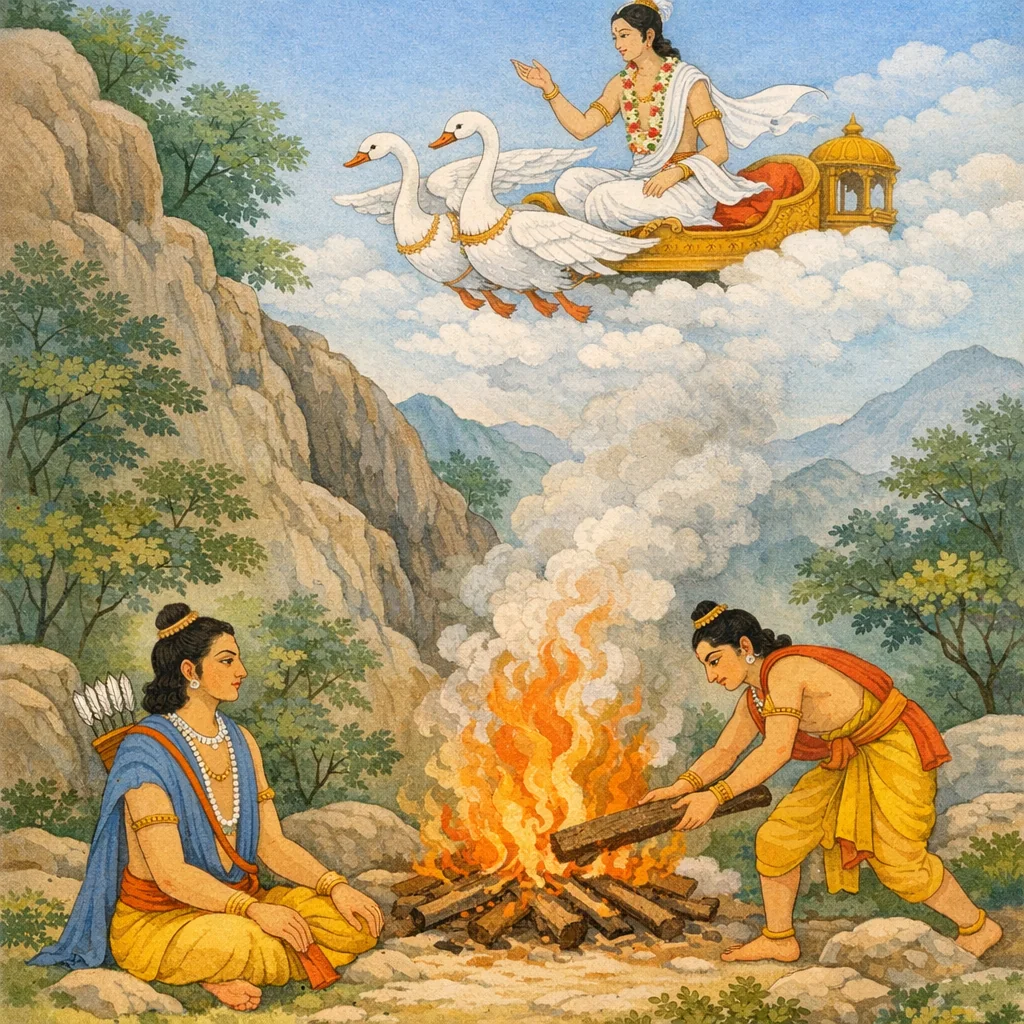
In this chapter, Rāma and Lakṣmaṇa, following Kabandha’s earlier instruction, reach a mountain cleft and kindle a funeral pyre. Lakṣmaṇa feeds it with great blazing logs, and Kabandha’s huge, fat-like body burns slowly. Released, Kabandha rises purified, clad in clean garments and a divine garland, ascends in a radiant vimāna drawn by swans, and speaks to Rāma from the sky. He explains that Rāma’s present sorrow is a hard phase governed by kāla (time and destiny), and that what is ordained cannot be changed by wish alone. He then gives clear counsel: Rāma must form a sincere alliance with Sugrīva, the exiled vānarendra living near Ṛṣyamūka and Lake Pampā, driven out by his brother Vāli, and seal this friendship with a true pact, with Agni as witness. Kabandha praises Sugrīva’s virtues—truthfulness, humility, strength, and intelligence—warning Rāma not to slight him. He sets forth the mutual benefit: Rāma can aid Sugrīva’s cause, and Sugrīva, with vānar forces and knowledge of paths, terrains, and hostile rākṣasa regions, can organize a systematic search for Sītā, even if she were hidden on Meru’s peak or in the netherworld.
Shlokas
Verse 1
एवमुक्तौतु तौ वीरौ कबन्धेन नरेश्वरौ।गिरिप्रदरमासाद्य पावकं विससर्जतुः।।।।
Thus instructed by Kabandha, the two heroic lords among men reached a cleft in the mountain and kindled the sacred fire to perform the rite.
Verse 2
लक्ष्मणस्तु महोल्काभिर्ज्वलिताभिस्समन्ततः।चितामादीपयामास सा प्रजज्वाल सर्वतः।।।।
Then Lakṣmaṇa kindled the funeral pyre all around with great flaming brands, and it blazed on every side.
Verse 3
तच्छरीरं कबन्धस्य घृतपिण्डोपमं महत्।मेदसा पच्यमानस्य मन्दं दहति पावकः।।।।
Kabandha’s huge body—like a great lump of ghee—burned slowly, as its fat fed the fire.
Verse 4
स विधूय चितामाशु विधूमोऽग्निरिवोत्थितः।अरजे वाससी बिभ्रन्मालां दिव्यां महाबलः।।।।
Shaking off the pyre at once, the mighty one rose up like smokeless fire, wearing spotless garments and a divine garland.
Verse 5
ततश्चिताया वेगेन भास्वरो विमलाम्बरः।उत्पपाताशु संहृष्टस्सर्वप्रत्यङ्गभूषणः।।।।
Then, radiant and clad in pure garments, adorned on every limb, he sprang up swiftly from the pyre, filled with joy.
Verse 6
विमाने भास्वरे तिष्ठन्हंसयुक्ते यशस्करे।प्रभया च महातेजा दिशो दश विराजयन्।।।।सोऽन्तरिक्षगतो रामं कबन्धो वाक्यमब्रवीत्।शृणु राघव तत्त्वेन यथा सीतामवाप्स्यसि।।।।
Standing in a shining, renowned vimāna yoked with swans, Kabandha of mighty radiance illumined the ten directions with his splendor. Rising into the sky, he spoke to Rama: “Hear, O Raghava; in truth I shall tell you how you will regain Sita.”
Verse 7
विमाने भास्वरे तिष्ठन्हंसयुक्ते यशस्करे।प्रभया च महातेजा दिशो दश विराजयन्।।3.72.6।।सोऽन्तरिक्षगतो रामं कबन्धो वाक्यमब्रवीत्।शृणु राघव तत्त्वेन यथा सीतामवाप्स्यसि।।3.72.7।।
In a shining, famed vimāna yoked with swans, Kabandha—radiant enough to brighten the ten directions—rose into the sky and said to Rama: “Listen, O Raghava; truly I will tell you how you will recover Sita.”
Verse 8
राम षड्युक्तयो लोके याभिस्सर्वं विमृश्यते।परिमृष्टो दशान्तेन दशाभागेन सेव्यते।।।।
O Rama, in this world there are six practical expedients by which all matters are weighed and decided; and when a person is tested by the turning of time, he must endure the portion of ill fortune that falls to his lot.
Verse 9
दशाभागगतो हीनस्त्वं हि राम सलक्ष्मणः।यत्कृते व्यसनं प्राप्तं त्वया दारप्रधर्षणम्।।।।।
Indeed, O Rama—together with Lakshmana—you have entered an adverse share of fortune and have been brought low; because of that, calamity has come upon you: the violation of your marriage by the abduction of your wife.
Verse 10
तदवश्यं त्वया कार्यस्ससुहृत्सुहृदां वर।अकृत्वा हि न ते सिद्धिमहं पश्यामि चिन्तयन्।।।।
Therefore you must certainly do this, O best of friends: form an alliance with that well-wisher; for, reflecting on it, I see no success for you without doing so.
Verse 11
श्रूयतां राम वक्ष्यामि सुग्रीवो नाम वानरः।भ्रात्रा निरस्तः क्रुद्धेन वालिना शक्रसूनुना।।।।
Listen, Rāma—I shall tell you: there is a monkey named Sugrīva, driven out by his own brother Vālin, the son of Śakra, in a fit of anger.
Verse 12
ऋश्यमूके गिरिवरे पम्पापर्यन्तशोभिते।निवसत्यात्मवान्वीरश्चतुर्भिस्सह वानरैः।।।।
That self-respecting hero dwells on the excellent mountain Ṛśyamūka, beautiful up to the region of Lake Pampā, together with four monkeys.
Verse 13
वानरेन्द्रो महावीर्यस्तेजोवानमितप्रभः।सत्यसन्धो विनीतश्च धृतिमान्मतिमान्महान्।।।।
That lord of monkeys is of great prowess—radiant, of boundless splendour; steadfast in truth, humble in conduct, patient, intelligent, and truly great.
Verse 14
दक्षः प्रगल्भो द्युतिमान्महाबलपराक्रमः।भ्रात्रा विवासितो राम राज्यहेतोर्महाबलः।।।।
He is capable, bold of speech, and radiant—great in strength and valor; yet, O Rāma, that mighty one has been exiled by his brother for the sake of kingship.
Verse 15
स ते सहायो मित्रं च सीतायाः परिमार्गणे।भविष्यति हिते राम मा च शोके मनः कृथाः।।।।
He will be your helper and friend in the search for Sītā, working for your good, O Rāma; therefore do not let your mind sink into sorrow.
Verse 16
भवितव्यं हि यच्चापि न तच्छक्यमिहान्यथा।कर्तुमिक्ष्वाकुशार्दूल कालो हि दुरतिक्रमः।।।।
O tiger among the Ikṣvākus, whatever must come to pass cannot be made otherwise here; for Time—fate—is indeed not to be overstepped.
Verse 17
गच्छ श्रीघ्रमितो राम सुग्रीवं तं महाबलम्।वयस्यं तं कुरु क्षिप्रमितो गत्वाऽद्य राघव।।।।अद्रोहाय समागम्य दीप्यमाने विभावसौ।
Go swiftly from here, O Rāma, to that mighty Sugrīva. Having gone quickly today, O Rāghava, make him your friend—forming the alliance without hostility, with the blazing fire as witness.
Verse 18
स च ते नावमन्तव्यस्सुग्रीवो वानराधिपः।।।।कृतज्ञः कामरूपी च सहायार्थी च वीर्यवान्।
And Sugrīva, lord of the Vānara, is not to be slighted by you: he is grateful, able to assume forms at will, and though powerful, he seeks an ally’s help.
Verse 19
शक्तौह्यद्य युवां कर्तुं कार्यं तस्य चिकीर्षितम्।।।।कृतार्थो वाऽकृतार्थो वा कृत्यं तव करिष्यति।
Today you two are able to accomplish the task he desires; and whether his own aim is fulfilled or not, he will carry out what must be done for you.
Verse 20
स ऋक्षरजसः पुत्रः पम्पामटति शङ्कितः।।.।।भास्करस्यौरसः पुत्रो वालिना कृतकिल्बिषः।
He is the son of Ṛkṣarajas, the true-born son of the Sun; having incurred conflict with Vāli, he roams by Lake Pampā, wary and apprehensive.
Verse 21
सन्निधायायुधं क्षिप्रमृष्यमूकालयं कपिम्।।।।कुरु राघव सत्येन वयस्यं वनचारिणम्।
With your weapons made ready, quickly make that monkey—dwelling at Ṛṣyamūka and roaming the forest—your friend, O Rāghava, by truth and sincerity.
Verse 22
स हि स्थानानि सर्वाणि कार्त्स्न्येन कपिकुञ्जरः।।।।नरमांसाशिनां लोके नैपुण्यादधिगच्छति।
For that foremost of monkeys, with skill and tact, knows in full all the haunts in the world of man-eating beings.
Verse 23
न तस्याविदितं लोकेकिञ्चिदस्ति हि राघव।।।।यावत्सूर्यः प्रतपति सहस्रांशुररिन्दम।
Nothing in the world is unknown to him, O Rāghava—so long as the thousand-rayed Sun shines, O subduer of foes.
Verse 24
स नदीर्विपुलान्शैलान् गिरिदुर्गाणि कन्दरान्।।।।अन्वीक्ष्य वानरैस्सार्धं पत्नीं तेऽधिगमिष्यति।
Along with the monkeys, he will search the rivers, vast mountains, mountain-fortresses, and caverns—and he will find your wife.
Verse 25
वानरांश्च महाकायान्प्रेषयिष्यति राघव।।।।दिशो विचेतुं तां सीतां त्वद्वियोगेन शोचतीम्।स ज्ञास्यति वरारोहां निर्मलां रावणालये।।।।
O Raghava, he will dispatch great, mighty-bodied vanaras in every direction to search for that Sita who grieves in separation from you; and he will discover the blameless, noble lady in Ravana’s dwelling.
Verse 26
वानरांश्च महाकायान्प्रेषयिष्यति राघव।।3.72.25।।दिशो विचेतुं तां सीतां त्वद्वियोगेन शोचतीम्।स ज्ञास्यति वरारोहां निर्मलां रावणालये।।3.72.26।।
O Rāghava, he will send gigantic monkeys in every direction to seek Sītā, who grieves in sorrow at separation from you; and he will find the blameless, noble lady in Rāvaṇa’s abode.
Verse 27
स मेरुशृङ्गाग्रगतामनिन्दितां प्रविश्य पातालतलेऽपि वा श्रिताम्।प्लवङ्गमानां प्रवरस्तव प्रियां निहत्य रक्षांसि पुनः प्रदास्यति।।।।
Even if your blameless beloved has reached the summit of Mount Meru, or taken refuge in the depths of the underworld, the foremost of the monkey-kind will enter there, slay the rākṣasas, and restore her to you again.
Frequently Asked Questions
The pivotal action is strategic yet ethical: Rāma is urged to pursue alliance (maitrī) without malice, honoring Sugrīva despite his vānar identity, and to seal the relationship in the presence of fire—an act that frames diplomacy as a dharmic commitment.
Kabandha’s upadeśa links human effort with kāla: one should not collapse into grief over unavoidable turns of fate, but respond with disciplined, timely action—here, by choosing the right means (mitra, sahāya, intelligence networks) to restore dharma.
Key landmarks include Ṛṣyamūka mountain and the Pampā region, presented as Sugrīva’s refuge; culturally, the chapter emphasizes fire (vibhāvasu) as witness to alliance-making, and the vimāna ascent motif marking Kabandha’s purification and transition.