Sarga 62
सीतावियोगे रामविलापः (Rāma’s Lament in Separation from Sītā)
अरण्यकाण्ड
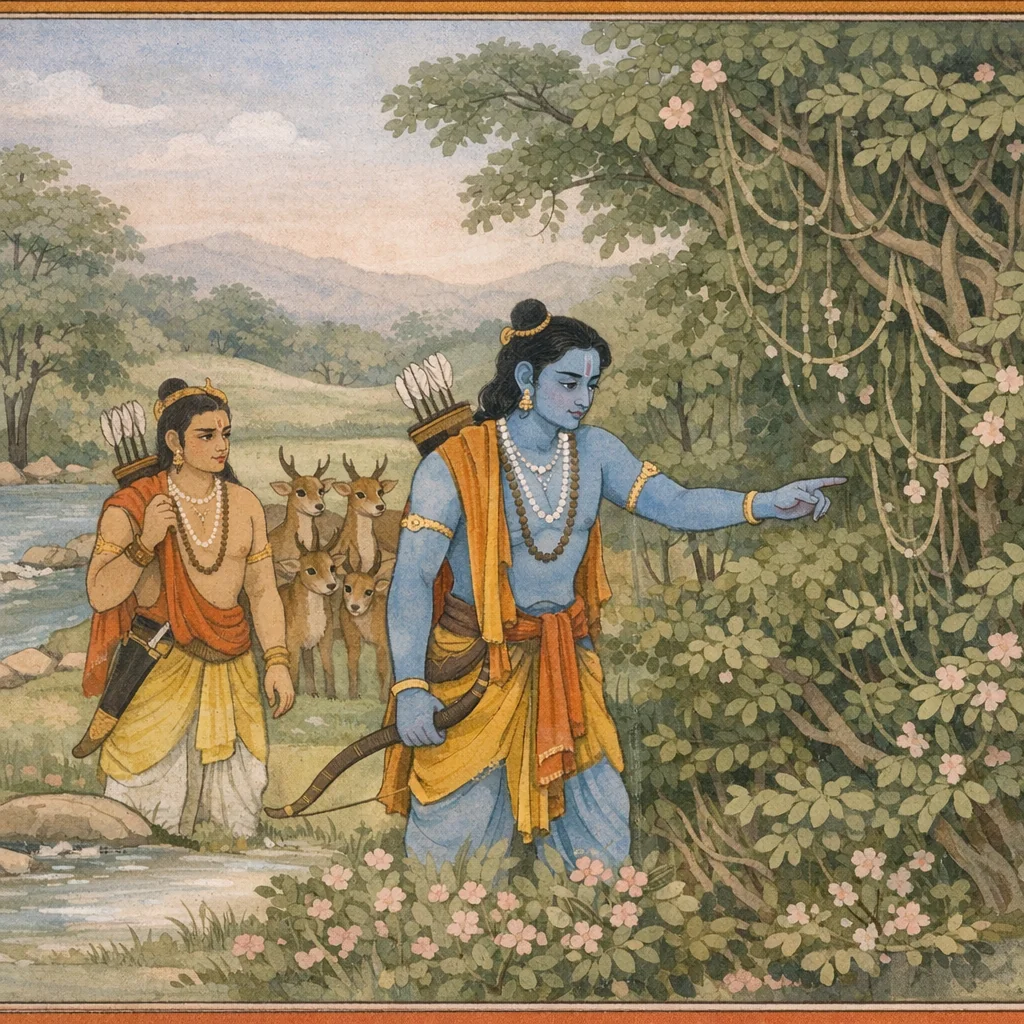
Sarga 62 records the immediate psychological and ethical shock after Sītā’s disappearance. Rāma, praised as dharmātmā and kamalalocana, cannot find her and breaks into a structured lament (vilāpa), briefly imagining her presence in the forest foliage and addressing her as though she were playfully hiding. The mood then turns to fearful scrutiny: he infers that rākṣasas have either devoured or abducted her, and reads the tearful gaze of deer-herds as nature’s own testimony. Rāma voices anxiety over reputation and righteousness—fearing the world will call him nirvīrya (without valor) and nirdaya (without compassion)—and foresees the unbearable social and ritual consequences of returning to Ayodhyā and facing Janaka’s questions. Even in grief he instructs Lakṣmaṇa: counsel concerning Bharata’s governance, the respectful protection of the queens Kaikeyī, Sumitrā, and Kauśalyā, and a command to report the loss in detail to his mother. The chapter closes with Lakṣmaṇa’s visible fear and agitation, mirroring the crisis of leadership and kinship duty unleashed by Sītā’s abduction.
Shlokas
Verse 1
सीतामपश्यन्धर्मात्मा शोकोपहतचेतनः।विललाप महाबाहू रामः कमललोचनः।।3.62.1।।
Not seeing Sītā, righteous Rāma—long-armed and lotus-eyed—lamented, his mind overwhelmed by grief.
Verse 2
पश्यन्निव च तां सीतामपश्यन्मदनार्दितः।उवाच राघवो वाक्यं विलापाश्रयदुर्वचम्।।3.62.2।।
Though he did not truly see Sītā, Rāghava—overpowered by love—spoke as if she were before him, uttering words born of lament and otherwise unspeakable.
Verse 3
त्वमशोकस्य शाखाभिः पुष्पप्रियतया प्रिये।आवृणोषि शरीरं ते मम शोकविवर्धिनी।।3.62.3।।
Beloved, because of your fondness for flowers, you hide your body behind the branches of the aśoka tree—yet this only increases my sorrow.
Verse 4
कदलीस्कन्धसदृशौ कदल्या संवृतावुभौ।ऊरू पश्यामि ते देवि नासि शक्ता निगूहितुम्।।3.62.4।।
Goddess, I can see your two thighs—like plantain trunks—though you are screened by a banana plant; you are not able to hide from me.
Verse 5
कर्णिकारवनं भद्रे हसन्ती देवि सेवसे।अलं ते परिहासेन मम बाधावहेन वै।।3.62.5।।
Gentle lady, you roam the karṇikāra grove laughing; enough of this jesting, for it truly brings me pain.
Verse 6
परिहासेन किं सीते परिश्रान्तस्य मे प्रिये।अयं स परिहासोऽपि साधु देवि न रोचते।।3.62.6।।
Sītā, my beloved—why jest when I am worn with fatigue? Even such play does not please me now, O lady.
Verse 7
विशेषेणाश्रमस्थाने हासोऽयं न प्रशस्यते।अवगच्छामि ते शीलं परिहासप्रियं प्रिये।।3.62.7।।आगच्छ त्वं विशालाक्षि शून्योऽयमुटजस्तव।
Especially in a hermitage, such jesting is not praised. I know your nature, beloved—you delight in play. Come, large-eyed one; your cottage here stands empty.
Verse 8
सुव्यक्तं राक्षसैस्सीता भक्षिता वा हृतापि वा।।3.62.8।।न हि सा विलपन्तं मामुपसम्प्रैति लक्ष्मण।
Lakṣmaṇa, it is all too clear—Sītā has either been devoured by rākṣasas or abducted; for as I lament, she does not come to me.
Verse 9
एतानि मृगयूथानि साश्रुनेत्राणि लक्ष्मण।।3.62.9।।शंसन्तीव हि वैदेहीं भक्षितां रजनीचरैः।
Lakṣmaṇa, these herds of deer—with tearful eyes—seem as though they are telling me that Vaidehī has been consumed by the night-roamers.
Verse 10
हा ममार्ये क्व यातासि हा साध्वि वरवर्णिनि।।3.62.10।।हा सकामा त्वया देवी कैकेयी सा भविष्यति।
Alas, my noble lady—where have you gone? Alas, O virtuous one of exquisite beauty! Because of you, Queen Kaikeyī will now have her desire fulfilled.
Verse 11
सीतया सह निर्यातो विना सीतामुपागतः।।3.62.11।।कथं नाम प्रवेक्ष्यामि शून्यमन्तःपुरं पुनः।
I went forth together with Sītā, yet I have returned without her—how indeed can I enter the inner palace again, now empty?
Verse 12
निर्वीर्य इति लोको मां निर्दयश्चेति वक्ष्यति।।3.62.12।।कातरत्वं प्रकाशं हि सीतापनयनेन मे।
The world will say of me, ‘He is without valor’ and ‘he is without compassion’; for by Sītā’s abduction my cowardice will stand revealed.
Verse 13
निवृत्तवनवासश्च जनकं मिथिलाधिपम्।।3.62.13।।कुशलं परिपृच्छन्तं कथं शक्ष्ये निरीक्षितुम्।
When my forest-exile is completed, how shall I be able to face Janaka, lord of Mithilā, as he asks after her welfare?
Verse 14
विदेहराजो नूनं मां दृष्ट्वा विरहितं तया।।3.62.14।।सुतास्नेहेन सन्तप्तो मोहस्य वशमेष्यति।
Surely the king of Videha, seeing me bereft of her, will be scorched by love for his daughter and fall under the power of grief and bewilderment.
Verse 15
अथवा न गमिष्यामि पुरीं भरतपालिताम्।।3.62.15।।स्वर्गोऽपि सीतया हीनश्शून्य एव मतो मम।
Or else I will not go to the city governed by Bharata; for to me, even heaven itself is emptiness if it is without Sītā.
Verse 16
मामिहोत्सृज्य हि वने गच्छायोध्यां पुरीं शुभाम्।।3.62.16।।न त्वहं तां विना सीतां जीवेयं हि कथञ्चन।
Leave me here in the forest and go to the auspicious city of Ayodhyā; but I—without Sītā—could not live, not in any way.
Verse 17
गाढमाश्लिष्य भरतो वाच्यो मद्वचनात्त्वया।।3.62.17।।अनुज्ञातोऽसि रामेण पालयेति वसुन्धराम्।
Embracing Bharata tightly, you should tell him on my behalf: ‘You have been authorized by Rāma—govern and protect the earth.’
Verse 18
अम्बा च मम कैकेयी सुमित्रा च त्वया विभो।।3.62.18।।कौसल्या च यथान्यायमभिवाद्या ममाऽज्ञया।रक्षणीया प्रयत्नेन भवता सूक्तकारिणा।।3.62.19।।
And my mothers—Kaikeyī, Sumitrā, and Kausalyā—must be duly saluted by you, in accordance with propriety, by my command; and you, who carry out good counsel, must protect them with all effort.
Verse 19
अम्बा च मम कैकेयी सुमित्रा च त्वया विभो।।3.62.18।।कौसल्या च यथान्यायमभिवाद्या ममाऽज्ञया।रक्षणीया प्रयत्नेन भवता सूक्तकारिणा।।3.62.19।।
And my mothers—Kaikeyī, Sumitrā, and Kausalyā—must be duly saluted by you, in accordance with propriety, by my command; and you, who carry out good counsel, must protect them with all effort.
Verse 20
सीतायाश्च विनाशोऽयं मम चामित्रकर्शन।विस्तरेण जनन्या मे विनिवेद्यस्त्वया भवेत्।।3.62.20।।
O Lakṣmaṇa, subduer of enemies—this ruin that has befallen Sītā and me should be reported by you to my mother, fully and in detail.
Verse 21
इति विलपति राघवे सुदीने वनमुपगम्य तया विना सुकेश्या।भयविकलमुखस्तु लक्ष्मणोऽपि व्यथितमना भृशमातुरो बभूव।।3.62.21।।
Thus, in that wretched hour, Rāghava wailed; and having entered the forest without the fair‑haired lady, Lakṣmaṇa too—his face shaken with fear—became deeply distressed and exceedingly agitated.
Frequently Asked Questions
Rāma confronts the dharma-sankat of leadership after a failure of protection: Sītā is missing, and he fears the world will interpret this as lack of valor and compassion. The action is not martial but ethical-interpretive—how a righteous ruler should respond when guardianship has been breached and social accountability (to Ayodhyā and to Janaka) becomes unavoidable.
The sarga presents grief as a disciplined moral cognition rather than mere emotion: Rāma’s lament rapidly becomes analysis of obligation—toward spouse, family, kingdom, and public judgment. It teaches that dharma includes responsibility for consequences, truthful reporting, and continuity of governance even when the agent is personally shattered.
The forest-ecology functions as a landmark system: aśoka branches, kadalī (banana plants), and the karṇikāra grove form the imagined search-space where Rāma addresses Sītā. Culturally, Ayodhyā’s antaḥpura (inner apartments), the queens’ protocol of obeisance, and Janaka of Mithilā/Videha anchor the episode in royal-ritual expectations and inter-dynastic accountability.