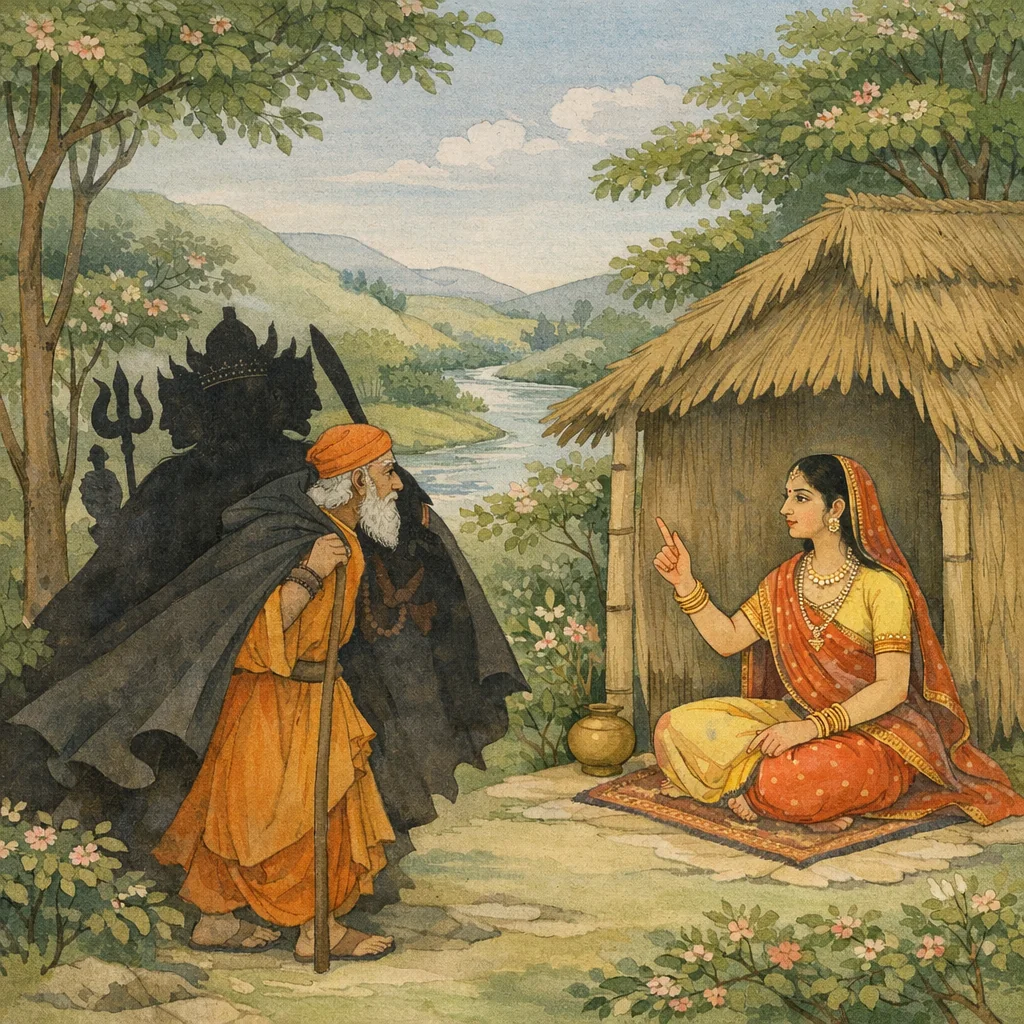
Sarga 47
सीतारावणसंवादः — Ravana Reveals Himself; Sita Affirms Rama’s Dharma
अरण्यकाण्ड
This sarga unfolds a tense dialogue of recognition. Ravana, disguised as a parivrājaka (mendicant ascetic), questions Vaidehī and exploits the ethical pressure of atithi-dharma—that a guest must not be left unanswered. Sītā identifies herself (Janaka’s daughter, Rama’s wife) and recounts the course of exile: the intended consecration, Kaikeyī’s two boons, Rama’s fearless acceptance, and Lakshmana’s loyal accompaniment. Sītā then invites the “guest” to rest, expecting Rama to return with forest provisions—an ironic hospitality offered to her would-be abductor. When she asks his name, gotra, and purpose, Ravana casts off the disguise and declares himself Ravana, lord of the rākṣasas, boasting of Laṅkā and offering her queenship, attendants, and pleasure-gardens. Sītā rejects him through sustained ethical and poetic rebuttal: she extols Rama’s virtues (truth, self-control, refuge-like leadership) and contrasts Ravana with Rama through layered upamā (jackal vs lion; ditch vs sea; gold vs lead), portraying Ravana’s desire as a self-destructive impossibility. The chapter closes with Sītā trembling after her fierce speech, while Ravana intensifies intimidation by recounting his lineage, power, and deeds.
Shlokas
Verse 1
रावणेन तु वैदेही तदा पृष्टा जिहीर्षता।परिव्राजकरूपेण शशंसात्मानमात्मना।।3.47.1।।
Then Vaidehī, questioned by Rāvaṇa—who, disguised as a wandering mendicant, meant to abduct her—spoke of herself in her own words.
Verse 2
ब्राह्मणश्चातिथिश्चायमनुक्तो हि शपेत माम्।इति ध्यात्वा मुहूर्तं तु सीता वचनमब्रवीत्।।3.47.2।।
“He is a brahmin—and a guest as well; if I leave him unanswered, he might indeed curse me.” Thinking thus for a moment, Sītā spoke.
Verse 3
दुहिता जनकस्याहं मैथिलस्य महात्मनः।सीता नाम्नास्मि भद्रं ते रामभार्या द्विजोत्तम।।3.47.3।।
O best of brahmins, know this for your good: I am Sītā by name—daughter of the great-souled Janaka, king of Mithilā—and the lawful wife of Rāma.
Verse 4
उषित्वा द्वादश समा इक्ष्वाकुणां निवेशने।भुञ्जाना मानुषान्भोगान्सर्वकामसमृद्धिनी।।3.47.4।।
Having lived for twelve years in the dwelling of the Ikṣvākus, I enjoyed human pleasures, with every worldly desire fully supplied.
Verse 5
ततस्त्रयोदशे वर्षे राजामन्त्रयत प्रभुः।अभिषेचयितुं रामं समेतो राजमन्त्रिभिः।।3.47.5।।
Then, in the thirteenth year, the sovereign king consulted with his ministers about consecrating Rāma in the sacred rite of royal anointing.
Verse 6
तस्मिन्सम्भ्रियमाणे तु राघवस्याभिषेचने।कैकेयी नाम भर्तारमार्या सा याचते वरम्।।3.47.6।।
While preparations were being made for Rāghava’s consecration, the noble lady Kaikeyī asked her husband for a boon.
Verse 7
प्रतिगृह्य तु कैकेयी श्वशुरं सुकृतेन मे।मम प्रव्राजनं भर्तुर्भरतस्याभिषेचनम्।।3.47.7।।द्वावयाचत भर्तारं सत्यसन्धं नृपोत्तमम्।
Having secured, by my good fortune, a prior promise from my father-in-law, Kaikeyī asked that best of kings—true to his word—for two boons: my husband’s banishment and Bharata’s consecration.
Verse 8
नाद्य भोक्ष्ये न च स्वप्स्ये न पास्येच कथञ्चन।।3.47.8।।एष मे जीवितस्यान्तो रामो यद्यभिषिच्यते।
“Today I will neither eat nor sleep, nor will I drink in any way—this will be the end of my life if Rāma is consecrated.”
Verse 9
इति ब्रुवाणां कैकेयीं श्वशुरो मे स मानदः।।3.47.9।।अयाचतार्थैरन्वर्थैर्न च याञ्चां चकार सा।
As Kaikeyī spoke thus, my father-in-law—the honorable king—offered her fitting riches; yet she did not accept the offer.
Verse 10
मम भर्तामहातेजा वयसा पञ्चविंशकः।।3.47.10।।अष्टादश हि वर्षाणि मम जन्मनि गण्यते।
My husband is of great valor and is twenty-five years of age; and as for me, eighteen years are counted since my birth.
Verse 11
रामेति प्रथितो लोके गुणवान्सत्यवान्शुचिः।।3.47.11।।विशालाक्षो महाबाहुस्सर्वभूतहिते रतः।
My husband, famed in the world as Rāma, is virtuous, truthful, and pure—large-eyed and long-armed—ever devoted to the welfare of all beings.
Verse 12
कामार्तस्तु महातेजाः पिता दशरथस्स्वयम्।।3.47.12।।कैकेय्याः प्रियकामार्थं तं रामं नाभ्यषेचयत्।
But Daśaratha himself—brilliant though he was—overcome by attachment, did not consecrate Rāma, seeking to fulfill Kaikeyī’s desire.
Verse 13
अभिषेकाय तु पितुस्समीपं राममागतम्।।3.47.13।।कैकेयी मम भर्तारमित्युवाच धृतं वचः।
When my husband Rāma came near his father for the sacred consecration, Kaikeyī spoke to him firm words, without hesitation.
Verse 14
तव पित्रा समाज्ञप्तं ममेदं शृणु राघव।।3.47.14।।भरताय प्रदातव्यमिदं राज्यमकण्टकम्।
“O Rāghava, hear this from me: your father has commanded that this kingdom, free of impediment, be given to Bharata.”
Verse 15
त्वया हि खलु वस्तव्यं नव वर्षाणि पञ्च च।।3.47.15।।वने प्रव्रज काकुत्स्थ पितरं मोचयानृतान्।
“Indeed, you must dwell in the forest for nine years and five more. Go into exile, O Kakutstha, and free your father from falsehood.”
Verse 16
तथेत्युक्त्वा च तां रामः कैकेयीमकुतोभयः।।3.47.16।।चकार तद्वचस्तस्या मम भर्ता दृढव्रतः।
My husband Rāma—fearless and steadfast in his vow—said to Kaikeyī, “So be it,” and carried out her words.
Verse 17
दद्यान्न प्रतिगृह्णीयात्सत्यं ब्रूयान्न चानृतम्।।3.47.17।।एतद्ब्राह्मण रामस्य ध्रृवं व्रतमनुत्तमम्।
O brahmin, this is Rāma’s fixed and unsurpassed vow: to give and not accept; to speak truth and never falsehood.
Verse 18
तस्य भ्राता तु द्वैमात्रो लक्ष्मणो नाम वीर्यवान्।।3.47.18।।रामस्य पुरुषव्याघ्रस्सहायस्समरेरिहा।
Rāma has a mighty half-brother, Lakṣmaṇa by name—a tiger among men—his companion in battle, a destroyer of enemies.
Verse 19
स भ्राता लक्ष्मणो नाम धर्मचारी दृढव्रतः।।3.47.19।।अन्वगच्छद्दनुष्पाणिः प्रव्रजन्तं मया सह।
That brother, Lakṣmaṇa by name—righteous in conduct and firm in vow—followed Rāma into exile, bow in hand, together with me.
Verse 20
जटी तापसरूपेण मया सह सहानुजः।।3.47.20।।प्रविष्टो दण्डकारण्यं धर्मनित्यो जितेन्द्रियः।
Rāma—ever steadfast in dharma and master of his senses—entered the Daṇḍaka forest with matted hair, in the guise of an ascetic, together with his younger brother and with me.
Verse 21
ते वयं प्रच्युता राज्यात्कैकेय्यास्तु कृते त्रयः।।3.47.21।।विचरामो द्विजश्रेष्ठ वनं गम्भीरमोजसा।
O best of brahmins, the three of us, driven out from the kingdom on account of Kaikeyī, now roam this deep forest with undiminished courage.
Verse 22
समाश्वस मुहूर्तं तु शक्यं वस्तुमिह त्वया।।3.47.22।।आगमिष्यति मे भर्ता वन्यमादाय पुष्कलम्।रुरून्गोधा न्वराहांश्च हत्वाऽदायाऽमिषान्बहून्।।3.47.23।।
Rest here for a moment; you can stay here. My husband will return, bringing abundant provisions from the forest.
Verse 23
समाश्वस मुहूर्तं तु शक्यं वस्तुमिह त्वया।।3.47.22।।आगमिष्यति मे भर्ता वन्यमादाय पुष्कलम्।रुरून्गोधा न्वराहांश्च हत्वाऽदायाऽमिषान्बहून्।।3.47.23।।
Having slain deer, iguanas, and boars, he will return bearing many kinds of meat in abundance.
Verse 24
स त्वं नाम च गोत्रञ्च कुलं चाचक्ष्व तत्त्वतः।एकश्च दण्डकारण्ये किमर्थं चरसि द्विज।।3.47.24।।
Therefore, O brahmin, tell me truthfully your name, your gotra, your lineage and family; and for what purpose do you roam all alone in this Daṇḍaka forest?
Verse 25
एवं बृवन्त्यां सीतायां रामपत्न्यां महाबलः।प्रत्युवाचोत्तरं तीव्रं रावणो राक्षसाधिपः।।3.47.25।।
As Sītā, Rāma’s wife, spoke thus, Rāvaṇa—the mighty lord of the rākṣasas—answered her with a harsh reply.
Verse 26
येन वित्रासिता लोकास्सदेवासुरपन्नगाः।अहं तु रावणो नाम सीते रक्षोगणेश्वरः।।3.47.26।।
O Sītā, I am Rāvaṇa by name—the lord of the rākṣasa hosts—by whom the worlds, together with gods, asuras, and serpents, are struck with fear.
Verse 27
त्वां तु काञ्चनवर्णाभां दृष्ट्वा कौशेयवासिनीम्।रतिं स्वकेषु दारेषु नाधिगच्छाम्यनिन्दिते।।3.47.27।।
But seeing you—golden-hued and clad in silk, O blameless lady—I find no delight in my own wives.
Verse 28
बह्वीनामुत्तमस्त्रीणामाहृतानामितस्ततः।सर्वासामेव भद्रं ते ममाग्रमहिषी भव।।3.47.28।।
Among the many noble women I have brought from various places, be—good fortune to you—the foremost queen of them all.
Verse 29
लङ्कानाम समुद्रस्य मम मध्ये महापुरी।सागरेण परिक्षिस्ता निविष्टा नगमूर्धनि।।3.47.29।।
My great city, named Laṅkā, lies in the midst of the sea—encircled by the ocean and set upon a mountain peak.
Verse 30
तत्र सीते मया सार्धं वनेषु विहरिष्यसि।न चास्यारण्यवासस्य स्पृहयिष्यसि भामिनि।।3.47.30।।
There, O Sītā, you will roam with me in the pleasure-groves; and, O lovely woman, you will no longer desire this harsh dwelling in the wilderness.
Verse 31
पञ्च दास्यस्सहस्राणि सर्वाभरणभूषिताः।सीते परिचरिष्यन्ति भार्या भवसि मे यदि।।3.47.31।।
O Sītā, if you become my wife, five thousand maidservants—adorned with every ornament—will wait upon you.
Verse 32
रावणेनैवमुक्ता तु कुपिता जनकात्मजा।प्रत्युवाचानवद्याङ्गी तमनादृत्य राक्षसम्।।3.47.32।।
Thus addressed by Rāvaṇa, Janaka’s daughter—faultless in form—grew wrathful and replied, disregarding that rākṣasa.
Verse 33
महागिरिमिवाकम्प्यं महेन्द्रसदृशं पतिम्।महोदधिमिवाक्षोभ्यमहं राममनुव्रता।।3.47.33।।
I am devoted to Rāma, my husband—unshakable like a great mountain, majestic like Mahendra, and unperturbable like the mighty ocean.
Verse 34
सर्वलक्षणसम्पन्नं न्यग्रोधपरिमण्डलम्।सत्यसन्धं महाभागमहं राममनुव्रता।।3.47.34।।
I am devoted to Rāma—endowed with every auspicious mark, sheltering others like a spreading banyan, steadfast in truth, and greatly blessed.
Verse 35
महाबाहुं महोरस्कं सिंहविक्रान्तगामिनम्।नृसिंहं सिंहसङ्काशमहं राममनुव्रता।।3.47.35।।
I am devoted to Rāma—mighty-armed and broad-chested, moving with the stride of a lion; a lion among men, lion-like in irresistible power.
Verse 36
पूर्णचन्द्राननं रामं राजवत्सं जितेन्द्रियम्।पृथुकीर्तिं महात्मानमहं राममनुव्रता।।3.47.36।।
I am devoted to great-souled Rāma—his face like the full moon, a prince of royal lineage, master of his senses, and of far-spread renown.
Verse 37
त्वं पुनर्जम्बुकस्सिंहीं मामिच्छसि सुदुर्लभाम्।नाहं शक्या त्वया स्प्रष्टुमादित्यस्य प्रभा यथा।।3.47.37।।
Yet you are but a jackal, desiring me—a lioness hard to attain. You cannot even touch me, any more than one can touch the radiance of the sun.
Verse 38
पादपान्काञ्चनान्नूनं बहून्पश्यसि मन्दभाक्।राघपस्य प्रियां भार्यां यस्त्वमिच्छसि रावण।।3.47.38।।
O ill-fated Rāvaṇa, since you desire the beloved wife of Rāghava, you will surely behold many golden trees—visions that come to those near ruin.
Verse 39
क्षुधितस्य हि सिंहस्य मृगशत्रोस्तरस्विनः।आशीविषस्य मुखाद्दंष्ट्रामादातुमिच्छसि।।3.47.39।।
You seek to wrench out the teeth from the mouth of a hungry, powerful lion—an enemy of deer; and you even mean to pluck a fang from the mouth of a venomous serpent.
Verse 40
मन्दरं पर्वतश्रेष्ठं पाणिना हर्तुमिच्छसि।कालकूटं विषं पीत्वा स्वस्तिमान्गन्तुमिच्छसि।।3.47.40।।
You wish to lift Mandara, the best of mountains, with a single hand; and after drinking the deadly Kālakūṭa poison, you still expect to walk away unharmed.
Verse 41
अक्षि सूच्या प्रमृजसि जिह्वया लेक्षि च क्षुरम्।राघवस्य प्रियां भार्यां योऽधिगन्तुं त्वमिच्छसि।।3.47.41।।
To seek to violate the beloved wife of Raghava is like rubbing your eyes with a needle, and licking the edge of a razor with your tongue.
Verse 42
अवसज्य शिलां कण्ठे समुद्रं तर्तुमिच्छसि।सूर्याचन्द्रमसौ चोभौ पाणिभ्यां हर्तुमिच्छसि।।3.47.42।।यो रामस्य प्रियां भार्यां प्रधर्षयितुमिच्छसि।
You would be like one who ties a stone to his neck and tries to cross the sea; like one who would seize both the Sun and the Moon with his hands—so is your desire to assault Rama’s beloved wife.
Verse 43
अग्निं प्रज्वलितं दृष्ट्वा वस्त्रेणाहर्तुमिच्छसि।।3.47.43।।काल्याणवृत्तां रामस्य यो भार्यांहर्तुमिच्छसि।
To seize Rama’s wife—she whose conduct is noble—is like trying to catch blazing fire in a cloth after seeing it.
Verse 44
अयोमुखानां शूलानामग्रे चरितुमिच्छसि।।3.47.44।।रामस्य सदृशीं भार्यां योऽधिगन्तुं त्वमिच्छसि।
To seek to possess Rama’s worthy wife is like wishing to walk upon the points of spears with iron tips.
Verse 45
यदन्तरं सिंहशृगालयोर्वने यदन्तरं स्यन्दिनिका समुद्रयोः।सुराग्र्य सौवीरकयोर्यदन्तरं तदन्तरं वै तव राघवस्य च।।3.47.45।।
The gap between you and Raghava is the gap between a lion and a jackal in the forest, between a mere ditch and the sea, and between the finest wine and sour gruel.
Verse 46
यदन्तरं काञ्चनसीसलोहयोर्यदन्तरं चन्दनवारिपङ्कयोः।यदन्तरं हस्तिबिडालयोर्वने तदन्तरं दाशरथेस्तवैव च।।3.47.46।।
The gulf between you and Daśaratha’s son is like that between gold and lead, between fragrant sandalwood and mire, and between an elephant and a cat in the forest.
Verse 47
यदन्तरं वायसवैनतेययोर्यदन्तरं मद्गुमयूरयोरपि।यदन्तरं सारसगृध्रयोर्वने तदन्तरं दाशरथेस्तवैव च।।3.47.47।।
The gulf between you and Daśaratha’s son is like that between a crow and Garuḍa, between a water-bird and a peacock, and between a vulture and a swan in the forest.
Verse 48
तस्मिन्सहस्राक्षसमप्रभावे रामे स्थिते कार्मुकबाणपाणौ।हृतापि तेहं न जरां गमिष्ये वज्रं यथा मक्षिकयावगीर्णम्।।3.47.48।।
So long as Rāma—whose might equals that of the thousand-eyed Indra—stands firm with bow and arrows in hand, even if I am carried off, I will not waste away for your sake, like a diamond swallowed by a fly.
Verse 49
इतीव तद्वाक्यमदुष्टभावा सुदुष्टमुक्त्वा रजनीचरं तम्।गात्रप्रकम्पाद्व्यथिता बभूव वातोद्धता सा कदलीव तन्वी।।3.47.49।।
Having thus spoken sternly to that wicked night-roamer, Sītā—pure in heart—was distressed by the trembling of her limbs, like a slender banana plant shaken by a fierce wind.
Verse 50
तां वेपमानामुपलक्ष्य सीतां स रावणो मृत्युसमप्रभावः।कुलं बलं नाम च कर्म चात्मनः समाचचक्षे भयकारणार्थम्।।3.47.50।।
Seeing Sītā trembling, Rāvaṇa—terrible as Death itself—recounted his lineage, power, name, and deeds, intending to become a cause of fear.
Frequently Asked Questions
Sita faces an atithi-dharma pressure point: even suspecting danger, she feels compelled to answer a ‘brahmin-guest’ to avoid the moral risk of leaving him unanswered, which Ravana exploits as an entry into coercive questioning.
The sarga frames dharma as steadfast identity under coercion: Sita’s fidelity (anuvratā), Rama’s truth-vow and self-control, and the refusal to trade virtue for comfort; adharma is portrayed as inherently self-defeating through impossibility metaphors.
Key landmarks include Daṇḍakāraṇya (the exile setting) and Laṅkā (Ravana’s sea-surrounded mountain city). Culturally, the chapter foregrounds parivrājaka/atithi norms, royal consecration (abhiṣeka), and exile-vrata as social institutions.