Sarga 29
अरण्यकाण्डे एकोनत्रिंशः सर्गः (Sarga 29: Rama’s Admonition to Khara and the Shattering of the Mace)
अरण्यकाण्ड
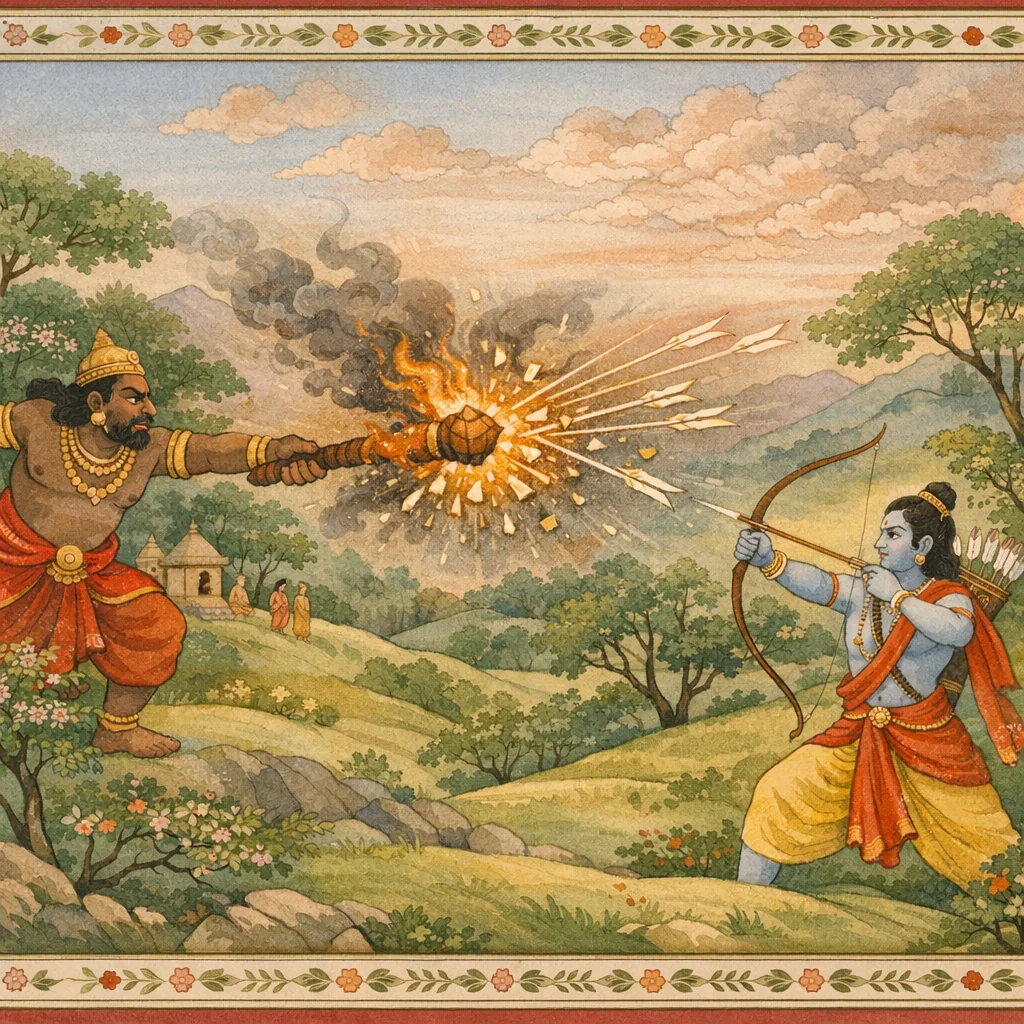
This sarga unfolds as a rhetorical duel before a decisive exchange of weapons. Rāma addresses Khara—stripped of his chariot yet standing with a mace—beginning with measured instruction and then turning to stern accusation. He brands Khara’s violence as lokaviruddha, opposed to the world’s moral order, affirms the inevitability of karmaphala, and declares himself an agent of royal dharma appointed to end the doers of ghora-pāpa. Rāma issues clear martial foretellings: golden arrows will pierce Khara; he will follow the righteous ascetics he devoured in Daṇḍakāraṇya; and the seers he harmed will witness his fall. Khara answers with contempt, deriding Rāma’s words as empty boasting and claiming true valor needs no self-praise. He insists he alone can kill Rāma, likening himself to Antaka (Yama) with the noose, and cuts off further speech as sunset nears and delayed combat is improper. The discourse resolves into action: Khara hurls a blazing mace like a thunderbolt, scorching trees and shrubs as it flies. Rāma intercepts it midair and shatters it into fragments with multiple arrows, neutralizing the threat and ending the chapter with a clear tactical advantage.
Shlokas
Verse 1
खरं तु विरथं रामो गदापाणिमवस्थितम्।मृदुपूर्वं महातेजाः परुषं वाक्यमब्रवीत्।।।।
But Rama—radiant in power—seeing Khara standing chariotless with mace in hand, addressed him: first gently, and then with stern words.
Verse 2
गजाश्वरथसम्बाधे बले महति तिष्ठता।कृतं सुदारुणं कर्म सर्वलोकजुगुप्सितम्।।।।
Though you stand upheld by a vast host, crowded with elephants, horses, and chariots, you have done a deed most dreadful, loathed by all the worlds.
Verse 3
उद्वेजनीयो भूतानां नृशंसः पापकर्मकृत्।त्रयाणामपि लोकानामीश्वरोऽपि न तिष्ठति।।।।
One who is cruel, who works sinful deeds, and who becomes a terror to all beings does not endure—even were he the lord of the three worlds.
Verse 4
कर्म लोकविरुद्धं तु कुर्वाणं क्षणदाचर।तीक्ष्णं सर्वजनो हन्ति सर्पं दुष्टमिवागतम्।।।।
O night-roamer, one who commits deeds opposed to the world’s dharma is struck down by all, like a wicked venomous serpent that has come too near.
Verse 5
लोभात्पापानि कुर्वाणः कामाद्वा यो न बुध्यते।भ्रष्टः पश्यति तस्यान्तं ब्राह्मणी करकादिव।।।।
Whoever, driven by greed or passion, commits sinful acts without understanding their wrongness—such a person is ruined and, in the end, comes to destruction, like a lizard that swallows a hailstone.
Verse 6
वसतो दण्डकारण्ये तापसान्धर्मचारिणः।किन्नु हत्वा महाभागान्फलं प्राप्स्यसि राक्षस।।।।
O rākṣasa, what ‘gain’ do you expect to obtain by killing those venerable ascetics—followers of dharma—who dwell in the Daṇḍaka forest?
Verse 7
न चिरं पापकर्माणः क्रूरा लोकजुगुप्सिताः।ऐश्वर्यं प्राप्य तिष्ठन्ति शीर्णमूला इव द्रुमाः।।।।
Those who perform sinful deeds—cruel and despised by the world—do not remain in prosperity for long, just like trees whose roots have rotted away.
Verse 8
अवश्यं लभते जन्तुः फलं पापस्य कर्मणः।घोरं पर्यागते काले द्रुमाः पुष्पमिवार्तवम्।।।।
Surely a being receives the fruit of sinful action—terrible though it may be—when the appointed time arrives, just as trees put forth blossoms in their season.
Verse 9
नचिरात्प्राप्यते लोके पापानां कर्मणां फलम्।सविषाणामिवान्नानां भुक्तानां क्षणदाचर।।।।
O night-roamer, in this very world the fruit of sinful deeds is obtained before long—like the effect of food eaten when it is laced with poison.
Verse 10
पापमाचरतां घोरं लोकस्याप्रियमिच्छताम्।अहमासादितो राजा प्राणान्हन्तुं निशाचर।।।।
O night-roamer, by the king’s command I have come to end the lives of those who commit dreadful sin and desire what is hateful to the world.
Verse 11
अद्य हि त्वां मया मुक्ताश्शराः काञ्चनभूषणाः।विदार्यातिपतिष्यन्ति वल्मीकमिव पन्नगाः।।।।
For today, the arrows I release—adorned with gold—will pierce through you and burst out, like serpents surging forth from an anthill.
Verse 12
ये त्वया दण्डकारण्ये भक्षिता धर्मचारिणः।तानद्य निहतस्सङ्ख्ये ससैन्योऽनुगमिष्यसि।।।।
Today, slain by me in battle, you will go after—along with your army—those righteous people whom you devoured in the Dandaka forest.
Verse 13
अद्य त्वां निहतं बाणैः पश्यन्तु परमर्षयः।निरयस्थं विमानस्था ये त्वया हिंसिताः पुरा।।।।
May the great seers—whom you once tormented—behold you today, struck down by arrows, fallen into hell, as they look on from their celestial cars.
Verse 14
प्रहर त्वं यथाकामं कुरु यत्नं कुलाधम।अद्य ते पातयिष्यामि शिरस्तालफलं यथा।।।।
Strike as you please and make whatever effort you can, O disgrace to your line; today I will make your head fall like a palm fruit.
Verse 15
एवमुक्तस्तु रामेण कृद्धस्संरक्तलोचनः।प्रत्युवाच खरो रामं प्रहसन्क्रोधमूर्छितः।।।।
Thus addressed by Rama, Khara—his eyes reddened with anger and his mind clouded by wrath—laughed aloud and replied to him.
Verse 16
प्राकृतान्राक्षसान्हत्वा युद्धे दशरथात्मज।आत्मना कथमात्मानमप्रशस्यं प्रशंससि।।।।
O son of Daśaratha, having slain only ordinary rākṣasas in battle, why do you praise yourself—one not worthy of praise?
Verse 17
विक्रान्ता बलवन्तो वा ये भवन्ति नरर्षभाः।कथयन्ति न ते किञ्चित्तेजसा स्वेन गर्विताः।।।।
Those who are truly valiant and strong—the best among men—do not speak even a little for self-display, being quietly proud of their own prowess.
Verse 18
प्राकृतास्त्वकृतात्मानो लोके क्षत्रियपांसनाः।निरर्थकं विकत्थन्ते यथा राम विकत्थसे।।।।
But in this world, common men lacking self-mastery—kṣatriyas of the lowest sort—boast without meaning, just as you, Rama, are boasting.
Verse 19
कुलं व्यपदिशन्वीरस्समरे कोऽभिधास्यति।मृत्युकाले हि सम्प्राप्ते स्वयमप्रस्तवे स्तवम्।।।।
When, in battle, death has truly drawn near, what hero will be naming his lineage and offering himself needless praise without occasion?
Verse 20
सर्वथैव लघुत्वं ते कत्थनेन विदर्शितम्।सुवर्णप्रतिरूपेण तप्तेनेव कुशाग्निना।।।।
By your boasting, your paltriness is wholly laid bare—like the fire of kuśa grass which, when it blazes, glows with a gold-like sheen.
Verse 21
न तु मामिह तिष्ठन्तं पश्यसि त्वं गदाधरम्।धराधरमिवाकम्प्यं पर्वतं धातुभिश्चितम्।।।।
Do you not see me standing here, mace in hand—unshakable like a mountain, streaked with mineral veins, as though it were the very bearer of the earth?
Verse 22
पर्याप्तोऽहं गदापाणिर्हन्तुं प्राणान्रणे तव।त्रयाणामपि लोकानां पाशहस्त इवान्तकः।।।।
I, with mace in hand, am enough to take your life in battle—just as Antaka (Yama), noose in hand, is enough to end even the three worlds.
Verse 23
कामं बह्वपि वक्तव्यं त्वयि वक्ष्यामि न त्वहम्।अस्तं गच्छेद्धि सविता युद्धविघ्नस्ततो भवेत्।।।।
Much could indeed be said about you, but I will not speak further—for the sun is setting, and after that there would be an impediment to battle.
Verse 24
चतुर्दश सहस्राणि राक्षसानां हतानि ते।त्वद्विनाशात्करोम्येषां तेषामश्रुप्रमार्जनम्।।।।
Fourteen thousand rākṣasas have been slain by you; by destroying you, I will wipe away their tears—I will avenge them.
Verse 25
इत्युक्त्वा परमक्रुद्धस्तां गदां परमाङ्गदः।खरश्चिक्षेप रामाय प्रदीप्तामशनिं यथा।।।।
Having said so, Khara—furious, adorned with splendid arm-bands—hurled that blazing mace at Rāma like a thunderbolt.
Verse 26
खरबाहुप्रयुक्ता सा प्रदीप्ता महती गदा।भस्मवृक्षांश्च गुल्मांश्च कृत्वागात्तत्समीपतः।।।।
That great blazing mace, driven by Khara’s arms, turned trees and thickets to ash as it sped close toward him (Rāma).
Verse 27
तामापतन्तीं ज्वलतां मृत्युपाशोपमां गदाम्।अन्तरिक्षगतां रामचशिच्छेद बहुधा शरैः।।।।
As that flaming mace fell through the sky, like the noose of death itself, Rāma shattered it into many pieces with his arrows.
Verse 28
सा विकीर्णा शरैर्भग्ना पपात धरणीतले।गदा मन्त्रौषधबलैर्व्यालीव विनिपातिता।।।।
Broken by Rāma’s arrows and scattered, the mace fell upon the earth—like a serpentess brought down by the power of mantras and medicines.
Frequently Asked Questions
The sarga presents the ethics of punitive violence: Rāma articulates that killing is not personal aggression but rājā-ājñā (royal mandate) aimed at ending ghora-pāpa that harms the world and ascetics, thereby framing battle as dharmically regulated enforcement.
Two complementary teachings emerge: (1) karmaphala is unavoidable—cruel, lokaviruddha deeds mature into destruction at the proper time; (2) true valor is restrained and not self-advertised, as Khara argues, even though the narrative tests that claim against his own pride and aggression.
Daṇḍakāraṇya is the key geographic setting as the forest-space where ascetics are endangered and protected; culturally, the chapter references royal command (rājā-ājñā), norms about fighting after sunset, and iconic similes (anthill-serpents, kusa-fire ‘gold,’ palm fruit) that encode classical Sanskrit poetic convention.