Adhyaya 35: Yayāti’s Forest-Renunciation, Austerities, and the Question of His Fall from Heaven
ययातिवनप्रस्थानं स्वर्गारोहणं च
Speaker: Śaunaka, Śatānīka
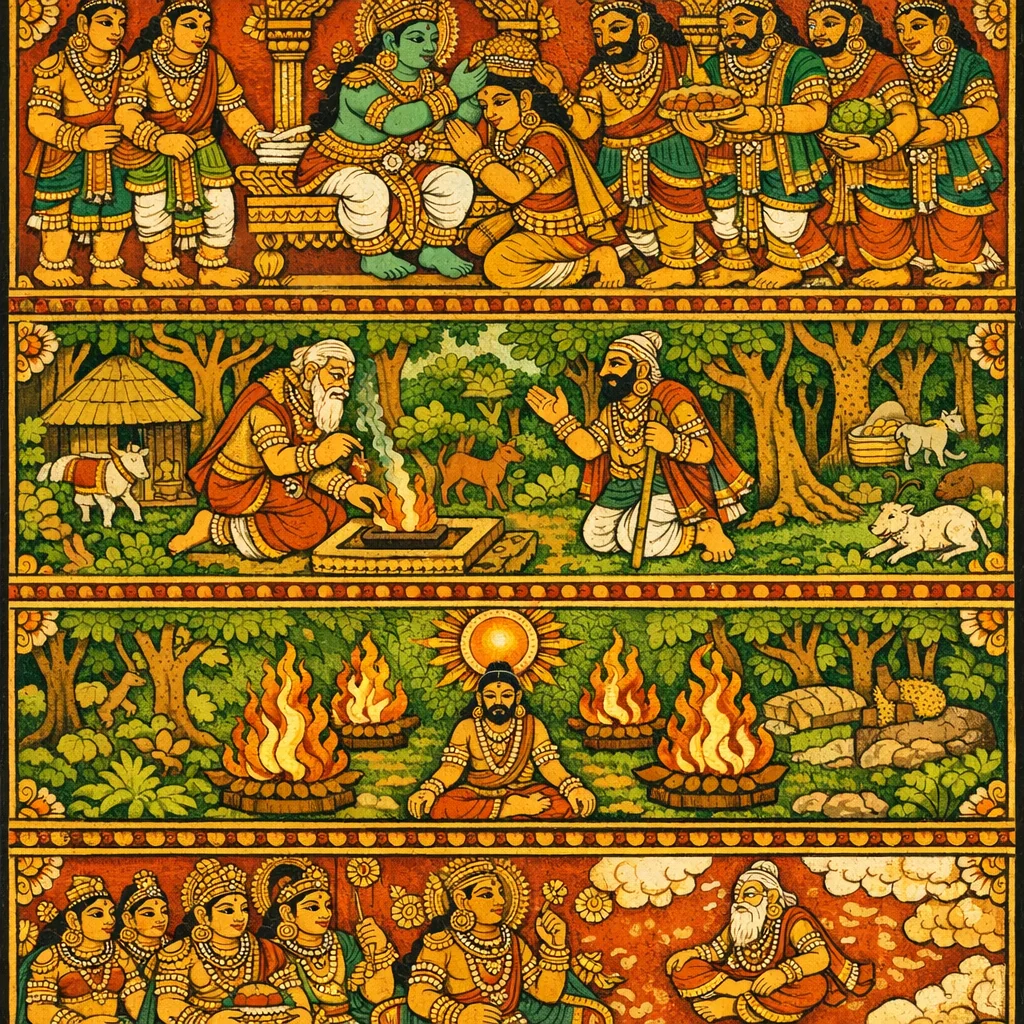
Śaunaka recounts Yayāti’s abdication in favor of Pūru and his forest-life as a vānaprastha. The account sets out Yayāti’s code: dwelling with or near Brāhmaṇas, living on fruits and roots, honoring guests, sustaining himself by śiloñcha, offering to the Pitṛs and the Devas, and maintaining the sacred fires. His tapas intensifies over vast periods—one thousand years of disciplined forest-life, then phases of water-only, air-only, pañcāgni austerity, and standing on one foot—culminating in attainment of svarga. Yet a paradox arises: after only a short time in heaven, Indra causes Yayāti’s fall, leaving him suspended in mid-air. A tradition is cited that Yayāti later returned to heaven after joining with Vasumat, Aṣṭaka, Pratardana, and Śibi. Śatānīka asks what deed enabled this re-attainment and why Indra struck him down, and Śaunaka promises the full, sin-destroying narration.
Key Concepts
Shlokas in Adhyaya 35
Verse 1
*शौनक उवाच एवं स नाहुषो राजा ययातिः पुत्रमीप्सितम् राज्ये ऽभिषिच्य मुदितो वानप्रस्थो ऽभवन्मुनिः //
Śaunaka said: Thus King Yayāti, the son of Nahuṣa, having joyfully consecrated his desired son to the kingship by royal anointing, entered the vānaprastha stage—the forest-life—and became like a muni, a sage-ascetic.
Verse 2
उषित्वा वनवासं स ब्राह्मणैः सह संश्रितः फलमूलाशनो दान्तो यथा स्वर्गमितो गतः //
Having lived the forest-dwelling life, taking refuge in the company of Brāhmaṇas, eating only fruits and roots, and remaining self-restrained, he departed thereafter, as though he had reached heaven (svarga).
Verse 3
स गतः स्वर्गवासं तु न्यवसन्मुदितः सुखी कालस्य नातिमहतः पुनः शक्रेण पातितः //
He went to dwell in heaven and lived there, joyful and at ease; but after no very long time, he was again cast down by Śakra (Indra).
Verse 4
विवशः प्रच्युतः स्वर्गाद् अप्राप्तो मेदिनीतलम् स्थितश्चासीद् अन्तरिक्षे स तदेति श्रुतं मया //
Helpless, he fell from heaven; not yet reaching the surface of the earth, he remained suspended in the mid-space. So it has been heard by me—that he then went on in that condition.
Verse 5
तत एव पुनश्चापि गतः स्वर्गमिति श्रुतिः राज्ञा वसुमता सार्धम् अष्टकेन च वीर्यवान् प्रतर्दनेन शिबिना समेत्य किल संसदि //
From there, again, tradition says he departed to heaven—having, it is said, assembled in the royal council together with King Vasumat, and with Aṣṭaka, the mighty Pratardana, and Śibi.
Verse 6
*शतानीक उवाच कर्मणा केन स दिवं पुनः प्राप्तो महीपतिः कथमिन्द्रेण भगवन् पातितो मेदिनीतले //
Śatānīka said: “By what deed did that king again attain heaven? And how, O Blessed one, was he struck down by Indra onto the surface of the earth?”
Verse 7
सर्वमेतद् अशेषेण श्रोतुमिच्छामि तत्त्वतः कथ्यमानं त्वया विप्र देवर्षिगणसंनिधौ //
“I wish to hear all of this, without remainder, in its true essence—O brāhmaṇa—exactly as you will relate it, here in the presence of the host of divine seers.”
Verse 8
देवराजसमो ह्य् आसीद् ययातिः पृथिवीपतिः वर्धनः कुरुवंशस्य विभावसुसमद्युतिः //
Yayāti, lord of the earth, was indeed equal to the king of the gods; he increased the Kuru lineage, radiant with a splendor like that of Vibhāvasu (the Sun).
Verse 9
तस्य विस्तीर्णयशसः सत्यकीर्तेर् महात्मनः श्रोतुमिच्छामि देवेश दिवि चेह च सर्वशः //
O Lord of the gods, I wish to hear in full—both in heaven and here on earth—of that great-souled one whose fame is far-spread and whose renown is true.
Verse 10
*शौनक उवाच हन्त ते कथयिष्यामि ययातेरुत्तमां कथाम् दिवि चेह च पुण्यार्थां सर्वपापप्रणाशिनीम् //
Śaunaka said: “Come then—I shall tell you the excellent tale of King Yayāti, a meritorious narrative that brings spiritual benefit both here and in heaven, and that destroys all sins.”
Verse 11
ययातिर्नाहुषो राजा पूरुं पुत्रं कनीयसम् राज्ये ऽभिषिच्य मुदितः प्रवव्राज वनं तदा //
Then King Yayāti, the son of Nahusha, joyfully installed his younger son Puru as ruler of the kingdom and set out for the forest in renunciation.
Verse 12
अन्तेषु स विनिक्षिप्य पुत्रान् यदुपुरोगमान् फलमूलाशनो राजा वने ऽसौ न्यवसच्चिरम् //
Having settled his sons—led by Yadu—in their respective domains, that king lived for a long time in the forest, subsisting on fruits and roots.
Verse 13
स जितात्मा जितक्रोधस् तर्पयन् पितृदेवताः अग्नींश्च विधिवज्जुह्वन् वानप्रस्थविधानतः //
Self-controlled and having conquered anger, he should satisfy the Fathers (Pitṛs) and the gods with offerings; and, maintaining the sacred fires, perform oblations in the prescribed manner, according to the ordinances for a vānaprastha (forest-dweller).
Verse 14
अतिथीन् पूजयन्नित्यं वन्येन हविषा विभुः शिलोञ्छवृत्तिमास्थाय शेषान्नकृतभोजनः //
Ever honouring guests with forest-offerings—simple produce of the wild—that noble man should adopt the ‘śiloñcha’ mode of livelihood, and eat only after the guests, taking food solely from what remains.
Verse 15
पूर्णं सहस्रं वर्षाणाम् एवंवृत्तिर् अभून्नृपः अम्बुभक्षः स चाब्दांस्त्रीन् आसीन् नियतवाङ्मनाः //
For a full thousand years, the king lived in this manner; then, subsisting only on water, he remained so for three years, with speech and mind held in strict restraint.
Verse 16
ततस्तु वायुभक्षो ऽभूत् संवत्सरमतन्द्रितः पञ्चाग्निमध्ये च तपस् तेपे संवत्सरं पुनः //
Then, untiringly, he lived for a full year subsisting only on air; and again, for another year, he performed austerities seated amid the five fires (pañcāgni).
Verse 17
एकपादस्थितश्चासीत् षण्मासान् अनिलाशनः पुण्यकीर्तिस्ततः स्वर्गं जगामावृत्य रोदसी //
Standing on a single foot for six months, living only on air, Puṇyakīrti thereafter went to heaven; his holy renown spread so widely that it seemed to cover both earth and sky.
Frequently Asked Questions
The chapter teaches that a king perfects dharma not only through rule but also through timely renunciation: installing a worthy heir, then practicing vānaprastha with self-restraint, guest-honoring, offerings to Pitṛs and Devas, and sustained tapas. It also hints that heavenly reward is conditional and can be lost, introducing the theme of svarga’s impermanence and the need for deeper spiritual grounding beyond merit alone.
Primarily Dharma and Genealogy. Dharma appears as āśrama-dharma (vānaprastha rules, agni-ritual observance, atithi-dharma, tapas disciplines) and as Rajadharma through abdication and succession planning (Pūru’s consecration; Yadu and others assigned domains). Genealogy is present through Yayāti’s role as enhancer of the Kuru lineage. Vastu/architecture is not a focus in this adhyāya.