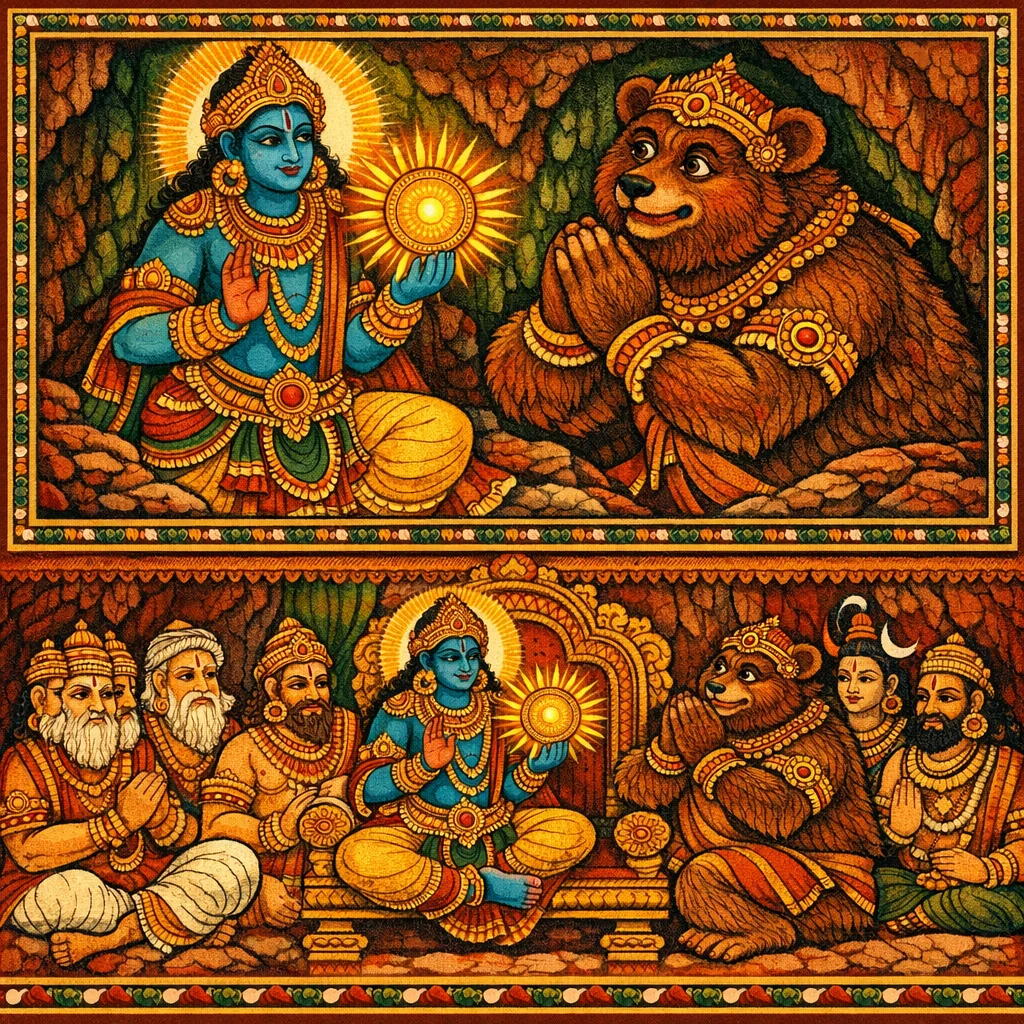
Adhyaya 45: The Syamantaka Jewel Episode and the Vrishni–Sainya Genealogies
स्यामन्तक-मणि-प्रसङ्गः तथा वृष्णिवंश-प्रवरा
Speaker: Sūta, Jāmbavān, Govinda (Kṛṣṇa)
Sūta continues the Vrishni genealogies: Gāndhārī and Mādrī are named as wives, with sons including Sumitra, Yudhājit, Devamīḍhuṣa, Anamitra, and Śibi. From Anamitra comes Nighna; from Nighna, Prasena and Śaktisena. The Syamantaka jewel belongs to Prasena, who refuses all requests; while hunting he is slain by a bear, his body hidden in a cave, and the jewel taken. When Prasena’s death is known, people suspect Govinda (Kṛṣṇa) of murder for the jewel. Govinda reaches the cave, confronts the bear-king Ṛkṣarāja Jāmbavān, and seizes him in wrath; Jāmbavān then praises the Lord with Vaiṣṇava observances and asks boons—death by the discus, his daughter’s marriage to Kṛṣṇa, and the jewel’s return. Kṛṣṇa kills Jāmbavān, recovers the jewel with the daughter, and publicly restores it to Satrājit in the Sātvata assembly, though he remains pained by the false charge. The chapter then lists Satrājit’s wives and sons, Bhaṅgakāra’s daughters (including Satyabhāmā) given to Kṛṣṇa, the Śini–Sātyaki–Śainya line, and Akrūra’s descendants, concluding that knowledge of a Kṛṣṇa-purified counter-formula protects from false imprecation.
Key Concepts
Shlokas in Adhyaya 45
Verse 1
*सूत उवाच गान्धारी चैव माद्री च वृष्णिभार्ये बभूवतुः गान्धारी जनयामास सुमित्रं मित्रनन्दनम् //
Sūta said: Gāndhārī and Mādrī became the wives of Vṛṣṇi. Gāndhārī gave birth to Sumitra, the delight of his friends.
Verse 2
माद्री युधाजितं पुत्रं ततो वै देवमीढुषम् अनमित्रं शिबिं चैव पञ्चमं कृतलक्षणम् //
Mādrī bore a son, Yudhājit; and thereafter she bore Devamīḍhuṣa, Anamitra, and Śibi—these, as the fifth, were marked with accomplished royal characteristics.
Verse 3
अनमित्रसुतो निघ्नो निघ्नस्यापि तु द्वौ सुतौ प्रसेनश्च महावीर्यः शक्तिसेनश्च ताव् उभौ //
Anamitra’s son was Nighna. And Nighna, in turn, had two sons—Prasena, of great valor, and Śaktisena; these two were his sons.
Verse 4
स्यमन्तकः प्रसेनस्य मणिरत्नमनुत्तमम् पृथिव्यां सर्वरत्नानां राजा वै सो ऽभवन्मणिः //
The Syamantaka—Prasena’s unsurpassed jewel—became, upon the earth, the sovereign among all gems.
Verse 5
हृदि कृत्वा तु बहुशो मणिं तमभियाचितः गोविन्दो ऽपि न तं लेभे शक्तो ऽपि न जहार सः //
Though repeatedly entreated for that jewel, he kept it close to his heart; even Govinda could not obtain it, and though fully capable, he did not take it away by force.
Verse 6
कदाचिन्मृगयां यातः प्रसेनस्तेन भूषितः यथाशब्दं स शुश्राव बिले सत्त्वेन पूरिते //
Once, Prasena went out on a hunt, adorned with that splendid gear. Just as the sound arose, he heard it within a cave that was filled with a living creature.
Verse 7
ततः प्रविश्य स बिलं प्रसेनो ह्य् ऋक्षमैक्षत ऋक्षः प्रसेनं च तथा ऋक्षं चैव प्रसेनजित् //
Then, entering that cave, Prasena indeed saw a bear; and the bear saw Prasena. Likewise, Prasenajit also saw both Prasena and the bear.
Verse 8
हत्वा ऋक्षः प्रसेनं तु ततस्तं मणिमाददात् अदृष्टस्तु हतस्तेन अन्तर्बिलगतस्तदा //
Having slain Prasena, the bear then took that jewel. And Prasena, unseen by anyone, was killed by it and at that time lay hidden within a cave.
Verse 9
प्रसेनं तु हतं ज्ञात्वा गोविन्दः परिशङ्कितः गोविन्देन हतो व्यक्तं प्रसेनो मणिकारणात् //
When it was learned that Prasena had been slain, Govinda became an object of suspicion; people were certain that Govinda had killed Prasena, and that the motive was the jewel.
Verse 10
प्रसेनस्तु गतो ऽरण्यं मणिरत्नेन भूषितः तं दृष्ट्वा स हतस्तेन गोविन्दः प्रत्युवाच ह हन्मि चैनं दुराचारं शत्रुभूतं हि वृष्णिषु //
Prasena went into the forest, adorned with that jewel-gem. Seeing that he had been slain because of it, Govinda spoke out: “I shall kill this wicked one, for he has become an enemy among the Vṛṣṇis.”
Verse 11
अथ दीर्घेण कालेन मृगयां निर्गतः पुनः यदृच्छया च गोविन्दो बिलस्याभ्याशमागमत् //
Then, after a long time, he again set out for the hunt; and by sheer chance Govinda came near the mouth of a cave.
Verse 12
तं दृष्ट्वा तु महाशब्दं स चक्रे ऋक्षराड्बली शब्दं श्रुत्वा तु गोविन्दः खड्गपाणिः प्रविश्य सः अपश्यज्जाम्बवन्तं तम् ऋक्षराजं महाबलम् //
Seeing him, the mighty king of bears (Ṛkṣarāja) let out a tremendous roar. Hearing that sound, Govinda entered with sword in hand, and beheld Jāmbavān—the powerful lord of the bears.
Verse 13
ततस्तूर्णं हृषीकेशस् तमृक्षपतिमञ्जसा जाम्बवन्तं स जग्राह क्रोधसंरक्तलोचनः //
Then, swiftly, Hṛṣīkeśa seized Jāmbavān—the lord of bears—at once, his eyes reddened with anger.
Verse 14
तुष्टावैनं तदा ऋक्षः कर्मभिर्वैष्णवैः प्रभुम् ततस्तुष्टस्तु भगवान् वरेणैनमरोचयत् //
Then the Bear (Ṛkṣa) praised that Lord, the supreme Master, by performing Vaiṣṇava rites and acts of devotion; and the Blessed Lord, being pleased, granted him a boon of his choosing.
Verse 15
*जाम्बवानुवाच इच्छे चक्रप्रहारेण त्वत्तो ऽहं मरणं प्रभो कन्या चेयं मम शुभा भर्तारं त्वामवाप्नुयात् यो ऽयं मणिः प्रसेनं तु हत्वा प्राप्तो मया प्रभो //
Jāmbavān said: “O Lord, I seek death at your hands by the blow of the discus. And may this auspicious daughter of mine attain you as her husband. This jewel—having been obtained by me after slaying Prasena—I now offer to you, O Lord.”
Verse 16
ततः स जाम्बवन्तं तं हत्वा चक्रेण वै प्रभुः कृतकर्मा महाबाहुः सकन्यं मणिमाहरत् //
Then the Lord, the mighty-armed one, having accomplished his purpose, slew that Jāmbavān with the discus, and brought back the jewel—together with his daughter.
Verse 17
ददौ सत्राजितायैनं सर्वसात्वतसंसदि तेन मिथ्यापवादेन संतप्तो ऽयं जनार्दनः //
In the full assembly of the Sātvatas, he gave it back to Satrājit. Yet by that false accusation, this Janārdana (Lord Kṛṣṇa) was deeply afflicted.
Verse 18
ततस्ते यादवाः सर्वे वासुदेवमथाब्रुवन् अस्माकं तु मतिर्ह्यासीत् प्रसेनस्तु त्वया हतः //
Then all those Yādavas said to Vāsudeva: “Indeed, our belief was that Prasena had been slain by you.”
Verse 19
कैकेयस्य सुता भार्या दश सत्राजितः शुभाः तासूत्पन्नाः सुतास्तस्य शतमेकं तु विश्रुताः ख्यातिमन्तो महावीर्या भङ्गकारस्तु पूर्वजः //
Satrājit had ten auspicious wives, daughters of the king of Kaikeya. From them were born his sons—famed as a full hundred in number—renowned and of great valor; among them, Bhaṅgakāra is mentioned as the eldest.
Verse 20
अथ व्रतवती तस्माद् भङ्गकारात्तु पूर्वजात् सुषुवे सुकुमारीस्तु तिस्रः कमललोचनाः //
Then Vratavatī, by that Bhaṅgakāra—her earlier-born husband—gave birth to three delicate daughters, lotus-eyed in beauty.
Verse 21
सत्यभामा वरा स्त्रीणां व्रतिनी च दृढव्रता तथा पद्मावती चैव ताश्च कृष्णाय सो ऽददात् //
Satyabhāmā—foremost among women—together with Vratinī of steadfast vows, and likewise Padmāvatī: all of them he gave in marriage to Kṛṣṇa.
Verse 22
अनमित्राच्छिनिर्जज्ञे कनिष्ठाद्वृष्णिनन्दनात् सत्यकस्तस्य पुत्रस्तु सात्यकिस्तस्य चात्मजः //
From Anamitra was born Chini, through Kanistha, the delight of the Vṛṣṇis. His son was Satyaka, and Sātyaki was Satyaka’s own son.
Verse 23
सत्यवान्युयुधानस्तु शिनेर्नप्ता प्रतापवान् असङ्गो युयुधानस्य द्युम्निस्तस्यात्मजो ऽभवत् //
Now, Satyavān—namely Yuyudhāna—was the valiant grandson of Śini. From Yuyudhāna was born Asaṅga, and Dyumni was born as Asaṅga’s son.
Verse 24
द्युम्नेर्युगंधरः पुत्र इति शैन्याः प्रकीर्तिताः अनमित्रान्वयो ह्य् एष व्याख्यातो वृष्णिवंशजः //
The Śainyas are proclaimed thus: “Yugaṃdhara is the son of Dyumna.” In this way the lineage of Anamitra—born in the Vṛṣṇi dynasty—has been set forth.
Verse 25
अनमित्रस्य संजज्ञे पृथ्व्यां वीरो युधाजितः अन्यौ तु तनयौ वीरौ वृषभः क्षत्र एव च //
From Anamitra was born upon the earth the heroic Yudhājit; and two other heroic sons were also born—Vṛṣabha and Kṣatra.
Verse 26
वृषभः काशिराजस्य सुतां भार्यामविन्दत जयन्तस्तु जयन्त्यां तु पुत्रः समभवच्छुभः //
Vṛṣabha took as his wife the daughter of the king of Kāśī. And to Jayanta, by Jayantī, a noble and auspicious son was born.
Verse 27
सदायज्ञो ऽतिवीरश्च श्रुतवानतिथिप्रियः अक्रूरः सुषुवे तस्मात् सदायज्ञो ऽतिदक्षिणः //
From him was born Akrūra—ever devoted to sacrifice (yajña), exceedingly valiant, learned in sacred lore, and fond of honoring guests. From Akrūra, in turn, was born Sadāyajña, renowned for great generosity in the giving of dakṣiṇā (ritual gifts).
Verse 28
रत्ना कन्या च शैब्यस्य अक्रूरस्तामवाप्तवान् पुत्रानुत्पादयामास एकादश महाबलान् //
Ratnā, the daughter of Śaibya—Akrūra took her as his wife, and he begot eleven sons of great strength.
Verse 29
उपलम्भः सदालम्भो वृकलो वीर्य एव च सवीतरः सदापक्षः शत्रुघ्नो वारिमेजयः //
Upalambha, Sadālambha, Vṛkala, Vīrya, Savītara, Sadāpakṣa, Śatrughna, and Vārimejaya—these are the kings named in successive order.
Verse 30
धर्मभृद्धर्मवर्माणौ धृष्टमानस्तथैव च सर्वे च प्रतिहोतारो रत्नायां जज्ञिरे च ते //
Dharmabhṛt, Dharmavarmā, and likewise Dhṛṣṭamāna—together with all those known as the Pratihotāras—were born from Ratnā.
Verse 31
अक्रूराद् उग्रसेनायां सुतौ द्वौ कुलवर्धनौ देववानुपदेवश्च जज्ञाते देवसंनिभौ //
From Akrūra, in Ugrasena’s line, two sons were born—enhancers of the family—Devavān and Upadeva, both radiant like the gods.
Verse 32
अश्विन्यां च ततः पुत्राः पृथुर् विपृथुरेव च अश्वत्थामा सुबाहुश्च सुपार्श्वकगवेषणौ //
And from Aśvinī, thereafter, sons were born—Pṛthu and Vipṛthu; Aśvatthāmā and Subāhu; and also Supārśvaka and Gaveṣaṇa.
Verse 33
वृष्टिनेमिः सुधर्मा च तथा शर्यातिरेव च अभूमिर् वर्जभूमिश्च श्रमिष्ठः श्रवणस्तथा //
Vṛṣṭinemi, Sudharmā, and likewise Śaryāti; also Abhūmi and Varjabhūmi; and further Śramiṣṭha and Śravaṇa—these too are named in that lineage.
Verse 34
इमां मिथ्याभिशस्तिं यो वेद कृष्णादपोहिताम् न स मिथ्याभिशापेन अभिशाप्यो ऽथ केनचित् //
Whoever knows this formula for countering false accusation—purified by Kṛṣṇa and stripped of its power—cannot be afflicted by any false curse or defamatory imprecation from anyone at all.
Frequently Asked Questions
The chapter teaches how false accusation (mithyāpavāda) can wound even the righteous, and how dharma requires public clarification and restoration of truth. Kṛṣṇa retrieves the Syamantaka jewel, returns it openly in the Sātvata assembly, and thereby demonstrates that legitimacy is secured not only by power but by transparent, communal vindication.
This adhyāya is primarily Genealogy (Yādava/Vṛṣṇi lines: Anamitra–Śini–Sātyaki; Satrājit; Akrūra and descendants) and Dharma (the ethics of reputation, slander, and public exoneration). It does not teach Vāstu measurements here; instead it preserves clan lineages and embeds a dhārmic case-study via the Syamantaka episode.
Prasena, owner of the unrivaled Syamantaka jewel, is killed in a cave by a bear (Jāmbavān), who takes the jewel. Because Prasena is missing, people suspect Govinda (Kṛṣṇa) of killing him for the jewel. Kṛṣṇa later reaches the cave, confronts Jāmbavān, receives the jewel back along with Jāmbavān’s daughter, and returns the jewel publicly to Satrājit—removing the stain of accusation.
Satrājit’s line is detailed, and among Bhaṅgakāra’s daughters, Satyabhāmā is explicitly named (along with Vratinī and Padmāvatī) as being given in marriage to Kṛṣṇa.
The text states that whoever knows the ‘mithyābhiśasti’ (a formula/knowledge that neutralizes false imprecation), described as being removed/purified by Kṛṣṇa, will not be afflicted by false curse or defamatory condemnation from anyone. It functions as an apotropaic dhārmic teaching rather than a detailed ritual manual.