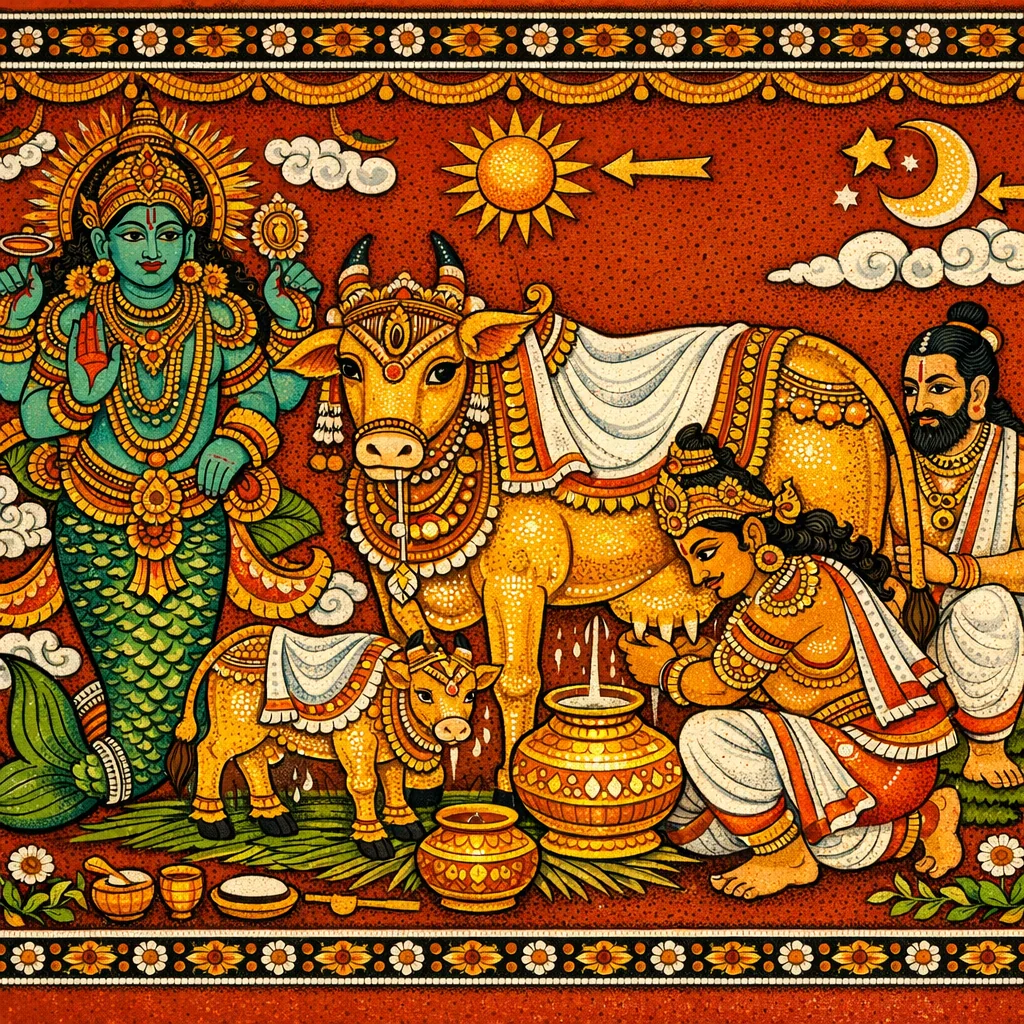
Adhyaya 82: The Rite of the Jaggery-Cow (Guḍa-Dhenu) Gift and the Ten Sin-Destroying ‘Cows’
गुडधेनुविधानम्
Speaker: Vaivasvata Manu, Lord Matsya
Manu asks for the exact procedure (vidhi), form (rūpa), and mantra for the guḍa-dhenu gift—a “cow” fashioned from jaggery. Lord Matsya prescribes preparing the ritual ground and arranging the offering by directions, then sets proportional amounts of jaggery for making the cow and calf according to one’s means. He details the iconography and ornaments that consecrate the gift, followed by invocatory mantras that identify the cow with divine powers of prosperity and sin-destruction. The rite ends with the formal donation to a brāhmaṇa. Matsya then teaches the wider doctrine of ten “dhenus” (substance-cows), clarifies measurement rules, and recommends such gifts on sacred calendrical occasions—especially as an aṅga of the Viśokā-Dvādaśī vow—promising worldly welfare, longevity, and final attainment of Viṣṇu’s abode through fasting, remembrance, and devotional song.
Key Concepts
Shlokas in Adhyaya 82
Verse 1
*मनुरुवाच गुडधेनुविधानं मे समाचक्ष्व जगत्पते किंरूपं केन मन्त्रेण दातव्यं तदिहोच्यताम् //
Manu said: “O Lord of the world, explain to me the proper procedure for the gift of the ‘guḍa-dhenu’—the jaggery-cow: what form it should take, and with which mantra it is to be bestowed. Let it be stated here.”
Verse 2
*मत्स्य उवाच गुडधेनुविधानस्य यद्रूपमिह यत्फलम् तदिदानीं प्रवक्ष्यामि सर्वपापविनाशनम् //
Lord Matsya said: “Now I shall explain the form of the rite of the ‘guḍa-dhenu’ gift and the fruit it yields here—a practice that destroys all sins.”
Verse 3
कृष्णाजिनं चतुर्हस्तं प्राग्ग्रीवं विन्यसेद्भुवि गोमयेनानुलिप्तायां दर्भानास्तीर्य सर्वतः //
On the ground, first smeared with cow-dung, one should spread darbha grass on all sides and then place a black antelope-skin measuring four hands in length, with its neck-end oriented toward the east.
Verse 4
लघ्वेणकाजिनं तद्वद् वत्सं च परिकल्पयेत् प्राङ्मुखीं कल्पयेद्धेनुम् उदक्पादां सवत्सकाम् //
In the same manner, one should arrange a light antelope-skin and also provide a calf. One should set the cow facing east, with her feet oriented to the north, together with her calf, as desired for the rite.
Verse 5
उत्तमा गुडधेनुः स्यात् सदा भारचतुष्टयम् वत्सं भारेण कुर्वीत द्वाभ्यां वै मध्यमा स्मृता //
The finest “jaggery-cow” (guḍa-dhenū) should always weigh four bhāras. Its calf should be fashioned with one bhāra; the medium grade is remembered as two bhāras.
Verse 6
अर्धभारेण वत्सः स्यात् कनिष्ठा भारकेण तु चतुर्थांशेन वत्सः स्याद् गृहवित्तानुसारतः //
A calf (vatsa) is to be valued at half a bhāra; a smaller, lower-grade one at a bhāraka. By another reckoning, a calf is valued at a quarter share—according to the household’s means.
Verse 7
धेनुवत्सौ घृतास्यौ च सितसूक्ष्माम्बरावृतौ शुक्तिकर्णाविक्षुपादौ शुचिमुक्ताफलेक्षणौ //
Both are to be like a cow with her calf; their mouths are as though anointed with ghee; they are covered in fine white garments; their ears are like mother-of-pearl shells; their feet like sugarcane; and their eyes resemble pure pearls, or fruits with a pearly lustre.
Verse 8
सितसूत्रशिरालौ तौ सितकम्बलकम्बलौ ताम्रगण्डकपृष्ठौ तौ सितचामररोमकौ //
Both were marked with veins like white threads upon the head, and both were covered with white woollen coverings. Both had coppery cheeks and backs, and both bore hair like the white cāmara yak-tail—bright, soft, and auspicious.
Verse 9
विद्रुमभ्रूयुगोपेतौ नवनीतस्तनावुभौ क्षौमपुच्छौ कांस्यदोहाव् इन्द्रनीलकतारकौ //
They are endowed with eyebrows like coral; both have udders like fresh butter (navanīta); their tail is like fine linen (kṣauma); their flanks like bronze; and their eyes are speckled like sapphire.
Verse 10
सुवर्णशृङ्गाभरणौ राजतैः खुरसंयुतौ नानाफलसमायुक्तौ घ्राणगन्धकरण्डकौ इत्येवं रचयित्वा तौ धूपदीपैरथार्चयेत् //
Adorning the pair with golden horn-ornaments, fitting them with silver hoof-covers, and providing baskets filled with various fruits and fragrant aromatics—having arranged them thus, one should then worship with incense and lamps.
Verse 11
या लक्ष्मीः सर्वभूतानां या च देवेष्ववस्थिता धेनुरूपेण सा देवी मम शान्तिं प्रयच्छतु //
May that Lakṣmī—who abides in all beings and is established among the gods—she who appears in the form of the cow, grant me peace.
Verse 12
देहस्था या च रुद्राणी शंकरस्य सदा प्रिया धेनुरूपेण सा देवी मम पापं व्यपोहतु //
May that Rudrāṇī—dwelling within the body, ever dear to Śaṅkara—she who appears in the form of the cow, remove my sin.
Verse 13
विष्णोर्वक्षसि या लक्ष्मीः स्वाहा या च विभावसोः चन्द्रार्कशक्रशक्तिर्या धेनुरूपास्तु सा श्रिये //
May that Śrī—who is Lakṣmī upon Viṣṇu’s chest, who is Svāhā in the Fire-god, and who is the power of the Moon, the Sun, and Indra—manifest for prosperity in the form of the wish-fulfilling cow.
Verse 14
चतुर्मुखस्य या लक्ष्मीर् या लक्ष्मीर्धनदस्य च लक्ष्मीर्या लोकपालानां सा धेनुर्वरदास्तु मे //
May the boon-bestowing Cow grant me blessings—the very Prosperity (Lakṣmī) of four-faced Brahmā, the Prosperity of Dhanada (Kubera), and the Prosperity of the Lokapālas, guardians of the directions.
Verse 15
स्वधा या पितृमुख्याणां स्वाहा यज्ञभुजां च या सर्वपापहरा धेनुस् तस्माच्छान्तिं प्रयच्छ मे //
You who are called Svadhā for the foremost of the Ancestors, and Svāhā for the gods who partake of the sacrifice—O sin-destroying Cow of abundance, therefore grant me peace and appeasement.
Verse 16
एवमामन्त्र्य तां धेनुं ब्राह्मणाय निवेदयेत् विधानमेतद्धेनूनां सर्वासाम् अभिपठ्यते //
Having thus addressed and ritually invited that cow, one should formally present her to a brāhmaṇa. This is the prescribed procedure for offering all kinds of cows, as it is recited in the tradition.
Verse 17
यास्ताः पापविनाशिन्यः पठ्यन्ते दश धेनवः तासां स्वरूपं वक्ष्यामि नामानि च नराधिप //
O king, those ten “cows” that are recited as destroyers of sin—I shall now describe their distinctive forms and also their names.
Verse 18
प्रथमा गुडधेनुः स्याद् घृतधेनुस् तथापरा तिलधेनुस्तृतीया तु चतुर्थी जलसंज्ञिता //
The first is called the ‘jaggery-cow’ (guḍa-dhenu); the next is the ‘ghee-cow’ (ghṛta-dhenu). The third is the ‘sesame-cow’ (tila-dhenu), and the fourth is known as the ‘water-cow’ (jala-saṃjñitā).
Verse 19
क्षीरधेनुश्च विख्याता मधुधेनुस्तथा परा सप्तमी शर्कराधेनुर् दधिधेनुस्तथाष्टमी रसधेनुश्च नवमी दशमी स्यात् स्वरूपतः //
The gift-cow known as the Milk-cow (kṣīra-dhenu) is renowned; likewise, the Honey-cow (madhu-dhenu) comes next. The seventh is the Sugar-cow (śarkarā-dhenu); the eighth, the Curd-cow (dadhi-dhenu). The ninth is the Juice/Essence-cow (rasa-dhenu); and the tenth, in its proper form, is to be given as prescribed.
Verse 20
कुम्भाः स्युर्द्रवधेनूनाम् इतरासां तु राशयः सुवर्णधेनुमप्यत्र केचिदिच्छन्ति भानवः //
For the “liquid-cow” (drava-dhenu) offerings, the proper measure is by jars (kumbhas); but for the other kinds, the measure is by heaps (rāśis). In this very context, some authorities also prescribe a cow made of gold (suvarṇa-dhenu) as an appropriate gift.
Verse 21
नवनीतेन रत्नैश्च तथान्ये तु महर्षयः एतदेवंविधानं स्यात् त एवोपस्कराः स्मृताः //
With fresh butter (navanīta) and with gems (ratna)—and likewise with other such offerings, O great sages—when the procedure is of this kind, these very items are traditionally remembered as the requisite implements (upaskaras) for the rite.
Verse 22
मन्त्रावाहनसंयुक्ताः सदा पर्वणि पर्वणि यथाश्रद्धं प्रदातव्या भुक्तिमुक्तिफलप्रदाः //
Offerings consecrated with mantra and accompanied by proper invocation (āvāhana) should always be given at every sacred occasion (parvan), according to one’s faith and capacity; they bestow the fruits of worldly enjoyment as well as liberation (mokṣa).
Verse 23
गुडधेनुप्रसङ्गेन सर्वास्तावन्मयोदिताः अशेषयज्ञफलदाः सर्वाः पापहराः शुभाः //
In connection with the guḍa-dhenu (the “jaggery-cow”), I have thus described them all. Each of these gifts bestows the full fruit of sacrifices (yajñas), removes sins, and is auspicious.
Verse 24
व्रतानामुत्तमं यस्माद् विशोकद्वादशीव्रतम् तदङ्गत्वेन चैवात्र गुडधेनुः प्रशस्यते //
Since the Viśoka-Dvādaśī observance is the best among vows, therefore, as an auxiliary rite (aṅga) to it, the offering of a “jaggery-cow” (guḍa-dhenu)—a cow represented with jaggery as a ritual gift—is praised here.
Verse 25
अयने विषुवे पुण्ये व्यतीपाते ऽथवा पुनः गुडधेन्वादयो देयास् तूपरागादिपर्वसु //
At the ayanas (solstices), at the sacred viṣuvas (equinoxes), and on the auspicious Vyatīpāta; likewise, on festival occasions such as eclipses and the like, one should give the prescribed gifts—such as the “guḍa-dhenu” (jaggery-cow) and other appointed donations.
Verse 26
विशोकद्वादशी चैषा पुण्या पापहरा शुभा यामुपोष्य नरो याति तद्विष्णोः परमं पदम् //
This Viśokā-Dvādaśī is indeed meritorious, auspicious, and a remover of sins. By observing a fast (upavāsa) on it, a person attains the supreme abode of Viṣṇu.
Verse 27
इह लोके च सौभाग्यम् आयुरारोग्यमेव च वैष्णवं पुरमाप्नोति मरणे च स्मरन्हरिम् //
In this very world one gains good fortune, long life, and health; and by remembering Hari at the time of death, one reaches the city— the abode—of Viṣṇu.
Verse 28
नवार्बुदसहस्राणि दश चाष्टौ च धर्मवित् न शोकदुःखदौर्गत्यं तस्य संजायते नृप //
O King, for one who truly knows and upholds Dharma, for nine thousand arbudas and a further eighteen years, no sorrow, suffering, or misfortune arises.
Verse 29
नारी वा कुरुते या तु विशोकद्वादशीव्रतम् नृत्यगीतपरा नित्यं सापि तत्फलमाप्नुयात् //
Even a woman who habitually delights in dance and song—if she undertakes the vow (vrata) of Viśokā-Dvādaśī—shall likewise attain the very same fruit, the merit of that observance.
Verse 30
तस्मादग्रे हरेर्नित्यम् अनन्तं गीतवादनम् कर्तव्यं भूतिकामेन भक्त्या तु परया नृप //
Therefore, O king, one who seeks prosperity should always, in the presence of Hari, perform unceasing sacred song and instrumental music, doing so with supreme devotion.
Verse 31
इति पठति य इत्थं यः शृणोतीह सम्यङ् मधुमुरनरकारेर् अर्चनं यश्च पश्येत् मतिमाप च जनानां यो ददातीन्द्रलोके वसति स विबुधौघैः पूज्यते कल्पमेकम् //
Whoever recites this in such a manner; whoever here listens to it with full attention; whoever beholds the worship of the slayer of Madhu, Mura, and Naraka; and whoever also awakens understanding among people—such a one dwells in Indra’s world and is honored by hosts of gods for an entire kalpa.
Frequently Asked Questions
The chapter teaches the complete procedure for guḍa-dhenu dāna: preparing a purified space (cow-dung smear, darbha), placing antelope-skins with eastward orientation, constructing a jaggery cow and calf with prescribed weights, adorning them with symbolic features and ornaments, reciting mantras that invoke Lakṣmī/Śrī and other divine powers in cow-form, and finally donating the offering to a brāhmaṇa.
This adhyāya is primarily Dharma-focused—especially dāna-vidhi (ritual gifting), prāyaścitta-like sin-removal, and vrata practice (Viśokā-Dvādaśī). It does not address Vāstu Śāstra, royal statecraft (rājadharma), or Purāṇic genealogy in this chapter.
Matsya lists ten sin-destroying ‘cows’ (substance-based gifts): guḍa-dhenu (jaggery), ghṛta-dhenu (ghee), tila-dhenu (sesame), jala-dhenu (water), kṣīra-dhenu (milk), madhu-dhenu (honey), śarkarā-dhenu (sugar), dadhi-dhenu (curd), rasa-dhenu (juice/essence), and a tenth dhenu “in proper form” as prescribed by tradition; some authorities also accept suvarṇa-dhenu (gold-cow) in this context.
They should be offered on sacred occasions (parvans), including solstices (ayana), equinoxes (viṣuva), Vyatīpāta, eclipses, and other festival times—according to faith and capacity—because they yield both worldly benefits and liberation-oriented merit.
The text promises sin-removal, auspiciousness, good fortune, longevity, health, and—through fasting and remembering Hari at death—attainment of Viṣṇu’s supreme abode (Vaishnava realm). It also extols devotional singing and music before Hari as a prosperity-enhancing practice connected to the vow.