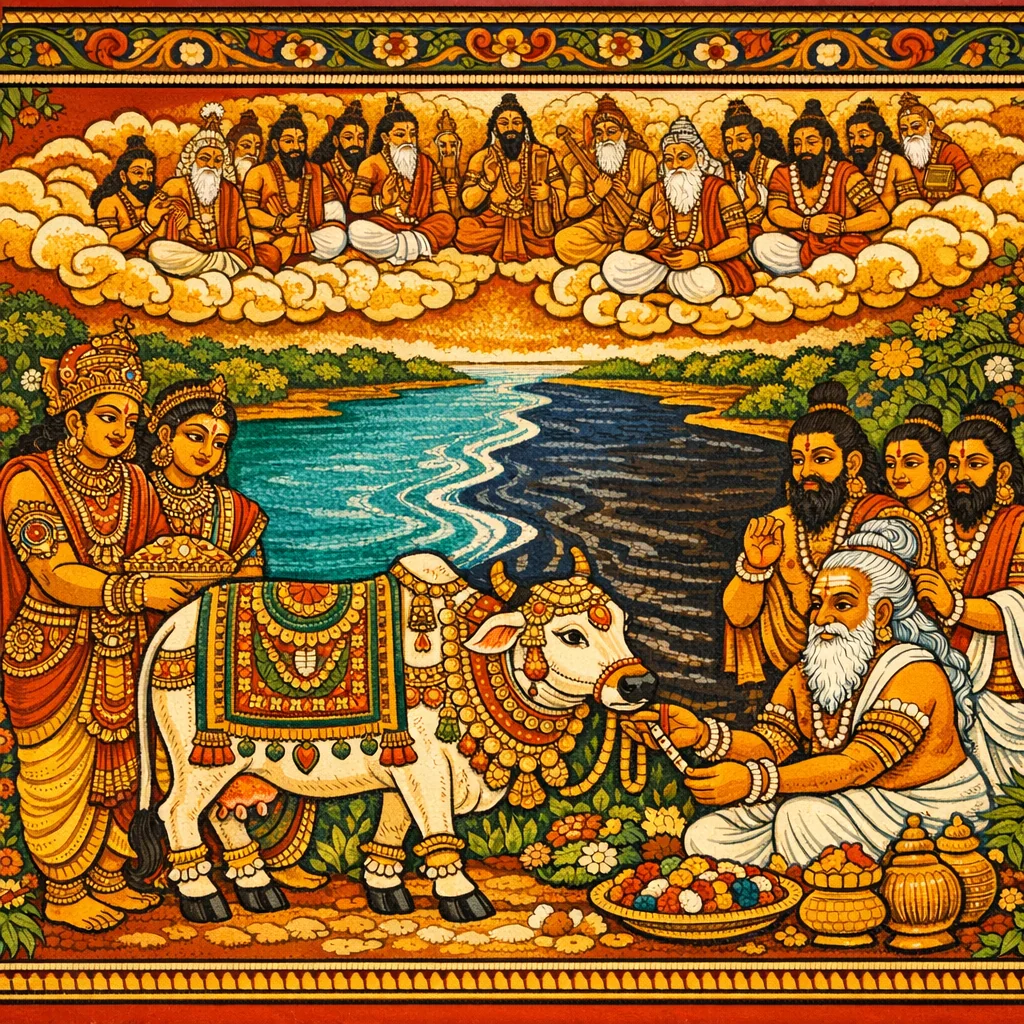
Adhyaya 105: The Greatness of Prayaga and the Supremacy of Cow-Donation (Go-dana)
प्रयागमाहात्म्यं तथा गोदानप्रशंसा
Speaker: Mārkaṇḍeya, The King (Rāja)
Mārkaṇḍeya continues addressing the king, urging him to hear again the sin-destroying Prayāga-māhātmya. He presents Prayāga as a guarded teaching and a refuge for the distressed. He then lists the fruits: dying in the Gaṅgā–Yamunā interval brings heavenly vehicles, enjoyments, and honored residence in Svarga until one’s merit is spent; after descent one gains a prosperous rebirth and an irresistible remembrance that draws one back to the tīrtha. He further declares that mere remembrance of Prayāga at death grants Brahmaloka, a golden, wish-fulfilling realm of sages and siddhas. The discourse turns to practice: dāna at the tīrtha bears full fruit when done properly; a dvija should avoid improper acceptance on sacred occasions; and go-dāna at the saṅgama should be performed by choosing a qualified śrotriya recipient and gifting an auspicious milch-cow with prescribed adornments—concluding that go-dāna is the highest charity and a protection in times of grave sin and danger.
Key Concepts
Shlokas in Adhyaya 105
Verse 1
*मार्कण्डेय उवाच शृणु राजन्प्रयागस्य माहात्म्यं पुनरेव तु यच्छ्रुत्वा सर्वपापेभ्यो मुच्यते नात्र संशयः //
Mārkaṇḍeya said: Listen, O King, once again to the greatness of Prayāga—hearing which one is freed from all sins; of this there is no doubt.
Verse 2
आर्तानां हि दरिद्राणां निश्चितव्यवसायिनाम् स्थानमुक्तं प्रयागं तु नाख्येयं तु कदाचन //
Indeed, for the afflicted and the poor—those resolute in their undertaking—Prayāga has been declared the sure refuge; yet it should never be divulged casually to anyone.
Verse 3
व्याधितो यदि वा दीनो वृद्धो वापि भवेन्नरः गङ्गायमुनयोर्मध्ये यस्तु प्राणान्परित्यजेत् //
Whether a man is afflicted with illness, or is destitute, or has grown old—whoever relinquishes his life in the region between the Gaṅgā and the Yamunā attains exceptional sacred merit.
Verse 4
दीप्तकाञ्चनवर्णाभैर् विमानैः सूर्यसंनिभैः गन्धर्वाप्सरसां मध्ये स्वर्गे क्रीडति मानवः //
With radiant, golden-hued aerial chariots, brilliant like the sun, a human being sports in heaven amid the Gandharvas and the Apsarases.
Verse 5
ईप्सितांल्लभते कामान् वदन्ति ऋषिपुंगवाः सर्वरत्नमयैर्दिव्यैर् नानाध्वजसमाकुलैः वराङ्गनासमाकीर्णैर् मोदते शुभलक्षणैः //
The foremost Ṛṣis declare that one attains the desired enjoyments; and, amid divine mansions fashioned of every kind of jewel—thronged with many banners and filled with excellent women bearing auspicious marks—he delights in blessed fortune.
Verse 6
गीतवाद्यविनिर्घोषैः प्रसुप्तः प्रतिबुध्यते यावन्न स्मरते जन्म तावत्स्वर्गे महीयते //
Awakened from sleep by the resounding music of songs and instruments, he remains honored in heaven so long as he does not remember his former birth on earth.
Verse 7
ततः स्वर्गात्परिभ्रष्टः क्षीणकर्मा दिवश्च्युतः हिरण्यरत्नसम्पूर्णे समृद्धे जायते कुले तदेव स्मरते तीर्थं स्मरणात्तत्र गच्छति //
Thereafter, when he falls from heaven—his merit exhausted, cast down from the celestial world—he is born in a prosperous family filled with gold and jewels. Yet he remembers that very sacred ford (tīrtha), and by the power of remembrance he goes to that holy place.
Verse 8
देशस्थो यदि वारण्ये विदेशस्थो ऽथवा गृहे प्रयागं स्मरमाणो ऽपि यस्तु प्राणान्परित्यजेत् ब्रह्मलोकमवाप्नोति वदन्ति ऋषिपुंगवाः //
Whether one is in one’s own land or in the wilderness, whether abroad or even at home—whoever gives up the breath while merely remembering Prayāga is said by the foremost Ṛṣis to attain the world of Brahmā (Brahmaloka).
Verse 9
सर्वकामफला वृक्षा मही यत्र हिरण्मयी ऋषयो मुनयः सिद्धास् तत्र लोके स गच्छति //
He goes to that world where the trees bear the fruits of every desire, where the earth is golden, and where Ṛṣis, Munis, and perfected Siddhas dwell.
Verse 10
स्त्रीसहस्रावृते रम्ये मन्दाकिन्यास्तटे शुभे मोदते ऋषिभिः सार्धं सुकृतेनेह कर्मणा //
In that lovely, auspicious place on the holy bank of the Mandākinī, surrounded by a thousand women, he rejoices together with the sages, as the fruit of the meritorious deeds performed here.
Verse 11
सिद्धचारणगन्धर्वैः पूज्यते दिवि दैवतैः ततः स्वर्गात्परिभ्रष्टो जम्बूद्वीपपतिर्भवेत् //
Honoured in heaven by the Siddhas, Cāraṇas, and Gandharvas, and worshipped there by the gods, he then—when his merit in Svarga is exhausted and he falls from heaven—becomes the sovereign lord of Jambūdvīpa.
Verse 12
ततः शुभानि कर्माणि चिन्तयानः पुनः पुनः गुणवान्वित्तसम्पन्नो भवतीह न संशयः //
Therefore, one who repeatedly reflects upon auspicious deeds becomes, in this very life, endowed with virtue and possessed of wealth—of this there is no doubt.
Verse 13
कर्मणा मनसा वाचा धर्मसत्यप्रतिष्ठितः गङ्गायमुनयोर्मध्ये यस्तु गां सम्प्रयच्छति //
Established in dharma and truth through deed, thought, and speech, whoever bestows a cow in the land between the Gaṅgā and the Yamunā attains great religious merit.
Verse 14
सुवर्णमणिमुक्ताश्च यदि वान्यत्परिग्रहम् स्वकार्ये पितृकार्ये वा देवताभ्यर्चने ऽपि वा सफलं तस्य तत्तीर्थं यथावत्पुण्यमाप्नुयात् //
Whether one takes up gold, jewels, pearls, or any other possessions—be it for one’s own rites, for rites offered to the ancestors, or even for the worship of the deities—if it is done in the proper manner, that sacred ford (tīrtha) makes it fruitful, and one duly attains the full religious merit.
Verse 15
एवं तीर्थे न गृह्णीयात् पुण्येष्वायतनेषु च निमित्तेषु च सर्वेषु ह्य् अप्रमत्तो भवेद्द्विजः //
Thus, at a tīrtha (sacred ford), in holy precincts, and on all auspicious occasions, a twice-born man should not accept improper gifts, but should remain ever vigilant and self-controlled.
Verse 16
कपिलां पाटलावर्णां यस्तु धेनुं प्रयच्छति स्वर्णशृङ्गीं रौप्यखुरां कांस्यदोहां पयस्विनीम् //
Whoever donates a milch-cow—kapilā, tawny with a lotus-rose hue—adorned with golden horns, silvered hooves, and a bronze milking-vessel, rich in milk and fit for gifting, earns great religious merit.
Verse 17
प्रयागे श्रोत्रियं सन्तं ग्राहयित्वा यथाविधि शुक्लाम्बरधरं शान्तं धर्मज्ञं वेदपारगम् //
At Prayāga, in the prescribed manner, one should arrange for a worthy śrotriya (a Veda-learned Brahmin) to receive the gift or dakṣiṇā—one clad in white, tranquil, knowing dharma, and thoroughly versed in the Vedas.
Verse 18
सा गौस्तस्मै प्रदातव्या गङ्गायमुनसंगमे वासांसि च महार्हाणि रत्नानि विविधानि च //
That cow should be given to him at the confluence of the Gaṅgā and Yamunā; likewise, precious garments and various kinds of jewels should also be gifted.
Verse 19
यावद्रोमाणि तस्या गोः सन्ति गात्रेषु सत्तम तावद्वर्षसहस्राणि स्वर्गलोके महीयते //
O best of the virtuous: for as many hairs as are upon the limbs of that cow, for that many thousands of years the donor is honored and exalted in the heavenly world.
Verse 20
यत्रासौ लभते जन्म सा गौस्तस्याभिजायते न च पश्यति तं घोरं नरकं तेन कर्मणा उत्तरान्स कुरून्प्राप्य मोदते कालमक्षयम् //
Wherever he attains a new birth, that very cow is born there as belonging to him; and by that deed he does not behold the dreadful hell. Reaching the Northern Kurus, he rejoices for imperishable time.
Verse 21
गवां शतसहस्रेभ्यो दद्यादेकां पयस्विनीम् पुत्रान्दारांस्तथा भृत्यान् गौरेका प्रति तारयेत् //
Even among hundreds of thousands of cows, one should give as a gift a single milk-yielding cow; by that one cow, a person is said to help ferry across to spiritual welfare his sons, wife, and even his dependents.
Verse 22
तस्मात्सर्वेषु दानेषु गोदानं तु विशिष्यते दुर्गमे विषमे घोरे महापातकसम्भवे गौरेव रक्षां कुरुते तस्माद्देया द्विजोत्तमे //
Therefore, among all forms of charity, the gift of a cow is pre-eminent. In difficult, uneven, and dreadful circumstances—when great sins arise—the cow alone provides protection; hence a cow should be given, especially to an excellent Brāhmaṇa.
Frequently Asked Questions
Mārkaṇḍeya teaches the King that Prayāga is a supremely sin-destroying tīrtha whose power operates through residence, death within the Gaṅgā–Yamunā region, and even remembrance at the time of death. He then instructs on dharma at sacred places—especially that charity done properly at Prayāga becomes fully fruitful—and proclaims go-dāna as the foremost form of dāna that protects even in grave, perilous conditions.
This chapter is primarily Dharma and Tīrtha Māhātmya (sacred geography). It discusses the merit of Prayāga, outcomes like Svarga and Brahmaloka, ethical discipline at holy occasions, and detailed dāna practice—especially go-dāna to a worthy śrotriya at the Gaṅgā–Yamunā saṅgama. It does not treat Vastu/architecture or genealogies in this adhyaya.