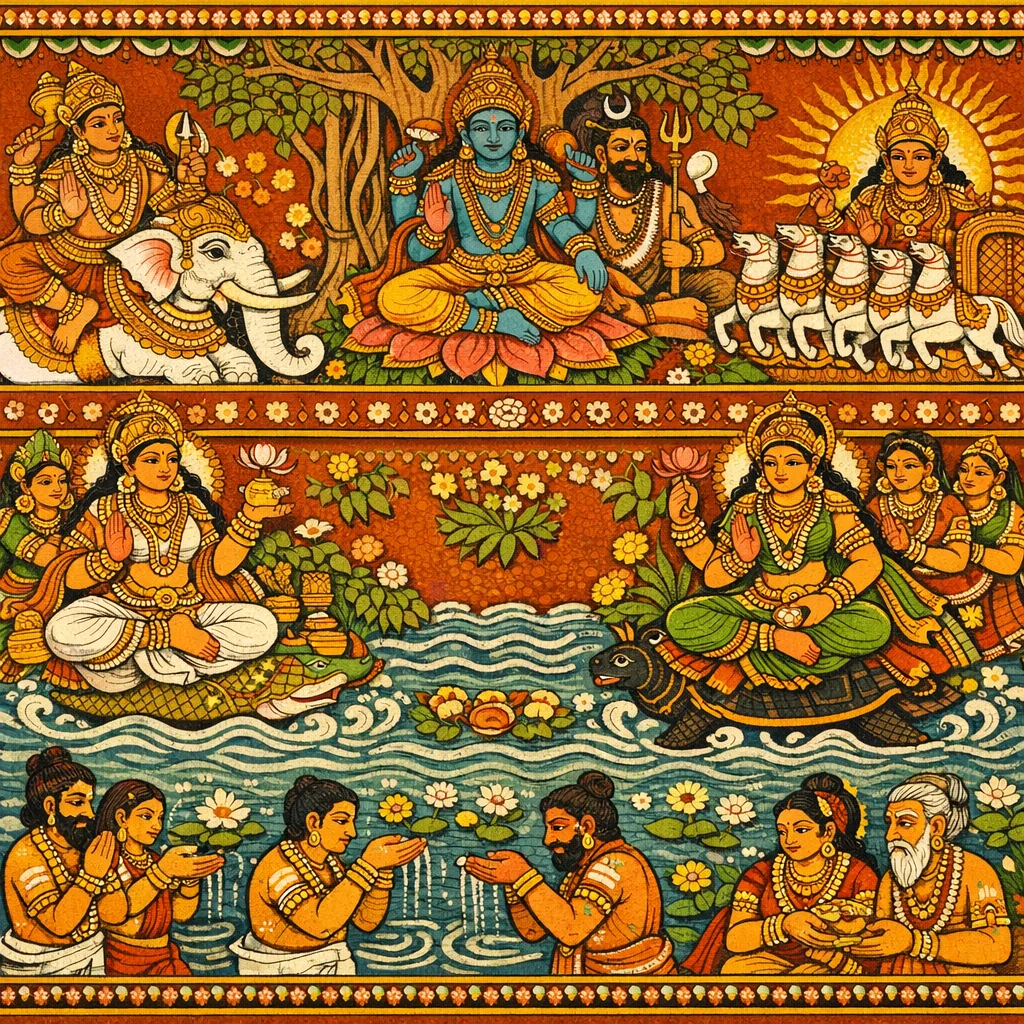
Adhyaya 104: The Glory of Prayaga: Pilgrimage, Bathing, and Liberation at the Triveni Region
प्रयागमाहात्म्य (प्रयागतीर्थप्रशंसा)
Speaker: Yudhiṣṭhira, Mārkaṇḍeya
Yudhiṣṭhira asks about Brahmā’s account from a former kalpa and then turns to Prayāga: how to undertake the pilgrimage, proper conduct, the after-death destiny of those who die there, the merit of bathing, and the reward for residents. Mārkaṇḍeya replies by citing an ancient teaching heard for the welfare of brāhmaṇas, identifying Prayāga as Prajāpati’s sacred region linked with Pratiṣṭhāna and other landmarks, and declaring that bathing there grants heaven and freedom from rebirth. He describes its extraordinary divine protection—Gaṅgā guarded by celestial archers, Yamunā by the Sun, Prayāga by Indra, the maṇḍala by Viṣṇu, and the banyan by Śiva—and stresses that mere remembrance, sight, name-recitation, or touching its earth destroys sin at once. The chapter ends with practices and fruits: bathing between Gaṅgā and Yamunā, living one month as a brahmacārin, and performing tarpana, bringing fulfillment of desires across births; it concludes that Prayāga is rare for humans yet draws even divine beings.
Key Concepts
Shlokas in Adhyaya 104
Verse 1
*युधिष्ठिर उवाच भगवञ्छ्रोतुमिच्छामि पुरा कल्पे यथास्थितम् ब्रह्मणा देवमुख्येन यथावत्कथितं मुने //
Yudhiṣṭhira said: “O Blessed one, I wish to hear how things stood in the former aeon (kalpa)—exactly as it was rightly narrated by Brahmā, the foremost among the gods, O sage.”
Verse 2
कथं प्रयागगमनं नराणां तत्र कीदृशम् मृतानां का गतिस्तत्र स्नातानां तत्र किं फलम् //
“How should people undertake the journey to Prayāga, and what is its proper manner there? What destiny do the dead attain there, and what fruit is gained by those who bathe there?”
Verse 3
ये वसन्ति प्रयागे तु ब्रूहि तेषां च किं फलम् एतन्मे सर्वमाख्याहि परं कौतूहलं हि मे //
Tell me what reward is gained by those who dwell at Prayāga. Explain all this to me in full, for my curiosity is exceedingly great.
Verse 4
*मार्कण्डेय उवाच कथयिष्यामि ते वत्स यच्छ्रेष्ठं तत्र यत्फलम् पुरा हि सर्वविप्राणां कथ्यमानं मया श्रुतम् //
Mārkaṇḍeya said: “Dear child, I shall tell you what is the best among them and what fruit arises from it. For long ago I heard it being expounded for the benefit of all brāhmaṇas.”
Verse 5
आ प्रयागप्रतिष्ठानाद् आपुराद्वासुकेर्ह्रदात् कम्बलाश्वतरौ नागौ नागश्च बहुमूलकः एतत्प्रजापतेः क्षेत्रं त्रिषु लोकेषु विश्रुतम् //
From Prayāga and Pratiṣṭhāna, from Āpura, and from Vāsuki’s lake—there dwell the serpent-lords Kambala and Aśvatara, and also the Nāga named Bahumūlaka. This is Prajāpati’s sacred region, renowned throughout the three worlds.
Verse 6
तत्र स्नात्वा दिवं यान्ति ये मृतास्ते ऽपुनर्भवाः ततो ब्रह्मादयो देवा रक्षां कुर्वन्ति संगताः //
Having bathed there, even those who die thereafter go to heaven and do not return to rebirth. Therefore Brahmā and the other gods, assembled together, provide protection (to that sacred place and its devotees).
Verse 7
अन्ये च बहवस्तीर्थाः सर्वपापहराः शुभाः न शक्याः कथितुं राजन् बहुवर्षशतैरपि संक्षेपेण प्रवक्ष्यामि प्रयागस्य तु कीर्तनम् //
And there are many other sacred fords as well—auspicious places that remove all sins. O King, they cannot be fully described even in hundreds of years. Therefore, I shall declare in brief the praise (account) of Prayāga.
Verse 8
षष्टिर्धनुःसहस्राणि यानि रक्षन्ति जाह्नवीम् यमुनां रक्षति सदा सविता सप्तवाहनः //
Sixty thousand celestial archers guard the river Jāhnavī (Gaṅgā); and the Sun-god, the seven-horsed Savitṛ, ever protects the Yamunā.
Verse 9
प्रयागं तु विशेषेण सदा रक्षति वासवः मण्डलं रक्षति हरिर् दैवतैः सह संगतः //
Indra (Vāsava) continually protects Prayāga in a special way; and Hari (Viṣṇu), accompanied by the gods, safeguards the entire sacred circuit (maṇḍala) around it.
Verse 10
तं वटं रक्षति सदा शूलपाणिर्महेश्वरः स्थानं रक्षन्ति वै देवाः सर्वपापहरं शुभम् //
That banyan tree is ever protected by Maheśvara, the great Lord who bears the trident; and indeed the gods safeguard that holy place—auspicious and the remover of all sins.
Verse 11
अधर्मेणावृतो लोको नैव गच्छति तत्पदम् स्वल्पमल्पतरं पापं यदा ते स्यान्नराधिप प्रयागं स्मरमाणस्य सर्वमायाति संक्षयम् //
A world veiled by unrighteousness does not reach that supreme state. Yet, O king, when even a small—indeed, the slightest—sin arises in you, by merely remembering Prayāga it all comes to complete destruction.
Verse 12
दर्शनात्तस्य तीर्थस्य नामसंकीर्तनादपि मृत्तिकालम्भनाद्वापि नरः पापात्प्रमुच्यते //
By merely beholding that sacred ford (tīrtha), by chanting its name, or even by applying/using its holy earth (mṛttikā), a person is released from sin.
Verse 13
पञ्च कुण्डानि राजेन्द्र तेषां मध्ये तु जाह्नवी प्रयागस्य प्रवेशे तु पापं नश्यति तत्क्षणात् //
O best of kings, there are five sacred ponds (kuṇḍas); among them is the river Jāhnavī (Gaṅgā). Upon entering Prayāga, sin is destroyed at that very instant.
Verse 14
योजनानां सहस्रेषु गङ्गायाः स्मरणान्नरः अपि दुष्कृतकर्मा तु लभते परमां गतिम् //
Even from thousands of yojanas away, a man—though burdened with sinful deeds—attains the highest state merely by remembering the Gaṅgā.
Verse 15
कीर्तनान्मुच्यते पापाद् दृष्ट्वा भद्राणि पश्यति अवगाह्य च पीत्वा तु पुनात्यासप्तमं कुलम् //
By chanting its name and glories one is freed from sin; by beholding it one beholds auspiciousness. And by bathing in it and drinking its waters, one purifies one’s lineage up to the seventh generation.
Verse 16
सत्यवादी जितक्रोधो ह्य् अहिंसायां व्यवस्थितः धर्मानुसारी तत्त्वज्ञो गोब्राह्मणहिते रतः //
He speaks truth, has conquered anger, and is firmly established in ahiṃsā (non-violence). He follows dharma, knows the true principles, and remains devoted to the welfare of cows and Brahmins.
Verse 17
गङ्गायमुनयोर्मध्ये स्नातो मुच्येत किल्बिषात् मनसा चिन्तयन्कामान् अवाप्नोति सुपुष्कलान् //
One who bathes in the space between the Gaṅgā and the Yamunā is freed from sin; and by mentally contemplating one’s desired aims, one attains those wishes in abundant measure.
Verse 18
ततो गत्वा प्रयागं तु सर्वदेवाभिरक्षितम् ब्रह्मचारी वसेन्मासं पितॄन्देवांश्च तर्पयेत् ईप्सितांल्लभते कामान् यत्र यत्राभिजायते //
Then, having gone to Prayāga—protected by all the gods—one should live there for a month as a brahmacārin (celibate student) and offer tarpana, libations of water, to the ancestors and the gods. Wherever such a person is reborn, he attains the desired enjoyments and fulfillments.
Verse 19
तपनस्य सुता देवी त्रिषु लोकेषु विश्रुता समागता महाभागा यमुना तत्र निम्नगा तत्र संनिहितो नित्यं साक्षाद्देवो महेश्वरः //
There, the goddess Yamunā—daughter of Tapana (the Sun), renowned in the three worlds—has arrived as the auspicious river-stream. And there, eternally present, is Mahēśvara himself, the manifest Lord.
Verse 20
दुष्प्राप्यं मानुषैः पुण्यं प्रयागं तु युधिष्ठिर देवदानवगन्धर्वा ऋषयः सिद्धचारणाः तदुपस्पृश्य राजेन्द्र स्वर्गलोकमुपासते //
O Yudhiṣṭhira, sacred Prayāga is difficult for human beings to attain. Gods, Dānavas, Gandharvas, Ṛṣis, Siddhas, and Cāraṇas—having bathed there, O king—abide in the heavenly world.
Frequently Asked Questions
The chapter teaches Prayāga’s exceptional tīrtha-power: sin is destroyed through remembrance, darśana, name-recitation, contact with its earth, and especially bathing at the Gaṅgā–Yamunā confluence; it further recommends month-long brahmacarya residence with tarpana to ancestors and gods as a disciplined way to obtain lasting merit, desired fulfillments, and even non-return from rebirth when death follows such sanctification.
This adhyāya centers on Dharma in the form of tīrtha-yātrā and ritual conduct (snāna, tarpana, brahmacarya), sacred geography (Prayāga-kṣetra, maṇḍala, associated landmarks), and soteriology (heaven, apunarbhava). It does not teach Vāstu measurements or genealogical lists in the provided verses.