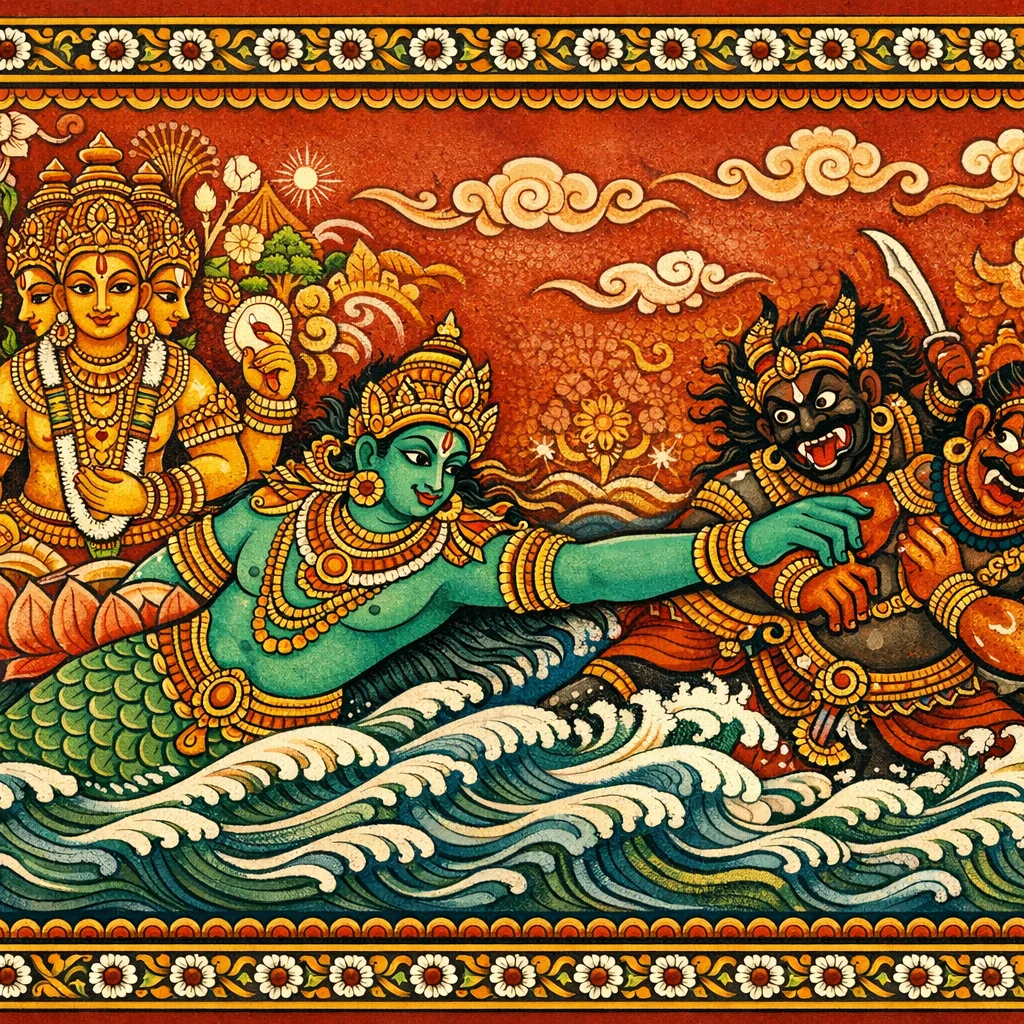
Adhyaya 170: The Episode of Madhu and Kaiṭabha: Gunas, Delusion, and the Lord’s Boon
मधुकैटभोपाख्यानम्
Speaker: Lord Matsya, Brahmā (Viśvatomukha/Padmaja), Madhu and Kaiṭabha, The Blessed Lord (Nārāyaṇa/Padmanābha/Hṛṣīkeśa)
Adhyaya 170 narrates the rise and defeat of the asuras Madhu and Kaiṭabha, born from an obstruction arising in tapas and characterized as embodiments of rajas and tamas. In the single cosmic ocean (ekārṇava) of dissolution, they agitate the universe and confront Brahmā (Viśvatomukha), who is engaged in creation under Nārāyaṇa’s command. Their challenge becomes a theological debate: the asuras proclaim themselves unsurpassed, identifying their power with artha and kāma and asserting that they delude beings age after age. Brahmā responds by grounding creation and liberation in yoga and sattva, affirming that the Supreme Lord is simultaneously the basis of sattva, rajas, and tamas and will end their dominance when they are “without a share.” Nārāyaṇa then draws them to Himself; they recognize Him as the cosmic source and request a paradoxical boon—death only in a place where none have died. The Lord grants it and slays them upon His thigh, illustrating divine sovereignty, the limits of rajasic-tamasic power, and the puranic logic of māyā, boons, and cosmic order.
Key Concepts
Shlokas in Adhyaya 170
Verse 1
*मत्स्य उवाच विघ्नस्तपसि सम्भूतो मधुर्नाम महासुरः तेनैव च सहोद्भूतो ह्य् असुरो नाम कैटभः //
Lord Matsya said: From an obstruction that arose during austerity (tapas) was born the great asura named Madhu; and along with him, from that very same source, there also arose the asura named Kaiṭabha.
Verse 2
तौ रजस्तमसौ विष्णोः सम्भूतौ तामसौ गणौ एकार्णवे जगत्सर्वं क्षोभयन्तौ महाबलौ //
Those two—Rajas and Tamas—born from Viṣṇu, a pair of dark (tāmasic) mighty beings, were powerfully agitating the entire universe within the single, all-engulfing ocean (of dissolution).
Verse 3
दिव्यरक्ताम्बरधरौ श्वेतदीप्तोग्रदंष्ट्रिणौ किरीटकुण्डलोदग्रौ केयूरवलयोज्ज्वलौ //
Both are clad in divine red garments; their formidable tusks gleam with a brilliant white radiance. They are splendid with tall crowns and prominent earrings, and they shine with armlets and bracelets.
Verse 4
महाविवृतताम्राक्षौ पीनोरस्कौ महाभुजौ महागिरेः संहननौ जङ्गमाविव पर्वतौ //
Their eyes are wide and reddish-brown; their chests are full and broad; their arms are mighty; their bodies are compact and powerfully built like a great mountain—like moving mountains themselves.
Verse 5
नवमेघप्रतीकाशाव् आदित्यसदृशाननौ विद्युदाभौ गदाग्राभ्यां कराभ्यामतिभीषणौ //
Two awe-inspiring beings appeared—dark-hued like fresh rainclouds, yet with faces radiant like the Sun; flashing like lightning, and exceedingly fearsome, their two hands grasping the ends of maces.
Verse 6
तौ पादयोस्तु विन्यासाद् उत्क्षिपन्ताविवार्णवम् कम्पयन्ताविव हरिं शयानं मधुसूदनम् //
By the mere setting down of those two feet, it was as though the ocean were being heaved up; and it was as though the reclining Hari—Madhusūdana—were being made to tremble.
Verse 7
तौ तत्र विचरन्तौ स्म पुष्करे विश्वतोमुखम् योगिनां श्रेष्ठमासाद्य दीप्तं ददृशतुस्तदा //
While the two of them were roaming there in Puṣkara, they then approached Viśvatomukha—the foremost among yogins—and beheld him, radiant with spiritual splendor.
Verse 8
नारायणसमाज्ञातं सृजन्तमखिलाः प्रजाः दैवतानि च विश्वानि मानसानसुरानृषीन् //
Commanded by Nārāyaṇa, he created all progeny—divine beings and the worlds, and also the mind-born ones, the Asuras, and the seer-sages.
Verse 9
ततस्तावूचतुस्तत्र ब्रह्माणमसुरोत्तमौ दीप्तौ मुमूर्षू संक्रुद्धौ रोषव्याकुलितेक्षणौ //
Then, there the two foremost Asuras addressed Brahmā—flaring with fury, ready to die, enraged, their eyes trembling with wrath.
Verse 10
कस्त्वं पुष्करमध्यस्थः सितोष्णीषश्चतुर्भुजः आधाय नियमं मोहाद् आस्ते त्वं विगतज्वरः //
Who are you, seated in the midst of Pushkara—wearing a white turban and having four arms—who, having undertaken a vow, remain here as if in delusion, yet free from fever and affliction?
Verse 11
एह्यागच्छावयोर् युद्धं देहि त्वं कमलोद्भव आवाभ्यां परमीशाभ्याम् अशक्तस्त्वमिहार्णवे //
“Come—approach and grant us battle, O Lotus-born (Brahmā)! For you are powerless here in this ocean before us two, the supreme lords.”
Verse 12
तत्र कश्चोद्भवस्तुभ्यं केन वासि न योजितः कः स्रष्टा कश्च ते गोप्ता केन नाम्ना विधीयसे //
“From what source have you arisen? By whom are you made to dwell (here), or not made to dwell? Who is your creator, and who is your protector? And by what name are you designated?”
Verse 13
*ब्रह्मोवाच एक इत्युच्यते लोकैर् अविचिन्त्यः सहस्रदृक् तत्संयोगेन भवतोः कर्म नामावगच्छताम् //
Brahmā said: He is called by people “the One”—the unthinkable, the thousand-eyed. By communion with Him, may you both come to understand action (karma) and its true designation (its real nature and name).
Verse 14
*मधुकैटभावूचतुः नावयोः परमं लोके किंचिदस्ति महामते आवाभ्यां छाद्यते विश्वं तमसा रजसाथ वै //
Madhu and Kaiṭabha said: “O great-minded one, there is nothing whatsoever in the worlds that is superior to us. By us the entire universe is covered—by darkness (tamas) and indeed by passion and turbulence (rajas).”
Verse 15
रजस्तमोमयावावाम् ऋषीणाम् अवलङ्घितौ छाद्यमानौ धर्मशीलौ दुस्तरौ सर्वदेहिनाम् //
Made of rajas and tamas, these two are not to be overstepped even by seers; they veil those devoted to dharma and are hard to cross for all embodied beings.
Verse 16
आवाभ्यामुह्यते लोको दुष्कराभ्यां युगे युगे आवामर्थश्च कामश्च यज्ञः स्वर्गपरिग्रहः //
Age after age, the world is led into delusion by us two, who are hard to master: we are Artha (worldly gain) and Kāma (desire). Through sacrifice (yajña), people seek to appropriate heaven as their prize.
Verse 17
सुखं यत्र मुदा युक्तं यत्र श्रीः कीर्तिरेव च येषां यत्काङ्क्षितं चैव तत्तदावां विचिन्तय //
Consider well—where happiness is joined with gladness, where prosperity and fame are found, and for whom the desired aim is actually fulfilled—reflect on that, for us both.
Verse 18
*ब्रह्मोवाच यत्नाद् योगवतो दृष्ट्या योगः पूर्वं मयार्जितः तं समाधाय गुणवत् सत्त्वं चास्मि समाश्रितः //
Brahmā said: By diligent effort, through the vision of a disciplined yogin, I formerly attained yoga. Establishing myself in that samādhi, I have taken refuge in sattva endowed with excellence (the elevating quality).
Verse 19
यः परो योगमतिमान् योगाख्यः सत्त्वमेव च रजसस्तमसश्चैव यः स्रष्टा विश्वसंभवः //
He who is Supreme—whose intelligence is Yoga itself, who is known as Yoga; who is also Sattva, and likewise Rajas and Tamas; and who, as the Creator, is the source from whom the universe arises.
Verse 20
ततो भूतानि जायन्ते सात्त्विकानीतराणि च स एव हि युवां नांशे वशी देवो हनिष्यति //
From that (source) beings are born—those of the sattva-type as well as the others. Indeed, that very Lord, the self-controlled God, will destroy you both when you are without a share (of His grace/power).
Verse 21
स्वपन्नेव ततः श्रीमान् बहुयोजनविस्तृतम् बाहुं नारायणो ब्रह्मा कृतवानात्ममायया //
Then, as if in a dream, the glorious Nārāyaṇa—Brahmā himself—by his own māyā, fashioned an arm extending across many yojanas.
Verse 22
कृष्यमाणौ ततस्तस्य बाहुना बाहुशालिनः चेरतुस्तौ विगलितौ शकुनाविव पीवरौ //
Then, being dragged by the arm of that strong-armed man, those two moved along, slipping and floundering—like two well-fed birds whose wings have come loose.
Verse 23
ततस्तावाहतुर्गत्वा तदा देवं सनातनम् पद्मनाभं हृषीकेशं प्रणिपत्य स्थितावुभौ //
Then the two of them went to the eternal God—Padmanābha, Hṛṣīkeśa—and, bowing down in reverence, both stood there (before Him).
Verse 24
जानीवस्त्वां विश्वयोनिं त्वामेकं पुरुषोत्तमम् त्वमावां पाहि हेत्वर्थम् इदं नौ बुद्धिकारणम् //
We know You as the womb-source of the universe—You alone are the Supreme Person. Protect us both for the sake of the cause (that must be fulfilled); this undertaking of ours is meant to be the occasion for right understanding.
Verse 25
अमोघदर्शनः स त्वं यतस्त्वां विद्वः शाश्वतम् ततस्त्वामागतावावाम् अभितः प्रसमीक्षितुम् //
Your vision is never in vain; for the wise know you to be eternal. Therefore we have come to you, from every side, to behold you clearly.
Verse 26
तदिच्छामो वरं देव त्वत्तो ऽद्भुतम् अरिंदम अमोघदर्शनो ऽसि त्वं नमस्ते समितिंजय //
Therefore, O God, we desire from You a wondrous boon, O crusher of foes. Your vision never fails; salutations to You, O conqueror of battles.
Verse 27
*श्रीभगवानुवाच किमर्थं हि द्रुतं ब्रूतं वरं ह्यसुरसत्तमौ दत्तायुष्कौ पुनर्भूयो रहो जीवितुम् इच्छथः //
The Blessed Lord said: “Why did you speak out that boon in such haste, O best of Asuras? Though life has been granted to you, you now wish once again to live on in secrecy.”
Verse 28
*मधुकैटभावूचतुः यस्मिन्न कश्चिन्मृतवान् देव तस्मिन्प्रभो वधम् तमिच्छावो वधश्चैव त्वत्तो नो ऽस्तु महाव्रत //
Madhu and Kaiṭabha said: “O God, in that place where no one has ever died—O Lord—there we desire our slaying. Let our death indeed come from you alone, O great-vowed One.”
Verse 29
*श्रीभगवानुवाच बाढं युवां तु प्रवरौ भविष्यत्कालसंभवे भविष्यतो न संदेहः सत्यमेतद्ब्रवीमि वाम् //
The Blessed Lord said: “Indeed. In the time that is yet to come, you two will arise as the foremost among beings. Of what is to be, there is no doubt—this I declare to you both as truth.”
Verse 30
वरं प्रदायाथ महासुराभ्यां सनातनो विश्ववरः सुरोत्तमः रजस्तमोवर्गभवायनौ यमौ ममन्थ तावूरुतलेन वै प्रभुः //
After granting a boon to those two great Asuras, the Eternal Lord—supreme in the universe and foremost among the gods—then crushed those twin beings, born of the classes of Rajas and Tamas, by striking them with the sole of his thigh.
Frequently Asked Questions
The chapter teaches that rajasic and tamasic powers—linked with artha (gain) and kāma (desire)—can dominate and delude the world, yet they remain subordinate to the Supreme Lord who is the source of all three guṇas. Brahmā’s stance models refuge in yoga and sattva as the stabilizing principle for creation and clarity. The Madhu–Kaiṭabha boon episode illustrates how divine māyā and ‘vara’ operate: even a seemingly invincible boon is fulfilled in a way that restores dharma and cosmic balance.
This adhyaya is primarily a creation/cosmogony and theology chapter: ekārṇava (pralaya-ocean imagery), Brahmā’s creation under Nārāyaṇa, and the guṇas (sattva-rajas-tamas) as cosmic principles. It also touches dharma indirectly by portraying how artha and kāma veil dharma-minded beings. Vastu-śāstra and architectural prescriptions are not discussed here, and genealogy appears only implicitly through the origin-story of the two asuras.