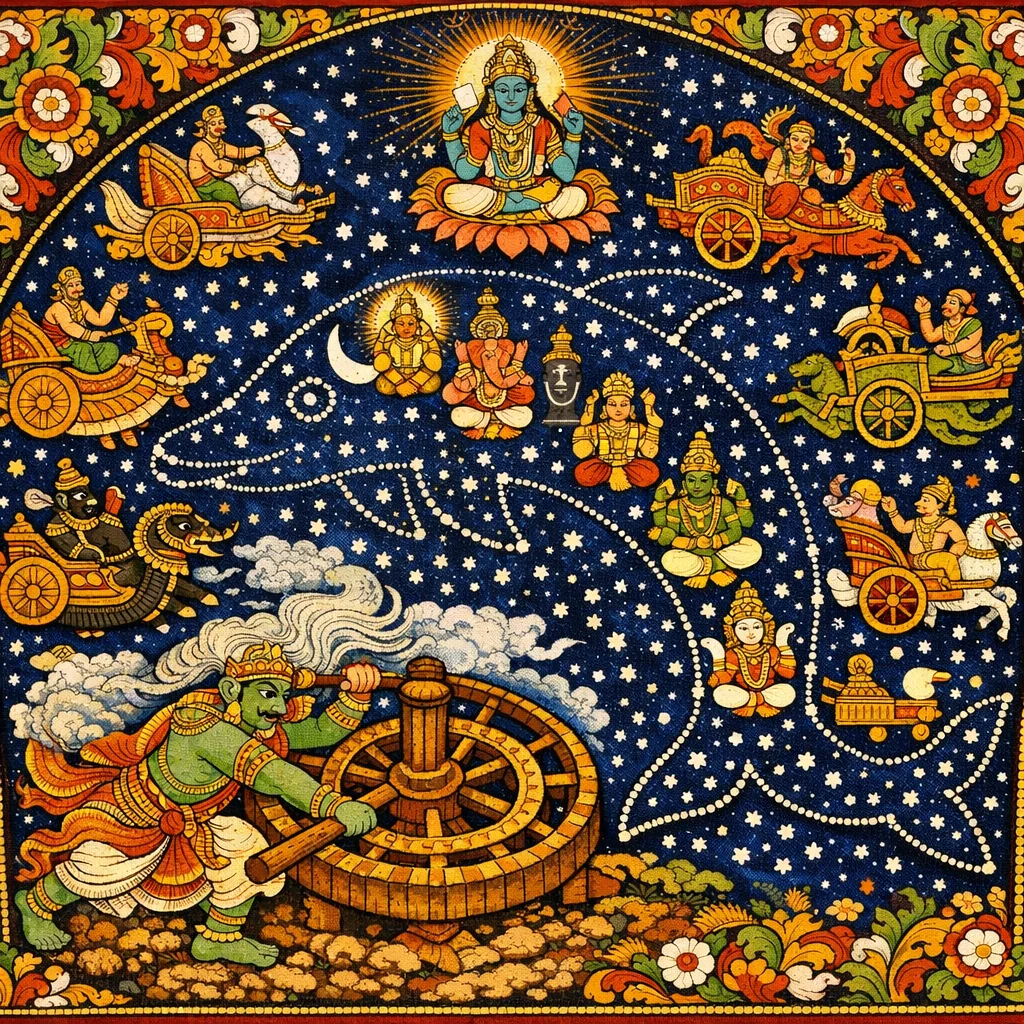
Adhyaya 127: Planetary Chariots, Dhruva-Bond (Pole-Star Axis), and the Śiśumāra Celestial Formation
ग्रह-रथ-वर्णनं ध्रुवबन्धः शिशुमारचक्रं च
Speaker: Suta
Sūta continues the cosmological teaching, first detailing the rathas (chariots) and steeds of the grahas (planets), then explaining the mechanism of their motion. The luminaries are bound to Dhruva (the Pole Star) by invisible cords of wind and are driven by Vāyu (the Pravaha force), producing a clockwise revolution around Dhruva and Mount Meru. He identifies the star-formed pattern as the Śiśumāra, praises the merit of beholding and knowing its arrangement, and concludes by assigning deities and principles to positions on the Śiśumāra’s body—a cosmogram anchored in Dhruva.
Key Concepts
Shlokas in Adhyaya 127
Verse 1
*सूत उवाच ताराग्रहाणां वक्ष्यामि स्वर्भानोस्तु रथं पुनः अथ तेजोमयः शुभ्रः सोमपुत्रस्य वै रथः //
Sūta said: “I shall describe the stars and planets, and again the chariot of Svarbhānu (Rāhu). Now, the chariot of Soma’s son is radiant—made of light—and brilliant white.”
Verse 2
युक्तो हयैः पिशङ्गस्तु दशभिर् वातरंहसैः श्वेतः पिशङ्गः सारङ्गो नीलः श्यामो विलोहितः //
He is yoked to ten wind-swift horses: one pale-tawny, one white, one tawny, one dappled, one blue, one dark, and one reddish-brown.
Verse 3
श्वेतश्च हरितश्चैव पृषतो वृष्णिरेव च दशभिस्तु महाभागैर् उत्तमैर्वातसम्भवैः //
Śveta and Harita, Pṛṣata and Vṛṣṇi as well—together with ten highly fortunate and excellent ones, born of Vāta (Vāyu).
Verse 4
ततो भौमरथश्चापि अष्टाङ्गः काञ्चनः स्मृतः अष्टभिर् लोहितैरश्वैः सध्वजैर् अग्निसम्भवैः सर्पते ऽसौ कुमारो वै ऋजुवक्रानुवक्रगः //
Next is also remembered the Bhauma chariot: a golden chariot furnished with eight parts. Drawn by eight red horses—born of fire and bearing banners—it speeds on; that youthful one moves along, going straight, curving, and then curving after the curve.
Verse 5
अतश्चाङ्गिरसो विद्वान् देवाचार्यो बृहस्पतिः गौराश्वेन तु रौक्मेण स्यन्दनेन विसर्पति //
Then the wise descendant of Aṅgiras—Bṛhaspati, the preceptor of the gods—moves onward in a golden chariot drawn by a pale (whitish) horse.
Verse 6
युक्तेनाष्टाभिरश्वैश्च ध्वजैरग्निसमुद्भवैः अब्दं वसति यो राशौ स्वदिशं तेन गच्छति //
When the “year” abides in a zodiacal sign, furnished with eight horses and banners born of fire, one should proceed in the direction naturally associated with that sign.
Verse 7
युक्तेनाष्टाभिर् अश्वैश्च सध्वजैरग्निसंनिभैः रथेन क्षिप्रवेगेण भार्गवस्तेन गच्छति //
Mounted on a swift-moving chariot, yoked with eight horses and bearing banners that shone like fire, Bhārgava (Paraśurāma) rides onward in it.
Verse 8
ततः शनैश्चरो ऽप्यश्वैः सबलैर् वातरंहसैः कार्ष्णायसं समारुह्य स्यन्दनं यात्यसौ शनिः //
Then Śanaiścara (Saturn) too proceeds, having mounted an iron chariot drawn by strong horses swift as the wind.
Verse 9
स्वर्भानोस्तु यथाष्टाश्वाः कृष्णा वै वातरंहसः रथं तमोमयं तस्य वहन्ति स्म सुदंशिताः //
For Svarbhānu (Rāhu), there are eight black horses, swift as the wind; well-harnessed, they draw his chariot, which is made of darkness.
Verse 10
आदित्यनिलयो राहुः सोमं गच्छति पर्वसु आदित्यमेति सोमाच्च तमसो ऽन्तेषु पर्वसु //
Rāhu, whose station is near the Sun, approaches the Moon at the junction-points (parvan) of time; and from the Moon he proceeds to the Sun—thus, at the endings of those darkening phases, he moves along the parvans.
Verse 11
ततः केतुमतस्त्वश्वा अष्टौ ते वातरंहसः पलालधूमवर्णाभाः क्षामदेहाः सुदारुणाः //
Then, from Ketumat there arose eight horses, swift as the wind—of the color of chaff-smoke, gaunt-bodied, and exceedingly dreadful.
Verse 12
एते वाहा ग्रहाणां वै मया प्रोक्ता रथैः सह सर्वे ध्रुवे निबद्धास्ते निबद्धा वातरश्मिभिः //
Thus have I described the steeds of the planets, together with their chariots. All of them are fastened to Dhruva (the Pole Star), being bound by cords made of the rays of wind.
Verse 13
एते वै भ्राम्यमाणास्ते यथायोगं वहन्ति वै वाय याभिरदृश्याभिः प्रबद्धा वातरश्मिभिः //
These beings, whirled about, are carried along according to their due condition; bound by invisible bonds—cords made of the wind—they are borne by the Wind.
Verse 14
परिभ्रमन्ति तद्बद्धाश् चन्द्रसूर्यग्रहा दिवि यावत्तमनुपर्येति ध्रुवं च ज्योतिषां गणः //
Bound to that (cosmic support), the Moon, the Sun, and the planets revolve in the sky, for as long as the host of luminaries continues to circle Dhruva (the Pole Star).
Verse 15
यथा नद्युदके नोस्तु उदकेन सहोह्यते तथा देवगृहाणि स्युर् उह्यन्ते वातरंहसा तस्माद्यानि प्रगृह्यन्ते व्योम्नि देवगृहा इति //
Just as a boat upon a river’s waters is carried along together with the water, so too temple-structures may be swept away by the force of the wind. Therefore, those divine houses which are firmly secured—(as if) held up in the sky—are called ‘deva-gṛhas’ (temples).
Verse 16
यावत्यश्चैव ताराः स्युस् तावन्तो ऽस्य मरीचयः सर्वा ध्रुवनिबद्धास्ता भ्रमन्त्यो भ्रामयन्ति च //
As many as the stars are, so many are his rays. All are fastened to Dhruva (the Pole Star); moving themselves, they also set others in motion.
Verse 17
तैलपीडं यथा चक्रं भ्रमते भ्रामयन्ति वै तथा भ्रमन्ति ज्योतींषि वातबद्धानि सर्वशः //
Just as the wheel of an oil-press turns when it is made to turn, so too the heavenly lights revolve everywhere, being constrained and driven by the power of the Wind (Vāyu).
Verse 18
अलातचक्रवद्यान्ति वातचक्रेरितानि तु यस्मात्प्रवहते तानि प्रवहस्तेन स स्मृतः //
As things set in motion by a wheel driven by the wind move like a whirling firebrand, and because from him those things are carried onward (flow forth), he is therefore remembered by the name Pravahastena (“the one whose hand causes the onward flow”).
Verse 19
एवं ध्रुवे नियुक्तो ऽसौ भ्रमते ज्योतिषां गणः एष तारामयः प्रोक्तः शिशुमारे ध्रुवो दिवि //
Thus, when he is stationed at Dhruva (the Pole Star), the host of luminaries revolves. This star-formed configuration is described as the Śiśumāra (celestial ‘porpoise’), with Dhruva fixed in the heavens.
Verse 20
यदह्ना कुरुते पापं तं दृष्ट्वा निशि मुञ्चति शिशुमारशरीरस्था यावत्यस्तारकास्तु ताः //
Whatever sin a person commits by day, upon beholding it at night he is released from that sin—so far as the stars that abide within the body of the Śiśumāra (the celestial ‘dolphin’ formation) bear witness to it.
Verse 21
वर्षाणि दृष्ट्वा जीवेत तावदेवाधिकानि तु शिशुमाराकृतिं ज्ञात्वा प्रविभागेन सर्वशः //
Having beheld the (appointed) years, one lives for just that many—and even more—when one understands, in every respect and by proper divisions, the Śiśumāra-shaped arrangement of the celestial sphere.
Verse 22
उत्तानपादस्तस्याथ विज्ञेयः सोत्तरो हनुः यज्ञो ऽधरस्तु विज्ञेयो धर्मो मूर्धानमाश्रितः //
Know that for him (the Vāstu-Puruṣa), Uttānapāda is the upper jaw; Yajña is to be understood as the lower jaw; and Dharma abides in, and is established upon, the head.
Verse 23
हृदि नारायणः साध्या अश्विनौ पूर्वपादयोः वरुणश्चार्यमा चैव पश्चिमे तस्य सक्थिनी //
Nārāyaṇa is to be placed in the heart; the Sādhyas, divine beings, are there as well. The Aśvins are assigned to the fore-feet, and Varuṇa together with Aryaman to the hind thighs of that form.
Verse 24
शिश्ने संवत्सरो ज्ञेयो मित्रश्चापानमाश्रितः पुच्छे ऽग्निश्च महेन्द्रश्च मरीचिः कश्यपो ध्रुवः //
In the generative organ is to be known Saṃvatsara, the Year. Mitra is stationed in the apāna region, the downward-moving vital current. In the tail are Agni and Mahendra; and there also are Marīci, Kaśyapa, and Dhruva.
Verse 25
एष तारामयः स्तम्भो नास्तमेति न वोदयम् नक्षत्रचन्द्रसूर्याश्च ग्रहास्तारागणैः सह //
This is the star-made cosmic pillar: it neither sets nor truly rises. Along with it are the constellations, the Moon and the Sun, and the planets together with the hosts of stars.
Verse 26
तन्मुखाभिमुखाः सर्वे चक्रभूता दिवि स्थिताः ध्रुवेणाधिष्ठिताश्चैव ध्रुवमेव प्रदक्षिणम् //
All of them, facing toward his presence, abide in the sky as circular formations; established and governed by Dhruva, they revolve in rightward (clockwise) pradakṣiṇa around Dhruva alone.
Verse 27
परियान्ति सुरश्रेष्ठं मेढीभूतं ध्रुवं दिवि आग्नीध्रकाश्यपानां तु तेषां स परमो ध्रुवः //
In heaven, the foremost of the gods move in their courses around Dhruva, who stands fixed like the pivot-post. For the lines of Agnīdhra and Kaśyapa, he is indeed the supreme Dhruva—the highest, unmoving pole.
Verse 28
एक एव भ्रमत्येष मेरोरन्तरमूर्धनि ज्योतिषां चक्रमादाय आकर्षंस्तमधोमुखः मेरुमालोकयन्नेव प्रतियाति प्रदक्षिणम् //
He alone revolves upon the inner summit of Mount Meru; bearing along the wheel of the heavenly lights, he draws it after him. Facing downward, and keeping Meru in view, he returns again, moving in a rightward (clockwise) circuit of pradakṣiṇa.
Frequently Asked Questions
It teaches a Purāṇic model of cosmic mechanics: the Sun, Moon, planets, and stars revolve in orderly, clockwise courses because they are bound to Dhruva (the Pole Star) by invisible cords made of wind-rays (vāta-raśmi), and are driven by Vāyu—called Pravahastena—who turns the celestial wheel.
The chapter is primarily Jyotiṣa/cosmology (graha chariots, Dhruva-axis, Meru-centric revolution) and includes a dharmic-ritual idea (purification by beholding the Śiśumāra at night). It is not a genealogy chapter, and Vāstu appears only as an analogy (deva-gṛha/temple structures being carried by wind) to explain cosmic motion and stability.
Rāhu (Svarbhānu), stationed near the Sun, is said to approach the Moon at parvan junctions and then move from the Moon toward the Sun, indicating eclipse activity tied to specific time-joints (parvan) and the transition points of lunar phases.
Śiśumāra is a star-formed celestial configuration with Dhruva fixed as its anchor. The text treats it as a sacred cosmogram: seeing it at night is said to remove sins committed by day, and understanding its divisions is linked with longevity and spiritual merit.
Read Matsya Purana in the Vedapath app
Scan the QR code to open this directly in the app, with audio, word-by-word meanings, and more.