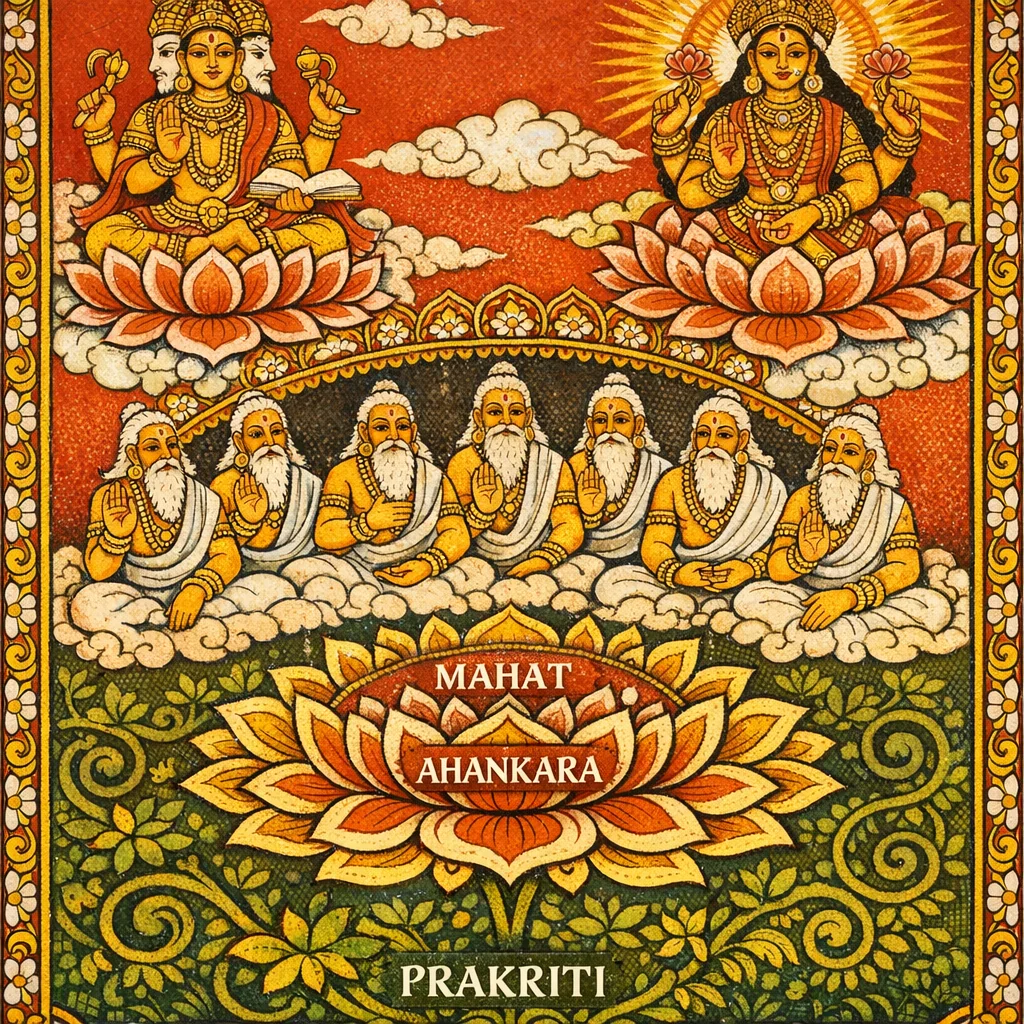
Adhyaya 3: Brahmā’s Four Faces, Mind-born Sages, and Sāṅkhya-Based Creation (Tattvas and Elements)
ब्रह्मसृष्टिवर्णनम् (चतुर्मुखब्रह्मोत्पत्तिः, सांख्यतत्त्वनिर्णयः)
Speaker: Manu, Lord Matsya
Manu asks why Brahmā became four-faced and how creation unfolded. Matsya replies by placing tapas and the manifestation of the Veda at the very beginning; he describes Brahmā’s first creations as mind-born sages, followed by bodily-born progenitors and inner powers. He then clarifies “buddhi” through the Sāṅkhya scheme of the three guṇas, Prakṛti/Pradhāna, Mahat, Ahaṅkāra, the indriyas, the tanmātras, and the pañcabhūtas. Finally he narrates Brahmā’s Sāvitrī-japa, the arising of Śatarūpā/Sāvitrī and the episode that brings forth additional faces, after which comes the command to create beings and the genealogy culminating in Svāyaṃbhuva Manu and later Manus.
Key Concepts
Shlokas in Adhyaya 3
Verse 1
*मनुर् उवाच चतुर्मुखत्वम् अगमत् कस्माल् लोकपितामहः कथं तु लोकान् असृजद् ब्रह्मा ब्रह्मविदां वरः //
Manu said: For what reason did the Grandfather of the worlds, Brahmā, attain four-facedness? And how did Brahmā—the foremost among the knowers of Brahman—create the worlds?
Verse 2
*मत्स्य उवाच तपश् चचार प्रथमम् अमराणां पितामहः आविभूतास् तथा वेदाः साङ्गोपाङ्गपदक्रमाः //
Lord Matsya said: In the beginning, the Grandfather of the immortals, Brahmā, first undertook tapas (austerity and spiritual discipline); then the Vedas manifested—together with their limbs and subsidiary disciplines, and with the ordered arrangement of words and recitation.
Verse 3
पुराणसर्वशास्त्राणां प्रथमं ब्रह्मणा स्मृतम् नित्यं शब्दमयं पुण्यं शतकोटिप्रविस्तरम् //
Among all Purāṇas and śāstras, this was remembered first by Brahmā—eternal, composed of sacred sound, meritorious, and vast in extent, spreading to a hundred koṭis (of verses).
Verse 4
अनन्तरं च वक्त्रेभ्यो वेदास् तस्य विनिःसृताः मीमांसान्यायविद्याश् च प्रमाणाष्टकसंयुताः //
Thereafter, from his mouths the Vedas issued forth; and likewise the disciplines of Mīmāṃsā and Nyāya arose, endowed with the eight pramāṇas—the eight means of valid knowledge.
Verse 5
वेदाभ्यासरतस्यास्य प्रजाकामस्य मानसाः मनसः पूर्वसृष्टा वै जाता यत् तेन मानसाः //
Because he was devoted to the practice of the Vedas and desired progeny, beings were first created from his mind; since they were born of the mind, they are therefore called “mānasas” (mind-born).
Verse 6
मरीचिर् अभवत् पूर्वं ततो ऽत्रिर् भगवान् ऋषिः अङ्गिरश् चाभवत् पश्चात् पुलस्त्यस् तदनन्तरम् //
Marīci came into being first; then the revered sage Atri; after that arose Aṅgiras, and thereafter Pulastya in due sequence.
Verse 7
ततः पुलहनामा वै ततः क्रतुर् अजायत प्रचेताश् च ततः पुत्रो वसिष्ठश् चाभवत् पुनः //
Then Pulaha (by name) came forth; then Kratu was born; and then Pracetas; and again thereafter Vasiṣṭha too came into being as a son.
Verse 8
पुत्रो भृगुर् अभूत् तद्वन् नारदो ऽप्य् अचिराद् अभूत् दशेमान् मानसान् ब्रह्मा मुनीन् पुत्रान् अजिजनत् //
Bhr̥gu became his son; likewise, Nārada too was born before long. Thus Brahmā generated these ten mind-born sons—sages, muni—as his progeny.
Verse 9
शारीरान् अथ वक्ष्यामि मातृहीनान् प्रजापतेः अङ्गुष्ठाद् दक्षिणाद् दक्षः प्रजापतिर् अजायत //
Now I shall describe the progenitors born from the body of Prajāpati, who were without a mother. From the right thumb, Dakṣa—the Prajāpati—was born.
Verse 10
धर्मः स्तनान्ताद् अभवद् धृदयात् कुसुमायुधः भ्रूमध्याद् अभवत् क्रोधो लोभश् चाधरसंभवः //
Dharma arose from the region of the breasts; Kāma, the Flower-armed one, arose from the heart. From the space between the eyebrows arose anger, and greed was born from the lower lip.
Verse 11
बुद्धेर् मोहः समभवद् अहंकाराद् अभून् मदः प्रमोदश् चाभवत् कण्ठान् मृत्युर् लोचनतो ण्र्प भरतः करमध्यात् तु ब्रह्मसूनुर् अभूत् ततः //
From the intellect (buddhi) arose delusion; from ego (ahaṃkāra) arose intoxication, and joy as well. From the throat came Death; from the eyes, O king, Bharata; and from the middle of the hand thereafter arose the son of Brahmā.
Verse 12
एते नव सुता राजन् कन्या च दशमी पुनः अङ्गजा इति विख्याता दशमी ब्रह्मणः सुता //
O King, these are the nine sons; and again, the tenth is a daughter—renowned by the name Aṅgajā—who is Brahmā’s tenth child.
Verse 13
*मनुर् उवाच बुद्धेर् मोहः समभवद् इति यत् परिकीर्तितम् अहंकारः स्मृतः क्रोधो बुद्धिर् नाम किम् उच्यते //
Manu said: “It has been proclaimed that delusion arises from buddhi; and that from it the sense of ‘I’ (ahaṃkāra) and anger (krodha) are produced. What, then, is meant by the term buddhi?”
Verse 14
*मत्स्य उवाच सत्त्वं रजस् तमश् चैव गुणत्रयम् उदाहृतम् साम्यावस्थितिर् एतेषां प्रकृतिः परिकीर्तिता //
Lord Matsya said: Sattva, rajas, and tamas are declared to be the three guṇas. The condition in which these abide in equilibrium is called Prakṛti, primordial Nature.
Verse 15
केचित् प्रधानम् इत्य् आहुर् अव्यक्तम् अपरे जगुः एतद् एव प्रजासृष्टिं करोति विकरोति च //
Some call it Pradhāna, the primordial principle; others declare it to be Avyakta, the Unmanifest. It alone brings forth the creation of beings, and it also transforms the created world.
Verse 16
गुणेभ्यः क्षोभमाणेभ्यस् त्रयो देवा विजज्ञिरे एका मूर्तिस् त्रयो भागा ब्रह्मविष्णुमहेश्वराः //
When the three guṇas were stirred into agitation, three deities came into manifestation. Though of one essential form, they appeared in three portions—Brahmā, Viṣṇu, and Maheśvara.
Verse 17
सविकारात् प्रधानात् तु महत् तत्त्वं प्रजायते महान् इति यतः ख्यातिर् लोकानां जायते सदा //
From Pradhāna, primordial Nature, when it becomes modified, the Mahat-tattva—the Great Principle, cosmic intelligence—is produced. It is called “Mahān” because from it the enduring notion and renown of greatness among beings continually arise.
Verse 18
अहंकारश् च महतो जायते मानवर्धनः इन्द्रियाणि ततः पञ्च वक्ष्ये बुद्धिवशानि तु प्रादुर् भवन्ति चान्यानि तथा कर्मवशानि तु //
O enhancer of mankind, from Mahat, the Great Principle, arises Ahaṅkāra, the sense of “I.” From that arise the five senses; I shall explain those governed by buddhi, the intellect. Other faculties also manifest, likewise those governed by karma, action.
Verse 19
श्रोत्रं त्वक् चक्षुषी जिह्वा नासिका च यथाक्रमम् पायूपस्थं हस्तपादं वाक्क चेन्द्रियसंग्रहः //
In due order are the ear, the skin, the two eyes, the tongue, and the nose; likewise the anus and the generative organ, the hands and the feet, and speech—this is the complete grouping of the faculties (indriyas).
Verse 20
शब्दः स्पर्शश् च रूपं च रसो गन्धश् च पञ्चमः उत्सर्गानन्दनादानगत्यालापाश् च तत्क्रियाः //
Sound, touch, form, taste, and—fifth—smell: these are the five sensory qualities; and their corresponding functions are excretion, delight (pleasure), utterance (voicing), movement, and speech.
Verse 21
मन एकादशं तेषां कर्मबुद्धिगुणान्वितम् इन्द्रियावयवाः सूक्ष्मास् तस्य मूर्तिं मनीषिणः //
Among them, the mind (manas) is the eleventh, endowed with activity, intelligence (buddhi), and the guṇas. The subtle sense-faculties and their parts are, the sages say, the very “form” (mūrti) of that subtle being.
Verse 22
श्रयन्ति यस्मात् तन्मात्राः शरीरं तेन संस्मृतम् शरीरयोगाज् जीवो ऽपि शरीरी गद्यते बुधैः //
Because the subtle elements (tanmātras) take refuge in it, it is remembered as the “body” (śarīra). And through association with the body, the living self (jīva) too is spoken of by the wise as “embodied” (śarīrī).
Verse 23
मनः सृष्टिं विकुरुते चोद्यमानं सिसृक्षया आकाशं शब्दतन्मात्राद् अभूच् छब्दगुणात्मकम् //
Urged by the will to create, the mind sets creation in motion; from the subtle essence of sound (śabda-tanmātra) arose ākāśa (ether), whose defining quality is sound.
Verse 24
आकाशविकृतेर् वायुः शब्दस्पर्शगुणो ऽभवत् वायोश् च स्पर्शतन्मात्रात् तेजश् चाविर् अभूत् ततः //
From the modification of ether (ākāśa) arose wind (vāyu), endowed with the qualities of sound and touch. And from wind—through the subtle essence (tanmātra) of touch—fire (tejas) then manifested.
Verse 25
त्रिगुणं तद्विकारेण तच्छब्दस्पर्शरूपवत् तेजोविकाराद् अभवद् वारि राजंश् चतुर्गुणम् //
From that fire, by its transformation, there arose water, O King—possessing four qualities: it bears sound, touch, and form, and in addition taste.
Verse 26
रसतन्मात्रसंभूतं प्रायो रसगुणात्मकम् भूमिस् तु गन्धतन्मात्राद् अभूत् पञ्चगुणान्विता //
From the subtle essence of taste (rasa-tanmātra) arises, for the most part, that element whose nature is taste; but Earth is born from the subtle essence of smell (gandha-tanmātra), endowed with all five qualities.
Verse 27
प्रायो गन्धगुणा सा तु बुद्धिर् एषा गरीयसी एभिः संपादितं भुङ्क्ते पुरुषः पञ्चविंशकः //
This buddhi (intellect) is predominantly characterized by the quality of smell, and it is indeed the superior principle. The twenty-fifth tattva, the Puruṣa, experiences (enjoys) what is produced by these principles.
Verse 28
ईश्वरेच्छावशः सो ऽपि जीवात्मा कथ्यते बुधैः एवं षड्विंशकं प्रोक्तं शरीरम् इह मानवे //
That inner principle too, being governed by the will of the Lord (Īśvara), is called the individual self (jīvātman) by the wise. Thus, O Manu, the body here has been declared to consist of twenty-six constituents.
Verse 29
सांख्यं संख्यात्मकत्वाच् च कपिलादिभिर् उच्यते एतत् तत्त्वात्मकं कृत्वा जगद् वेधा अजीजनत् //
It is called Sāṅkhya because it is constituted by the enumeration of the tattvas (fundamental principles), as taught by Kapila and others. Having made this teaching the very nature of the tattvas, the Creator (Vedhā) brought the world into being.
Verse 30
सावित्रीं लोकसृष्ट्यर्थे हृदि कृत्वा समास्थितः ततः संजपतस् तस्य भित्वा देहम् अकल्मषम् //
For the sake of creating the worlds, he enthroned Sāvitrī (the sacred Gāyatrī) within his heart and remained absorbed in it. As he recited it unceasingly, a stainless, sinless body manifested forth from him.
Verse 31
स्त्रीरूपम् अर्धम् अकरोद् अर्धं पुरुषरूपवत् शतरूपा च सा ख्याता सावित्री च निगद्यते //
He fashioned one half as a woman’s form and the other half as a man’s form. She became renowned as Śatarūpā, and she is also spoken of as Sāvitrī.
Verse 32
सरस्वत्य् अथ गायत्री ब्रह्माणी च परन्तप ततः स्वदेहसंभूताम् आत्मजाम् इत्य् अकल्पयत् //
Then he brought forth Sarasvatī, and also Gāyatrī and Brahmāṇī; O scorcher of foes. Thereafter he ordained her as his own daughter, born from his very body.
Verse 33
दृष्ट्वा तां व्यथितस् तावत् कामबाणार्दितो विभुः अहो रूपम् अहो रूपम् इति चाह प्रजापतिः //
Seeing her, the mighty lord at once became agitated, struck by the arrows of Kāma; and Prajāpati exclaimed, “Ah, what beauty! Ah, what beauty!”
Verse 34
ततो वासिष्ठप्रमुखा भगिनीम् इति चुक्रुशुः ब्रह्मा न किंचिद् ददृशे तन्मुखालोकनाद् ऋते //
Then the sages, led by Vasiṣṭha, cried out, “Sister!” Yet Brahmā perceived nothing—except the sight of her face.
Verse 35
अहो रूपम् अहो रूपम् इति प्राह पुनः पुनः ततः प्रणामनम्रां तां पुनर् एवाभ्यलोकयत् //
“Ah, what a form! Ah, what a form!” he exclaimed again and again; then he looked once more at her, bowed down in reverent salutation.
Verse 36
अथ प्रदक्षिणं चक्रे सा पितुर् वरवर्णिनी पुत्रेभ्यो लज्जितस्यास्य तद्रूपालोकनेच्छया //
Then that fair-complexioned lady circumambulated her father, for he—ashamed in the presence of his sons—still wished to behold her beauty (form).
Verse 37
आविर्भूतं तत्रो वक्त्रं दक्षिणं पाण्डुगण्डवत् विस्मयस्फुरदोष्ठं च पाश्चात्यम् उदगात् ततः //
There, a southern face manifested, its cheeks pale; and then, from the western side, another rose up, its lips quivering in astonishment.
Verse 38
चतुर्थम् अभवत् पश्चाद् वामं कामशरातुरम् ततो ऽन्यद् अभवत् तस्य कामातुरतया तथा //
After that, a fourth form arose—on the left—afflicted by the arrows of desire; then yet another came into being from it as well, in the same way, because it was tormented by passion.
Verse 39
उत्पतन्त्यास् तदाकारा आलोकनकुतूहलात् सृष्ट्यर्थं यत् कृतं तेन तपः परमदारुणम् //
As she was emerging and assuming that very form, out of curiosity to behold her own manifestation, he performed—toward the purpose of creation—an austerity exceedingly severe.
Verse 40
तत् सर्वं नाशम् अगमत् स्वसुतोपगमेच्छया तेनोर्ध्वं वक्त्रम् अभवत् पञ्चमं तस्य धीमतः आविर्भवज्जटाभिश् च तद् वक्त्रं चावृणोत् प्रभुः //
All of that came to ruin because of his desire to approach his own son. Then, above, a fifth face appeared upon that wise one; and the Lord, as matted locks suddenly manifested, covered that face.
Verse 41
ततस् तान् अब्रवीद् ब्रह्मा पुत्रान् आत्मसमुद्भवान् प्रजाः सृजध्वम् अभितः सदेवासुरमानुषीः //
Then Brahmā addressed those sons born from his own being: “Create living beings on all sides—together with the gods, the asuras, and humankind.”
Verse 42
एवम् उक्तास् ततः सर्वे ससृजुर् विविधाः प्रजाः गतेषु तेषु सृष्ट्यर्थं प्रणामावनताम् इमाम् //
Thus instructed, all of them then brought forth diverse kinds of creatures; and when they had departed for the purpose of creation, this one remained bowed down in reverent obeisance.
Verse 43
उपयेमे स विश्वात्मा शतरूपाम् अनिन्दिताम् संबभूव तया सार्धम् अतिकामातुरो विभुः सलज्जां चकमे देवः कमलोदरमन्दिरे //
That Universal Self took to wife the blameless Śatarūpā; and the mighty one, overcome with intense desire, united with her. The god delighted in her—she, modest and bashful—within the lotus-bellied, lotus-like abode.
Verse 44
यावद् अब्दशतं दिव्यं यथान्यः प्राकृतो जनः ततःकालेन महता तस्याः पुत्रो ऽभवन् मनुः //
For a hundred divine years she lived like any other ordinary person; then, after a long passage of time, her son was born—Manu.
Verse 45
स्वायंभुवो इति ख्यातः स विराड् इति नः श्रुतम् तद्रूपगुणसामान्याद् अधिपुरुष उच्यते //
He is renowned as Svāyaṃbhuva, and we have heard that he is also called Virāṭ. Because his form and qualities are universal and common to all, he is therefore spoken of as the Adhipuruṣa, the Supreme Over-Person.
Verse 46
वैराजा यत्र ते जाता बहवः शंसितव्रताः स्वायंभुवा महाभागाः सप्त सप्त तथापरे //
From Virāja arose many illustrious descendants—men of praised vows—among whom were the noble Svāyambhuvas: seven, and again another seven besides.
Verse 47
स्वारोचिषाद्याः सर्वे ते ब्रह्मतुल्यस्वरूपिणः औत्तमिप्रमुखास् तद्वद् येसां त्वं सप्तमो ऽधुना //
All those Manus beginning with Svārociṣa are of a form equal to Brahmā. Likewise are those beginning with Auttami; among them, you are now the seventh.
Frequently Asked Questions
It links creation to both revelation and metaphysics: Brahmā’s tapas precipitates the manifestation of the Vedas and śāstric disciplines, and creation proceeds through an enumerated Sāṅkhya sequence (Prakṛti/Pradhāna → Mahat → Ahaṅkāra → indriyas/mind → tanmātras → five elements). The chapter also teaches that cosmic origins and human genealogy (Svāyaṃbhuva Manu) are grounded in these principles, while the chaturmukha episode functions as a theological narrative explaining Brahmā’s multiple faces and the dynamics of desire, shame, and creative impetus.
This chapter is primarily Sṛṣṭi (creation philosophy) and Puranic genealogy. Dharma appears as a principle/personification arising from Brahmā, alongside Kāma, krodha, lobha, and moha—showing a dharma-psychology bridge. Genealogy is explicit in the list of ten mind-born sages and the birth of Svāyaṃbhuva Manu (Virāṭ/Adhipuruṣa) and the broader Manu succession. Vāstu/architecture is not a focus in Adhyāya 3; it serves instead as a cosmological foundation that later Vāstu and rājadharma sections can presuppose.