Adhyaya 152
Adhyāya 152: Kaurava-sainyavibhāgaḥ (Division and Standardization of the Kaurava Host)
Upa-parva: Sainyavinyāsa (Akṣauhiṇī-nirūpaṇa) Sub-episode
Vaiśaṃpāyana reports that, after night passes, Duryodhana divides the Kaurava forces into eleven formations and assigns graded strengths across human, elephant, chariot, and horse contingents. The chapter catalogues equipment and logistical supports—quivers, standards, banners, cords, snares, coverings, protective gear, and varied weapons—describing an army visually standardized and battle-ready. It then specifies chariot and elephant complements and attendant personnel, moving from descriptive inventory to formal enumeration of unit-scales: from smaller groupings (patti, senāmukha, gulma, gaṇa) up to the akṣauhiṇī, with synonymous terms (vāhinī, pṛtanā, senā, dhvajinī, sādinī, camū, varūthinī). The text states the comparative totals: the Pāṇḍavas possess seven akṣauhiṇīs, while the Kauravas possess eleven. Finally, Duryodhana appoints eminent warriors as commanders and reiterates daily signals and supervision, emphasizing discipline, hierarchy, and repeatable communication as the infrastructure of large-scale coordination.
Chapter Arc: Janamejaya presses Vaishampayana to narrate in full what transpired in the tumultuous Kuru assembly of forces at Kurukshetra—what Duryodhana did upon hearing that Yudhishthira’s side, guarded by great chariot-warriors, was advancing like Indra protected by the Adityas. → Reports arrive of the Pandava coalition—Virata and Drupada with their sons, and many kings (including Kekayas and Vrishnis) surrounding the sons of Pandu in hundreds—forming a formidable, radiant host. Duryodhana’s mind turns from counsel to logistics: speed, space, and security. → Duryodhana issues decisive commands: construct vast, well-spaced, defensible shibiras across Kurukshetra—camps difficult for enemies to seize—and proclaim without delay that the army must depart at dawn for war. The Kuru host swells like the ocean at moonrise, its ‘war-moon’ lifting the tide of battle-lust. → Kings and commanders, hearing the order, become energized and wrath-filled; they prepare immediately—adorned, anointed with sandal and aguru, their standards and retinues assembling—turning intention into marching readiness. → With camps laid out and departure fixed for the next morning, the narrative leans into the imminent collision of the two oceans of warriors at Kurukshetra.
Shlokas
Verse 1
/ अपन बक। है २ >> त्रिपठ्चाशदाधिकशततमोब< ध्याय: दुर्योधनका सेनाको सुसज्जित होने और शिविर-निर्माण करनेके लिये आज्ञा देना पा सैनिकोंकी रणयात्राके लिये या जनमेजय उवाच युधिष्ठटिरे सहानीकमुपायान्तं युयुत्सया । संनिविष्टं कुरुक्षेत्र वासुदेवेन पालितम्,जनमेजयने पूछा--मुने! दुर्योधनने जब यह सुना कि राजा युधिष्ठिर युद्धकी इच्छासे सेनाओंके साथ यात्रा करके भगवान् श्रीकृष्णके द्वारा सुरक्षित हो कुरुक्षेत्रमें पहुँच गये और वहाँ सेनाका पड़ाव डाले बैठे हैं, पुत्रोंसहित राजा विराट और ट्रुपद भी उनके साथ हैं, केकयराजकुमार, वृष्णिवंशी योद्धा तथा सैकड़ों भूपाल उन्हें घेरे रहते हैं तथा वे आदित्योंसहित घिरे हुए देवराज इन्द्रकी भाँति अनेक महारथी योद्धाओंद्वारा सुरक्षित हैं, तब उसने क्या किया?
Janamejaya said: “O sage, when King Yudhiṣṭhira—eager for battle—advanced with his full army and, protected by Vāsudeva (Kṛṣṇa), took up a fortified encampment on the field of Kurukṣetra, what did Duryodhana do upon hearing this?”
Verse 2
विराटद्रुपदाभ्यां च सपुत्राभ्यां समन्वितम् | केकयैरव॑ष्णिभिश्लैव पार्थिव: शतशो वृतम्,जनमेजयने पूछा--मुने! दुर्योधनने जब यह सुना कि राजा युधिष्ठिर युद्धकी इच्छासे सेनाओंके साथ यात्रा करके भगवान् श्रीकृष्णके द्वारा सुरक्षित हो कुरुक्षेत्रमें पहुँच गये और वहाँ सेनाका पड़ाव डाले बैठे हैं, पुत्रोंसहित राजा विराट और ट्रुपद भी उनके साथ हैं, केकयराजकुमार, वृष्णिवंशी योद्धा तथा सैकड़ों भूपाल उन्हें घेरे रहते हैं तथा वे आदित्योंसहित घिरे हुए देवराज इन्द्रकी भाँति अनेक महारथी योद्धाओंद्वारा सुरक्षित हैं, तब उसने क्या किया?
Janamejaya said: “(Yudhiṣṭhira’s host) was joined by Virāṭa and Drupada together with their sons, and was surrounded by the Kekayas and the Vṛṣṇis as well—encircled by hundreds of kings. Hearing that Yudhiṣṭhira, intent on war and protected by Śrī Kṛṣṇa, had reached Kurukṣetra and established his camp there—attended by Virāṭa and Drupada with their sons and guarded by many great chariot-warriors like Indra surrounded by the Ādityas—what did Duryodhana do then?”
Verse 3
महेन्द्रमिव चादित्यैरभिगुप्तं महारथै: । श्र॒ुत्वा दुर्योधनो राजा किं कार्य प्रत्यपद्यत,जनमेजयने पूछा--मुने! दुर्योधनने जब यह सुना कि राजा युधिष्ठिर युद्धकी इच्छासे सेनाओंके साथ यात्रा करके भगवान् श्रीकृष्णके द्वारा सुरक्षित हो कुरुक्षेत्रमें पहुँच गये और वहाँ सेनाका पड़ाव डाले बैठे हैं, पुत्रोंसहित राजा विराट और ट्रुपद भी उनके साथ हैं, केकयराजकुमार, वृष्णिवंशी योद्धा तथा सैकड़ों भूपाल उन्हें घेरे रहते हैं तथा वे आदित्योंसहित घिरे हुए देवराज इन्द्रकी भाँति अनेक महारथी योद्धाओंद्वारा सुरक्षित हैं, तब उसने क्या किया?
Janamejaya asked: “O sage, when King Duryodhana heard that Yudhiṣṭhira—surrounded by many great chariot-warriors and guarded like Indra encircled by the Ādityas—had reached Kurukṣetra with his forces and established his camp, what course of action did he adopt?”
Verse 4
एतदिच्छाम्यहं श्रोतुं विस्तरेण महामते । सम्भ्रमे तुमुले तस्मिन् यदासीत् कुरुजाड़ले,महामते! कुरुक्षेत्रके उस भयंकर समारोहमें जो कुछ हुआ हो वह सब मैं विस्तारपूर्वक सुनना चाहता हूँ
Janamejaya said: “O wise one, I wish to hear this in full detail—what exactly took place in that tumultuous, terrifying commotion there in the Kuru wilderness (Kurukṣetra).”
Verse 5
व्यथयेयुरिमे देवान् सेन्द्रानपि समागमे । पाण्डवा वासुदेवश्च विराटद्रुपदौ तथा,तपोधन! पाण्डव, भगवान् श्रीकृष्ण, विराट, ट्रुपद, पांचालराजकुमार धूष्टद्युम्न, महारथी शिखण्डी तथा देवताओंके लिये भी दुर्जय महापराक्रमी युधामन्यु--ये सब तो संग्राममें एकत्र होनेपर इन्द्रसहित सम्पूर्ण देवताओंको भी पीड़ित कर सकते हैं; अतः वहाँ कौरवों तथा पाण्डवोंने जो-जो कर्म किया था वह सब विस्तारपूर्वक सुननेकी मेरी इच्छा है
Janamejaya said: “O ascetic rich in austerity, when gathered together for battle these—the Pāṇḍavas, Vāsudeva (Kṛṣṇa), and also Virāṭa and Drupada—could afflict even the gods with Indra at their head. Therefore I wish to hear, in full detail, all that the Kauravas and the Pāṇḍavas did there.”
Verse 6
धष्टद्युम्नश्व॒ पाज्चाल्य: शिखण्डी च महारथ: । युधामन्युश्न विक्रान्तो देवैरपि दुरासद:,तपोधन! पाण्डव, भगवान् श्रीकृष्ण, विराट, ट्रुपद, पांचालराजकुमार धूष्टद्युम्न, महारथी शिखण्डी तथा देवताओंके लिये भी दुर्जय महापराक्रमी युधामन्यु--ये सब तो संग्राममें एकत्र होनेपर इन्द्रसहित सम्पूर्ण देवताओंको भी पीड़ित कर सकते हैं; अतः वहाँ कौरवों तथा पाण्डवोंने जो-जो कर्म किया था वह सब विस्तारपूर्वक सुननेकी मेरी इच्छा है
Janamejaya said: “O ascetic of great austerity, Dhṛṣṭadyumna of the Pāñcālas, the great chariot-warrior Śikhaṇḍin, and the valiant Yudhāmanyu—hard to assail even for the gods—together with the Pāṇḍavas, the Blessed Śrī Kṛṣṇa, Virāṭa, Drupada, and the Pāñcāla prince Dhṛṣṭadyumna: if all these gather in battle, they could trouble even the entire host of gods led by Indra. Therefore I wish to hear, in full detail, everything that the Kauravas and the Pāṇḍavas did there.”
Verse 7
एतदिच्छाम्यहं श्रोतुं विस्तरेण तपोधन । कुरूणां पाण्डवानां च यद् यदासीद् विचेष्टितम्,तपोधन! पाण्डव, भगवान् श्रीकृष्ण, विराट, ट्रुपद, पांचालराजकुमार धूष्टद्युम्न, महारथी शिखण्डी तथा देवताओंके लिये भी दुर्जय महापराक्रमी युधामन्यु--ये सब तो संग्राममें एकत्र होनेपर इन्द्रसहित सम्पूर्ण देवताओंको भी पीड़ित कर सकते हैं; अतः वहाँ कौरवों तथा पाण्डवोंने जो-जो कर्म किया था वह सब विस्तारपूर्वक सुननेकी मेरी इच्छा है
Janamejaya said: “O ascetic rich in austerity, I wish to hear in detail all that was done—every act and maneuver—by the Kurus and the Pandavas.”
Verse 8
वैशम्पायन उवाच प्रतियाते तु दाशाहें राजा दुर्योधनस्तदा । कर्ण दुःशासनं चैव शकुनिं चाब्रवीदिदम्,वैशम्पायनजी कहते हैं--राजन्! भगवान् श्रीकृष्णके चले जानेपर उस समय राजा दुर्योधनने कर्ण, दःशासन और शकुनिसे इस प्रकार कहा--
Vaiśampāyana said: When Dāśārha (Śrī Kṛṣṇa) had departed, King Duryodhana then addressed Karṇa, Duḥśāsana, and Śakuni in these words—setting in motion counsel that would harden their resolve and hasten the path toward war rather than reconciliation.
Verse 9
अकृतेनैव कार्येण गत: पार्थानधोक्षज: । स एनान्मन्युना5<विष्टो ध्रुवं धक्ष्यत्यसंशयम्,“श्रीकृष्ण यहाँसे कृतकार्य होकर नहीं गये हैं। इसके लिये वे क्रोधमें भरकर पाण्डवोंको निश्चय ही युद्धके लिये उत्तेजित करेंगे, इसमें तनिक भी संशय नहीं है
Vaiśampāyana said: “Adhokṣaja (Kṛṣṇa) has not departed from the Pārthas with his mission accomplished. Inflamed with anger, he will surely—without any doubt—set them ablaze, that is, rouse and drive them decisively toward war.”
Verse 10
इष्टो हि वासुदेवस्य पाण्डवैर्मम विग्रह: । भीमसेनार्जुनी चैव दाशार्हस्य मते स्थितौ,*वास्तवमें श्रीकृष्ण यही चाहते हैं कि पाण्डवोंके साथ मेरा युद्ध हो। भीमसेन और अर्जन--से दोनों भाई तो श्रीकृष्णके ही मतमें रहनेवाले हैं
Vaiśampāyana said: “Indeed, Vāsudeva (Kṛṣṇa) desires that I should come into conflict with the Pāṇḍavas. And Bhīmasena and Arjuna, those two brothers, stand firmly in the counsel and intention of the Dāśārha (Kṛṣṇa).”
Verse 11
अजातशशभ्रुरत्यर्थ भीमसेनवशानुग: । निकृतश्च मया पूर्व सह सर्व: सहोदरै:,“अजातशत्रु युधिष्ठिर भी अधिकतर भीमसेनके वशमें रहा करते हैं। इसके सिवा मैंने पहले सब भाइयोंसहित उनका तिरस्कार भी किया है
Vaiśampāyana said: “Ajātaśatru (Yudhiṣṭhira) was, to an exceptional degree, one who moved under Bhīmasena’s influence. Moreover, earlier I also treated him with contempt—along with all his brothers.”
Verse 12
विराटद्रुपदौ चैव कृतवैराी मया सह । तौ च सेनाप्रणेतारौ वासुदेववशानुगौ,“विराट और ट्रुपद तो मेरे साथ पहलेसे ही वैर रखते हैं। वे दोनों पाण्डव-सेनाके संचालक तथा श्रीकृष्णकी आज्ञाके अधीन रहनेवाले हैं
Vaiśampāyana said: “Virāṭa and Drupada are already sworn enemies in relation to me. Moreover, those two are commanders who direct the Pāṇḍavas’ forces, and they act in obedience to Vāsudeva’s will.”
Verse 13
भविता विग्रह: सो<यं तुमुलो लोमहर्षण: । तस्मात् सांग्रामिकं सर्व कारयध्वमतन्द्रिता:,“अत: अब हमलोगोंका पाण्डवोंके साथ होनेवाला यह युद्ध बड़ा ही भयंकर और रोमांचकारी होगा। इसलिये राजाओं! आप सब लोग आलस्य छोड़कर युद्धकी सारी तैयारी करें
Vaiśampāyana said: “This impending conflict will indeed be tumultuous and hair-raising. Therefore, without negligence, have every preparation for war carried out in full.”
Verse 14
शिबिराणि कुरुक्षेत्रे क्रियन्तां वसुधाधिपा: । सुपर्याप्तावकाशानि दुरादेयानि शत्रुभि:,'भूमिपालो! आप कुरक्षेत्रमें सैकड़ों और हजारोंकी संख्यामें ऐसे शिविर तैयार करावें, जिनमें अपनी आवश्यकताके अनुसार पर्याप्त अवकाश हों तथा शत्रुलोग जिनपर अधिकार न कर सकें। उनमें पास ही जल और काष्ठ आदि मिलनेकी सुविधाएँ हों। उनमें ऐसे मार्ग होने चाहिये जिनके द्वारा खाद्यसामग्री सुविधासे लायी जा सके और शत्रुलोग उसे नष्ट न कर सकें तथा उनके चारों तरफ किलेबन्दी कर देनी चाहिये
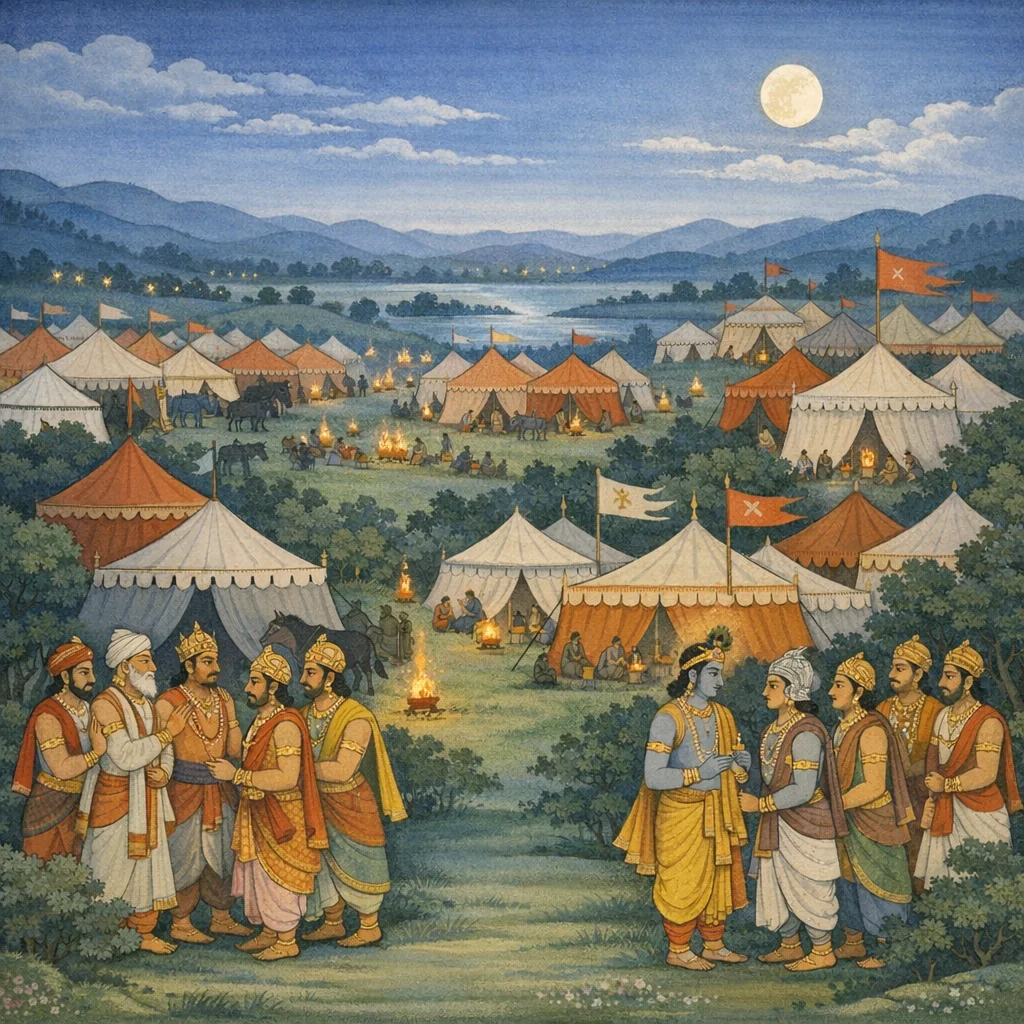
Vaiśampāyana said: “O lords of the earth, let encampments be established on Kurukṣetra—spacious enough for every need, and so well secured that the enemy cannot seize them. Let them be arranged with ready access to water and timber, with routes by which provisions can be brought in safely, and let them be fortified on all sides.”
Verse 15
आसन्नजलकाष्ठानि शतशो5थ सहस्रश: । अच्छेद्याहारमार्गाणि बन्धोच्छूयचितानि च,'भूमिपालो! आप कुरक्षेत्रमें सैकड़ों और हजारोंकी संख्यामें ऐसे शिविर तैयार करावें, जिनमें अपनी आवश्यकताके अनुसार पर्याप्त अवकाश हों तथा शत्रुलोग जिनपर अधिकार न कर सकें। उनमें पास ही जल और काष्ठ आदि मिलनेकी सुविधाएँ हों। उनमें ऐसे मार्ग होने चाहिये जिनके द्वारा खाद्यसामग्री सुविधासे लायी जा सके और शत्रुलोग उसे नष्ट न कर सकें तथा उनके चारों तरफ किलेबन्दी कर देनी चाहिये
Vaiśampāyana said: “O king, have hundreds and even thousands of encampments prepared on the field of Kurukṣetra—spacious according to need, supplied with nearby water and firewood, and arranged so that the enemy cannot seize them. Let their supply-routes for provisions be such that they cannot be cut off or destroyed by opponents, and let them be secured with proper fortifications.”
Verse 16
विविधायुधपूर्णानि पताकाध्वजवन्ति च । समाश्ष तेषां पन्थान: क्रियन्तां नगराद् बहि:,“उन शिविरोंको नाना प्रकारके अस्त्र-शस्त्रोंस भरपूर तथा ध्वजा-पताकाओंसे सुशोभित रखना चाहिये। शिविरोंका जो नगर बसाया जाय, उससे बाहर अनेक सीधे तथा समतल मार्ग उन शिविरोंमें जानेके लिये बनाये जायूँ
Vaishampayana said: “Let those encampments be kept well supplied with many kinds of weapons and arms, and adorned with banners and standards. And from outside the city, let many straight, level roads be made to reach those camps.”
Verse 17
प्रयाणं घुष्यतामद्य श्वोभूत इति मा चिरम् | ते तथेति प्रतिज्ञाय श्वोभूते चक्रिरे तथा
Vaiśaṃpāyana said: “Let the departure be proclaimed today—‘tomorrow at daybreak’—without delay.” They assented, saying “So be it,” and, having pledged thus, they made the arrangements accordingly for the next morning.
Verse 18
ततस्ते पार्थिवा: सर्वे तच्छुत्वा राजशासनम्,काज्चनाड्डददीप्तांश्व चन्दनागुरुभूषितान् । तदनन्तर वहाँ आये हुए सब नरेश राजा दुर्योधनकी यह आज्ञा सुनकर रोषावेशसे परिपूर्ण हो चन्दन और अगुरुसे चर्चित तथा सोनेके भुजबंदोंसे प्रकाशित अपनी परिघके समान मोटी भुजाओंका धीरे-धीरे स्पर्श करते हुए बहुमूल्य आसनोंसे उठकर खड़े हो गये
Vaiśampāyana said: Then all those kings, having heard King Duryodhana’s command, rose from their costly seats in a surge of anger. Their arms—thick like iron clubs, anointed with sandal and aloe-wood paste and gleaming with golden armlets—moved as they slowly touched and flexed them, signaling readiness to act under royal order and the mounting pressure toward conflict.
Verse 19
आसनेभ्यो महारहेंभ्य उदतिष्ठ न्नमर्षिता: | बाहून् परिघसंकाशान् संस्पृशन्त: शनै: शनै:
Vaiśampāyana said: Then, unable to restrain their indignation, they rose from their costly seats. Slowly, deliberately, they began to touch and feel their arms—like iron clubs—signaling a gathering resolve and the ominous readiness for force that follows when anger overrules restraint.
Verse 20
उष्णीषाणि नियच्छन्त: पुण्डरीकनिभै: करै: । अन्तरीयोत्तरीयाणि भूषणानि च सर्वश:,उन्होंने अपने कमलसदृश करोंसे मस्तकपर पगड़ी बाँध ली; फिर धोती, चादर और सब प्रकारके आभूषण धारण कर लिये
Vaiśampāyana said: With hands like white lotuses, they adjusted and fastened their turbans upon their heads; then they put on their lower and upper garments and adorned themselves in every way with ornaments—preparing their appearance with dignity and readiness for the solemn business ahead.
Verse 21
ते रथान् रथिन: श्रेष्ठा हयांश्ष हयकोविदा: । सज्जयन्ि सम नागांश्व॒ नागशिक्षास्वनुछिता:,श्रेष्ठ रथी अपने रथोंको, अश्वसंचालनकी कलामें कुशल योद्धा घोड़ोंको और हस्तिशिक्षामें निपुण सैनिक हाथियोंको सुसज्जित करने लगे
Vaiśampāyana said: The foremost chariot-warriors began readying their chariots; those skilled in horsemanship prepared the horses; and men trained in the discipline of elephant-handling equipped the elephants as well. The scene underscores organized martial duty—each group performing its appointed role with trained competence as the forces move toward the coming conflict.
Verse 22
अथ वर्माणि चित्राणि काज्चनानि बहूनि च । विविधानि च शस्त्राणि चक्कुः सर्वाणि सर्वश:,उन्होंने सोनेके बने हुए बहुत-से विचित्र कवच तथा सब प्रकारके विभिन्न अनेक अस्त्र- शस्त्र धारण कर लिये
Then they prepared and put on many splendid, gold-adorned coats of mail, and they also made ready weapons of every kind in full measure—an unmistakable sign that the assembly was turning from counsel toward the hard necessities of war, where outward readiness often replaces inward restraint.
Verse 23
पदातयश्च पुरुषा: शस्त्राणि विविधानि च | उपाजहु: शरीरेषु हेमचित्राण्यनेकश:,पैदल योद्धाओंने भी अपने अंगोंमें सुवर्णजटित कवच तथा भाँति-भाँतिके अनेक अस्त्र-शस्त्र धारण कर लिये
Vaiśampāyana said: The foot-soldiers too equipped themselves in many ways—taking up diverse weapons and adorning their bodies repeatedly with armor inlaid and ornamented with gold. The scene underscores the deliberate, organized preparation for war, where outward splendor and martial readiness signal the gravity of the coming conflict and the collective resolve of the troops.
Verse 24
तदुत्सव इवोदग्रं सम्प्रहृष्टनरावृतम् । नगर धार्तराष्ट्स्य भारतासीत् समाकुलम्,जनमेजय! दुर्योधनका वह हस्तिनापुर नगर मानो वहाँ कोई उत्सव हो रहा हो, इस प्रकार समृद्ध और हर्षोत्फुल्ल मनुष्योंसे भर गया था, इससे वहाँ बड़ी हलचल मच गयी थी
Vaiśampāyana said: O Janamejaya, the city of the Dhārtarāṣṭras (the Kauravas) became crowded and tumultuous—uplifted as if a festival were underway—filled with men who were delighted and excited. The public stir reflects how Duryodhana’s cause could quickly inflame collective emotion, turning political ambition into a celebratory frenzy that foreshadows the ethical blindness leading toward war.
Verse 25
जनौघसलिलावर्तो रथनागाश्चमीनवान् | शड्खदुन्दुभिनिर्धोष: कोशसंचयरत्नवान्,राजन! जैसे चन्द्रोदयकालमें समुद्र उत्ताल तरंगोंसे व्याप्त हो जाता है, उसी प्रकार कुरुराज दुर्योधनरूपी महासागर सैनिक-समुदायरूपी चन्द्रमाके उदयसे अत्यन्त उललसित दिखायी देने लगा। सब ओर घूमता हुआ जनसमुदाय ही वहाँ जलमें उठनेवाली भँवरोंके समान जान पड़ता था। रथ, हाथी और घोड़े उसमें मछलीके समान प्रतीत होते थे। शंख और दुन्दुभियोंकी ध्वनि ही उस कुरुराजरूपी समुद्रकी गर्जना थी। खजानोंका संग्रह ही रत्नराशिका प्रतिनिधित्व कर रहा था। योद्धाओंके विचित्र आभूषण और कवच ही उस समुद्रकी उठती हुई तरंगोंके समान जान पड़ते थे। चमकीले शस्त्र ही निर्मल फेन-से प्रतीत होते थे। महलोंकी पंक्तियाँ ही तटवर्ती पर्वत-सी जान पड़ती थीं। सड़कोंपर स्थित दूकानें ही मानो गुफाएँ थीं
Vaiśampāyana said: O King, that vast gathering of people looked like a churning whirlpool in a sea; the chariots, elephants, and horses seemed like fish moving within it. The blare of conches and the thunder of kettledrums became its roaring sound, and the amassed treasuries stood in for its heaps of jewels. In this way, the Kuru host—swelling with martial excitement—was pictured as an ocean surging with power and wealth, a spectacle that foreshadows the moral peril of pride and the coming war.
Verse 26
चित्राभरणवर्मोर्मि: शस्त्रनिर्मलफेनवान् । प्रासादमालाद्रविवृतो रथ्यापणमहाह्नद:,राजन! जैसे चन्द्रोदयकालमें समुद्र उत्ताल तरंगोंसे व्याप्त हो जाता है, उसी प्रकार कुरुराज दुर्योधनरूपी महासागर सैनिक-समुदायरूपी चन्द्रमाके उदयसे अत्यन्त उललसित दिखायी देने लगा। सब ओर घूमता हुआ जनसमुदाय ही वहाँ जलमें उठनेवाली भँवरोंके समान जान पड़ता था। रथ, हाथी और घोड़े उसमें मछलीके समान प्रतीत होते थे। शंख और दुन्दुभियोंकी ध्वनि ही उस कुरुराजरूपी समुद्रकी गर्जना थी। खजानोंका संग्रह ही रत्नराशिका प्रतिनिधित्व कर रहा था। योद्धाओंके विचित्र आभूषण और कवच ही उस समुद्रकी उठती हुई तरंगोंके समान जान पड़ते थे। चमकीले शस्त्र ही निर्मल फेन-से प्रतीत होते थे। महलोंकी पंक्तियाँ ही तटवर्ती पर्वत-सी जान पड़ती थीं। सड़कोंपर स्थित दूकानें ही मानो गुफाएँ थीं
Vaiśampāyana said: The city-scene around King Duryodhana appeared like a vast ocean at moonrise—exultant and swelling. The moving crowds seemed like whirlpools; chariots, elephants, and horses like fish within it. The blare of conches and the beat of kettledrums were its thunder. Hoarded treasures stood in for heaps of gems. Warriors’ varied ornaments and armor looked like rising waves, and the gleam of polished weapons like clear foam. Rows of palaces resembled mountains along the shore, and the shops lining the streets seemed like caves—an image of worldly splendor gathering force on the eve of war, dazzling yet ominous in its momentum.
Verse 27
योधचन्द्रोदयोद्धूत: कुरुराजमहार्णव: । व्यदृश्यत तदा राजंश्वन्द्रोदय इवोदधि:,राजन! जैसे चन्द्रोदयकालमें समुद्र उत्ताल तरंगोंसे व्याप्त हो जाता है, उसी प्रकार कुरुराज दुर्योधनरूपी महासागर सैनिक-समुदायरूपी चन्द्रमाके उदयसे अत्यन्त उललसित दिखायी देने लगा। सब ओर घूमता हुआ जनसमुदाय ही वहाँ जलमें उठनेवाली भँवरोंके समान जान पड़ता था। रथ, हाथी और घोड़े उसमें मछलीके समान प्रतीत होते थे। शंख और दुन्दुभियोंकी ध्वनि ही उस कुरुराजरूपी समुद्रकी गर्जना थी। खजानोंका संग्रह ही रत्नराशिका प्रतिनिधित्व कर रहा था। योद्धाओंके विचित्र आभूषण और कवच ही उस समुद्रकी उठती हुई तरंगोंके समान जान पड़ते थे। चमकीले शस्त्र ही निर्मल फेन-से प्रतीत होते थे। महलोंकी पंक्तियाँ ही तटवर्ती पर्वत-सी जान पड़ती थीं। सड़कोंपर स्थित दूकानें ही मानो गुफाएँ थीं
Vaiśampāyana said: Then, O King, the vast ocean that was the Kuru realm—like a mighty sea—appeared stirred and uplifted by the rise of the ‘moon’ of warriors; it shone forth like the ocean at moonrise. The image suggests a swelling, dazzling mobilization of power: the kingdom’s energy and pride surge as armed forces gather, even as such splendor foreshadows the moral peril of war driven by ambition.
Verse 152
इस प्रकार श्रीमहाभारत उद्योगपर्वके अन्तर्गत यैन्यनिर्याणपर्वमें शिविर आदिका निर्माणविषयक एक सौ बावनवाँ अध्याय पूरा हुआ
Thus ends the one hundred and fifty-second chapter of the Udyoga Parva of the Śrī Mahābhārata, within the section called the Yānyaniryāṇa Parva, dealing with the construction and arrangement of the military camp and related preparations. The narration marks the completion of this unit, underscoring the organized, deliberate steps by which the parties move toward the impending conflict.
Verse 153
इति श्रीमहाभारते उद्योगपर्वणि सैन्यनिर्याणपर्वणि दुर्योधनसैन्यसज्जकरणे त्रिपठड्चाशदधिकशततमो<ध्याय:
Thus ends, in the Śrī Mahābhārata, within the Udyoga Parva—specifically in the section on the army’s departure—the chapter describing Duryodhana’s preparations and mustering of his forces: the one hundred and fifty-third chapter. This colophon marks the formal close of the narrative unit, underscoring the irreversible movement toward war through deliberate mobilization and choice.
Verse 176
हृष्टरूपा महात्मानो निवासाय महीक्षिताम् । “आज ही यह घोषणा करा दी जाय कि कल खबेरे ही युद्धके लिये प्रस्थान करना है। इसमें विलम्ब नहीं होना चाहिये।' दुर्योधनका यह आदेश सुनकर “बहुत अच्छा--ऐसा ही होगा” यह प्रतिज्ञा करके महामना कर्ण आदिने अत्यन्त प्रसन्न होकर सबेरा होते ही राजाओंके निवासके लिये शिविर बनवाने आरम्भ कर दिये
Vaiśampāyana said: The great-hearted men, their spirits uplifted, set about arranging quarters for the kings. Duryodhana commanded that a proclamation be made at once: “Let it be announced today itself that tomorrow at daybreak we must march for war; there must be no delay.” Hearing this order, the high-minded Karṇa and the others, exceedingly pleased, vowed, “Very well—so it shall be,” and at dawn began having camps prepared for the kings’ lodging.
Verse 196
काज्चनाड्डददीप्तांश्व चन्दनागुरुभूषितान् । तदनन्तर वहाँ आये हुए सब नरेश राजा दुर्योधनकी यह आज्ञा सुनकर रोषावेशसे परिपूर्ण हो चन्दन और अगुरुसे चर्चित तथा सोनेके भुजबंदोंसे प्रकाशित अपनी परिघके समान मोटी भुजाओंका धीरे-धीरे स्पर्श करते हुए बहुमूल्य आसनोंसे उठकर खड़े हो गये
Vaiśampāyana said: Next, the kings who had arrived there heard King Duryodhana’s command and were filled with a surge of wrath. Anointed with sandal and agaru and gleaming with golden armlets, they slowly ran their hands over their thick, club-like arms, rose from their costly seats, and stood—an outward display of readiness and aggression.
Frequently Asked Questions
The chapter highlights how political intent becomes institutional capacity: once resources, hierarchies, and signals are standardized, escalation gains inertia, raising the dharmic question of responsibility for outcomes produced by organized systems rather than isolated individuals.
Effective large-scale coordination depends on clear unit definitions, role specialization, visible standards (dhvaja/patākā), and repeatable communication protocols—presented as the practical grammar of collective action in rājanīti.
No explicit phalaśruti is stated in this passage; its meta-function is archival and technical—preserving terminology, counts, and command structure that contextualize later ethical debates about conduct during the conflict.