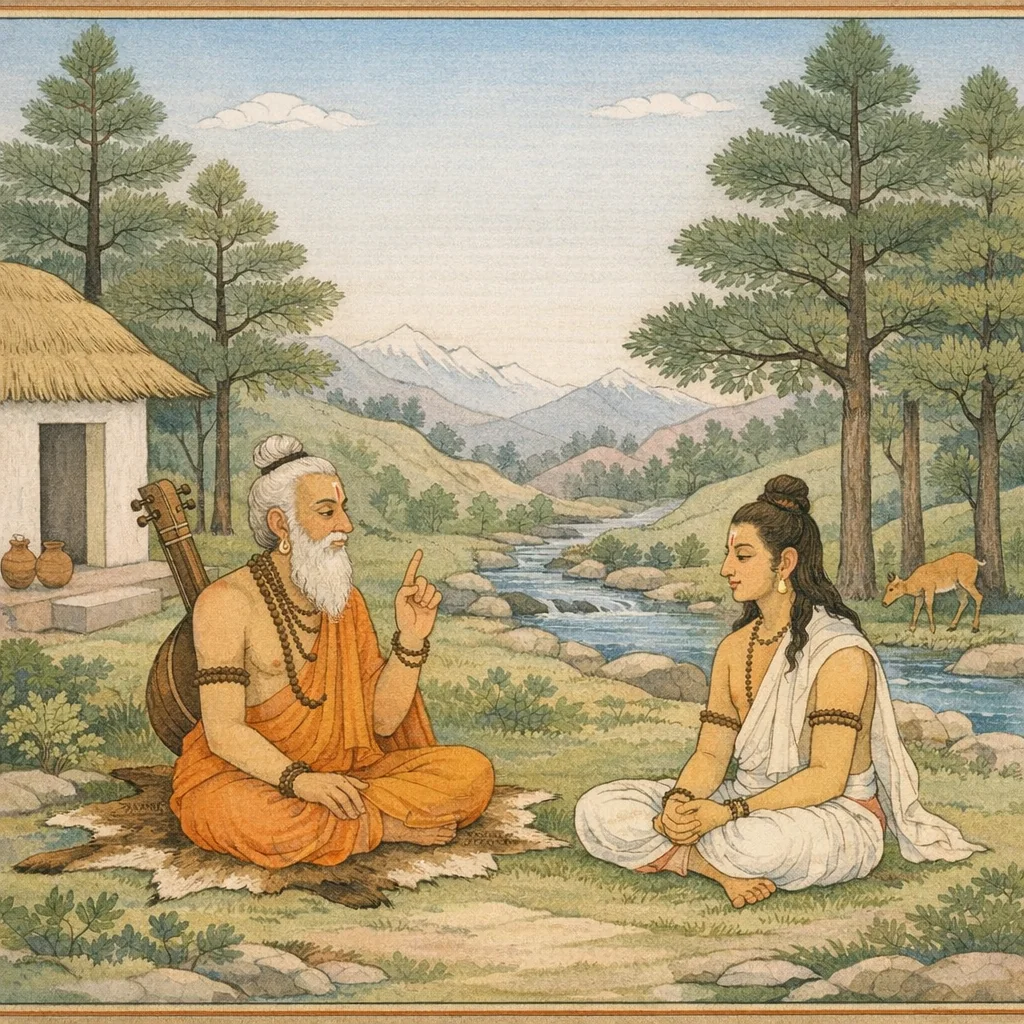
Adhyaya 331
अध्याय ३३१: नारायणकथा-प्रशंसा तथा नारदस्य श्वेतद्वीप-निवृत्ति एवं बदरी-आगमनम् | Chapter 331: Praise of the Nārāyaṇa Narrative; Nārada’s Return from Śvetadvīpa and Arrival at Badarī
Upa-parva: Nārāyaṇīya (Nārāyaṇa-kathā / Śvetadvīpa–Nara-Nārāyaṇa Episode)
Chapter 331 opens with Janamejaya commending the previously recited “great narrative,” describing it as a distilled essence drawn from the expansive Bhārata—likened to butter from curd, sandal from the Malaya region, and nectar from herbs—thereby asserting its canonical density and purificatory force. He elevates Nārāyaṇa-kathā as surpassing the fruit of traversing all āśramas and bathing in all tīrthas, framing it as a comprehensive means of moral purification. Janamejaya then connects Arjuna’s success to Vāsudeva’s companionship and praises those who directly beheld the Lord marked with Śrīvatsa; he singles out Nārada as especially fortunate for having seen Hari at Śvetadvīpa. Janamejaya asks why Nārada, after returning, hastened to Badarī-āśrama to see Nara and Nārāyaṇa and what was said there. Vaiśaṃpāyana begins his reply with an invocation to Vyāsa and narrates Nārada’s swift return via Meru and Gandhamādana to Badarī, where he encounters the two ancient ascetic sages with mahāpuruṣa marks, is welcomed with hospitality rites, and is addressed by Nārāyaṇa. Nārada reports his vision of the viśvarūpa Lord, describes Śvetadvīpa devotees and the Lord’s acceptance of single-minded offerings, and concludes by stating he was dispatched by the Paramātman and will remain devoted in their company.
Chapter Arc: नारद शुकदेव को ‘अशोक’—शोक-नाशक, शान्तिकर और शिव (कल्याणकारी) शास्त्रीय उपदेश का द्वार खोलते हैं, मानो मनुष्य के भीतर प्रतिदिन उठने वाले शोक-भय के ज्वार को शांत करने का अमोघ उपाय सुनाने जा रहे हों। → वे बताते हैं कि शोक के सहस्रों और भय के सैकड़ों कारण प्रतिदिन मूढ़ जन को घेरते हैं; भूतकाल में मरे हुए व्यक्ति या नष्ट वस्तु के लिए शोक करने वाला दुःख से दुःख ही पाता है—एक अनर्थ पर दूसरा अनर्थ चढ़ता जाता है। → उपदेश का शिखर यह निर्णायक सूत्र है: मानसिक दुःख को प्रज्ञा-विचार से काटो और शारीरिक कष्ट को औषध-सेवन से—यह ‘विज्ञान-सामर्थ्य’ बालबुद्धि से नहीं, शास्त्र-ज्ञान और विवेक से संभव है। → नारद संतोष और संयम का मार्ग रखते हैं: धन-स्थिति बढ़ती जाए तो भी अतृप्ति विनाश की ओर ले जाती है, जबकि पण्डित संतोष से स्थिर होते हैं; इन्द्रियों की रक्षा धैर्य, नेत्र, मन और सद्विद्या के अनुशासन से हो; जो अध्यात्म-रत, निरपेक्ष, निरामिष होकर आत्मा को ही सहायक बनाकर चलता है, वही सुखी होता है।
Shlokas
Verse 1
#ब>८5 >> हु #* +/<<< त्रिशर्दाधिकत्रिशततमो< ध्याय: शुकदेवको नारदजीका सदाचार और अध्यात्मविषयक उपदेश नारद उवाच अशोकं शोकनाशार्थ शास्त्र शान्तिकरं शिवम् | निशम्य लभते बुद्धि तां लब्ध्वा सुखमेधते,नारदजी कहते हैं--शुकदेव! शास्त्र शोकको दूर करनेवाला, शान्तिकारक और कल्याणमय है। जो अपने शोकका नाश करनेके लिये शास्त्रका श्रवण करता है, वह उत्तम बुद्धि पाकर सुखी हो जाता है
Narada said: “O Śukadeva, sacred teaching (śāstra) is free from sorrow, and it is heard for the very purpose of destroying sorrow; it brings peace and is auspicious. One who listens to śāstra in order to end grief gains true understanding, and having gained that understanding, he flourishes in happiness.”
Verse 2
शोकस्थानसहस्राणि भयस्थानशतानि च । दिवसे दिवसे मूढमाविशन्ति न पण्डितम्,शोकके सहस्रों और भयके सैकड़ों स्थान हैं, जो प्रतिदिन मूढ़ पुरुषोंपर ही अपना प्रभाव डालते हैं, विद्वानूपर नहीं
Nārada said: “There are thousands of occasions for grief and hundreds of occasions for fear. Day after day they seize the deluded person, but they do not overpower the wise.”
Verse 3
तस्मादनिष्टनाशार्थमितिहासं निबोध मे | तिष्ठते चेद् वशे बुद्धिर्लभते शोकनाशनम्,इसलिये अपने अनिष्टका नाश करनेके लिये मेरा यह उपदेश सुनो--यदि बुद्धि अपने वशमें रहे तो सदाके लिये शोकका नाश हो जाता है
Therefore, in order to destroy what is undesirable, listen to this instruction of mine in the form of an ancient account. If one’s intellect remains under one’s own control, one attains the destruction of sorrow—once and for all.
Verse 4
अनिष्टसम्प्रयोगाच्च विप्रयोगात् प्रियस्प च । मनुष्या मानसैर्दु:खैर्युज्यन्ते स्वल्पबुद्धय:,मन्दबुद्धि मनुष्य ही अप्रिय वस्तुकी प्राप्ति और प्रिय वस्तुका वियोग होनेपर मन-ही- मन दुखी होते हैं
Nārada said: Through association with what is undesirable, and through separation from what is dear, people of little understanding become bound by mental sorrows. The teaching points to an ethical discipline of mind: suffering intensifies when one’s happiness depends on external contacts and losses, whereas steadiness comes from discernment and inner restraint.
Verse 5
द्रव्येषु समतीतेषु ये गुणास्तान् न चिन्तयेत् । न तानाद्रियमाणस्य स्नेहबन्ध: प्रमुच्यते,जो वस्तु भूतकालके गर्भमें छिप गयी (नष्ट हो गयी), उसके गुणोंका स्मरण नहीं करना चाहिये; क्योंकि जो आदरपूर्वक उसके गुणोंका चिन्तन करता है, उसका उसके प्रति आसक्तिका बन्धन नहीं छूटता है
Nārada said: When possessions have passed away, one should not dwell on their former qualities. For if a person keeps honoring and contemplating those qualities, the bond of attachment to them is not released.
Verse 6
दोषदर्शी भवेत् तत्र यत्र राग: प्रवर्तते । अनिष्टवर्धितं पश्येत् तथा क्षिप्रं विरज्यते,जहाँ चित्तकी आसक्ति बढ़ने लगे, वहीं दोषदृष्टि करनी चाहिये और उसे अनिष्टको बढ़ानेवाला समझना चाहिये। ऐसा करनेपर उससे शीघ्र ही वैराग्य हो जाता है
Narada said: Wherever attachment begins to arise, one should deliberately look for the fault there. One should regard that object of craving as something that increases what is undesirable. By cultivating this way of seeing, dispassion quickly arises and the mind loosens its grip on the attachment.
Verse 7
नार्थों न धर्मो न यशो यो5तीतमनुशोचति । अप्यभावेन युज्येत तच्चास्य न निवर्तते,जो बीती बातके लिये शोक करता है, उसे न तो अर्थकी प्राप्ति होती है न धर्मकी और न यशकी ही प्राप्ति होती है। वह उसके अभावका अनुभव करके केवल दु:ख ही उठाता है। उससे अभाव दूर नहीं होता
Nārada said: One who grieves over what has already passed gains neither wealth, nor dharma, nor good repute. Even if he is joined only to the experience of loss, he merely suffers; that absence does not, by such lamentation, come to an end.
Verse 8
गुणैर्भूतानि युज्यन्ते वियुज्यन्ते तथैव च । सर्वाणि नैतदेकस्य शोकस्थान हि विद्यते,सभी प्राणियोंको उत्तम पदार्थोंसे संयोग और वियोग प्राप्त होते रहते हैं। किसी एकपर ही यह शोकका अवसर आता हो, ऐसी बात नहीं है
Nārada said: All beings come into union with desirable qualities and possessions, and likewise they are separated from them. This is the common condition of all; sorrow is not a circumstance that befalls only one person. Therefore one should understand grief as universal and steady the mind with discernment rather than be overwhelmed by it.
Verse 9
मृतं वा यदि वा नष्ट यो5तीतमनुशोचति । दुःखेन लभते दुःखं द्वावनर्थो प्रपद्यते,जो मनुष्य भूतकालमें मरे हुए किसी व्यक्तिके लिये अथवा नष्ट हुई किसी वस्तुके लिये निरन्तर शोक करता है, वह एक दुःखसे दूसरे दुःखको प्राप्त होता है। इस प्रकार उसे दो अनर्थ भोगने पड़ते हैं
Nārada said: Whoever continually grieves over what is past—whether for one who has died or for something that has been lost—passes from one sorrow into another. Thus he suffers a double misfortune: the pain of the first loss and the self-made suffering of unending lamentation.
Verse 10
नाश्रु कुर्वन्ति ये बुद्धया दृष्टवा लोकेषु संततिम् सम्यक् प्रपश्यत: सर्वे नाश्रुकर्मोपपद्यते,जो मनुष्य संसारमें अपनी संतानकी मृत्यु हुई देखकर भी अश्रुपात नहीं करते, वे ही धीर हैं। सभी वस्तुओंपर समीचीन भावसे दृष्टिपात या विचार करनेपर किसीका भी आँसू बहाना युक्तिसंगत नहीं जान पड़ता है
Narada said: Those who, with clear understanding, do not shed tears even after witnessing in this world the death of their own offspring—only they are truly steadfast. For when one looks rightly and comprehensively at all things, weeping does not appear to be a fitting response.
Verse 11
दुःखोपघाते शारीरे मानसे चाप्युपस्थिते | यस्मिन् न शक्यते कर्तु यलस्तन्नानुचिन्तयेत्,यदि कोई शारीरिक या मानसिक दुःख उपस्थित हो जाय और उसे दूर करनेके लिये कोई यत्न किया जा सके अथवा किया हुआ यत्न काम न दे सके तो उसके लिये चिन्ता नहीं करनी चाहिये
Nārada said: When bodily or mental suffering has arisen, one should not brood over it. If it is something for which an effort can be made, then act; and if, even after effort, it cannot be remedied, then too one should not sink into anxious rumination.
Verse 12
भैषज्यमेतद् दुःखस्य यदेतन्नानुचिन्तयेत् । चिन्त्यमानं हि न व्येति भूयश्चापि प्रवर्धते,दुःख दूर करनेकी सबसे अच्छी दवा यही है कि उसका बार-बार चिन्तन न किया जाय। चिन्तन करनेसे वह घटता नहीं, बल्कि बढ़ता ही जाता है
Nārada said: “This is the remedy for sorrow: do not keep brooding over it again and again. For when sorrow is continually dwelt upon, it does not pass away; rather, it grows all the more.”
Verse 13
प्रज्ञया मानसं दु:खं हन्याच्छारीरमौषधै: । एतद् विज्ञानसामर्थ्य न बालै: समतामियात्
Nārada said: “With discernment one should strike down the sorrow that arises in the mind; with medicines one should cure the body’s afflictions. Such is the power of true understanding—children and the immature do not attain equality with it.”
Verse 14
इसलिये मानसिक दु:खको बुद्धिके द्वारा विचारसे और शारीरिक कष्टको औषध- सेवनद्वारा नष्ट करना चाहिये। शास्त्रज्ञानके प्रभावसे ही ऐसा होना सम्भव है। दुःख पड़नेपर बालकोंकी तरह रोना उचित नहीं है ।। अनित्यं यौवन रूप॑ं जीवितं द्रव्यसंचय: । आरोग्यं प्रियसंवासो गृध्येत् तत्र न पण्डित:,रूप, यौवन, जीवन, धन-संग्रह, आरोग्य तथा प्रियजनोंका सहवास--ये सब अनित्य हैं। विद्वान् पुरुषको इनमें आसक्त नहीं होना चाहिये
Nārada said: Youth and beauty are impermanent; so are life itself, the accumulation of wealth, health, and the company of those one loves. Therefore a wise person does not cling to these. When sorrow arises, one should dispel mental anguish through discerning reflection and bodily suffering through appropriate remedies; such steadiness is possible through the power of scriptural understanding. It is not fitting to weep like a child when misfortune comes.
Verse 15
न जानपदिकं दुःखमेक: शोचितुमहति । अशोचन् प्रतिकुर्वीत यदि पश्येदुपक्रमम्,सारे देशपर आये हुए संकटके लिये किसी एक व्यक्तिको शोक करना उचित नहीं है। यदि उस संकटको टालनेका कोई उपाय दिखलायी दे तो शोक छोड़कर उसे ही करना चाहिये
Nārada said: “When a calamity has befallen an entire region, it is not fitting that a single person should grieve as though it were his alone. If one can see a practical means to avert or counter it, then abandoning grief, one should act to remedy it.”
Verse 16
सुखाद् बहुतरं दुःखं जीविते नात्र संशय: । स्निग्धत्वं चेन्द्रियार्थेषु मोहान्मरणमप्रियम्,इसमें संदेह नहीं कि जीवनमें सुखकी अपेक्षा दुःख ही अधिक होता है। किंतु सभीको मोहवश विषयोंके प्रति अनुराग होता है और मृत्यु अप्रिय लगती है
Nārada said: In this life, there is no doubt that sorrow outweighs happiness. Yet, through delusion, beings grow attached to the objects of the senses, and therefore death appears unwelcome to them.
Verse 17
परित्यजति यो दु:खं सुखं वाप्युभयं नर: । अभ्येति ब्रह्म सो>त्यन्तं न तं शोचन्ति पण्डिता:,जो मनुष्य सुख और दु:ख दोनोंकी ही चिन्ता छोड़ देता है, वह अक्षय ब्रह्मको प्राप्त हो जाता है। विद्वान पुरुष उसके लिये शोक नहीं करते
Nārada said: The person who relinquishes anxious clinging to both sorrow and pleasure attains the imperishable Brahman completely. The wise do not grieve for such a one, for he has reached the highest good beyond the swing of worldly opposites.
Verse 18
त्यज्यन्ते दुःखमर्था हि पालने न च ते सुखा: । दुःखेन चाधिगम्यन्ते नाशमेषां न चिन्तयेत्,धन खर्च करते समय बड़ा दुःख होता है। उसकी रक्षामें भी सुख नहीं है और उसकी प्राप्ति भी बड़े कष्टसे होती है, अत: धनको प्रत्येक अवस्थामें दु:खदायक समझकर उसके नष्ट होनेपर चिन्ता नहीं करनी चाहिये
Nārada said: Wealth is relinquished only with pain; even in guarding it there is no real happiness. It is acquired through hardship as well. Therefore, knowing wealth to be a source of suffering in every condition, one should not grieve when it is lost.
Verse 19
अन्यामन्यां धनावस्थां प्राप्य वैशेषिकीं नसः । अतृप्ता यान्ति विध्वंसं संतोष यान्ति पण्डिता:,मनुष्य धनका संग्रह करते-करते पहलेकी अपेक्षा ऊँची धन-सम्पन्न स्थितिको प्राप्त होकर भी कभी तृप्त नहीं होते। वे और अधिककी आशा लिये हुए ही मर जाते है; किंतु विद्वान् पुरुष सदा संतुष्ट रहते हैं (वे धनकी तृष्णामें नहीं पड़ते
Nārada said: Even after attaining ever higher and more exceptional states of wealth, people remain unsatisfied; still craving more, they go to ruin. The wise, however, attain contentment—they do not fall into the thirst for riches.
Verse 20
सर्वे क्षयान्ता निचया: पतनान्ता: समुच्छुया: । संयोगा विप्रयोगान्ता मरणान्तं हि जीवितम्,संग्रहका अन्त है विनाश। ऊँचे चढ़नेका अन्त है नीचे गिरना। संयोगका अन्त है वियोग और जीवनका अन्त है मरण
Narada said: All accumulations end in depletion; all elevations end in a fall. Every meeting ends in separation, and life itself ends in death. Therefore, one should not cling to possessions, status, or relationships as though they were permanent, but cultivate steadiness and right conduct in the face of inevitable change.
Verse 21
अन्तो नास्ति पिपासायास्तुष्टिस्तु परमं सुखम् | तस्मात् संतोषमेवेह धनं पश्यन्ति पण्डित:,तृष्णाका कभी अन्त नहीं होता। संतोष ही परम सुख है, अत: पण्डितजन इस लोकमें संतोषको ही उत्तम धन समझते हैं
Nārada said: “There is no end to craving; contentment alone is the highest happiness. Therefore, the wise in this world regard contentment itself as the finest wealth.”
Verse 22
निमेषमात्रमपि हि वयो गच्छन्न तिष्ठति । स्वशरीरेष्वनित्येषु नित्यं किमनुचिन्तयेत्,आयु निरन्तर बीती जा रही है। वह पलभर भी ठहरती नहीं है। जब अपना शरीर ही अनित्य है, तब इस संसारकी किस वस्तुको नित्य समझा जाय
Nārada said: “Even for the span of a single blink, life does not stand still; it keeps moving on. When one’s own body is impermanent, what in this world should one keep contemplating as if it were eternal?”
Verse 23
भूतेषु भावं संचिन्त्य ये बुद्ध्वा मनस: परम् । न शोचन्ति गताध्वान: पश्यन्त: परमां गतिम्,जो मनुष्य सब प्राणियोंके भीतर मनसे परे परमात्माकी स्थिति जानकर उन्हींका चिन्तन करते हैं, वे संसार-यात्रा समाप्त होनेपर परमपदका साक्षात्कार करते हुए शोकके पार हो जाते हैं
Those who contemplate the presence within all beings, and, knowing the Supreme Self beyond the mind—the Paramātman—abide in that contemplation, do not grieve; when their journey through the world is complete, they behold the highest goal and pass beyond sorrow.
Verse 24
संचिन्वानकमेवैनं कामानामवितृप्तकम् । व्याप्र: पशुमिवासाद्य मृत्युरादाय गच्छति,जैसे जंगलमें नयी-नयी घासकी खोजमें विचरते हुए अतृप्त पशुको सहसा व्याघ्र आकर दबोच लेता है, उसी प्रकार भोगोंकी खोजमें लगे हुए अतृप्त मनुष्यको मृत्यु उठा ले जाती है
Nārada said: “Death carries off the man who keeps accumulating objects of desire yet remains unsated—just as a tiger suddenly seizes an animal wandering in the forest in search of ever-fresh grass.”
Verse 25
तथाप्युपायं सम्पश्येद् दुः:खस्य परिमोक्षणम् । अशोचन् नारभेच्चैव मुक्तश्नाव्यसनी भवेत्,तथापि सबको दुःखसे छूटनेका उपाय अवश्य सोचना चाहिये। जो शोक छोड़कर साधन आरम्भ करता है और किसी व्यसनमें आसक्त नहीं होता, वह निश्चय ही दु:खोंसे मुक्त हो जाता है
Even so, one should deliberately seek a means for release from sorrow. Casting off grief, one should set about right effort; and if one remains free from addictions and ruinous habits, one becomes truly liberated from suffering.
Verse 26
शब्दे स्पर्शे च रूपे च गन्धेषु च रसेषु च । नोपभोगात् परं किंचिद् धनिनो वाधनस्य च,धनी हो या निर्धन, सबको उपभोगकालनमें ही शब्द, स्पर्श, रूप, रस और उत्तम गन्ध आदि विषयोंमें किंचित् सुखकी प्रतीति होती है, उपभोगके पश्चात् नहीं
Nārada said: “In sound, touch, form, smell, and taste, there is no pleasure beyond the very act of enjoyment itself—whether for a wealthy person or for wealth as such. The sense of happiness arises only while the objects are being experienced; once the enjoyment has passed, it does not remain.”
Verse 27
प्राक्सम्प्रयोगाद् भूतानां नास्ति दुःखं परायणम् । विप्रयोगात् तु सर्वस्य न शोचेत् प्रकृतिस्थित:,प्राणियोंके एक-दूसरेसे संयोग होनेके पहले कोई दुःख नहीं रहता। जब संयोगके बाद वियोग होता है तभी सबको दुःख हुआ करता है। अतः अपने स्वरूपमें स्थित विवेकी पुरुषको किसीके वियोगमें कभी भी शोक नहीं करना चाहिये
Nārada said: Before beings ever come into association with one another, there is no sorrow that can take hold as one’s final resort. It is only after union—when separation occurs—that sorrow arises for all. Therefore, the discerning person who abides in one’s own true nature should not grieve over separation from anyone.
Verse 28
धृत्या शिक्षोदरं रक्षेत् पाणिपादं च चक्षुषा । चक्षु:श्रोत्रे च मनसा मनो वाचं च विद्यया
Nārada said: “By steadfastness one should restrain the belly and the impulses of appetite; by watchfulness one should guard the hands and feet from wrongful action. By the mind one should govern the eyes and ears, and by true knowledge one should discipline the mind and speech.”
Verse 29
मनुष्यको चाहिये कि वह धैर्यके द्वारा शिश्र और उदरकी, नेत्रके द्वारा हाथ और पैरकी, मनके द्वारा आँख और कानकी तथा सद्विद्याके द्वारा मन और वाणीकी रक्षा करे |। प्रणयं प्रतिसंहृत्य संस्तुतेष्वितरेषु च । विचरेदसमुन्नद्ध: स सुखी स च पण्डित:,जो पूजनीय तथा अन्य मनुष्योंमें आसक्तिको हटाकर विनीतभावसे विचरण करता है, वही सुखी और वही विद्वान है
Nārada teaches that a person should guard the senses and the inner life through disciplined self-control: by steadiness one restrains the impulses of the generative organ and the belly; by the eyes one keeps the hands and feet from straying; by the mind one governs the eyes and ears; and by true knowledge one protects the mind and speech. Having withdrawn personal attachment—both toward those who honor him and toward others—one should move about with humility, free from arrogance. Such a person alone is truly happy, and truly wise.
Verse 30
अध्यात्मरतिरासीनो निरपेक्षो निरामिष: । आत्मनैव सहायेन यश्चरेत् स सुखी भवेत्,जो अध्यात्मविद्यामें अनुरक्त, कामनाशून्य तथा भोगासक्तिसे दूर है, जो अकेला ही विचरण करता है, वह सुखी होता है
Nārada said: One who sits established in delight in the inner Self, free from dependence on external supports, and untouched by the lure of sense-pleasures—who moves about relying only on the Self as his companion—such a person becomes truly happy.
Verse 330
इति श्रीमहाभारते शान्तिपर्वणि मोक्षधर्मपर्वणि शुकाभिपतने त्रिंशदधिकत्रिशततमो<्ध्याय:
Thus, in the Śrī Mahābhārata, within the Śānti Parvan—specifically the Mokṣa-dharma section—ends the three-hundred-and-thirtieth chapter, concerning Śuka’s descent/approach. This concluding colophon marks the close of the chapter and situates the teaching within the discourse on liberation and right conduct.
Frequently Asked Questions
The chapter frames an interpretive dilemma rather than a tactical one: how to rank and justify spiritual means—pilgrimage and ritual breadth versus concentrated devotional hearing—by asserting Nārāyaṇa-kathā as the superior purificatory practice.
Single-minded devotion and disciplined receptivity to authoritative teaching are presented as high-yield ethical-spiritual practices; proximity to the divine is mediated through tapas, humility, and reliable transmission within rṣi lineages.
Yes. Janamejaya explicitly characterizes the Nārāyaṇa narrative as “sarva-pāpa-praṇāśinī” (destroyer of all sins) and more fruitful than comprehensive āśrama visitation and tīrtha bathing, functioning as an internal phalāśruti-style valuation of hearing the discourse.