Adhyaya 329
अग्नीषोमोत्पत्तिः (Agni–Soma Origin and the Brahmāgnīṣomīya Doctrine)
Upa-parva: Mokṣa-dharma (Liberation Discourse) — Brahmāgnīṣomīya / Agni–Soma Cosmogonic Episode (contextual unit)
Arjuna asks Kṛṣṇa how Agni and Soma, understood as dual principles, first proceeded from a single womb/source (ekayonī). Kṛṣṇa responds with a purāṇic cosmogony: after a vast yuga-cycle culmination, the universe is described in pralaya as an undifferentiated, lightless, water-encircled darkness where conventional binaries (day/night, sat/asat, vyakta/avyakta) are not established. From this condition, Hari/Nārāyaṇa is stated to manifest as the imperishable, all-pervading agent. With the arising of Brahmā (padmayoni), the creator, desiring progeny, generates Agni and Soma from his eyes. The discourse then proposes a functional-social mapping: Soma corresponds to brahma (and thus brāhmaṇas), while Agni corresponds to kṣatra; brahma is argued as stronger, supported by observable ritual practice (offerings made into blazing fire) and by Vedic mantra citation describing Agni as the hotṛ of all sacrifices. The chapter stresses that sacrifice requires mantra and qualified human agency, assigning officiation primarily to brāhmaṇas, and presents select verses (attributed to Sanatkumāra) extolling brāhmaṇa virtues and societal dependence on their learning, speech, and austerity. A long exempla sequence follows, recounting etiological episodes (curses, boons, and mythic consequences) involving Indra, Viśvarūpa/Triśiras, Dadhīci and the vajra, Nahūṣa, Soma’s yakṣma and the Prabhāsa tīrtha, and other figures, functioning as supporting precedent for the chapter’s theological-ritual claims. The conclusion frames this integrated structure as “brahmāgnīṣomīya,” asserting that the world is sustained through the coordinated operation of brahma, Agni, and Soma.
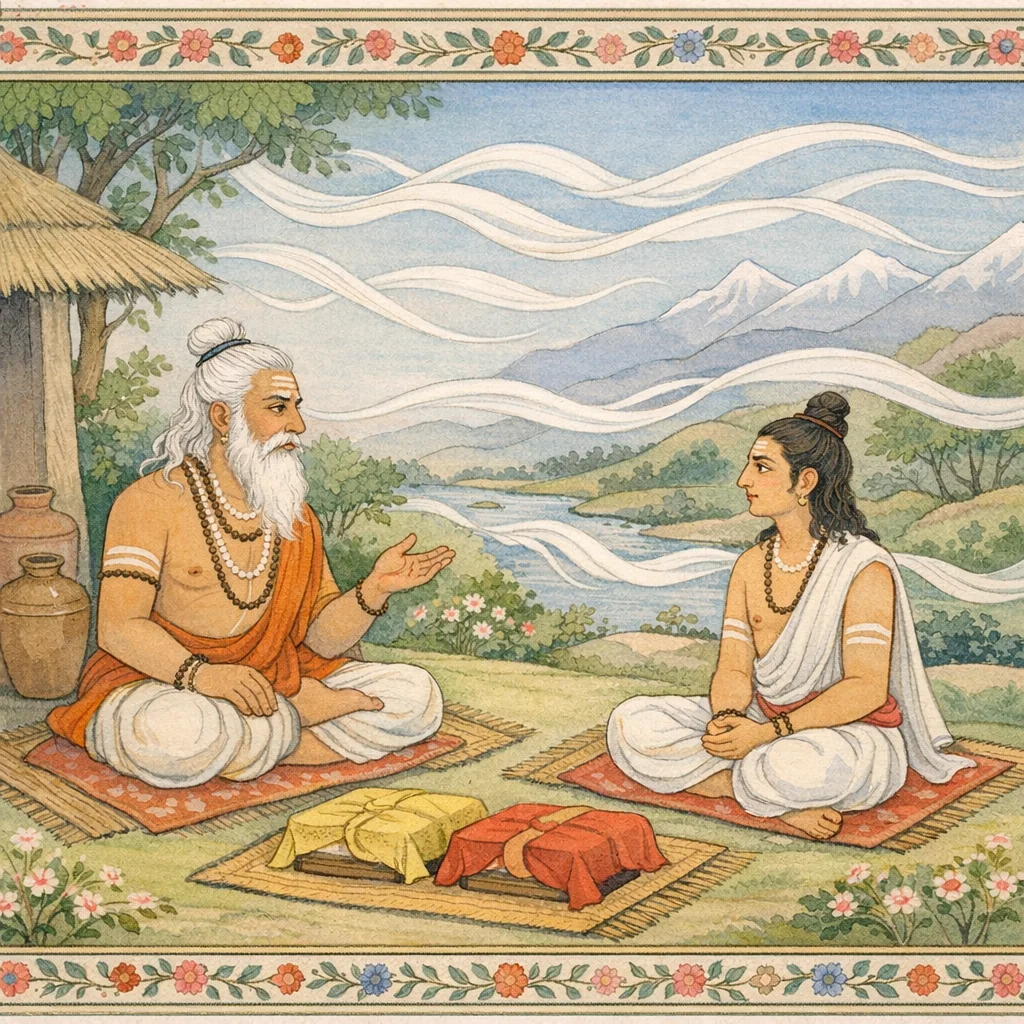
Chapter Arc: शुक, अपने भीतर जागी दिव्य-दृष्टि के बल पर, पिता व्यास से पूछते हैं—“ब्रह्मन्! यह वायु कहाँ से उत्पन्न हुई, और इसका समस्त विचेष्टित क्या है?” → व्यास शुक की प्रश्न-तीक्ष्णता और अंतर्दृष्टि से विस्मित होकर वायु के मार्गों और कार्यों का क्रमबद्ध विवेचन आरम्भ करते हैं—पृथ्वी और अन्तरिक्ष में वायु के बहने के ‘सप्त मार्ग’, तथा प्राण-वायु की प्रधानता और भेद। → व्यास ‘अनध्याय’ का निर्णायक कारण बताते हैं—प्रचण्ड वायु/आँधी के समय वेदाध्ययन नहीं करना चाहिए; क्योंकि वायु-भय से ब्रह्म (वेद/ब्रह्मविद्या) पीड़ित होता है और अध्ययन की पवित्रता-एकाग्रता भंग होती है। → व्यास वायु के विविध कर्मों (विशेषतः प्राण के द्वारा प्राणियों की चेष्टाओं का संचालन और अंतकाल में प्राण-हरण करने वाली वायु की भूमिका) का सार कहकर शुक को ‘अधीष्व’—अध्ययन में प्रवृत्त होने का उपदेश देते हैं।
Shlokas
Verse 26
अपृच्छत् पितरं ब्रह्मन् कुतो वायुरभूदयम् । आख्यातुमहति भवान् वायो: सर्व विचेष्टितम्,उन्होंने अपने पितासे पूछा--'ब्रह्मन! इस वायुकी उत्पत्ति किससे हुई है? आप वायुकी सारी चेष्टाओंका विस्तारपूर्वक वर्णन करें”
He asked his father: “O Brahmin, from what source has this Wind arisen? You are fit to explain in full the entire range of the Wind’s activities.”
Verse 27
शुकस्यैतद् वच: श्रुत्वा व्यास: परमविस्मित: । अनध्यायनिमित्तेडस्मिन्निदं वचनमब्रवीत्,शुकदेवजीका यह वचन सुनकर व्यासजी अत्यन्त आश्चर्यसे चकित हो उठे और अनध्यायके कारणपर प्रकाश डालते हुए इस प्रकार बोले--
Bhishma said: Hearing these words of Śuka, Vyāsa was struck with profound amazement. Then, with the intention of clarifying the cause and meaning of ‘anadhyāya’ (the suspension of Vedic study), he spoke the following words.
Verse 28
दिव्यं ते चक्षुरुत्पन्नं स्वयं ते निर्मल मन: । तमसा रजसा चापि त्यक्तः सत्त्वे व्यवस्थित:,“बेटा! तुम्हें स्वयं ही दिव्य दृष्टि प्राप्त हो गयी है। तुम्हारा हृदय अत्यन्त निर्मल है। तुम रजोगुण और तमोगुणसे रहित होकर सत्त्वगुणमें प्रतिष्ठित हो
Bhishma said: “My son, a divine vision has arisen in you of its own accord. Your mind is utterly pure. Having cast off both darkness (tamas) and agitation (rajas), you stand firmly established in clarity and goodness (sattva).”
Verse 29
आदर्शे स्वामिव च्छायां पश्यस्यात्मानमात्मना | व्यस्यात्मनि स्वयं वेदान् बुद्धया समनुचिन्तय,“जैसे लोग दर्पणमें अपना प्रतिबिम्ब देखते हैं, उसी प्रकार तुम बुद्धिके द्वारा आत्माका साक्षात्कार करते हो; अतः स्वयं ही वेदोंको अपने भीतर स्थापित करके बुद्धिद्वारा अनध्यायके कारणभूत वायुके विषयमें विचार करो
Bhīṣma said: “As a person sees his own reflection in a mirror, so you should perceive the Self by the Self—through clear intelligence. Therefore, establish the Vedas within your own being, and with your intellect reflect carefully on the subtle ‘wind’ (vāyu) that becomes the cause of non-study and distraction.”
Verse 30
देवयानचरो विष्णो: पितृयाणश्व॒ तामस: । द्वावेतौ प्रेत्य पन्थानौ दिव॑ चाधश्ष गच्छत:,“मरकर ऊपरके लोकोंमें जानेवाले और नीचेके लोकोंमें जानेवाले मनुष्योंके लिये दो मार्ग हैं, एक तो देवयान जो कि विष्णुलोकका मार्ग है, अतः सात्त्विक है, दूसरा पितृयान जो कि तामस है
Bhīṣma said: “For beings who depart from this world, there are two paths: the Devayāna, the divine way leading to Viṣṇu’s realm and therefore aligned with sattva; and the Pitṛyāna, the ancestral way, characterized here as tamasic. By these two routes, one goes either upward to the heavenly regions or downward to lower states.”
Verse 31
पृथिव्यामन्तरिक्षे च यत्र संवान्ति वायव: । सप्तैते वायुमार्गा वै तान् निबोधानुपूर्वश:,'पृथ्वीपर या आकाशमें जहाँ भी हवा चलती है, उसके बहनेके लिये सात मार्ग हैं। तुम क्रमश: उनका वर्णन सुनो
Bhīṣma said: “On the earth and in the mid-region (the atmosphere), wherever the winds course, there are indeed seven pathways for their movement. Listen now as I describe them in due order.”
Verse 32
तत्र देवगणा: साध्या महा भूता महाबला: । तेषामप्यभवत् पुत्र: समानो नाम दुर्जय:,“पृथ्वी और आकाशमें जो महाबली और महान् भूत-स्वरूप साध्य नामक देवगण अदृश्यभावसे रहते हैं, उनके दुर्जय पुत्रका नाम है समान
Bhīṣma said: “There, in that realm, dwell the divine hosts known as the Sādhyas—mighty, elemental beings of great power, subtle and unseen. Among them too there was born a son, invincible in battle; his name was Samāna.”
Verse 33
उदानस्तस्य पुत्रो$ भूद् व्यानस्तस्याभवत् सुतः । अपानभ्ष ततो ज्ञेय: प्राणश्षापि ततो5पर:,“समानका पुत्र है उदान, उदानका पुत्र है व्यान, उसके पुत्रका नाम अपान जानना चाहिये और अपानसे प्राणकी उत्पत्ति हुई है
Bhishma said: “From him was born Udāna; Udāna’s son was Vyāna. Next one should know Apāna as his offspring, and from Apāna, thereafter, arose Prāṇa.”
Verse 34
अनपत्यो5भवत् प्राणो दुर्धर्ष: शत्रुतापन: । पृथक् कर्माणि तेषां ते प्रवक्ष्यामि यथातथम्,'प्राणके कोई संतान नहीं हुई। वह शत्रुओंको संताप देनेवाला और दुर्जय है। उन सबके कर्म पृथक्-पृथक् हैं, जिनका मैं तुमसे यथावत्रूपसे वर्णन करता हूँ
Bhishma said: “Prāṇa had no offspring; he was unassailable and a tormentor of enemies. Their deeds are distinct from one another—those I shall relate to you exactly as they were.”
Verse 35
प्राणिनां सर्वतो वायुश्रैष्टां वर्तयते पृथक् । प्राणनाच्चैव भूतानां प्राण इत्यभिधीयते,*वायुदेव प्राणियोंकी पृथक्ू-पृथक् समस्त चेष्टाओंका सम्पादन करते हैं तथा सम्पूर्ण भूतोंको अनुप्राणित (जीवित) रखते हैं, इसलिये “प्राण” कहलाते हैं
Bhīṣma said: The Wind, moving everywhere, separately sets in motion the various excellent functions of living beings; and because it vitalizes all creatures by sustaining their breathing and life, it is therefore called “Prāṇa,” the life-breath.
Verse 36
प्रेरयत्य भ्रसंघातान् धूमजांश्रोष्मजांश्व॒ यः । प्रथम: प्रथमे मार्गे प्रवहो नाम योडनिल:,“जो धूम तथा गर्मीसे उत्पन्न बादलों और ओलोंको इधरसे उधर ले जाता है, वह प्रथम मार्गमें प्रवाहित होनेवाला 'प्रवह” नामक प्रथम वायु है
Bhīṣma said: The wind that drives about the masses of clouds—those born of smoke and those born of heat—is the first wind, called Pravaha, moving in the first course.
Verse 37
अम्बरे स्नेहमभ्येत्य विद्युदभ्यश्न महाद्युति: । आवटहो नाम संवाति द्वितीय: श्वसनो नदन्,“जो आकाशमें रसकी मात्राओं और बिजली आदिकी उत्पत्तिके लिये प्रकट होता है, वह महान् तेजसे सम्पन्न द्वितीय वायु “आवह' नामसे प्रसिद्ध है। वह बड़ी भारी आवाजके साथ बहता है
Bhīṣma said: The wind that appears in the sky to bring forth measures of moisture and the birth of lightning and the like is the second wind, possessed of great radiance, famed by the name Āvaha; it blows with a mighty sound.
Verse 38
उदयं ज्योतिषां शश्वत् सोमादीनां करोति यः । अन्तर्देहेषु चोदानं यं वदन्ति मनीषिण:,“जो सदा सोम, सूर्य आदि ग्रहोंका उदय एवं उद्भव करता है, मनीषी पुरुष शरीरके भीतर जिसे “उदान” कहते हैं, जो चारों समुद्रोंस जलको ऊपर उठाकर जीमूत नामक मेघोंमें स्थापित करता है तथा जीमूत नामक मेघोंको जलसे संयुक्त करके उन्हें पर्जन्यके हवाले कर देता है, वह महान् वायु 'उद्बधह” कहलाता है, जो तृतीय मार्गपर चलनेके कारण तीसरा कहा गया है
Bhīṣma said: He who continually brings about the rising of the luminaries—beginning with the Moon—and whom the wise describe as the vital current called Udāna within embodied beings: that power is being indicated as the cosmic wind that governs upward movement, linking the inner life-breath with the outer order of the heavens.
Verse 39
यश्नतुर्भ्य: समुद्रेभ्यो वायुर्धारयते जलम् । उद्धृत्याददते चापो जीमूते भ्यो5म्बरेडनिल:,“जो सदा सोम, सूर्य आदि ग्रहोंका उदय एवं उद्भव करता है, मनीषी पुरुष शरीरके भीतर जिसे “उदान” कहते हैं, जो चारों समुद्रोंस जलको ऊपर उठाकर जीमूत नामक मेघोंमें स्थापित करता है तथा जीमूत नामक मेघोंको जलसे संयुक्त करके उन्हें पर्जन्यके हवाले कर देता है, वह महान् वायु 'उद्बधह” कहलाता है, जो तृतीय मार्गपर चलनेके कारण तीसरा कहा गया है
Bhishma said: From the oceans, the Wind upholds and draws up the waters; having lifted them, that same Wind in the sky gathers the waters into the cloud-masses. Thus the life-wind called Udāna—celebrated as the great Vāyu—raises water from the four seas, establishes it in the clouds, and, joining cloud and water, hands it onward as rain. The teaching points to the ordered, duty-bound functioning of nature: even the mightiest force acts as a steward, sustaining the world through regulated service rather than caprice.
Verse 40
योडद्धि: संयोज्य जीमूतान् पर्जन्याय प्रयच्छति । उद्वहो नाम बंहिष्ठस्तृतीय: स सदागति:,“जो सदा सोम, सूर्य आदि ग्रहोंका उदय एवं उद्भव करता है, मनीषी पुरुष शरीरके भीतर जिसे “उदान” कहते हैं, जो चारों समुद्रोंस जलको ऊपर उठाकर जीमूत नामक मेघोंमें स्थापित करता है तथा जीमूत नामक मेघोंको जलसे संयुक्त करके उन्हें पर्जन्यके हवाले कर देता है, वह महान् वायु 'उद्बधह” कहलाता है, जो तृतीय मार्गपर चलनेके कारण तीसरा कहा गया है
Bhishma said: “That vital wind which, having gathered the waters and joined them to the clouds, delivers those clouds to the rain-bearing power—ever moving onward—is called Udvaha. Because it proceeds along a ‘third course’ and operates outwardly on a vast scale, it is spoken of as the third.”
Verse 41
समूहा[माना बहुधा येन नीता: पृथग् घना: । वर्षमोक्षकृतारम्भास्ते भवन्ति घनाघना:,“जिसके द्वारा इधर-उधर ले जाये गये अनेक प्रकारके महामेघ घटा बाँधकर जल बरसाना आरम्भ करते हैं, घटाके रूपमें घनीभूत होनेपर भी जिसकी प्रेरणासे सारे बादल फट जाते हैं, फिर वे वेणुनादके समान शब्द करनेके कारण “नद” कहलाते हैं तथा प्राणियोंकी रक्षाके लिये पुन: जलका संग्रह करके घनीभूत हो जाते हैं, जो वायु देवताओंके आकाश शभमार्गसे जानेवाले विमानोंको स्वयं ही वहन करता है, वह पर्वतोंका मान मर्दन करनेवाला चतुर्थ वायु 'संवह' नामसे प्रसिद्ध है
Bhishma said: “Driven in many ways by that force, the clouds—though scattered apart—gather into masses and begin the work of releasing rain. Having become dense as cloud-banks, they set in motion the discharge that sustains living beings.”
Verse 42
संहता येन चाविद्धा भवन्ति नदतां नदा: । रक्षणार्थाय सम्भूता मेघत्वमुपयान्ति च,“जिसके द्वारा इधर-उधर ले जाये गये अनेक प्रकारके महामेघ घटा बाँधकर जल बरसाना आरम्भ करते हैं, घटाके रूपमें घनीभूत होनेपर भी जिसकी प्रेरणासे सारे बादल फट जाते हैं, फिर वे वेणुनादके समान शब्द करनेके कारण “नद” कहलाते हैं तथा प्राणियोंकी रक्षाके लिये पुन: जलका संग्रह करके घनीभूत हो जाते हैं, जो वायु देवताओंके आकाश शभमार्गसे जानेवाले विमानोंको स्वयं ही वहन करता है, वह पर्वतोंका मान मर्दन करनेवाला चतुर्थ वायु 'संवह' नामसे प्रसिद्ध है
Bhishma said: “That wind by which the clouds—though driven and scattered—are gathered into compact masses and made to roar; which, for the protection of living beings, causes them to assume the state of cloud again (collecting and holding water for rain).”
Verse 43
योडसौ वहति भूतानां विमानानि विहायसा । चतुर्थ: संवहो नाम वायु: स गिरिमर्दन:,“जिसके द्वारा इधर-उधर ले जाये गये अनेक प्रकारके महामेघ घटा बाँधकर जल बरसाना आरम्भ करते हैं, घटाके रूपमें घनीभूत होनेपर भी जिसकी प्रेरणासे सारे बादल फट जाते हैं, फिर वे वेणुनादके समान शब्द करनेके कारण “नद” कहलाते हैं तथा प्राणियोंकी रक्षाके लिये पुन: जलका संग्रह करके घनीभूत हो जाते हैं, जो वायु देवताओंके आकाश शभमार्गसे जानेवाले विमानोंको स्वयं ही वहन करता है, वह पर्वतोंका मान मर्दन करनेवाला चतुर्थ वायु 'संवह' नामसे प्रसिद्ध है
Bhishma said: “That wind which bears the aerial chariots (vimānas) of beings through the sky—known as the fourth wind, Saṁvaha—is a crusher of mountains, a mighty force that carries and drives all that moves aloft.”
Verse 44
येन वेगवता रुग्णा रूक्षेण रुवता नगान् | वायुना सहिता मेघास्ते भवन्ति बलाहका:,'जो रुक्षभावसे वेगपूर्वक महान् शब्दके साथ बहकर बड़े-बड़े वृक्षोंको तोड़ देता और उखाड़ फेंकता है तथा जिसके द्वारा संगठित हुए प्रलयकालीन मेघ “बलाहक' संज्ञा धारण करते हैं, जिस वायुका संचरण भयानक उत्पात लानेवाला होता है तथा जो आकाशसे अपने साथ मेघोंकी घटाएँ लिये चलता है, उस अत्यन्त वेगशाली पंचम वायुको “विवह' नाम दिया गया है
Bhishma said: “By that harsh, roaring wind, swift in its rush, the mountains are shaken. And when clouds are gathered and driven along by that wind, they become what are called ‘balāhaka’ clouds.”
Verse 45
दारुणोत्पातसंचारो नभस: स्तनयित्नुमान् । पजञ्चम: स महावेगो विवहो नाम मारुत:,'जो रुक्षभावसे वेगपूर्वक महान् शब्दके साथ बहकर बड़े-बड़े वृक्षोंको तोड़ देता और उखाड़ फेंकता है तथा जिसके द्वारा संगठित हुए प्रलयकालीन मेघ “बलाहक' संज्ञा धारण करते हैं, जिस वायुका संचरण भयानक उत्पात लानेवाला होता है तथा जो आकाशसे अपने साथ मेघोंकी घटाएँ लिये चलता है, उस अत्यन्त वेगशाली पंचम वायुको “विवह' नाम दिया गया है
Bhīṣma said: “That fifth wind is called Vivaha—an exceedingly swift gale whose movement brings dreadful portents, and which ranges through the sky bearing thunder-laden storm-clouds.”
Verse 46
यस्मिन् पारिप्लवा दिव्या वहन्त्यापो विहायसा । पुण्यं चाकाशगज़जायास्तोयं विष्टभ्य तिष्ठति,“जिस वायुके आधारपर आकाशमें दिव्य जल ऊपर-ही-ऊपर प्रवाहित होते हैं, जो आकाशगंगाके पवित्र जलको धारण करके स्थित है और जिसके द्वारा दूरसे ही प्रतिहत होकर सहस्रों किरणोंके उत्पत्तिस्थान सूर्यदेव, जिनसे यह पृथ्वी प्रकाशित होती है, एक ही किरणसे युक्त जान पड़ते हैं तथा जिससे अमृतकी दिव्य निधि चन्द्रमाका भी पोषण होता है, वह विजयशीलोंमें श्रेष्ठ छठा वायुतत्त्व 'परिवह' नामसे प्रसिद्ध है
Bhishma describes a victorious form of the wind-principle: that support in the sky by which divine waters flow aloft, and by which the holy water of the celestial Ganga is upheld and held in place. Thus is cosmic order sustained by subtle, unseen forces governed by Dharma.
Verse 47
दूरात् प्रतिहतो यस्मिन्नेकरश्मिर्दिवाकर: । योनिरंशुसहस्रस्थ येन भाति वसुन्धरा,“जिस वायुके आधारपर आकाशमें दिव्य जल ऊपर-ही-ऊपर प्रवाहित होते हैं, जो आकाशगंगाके पवित्र जलको धारण करके स्थित है और जिसके द्वारा दूरसे ही प्रतिहत होकर सहस्रों किरणोंके उत्पत्तिस्थान सूर्यदेव, जिनसे यह पृथ्वी प्रकाशित होती है, एक ही किरणसे युक्त जान पड़ते हैं तथा जिससे अमृतकी दिव्य निधि चन्द्रमाका भी पोषण होता है, वह विजयशीलोंमें श्रेष्ठ छठा वायुतत्त्व 'परिवह' नामसे प्रसिद्ध है
Bhishma said: “When checked by that wind from afar, the Sun—source of a thousand beams—seems as if reduced to a single ray; and by that same agency the earth is made to shine.”
Verse 48
यस्मादाप्यायते सोमो निधिर्दिव्योडमृतस्य च । षष्ठ: परिवहो नाम स वायुर्जयतां वर:,“जिस वायुके आधारपर आकाशमें दिव्य जल ऊपर-ही-ऊपर प्रवाहित होते हैं, जो आकाशगंगाके पवित्र जलको धारण करके स्थित है और जिसके द्वारा दूरसे ही प्रतिहत होकर सहस्रों किरणोंके उत्पत्तिस्थान सूर्यदेव, जिनसे यह पृथ्वी प्रकाशित होती है, एक ही किरणसे युक्त जान पड़ते हैं तथा जिससे अमृतकी दिव्य निधि चन्द्रमाका भी पोषण होता है, वह विजयशीलोंमें श्रेष्ठ छठा वायुतत्त्व 'परिवह' नामसे प्रसिद्ध है
Bhīṣma said: “That Wind-principle by which Soma (the Moon) is nourished—Soma being the divine treasury of nectar—is the sixth, known as Parivaha; among all that bring victory, it is the foremost.”
Verse 49
सर्वप्राणभृतां प्राणान् योडन्तकाले निरस्यति । यस्य वर्त्मनुवर्तेते मृत्युवैवस्वतावुभौ,“जो वायु अन्तकालमें सम्पूर्ण प्राणियोंके प्राणोंको शरीरसे निकालता है, जिसके इस प्राणनिष्कासनरूप मार्गका मृत्यु तथा वैवस्वत यम अनुगमनमात्र करते हैं, सदा अध्यात्मचिन्तनमें लगी हुई शान्त बुद्धिके द्वारा भलीभाँति अनुसंधान करनेवाले तथा ध्यानके अभ्यासमें ही सानन्द रत रहनेवाले पुरुषोंको जो अमृतत्व देनेमें समर्थ है, जिसमें स्थित होकर प्रजापति दक्षके दस हजार पुत्र सम्पूर्ण दिशाओंके अन्तमें पहुँच गये तथा जिससे स्पर्शित होकर विलीन हुआ प्राणी यहाँसे केवल जाता है वापस नहीं लौटता, उस सर्वश्रेष्ठ सप्तम वायुका नाम “परावह' है। उसका अतिक्रमण करना सभीके लिये सर्वथा कठिन है
Bhishma said: “That (supreme) Wind which, at the final moment, drives out the life-breaths of all living beings from the body—whose very path is merely followed by Death and by Yama, the son of Vivasvat.”
Verse 50
सम्यगन्वीक्षतां बुद्धया शान्तयाध्यात्मनित्यया । ध्यानाभ्यासाभिरामाणां योडमृतत्वाय कल्पते,“जो वायु अन्तकालमें सम्पूर्ण प्राणियोंके प्राणोंको शरीरसे निकालता है, जिसके इस प्राणनिष्कासनरूप मार्गका मृत्यु तथा वैवस्वत यम अनुगमनमात्र करते हैं, सदा अध्यात्मचिन्तनमें लगी हुई शान्त बुद्धिके द्वारा भलीभाँति अनुसंधान करनेवाले तथा ध्यानके अभ्यासमें ही सानन्द रत रहनेवाले पुरुषोंको जो अमृतत्व देनेमें समर्थ है, जिसमें स्थित होकर प्रजापति दक्षके दस हजार पुत्र सम्पूर्ण दिशाओंके अन्तमें पहुँच गये तथा जिससे स्पर्शित होकर विलीन हुआ प्राणी यहाँसे केवल जाता है वापस नहीं लौटता, उस सर्वश्रेष्ठ सप्तम वायुका नाम “परावह' है। उसका अतिक्रमण करना सभीके लिये सर्वथा कठिन है
Bhishma said: “For those who, with a tranquil intellect ever grounded in inner contemplation, investigate reality rightly, and who delight in the steady practice of meditation, that supreme principle becomes capable of granting immortality—liberation beyond death.”
Verse 51
यं समासाद्य वेगेन दिशो<न्तं प्रतिपेदिरे । दक्षस्य दशपुत्राणां सहस्राणि प्रजापते:,“जो वायु अन्तकालमें सम्पूर्ण प्राणियोंके प्राणोंको शरीरसे निकालता है, जिसके इस प्राणनिष्कासनरूप मार्गका मृत्यु तथा वैवस्वत यम अनुगमनमात्र करते हैं, सदा अध्यात्मचिन्तनमें लगी हुई शान्त बुद्धिके द्वारा भलीभाँति अनुसंधान करनेवाले तथा ध्यानके अभ्यासमें ही सानन्द रत रहनेवाले पुरुषोंको जो अमृतत्व देनेमें समर्थ है, जिसमें स्थित होकर प्रजापति दक्षके दस हजार पुत्र सम्पूर्ण दिशाओंके अन्तमें पहुँच गये तथा जिससे स्पर्शित होकर विलीन हुआ प्राणी यहाँसे केवल जाता है वापस नहीं लौटता, उस सर्वश्रेष्ठ सप्तम वायुका नाम “परावह' है। उसका अतिक्रमण करना सभीके लिये सर्वथा कठिन है
Bhishma said: “Reaching that (supreme current) with irresistible speed, the thousands of the ten sons of Prajapati Daksha attained the farthest limits of the directions.”
Verse 52
येन स्पृष्ट: पराभूतो यात्येव न निवर्तते । परावहो नाम परो वायु: स दुरतिक्रम:,“जो वायु अन्तकालमें सम्पूर्ण प्राणियोंके प्राणोंको शरीरसे निकालता है, जिसके इस प्राणनिष्कासनरूप मार्गका मृत्यु तथा वैवस्वत यम अनुगमनमात्र करते हैं, सदा अध्यात्मचिन्तनमें लगी हुई शान्त बुद्धिके द्वारा भलीभाँति अनुसंधान करनेवाले तथा ध्यानके अभ्यासमें ही सानन्द रत रहनेवाले पुरुषोंको जो अमृतत्व देनेमें समर्थ है, जिसमें स्थित होकर प्रजापति दक्षके दस हजार पुत्र सम्पूर्ण दिशाओंके अन्तमें पहुँच गये तथा जिससे स्पर्शित होकर विलीन हुआ प्राणी यहाँसे केवल जाता है वापस नहीं लौटता, उस सर्वश्रेष्ठ सप्तम वायुका नाम “परावह' है। उसका अतिक्रमण करना सभीके लिये सर्वथा कठिन है
Bhishma said: “That by whose touch a being is utterly overcome departs from here and does not return—this supreme wind is called ‘Parāvaha’. It is exceedingly difficult for anyone to transcend.”
Verse 53
एवमेते दिते: पुत्रा मारुता: परमाद्भुता: । अनारतं ते संवान्ति सर्वगा: सर्वधारिण:,“इस प्रकार ये सात मरुद्गण दितिके अत्यन्त अदभुत पुत्र हैं। इनकी सर्वत्र गति है। ये निरन्तर बहते और सबको धारण करते हैं
Bhishma said: “Thus these Maruts—marvelous sons of Diti—are extraordinary. They move everywhere without obstruction; they blow unceasingly, and by their sustaining power they uphold all beings.”
Verse 54
एतत् तु महदाश्चर्य यदयं पर्वतोत्तम: । कम्पित: सहसा तेन वायुनातिप्रवायता,'यह बड़े आश्वर्यकी बात है कि अत्यन्त वेगसे बहते हुए उस वायुके द्वारा यह पर्वतोंमें श्रेष्ठ हिमालय भी सहसा काँप उठा है
Bhishma said: “This indeed is a great wonder—that this best of mountains, the Himalaya itself, has suddenly begun to tremble, shaken by that wind rushing with extraordinary force.”
Verse 55
विष्णोर्नि:श्वासवातो5यं यदा वेगसमीरित: । सहसोदीर्यते तात जगत् प्रव्यथते तदा,“तात! यह भगवान् विष्णुका नि:श्वास है। जब कभी सहसा वह नि:श्वास वेगसे निकल पड़ता है, उस समय यह सारा जगत् व्यथित हो उठता है
Bhīṣma said: “Dear one, this is the very wind of Lord Viṣṇu’s exhalation. Whenever that breath suddenly surges forth with force, the whole world is shaken and distressed.”
Verse 56
तस्माद ब्रह्मविदो वेदान् नाधीयन्तेडतिवायति । वायोर्वायुभयं हाक्तं ब्रह्म तत्पीडितं॑ भवेत्,“इसलिये ब्रह्मवेत्ता पुरुष प्रचण्ड वायु (आँधी) चलनेपर वेदका पाठ नहीं करते हैं। वेद भी भगवानका नि:श्वास ही है। उस समय वेदपाठ करनेपर वायुको वायुसे भय प्राप्त होता है और उस वेदको भी पीड़ा होती है”
Bhishma said: “Therefore, those who know Brahman do not recite the Vedas when a violent windstorm is blowing. The Veda is spoken of as the very breath of the Lord; if one recites at such a time, the wind is said to become ‘afraid of wind’ (i.e., disturbed by its own turbulence), and that sacred Brahman—embodied as the Veda—also suffers injury.”
Verse 57
एतावदुकक््त्वा वचनं पराशरसुत: प्रभु: । उक्त्वा पुत्रमधीष्वेति व्योमगड्रामगात् तदा,अनध्यायके विषयमें यह बात कहकर पराशरनन्दन भगवान् व्यास अपने पुत्र शुकदेवसे बोले--“अब तुम वेदपाठ करो।” यों कहकर वे आकाशगंगाके तटपर चल गये
Bhishma said: Having spoken only this much, the mighty lord, the son of Parashara (Vyasa), then addressed his son: “Now undertake the recitation and study of the Veda.” After saying this—having laid down the rule concerning days of non-study—he departed to the bank of the celestial Ganga.
Verse 328
इति श्रीमहाभारते शान्तिपर्वणि मोक्षधर्मपर्वणि अनध्यायनिमित्तकथनं नामाष्टाविंशत्यधिकत्रिशततमो< ध्याय:
Thus, in the Śrī Mahābhārata, within the Śānti Parva and its Mokṣa-dharma section, ends the three-hundred-and-twenty-eighth chapter, entitled “The Account of the Causes for Suspending Vedic Study (Anadhyāya).”
Frequently Asked Questions
Arjuna’s doubt concerns how Agni and Soma—often treated as dual ritual-cosmic principles—could have originally proceeded from a single source (ekayonī), prompting a cosmogonic explanation that unifies them under a single emergence narrative.
The discourse links metaphysics to institution: creation proceeds from an undifferentiated pralaya through Nārāyaṇa and Brahmā into ritual principles (Agni–Soma), and social order is justified as an extension of cosmic-ritual structure (mantra, hotṛ function, and role differentiation).
Rather than a formal phalaśruti, the chapter ends with a summative meta-claim—“tad etad brahmāgnīṣomīyam; tena jagad dhāryate”—which functions as a doctrinal colophon asserting that comprehension of this integrated Brahmā–Agni–Soma framework explains world-maintenance (jagad-dhāraṇa) within the text’s ritual-theological logic.