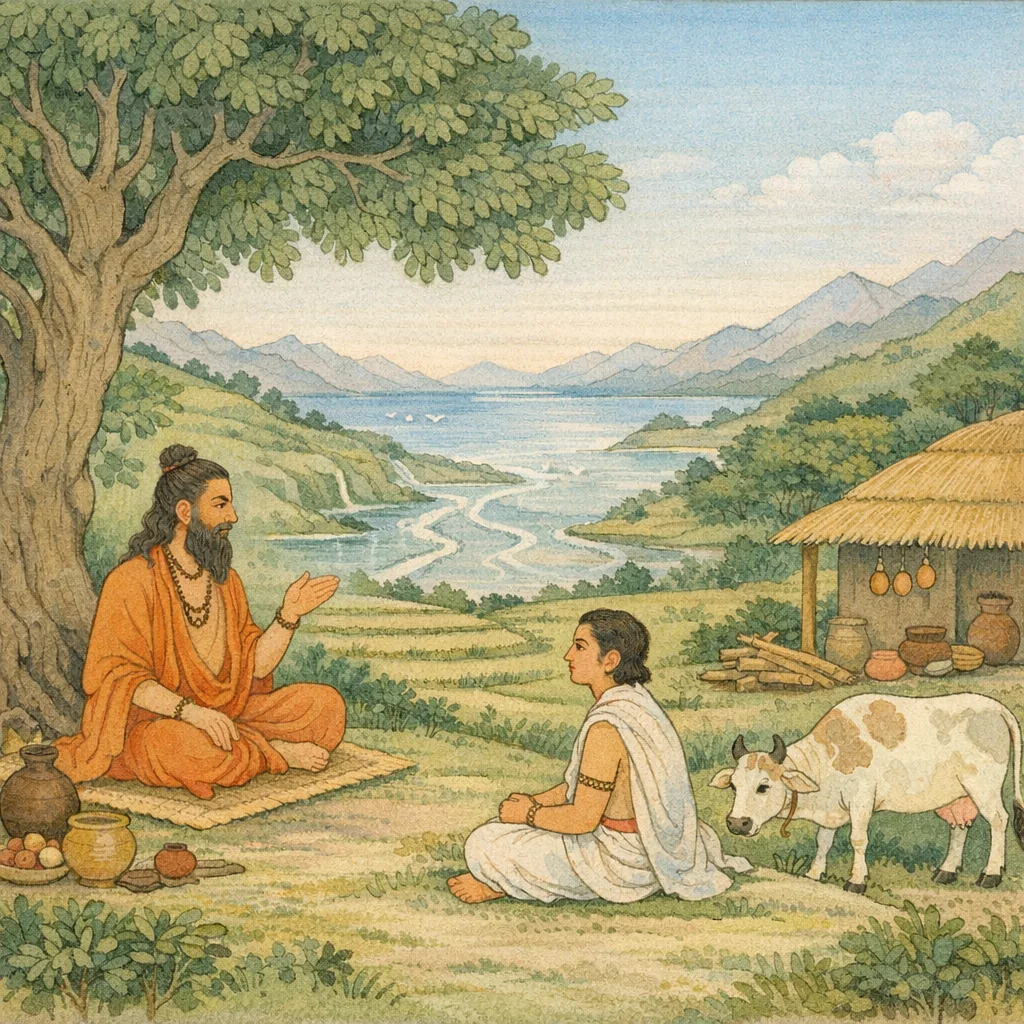
Adhyaya 295
Vidyā–Avidyā and the Twenty-Fifth Principle (Sāṃkhya–Yoga Clarification)
Upa-parva: Mokṣa-dharma Parva (Liberation Teachings Sub-Book)
Vasiṣṭha addresses a king (nṛpasattama) and, after summarizing Sāṃkhya, explains the paired categories of vidyā (knowledge) and avidyā (ignorance) through a hierarchical mapping of principles. Avidyā is associated with the unmanifest (avyakta) characterized by creation and dissolution (sarga–pralaya), while vidyā is linked to the ‘twenty-fifth’ (pañcaviṃśaka) principle described as beyond those cyclic modifications. The discourse then traces an ordered relation among faculties and elements—organs of action, organs of cognition, mind, the five great elements, ahaṃkāra, buddhi, and prakṛti/avyakta—showing how identification and misidentification arise. Vasiṣṭha distinguishes akṣara and kṣara in a nuanced way, arguing that both can be described under these terms depending on whether one is considering guṇa-entanglement or guṇa-transcendence. The chapter uses an extended self-critique metaphor (the fish following a net through ignorance) to depict how the knower becomes bound by prakṛti through mamatā (possessiveness) and ahaṃkāra, and how purification occurs when the self discerns ‘I am other than this’ (anyō’ham). It concludes by asserting the interpretive unity of Sāṃkhya and Yoga: what Sāṃkhya states as doctrine is presented as Yoga-darśana in practical orientation, including states of awakening (buddha), non-awakening, and the process of becoming awakened.
Chapter Arc: पराशर ऋषि गृहस्थ-जीवन के भीतर उठने वाले ‘ममत्व’ के सूक्ष्म विष को सामने रखते हैं—कैसे राजस-तामस भाव मनुष्य को वस्तुओं, संबंधों और अधिकार-बोध में बाँध देते हैं। → घर का आश्रय लेते ही गौ, क्षेत्र, धन, दारा, पुत्र, भृत्य—सब ‘मेरा’ बनकर मन को घेर लेते हैं; आसक्ति बढ़ते-बढ़ते बुद्धि का नाश करती है, और तब मनुष्य कर्तव्य-अकर्तव्य का विवेक खो देता है। → पराशर तप की सर्वोच्चता घोषित करते हैं: तप सर्वगत है, सबके लिए विधेय है—हीन वर्ण के लिए भी—पर शर्त है जितेन्द्रियता और दमन; यही तप स्वर्गमार्ग का प्रवर्तक बनता है और पतन के प्रवाह को पलट देता है। → आश्रम-व्यवस्था का संतुलन दिखाते हुए कहा जाता है कि जैसे नदियाँ समुद्र में जाकर स्थित होती हैं, वैसे ही सभी आश्रम गृहस्थ में प्रतिष्ठित हैं—पर गृहस्थ का धर्म भी दृढ़ता से, आसक्ति-रहित होकर निभाना चाहिए; ममत्व घटे तो गृहस्थ भी साधना का आधार बनता है। → तप और गृहस्थ-धर्म के इस संगम के बाद अगला प्रश्न उभरता है—आसक्ति के बीच रहते हुए वैराग्य की स्थिरता कैसे साधी जाए?
Shlokas
Verse 1
ऑपनआक्षातत [छ। अंक पज्चनवर्त्याधिकद्विशततमो< ध्याय: पराशरगीता--विषयासक्त मनुष्यका पतन, तपोबलकी श्रेष्ठता तथा दृढ़तापूर्वक स्वरधर्मपालनका आदेश पराशर उवाच एष धर्मविधिस्तात गृहस्थस्य प्रकीर्तित: । तपोविधिं तु वक्ष्यामि तन््मे निगदत: शृणु,पराशरजी कहते हैं--तात! यह मैंने गृहस्थके धर्मका विधान बताया है। अब मैं तपकी विधि बताऊँगा, उसे मेरे मुखसे सुनो
Parāśara said: “Dear child, I have thus set forth the rule and discipline of dharma for the householder. Now I shall explain the discipline of austerity (tapas); listen as I declare it.”
Verse 2
प्रायेण च गृहस्थस्य ममत्वं नाम जायते । सड्जागतं नरश्रेष्ठ भावै राजसतामसै:,नरश्रेष्ठ। गृहस्थ पुरुषको प्रायः राजस और तामस भावोंके संसर्गवश पदार्थ और व्यक्तियोंमें ममता हो जाती है
Parāśara said: In the case of a householder, attachment—called “mine-ness”—generally arises. O best of men, once it is born, it is nourished by the impulses of rajas and tamas, leading one to cling to possessions and persons as “mine”.
Verse 3
गृहाण्याश्रित्य गावश्ष क्षेत्राणि च धनानि च । दारा: पुत्राश्न भृत्याश्न भवन्तीह नरस्य वै,घरका आश्रय लेते ही मनुष्यका गौ, खेती-बारी, धन-दौलत, स्त्री-पुत्र तथा भरण- पोषणके योग्य अन्यान्य कुटुम्बीजनोंसे सम्बन्ध स्थापित हो जाता है
Parāśara said: “By taking shelter in a house, a man comes to possess and be connected with cattle, fields, and wealth; and here in this world he also comes to have wife, sons, and dependants/servants. Thus household life becomes the basis from which one’s social and economic ties arise.”
Verse 4
एवं तस्य प्रवृत्तस्य नित्यमेवानुपश्यत: । रागद्वेषौ विवर्धेते हानित्यत्वमपश्यत:,इस प्रकार प्रवृत्तिमार्गमें रहकर वह नित्य ही उन वस्तुओंको देखता है, किंतु उनकी अनित्यताकी ओर उसकी दृष्टि नहीं जाती; इसलिये उसके मनमें इनके प्रति राग और द्वेष बढ़ने लगते हैं
When a person remains engaged in the outward path of activity and keeps continually looking at sense-objects, yet fails to notice their impermanence, attachment and aversion steadily grow within him. Thus, by overlooking transience, the mind becomes bound by likes and dislikes rather than guided by discernment.
Verse 5
रागद्वेषाभिभूतं च नरं द्रव्यवशानुगम् । मोहजाता रतिराम समुपैति नराधिप,नरेश्वर! राग और द्वेषके वशीभूत होकर जब मनुष्य द्रव्यमें आसक्त हो जाता है, तब मोहकी कन्या रति उसके पास आ जाती है
Parāśara said: When a man is overpowered by attachment and aversion and, under the sway of wealth, becomes engrossed in possessions, then Rati—born of delusion—draws near to him, binding him more tightly to infatuation and pleasure-seeking.
Verse 6
कृतार्थ भोगिनं मत्वा सर्वो रतिपरायण: । लाभं ग्राम्यसुखादन्यं रतितो नानुपश्यति
Thinking the sensual enjoyer to be “successful” and fulfilled, people become wholly devoted to pleasure. From their attachment to gratification, they fail to perceive any gain higher than the comforts of ordinary, worldly life.
Verse 7
तब रतिकी उपासनामें लगे हुए सभी लोग भोगीको ही कृतार्थ मानकर रतिके द्वारा जो विषय-सुख प्राप्त होता है, उससे बढ़कर दूसरा कोई लाभ नहीं समझते हैं ।। ततो लोभाभिभूतात्मा संगाद् वर्धयते जनम् | पुष्ट्यर्थ चैव तस्येह जनस्यार्थ चिकीर्षति,तदनन्तर उनके मनपर लोभका अधिकार हो जाता है और वे आसक्तिवश अपने परिजनोंकी संख्या बढ़ाने लगते हैं। इसके बाद उन कुट॒म्बीजनोंके पालन-पोषणके लिये मनुष्यके मनमें धन-संग्रहकी इच्छा होती है
Then, with the mind overpowered by greed, a person—driven by attachment—seeks to increase his circle of dependents and relations. Thereafter, for the sake of maintaining and nourishing that household, he develops the urge to acquire and accumulate wealth, taking sensual enjoyment to be the highest attainment and imagining no greater good beyond the pleasures gained through sexual delight.
Verse 8
स जानन्नपि चाकार्यमर्थार्थ सेवते नर: । बालस्नेहपरीतात्मा तत्क्षयाच्चानुतप्यते,यद्यपि मनुष्य जानता है कि अमुक काम करना पाप है, तो भी वह धनके लिये उसका सेवन करता है। बाल-बच्चोंके स्नेहमें उसका मन डूबा रहता है और उनमेंसे जब कोई मर जाता है तब उनके लिये वह बारंबार संतप्त होता है
Even while knowing that a certain act is improper, a man still pursues it for the sake of wealth. His mind is overwhelmed by attachment to his children; and when they perish, he repeatedly grieves for them.
Verse 9
ततो मानेन सम्पन्नो रक्षन्नात्मपराजयम् । करोति येन भोगी स्यामिति तस्माद् विनश्यति,धनसे जब लोकमें सम्मान बढ़ता है, तब वह मानसम्पन्न पुरुष सदा अपने अपमानसे बचनेके लिये प्रयत्न करता रहता है एवं “मैं भोग-सामग्रियोंसे सम्पन्न होऊँ” यह उद्देश्य लेकर ही वह सारा कार्य करता है और इसी प्रयत्नमें एक दिन नष्ट हो जाता है
Then, when a man becomes endowed with social honor, he constantly strives to protect himself from humiliation. With the aim, “May I become one who enjoys abundant pleasures,” he undertakes all his actions; and in that very striving he is, one day, ruined.
Verse 10
तथा हि बुद्धियुक्तानां शाश्रृतं ब्रह्मवादिनाम् । अन्विच्छतां शुभं कर्म नराणां त्यजतां सुखम्,वास्तवमें जो शुभ कर्मोंका अनुष्ठान तो करते हैं, परन्तु उनसे सुख पानेकी इच्छाको त्याग देते हैं, उन समत्व-बुद्धिसे युक्त ब्रह्मयवादी पुरुषोंको ही सनातन पदकी प्राप्ति होती है
For indeed, those brahma-speaking sages who are endowed with steady, balanced understanding—who pursue and perform auspicious action, yet renounce the desire to obtain personal pleasure from it—attain the eternal state. The teaching emphasizes disciplined action without craving for its fruits as the ethical path to the highest good.
Verse 11
स्नेहायतननाशाच्च धननाशाच्च पार्थिव । आधिव्याधिप्रतापाच्च निर्वेदमुपगच्छति,पृथ्वीनाथ! संसारी जीवोंको तो जब उनके स्नेहके आधारभूत स्त्री-पुत्र आदिका नाश हो जाता, धन चला जाता और रोग तथा चिन्तासे कष्ट उठाना पड़ता है, तभी वैराग्य होता है
Parāśara said: “O king, when a worldly person’s supports of affection—such as wife, children, and the like—are destroyed, when wealth is lost, and when he is scorched by anxiety and disease, then he comes to dispassion (nirveda).”
Verse 12
निर्वेदादात्मसम्बोध: सम्बोधाच्छास्त्रदर्शनम् । शाल्त्रार्थदर्शनाद् राज॑ंस्तप एवानुपश्यति,राजन! वैराग्यसे मनुष्यको आत्मतत्त्वकी जिज्ञासा होती है। जिज्ञासासे शास््त्रोंके स्वाध्यायमें मन लगता है तथा शास्त्रोंके अर्थ और भावके ज्ञानसे वह तपको ही कल्याणका साधन समझता है
Parāśara said: “From dispassion arises awakening to the Self. From that awakening comes a true turning toward the scriptures. And when one clearly understands the meaning and intent of the scriptures, O King, one recognizes austerity (tapas)—disciplined self-restraint and inner practice—as the very means to welfare and spiritual good.”
Verse 13
दुर्लभो हि मनुष्येन्द्र नर: प्रत्यवमर्शवान् । यो वै प्रियसुखे क्षीणे तप: कर्तुं व्यवस्यति,नरेन्द्र! संसारमें ऐसा विवेकी मनुष्य दुर्लभ है, जो स्टत्री-पुत्र आदि प्रियजनोंसे मिलनेवाले सुखके न रहनेपर तपमें प्रवृत्त होनेका ही निश्चय करता है
Parāśara said: “O lord of men, rare indeed is that person endowed with reflective discernment—one who, when the pleasures born of what is dear have been exhausted, resolves firmly to undertake austerity. Such a one does not collapse when familial and worldly comforts fade, but turns that loss into a deliberate commitment to inner discipline.”
Verse 14
तप: सर्वगतं तात हीनस्यापि विधीयते । जितेन्द्रियस्य दान्तस्य स्वर्गमार्गप्रवर्तकम्
Parāśara said: “Austerity, my son, is all-pervading; it is prescribed even for one who is deficient or lowly. For the self-controlled and disciplined person, it becomes the force that sets one upon the path to heaven.”
Verse 15
तात! तपस्यामें सभीका अधिकार है। जितेन्द्रिय और मनोनिग्रहसम्पन्न हीन वर्णके लिये भी तपका विधान है; क्योंकि तप पुरुषको स्वर्गकी राहपर लानेवाला है ।। प्रजापति: प्रजा: पूर्वमसृजत् तपसा विभु: । क्वचित् क्वचिद् ब्रह्मपरो व्रतान्यास्थाय पार्थिव,भूपाल! पूर्वकालमें शक्तिशाली प्रजापतिने तपमें स्थित होकर और कभी-कभी ब्रह्मपरायण व्रतमें स्थित होकर संसारकी रचना की थी
Parāśara said: “Dear one, everyone has a right to practise austerity. Even a person of low social standing, if self-controlled and disciplined in mind, is enjoined to undertake tapas; for austerity leads a person onto the path to heaven. In ancient times the mighty Prajāpati created beings through tapas; and at times, O king and protector of the earth, he established himself in vows devoted to Brahman and thus brought forth the creation of the world.”
Verse 16
आदित्या वसवो रुद्रास्तथैवाग्न्यश्विमारुता: । विश्वेदेवास्तथा साध्या: पितरो5थ मरुद्गणा:
Parāśara said: “The Ādityas, the Vasus, the Rudras, and likewise Agni, the Aśvins, and the Maruts; the Viśvedevas and the Sādhyas; and also the Pitṛs (ancestral fathers) and the hosts of Maruts—these divine orders are to be understood as the great celestial classes (invoked and acknowledged in the sacred vision of dharma).”
Verse 17
यक्षराक्षसगन्धर्वा: सिद्धाश्षान्ये दिवौकस: । संसिद्धास्तपसा तात ये चान्ये स्वर्गवासिन:
Parāśara said: “Yakṣas, Rākṣasas, Gandharvas, and Siddhas, along with other celestial beings—those perfected through austerity, dear one, and all others who dwell in heaven—(are included here).”
Verse 18
तात! आदित्य, वसु, रुद्र, अग्नि, अश्विनीकुमार, वायु, विश्वेदेव, साध्य, पितर, मरुदगण, यक्ष, राक्षस, गन्धर्व, सिद्ध तथा अन्य जो स्वर्गवासी देवता हैं, वे सब-के-सब तपस्यासे ही सिद्धिको प्राप्त हुए हैं ।। ये चादौ ब्राह्मणा: सृष्टा ब्रहद्मयणा तपसा पुरा । ते भावयन्त: पृथिवीं विचरन्ति दिवं तथा,ब्रह्माजीने पूर्वकालमें जिन मरीचि आदि ब्राह्मणोंको उत्पन्न किया था, वे तपके ही प्रभावसे पृथ्वी और आकाशको पवित्र करते हुए ही विचरते हैं
Parāśara said: “Dear child! The Ādityas, Vasus, Rudras, Agni, the Aśvin twins, Vāyu, the Viśvedevas, Sādhyas, Pitṛs, hosts of Maruts, Yakṣas, Rākṣasas, Gandharvas, Siddhas, and all other deities who dwell in heaven—every one of them attained their powers and fulfillment through austerity alone. And the Brahmins who were created in the beginning by Brahmā through ancient tapas—those primordial sages—move about sanctifying the earth and the heavens by the very force of their ascetic discipline.”
Verse 19
मर्त्यलोके च राजानो ये चान्ये गृहमेधिन: । महाकुलेषु दृश्यन्ते तत् सर्व तपस: फलम्,मर्त्यलोकमें भी जो राजे-महाराजे तथा अन्यान्य गृहस्थ महान् कुलोंमें उत्पन्न देखे जाते हैं, वह सब उनकी तपस्याका ही फल है
Parāśara said: “In the human world, the kings and rulers—and likewise other householders—who are seen to be born and established in great and noble lineages: all of that is the fruit of austerity (tapas).”
Verse 20
कौशिकानि च वस्त्राणि शुभान्याभरणानि च । वाहनासनपानानि तत् सर्व तपस: फलम्
Parāśara said: “Fine garments of kuśa-fibre, auspicious ornaments, and the comforts of conveyances, seats, and drinks—these, all of them, are the fruits that arise from austerity.”
Verse 21
रेशमी वस्त्र, सुन्दर आभूषण, वाहन, आसन और उत्तम खान-पान आदि सब कुछ तपस्याका ही फल है ।। मनो<नुकूला: प्रमदा रूपवत्य: सहस्रश: । वास: प्रासादपृषछ्ठे च तत् सर्व तपस: फलम्,मनके अनुकूल चलनेवाली सहस्रों रूपवती युवतियाँ और महलोंका निवास आदि सब कुछ तपस्याका ही फल है
Parāśara said: “Silken garments, beautiful ornaments, conveyances, seats, and the finest food and drink—these are all the fruits of austerity. And thousands of beautiful young women who move in accordance with one’s wishes, residence upon the terraces of palaces, and all such enjoyments—these are entirely the fruits of austerity.”
Verse 22
शयनानि च मुख्यानि भोज्यानि विविधानि च । अभिप्रेतानि सर्वाणि भवन्ति शुभकर्मिणाम्,श्रेष्ठ शय्या, भाँति-भाँतिके उत्तम भोजन तथा सभी मनोवांछित पदार्थ पुण्यकर्म करनेवाले लोगोंको ही प्राप्त होते हैं
Parāśara said: For those who perform auspicious and meritorious deeds, excellent beds and resting-places, many kinds of fine foods, and indeed all desired enjoyments come to them.
Verse 23
नाप्राप्यं तपस: किंचित् त्रैलोक्येडपि परंतप । उपभोगपरित्याग: फलान्यकृतकर्मणाम्,परंतप! त्रिलोकीमें कोई ऐसी वस्तु नहीं है, जो तपस्यासे प्राप्त न हो सके; किंतु जिन्होंने काम्य अथवा निषिद्ध कर्म नहीं किये हैं, उनकी तपस्याका फल सुखभोगोंका परित्याग ही है
Parāśara said: “O scorcher of foes, there is nothing anywhere in the three worlds that cannot be attained through austerity. Yet for those who have not performed desire-driven or forbidden acts, the fruit of their austerity is precisely this: the renunciation of sense-enjoyments.”
Verse 24
सुखितो दुःखितो वापि नरो लोभ॑ परित्यजेत् । अवेक्ष्य मनसा शास्त्र बुद्धा च नृपसत्तम,नृपश्रेष्ठ! मनुष्य सुखमें हो या दुःखमें, मन और बुद्धिसे शास्त्रका तत्व समझकर लोभका परित्याग कर दे
Whether a man is in happiness or in sorrow, he should renounce greed. Having examined the teaching of the śāstras with a steady mind and with discernment, O best of kings, let him abandon covetousness.
Verse 25
असंतोषो5सुखायेति लोभादिन्द्रियसम्भ्रम: । ततोअस्य नश्यति प्रज्ञा विद्येवाभ्यासवर्जिता
Discontent leads only to unhappiness; from greed arises the agitation and confusion of the senses. From that, a person’s discernment is destroyed—just as learning fades away when it is left without practice.
Verse 26
असंतोष दुःखका ही कारण है। लोभसे मन और इन्द्रियाँ चंचल होती हैं, उससे मनुष्यकी बुद्धि उसी प्रकार नष्ट हो जाती है, जैसे बिना अभ्यासके विद्या ।। नष्टप्रज्ञो यदा तु स्यात् तदा न्यायं न पश्यति । तस्मात् सुखक्षये प्राप्ते पुमानुग्रं तपश्चरेत्
Parāśara said: When a person’s discernment is ruined, he no longer perceives what is just and right. Therefore, when one’s happiness has dwindled and adversity has arrived, one should undertake rigorous austerity—self-discipline that steadies the mind and restores clarity—rather than be driven by restless desire.
Verse 27
जब मनुष्यकी बुद्धि नष्ट हो जाती है, तब वह न्यायको नहीं देख पाता अर्थात् कर्तव्य और अकर्तव्यका निर्णय नहीं कर पाता है। इसलिये सुखका क्षय हो जानेपर प्रत्येक पुरुषको घोर तपस्या करनी चाहिये ।। यदिष्टं तत् सुख प्राहुर्द्धैष्यं दुःखमिहेष्यते । कृताकृतस्य तपस: फलं॑ पश्यस्व यादृशम्,जो अपनेको प्रिय जान पड़ता है, उसे सुख कहते हैं तथा जो मनके प्रतिकूल होता है, वह दुःख कहलाता है। तपस्या करनेसे सुख और न करनेसे दुःख होता है। इस प्रकार तप करने और न करनेका जैसा फल होता है, उसे तुम भलीभाँति समझ लो
Parāśara said: “That which is desired is called happiness; what goes against the mind is here regarded as suffering. Therefore, understand clearly what sort of result arises from austerity (tapas)—whether it is undertaken or neglected. When a person’s discernment collapses, he can no longer see justice, that is, he cannot decide what ought to be done and what ought not; hence, when one’s happiness declines, one should take up severe self-discipline (tapas) to restore right judgment and well-being.”
Verse 28
नित्यं भद्राणि पश्यन्ति विषयांश्वोपभुञ्जते । प्राकाश्यं चैव गच्छन्ति कृत्वा निष्कल्मषं तप:,मनुष्य पापरहित तपस्या करके सदा अपना कल्याण ही देखते हैं। मनोवांछित विषयोंका उपभोग करते हैं और संसारमें उनकी ख्याति होती है
Those who undertake austerity free from sin continually behold what is auspicious. They also enjoy the desired objects of the senses, and, through such stainless discipline, they attain renown and public esteem in the world.
Verse 29
अप्रियाण्यवमानांश्व दुःखं बहुविधात्मकम् । फलार्थी तत्फलं त्यक्त्वा प्राप्रोति विषयात्मकम्,मनके अनुकूल फलकी इच्छा रखनेवाला मनुष्य सकाम कर्मका अनुष्ठान करके अप्रिय, अपमान और नाना प्रकारके दुःख पाता है, किंतु उस फलका परित्याग करके वह सम्पूर्ण विषयोंके आत्मस्वरूप परब्रह्म परमेश्वरको प्राप्त कर लेता है
Parāśara said: A person who acts with desire for results encounters what is unpleasant—insults and many kinds of suffering. But when one relinquishes that very fruit of action, one attains the inner reality of all objects of experience: the Supreme Brahman, the Lord who is the Self of everything.
Verse 30
धर्मे तपसि दाने च विचिकित्सास्य जायते । स कुत्वा पापकान्येव निरयं प्रतिपद्यते,जिसे धर्म, तपस्या और दानमें संशय उत्पन्न हो जाता है, वह पापकर्म करके नरकमें पड़ता है
Parāśara said: When a person becomes doubtful about dharma, austerity, and charity—hesitating over whether these are truly to be practiced—he turns instead to sinful acts, and by that choice he falls into hell.
Verse 31
सुखे तु वर्तमानो वै दुःखे वापि नरोत्तम | सुवृत्ताद् यो न चलते शास्त्रचक्षु;ः स मानव:
Whether living amid happiness or facing sorrow, O best of men, the person who does not deviate from good conduct—guided by the discerning eye of the śāstras—is truly a worthy human being.
Verse 32
नरश्रेष्ठ! मनुष्य सुखमें हो या दुःखमें, जो सदाचारसे कभी विचलित नहीं होता, वही शास्त्रका ज्ञाता है ।। इषुप्रपातमात्र हि स्पर्शयोगे रति: स्मृता । रसने दर्शने घ्राणे श्रवणे च विशाम्पते
O best of men, whether a person is in happiness or in sorrow, the one who never swerves from right conduct is truly a knower of the śāstras. For in the sphere of touch, pleasure is said to be only as fleeting as the fall of an arrow; and so too, O lord of the people, with the tongue (taste), the eyes (sight), the nose (smell), and the ears (hearing).
Verse 33
प्रजानाथ! बाणको धनुषसे छूटकर पृथ्वीपर गिरनेमें जितनी देर लगती है, उतना ही समय स्पर्शेन्द्रिय, रसना, नेत्र, नासिका और कानके विषयोंका सुख अनुभव करनेमें लगता है अर्थात् विषयोंका सुख क्षणिक है ।। ततो<स्य जायते तीव्रा वेदना तत्क्षयात् पुन: । अबुधा न प्रशंसन्ति मोक्ष सुखमनुत्तमम्,फिर वह सुख जब नष्ट हो जाता है, तब उसके लिये मनमें बड़ी वेदना होती है। इतनेपर भी अज्ञानी पुरुष (विषयोंमें ही लिप्त रहते हैं, वे) सर्वोत्तम मोक्ष-सुखकी प्रशंसा नहीं करते हैं अर्थात् उसे नहीं चाहते
Parāśara said: “O lord of creatures, the pleasure gained from the objects of touch, taste, sight, smell, and hearing lasts only as long as an arrow, released from a bow, takes to fall to the earth—so fleeting is sense-enjoyment. When that pleasure is exhausted, a sharp pain arises again in the mind for its loss. Yet the unwise, though repeatedly scorched by this cycle of brief delight and ensuing anguish, do not praise or seek the unsurpassed happiness of liberation.”
Verse 34
ततः फलार्थ सर्वस्य भवन्ति ज्यायसे गुणा: । धर्मवृत्त्या च सततं कामार्थाभ्यां न हीयते,अतः प्रत्येक विवेकी पुरुषके मनमें श्रेष्ठ मोक्षफलकी प्राप्ति करानेके लिये शम-दम आदि गुणोंकी उत्पत्ति होती है। निरन्तर धर्मका पालन करनेसे मनुष्य कभी धन और भोगोंसे वंचित नहीं रहता
Thereafter, in order that all may attain the excellent fruit of liberation, higher virtues—such as śama (tranquility) and dama (self-restraint) and the like—arise in the heart of each discerning man. And by constantly abiding in dharma, a person is never deprived of wealth and rightful enjoyments.
Verse 35
अप्रयत्नागता: सेव्या गृहस्थैरविषया: सदा । प्रयत्नेनोपगम्यश्न स्वधर्म इति मे मतिः,इसलिये गृहस्थ पुरुषको सदा बिना प्रयत्न अपने-आप प्राप्त हुए विषयोंका ही सेवन करना चाहिये और प्रयत्न करके तो अपने धर्मका ही पालन करना चाहिये। यही मेरा मत है
Parāśara said: A householder should always partake only of those enjoyments that come of themselves, without deliberate striving. If effort is to be made, it should be directed to the performance of one’s own duty—this is my considered view.
Verse 36
मानिनां कुलजातानां नित्य शास्त्रार्थचक्षुषाम् । क्रियाधर्मविमुक्तानामशक््त्या संवृतात्मनाम्,जब उत्तम कुलमें उत्पन्न, सम्मानित तथा शास्त्रके अर्थको जाननेवाले पुरुषोंका और असमर्थताके कारण कर्म-धर्मसे रहित एवं आत्मतत्त्वसे अनभिज्ञ मनुष्योंका भी किया हुआ लौकिक कर्म नष्ट हो ही जाता है, तब यही निष्कर्ष निकलता है कि जगत्में उनके लिये तपके सिवा दूसरा कोई सत्कर्म नहीं है
Parāśara said: Even the worldly actions performed by men who are honored and well-born, who constantly see with the ‘eye’ of scriptural meaning, and likewise by those who—through incapacity—are cut off from ritual duty and whose inner self is veiled, inevitably come to ruin. From this it follows that, for such people, there is no truly wholesome deed in the world other than austerity (tapas), which alone purifies and steadies the self when ordinary action fails to bear lasting fruit.
Verse 37
क्रियमाणं यदा कर्म नाशं गच्छति मानुषम् । तेषां नान्यदृते लोके तपस: कर्म विद्यते,जब उत्तम कुलमें उत्पन्न, सम्मानित तथा शास्त्रके अर्थको जाननेवाले पुरुषोंका और असमर्थताके कारण कर्म-धर्मसे रहित एवं आत्मतत्त्वसे अनभिज्ञ मनुष्योंका भी किया हुआ लौकिक कर्म नष्ट हो ही जाता है, तब यही निष्कर्ष निकलता है कि जगत्में उनके लिये तपके सिवा दूसरा कोई सत्कर्म नहीं है
Parāśara said: When a human being’s actions—even while being done—come to ruin and yield no lasting fruit, one conclusion stands clear: for such people, in this world there is no truly enduring and purifying deed other than austerity (tapas). Worldly undertakings are fragile and often fail; inner discipline alone remains a reliable means of self-elevation.
Verse 38
सर्वात्मनानुकुर्वीत गृहस्थ: कर्मनिश्चयम् । दाक्ष्येण हव्यकव्यार्थ स्वधर्मे विचरन् नृप,नरेश्वर! गृहस्थको सर्वथा अपने कर्तव्यका निश्चय करके स्वधर्मका पालन करते हुए कुशलतापूर्वक यज्ञ तथा श्राद्ध आदि कर्मोका अनुष्ठान करना चाहिये
Parāśara said: “O king, lord among men, the householder should, with his whole being, firmly resolve upon his proper duties. While moving within his own dharma, he should skillfully carry out the rites meant for the gods and the ancestors—such as sacrifices and śrāddha—so that his life becomes steady, responsible, and beneficial to the sacred order.”
Verse 39
यथा नदीनदा:ः सर्वे सागरे यान्ति संस्थितिम् | एवमाश्रमिण: सर्वे गृहस्थे यान्ति संस्थितिम्,जैसे सम्पूर्ण नदियाँ और नद समुद्रमें जाकर मिलते हैं, उसी प्रकार समस्त आश्रम गृहस्थका ही सहारा लेते हैं
Parāśara said: “Just as all rivers and streams find their final resting-place by entering the ocean, so too do all the āśramas ultimately find their support and stability in the householder’s way of life. The householder sustains the entire social and spiritual order by providing the material and ethical foundation upon which the other stages of life depend.”
Verse 294
इस प्रकार श्रीमहाभारत शान्तिपर्वके अन्तर्गत मोक्षधर्मपर्वमें पराशरगीताविषयक दो सौ चौरानबेवाँ अध्याय पूरा हुआ
Thus ends the two hundred and ninety-fourth chapter on the theme of the Parāśara-gītā, within the Mokṣa-dharma section of the Śānti Parva of the Śrī Mahābhārata. This closing colophon marks the completion of the chapter’s teaching discourse on liberation and right conduct.
Verse 295
इति श्रीमहाभारते शान्तिपर्वणि मोक्षधर्मपर्वणि पराशरगीतायां पजञ्चनवत्यधिकद्धिशततमो<ध्याय:
Thus, in the Śrī Mahābhārata, within the Śānti Parvan—specifically the Mokṣa-dharma section—ends the two-hundred-and-ninety-fifth chapter, known as the Parāśara-gītā. This is a colophon marking the close of a teaching discourse attributed to the sage Parāśara, situated in the Mahābhārata’s larger ethical and liberative reflection after the war.
Frequently Asked Questions
Avidyā is associated with the unmanifest principle involved in cyclical manifestation (sarga–pralaya), while vidyā is associated with the pañcaviṃśaka (‘twenty-fifth’) that is described as free from those cycles; the teaching aims to produce discriminative clarity about what truly binds and what liberates.
Bondage is depicted as misidentification: the self, through delusion, follows prakṛti’s guṇa-network and develops possessiveness (‘mine-ness’) and ego-construction, likened to a fish repeatedly tracking a net due to ignorance; liberation begins when this identification is rejected.
It presents them as aligned: the chapter states that what is taught as Sāṃkhya doctrine is, in effect, Yoga-darśana as well, distinguishing analytic exposition from the practical depiction of awakening and the process of becoming awakened.