Adhyaya 232
Yoga-kṛtya (योककृत्य) — Vyāsa on Sense-Restraint, Obstacles, and Brahman-Realization
Upa-parva: Mokṣa-dharma (Liberation Teachings) — Yoga and Sāṃkhya-Oriented Instruction
Vyāsa responds to a questioner (addressed as ‘satputra’) by presenting a Sāṃkhya-informed account of Yoga practice. He defines superior knowledge as the integration (ekatva) of intellect (buddhi), mind (manas), and the senses under contemplative supervision of the self. The chapter prescribes a moral-psychological purification: the yogin must cut five recognized ‘yoga-doṣas’—desire (kāma), anger (krodha), greed (lobha), fear (bhaya), and sleep/drowsiness (svapna/nidrā)—and it offers targeted countermeasures (e.g., śama for anger, renunciation of saṅkalpa for desire, association with the wise for greed, vigilance for fear). Practical restraint is mapped as a hierarchy of control (sense-to-mind-to-speech-to-action), supported by worshipful respect (toward fire, brāhmaṇas, deities) and non-injurious speech. The chapter then details concentration technique: gather the senses into the mind, remove proliferating intentions, and stabilize mind in the self; when the ‘mind as sixth’ with the five senses rests in the self, brahman ‘shines forth.’ Phenomenological markers and disturbances are noted (confusion, sensory anomalies, unusual perceptions), which the knower of truth should disregard and dissolve through inward steadiness. Environmental and behavioral supports are recommended—solitude, measured diet, equanimity toward praise/blame and gain/loss—culminating in the claim that sustained practice leads beyond merely verbal sacred learning (śabda-brahman) toward direct realization.
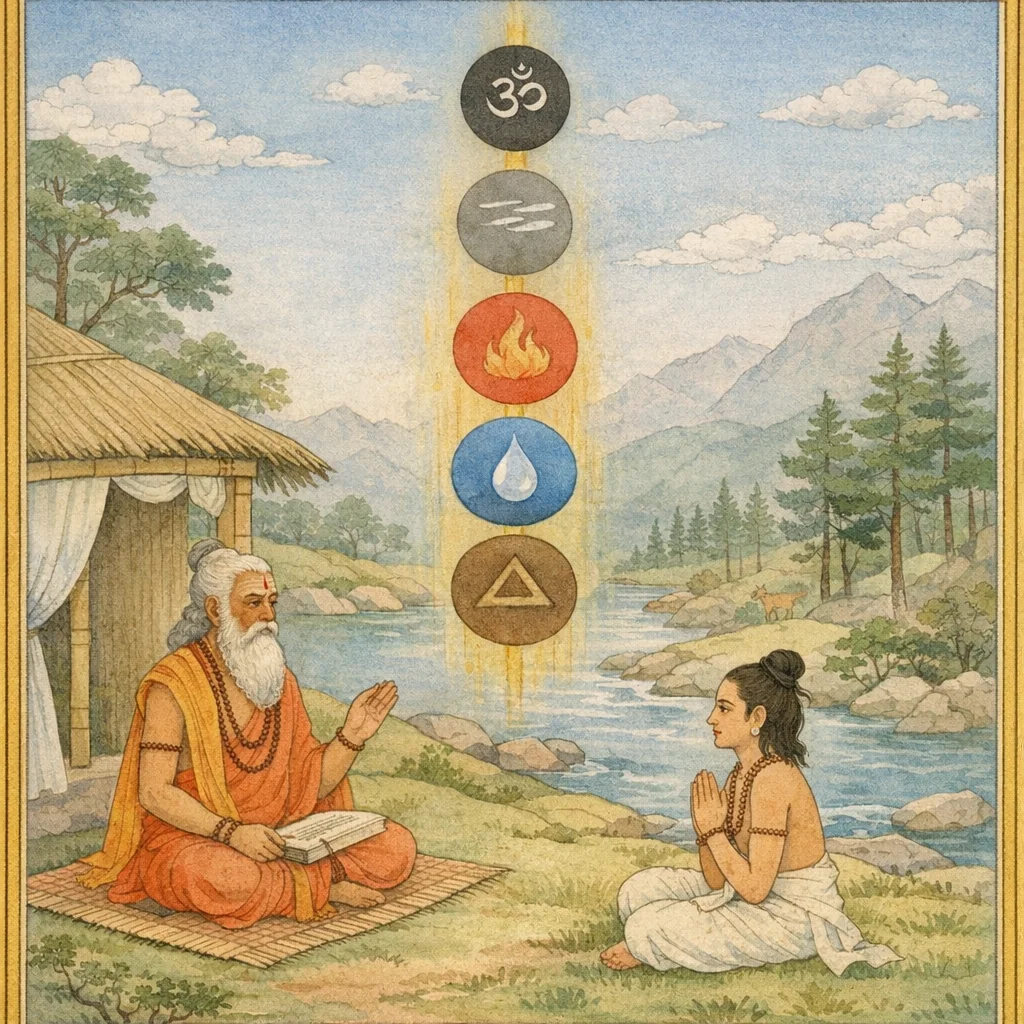
Chapter Arc: शुक के प्रश्नों के उत्तर में व्यास सृष्टि-क्रम का द्वार खोलते हैं—युगों के मान, ‘अकाल’ की गणना, और यह संकेत कि काल-चक्र भी ब्रह्म-बीज से ही उद्भूत है। → व्यास एक-एक तत्त्व का उद्गम बताते हुए सूक्ष्म से स्थूल की यात्रा कराते हैं: तेजोमय ब्रह्म से जगत्, फिर आकाश, वायु (स्पर्श-गुण), अग्नि, जल (रस), और पृथ्वी (गन्ध) तक; साथ ही मन की चंचल, दूरगामी, संशयात्मक गति को रेखांकित कर साधक के लिए भीतर का संकट खड़ा करते हैं। → तप का रहस्य उद्घाटित होता है—निःश्रेयस का मूल तप है, और तप का मूल शम-दम; यही वह मोड़ है जहाँ ब्रह्माण्ड-रचना का ज्ञान सीधे आत्म-रचना (आत्मसंयम) की साधना में बदल जाता है। → व्यास समेटते हैं कि सर्ग, काल-क्रिया, वेद, कर्ता-कार्य, क्रिया-फल—ये सब वही हैं जिनके विषय में शुक ने पूछा; और ईश्वर वेद-शब्दों के अनुसार नाम-रूप, ऋषि-नाम, प्राणी-रूप तथा कर्म-व्यवस्था की रचना करता है। → वेद-शब्द से नाम-रूप की रचना का सिद्धान्त आगे के अध्यायों में ‘शब्द-ब्रह्म’ और मोक्ष-मार्ग की अधिक सूक्ष्म व्याख्या की ओर संकेत करता है।
Shlokas
Verse 1
अकाल - अर्थात् संध्या और संध्याशोंसहित त्रेतायुग छत्तीस सौ वर्षोका, द्वापर चौबीस सौ वर्षोफका और कलियुग बारह सौ वर्षोका होता है। द्वात्रिशर्दाधिकद्विशततमो< ध्याय: व्यासजीका शुकदेवको सृष्टिके उत्पत्ति-क्रम तथा युगधर्मोका उपदेश व्यास उवाच ब्रह्म तेजोमयं शुक्र यस्य सर्वमिदं जगत् | एकस्य ब्रह्मुभूतस्य द्ववं स्थावरजड्रमम्
Vyāsa said: Brahman is pure, radiant, and luminous; from That, this entire universe is constituted. From the one Reality that has become Brahman, the whole field of experience appears as the moving and the unmoving—everything that can be seen in the world.
Verse 2
व्यासजी कहते हैं--बेटा! तेजोमय ब्रह्म ही सबका बीज है, उसीसे यह सम्पूर्ण जगत् उत्पन्न हुआ है। उस एक ही ब्रह्मसे स्थावर और जंगम दोनोंकी उत्पत्ति होती है ।। अहर्मुखे विबुद्ध: सन् सृजतेडविद्यया जगत् । अग्र एव महद्भूतमाशु व्यक्तात्मक॑ं मन:,पहले कह आये हैं, ब्रह्माजी अपने दिनके आरम्भमें जागकर अविद्या (त्रिगुणात्मिका प्रकृतिके) द्वारा सम्पूर्ण जगत्की सृष्टि करते हैं। सबसे पहले महत्तत्त्व प्रकट होता है। उससे स्थूल सृष्टिका आधारभूत मन उत्पन्न होता है
Vyāsa said: “My son, the luminous Brahman alone is the seed of all; from That this entire universe has arisen. From that one Brahman come forth both the immovable and the moving orders of beings. At the beginning of his day, having awakened, Brahmā—through avidyā, the three guṇas constituting prakṛti—brings forth the world. First the great principle (mahat) manifests; from it quickly arises mind (manas), the basis for the later, gross creation.”
Verse 3
अभिभूयेह चार्चिष्मद् व्यसृजत् सप्त मानसान् | दूरगं बहुधागामि प्रार्थनासंशयात्मकम्,उस मनकी दूरतक गति है तथा वह अनेक प्रकारसे गमनागमन करता है। प्रार्थना और संशय-वृत्तिशाली वह मन चैतन्यसे संयुक्त होकर सम्पूर्ण पदार्थोको अभिभूत करके सात- मानस ऋषियोंकी सृष्टि करता है
Vyāsa said: Here, having overpowered all things, the radiant principle brought forth the seven mind-born sages. The mind ranges far, moves to and fro in many ways, and is marked by supplication and doubt; yet, joined to consciousness, it subdues all objects and becomes the source of creation.
Verse 4
मन: सृष्टिं विकुरुते चोद्यमानं सिसृक्षया । आकाशं जायते तस्मात् तस्य शब्दं गुणं विदु:,फिर सृष्टिकी इच्छासे प्रेरित होनेपर मन नाना प्रकारकी सृष्टि करता है। उससे आकाशकी उत्पत्ति होती है। आकाशका गुण “शब्द” माना गया है
Vyāsa said: When the mind is impelled by the desire to create, it fashions the manifold process of creation. From that arises ākāśa (space/ether), and the wise know its defining quality to be sound.
Verse 5
आकाशात् तु विकुर्वाणात् सर्वगन्धवह: शुचि: । बलवान जायते वायुस्तस्य स्पर्शो गुणो मत:,तत्पश्चात् जब आकाशमें विकार होता है, तब उससे पवित्र और सम्पूर्ण गन्धोंको वहन करनेवाले बलवान वायुतत्त्वका आविर्भाव होता है। उसका गुण स्पर्श! माना गया है
Vyāsa explains the sequence of elemental manifestation: when space (ākāśa) undergoes modification, there arises the powerful principle of wind (vāyu), pure and capable of carrying all fragrances. The distinctive quality assigned to wind is touch (sparśa).
Verse 6
वायोरपि विकुर्वाणाज्ज्योतिर्भवति भास्वरम् | रोचिष्णु जायते शुक्र तद्रूपगुणमुच्यते,फिर वायुमें भी विकार होता है और उससे प्रकाशपूर्ण अग्नि-तत्त्व प्रकट होता है। वह अग्नि-तत्त्व चमचमाता हुआ एवं दीप्तिमान् है। उसका गुण “रूप! बताया जाता है
Vyāsa explains the sequence of elemental transformation: even within wind (vāyu), a modification arises, and from that arises radiant fire as luminous light. That fire-element is shining and brilliant; its characteristic quality is said to be “form/visibility” (rūpa).
Verse 7
ज्योतिषो5पि विकुर्वाणाद् भवन्त्यापो रसात्मिका: । अदृभ्यो गन्धवहा भूमि: सर्वेषां सृष्टिरुच्यते,फिर अग्नि-तत्त्वमें विकार आनेपर रसमय जल-तत्त्वकी उत्पत्ति होती है। जलसे गन्धका वहन करनेवाली पृथ्वीका प्रादुर्भाव होता है। इस प्रकार पञ्चमहाभूतोंकी सृष्टि बतायी जाती है
Vyāsa said: When the luminous principle (fire/tejas) undergoes transformation, waters arise, whose nature is taste (rasa). From the waters, earth comes forth as the bearer of scent (gandha). Thus is described the origination of all the elements in the account of creation.
Verse 8
गुणा: सर्वस्य पूर्वस्य प्राप्तुवन्त्युत्तरोत्तरम् । तेषां यावद् यथा यच्च तत्तत् तावदगुणं स्मृतम्,पीछे प्रकट हुए वायु आदि भूत उत्तरोत्तर अपने पूर्ववर्ती सभी भूतोंके गुण धारण करते हैं। इन सब भूतोंमेंसे जो भूत जितने समयतक जिस प्रकार रहता है, उसके गुण भी उतने ही समयतक रहते हैं
Vyāsa said: In the successive unfolding of the elements, each later element takes on the qualities of the one that came before it. And among these elements, whatever element persists for whatever duration and in whatever mode, its qualities are understood to endure only for that same extent—beyond that, it is regarded as devoid of those qualities.
Verse 9
उपलकभ्याप्सु चेद् गन्धं केचिद् ब्रूयुरनैपुणात् । पृथिव्यामेव तं॑ विद्यादपां वायोश्व संश्रितम्,यदि कुछ मनुष्य जलमें गन्ध पाकर अयोग्यतावश यह कहने लगें कि यह जलका ही गुण है तो उनका वह कथन मिथ्या होगा; क्योंकि गन्ध वास्तवमें पृथ्वीका गुण है; अतः उसे पृथ्वीमें ही स्थित जानना चाहिये। जल और वायुमें तो वह आगन्तुककी भाँति स्थित होता है
Vyāsa said: If, on perceiving fragrance in water, some people—through lack of discernment—declare, “This is a property of water,” their statement is mistaken. Fragrance truly belongs to earth; therefore it should be understood as residing in earth. In water and in wind it abides only as something adventitious, as though a guest.
Verse 10
एते सप्तविधात्मानो नानावीर्या: पृथक् पृथक् । नाशवनुवन् प्रजा: स्रष्टमसमागम्य कृत्स्नश:,ये नाना प्रकारकी शक्तिवाले महत्तत््व, मन (अहंकार) और पज्चसूक्ष्म महाभूत--सात पदार्थ पृथक्ू-पृथक् रहकर जबतक सब-के-सब मिल न सकें; तबतक उनमें प्रजाकी सृष्टि करनेकी शक्ति नहीं आयी
Vyāsa said: These seven principles, each of a distinct nature and potency, remained separate and could not create living beings so long as they did not all come together in their entirety. Only through their complete conjunction does the capacity for creation arise—showing that the world’s origination depends on coordinated union, not isolated power.
Verse 11
ते समेत्य महात्मानो हरान्योन्यमभिसंश्रिता: । शरीराश्रयणं प्राप्तास्तत: पुरुष उच्यते,परंतु ये सातों व्यापक पदार्थ ईश्वरकी इच्छा होनेपर जब एक-दूसरेसे मिलकर परस्पर सहयोगी हो गये, तब भिन्न-भिन्न शरीरके आकारमें परिणत हुए। उस शरीरनामक पुरमें निवास करनेके कारण जीवात्मा पुरुष कहलाता है
Vyāsa said: When those great, all-pervading principles, coming together and mutually supporting one another, take on the condition of being lodged in a body, then the indwelling self is called ‘puruṣa’—so named because it dwells within the ‘pura’, the city-like body.
Verse 12
शरीरं श्रयणाद् भवति मूर्तिमत् षोडशात्मकम् | तमाविशन्ति भूतानि महान्ति सह कर्मणा,पञ्च स्थूल महाभूत, दस इन्द्रियाँ और मन--इन सोलह तत्त्वोंसे शरीरका निर्माण हुआ है। इन सबका आश्रय होनेके कारण ही देहको शरीर कहते हैं। शरीरके उत्पन्न होनेपर उसमें जीवोंके भोगावशिष्ट कर्मोके साथ सूक्ष्म महाभूत प्रवेश करते हैं
Vyāsa explains that the body is called ‘śarīra’ because it serves as a support and dwelling-place. It is a tangible form constituted of sixteen principles. When such a body arises, the great elements enter into it together with the residue of past actions, so that embodied experience—pleasure, pain, and moral consequence—can unfold in an ordered way.
Verse 13
सर्वभूतान्युपादाय तपसश्नलरणाय हि । आदिकर्ता स भूतानां तमेवाहु: प्रजापतिम्,भूतोंके आदि कर्ता ब्रह्माजी ही तपस्याके लिये समस्त सूक्ष्म भूतोंको साथ लेकर समष्टि शरीरमें प्रवेश करके स्थित होते हैं; इसलिये मुनिजन उन्हें प्रजापति कहते हैं
Vyāsa said: Taking up all beings (in their subtle constituents) for the sake of austerity and creative exertion, he becomes the primordial maker of creatures. Therefore the sages call him “Prajāpati”, the Lord who brings forth and orders living beings.
Verse 14
स वै सृजति भूतानि स्थावराणि चराणि च । ततः स सृजति ब्रह्मा देवर्षिपितृमानवान्,तदनन्तर वे ब्रह्मा ही चराचर प्राणियोंकी सृष्टि करते हैं। वे ही देवता, ऋषि, पितर, मनुष्य, नाना प्रकारके लोक, नदी, समुद्र, दिशा, पर्वत, वनस्पति, किन्नर, राक्षस, पशु, पक्षी, मृग तथा सर्पोको भी उत्पन्न करते हैं। अक्षय आकाश आदि और क्षयशील चराचर प्राणियोंकी सृष्टि भी उन्हींके द्वारा हुई है
Vyāsa said: He indeed brings forth all beings, both immobile and mobile. Thereafter that very Brahmā creates the gods, the divine seers, the ancestors, and human beings—thus portraying the cosmic order as arising from a single creative principle that sustains all categories of life and duty within the world.
Verse 15
लोकान् नदी: समुद्रांश्न दिश: शैलान् वनस्पतीन् । नरकिन्नररक्षांसि वयःपशुमृगोरगान् । अव्ययं च व्ययं चैव द्वयं स्थावरजजड्रमम्,तदनन्तर वे ब्रह्मा ही चराचर प्राणियोंकी सृष्टि करते हैं। वे ही देवता, ऋषि, पितर, मनुष्य, नाना प्रकारके लोक, नदी, समुद्र, दिशा, पर्वत, वनस्पति, किन्नर, राक्षस, पशु, पक्षी, मृग तथा सर्पोको भी उत्पन्न करते हैं। अक्षय आकाश आदि और क्षयशील चराचर प्राणियोंकी सृष्टि भी उन्हींके द्वारा हुई है
Vyāsa said: Brahmā brings forth the worlds—rivers and oceans, the directions, mountains, and plants; beings such as men, Kinnaras and Rākṣasas; and all creatures that fly, walk, crawl, or swim—birds, cattle, wild animals, and serpents. He also produces both the imperishable and the perishable: the twofold creation of the unmoving and the moving. Thus, after the primordial principles are set in order, Brahmā becomes the agent through whom the entire community of living beings, mobile and immobile, comes into manifestation.
Verse 16
तेषां ये यानि कर्माणि प्राक्सृष्ट्यां प्रतिपेदिरे । तान्येव प्रतिपाद्यन्ते सृज्यमाना: पुनः पुन:,पूर्वकल्पकी सृष्टिमें जिन प्राणियोंद्वारा जैसे कर्म किये गये होते हैं, दूसरे कल्पोंमें बारंबार जन्म लेनेपर वे उन पूर्वकृत कर्मोंकी वासनासे प्रभावित होनेके कारण वैसे ही कर्म करने लगते हैं
Vyāsa said: Whatever deeds those beings undertook in the former creation, those very patterns are set in motion again and again when they are created anew. Thus, across repeated cycles of creation, creatures tend to act in accordance with the residual impressions of their earlier actions.
Verse 17
हिंस्राहिंस्रे मृदुक्ूरे धर्माधमावृतानृते । तद्धाविता: प्रपद्यन्ते तस्मात् तत् तस्य रोचते,एक जन्ममें मनुष्य हिंसा-अहिंसा, कोमलता-कठोरता, धर्म-अधर्म और सच-झूठ आदि जिन गुणों या दोषोंको अपनाता है, दूसरे जन्ममें भी उनके संस्कारोंसे प्रभावित होकर उन्हीं गुणोंको वह पसंद करता और वैसे ही कार्योमें लग जाता है
Vyāsa explains that a person’s tendencies are shaped by what they repeatedly choose: violence or non-violence, gentleness or cruelty, righteousness or unrighteousness, truth or falsehood. Driven by those ingrained dispositions, they take to the same kinds of actions again; therefore, what one has cultivated comes to feel pleasing and natural to them—even in a later birth.
Verse 18
महाभूतेषु नानात्वमिन्द्रियार्थेषु मूर्तिषु । विनियोगं च भूतानां धातैव विदधात्युत,आकाश आदि महाभूतोंमें, शब्द आदि विषयोंमें तथा देवता आदिकी आकृतियोंमें जो अनेकता और भिन्नता है तथा प्राणियोंकी जो भिन्न-भिन्न कार्योमें नियुक्ति है, इन सबका विधान विधाता ही करते हैं
In the great elements—beginning with ether—, in the objects of the senses—beginning with sound—, and in the forms of gods and other embodied shapes, whatever diversity and distinction there is, and whatever appointment of beings to their various functions—of all this the Ordainer, the Vidhātā, is indeed the maker.
Verse 19
केचित् पुरुषकार तु प्राहु: कर्मसु मानवा: । दैवमित्यपरे विप्रा: स्वभावं भूतचिन्तका:,कुछ लोग कर्मोंकी सिद्धिमें पुरुषार्थको ही प्रधान मानते हैं। दूसरे ब्राह्मण दैवको प्रधानता देते हैं और भूतचिन्तक नास्तिकगण स्वभावको ही कार्यसिद्धिका कारण बताते हैं
Vyāsa said: Among human beings, some declare personal effort (puruṣakāra) to be the chief factor in the success of actions. Others—learned Brahmins—call destiny (daiva) the decisive power; while those who speculate on the elements and deny higher agency assert that one’s innate nature (svabhāva) alone brings about the fruition of deeds.
Verse 20
पौरुषं कर्म दैवं च फलवृत्ति: स्वभावत: । त्रय एते5पृथग्भूता न विवेक॑ तु केचन,कुछ विद्वान् कहते हैं कि पुरुषार्थ, दैव और स्वभावसे अनुगृहीत कर्म--इन तीनोंके सहयोगसे फलकी सिद्धि होती है। ये तीनों मिलकर ही कार्यसाधक होते हैं। इनका अलग-अलग होना कार्यकी सिद्धिका हेतु नहीं होता है
Some declare that the fruition of action arises naturally from the combined working of three factors: human effort, destiny, and innate disposition. These three bring about results only as an inseparable whole; taken separately, none is sufficient for success.
Verse 21
एतमेव च नैवं च न चोभे नानुभे न च । कर्मस्था विषयं ब्रूयु: सत्त्वस्था: समदर्शिन:,कर्मवादी इस विषयमें यह पुरुषार्थ ही कार्यसाधक है, ऐसा नहीं कहते। ऐसा नहीं है, अर्थात् पुरुषार्थ नहीं, दैव कारण है, यह भी नहीं कहते। दोनों मिलकर कार्यसिद्धिके हेतु हैं, यह भी नहीं कहते और दोनों नहीं हैं, यह भी नहीं कहते हैं। तात्पर्य यह है कि वे इस विषयमें कुछ निश्चय नहीं कर पाते हैं; परंतु जो सत्त्वस्वरूप परमात्मामें स्थित हुए योगी हैं, वे समदर्शी हैं अर्थात् शम (ब्रह्म) को ही कारण मानते हैं
Vyāsa said: Those who stand by action speak of this matter in conflicting ways: some say, “This alone (human effort) is the cause”; others say, “Not so—effort is not the cause; fate is.” Some claim that both together bring about success, while others deny both. Thus they fail to reach a settled conclusion. But the yogins established in sattva, who see equally, discern the one underlying reality as the true ground of causation.
Verse 22
तपो निः:श्रेयसं जन्तोस्तस्य मूलं शमो दम: । तेन सर्वानिवाप्नोति यान् कामान् मनसेच्छति,तप ही जीवके कल्याणका मुख्य साधन है। तपका मूल है शम और दम। पुरुष अपने मनसे जिन-जिन कामनाओंको पाना चाहता है, उन सबको वह तपस्यासे प्राप्त कर लेता है
Vyāsa said: For a living being, austerity (tapas) is a direct means to the highest good. The root of that austerity is inner calm (śama) and self-restraint (dama). By such disciplined practice, a person attains all those aims and fulfillments that the mind rightly seeks.
Verse 23
तपसा तदवाप्रोति यद्धूतं सूजते जगत् | स तद्धूतश्व सर्वेषां भूतानां भवति प्रभु:,तपस्यासे वह उस परमात्मसत्ताको भी प्राप्त कर लेता है, जिससे इस जगत्की सृष्टि होती है। तपसे परमात्मस्वरूप होकर मनुष्य समस्त प्राणियोंपर अपना प्रभुत्व स्थापित करता है
Vyāsa said: By austerity one attains that purified, subtle principle from which the world is brought forth. Having become identified with that purified state through tapas, a person becomes masterful—gaining lordship over all beings.
Verse 24
ऋषयस्तपसा वेदानध्यैषन्त दिवानिशम् । अनादिनिधना विद्या वागुत्सृष्टा स्वयम्भुवा,तपके ही प्रभावसे महर्षिगण दिन-रात वेदोंका अध्ययन करते थे। तपःशक्तिसे सम्पन्न होकर ही ब्रह्माजीने आदि-अन्तसे रहित वेदमयी वाणीका प्रथम उच्चारण किया
Vyāsa said: The sages, empowered by austerity, studied the Vedas day and night. That Vedic knowledge—without beginning or end—was first uttered as sacred speech by the Self-born (Brahmā). The passage highlights that revelation is approached through disciplined tapas and sustained study, and that true learning is treated as timeless and impersonal rather than a mere human invention.
Verse 25
ऋषीणां नामधेयानि याश्च वेदेषु सृष्टय: । नानारूपं च भूतानां कर्मणां च प्रवर्तनम्
Vyāsa said: “(He taught) the names and lineages of the seers, and the various emanations described in the Vedas; and also the manifold forms of living beings, together with the way actions are set in motion and come to operate.”
Verse 26
नामथेयानि चर्षीणां याश्व वेदेषु सृष्टय:
Vyāsa said: “And the appellations (names) of the seers, together with the various creations as described in the Vedas, are to be understood in that sacred tradition.”
Verse 27
शर्वर्यन्ते सुजातानामन्येभ्यो विदधात्यज: । वेदोंमें ऋषियोंके नाम तो हैं ही, सृष्टिमें उत्पन्न हुए सब पदार्थोंके भी नाम हैं। अजन्मा ब्रह्माजी अपनी रात्रिके अन्तमें अर्थात् नूतन सृष्टिके प्रभातकालमें अपने द्वारा रचे गये सभी पदार्थोंका दूसरोंके लिये नाम-निर्देश करते हैं || २६६ || नामभेदतप:कर्मयज्ञाख्या लोकसिद्धय:,फिर ब्रह्माजीने ऋग्वेद आदिके नाम, वर्ण और आश्रमके भेद, तप, शाम, दम (कृच्छु-चान्द्रायणादि व्रत), कर्म (संध्योपासन आदि नित्य-कर्म) और ज्योतिष्टोम आदि यज्ञ बनाये। ये नाम आदि लौकिक सिद्धियाँ हैं
Vyāsa said: At the close of the cosmic night, the Unborn (Brahmā) assigns names to the well-born beings and to all the created entities, making them known to others. Thereafter he establishes the recognized distinctions and designations—names and classifications, the disciplines of austerity, the codes of conduct and ritual action, and the appellations of sacrifices—so that the world may function through shared conventions and ordered duties.
Verse 28
आत्मसिद्धिस्तु वेदेषु प्रोच्यते दशभि: क्रमै: । यदुक्तं वेदवादेषु गहनं वेददर्शिभि: । तदन्तेषु यथायुक्तं क्रमयोगेन लक्ष्यते,आत्मा (के मोक्ष) की सिद्धि तो वेदोंमें दस- उपायोंद्वारा बतायी जाती है। जो गहन ([दुर्बोध) ब्रह्म वेदवाक्योंमें वेददर्शी विद्वानोंद्वारा वर्णित हुआ है और वेदान्तवचनोंमें जिसका स्पष्टरूपसे वर्णन किया गया है, वह क्रमयोगसे लक्षित होता है
Vyāsa said: In the Vedas, the attainment of the Self is taught through ten successive stages. That profound truth which the seers of the Veda have expressed in Vedic declarations—and which is set forth with clarity in the concluding teachings (Vedānta)—is to be discerned through the disciplined practice of step-by-step yoga.
Verse 29
कर्मजो<यं पृथग्भावो द्वन्द्ययुक्तोडपि देहिन: । तमात्मसिद्धिर्विज्ञानाज्जहाति पुरुषो बलात्,देहाभिमानी जीवको जो यह पृथक्-पृथक् शीत-उष्ण आदि द्वन्धोंका भोग प्राप्त होता है, वह कर्मजनित है। मनुष्य तत्त्वज्ञानके द्वारा उस द्वन्द्रभोगको त्याग देता है तथा ज्ञानके ही बलसे आत्मसिद्धि (मोक्ष) प्राप्त कर लेता है
Vyāsa said: This sense of separateness in the embodied being—though bound up with the pairs of opposites (like cold and heat)—arises from karma. Through true discernment, a person forcefully abandons that experience of duality, and by the very power of knowledge attains self-realization, i.e., liberation.
Verse 30
दे ब्रह्मणी वेदितव्ये शब्दब्रह्म परं च यत् शब्दब्रद्माणि निष्णात: परं ब्रह्माधिगच्छति,ब्रह्मके दो स्वरूप जानने चाहिये--एक शब्दब्रह्म और दूसरा परब्रह्म, जो शब्दब्रह्म अर्थात् वेदका पूर्ण विद्वान् है, वह सुगमतासे परब्रह्मका साक्षात्कार कर लेता है
Vyāsa said: There are two aspects of Brahman that should be understood—Brahman as sacred sound (the Veda, grasped through words) and that supreme Brahman which transcends words. One who is thoroughly accomplished in the Brahman of sound—fully versed in the Veda—can, with relative ease, attain direct realization of the supreme Brahman.
Verse 31
आलम्भयज्ञा: क्षत्राश्न॒ हविर्यज्ञा विश: स्मृता: । परिचारयज्ञा: शूद्रास्तु तपोयज्ञा द्विजातय:,ब्राह्मणोंके लिये तप ही यज्ञ है, क्षत्रियोंके लिये हिंसाप्रधान युद्ध आदि ही यज्ञ हैं, वैश्योंक लिये घृत आदि हविष्यकी आहुति देना ही यज्ञ है और शूद्रोंके लिये तीनों वर्णोकी सेवा ही यज्ञ है
Vyāsa said: For kṣatriyas, sacrifice is understood as the ‘ālam̐bha’ type—acts involving force such as battle and the exertion of royal power. For vaiśyas, sacrifice is the offering of havis, such as ghee and other oblations, into the sacred fire. For śūdras, sacrifice is service and attendance upon the other three social orders. For the twice-born, sacrifice is austerity—self-discipline and spiritual effort. Thus each group is taught a form of yajña suited to its station, directing duty toward social order and inner restraint.
Verse 32
त्रेतायुगे विधिस्त्वेष यज्ञानां न कृते युगे । द्वापरे विप्लवं यान्ति यज्ञा: कलियुगे तथा,यह यज्ञोंका विधान त्रेतायुगमें ही था, सत्ययुगमें नहीं। द्वापरसे क्रमश: क्षीण होते हुए यज्ञ कलियुगमें लुप्त हो जाते हैं
Vyāsa said: “This formal ordinance for sacrificial rites belongs to the Tretā age, not to the Kṛta age. In the Dvāpara age the sacrifices begin to fall into disorder and decline, and in the Kali age they likewise disappear.”
Verse 33
अपृथग्धर्मिणो मर्त्या ऋक्सामानि यजूंषि च | काम्या इष्टी: पृथग् दृष्टया तपोभिस्तप एव च,सत्ययुगमें अद्दैत-धर्ममें निष्ठा रखनेवाले मनुष्य ऋग्वेद, सामवेद और यजुर्वेद तथा सकाम इष्टियोंको ज्ञानरूप तपस्यासे भिन्न देखकर उन सबको छोड़ केवल ज्ञानरूप तपस्यामें ही संलग्न होते हैं
Vyāsa said: In the Satya Yuga, mortals established in the non-dual (advaita) understanding of dharma do not treat the Ṛg, Sāma, and Yajur Vedas, nor desire-driven sacrifices, as separate and independent ends. Seeing them as distinct from the austerity of knowledge, they set those ritual pursuits aside and devote themselves solely to that knowledge-austerity, which leads to liberation rather than worldly gain.
Verse 34
त्रेतायां तु समस्ता ये प्रादुरासन् महाबला: । संयन्तार: स्थावराणां जड़मानां च सर्वश:,त्रेतायुगमें जो महाबली नरेश प्रकट हुए थे, वे सब-के-सब समस्त चराचर प्राणियोंके नियन्ता थे
Vyāsa said: In the Tretā age, all those mighty rulers who appeared were, in every way, restrainers and governors of all beings—of the immobile as well as the dull-witted—maintaining order across the whole range of life.
Verse 35
त्रेतायां संहता वेदा यज्ञा वर्णाश्रमास्तथा । संरोधादायुषस्त्वेते भ्रश्यन्ते द्वापरे युगे,त्रेतायुगमें वेद, यज्ञ और वर्णाश्रम-धर्म सुव्यवस्थितरूपसे पालित होते थे; परंतु द्वापरयुगमें आयुकी न्यूनता होनेसे लोगोंमें उनके पालनका उत्साह कम हो गया--वे वेद यज्ञ आदिसे च्युत होने लगे
Vyāsa said: In the Tretā age, the Vedas were held together in an undivided form, and so too were the sacrificial rites and the disciplines of the social and spiritual orders properly maintained. But in the Dvāpara age, because human lifespan becomes constrained, these institutions begin to decline—people gradually fall away from the Vedas, sacrifice, and the duties of varṇa and āśrama.
Verse 36
दृश्यन्ते न च दृश्यन्ते वेदा: कलियुगेडखिला: । उत्सीदन्ते सयज्ञाशक्ष॒ केवलाधर्मपीडिता:,कलियुग आनेपर तो कहीं वेदोंका दर्शन होता है और कहीं नहीं होता है। उस समय केवल अधर्मसे पीड़ित होकर यज्ञ और वेद लुप्त हो जाते हैं
Vyāsa said: In the Kali age, the Vedas are, in some places, seen and preserved, and in other places not seen at all. Overwhelmed solely by the pressure of adharma, both the sacrificial rites and the Vedic tradition decline and fall into obscurity.
Verse 37
कृते युगे यस्तु धर्मों ब्राह्मुणेषु प्रदृश्यते । आत्मवत्सु तपोवत्सु श्रुतवत्सु प्रतिक्तित:,सत्ययुगमें जिस चारों चरणोंवाले धर्मकी चर्चा की गयी है, वह अन्य युगोंमें भी मनको वशमें रखनेवाले तपस्वी एवं वेद-वेदान्तोंके ज्ञाता ब्राह्मणोंमें प्रतिष्ठित देखा जाता है
Vyāsa said: The dharma that is seen in the Kṛta Yuga—complete and fully established—is also found established in other ages among brāhmaṇas who are self-controlled, devoted to austerity, and grounded in sacred learning.
Verse 38
सधर्मव्रतसंयोगं यथाधर्म युगे युगे । विक्रियन्ते स्वधर्मस्था वेदवादा यथागमम्,सत्ययुगमें मनुष्य स्वभावके अनुसार यज्ञ, व्रत और तीर्थाटन आदि करते हैं और त्रेता आदि युगमें वेदवादी एवं स्वधर्मनिष्ठ पुरुष शास्त्रके कथनानुसार धर्मके ह्वाससे विकारको प्राप्त होते हैं
Vyāsa said: “In each age, the union of righteous conduct and vowed observances takes form according to that age’s dharma. Yet as dharma wanes from one yuga to the next, even those who stand firm in their own duty and speak in accord with the Veda undergo change—conforming to what the scriptures prescribe for that shifting time.”
Verse 39
यथा विश्वानि भूतानि वृष्ट्या भूयांसि प्रावृषि । सृज्यन्ते जड़मस्थानि तथा धर्मा युगे युगे,जैसे वर्षाकालमें जलकी वर्षा होनेसे स्थावर और जंगम समस्त पदार्थ वृद्धिको प्राप्त होते हैं और वर्षा बीतनेपर उनका हास होने लगता है, उसी प्रकार प्रत्येक युगमें धर्म और अधर्मकी वृद्धि एवं हास होते रहते हैं
Vyāsa said: “Just as, in the rainy season, all beings—moving and unmoving—grow and multiply through rainfall, and then, when the rains pass, begin to wane, so too in every age dharma rises and declines, and with it adharma also alternately increases and diminishes.”
Verse 40
यर्थर्तष्वृतुलिड्रानि नानारूपाणि पर्यये । दृश्यन्ते तानि तान्येव तथा ब्रह्महरादिषु,जैसे वसन््त आदि ऋतुओंमें फूल और फल आदि नाना प्रकारके ऋतुचिह्न दृष्टिगोचर होते हैं और भिन्न ऋतुओंमें उन चिह्नोंका दर्शन नहीं होता, उसी प्रकार ब्रह्मा, विष्णु और महेश्वरमें भी सृष्टि, रक्षा और संहारकी शक्तियाँ कभी न्यून और कभी अधिक दिखायी देती हैं
Vyāsa said: “Just as, in the cycle of seasons, the distinctive signs of each season—appearing in many forms—are seen only in their proper turn and are not perceived in other seasons, so too among Brahmā, Viṣṇu, and Hara the powers of creation, preservation, and dissolution appear at times diminished and at times increased.”
Verse 41
विहितं कालनानात्वमनादिनिधनं तथा । कीर्तितं तत्पुरस्तात् ते तत्सूते चात्ति च प्रजा:,स्वयं ब्रह्माजीने ही सत्ययुग, त्रेता आदिके रूपमें कालभेदका विधान किया है। वह अनादि और अनन्त है। वह काल ही लोककी सृष्टि और संहार करता है। बेटा! यह बात मैं तुमसे पहले ही बता चुका हूँ
Vyāsa said: “Brahmā himself ordained the distinctions of Time—as Satya-yuga, Tretā-yuga, and the other ages—and that Time is without beginning and without end. Time itself creates the worlds and brings them to dissolution. My son, I have told you this before.”
Verse 42
दधाति प्रभवे स्थानं भूतानां संयमो यम: । स्वभावेनैव वर्तन्ते द्वन्द्ययुक्तानि भूरिश:,काल ही सम्पूर्ण प्राणियोंको संयम और नियममें रखनेवाला है। वही उनकी उत्पत्तिके लिये स्थान धारण करता है। सारे प्राणी स्वभावसे ही द्वद्धोंसे युक्त होकर अत्यन्त वष्ट पाते हैं
Vyāsa said: “Time is the keeper that holds all beings to restraint and rule; it also upholds the ground for the arising of creatures. All beings move by their very nature, bound to countless pairs of opposites (dvandva), and thus are sorely buffeted.”
Verse 43
सर्गकालक्रिया वेदा: कर्ता कार्य क्रियाफलम् | प्रोक्त ते पुत्र सर्व वै यन्मां त्वं परिपृच्छसि,बेटा! तुमने मुझसे जो कुछ पूछा था, उसके अनुसार मैंने तुम्हें सृष्टि, काल, क्रिया, वेद, कर्ता, कार्य तथा क्रियाफल आदि सब विषय बता दिये
Vyāsa said: “O son, I have explained to you everything you asked of me—creation and its unfolding, time, action, the Vedas, the agent, the act to be done, and the fruit that action yields.”
Verse 232
इति श्रीमहाभारते शान्तिपर्वणि मोक्षधर्मपर्वणि शुकानुप्रश्ने द्वात्रिंशयदधिकद्धिशततमो<ध्याय:
Thus ends the two-hundred-and-thirty-second chapter in the Mokṣadharma section of the Śānti Parva of the Śrī Mahābhārata, in the episode of Śuka’s inquiry—a formal colophon closing this unit of teaching on liberation and spiritual discipline.
Verse 256
वेदशब्देभ्य एवादौ निर्मिमीते स ईश्वर: । ऋषियोंके नाम, वेदोक्त सृष्टिक्रमके अनुसार रचे हुए सब पदार्थोके नाम, प्राणियोंके अनेकविध रूप तथा उनके कर्मोंका विधान--यह सब कुछ वे ऐश्वर्यशाली प्रजापति सृष्टिके आदिकालमें वेदोक्त शब्दोंके अनुसार ही रचते हैं
Vyāsa said: “In the very beginning, the Lord fashions creation from the words of the Veda. The names of the seers, the names of all things as arranged according to the Vedic order of creation, the many forms of living beings, and the ordinances governing their actions—all this the glorious Prajāpati establishes at the dawn of the world in accordance with Vedic speech.”
Frequently Asked Questions
How to stabilize mind and senses into one-pointed concentration by removing recurrent disturbances—especially desire, anger, greed, fear, and sleep—so that contemplative clarity becomes sustainable.
A progressive ‘gathering’ method: restrain the sense-group, place it in the mind, remove saṅkalpas (intentions/constructs), and then hold the mind in the self until the five senses with the mind-as-sixth settle and become tranquil.
Yes. It distinguishes transcending ‘śabda-brahman’ (primarily verbal or textual sacred knowledge) from the experiential disclosure in which brahman is said to ‘manifest’ to sustained, equanimous practice.