Adhyaya 188
ध्यानयोगवर्णनम् (Description of the Path of Meditation)
Upa-parva: Mokṣa-dharma (Liberation Teachings) — Dhyāna-yoga Sub-topic
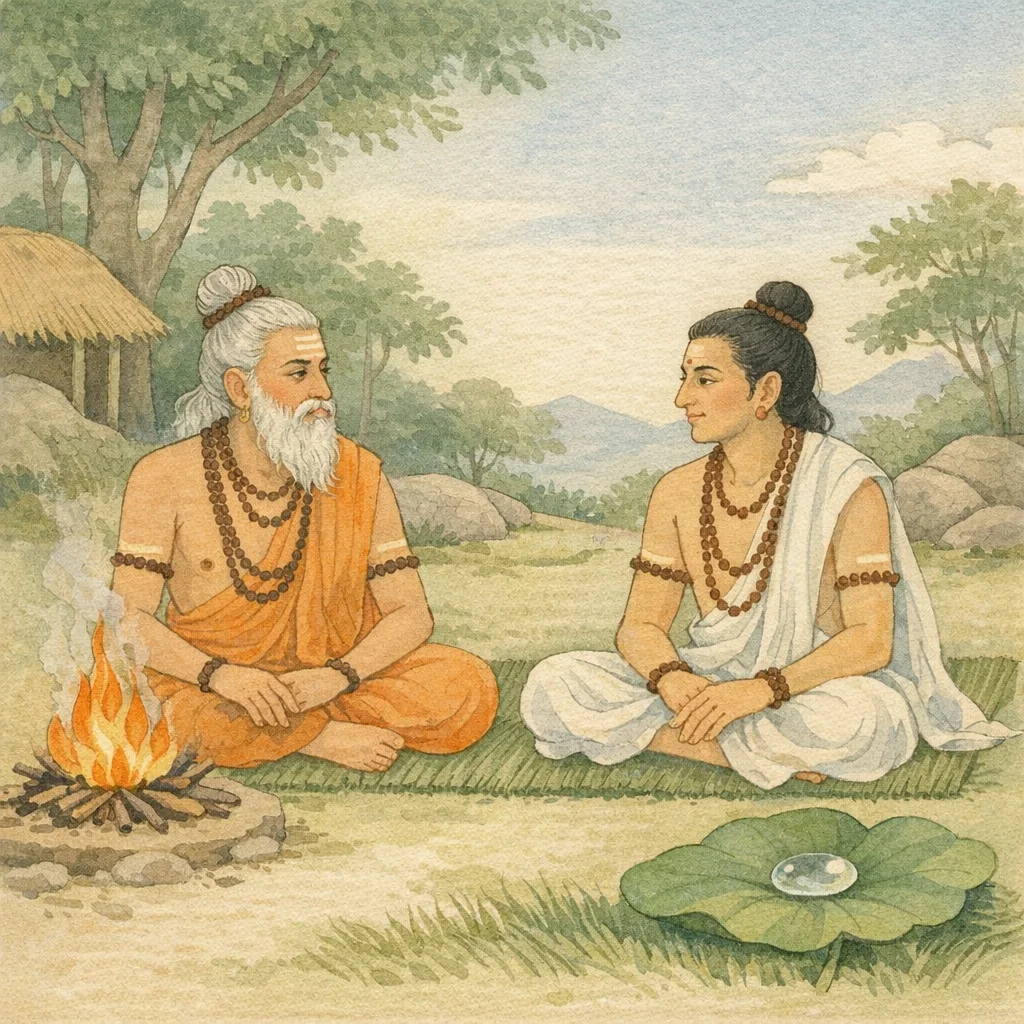
Bhīṣma outlines a fourfold dhyāna-yoga leading to enduring attainment (śāśvatī siddhi) and non-return from saṃsāra. He characterizes accomplished yogins and seers as knowledge-satiated, conflict-free, and established in a steady disposition. The method begins with seated stillness and the deliberate ‘bundling’ (piṇḍīkaraṇa) of the sense-group, maintaining one-pointed mind supported by svādhyāya. A procedural sensory withdrawal is described: not pursuing sound, touch, form, taste, or smell, and refusing the disruptive impulses of the fivefold sensory domain. Bhīṣma then details the mind’s instability in early practice—likened to lightning in clouds and a trembling water-drop on a leaf—followed by repeated recollection and re-stabilization without dejection. Gradual training is emphasized through analogies of soaking dry material slowly; similarly, the senses are pacified stepwise. Early meditative results include the arising of vitarka (applied thought), vicāra (sustained inquiry), and viveka (discriminative clarity). The chapter closes by presenting ease in practice and a movement toward nirvāṇa described as free from affliction (nirāmaya).
Chapter Arc: भृगु ऋषि एक निर्णायक प्रतिज्ञा के साथ संवाद खोलते हैं—जीव का नाश नहीं होता; न दान का फल नष्ट होता है, न कृत कर्म का—और इस अमरत्व को युक्तियों से सिद्ध करने का संकल्प लेते हैं। → भरद्वाज शंका उठाते हैं: यदि जीव अग्नि के समान अविनाशी है, तो ईंधन (शरीर) के समाप्त होने पर वह कहाँ और कैसे उपलब्ध होता है? फिर वे इन्द्रिय-आधारित अनुभवों (जैसे सुनना) को आधार बनाकर जीव की सत्ता पर आक्षेप करते हैं—कान सुनते हैं, मन व्यग्र हो तो ‘जीव’ निरर्थक-सा प्रतीत होता है। → भृगु सूक्ष्म विवेचन से निर्णायक बिंदु रखते हैं: जीव शरीराश्रित होकर भी शरीर के नष्ट होने पर नष्ट नहीं होता—जैसे जली हुई समिधाओं के बाद भी अग्नि-तत्त्व का नाश नहीं कहा जा सकता। वे ‘क्षेत्रज्ञ आत्मा’ को सर्वलोकहितात्मक बताते हैं—देह में स्थित होकर भी कमलपत्र पर बिंदु की तरह असंग। तत्त्वदर्शी सूक्ष्म बुद्धि से उसी गूढ़ आत्मा का दर्शन करते हैं। → चित्त-प्रसाद (चित्त-शुद्धि) से शुभ-अशुभ कर्मों के बंधन ढीले पड़ते हैं; प्रसन्न आत्मा आत्मनि स्थित होकर अनन्त सुख को प्राप्त होती है। देहाग्नि के शांत होने, रूप-स्पर्श-उष्मा आदि पंचभौतिक लक्षणों के लय होने पर भी जीव का नाश नहीं—देहत्याग केवल आवरण-परिवर्तन है। → भरद्वाज की शंकाओं का समाधान आत्मा की असंगता और सूक्ष्म-ज्ञान से होता है, पर आगे के लिए प्रश्न खुला रहता है—यह ‘सूक्ष्म बुद्धि’ और चित्त-प्रसाद साधना के ठोस उपाय क्या हैं, और कर्म-बंधन का क्षय क्रमशः कैसे घटित होता है?
Shlokas
Verse 1
अपने-आप छा अं काज सप्ताशीत्यधिकशततमो< ध्याय: जीवकी सत्ता तथा नित्यताको युक्तियोंसे सिद्ध करना भूगुरुवाच न प्रणाशो5स्ति जीवस्य दत्तस्य च कृतस्य च । याति देहान्तरं प्राणी शरीरं तु विशीर्यते,भगुजीने कहा--ब्रह्मय! जीवका तथा उसके दिये हुए दान एवं किये हुए कर्मका कभी नाश नहीं होता है। जीव तो दूसरे शरीरमें चला जाता है, केवल उसका छोड़ा हुआ शरीर ही यहाँ नष्ट होता है
Bhṛgu said: “The living self is never destroyed—nor are one’s gifts and performed deeds ever lost. The embodied being passes on into another body; only the discarded body here falls apart and perishes.”
Verse 2
न शरीराश्रितो जीवस्तस्मिन् नष्टे प्रणश्यति । समिधामिव दग्धानां यथानिनिर्दश्यते तथा,शरीरके आश्रयसे रहनेवाला जीव उसके नष्ट होनेपर भी नष्ट नहीं होता है। जैसे समिधाओंके आश्रित हुई आग उनके जल जानेपर भी देखी जाती है, उसी प्रकार जीवकी सत्ताका भी प्रत्यक्ष अनुभव होता है
Bharadvāja said: “The living self does not truly depend on the body; when the body is destroyed, the self is not destroyed. Just as fire—though supported by kindling—can still be recognized even after the sticks are burned, so too the reality of the self is apprehended as continuing beyond the body’s ruin.”
Verse 3
भरद्वाज उवाच अग्नेर्यथा तथा तस्य यदि नाशो न विद्यते | इन्धनस्योपयोगान्ते स चाग्नि्नोपलभ्यते,भरद्वाजने पूछा--भगवन्! यदि अग्निके समान जीवका नाश नहीं होता तो ईंधनके जल जानेपर वह भी तो बुझ ही जाती है; फिर उसकी तो उपलब्धि नहीं होती है
Bharadvāja said: “If, like fire, the self truly does not perish, then why is it that when the fuel has been fully consumed and its purpose is finished, that very fire is no longer perceived? In the same way, if the living being is said to be indestructible, how is its continued presence to be known when the body’s supports are exhausted?”
Verse 4
नश्यतीत्येव जानामि शान्तमग्निमनिन्धनम् | गतिर्यस्य प्रमाणं वा संस्थान वा न विद्यते,अतः मैं ईंधनरहित बुझी हुई आगको यही समझता हूँ कि वह नष्ट हो गयी; क्योंकि जिसकी गति, प्रमाण अथवा स्थिति नहीं है, उसका नाश भी मानना पड़ता है। यही दशा जीवकी भी है
Bharadvāja said: “I conclude that a fire which has become quenched and has no fuel is simply destroyed. For that which has no discernible movement, no measurable magnitude, and no ascertainable form or state must be regarded as having perished. Such, indeed, is the condition of the living being as well.”
Verse 5
भूगुरुवाच समिधामुपयोगान्ते यथाग्निर्नोपलभ्यते । आकाशानुगतत्वद्धि दुर्ग्राह्मो हि निराश्रय:,भगुजीने कहा--मुने! समिधाओंके जल जानेपर अग्निका नाश नहीं होता। वह आकाशमें अव्यक्तरूपसे स्थित हो जाती है, इसलिये उसकी उपलब्धि नहीं होती; क्योंकि बिना किसी आश्रयके अग्निका ग्रहण होना अत्यन्त कठिन है
Bhṛgu said: “Just as, when the fuel-sticks have been consumed at the end of their use, fire is no longer perceived, so too it is not apprehended because it has passed into the sky, remaining unmanifest. For fire, having no support, is exceedingly difficult to grasp.”
Verse 6
तथा शरीरसंत्यागे जीवो ह्याकाशवत् स्थित: । न गृहाते तु सूक्ष्मत्वाद् यथा ज्योतिर्न संशय:,उसी प्रकार शरीरको त्याग देनेपर जीव आकाशकी भाँति स्थित होता है। वह अत्यन्त सूक्ष्म होनेके कारण बुझी हुई आगके समान अनुभवमें नहीं आता, परंतु रहता अवश्य है; इसमें संशय नहीं है
“So too, when the body is cast off, the jīva abides like space. Because of its subtlety it is not perceived, like a fire that has gone out; yet it surely remains—of this there is no doubt.”
Verse 7
प्राणान् धारयते हाग्नि: स जीव उपधार्यताम् | वायुसंधारणो हान्निर्नश्यत्युच्छवासनिग्रहात्,अग्नि प्राणोंको धारण करती है। जीवको उस अग्निके समान ही ज्योतिर्मय समझो। उस अग्निको वायु देहके भीतर धारण किये रहती है। श्वास रुक जानेपर वायुके साथ-साथ अग्नि भी नष्ट हो जाती है
Bharadvāja said: “Fire sustains the vital breaths (prāṇa); therefore the living self should be understood as luminous like that fire. That inner fire is maintained within the body by the sustaining action of wind (vāyu). When the outgoing breath is restrained and breathing ceases, the wind perishes—and along with it, the fire too is extinguished.”
Verse 8
तस्मिन् नष्टे शरीराग्नौ ततो देहमचेतनम् | पतितं याति भूमित्वमयनं तस्य हि क्षिति:,उस शरीराग्निके नष्ट होनेपर अचेतन शरीर पृथ्वीपर गिरकर पार्थिवभावको प्राप्त हो जाता है; क्योंकि पृथ्वी ही उसका आधार है। समस्त स्थावरों और जंगमोंकी प्राणवायु आकाशको प्राप्त होती है और अग्नि भी उस वायुका ही अनुसरण करती है। इस प्रकार आकाश, वायु और अग्नि--ये तीन तत्त्व एकत्र हो जाते हैं और जल तथा पृथ्वी--दो तत्त्व भूमिपर ही रह जाते हैं
Bharadvāja said: “When the bodily fire is extinguished, the body becomes insentient; falling to the ground, it assumes the state of earth, for the earth is indeed its resting-place and support. (In this teaching on the dissolution of the elements at death, the body returns to its elemental basis.)”
Verse 9
जड़मानां हि सर्वेषां स्थावराणां तथैव च । आकाशं पवनो<न््वेति ज्योतिस्तमनुगच्छति । तेषां त्रयाणामेकत्वाद् द्ववं भूमौ प्रतिष्ठितम्,उस शरीराग्निके नष्ट होनेपर अचेतन शरीर पृथ्वीपर गिरकर पार्थिवभावको प्राप्त हो जाता है; क्योंकि पृथ्वी ही उसका आधार है। समस्त स्थावरों और जंगमोंकी प्राणवायु आकाशको प्राप्त होती है और अग्नि भी उस वायुका ही अनुसरण करती है। इस प्रकार आकाश, वायु और अग्नि--ये तीन तत्त्व एकत्र हो जाते हैं और जल तथा पृथ्वी--दो तत्त्व भूमिपर ही रह जाते हैं
Bharadvāja said: “For all insentient beings—especially the immobile ones—the wind departs into space, and fire follows that wind. Since these three—space, wind, and fire—thus merge together, the remaining two elements stay established upon the earth.”
Verse 10
यत्र खं तत्र पवनस्तत्राग्निर्यत्र मारुत: । अमूर्तयस्ते विज्ञेया मूर्तिमन्तः शरीरिणाम्,जहाँ आकाश होता है, वहीं वायुकी स्थिति होती है और जहाँ वायु होती है, वहीं अग्नि भी रहती है। ये तीनों तत्त्व यद्यपि निराकार हैं तथापि देहधारियोंके शरीरोंमें स्थित होकर मूर्तिमान् समझे जाते हैं
Bharadvāja said: “Wherever space is, there the wind abides; and wherever wind is, there fire also is. Though these three principles are in themselves formless, when present within embodied beings they are to be understood as taking on a manifest, bodily mode—showing how subtle elements become operative and perceptible through the living body.”
Verse 11
भरद्वाज उवाच यद्यग्निमारुतौ भूमि: खमापश्च शरीरिषु । जीव: किंलक्षणस्तत्रेत्येतदाचक्ष्व मेडनघ,भरद्वाजने पूछा--निष्पाप मुनिवर! यदि देह-धारियोंके शरीरोंमें केवल अग्नि, वायु, भूमि, आकाश और जल-तत्त्व ही विद्यमान है तो उनमें रहनेवाले जीवके कया लक्षण हैं? यह मुझे बताइये
Bharadvāja said: “If, in embodied beings, there are only the elements—fire, wind, earth, space, and water—then what distinguishing mark does the indwelling living self have there? O sinless one of pure intelligence, explain this to me.”
Verse 12
पञ्चात्मके पञ्चरतौ पज्चविज्ञानचेतने । शरीरे प्राणिनां जीवं वेत्तुमिच्छामि यादृशम्,प्राणियोंका शरीर पांचभौतिक है। पाँच विषयोंमें इसकी रति है। इसमें पाँच ज्ञानेन्द्रियाँ और चित्त उपलब्ध होते हैं। इसमें रहनेवाले जीवका स्वरूप कैसा है; इस बातको मैं जानना चाहता हूँ
Bharadvāja said: “This body of living beings is constituted of five elements; it delights in the five objects of sense; it is furnished with the five faculties of cognition and with mind. I wish to know what the indwelling jīva (living self) is like within such a body.”
Verse 13
मांसशोणितसंघाते मेद:स्नाय्वस्थिसंचये । भिद्यमाने शरीरे तु जीवो नैवोपलभ्यते,रक्त और मांसके समूह, चर्बी, नाड़ी और हडियोंके संग्रहरूपी इस शरीरको चीरने- फाड़नेपर इसके भीतर कोई जीव नहीं उपलब्ध होता
Bharadvāja said: “In this body—an aggregate of flesh and blood, a storehouse of fat, sinews, and bones—even when it is cut open and torn apart, no ‘living self’ is found within as a visible object. Thus the true self is not something that can be grasped by mere physical dissection.”
Verse 14
यद्यजीवं शरीरं तु पजचभूतसमन्वितम् | शारीरे मानसे दुः:खे कस्तां वेदयते रुजम्,यदि इस पांचभौतिक शरीरको जीवरहित मान लिया जाय, तब प्रश्न यह होता है कि शरीर अथवा मनमें पीड़ा होनेपर उसके कष्टका अनुभव कौन करता है?
Bharadvāja said: If this body—composed of the five great elements—is assumed to be without a living self, then when pain arises in the body or sorrow arises in the mind, who is it that actually feels that suffering?
Verse 15
शृणोति कथितं जीव: कर्णाभ्यां न शृणोति तत् । महर्षे मनसि व्यग्रे तस्माज्जीवो निरर्थक:,महर्ष! जीव किसीकी कही हुई बातको पहले दोनों कानोंसे सुनता है; परंतु यदि मनमें व्यग्रता रही तो वह सुनकर भी नहीं सुनता; इसलिये मनके अतिरिक्त किसी जीवकी सत्ता मानना व्यर्थ है
O great rishi! A living being hears what is spoken through both ears; yet if the mind is disturbed, though it hears, it does not truly hear. Therefore, to posit any being’s existence apart from the mind is futile.
Verse 16
सर्व पश्यति यद् दृश्यं मनोयुक्तेन चक्षुषा । मनसि व्याकुले चक्षु: पश्यन्नपि न पश्यति,जो भी दृश्य पदार्थ है, उसे प्राणी तभी देख पाता है जब कि उसकी दृष्टिके साथ मनका संयोग हो। यदि मन व्याकुल हो तो उसकी आँख देखती हुई भी नहीं देख पाती है
Bharadvāja said: Whatever is visible is truly perceived only when the eye is joined with the mind. But when the mind is agitated, the eye, though looking, does not really see.
Verse 17
न पश्यति न चाप्राति न शूणोति न भाषते । न च स्पर्शरसौ वेत्ति निद्रावशगत: पुनः,निद्राके वशमें पड़ा हुआ पुरुष (सम्पूर्ण इन्द्रियोंके होते हुए भी) न देखता है, न सूँघता है, न सुनता है, न बोलता है और न स्पर्श तथा रसका ही अनुभव करता है
Bharadvāja said: When a person is overpowered by sleep, even though all the senses are present, he neither sees nor smells, neither hears nor speaks; and he does not even apprehend touch or taste.
Verse 18
हृष्यति क्रुद्धयते कोअत्र शोचत्युद्धिजते च कः । इच्छति ध्यायति द्वेष्टि वाचमीरयते च कः,अतः यह जिज्ञासा होती है कि इस शरीरके अंदर कौन हर्ष और कौन क्रोध करता है? किसे शोक और उद्वेग होता है? इच्छा, ध्यान, द्वेष और बातचीत कौन करता है?
Bharadvāja said: “Who, indeed, within this body feels joy, and who becomes angry? Who grieves and who is agitated? Who desires, who reflects, who hates, and who sets speech in motion?”
Verse 19
भूगुरुवाच न पञ्चसाधारणमत्र किंचि- च्छरीरमेको वहते<न्तरात्मा | स वेत्ति गन्धांश्व रसान् श्रुतीश्व स्पर्श च रूप॑ च गुणांश्व येडन्ये,भगुजीने कहा--मुने! मन भी पांचभौतिक ही है; अतः वह पाँचों भूतोंसे भिन्न कोई दूसरा तत्त्व नहीं है। एकमात्र अन्तरात्मा ही इस शरीरका भार वहन करता है, वही रूप, रस, गन्ध, स्पर्श तथा शब्दका और दूसरे भी जो गुण हैं, उनका अनुभव करता है
Bhṛgu said: “Here, nothing exists as an independent principle common to the five elements. It is the one inner Self alone that bears the burden of the body. That very Self cognizes smell and taste, sound, touch, and form—and whatever other qualities there may be.”
Verse 20
पज्चात्मके पड्चगुणप्रदर्शी स सर्वगात्रानुगतो<न्तरात्मा । स वेत्ति दुःखानि सुखानि चात्र तद्विप्रयोगात् तु न वेत्ति देह:,वह अन्तरात्मा पाँचों इन्द्रियोंके गुणोंको धारण करनेवाले मनका द्रष्टा है और वही इस पाज्चभौतिक शरीरके सम्पूर्ण अवयवोंमें व्याप्त होकर सुख-दुःखका अनुभव करता है। जब उसका शरीरके साथ सम्बन्ध छूट जाता है, तब इस शरीरको सुख-दुःखका भान नहीं होता है (इससे मनके अतिरिक्त उसके साक्षी आत्माकी सत्ता स्वतः सिद्ध हो जाती है)
Bharadvāja said: “The inner Self, which reveals the fivefold qualities within the fivefold (psycho-physical) constitution, pervades all the limbs of the body. It is that inner Self which, here in embodied life, knows pleasure and pain. But when it is separated from the body, the body itself no longer has any awareness of pleasure or pain.”
Verse 21
जब पाञ्वचभौतिक शरीरमें रूप, स्पर्श और गर्मीका भान नहीं होता, उस अवस्थामें शरीरस्थित अग्निके शान्त हो जानेपर जीवात्मा इस शरीरको त्यागकर भी नष्ट नहीं होता
Bharadvāja said: When, in this body made of the five elements, there is no longer any awareness of form, touch, or heat, then—once the bodily fire has become quiet—the individual self does not perish even after leaving the body.
Verse 22
आपोमयमिदं सर्वमापो मूर्ति: शरीरिणाम् । तत्रात्मा मानसो ब्रह्मा सर्वभूतेषु लोककृत्,यह सब प्रपंच जलमय है, प्राणियोंका यह शरीर भी प्रायः जलमय ही है। उसमें मनमें रहनेवाला आत्मा विद्यमान है। वही सम्पूर्ण भूतोंमें लोकस्रष्टा ब्रह्माके नामसे विख्यात है; क्योंकि समस्त जीवोंके संघातका ही नाम ब्रह्मा है
Bharadvāja said: “All this manifested world is pervaded by water; and the bodies of embodied beings are themselves a form of water. Within that (water-formed body) abides the Self, present in the mind; that very principle is known among all beings as Brahmā, the maker of worlds—because the collective aggregate of living beings is designated as ‘Brahmā.’”
Verse 23
आत्मा क्षेत्रज्ञ इत्युक्त: संयुक्त: प्राकृतैर्गुणै: तैरेव तु विनिर्मुक्त: परमात्मेत्युदाहृत:,आत्मा जब प्राकृत गुणोंसे युक्त होता है, तब उसे क्षेत्रज्ञ कहते हैं और उन्हीं गुणोंसे जब वह मुक्त हो जाता है, तब परमात्मा कहलाता है
Bharadvāja said: When the Self is conjoined with the material qualities (guṇas) born of Prakṛti, it is spoken of as the ‘knower of the field’ (kṣetrajña), the conscious witness within embodied experience. But when that very Self is released from those same qualities, it is declared to be the Supreme Self (Paramātman).
Verse 24
आत्मानं तं विजानीहि सर्वलोकहितात्मकम् | तस्मिन् य: संश्रितो देहे हाब्बिन्दुरिव पुष्करे,तुम क्षेत्रज््को आत्मा ही समझो। वह सर्वलोक-हितकारी है। इस शरीरमें रहकर भी वह कमल-पत्रपर पड़े हुए जलबिन्दुकी तरह वास्तवमें इससे पृथक् ही है
Bharadvāja said: Know that Self to be the one whose very nature is the welfare of all worlds. Though it abides supported within the body, it remains in truth separate from it—like a drop of water resting on a lotus leaf.
Verse 25
क्षेत्रज्ं तं विजानीहि नित्यं लोकहितात्मकम् । तमो रजश्न सत्त्वं च विद्धि जीवगुणानिमान्,उस क्षेत्रज्षको सदा आत्मा ही जानो। वह सम्पूर्ण जगत्का हितस्वरूप है। तमोगुण, रजोगुण और सत्त्वगुण--इन तीनों प्राकृत गुणोंको प्रकृति-स्थित होनेके कारण जीवके गुण समझो
Know the Knower of the Field (kṣetrajña) as the Self (Ātman), ever-abiding and devoted to the welfare of the world. And understand tamas, rajas, and sattva—these three guṇas—as the qualities of the jīva.
Verse 26
सचेतनं जीवगुणं वदन्ति स चेष्टते चेष्टयते च सर्वम् । अतः: पर क्षेत्रविदो वदन्ति प्रावर्तयद् यो भुवनानि सप्त,चेतन जीवके सम्बन्धसे उपर्युक्त जीवके गुणोंको चेतनायुक्त कहते हैं-। वह जीव स्वयं चेष्टा करता है और सबसे चेष्टा करवाता है। शरीरके तत्त्वको जाननेवाले पुरुष इस क्षेत्रज्ञ आत्मासे उस परमात्माको श्रेष्ठ बताते हैं, जिसने भू:भुवः आदि सातों लोकोंको उत्पन्न किया है
They speak of the living principle as endowed with consciousness (sacetanam): it acts, and it causes all things to act. Therefore, those who truly know the “field” (the body and its constituents) declare that there is something higher than the knower of the field—the Supreme Self (Paramātman) who set in motion the seven worlds.
Verse 27
न जीवनाशो<स्ति हि देहभेदे मिथ्यैतदाहुर्मुत इत्यबुद्धा: । जीवस्तु देहान्तरित: प्रयाति दशार्धतैवास्यथ शरीरभेद:,देहका नाश होनेपर भी जीवका नाश नहीं होता। जो जीवकी मृत्यु बताते हैं, वे अज्ञानी हैं और उनका वह कथन मिथ्या है। जीव तो इस मृत देहका त्याग करके दूसरे शरीरमें चला जाता है। शरीरके पाँच तत्त्वोंका अलग-अलग हो जाना ही शरीरका नाश है
There is no destruction of the jīva when the body is broken up. Those who declare, “He is dead,” are unknowing; their statement is false. The jīva, leaving this body, goes on into another embodiment. What is called the “death” of the body is only the disjoining and dispersal of its constituent elements.
Verse 28
एवं सर्वेषु भूतेषु गूढश्षरति संवृतः । दृश्यते त्वग्र्यया बुद्धया सूक्ष्मया तत्त्वदर्शिभि:
Thus, within all beings, He moves about hidden and veiled. Yet He is perceived by those seers of truth through the finest, most excellent, and subtle intelligence.
Verse 29
इस प्रकार आत्मा सम्पूर्ण प्राणियोंके भीतर उनकी हृदयगुफामें गूढ़भावसे छिपा रहता है। वह तत्त्वदर्शी पुरुषोंद्वारा तीक्ष्ण एवं सूक्ष्म बुद्धिसे साक्षात् किया जाता है ।। त॑ पूर्वापररात्रेषु युज्जान: सततं बुध: । लघ्वाहारो विशुद्धात्मा पश्यत्यात्मानमात्मनि,जो विद्वान परिमित आहार करके रातके पहले और पिछले पहरमें सदा ध्यानयोगका अभ्यास करता है, वह अन्त:करण शुद्ध होनेपर अपने हृदयमें ही उस आत्माका साक्षात्कार कर लेता है
In this way the Self (Ātman) remains hidden within all beings, concealed deep in the cave of the heart. It is directly realized by seers of truth through a keen and subtle intelligence. The wise person who continually applies himself to meditative discipline in the early and later watches of the night, eating lightly and purifying the inner being, comes to behold the Self within the Self—realizing it inwardly, in the very heart.
Verse 30
चित्तस्य हि प्रसादेन हित्वा कर्म शुभाशुभम् । प्रसन्नात्मा55त्मनि स्थित्वा सुखमानन्त्यमश्लुते,चित्त शुद्ध होनेपर वह शुभाशुभ कर्मोंसे अपना सम्बन्ध हटाकर प्रसन्नचित्त हो आत्मस्वरूपमें स्थित हो जाता है और अनन्त आनन्दका अनुभव करने लगता है
Bharadvāja said: “When the mind becomes clear and serene, one abandons attachment to actions deemed ‘good’ or ‘bad’. With the inner self made tranquil, one abides established in the Self, and thereby tastes the endless happiness that is beyond ordinary moral accounting and worldly results.”
Verse 31
मानसोडग्नि: शरीरेषु जीव इत्यभिधीयते । सृष्टि: प्रजापतेरेषा भूताध्यात्मविनिश्चये,समस्त शरीरोंमें मनके भीतर रहनेवाला जो अग्निके समान प्रकाशस्वरूप चैतन्य है, उसीको समष्टि जीवस्वरूप प्रजापति कहते हैं। उसी प्रजापतिसे यह सृष्टि उत्पन्न हुई है। यह बात अध्यात्मतत्त्वका निश्चय करके कही गयी है
Bharadvāja said: “Within bodies, the inner fire that abides in the mind—luminous like flame—is spoken of as the ‘jīva’ (the living self). From that Prajāpati, understood as the collective principle of life, this creation proceeds. This is stated after a settled discernment of the truth of the inner self in relation to beings.”
Verse 186
इस प्रकार श्रीमहाभारत शान्तिपर्वके अन्तर्गत मोक्षधर्मपर्वमें जीवके स्वरूपपर आक्षेपविषयक एक सौ छियासीवाँ अध्याय पूरा हुआ
Thus ends the one hundred and eighty-sixth chapter of the Mokṣadharma section within the Śānti Parva of the Śrī Mahābhārata, dealing with objections and critical examination concerning the true nature of the individual self (jīva).
Verse 187
इति श्रीमहाभारते शान्तिपर्वणि मोक्षधर्मपर्वणि भुगुभरद्वाजसंवादे जीवस्वरूपनिरूपणे सप्ताशीत्यधिकशततमो<ध्याय:
Thus, in the Śrī Mahābhārata, within the Śānti Parva—specifically the Mokṣa-dharma section—ends the one-hundred-and-eighty-eighth chapter, in the dialogue between Bhṛgu and Bharadvāja, concerning the examination and exposition of the true nature of the individual self (jīva).
Verse 231
यदा न रूप॑ न स्पर्शो नोष्मभावश्नल पञज्चके । तदा शान्ते शरीराग्नौ देहत्यागे न नश्यति
Bharadvāja said: “When, within the fivefold complex of bodily experience, there is no longer form, no touch, and no heat, then—once the body’s fire has become quiet—at the moment of casting off the body, the self does not perish. The teaching underscores that death is a change of condition for the body and its sensations, not the destruction of the enduring principle that witnesses them.”
Frequently Asked Questions
The difficulty of stabilizing a restless mind and sense-system; the chapter prescribes systematic withdrawal from sensory objects and repeated recollection to restore steadiness without discouragement.
Practice should be gradual and methodical: collect the senses, maintain one-pointed attention supported by study, and re-establish concentration each time the mind disperses, allowing discrimination to arise naturally.
Yes in doctrinal form: it asserts that knowing and practicing this dhyāna-yoga leads toward lasting attainment, non-return from saṃsāra’s defects, and nirvāṇa characterized as free from affliction.