Adhyaya 99
अध्याय ९९ — युयुधान-दुःशासन-युद्धम् (Chapter 99: Sātyaki and Duḥśāsana’s engagement)
Upa-parva: Yuyudhāna–Duḥśāsana Saṅgrāma (Episode: Sātyaki’s engagement with Duḥśāsana and Trigartas)
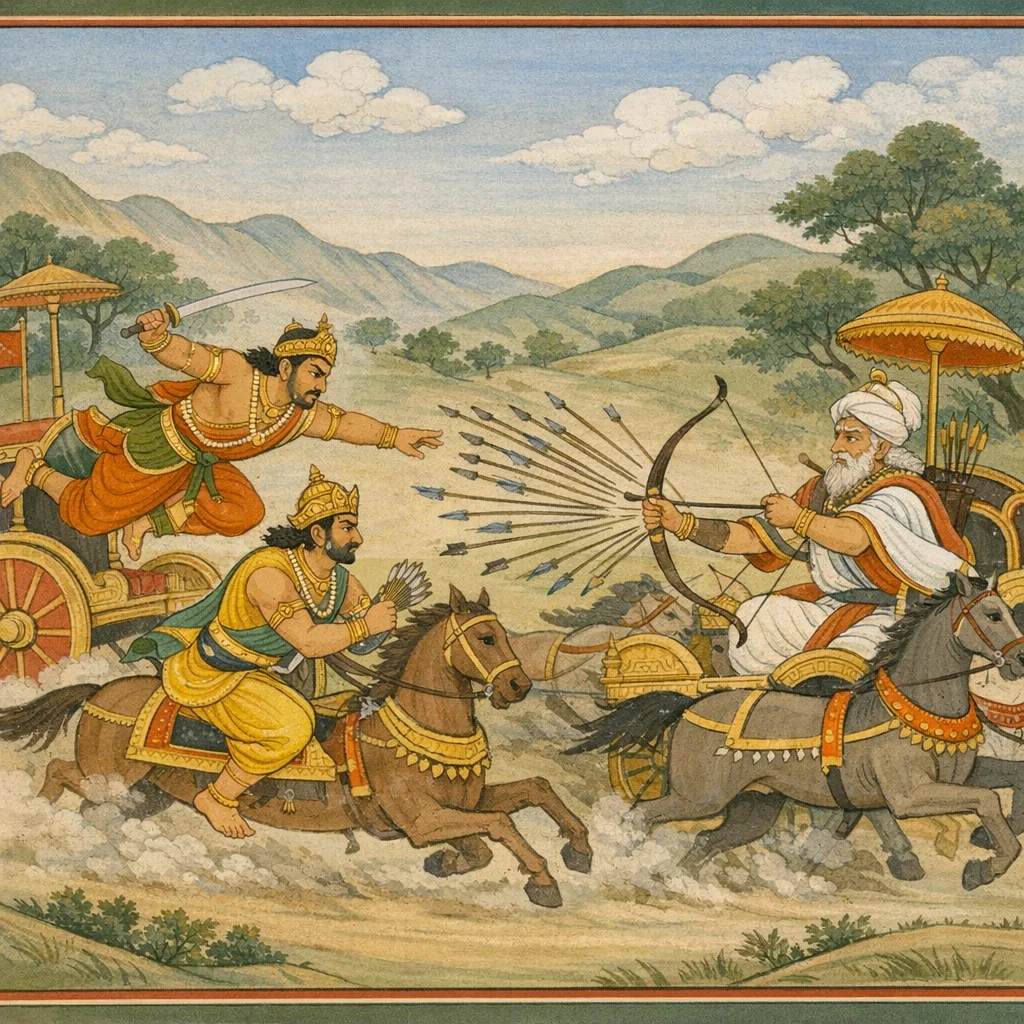
Saṃjaya narrates Duḥśāsana’s assault on Śaineya/Yuyudhāna (Sātyaki), beginning with dense arrow volleys that fail to destabilize Sātyaki’s stance. Sātyaki counters by blanketing Duḥśāsana with missiles, prompting the Kaurava command to direct Trigarta chariots against Sātyaki. Three thousand Trigarta chariots encircle him with synchronized resolve; Sātyaki answers with concentrated archery, cutting down five hundred leading fighters and breaking the formation. The battlefield is described through imagery of severed chariots, fallen standards, and blood-soaked ground likened to blossoming trees. The surviving Trigartas recoil toward Droṇa’s sector. Sātyaki advances toward Arjuna’s line; Duḥśāsana renews pursuit, exchanging volleys, losing his bow and chariot implements, and attempting a lethal śakti-throw that Sātyaki fragments mid-flight. Duḥśāsana re-arms and roars, but Sātyaki strikes decisively—killing horses and charioteer and disabling the chariot—yet does not deliver the final kill, explicitly recalling Bhīmasena’s prior vow to slay Dhṛtarāṣṭra’s sons. Having subdued Duḥśāsana, Sātyaki departs swiftly in the direction Arjuna has taken.
Chapter Arc: संजय धृतराष्ट्र से कहता है—जब संग्राम अपने चरम को छू रहा था, धृष्टद्युम्न सूर्य-सा दीप्त होकर द्रोणाचार्य पर टूट पड़ा; उसी क्षण अन्य मोर्चों पर भी भीम और युधिष्ठिर अपने-अपने प्रतिद्वन्द्वियों को ललकारते हैं। → धृष्टद्युम्न का लक्ष्य स्पष्ट है—द्रोण का वध। वह शरवर्षा करता हुआ रथ-रथ पर चढ़ आता है; द्रोण भी अद्भुत कौशल से उसके हर छिद्र को ढँकते हैं। रणभूमि में रथियों का रथियों से, अश्वारोहियों का अश्वारोहियों से, गजराजों का गजराजों से और पदातियों का पदातियों से घोर संमर्दन चलता है; चारों ओर कबन्ध उठे दिखते हैं—युद्ध का भयावह दृश्य मन को कंपा देता है। → धृष्टद्युम्न लाल घोड़ों पर खड़ा होकर खड्ग घुमाता है, द्रोण पर झपटता है—मानो मांस की चाह में बाज़ शिकार पर टूट पड़े। द्रोण को क्षण भर भी अवसर नहीं मिलता; तभी शिने का पौत्र सात्यकि बीच में कूद पड़ता है और द्रोण के वक्षस्थल में छब्बीस तीक्ष्ण बाणों से प्रहार कर धृष्टद्युम्न को बचा लेता है। → द्रोण का ध्यान सात्यकि की ओर खिंचता है; इस उलझाव का लाभ उठाकर पाञ्चालों के रथ द्रोण पर दबाव बढ़ाते हैं और धृष्टद्युम्न को पीछे खींचकर पुनः संगठित करते हैं। मोर्चा टूटता नहीं, पर द्रोण-धृष्टद्युम्न का निर्णायक क्षण टल जाता है। → द्रोण सात्यकि से जूझते हुए भी अजेय-सा बना रहता है—अब प्रश्न यह है कि धृष्टद्युम्न का प्रतिज्ञात लक्ष्य कब और कैसे पूरा होगा?
Shlokas
Verse 1
अपन प्रा बछ। अं सप्तनवतितमो< ध्याय: द्रोणाचार्य और धृष्टद्युम्नका युद्ध तथा सात्यकिद्धारा धृष्टद्युम्नकी रक्षा संजय उवाच तथा तस्मिन् प्रवत्ते तु संग्रामे लोमहर्षणे । कौरवेयांस्त्रिधाभूतान् पाण्डवा: समुपाद्रवन्,संजय कहते हैं--राजन्! उस रोमांचकारी संग्रामके होते समय वहाँ तीन भागोंमें बाँटे हुए कौरवोंपर पाण्डव-सैनिकोंने धावा किया
Sañjaya said: O King, when that hair-raising battle had begun, the Pandava forces launched a fierce assault upon the Kaurava troops, who had been split into three divisions—showing how strategy and resolve intensify amid the moral strain of war.
Verse 2
जलसंध॑ महाबाहुं भीमसेनो< भ्यवर्तत । युधिष्ठिर: सहानीक: कृतवर्माणमाहवे,भीमसेनने महाबाहु जलसंधपर आक्रमण किया और सेनासहित युधिष्ठिरने युद्धस्थलमें कृतवर्मापर धावा बोल दिया
Sañjaya said: Mighty-armed Bhīmasena advanced to attack Jalasaṃdha; and Yudhiṣṭhira, accompanied by his forces, charged at Kṛtavarmā on the battlefield. The verse underscores the grim momentum of war, where leaders must direct violence toward chosen foes while remaining bound to duty and the side they have embraced.
Verse 3
किरंस्तु शरवर्षाणि रोचमान इवांशुमान् | धृष्टद्युम्नो महाराज द्रोणमभ्यद्रवद् रणे
Sañjaya said: “Pouring forth showers of arrows, radiant like the sun, Dhṛṣṭadyumna, O King, charged straight at Droṇa on the battlefield.”
Verse 4
महाराज! जैसे प्रकाशमान सूर्य सहस्रों किरणोंका प्रसार करते हैं, उसी प्रकार धृष्टद्युम्नने बाणसमूहोंकी वर्षा करते हुए रणक्षेत्रमें द्रोणाचार्यपर आक्रमण किया ।। ततः प्रववृते युद्ध त्वरतां सर्वधन्विनाम् । कुरूणां पाण्डवानां च संक्रुद्धानां परस्परम्,तदनन्तर परस्पर क्रोधमें भरे और उतावले हुए कौरव-पाण्डवपक्षके सम्पूर्ण धनुर्धरोंका आपसमें युद्ध होने लगा
Sañjaya said: “O King, just as the radiant sun spreads forth thousands of rays, so did Dhṛṣṭadyumna, showering volleys of arrows, launch his assault upon Droṇācārya on the battlefield. Thereupon, as anger flared on both sides, a fierce engagement broke out between the Kuru and Pāṇḍava archers—each rushing against the other.”
Verse 5
संक्षये तु तथाभूते वर्तमाने महाभये । उन्डी भूतेषु सैन्येषु युध्यमानेष्वभीतवत्,इस प्रकार जब महाभयंकर जनसंहार होने लगा और सारे सैनिक निर्भय-से होकर बन्द्-युद्ध करने लगे, उस समय बलवान द्रोणाचार्यने शक्तिशाली पांचालराजकुमार धृष्टद्युम्मके साथ युद्ध करते हुए जो बाणसमूहोंकी वर्षा आरम्भ की, वह अद्भुत-सी प्रतीत होने लगी
Sañjaya said: When that dreadful slaughter had thus set in, and a great terror prevailed, the armies—thrown into tumult—fought on as if fearless. At that time the mighty Droṇācārya, engaged in battle with the powerful Pāñcāla prince Dhṛṣṭadyumna, began an astonishing shower of arrows—an act that displayed both the terrible momentum of war and the relentless resolve of a master of arms.
Verse 6
द्रोण: पाउ्चालपुत्रेण बली बलवता सह । यदक्षिपत् पृषत्कौघांस्तदद्भुतमिवाभवत्,इस प्रकार जब महाभयंकर जनसंहार होने लगा और सारे सैनिक निर्भय-से होकर बन्द्-युद्ध करने लगे, उस समय बलवान द्रोणाचार्यने शक्तिशाली पांचालराजकुमार धृष्टद्युम्मके साथ युद्ध करते हुए जो बाणसमूहोंकी वर्षा आरम्भ की, वह अद्भुत-सी प्रतीत होने लगी
Sañjaya said: When the dreadful slaughter had begun and the warriors, as if fearless, pressed into close combat, mighty Droṇa—locked in battle with the powerful son of the Pāñcālas, Dhṛṣṭadyumna—unleashed such a dense torrent of arrows that it appeared almost wondrous. The scene underscores the terrible momentum of war: extraordinary martial skill manifests amid a morally fraught carnage that consumes both sides.
Verse 7
पुण्डरीकवनानीव विध्वस्तानि समन्ततः । चक्राते द्रोणपाञ्चाल्यौ नृणां शीर्षाण्यनेकश:,द्रोणाचार्य और धृष्टद्युम्नने मनुष्योंके बहुत-से मस्तक काट गिराये, जो चारों ओर नष्ट होकर पड़े हुए कमलवनोंके समान जान पड़ते थे
Sañjaya said: On every side, many human heads lay shattered and strewn about, resembling lotus-groves ruined all around. Thus did Droṇa and the Pāñcāla prince (Dhṛṣṭadyumna) wreak their slaughter in the press of battle—an image that underscores how war, even when fought under vows and duty, turns living beings into anonymous ruin.
Verse 8
विनिकीर्णानि वीराणामनीकेषु समन्तत: । वस्त्राभरणशस्त्राणि ध्वजवर्मायुधानि च,चारों ओर सेनाओंमें वीरोंके बहुत-से वस्त्र, आभूषण, अस्त्र-शस्त्र, ध्वज, कवच तथा आयुध छिन्न-भिन्न होकर बिखरे पड़े थे
Sañjaya said: All around, scattered through the battle-formations of the warriors, lay torn and strewn garments and ornaments, weapons and missiles, as well as banners, armor, and implements of war—mute remnants of the fierce and indiscriminate destruction of battle.
Verse 9
तपनीयततनुत्राणा: संसिक्ता रुधिरेण च | संसक्ता इव दृश्यन्ते मेघसंघा: सविद्युत:,सुवर्णका कवच बाँधे तथा खूनसे लथपथ हुए सैनिक परस्पर सटे हुए बिजलियोंसहित मेघसमूहोंके समान दिखायी देते थे
Sañjaya said: The warriors, clad in golden cuirasses and drenched with blood, stood packed tightly together—like clusters of rain-clouds shot through with lightning. Thus did splendor and slaughter mingle on the field: the brilliance remained, yet it was stained by the moral cost of war.
Verse 10
कुण्जराश्वनरानन्ये पातयन्ति सम पत्रिभि: | तालमात्राणि चापानि विकर्षन्तो महारथा:,बहुत-से दूसरे महारथी चार हाथके धनुष खींचते हुए अपने पंखयुक्त बाणोंद्वारा हाथी, घोड़े और पैदल मनुष्योंको मार गिराते थे
Sañjaya said: Other great chariot-warriors, drawing bows as long as a tāla-palm, felled elephants, horses, and foot-soldiers with their feathered arrows. The scene reveals battle’s sweeping, impersonal force, where prowess and weaponry cut down living beings in masses, sharpening the ethical strain between duty in war and the human cost of violence.
Verse 11
असिचर्माणि चापानि शिरांसि कवचानि च । विप्रकीर्यन्त शूराणां सम्प्रहारे महात्मनाम्,उन महामनस्वी वीरोंके संग्राममें योद्धाओंके खड्ग, ढाल, धनुष, मस्तक और कवच कटकर इधर-उधर बिखरे जाते थे
Sañjaya said: In the fierce clash of those great-souled warriors, swords and shields, bows, heads, and armor were hewn apart and scattered in all directions—an image of battle’s terrible momentum, where valor and violence alike culminate in dismemberment and ruin.
Verse 12
उत्थितान्यगणेयानि कबन्धानि समन्ततः । अदृश्यन्त महाराज तस्मिन् परमसंकुले,महाराज! उस महाभयानक युद्धमें चारों ओर असंख्य कबन्ध खड़े दिखायी देते थे
Sañjaya said: “O King, in that utterly chaotic and dreadful battle, countless headless trunks (kabandhas) were seen standing upright on every side.”
Verse 13
गृध्रा: कड़्का बका: श्येना वायसा जम्बुकास्तथा । बहुश: पिशिताशाश्च तत्रादृश्यन्त मारिष,आर्य! वहाँ बहुत-से गीध, कंक, बगले, बाज, कौए, सियार तथा अन्य मांसभक्षी प्राणी दृष्टिगोचर होते थे
Sañjaya said: “There, O revered one, many flesh-seeking creatures were seen—vultures, herons, cranes, hawks, crows, and jackals. Their gathering signaled the grim harvest of war, reminding all of the moral cost and desolation that follow slaughter.”
Verse 14
भक्षयन्तश्न मांसानि पिबन्तश्नापि शोणितम् | विलुम्पन्तश्न केशांश्व मज्जाश्व बहुधा नूप,नरेश्वर! वे मांस खाते, रक्त पीते और केशों तथा मज्जाको बारंबार नोचते थे
Sañjaya said: “O king, those beings were devouring flesh and even drinking blood; again and again they were tearing out hair and marrow. The scene revealed the utter collapse of restraint and compassion amid the violence of war, where cruelty appeared unchecked and humanity seemed eclipsed.”
Verse 15
आकर्षन्त: शरीराणि शरीरावयवांस्तथा । नराश्वगजसंघानां शिरांसि च ततस्ततः:,मनुष्यों, घोड़ों तथा हाथियोंके समूहोंके सम्पूर्ण शरीरों और अवयवों एवं मस्तकोंको इधर-उधर खींचते थे
Sañjaya said: They were dragging about, here and there, the bodies and severed limbs, and also the heads of the masses of men, horses, and elephants—an image of the battlefield’s ruthless aftermath, where the frenzy of war reduces living beings to scattered remains.
Verse 16
कृतास्त्रा रणदीक्षाभिदीक्षिता रणशालिन: । रणे जयं प्रार्थयाना भूशं युयुधिरे तदा,अस्त्रविद्याके ज्ञाता और युद्धमें शोभा पानेवाले वीर रणयज्ञकी दीक्षा लेकर संग्राममें विजय चाहते हुए उस समय बड़े जोरसे युद्ध करने लगे
Sañjaya said: Those heroes, accomplished in the use of weapons and resplendent in battle, having undertaken the consecration for the war-sacrifice, fought fiercely at that time—seeking victory in the combat. The verse frames the clash not as mere violence but as a grimly ritualized undertaking, where martial skill and the will to win drive the warriors into relentless engagement.
Verse 17
असिमार्गान् बहुविधान् विचेरु: सैनिका रणे । ऋष्टिभि: शक्तिभि: प्रासै: शूलतोमरपट्टिशै:,समस्त सैनिक उस रफणक्षेत्रमें तलवारके बहुत-से पैंतरे दिखाते हुए विचर रहे थे। युद्धकी रंगभूमिमें आये हुए मनुष्य परस्पर कुपित हो एक-दूसरेपर ऋष्टि, शक्ति, प्रास, शूल, तोमर, पट्टिश, गदा, परिघ, अन्यान्य आयुध तथा भुजाओंद्वारा चोट पहुँचाते थे
Sañjaya said: On the battlefield the soldiers moved about displaying many kinds of sword-techniques and maneuvers. In the arena of war, men, inflamed with mutual anger, struck one another with spears, javelins, lances, tridents, tomara-darts, battle-axes, and other weapons—turning skill and wrath into relentless injury.
Verse 18
गदाभि: परिधैश्नान्यैरायुथैश्व भुजैरपि । अन्योन्यं जष्निरे क्रुद्धा युद्धरड्गरगता नरा:,समस्त सैनिक उस रफणक्षेत्रमें तलवारके बहुत-से पैंतरे दिखाते हुए विचर रहे थे। युद्धकी रंगभूमिमें आये हुए मनुष्य परस्पर कुपित हो एक-दूसरेपर ऋष्टि, शक्ति, प्रास, शूल, तोमर, पट्टिश, गदा, परिघ, अन्यान्य आयुध तथा भुजाओंद्वारा चोट पहुँचाते थे
Sañjaya said: Enraged men who had entered the arena of battle struck one another—using maces and iron clubs, other weapons as well, and even their own arms. The scene portrays warfare at its most unrestrained, where anger overrides restraint and the combatants reduce one another through sheer force rather than deliberation or mercy.
Verse 19
रथिनो रथिभश्रि: सार्थमश्वचारोहाश्ष सादिभि: | मातड़् वरमातज्जैः पदाताश्ष पदातिभि:,रथी रथियोंके, घुड़सवार घुड़सवारोंके, मतवाले हाथी श्रेष्ठ गजराजोंके और पैदल योद्धा पैदलोंके साथ युद्ध कर रहे थे
Sañjaya said: In that tumult of battle, chariot-warriors fought alongside chariot-warriors; horsemen engaged horsemen; mighty, rutting elephants clashed with the foremost elephant-lords; and foot-soldiers met foot-soldiers. Thus the armies confronted their equals in each arm of war, intensifying the violence of the conflict.
Verse 20
क्षीबा इवान्ये चोन्मत्ता रज्भेष्विव च वारणा: | उच्चुक्रुशु रथान्योन्यं जघ्नुरन्योन्यमेव च,रंगस्थलके समान उस रणक्षेत्रमें अन्य बहुत-से मत्त और उन्मत्त हाथी एक-दूसरेको देखकर चिग्घाड़ते और परस्पर आघात-प्रत्याघात करते थे
Sañjaya said: Like intoxicated men, and like elephants gone mad and tangled as if in ropes, many others on that battlefield bellowed aloud; they crashed into one another’s chariots and struck each other again and again. The scene underscores how, when wrath and delusion overtake warriors, discernment and restraint collapse, and violence turns indiscriminate—even against those nearby.
Verse 21
वर्तमाने तथा युद्धे निर्मय्यादे विशाम्पते । धृष्टद्युम्नो हयानश्वैद्रोणस्य व्यत्यमिश्रयत्,राजन! जिस समय वह मर्यादाशून्य युद्ध हो रहा था, उसी समय धूृष्टद्युम्नने अपने रथके घोड़ोंको द्रोणाचार्यके घोड़ोंसे मिला दिया
Sañjaya said: O lord of the people, while that battle was proceeding in such a lawless manner, Dhṛṣṭadyumna drove his chariot so as to press his horses into close mêlée with Droṇa’s horses—bringing their teams into direct contact amid the confusion of combat.
Verse 22
ते हया: साध्वशोभन्त मिश्रिता वातरंहस: । पारावतसवर्णाश्च रक्तशोणाश्च संयुगे
Sañjaya said: In that battle, the horses looked splendid—swift as the wind and of mixed kinds—some dove-coloured, and others red and ruddy, enhancing the martial spectacle as the war pressed on.
Verse 23
धृष्टद्युम्नके घोड़ोंका रंग कबूतरके समान था और द्रोणाचार्यके घोड़े लाल थे। उस युद्धके मैदानमें परस्पर मिले हुए वे वायुके समान वेगशाली अश्व बड़ी शोभा पा रहे थे ।। पारावतसवर्णस्ति रक्तशोणविमिश्रिता: । हया: शुशुभिरे राजन् मेघा इव सविद्युत:,राजन्! कबूतरके समान वर्णवाले घोड़े लाल रंगके घोड़ोंस मिलकर बिजलियोंसहित मेघोंके समान सुशोभित हो रहे थे
Sañjaya said: O King, the horses—some dove-coloured and others mingled with red and tawny hues—shone on the battlefield like clouds streaked with lightning. In the clash of Droṇa and Dhṛṣṭadyumna, even the meeting of their swift steeds became a vivid sign of the war’s fierce splendour, where martial prowess is displayed amid the grave cost of violence.
Verse 24
धृष्टद्युम्नस्तु सम्प्रेक्ष्य द्रोणमभ्याशमागतम् । असिचर्माददे वीरो धनुरुत्सूज्य भारत,भारत! वीर धृष्टद्युम्नने द्रोणाचार्यको अत्यन्त निकट आया हुआ देख धनुष छोड़कर हाथमें ढाल और तलवार ले ली
Sañjaya said: Seeing Droṇa come very near, the valiant Dhṛṣṭadyumna cast aside his bow and took up sword and shield—choosing close combat as the encounter tightened and the crisis demanded immediate, personal resolve.
Verse 25
चिकीर्षु्दुष्करं कर्म पार्षत: परवीरहा । ईषया समत्तिक्रम्य द्रोणस्प रथमाविशत्,शत्रुवीरोंका संहार करनेवाले धृष्टद्युम्न दुष्कर कर्म करना चाहते थे। अतः ईषादण्डके सहारे अपने रथको लाँघकर द्रोणाचार्यके रथपर जा चढ़े
Sañjaya said: Dhr̥ṣṭadyumna, the son of Pṛṣata and a slayer of enemy heroes, intent on accomplishing a difficult deed, used the chariot’s pole as support to vault across and enter Droṇa’s chariot. In the ethical tension of battle, this depicts a deliberate, high-risk act driven by resolve to confront a formidable teacher-warrior, where personal valor and strategic necessity press against the gravity of attacking a revered elder.
Verse 26
अतिष्ठद् युगमध्ये स युगसंनहनेषु च । जघनार्थेषु चाश्वानां तत् सैन्यान्यभ्यपूजयन्,वे एक पैर जूएके ठीक बीचमें और दूसरा पैर उस जूएसे सटे हुए (आचार्यके) घोड़ोंके पिछले आधे भागोंपर रखकर खड़े हो गये। उनके इस कार्यकी सभी सैनिकोंने भूरि-भूरि प्रशंसा की
Sañjaya said: He stood poised with one foot in the very middle of the yoke and the other upon the yoke-fastening, planting himself over the rear portion of the horses. Witnessing this daring feat performed amid battle, the assembled troops acclaimed him repeatedly, praising his prowess and presence of mind.
Verse 27
खड्गेन चरतस्तस्य शोणाश्वानधितिष्ठत: । न ददर्शान्तरं द्रोणस्तदद्भुतमिवाभवत्,लाल घोड़ोंपर खड़े हो तलवार घुमाते हुए धृष्टद्युम्नके ऊपर प्रहार करनेके लिये आचार्य द्रोणको थोड़ा-सा भी अवसर नहीं दिखायी दिया। वह अद्भुत-सी बात हुई
Sañjaya said: As he moved about brandishing his sword while standing upon the red horses, Droṇa found not the slightest opening to strike at Dhṛṣṭadyumna. It seemed a wondrous thing—an extraordinary moment in the press of battle, where skill and circumstance denied even a master his chance.
Verse 28
यथा श्येनस्य पतन वनेष्वामिषगृद्धिन: । तथैवासीदभीसारस्तस्य द्रोणं जिघांसत:
Sañjaya said: Just as a hawk swoops down in the forest, driven by hunger for flesh, so too was his charge—an impetuous rush born of the intent to slay Droṇa. The image underscores how, in the heat of war, purpose can harden into predatory single-mindedness, eclipsing restraint and deliberation.
Verse 29
जैसे वनमें मांसकी इच्छा रखनेवाला बाज झपट्टा मारता है, उसी प्रकार द्रोणको मार डालनेकी इच्छासे उनपर धृष्टद्युम्मका यह सहसा आक्रमण हुआ था ।। तत: शरशतेनास्य शतचन्द्रं समाक्षिपत् । दोणो द्रुपदपुत्रस्य खड़्गं च दशभि: शरै:,तदनन्तर द्रोणाचार्यने सौ बाण मारकर ट्रुपदकुमारकी ढालको, जिसमें सौ चन्द्राकार चिह्न बने हुए थे, काट गिराया और दस बाणोंसे उनकी तलवारके भी टुकड़े-टुकड़े कर दिये
Sañjaya said: Then Droṇa, with a hundred arrows, struck down the shield of Drupada’s son—marked with a hundred moon-emblems—and with ten more shafts he shattered his sword as well. In the fierce ethics of battle, this is mastery shown in disarming the foe: not merely to wound, but to strip him of the means to kill, asserting tactical superiority in a moment of deadly intent.
Verse 30
हयांश्वैव चतुःषष्ट्या शराणां जध्निवान् बली | ध्वजं क्षत्रं च भल्लाभ्यां तथा तौ पार्ष्णिसारथी
Sañjaya said: The mighty warrior struck down the horses with sixty-four arrows; and with two broad-headed shafts he also cut down the standard and the protective armor—thus did that charioteer, steadfast in battle, shatter the enemy’s strength and symbols of honor amid the fury of war.
Verse 31
बलवान् आचार्यने चौंसठ बाणोंसे धृष्टद्युम्नके चारों घोड़ोंको मार डाला। फिर दो भल्लोंसे ध्वज और छत्र काटकर उनके दोनों पार्श्वरक्षकोंको भी मार गिराया ।। अथास्मै त्वरितो बाणमपरं जीवितान्तकम् | आकर्णपूर्ण चिक्षेप वजं वजधरो यथा,तदनन्तर तुरंत ही एक दूसरा प्राणान््तकारी बाण कानतक खींचकर उनके ऊपर चलाया, मानो वज्रधारी इन्द्रने वज्ञ मारा हो
Sañjaya said: The mighty preceptor struck down all four of Dhṛṣṭadyumna’s horses with sixty-four arrows. Then, with two broad-headed shafts, he cut down the banner and the parasol, and he also felled the two flank-guards. After that, swiftly, he hurled yet another arrow—deadly enough to end life—drawing the bow to the ear, as if Indra, bearer of the thunderbolt, were casting his vajra.
Verse 32
त॑ चतुर्दशभिस्ती&णैर्बाणैश्विच्छेद सात्यकि: । ग्रस्तमाचार्यमुख्येन धृष्टद्युम्नं व्यमोचयत्,उस समय सात्यकिने चौदह तीखे बाण मारकर उस बाणको काट डाला और इस प्रकार आचार्यप्रवरके चंगुलमें फँसे हुए धृष्टद्यममको बचा लिया
Sañjaya said: Sātyaki, with fourteen sharp arrows, cut down those shafts; and thus he freed Dhṛṣṭadyumna, who had been seized and held fast by the foremost of teachers (Droṇa). In the midst of war’s fury, this act highlights the warrior’s duty to protect an ally and to counter superior force with timely skill rather than reckless violence.
Verse 33
सिंहेनेव मृगं ग्रस्तं नरसिंहेन मारिष । द्रोणेन मोचयामास पाज्चाल्यं शिनिपुड्भव:,पूजनीय नरेश! जैसे सिंहने किसी मृगको दबोच लिया हो, उसी प्रकार नरसिंह द्रोणाचार्यने धृष्टद्युम्नको ग्रस लिया था; परंतु शिनिप्रवर सात्यकिने उन्हें छुड़ा लिया
Sañjaya said: O revered one, just as a deer is seized by a lion, so had Droṇa—lion among men—gripped the Pāñcāla prince Dhṛṣṭadyumna. Yet Sātyaki, born in the Śini line, freed him. The verse underscores how, amid the brutal momentum of battle, timely intervention and loyal protection can avert a decisive fall, even when a mighty warrior has gained the upper hand.
Verse 34
सात्यकिं प्रेक्ष्य गोप्तारं पाउ्चाल्यं च महाहवे । शराणां त्वरितो द्रोण: षड्विंशत्या समार्पयत्,उस महासमरमें सात्यकि धृष्टद्युम्नके रक्षक हो गये, यह देखकर द्रोणाचार्यने तुरंत ही उनपर छब्बीस बाणोंसे प्रहार किया
Sañjaya said: Seeing Sātyaki acting as the protector of the Pāñcāla prince in that great battle, Droṇa, swift to respond, struck him at once with twenty-six arrows—meeting guardianship with immediate, measured force amid the ethics of war.
Verse 35
ततो द्रोणं शिने: पौत्रो ग्रसन्तमपि सृजजयान् । प्रत्यविध्यच्छितैर्बाणै: षड्विंशत्या स्तनान्तरे,तब शिनिके पौत्र सात्यकिने सूंजयोंके संहारमें लगे हुए द्रोणाचार्यकी छातीमें छब्बीस तीखे बाणोंद्वारा गहरी चोट पहुँचायी
Sañjaya said: Then Sātyaki, the grandson of Śini, even as Droṇa was cutting down the Sṛñjayas, struck Droṇa back in return—piercing him in the chest with twenty-six razor-sharp arrows. The scene underscores the relentless reciprocity of battle: prowess answers prowess, and the protection of one’s side is pursued even at the cost of escalating violence.
Verse 36
ततः सर्वे रथास्तूर्ण पाञज्चाल्या जयगृद्धिन: । सात्वताभिस्ते द्रोणे धृष्टद्युम्नमवाक्षिपन्,जब द्रोणाचार्य सात्यकिके साथ उलझ गये, तब विजयाभिलाषी समस्त पांचाल रथी तुरंत ही धृष्टद्युम्मको अपने रथपर बिठाकर दूर हटा ले गये
Sañjaya said: Then all the Pāñcāla chariot-warriors, eager for victory, swiftly intervened. As Droṇa became entangled in combat with the Sātvata (Sātyaki), they lifted up Dhṛṣṭadyumna and removed him from that perilous press—an act of loyal protection amid the ruthless ethics of war.
Verse 97
इति श्रीमहाभारते द्रोणपर्वणि जयद्रथवधपर्वणि द्रोणधृष्टझुम्नयुद्धे सप्तनवतितमो<ध्याय:
Sanjaya said: “Thus, in the Śrī Mahābhārata, within the Droṇa Parva, in the section concerning the slaying of Jayadratha, in the account of the battle between Droṇa and Dhṛṣṭadyumna, ends the ninety-seventh chapter.” This is a colophon marking the close of a chapter, situating the narrative within the larger ethical and martial arc of the war.
Frequently Asked Questions
Whether tactical superiority should culminate in immediate execution of a disabled opponent, or be restrained to honor a prior allied vow—Sātyaki chooses restraint due to Bhīma’s pledged responsibility for Dhṛtarāṣṭra’s sons.
The narrative models how intention and prior commitments structure ethical agency: even in extreme conflict, action is evaluated not only by outcome but by fidelity to publicly assumed obligations.
No explicit phalaśruti appears here; the chapter functions as battlefield reportage whose interpretive weight comes from the embedded reminder of vow-authority within the epic’s broader dharma framework.