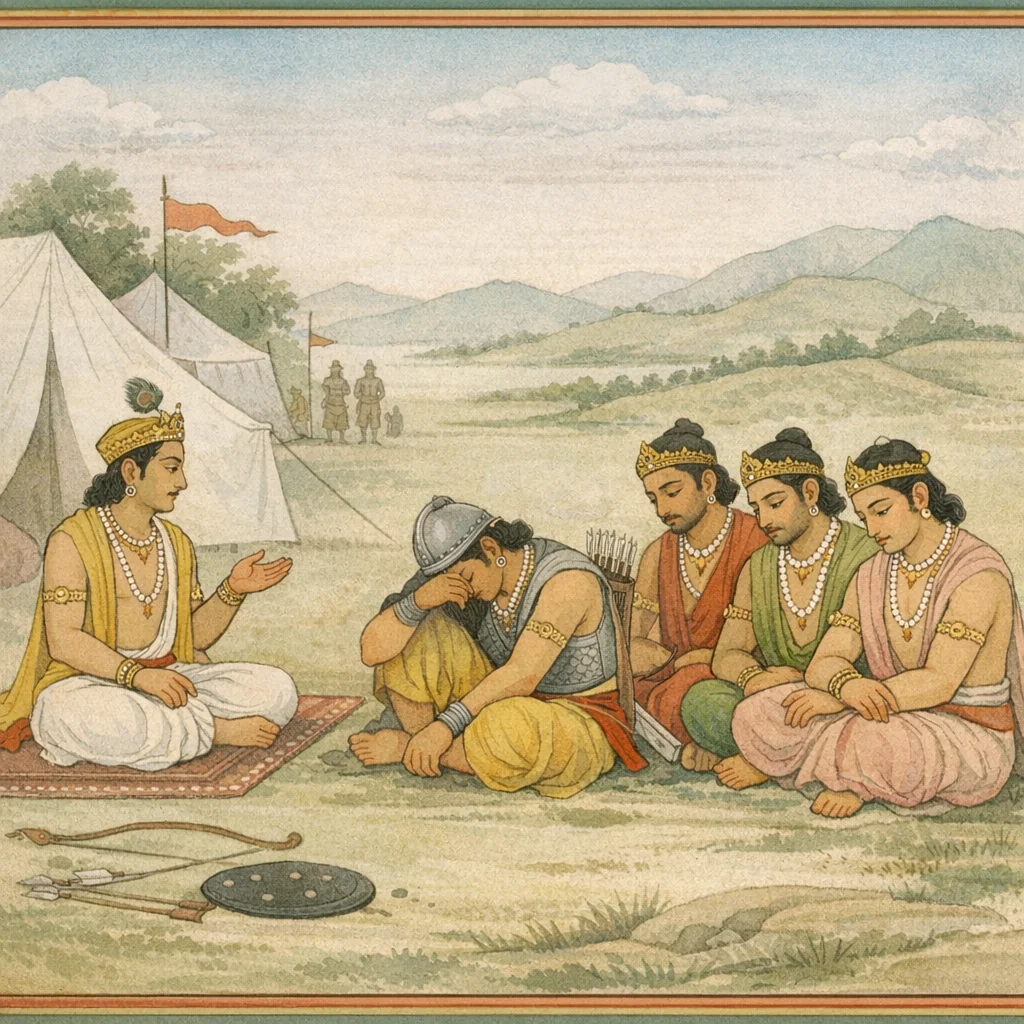
Adhyaya 73
द्रोण–सात्यकि द्वैरथम् (Droṇa and Sātyaki: The Chariot Duel)
Upa-parva: Droṇa–Sātyaki Dvairatha (Strategic Duel Episode)
Dhṛtarāṣṭra asks Saṃjaya how Droṇa responded once a severing arrow event has occurred and Dhṛṣṭadyumna is freed, focusing attention on Droṇa’s conduct toward Śaineya (Sātyaki). Saṃjaya describes Droṇa’s rapid, anger-charged advance, rendered through storm-and-serpent imagery: volleys of arrows form a ‘cloud’ of weapon-rain, with ratha-noise as thunder. Sātyaki, confident and combative, orders his charioteer to drive directly toward Droṇa, characterizing Droṇa as a harsh Brahmin aligned with the Kaurava king and a source of fear for the realm. The two masters exchange dense arrow-storms; their chariots, horses, banners, and parasols are struck down, and both are bloodied yet intent on victory. The surrounding armies fall silent, forming a ring of spectators as the duel becomes the visual center of the battlefield. The narrative then shifts to technical superiority displays: Sātyaki repeatedly cuts Droṇa’s bow and arrows; Droṇa rapidly re-arms, recognizes Sātyaki’s extraordinary skill, and mentally compares this astra-capacity with legendary exemplars. Both deploy divine weapons: Droṇa releases a fierce Agneya astra, and Sātyaki counters with a Varuṇa astra, provoking alarm among observers and even disrupting aerial movement. Reinforcements converge—Pāṇḍava leaders protect Sātyaki while Kaurava princes rally around Droṇa—expanding the duel into a broader engagement amid dust and arrow-nets where visibility and order collapse.
Chapter Arc: रणभूमि की धूल अभी बैठी भी नहीं कि धर्मराज युधिष्ठिर अपने मुख से वह वृत्तान्त खोलते हैं—चक्रव्यूह में फँसे सुभद्रानन्दन अभिमन्यु का वध कैसे हुआ। → युधिष्ठिर बताते हैं कि पाण्डवों ने रथों की सेनाओं के व्यूह रच-रचकर द्रोण को रोकने का यत्न किया, पर आचार्य बार-बार प्रतिव्यूह भेदते हुए आगे बढ़ते रहे; और जब वे रथियों द्वारा रोके भी गये, तब भी संकट का भार अभिमन्यु पर आ गिरा—उसे ‘नीक भेद’ करने को उकसाया गया, मानो बालक-वीर ही समस्त सेना का द्वार हो। → युधिष्ठिर का वचन अभिमन्यु-वध के नैतिक घाव को खोल देता है—जयद्रथ को न मार पाने पर वे उन नरकों/लोकों का स्मरण करते हैं जो पितृघाती, गुरु-पत्नीगामी और पिशुन को मिलते हैं; और फिर निर्णायक वाक्य आता है कि ‘पुरुषव्याघ्र अभिमन्यु स्वर्गलोक को प्राप्त हुआ’—यही शोक का शिखर है। → यह समाचार सुनते ही अर्जुन ‘हा पुत्र’ कहकर व्यथित होकर भूमि पर गिर पड़ते हैं; पाण्डव-समूह स्तब्ध, अनिमिष नेत्रों से एक-दूसरे को देखते हैं—शोक सामूहिक हो जाता है और कथा का स्वर विलाप से प्रतिज्ञा की ओर मुड़ने लगता है। → अर्जुन होश में आकर क्रोध से काँपते हुए उन्मत्त-सा वचन आरम्भ करते हैं—अब यह शोक प्रतिशोध में बदलेगा, और जयद्रथ के भाग्य का निर्णय निकट है।
Shlokas
Verse 1
(दाक्षिणात्य अधिक पाठके ३ ६ श्लोक मिलाकर कुल ९१३ “लोक हैं।) न२्््य्न्नितास श््यु नी नल त्रिसप्ततितमो< ध्याय: युधिष्ठिरके मुखसे अभिमन्युवधका वृत्तान्त सुनकर अर्जुनकी जयद्रथको मारनेके लिये शपथपूर्ण प्रतिज्ञा युधिछिर उवाच त्वयि याते महाबाहो संशप्तकबल प्रति । प्रयत्नमकरोत् तीव्रमाचार्यो ग्रहणे मम,युधिष्ठिर बोले--महाबाहो! जब तुम संशप्तक सेनाके साथ युद्धके लिये चले गये, उस समय आचार्य द्रोणने मुझे पकड़नेके लिये घोर प्रयत्न किया
Yudhiṣṭhira said: “O mighty-armed one, when you had gone forth to engage the Saṃśaptaka host, the preceptor Droṇa exerted a fierce and relentless effort to seize me.”
Verse 2
व्यूढानीका वयं द्रोणं वारयाम: सम सर्वश: । प्रतिव्यूह्ू रथानीकं यतमानं तथा रणे,वे रथोंकी सेनाका व्यूह बनाकर बारंबार उद्योग करते थे और हमलोग रणक्षेत्रमें अपनी सेनाको व्यूहाकारमें संघटित करके सब प्रकारसे द्रोणाचार्यको आगे बढ़नेसे रोक देते थे
Yudhiṣṭhira said: “With our forces drawn up in ordered battle-formations, we checked Droṇa on every side and in every way. And whenever he strove in the fight—re-forming and counter-forming his chariot-divisions—we too repeatedly arrayed our army in formation and prevented him from advancing.”
Verse 3
स वार्यमाणो रथिभिममयि चापि सुरक्षिते | अस्मानभिजगामाशु पीडयन् निशितै: शरै:,जब रथियोंके द्वारा आचार्य रोक दिये गये और मैं सर्वथा सुरक्षित रह गया, तब उन्होंने अपने तीखे बाणोंद्वारा हमें पीड़ा देते हुए हमलोगोंपर तीव्र वेगसे आक्रमण किया
Though checked by the chariot-warriors, and though I myself remained fully protected, he swiftly advanced against us, tormenting our forces with his razor-sharp arrows. The scene shows that in the press of battle, restraint imposed by others does not always end aggression; it can be redirected toward those nearby, intensifying the suffering of the many.
Verse 4
ते पीड्यमाना द्रोणेन द्रोणानीक॑ न शकक््नुम: । प्रतिवीक्षितुमप्याजौ भेत्तुं तत् कुत एव तु,द्रोणाचार्यसे पीड़ित होनेके कारण हमलोग उनके सैन्यव्यूहकी ओर आँख उठाकर देख भी नहीं सकते थे; फिर युद्धभूमिमें उसका भेदन तो कर ही कैसे सकते थे?
Yudhiṣṭhira said: Oppressed by Droṇa, we were unable even to raise our eyes toward Droṇa’s battle-array on the field; how then could we possibly break through it in combat? The words reveal the moral and strategic pressure born of Droṇa’s mastery—his force is not merely physical but also psychologically overwhelming, constraining the Pāṇḍavas’ agency in a dharmic war.
Verse 5
वयं त्वप्रतिमं वीर्ये सर्वे सौभद्रमात्मजम् । उक्तवन्त: सम तं तात भिन्ध्यनीकमिति प्रभो,तब हम सब लोग अनुपम पराक्रमी अपने पुत्र सुभद्रानन्दन अभिमन्युसे बोले--“तात! तुम इस व्यूहका भेदन करो; क्योंकि तुम ऐसा करनेमें समर्थ हो”
Yudhiṣṭhira said: “All of us, O lord, addressed Subhadrā’s son—Abhimanyu, peerless in valor—saying, ‘Dear one, break through the enemy’s battle-array.’”
Verse 6
स तथा नोदितोडस्माभि: सदश्च इव वीर्यवान् | असहामपि त॑ भार वोढुमेवोपचक्रमे,हमारे इस प्रकार आज्ञा देनेपर उस पराक्रमी वीरने अच्छे घोड़ेकी भाँति उस असहा भारको भी वहन करनेका ही प्रयत्न किया
Yudhiṣṭhira said: “Thus urged by us, that mighty man—like a fine horse—set himself to the task of bearing even that unbearable burden.”
Verse 7
स तवास्त्रोपदेशेन वीर्येण च समन्वित: । प्राविशत् तद्धलं बाल: सुपर्ण इव सागरम्
Endowed with the martial instruction you imparted and strengthened by his own valor, that young boy—though still a child—entered that mighty force as Garuḍa plunges into the ocean.
Verse 8
तुम्हारे दिये हुए अस्त्र-विद्याके उपदेश और पराक्रमसे सम्पन्न बालक अभिमन्युने उस सेनामें उसी प्रकार प्रवेश किया, जैसे गरुड़ समुद्रमें घुस जाते हैं ।। तेडनुयाता वयं वीरं सात्वतीपुत्रमाहवे । प्रवेष्टकामास्तेनैव येन स प्राविशच्चमूम्,तत्पश्चात् हमलोग रणक्षेत्रमें वीर सुभद्राकुमार अभिमन्युके पीछे उस व्यूहमें प्रवेश करनेकी इच्छासे चले। हम भी उसी मार्गसे उसमें घुसना चाहते थे, जिसके द्वारा उसने शत्रुसेनामें प्रवेश किया था
Yudhiṣṭhira said: “Thereafter we followed that heroic son of the Sātvata line in the thick of battle, wishing to enter the formation by the very same route through which he had penetrated the enemy host. We too sought to go in by that path.”
Verse 9
ततः सैन्धवको राजा क्षुद्रस्तात जयद्रथ: । वरदानेन रुद्रस्य सर्वान् न: समवारयत्,तात! ठीक इसी समय नीच सिंधुनरेश राजा जयद्रथने सामने आकर भगवान् शंकरके दिये हुए वरदानके प्रभावसे हम सब लोगोंको रोक दिया
Then that Saindhava king—base in conduct, Jayadratha—came forward, dear brother, and by the power of the boon granted by Rudra (Śiva) he checked and held back all of us.
Verse 10
ततो द्रोण: कृप: कर्णो द्रौणि: कौसल्य एव च । कृतवर्मा च सौभद्रंं षड् रथा: पर्यवारयन्,तदनन्तर द्रोण, कृपाचार्य, कर्ण, अश्व॒त्थामा, बृहद्बल और कृतवर्मा--इन छ: महारथियोंने सुभद्राकुमारको चारों ओरसे घेर लिया
Then Droṇa, Kṛpa, Karṇa, Droṇā’s son Aśvatthāmā, Kausalya (Bhūriśravas), and Kṛtavarmā—six great chariot-warriors—closed in on Saubhadra (Abhimanyu), surrounding him on all sides. The scene underscores the harsh ethics of war: a lone hero is deliberately hemmed in by multiple masters of combat, revealing how victory is pursued even when fairness is strained.
Verse 11
परिवार्य तु तैः सर्वेर्युधि बालो महारथै: । यतमानः: परं शक््त्या बहुभिर्विरथीकृत:,घिरा होनेपर भी वह बालक पूरी शक्ति लगाकर उन सबको जीतनेका प्रयत्न करता रहा; तथापि वे संख्यामें अधिक थे, अत: उन समस्त महारथियोंने उसे घेरकर रथहीन कर दिया
Surrounded on the battlefield by all those great chariot-warriors, the boy—striving with utmost strength—kept attempting to overcome them. Yet, because they were many, those mighty fighters closed in together and deprived him of his chariot, rendering him chariotless. The scene underscores the harsh asymmetry of war: valor and effort may persist, but numbers and coordinated force can overwhelm even a resolute combatant.
Verse 12
ततो दौ:शासनि: क्षिप्रं तथा तैर्विरथीकृतम् । संशयं परमं प्राप्य दिष्टान्तेनाभ्ययोजयत्,तत्पश्चात् दुःशासनपुत्रने अभिमन्युके प्रहारसे भारी प्राणसंकटमें पड़कर पूर्वोक्त महारथियोंद्वारा रथहीन किये हुए अभिमन्युको शीघ्र ही (गदाके आघातसे) मार डाला
Then Duḥśāsana’s son, seeing Abhimanyu swiftly stripped of his chariot by those warriors, fell into grave uncertainty and, driven by fate, pressed the attack. Thereafter, Duḥśāsana’s son struck the chariotless Abhimanyu down with a mace, killing him while he was in extreme peril—an act that underscores the collapse of warrior-ethics when a lone fighter is overwhelmed by many.
Verse 13
स तु हत्वा सहस्राणि नराश्वरथदन्तिनाम् अष्टौ रथसहस्राणि नव दन्तिशतानि च
Yudhiṣṭhira said: “He, having slain thousands among men, horses, charioteers, and elephants, also destroyed eight thousand chariots and nine hundred elephants.” The statement underscores the staggering scale of violence on the battlefield, inviting reflection on how martial prowess and mass slaughter coexist uneasily with the demands of dharma in a war fought among kin.
Verse 14
राजपुत्रसहसे द्वे वीरांश्वालक्षितान् बहून् । बृहद्धलं च राजानं स्वर्गेणाजौ प्रयोज्य ह
Yudhiṣṭhira said: “In the battle, he dispatched to heaven two thousands of princes, many other unrecognized heroes as well, and also King Bṛhaddhala.”
Verse 15
ततः परमधर्मात्मा दिष्टान्तमुपजग्मिवान् । इसके पहले उसने हजारों हाथी, रथ, घोड़े और मनुष्योंको मार डाला था। आठ हजार रथों और नौ सौ हाथियोंका संहार किया था। दो हजार राजकुमारों तथा और भी बहुत-से अलक्षित वीरोंका वध करके राजा बृहद्वलको भी युद्धस्थलमें स्वर्गलोकका अतिथि बनाया। इसके बाद परम धर्मात्मा अभिमन्यु स्वयं मृत्युको प्राप्त हुआ ।। १३-१४ $ ।। (गतःसुकृतिनां लोकान् ये च स्वर्गजितां शुभा: । अदीनस्त्रासयउछत्रून् नन्दयित्वा च बान्धवान् ।। असतवृज्ञाम विश्राव्य पितृणां मातुलस्य च | वीरो दिष्टान्तमापन्न: शोचयन् बान्धवान् बहून् ।। ततः सम शोकसंतप्ता भवताद्य समेयुष: ।) वह पुण्यात्माओंके लोकोंमें गया है। अपने पुण्यके बलसे स्वर्गलोकपर विजय पानेवाले धर्मात्मा पुरुषोंको जो शुभ लोक सुलभ होते हैं, वे ही उसे भी प्राप्त हुए हैं। उसने कभी युद्धमें दीनता नहीं दिखायी। वह वीर शत्रुओंको त्रास और बान्धवोंको आनन्द प्रदान करता हुआ अपने पितरों और मामाके नामको बारंबार विख्यात करके अपने बहुसंख्यक बन्धुओंको शोकमें डालकर मृत्युको प्राप्त हुआ है। तभीसे हमलोग शोकसे संतप्त हैं और इस समय तुमसे हमारी भेंट हुई है। एतावदेव निर्वृत्तमस्माकं शोकवर्धनम्
Then Abhimanyu, that supremely righteous-souled hero, met the end ordained by fate. Before this, he had already slain thousands of elephants, chariots, horses, and men—destroying eight thousand chariots and nine hundred elephants, killing two thousand princes and many other unrecognized warriors, and sending King Bṛhadvala too to heaven on the battlefield. Thereafter, the great-souled Abhimanyu himself attained death. He has gone to the worlds of the meritorious; by the power of his virtue he has reached those auspicious realms that belong to the righteous who win heaven through their own merit. He never showed dejection in battle; he terrified enemies and gladdened his kin, repeatedly making renowned the names of his forefathers and his maternal uncle. Yet, by dying, that hero has cast many relatives into grief. From that time we have been scorched by sorrow, and now we have met you in this state—this much alone has occurred, increasing our grief.
Verse 16
ततोडर्जुनो वच:ः श्रुत्वा धर्मराजेन भाषितम्
Then Arjuna, having heard the words spoken by Dharmarāja (Yudhiṣṭhira), responded in the unfolding crisis of war—where righteous intent must still be weighed against the harsh necessities of battle and leadership.
Verse 17
विषण्णवदना: सर्वे परिवार्य धनंजयम्
Yudhiṣṭhira said: “All of them, their faces fallen in dejection, gathered around Dhanañjaya (Arjuna).”
Verse 18
प्रतिलभ्य तत: संज्ञां वासवि: क्रोधमूर्च्छित:,उन्मत्त इव विप्रेक्षन्निदं वचनमत्रवीत् | तदनन्तर इन्द्रपुत्र अर्जुन होशमें आकर क्रोधसे व्याकुल हो मानो ज्वरसे काँप रहे हों-- इस प्रकार बारंबार लंबी साँस खींचते और हाथपर हाथ मलते हुए नेत्रोंसे आँसू बहाने लगे और उन्मत्तके समान देखते हुए इस तरह बोले--
Regaining consciousness, Arjuna—the son of Indra—was overwhelmed by a swoon of anger. Staring about like one deranged, he spoke these words. The scene underscores how even a righteous warrior, struck by grief and shock, can be shaken into loss of self-control, and how the struggle to return to composure becomes an ethical turning-point amid war.
Verse 19
कम्पमानो ज्वरेणेव नि:श्वसंश्व मुहुर्महु: । पार्णिं पाणौ विनिष्थिष्य श्वसमानो<घश्रुनेत्रवान्
Yudhiṣṭhira said: “Trembling as if seized by fever, and again and again breathing heavily, he placed the bow in his hand; panting, with eyes filled with tears.”
Verse 20
अजुन उवाच सत्यं वः प्रतिजानामि श्वो5स्मि हन्ता जयद्रथम् । न चेद् वधभयाद् भीतो धार्तराष्ट्रान् प्रहास्यति,अर्जुनने कहा--मैं आपलोगोंके सामने सच्ची प्रतिज्ञा करके कहता हूँ, कल जयद्रथको अवश्य मार डालूँगा। महाराज! यदि वह मारे जानेके भयसे डरकर धृतराष्ट्रपुत्रोंकी छोड़ नहीं देगा, मेरी, पुरुषोत्तम श्रीकृष्णकी अथवा आपकी शरणमें नहीं आ जायगा तो कल उसे अवश्य मार डालूँगा
Arjuna said: “In truth, I make this vow before you all: tomorrow I shall slay Jayadratha. And if, fearing death, he does not abandon the sons of Dhṛtarāṣṭra and seek refuge—whether in me, in Puruṣottama Śrī Kṛṣṇa, or in you—then tomorrow I will surely kill him.”
Verse 21
न चास्मान् शरणं गच्छेत् कृष्णं वा पुरुषोत्तमम् | भवन्तं वा महाराज श्वो5स्मि हनता जयद्रथम्,अर्जुनने कहा--मैं आपलोगोंके सामने सच्ची प्रतिज्ञा करके कहता हूँ, कल जयद्रथको अवश्य मार डालूँगा। महाराज! यदि वह मारे जानेके भयसे डरकर धृतराष्ट्रपुत्रोंकी छोड़ नहीं देगा, मेरी, पुरुषोत्तम श्रीकृष्णकी अथवा आपकी शरणमें नहीं आ जायगा तो कल उसे अवश्य मार डालूँगा
Arjuna said: “If Jayadratha does not seek refuge—whether with us, or with Krishna the Supreme Person, or with you, O great king—then tomorrow I shall surely slay Jayadratha.” In context, this is Arjuna’s solemn vow made openly before elders and allies: he frames the killing as conditional upon Jayadratha’s refusal to abandon the Kauravas and accept lawful protection, thereby presenting his resolve as bound to a moral choice offered to the enemy even amid war.
Verse 22
धार्तराष्ट्रप्रियकरं मयि विस्मृतसौहृदम् । पापं बालवधे हेतु श्वो5स्मि हनता जयद्रथम्,जो धृतराष्ट्रके पुत्रोंका प्रिय कर रहा है, जिसने मेरे प्रति अपना सौहार्द भुला दिया है तथा जो बालक अभिमन्युके वधमें कारण बना है, उस पापी जयद्रथको कल अवश्य मार डालूँगा
Arjuna said: “Jayadratha—who curries favor with the sons of Dhṛtarāṣṭra, who has forgotten his former friendship toward me, and who became a cause in the killing of the boy Abhimanyu—is a sinner. Tomorrow I shall surely slay Jayadratha.”
Verse 23
रक्षमाणाशक्ष तं संख्ये ये मां योत्स्यन्ति केचन । अपि द्रोणकृपौ राजन् छादयिष्यामि ताउछरै:,राजन! युद्धमें जयद्रथकी रक्षा करते हुए जो कोई मेरे साथ युद्ध करेंगे, वे द्रोणाचार्य और कृपाचार्य ही क्यों न हों, उन्हें अपने बाणोंके समूहसे आच्छादित कर दूँगा
Arjuna said: “O King, whoever in the battle chooses to fight me while protecting him (Jayadratha)—even if they be Droṇa and Kṛpa themselves—I shall overwhelm them, covering them with volleys of my arrows.”
Verse 24
यद्येतदेवं संग्रामे न कुर्या पुरुषर्षभा: । मा सम पुण्यकृतां लोकानू प्राप्तुयां शूरसम्मतान्,पुरुषश्रेष्ठ वीरो! यदि संग्रामभूमिमें मैं ऐसा न कर सकूँ तो पुण्यात्मा पुरुषोंके उन लोकोंको, जो शूरवीरोंको प्रिय हैं, न प्राप्त करूँ:
Arjuna said: “If, in this battle, I cannot do this, O best of men and foremost among heroes, then may I not attain those worlds earned by the righteous—those realms esteemed and beloved by the valiant.”
Verse 25
ये लोका ४8४६ | ये चापि पितृघातिनाम् । गुरुदारगतानां ये पिशुनानां च ये सदा
Arjuna said: “Those worlds of suffering that are assigned to the slayers of their fathers, and those also that fall to men who violate the wife of their teacher, and those that are for habitual slanderers—(to such realms do I deem myself bound if I commit this act).”
Verse 26
साधूनसूयतां ये च ये चापि परिवादिनाम् । ये च निक्षेपहर्त॒णां ये च विश्वासघातिनाम्
Arjuna said: “And those who are envious of the good, those who slander others, those who steal what has been entrusted for safekeeping, and those who betray trust—(these are the kinds of people whose conduct is condemned).”
Verse 27
भुक्तपूर्वा स्त्रियं ये च विन्दतामघशंसिनाम् | ब्रह्मघ्नानां च ये लोका ये च गोघातिनामपि
Arjuna said: “May those who commit cruel and sinful deeds meet the same fate as the gravest offenders: may they be forced to take as their lot a woman already enjoyed by another; and may they attain the worlds destined for slayers of Brahmins and for killers of cows as well.”
Verse 28
पायसं वा यवान्नं वा शाकं कूसरमेव वा । संयावापूपमांसानि ये च लोका वृथाश्रताम्
Arjuna said: “Whether it is sweet rice, barley-gruel, vegetables, or even coarse fare; whether it is thickened milk-preparations, cakes, or meat—those who cook and prepare such foods in vain (without a worthy purpose or proper offering) gain only fruitless results.”
Verse 29
तानन्हायाधिगच्छेयं न चेद्धन्यां जयद्रथम् । माता-पिताकी हत्या करनेवालोंको जो लोक प्राप्त होते हैं, गुरु-पत्नीगामी और चुगलखोरोंको जिन लोकोंकी प्राप्ति होती है, साधुपुरुषोंकी निन्दा करनेवालों और दूसरोंको कलंक लगानेवालोंको जो लोक प्राप्त होते हैं, धरोहर हड़पने और विश्वासघात करनेवालोंको जिन लोकोंकी प्राप्ति होती है, दूसरेके उपभोगमें आयी हुई स्त्रीको ग्रहण करनेवाले, पापकी बातें करनेवाले, ब्रह्महत्यारे और गोघातियोंको जो लोक प्राप्त होते हैं, खीर, यवान्न, साग, खिचड़ी, हलवा, पूआ आदिको बलिवैश्वदेव किये बिना ही खानेवाले मनुष्योंको जो लोक प्राप्त होते हैं, यदि मैं कल जयद्रथका वध न कर डालूँ तो मुझे भी तत्काल उन्हीं लोकोंको जाना पड़े || २५--२८ $ || वेदाध्यायिनमत्यर्थ संशितं वा द्विजोत्तमम्
Arjuna said: “May I fall into those very realms (of grievous sinners) if I do not slay Jayadratha tomorrow.” In the heat of battle and grief, Arjuna binds himself by a terrible vow: if he fails to punish the one held responsible for Abhimanyu’s death, he accepts the same moral and spiritual consequence as those who commit the most condemned betrayals and violations of dharma.
Verse 156
स चैवं पुरुषव्यात्र: स्वर्गलोकमवाप्तवान् | यही हमलोगोंके लिये शोक बढ़ानेवाली घटना घटित हुई है। पुरुषसिंह अभिमन्यु इस प्रकार स्वर्गलोकमें गया है
Yudhiṣṭhira said: “And thus that tiger among men attained the heavenly world. Here, for us, an event has occurred that only increases grief. The lion among men, Abhimanyu, has gone in this manner to heaven.”
Verse 166
हा पुत्र इति निः:श्वस्य व्यथितो न््यपतद् भुवि । धर्मराज युधिष्ठिरकी कही हुई यह बात सुनकर अर्जुन व्यथासे पीड़ित हो लंबी साँस खींचते हुए “हा पुत्र” कहकर पृथ्वीपर गिर पड़े
Sighing deeply and overwhelmed with anguish, he cried, “Alas, my son!” and collapsed upon the earth—Arjuna, stricken by the words spoken by Dharmarāja Yudhiṣṭhira, falling in grief at the moral and personal shock of the moment.
Verse 176
नेत्रैरनिमिषैद्दीना: प्रत्यवैक्षन् परस्परम् । उस समय सबके मुखपर विषाद छा गया। सब लोग अर्जुनको घेरकर दु:खी हो एकटक नेत्रोंसे एक-दूसरेकी ओर देखने लगे
Yudhiṣṭhira said: With unblinking eyes, overwhelmed by sorrow, they looked at one another. A pall of grief spread over every face; surrounding Arjuna, all stood distressed, staring fixedly as they searched each other’s expressions—an image of collective moral shock amid the duties and costs of war.
Verse 196
उन्मत्त इव विप्रेक्षन्निदं वचनमत्रवीत् | तदनन्तर इन्द्रपुत्र अर्जुन होशमें आकर क्रोधसे व्याकुल हो मानो ज्वरसे काँप रहे हों-- इस प्रकार बारंबार लंबी साँस खींचते और हाथपर हाथ मलते हुए नेत्रोंसे आँसू बहाने लगे और उन्मत्तके समान देखते हुए इस तरह बोले--
Staring about as if deranged, he spoke these words. Immediately afterward Arjuna, the son of Indra, came back to his senses; but overwhelmed by anger, trembling as though seized by fever, he repeatedly drew long breaths, rubbed his hands together, and let tears stream from his eyes. Looking like one distraught, he then spoke in this manner—revealing how even a righteous warrior, when struck by grief and outrage, can be shaken at the very edge of dharma amid the violence of war.
Frequently Asked Questions
The duel frames how duty and allegiance operate under anger and public scrutiny: both sides pursue victory while maintaining the appearance of disciplined mastery, testing whether technical excellence can remain aligned with restraint and broader responsibility.
The narrative emphasizes preparedness and countermeasure literacy: mastery is demonstrated not only by deploying powerful weapons but by recognizing, neutralizing, and adapting to an opponent’s escalation in real time.
No explicit phalaśruti appears here; the chapter functions as a technical-historical report within Saṃjaya’s narration, with implicit didactic value derived from observing discipline, adaptability, and the costs of escalation.