Adhyaya 82
Gavāṃ Māhātmya — Go-dāna, Yajña-ādhāra, and Goloka (Brahmā–Indra–Surabhi Itihāsa)
Upa-parva: Gavāṃ Māhātmya (Cow-Veneration and Go-dāna Instruction) — Anuśāsana-parva thematic unit
Bhīṣma instructs Yudhiṣṭhira that those who gift cows and those who subsist on sacrificial remnants are perpetually connected to satras and yajñas (1). He states that yajña cannot proceed without dairy—curd and ghee—thereby identifying cows as the functional root of ritual performance (2). Among all gifts, cow-gifting is praised as especially purifying; cows are declared foremost and intrinsically sanctifying (3). Service to cows is recommended for nourishment and peace; their milk, curd, and ghee are described as liberative from sin (4). Cows are characterized as supreme radiance and the highest purifier in both this world and the next (5). Bhīṣma then cites an ancient narrative: after the defeat of the daityas, beings assemble around Pitāmaha (Brahmā), with celestial music and offerings; Indra asks why cows have a realm above the gods and what austerity they performed (6–13). Brahmā replies that Indra has habitually disregarded cows and explains their greatness: cows are limbs of yajña and yajña itself; without them yajña cannot function (14–16). They sustain beings through milk and sacrificial substances, support agriculture via their offspring, generate grains and seeds, and thus enable offerings to gods and ancestors (17–20). Hence cows dwell above the gods; they are boon-bestowing and auspicious (21–22). Brahmā recounts Surabhi’s tapas in the devayuga—undertaken in alignment with Aditi’s austerity—standing on one foot for vast periods; pleased, Brahmā grants immortality and establishes the famed Goloka above the three worlds, describing its deathlessness and abundance, and noting access through vows, tīrtha-service, tapas, and meritorious action (23–40). Brahmā concludes by warning against contempt toward cows (41). Bhīṣma closes: Indra thereafter honors cows; hearing and recounting this purifying discourse benefits ritual contexts (yajñas, pitṛ-kārya), and devotion to cows is said to yield desired aims—offspring, marriage, wealth, dharma, learning, and happiness—framed as a phalaśruti (42–47).
Chapter Arc: The discourse opens by proclaiming the cow as the foremost of all dakṣiṇās (sacred gifts), seeking freedom from sin and the highest auspicious merit through her donation. → A graded map of merit unfolds: different colors and qualities of cows—each adorned, clothed, and given with a calf—lead the donor to distinct exalted realms; even the bull, fit for bearing burdens and ornamented with gems, becomes a vehicle to Prajāpati’s world. The listener is drawn deeper into the precise ritual economy of giving. → The chapter reaches its summit in the lavishly sensuous vision of heaven: the donor is awakened by the music of vīṇā and vallakī, by the jingling of anklets, and by the laughter of doe-eyed maidens—an image that makes the promised fruit feel immediate and irresistible. → The teaching seals the doctrine with a vast measure of reward: as many hairs as are on the cow, so many years the giver is honored; even after falling from heaven, the donor is reborn into a wealthy house—thus the merit persists across worlds.
Shlokas
Verse 1
अ-क्रा् एकोनाशीतितमो< ध्याय: गौओंको तपस्याद्वारा अभीष्ट वरकी प्राप्ति तथा उनके दानकी महिमा, विभिन्न प्रकारके गौओंके दानसे विभिन्न उत्तम लोकोंमें गमनका कथन वसिष्ठ उवाच शतं वर्षसहस्राणां तपस्तप्तं सुदुष्करम् । गोभि: पूर्व विसृष्टाभिर्गच्छेम श्रेष्ठतामिति
Chapter seventy-nine: On attaining the desired boon through austerity, on the greatness of gifting cows, and on how gifts of different kinds of cows lead to different excellent worlds. Vasiṣṭha said: “For a hundred thousand years we have performed austerities most difficult to endure; by the cows that were sent forth before, let us attain the highest excellence.”
Verse 2
लोकेडस्मिन् दक्षिणानां च सर्वासां वयमुत्तमा: । भवेम न च लिप्येम दोषेणेति परंतप
Vasiṣṭha said: “In this world, among all forms of dakṣiṇā (honorific gifts), we would be the foremost—yet we should not become tainted by any fault. This is what I say, O scorcher of foes.”
Verse 3
अस्मत्पुरीषस्नानेन जन: पूर्येत सर्वदा । शकृता च पतवित्रार्थ कुर्वीरन् देवमानुषा:
Vasiṣṭha said: “By bathing in our excrement, people would always become purified; and for the sake of purification, gods and humans would perform rites using dung.”
Verse 4
तथा सर्वाणि भूतानि स्थावराणि चराणि च । प्रदातारश्च॒ लोकान् नो गच्छेयुरिति मानद
Vasiṣṭha said: “So too, may all beings—both the immovable and the moving—become givers; and may such benefactors attain the worlds (of blessed reward). This, O bestower of honor, is the intent.”
Verse 5
वसिष्ठजी कहते हैं--मानद परंतप! प्राचीन कालमें जब गौओंकी सृष्टि हुई थी, तब उन गौओंने एक लाख वर्षोतक बड़ी कठोर तपस्या की थी। उनकी तपस्याका उद्देश्य यह था कि हम श्रेष्ठता प्राप्त करें। इस जगतमें जितनी दक्षिणा देने योग्य वस्तुएँ हैं, उन सबमें हम उत्तम समझी जायाँ। किसी दोषसे लिप्त न हों। हमारे गोबरसे स्नान करनेपर सदा सब लोग पवित्र हों। देवता और मनुष्य पवित्रताके लिये हमेशा हमारे गोबरका उपयोग करें। समस्त चराचर प्राणी भी हमारे गोबरसे पवित्र हो जायेँ और हमारा दान करनेवाले मनुष्य हमारे ही लोक (गोलोकधाम) में जाया ।। ताभ्यो वरं ददौ ब्रह्मा तपसोडचन्ते स्वयं प्रभु: । एवं भवव्विति प्रभुलोंकांस्तारयतेति च,जब उनकी तपस्या समाप्त हुई, तब साक्षात् भगवान ब्रह्माने उन्हें वर दिया--“गौओ! ऐसा ही हो--तुम्हारे मनमें जो संकल्प है, वह परिपूर्ण हो। तुम सम्पूर्ण जगत्के जीवोंका उद्धार करती रहो”
Vasiṣṭha said: “O honored one, O scorcher of foes! In ancient times, when the cows were first brought into being, they undertook a severe austerity for a hundred thousand years. Their aim was this: ‘May we attain preeminence. Among all things fit to be given as sacred gifts, may we be regarded as the best. May no fault cling to us. By bathing with our cow-dung, may people always become pure. Let gods and humans continually use our cow-dung for purification. Let all moving and unmoving beings be purified by it, and let those who gift cows attain our own world—Goloka.’ When their austerity was completed, Brahmā himself granted them a boon: ‘So be it. Let the resolve in your hearts be fulfilled. Continue to uplift and deliver the beings of the entire world.’”
Verse 6
उत्तस्थु: सिद्धकामास्ता भूतभव्यस्य मातर: । प्रातर्नमस्यास्ता गावस्तत:ः पुष्टिमवाप्लुयात्,इस प्रकार अपनी समस्त कामनाएँ सिद्ध हो जानेपर गौएँ तपस्यासे उठीं। वे भूत, भविष्य और वर्तमान--तीनों कालोंकी जननी हैं; अतः प्रतिदिन प्रातःकाल उठकर गौओंको प्रणाम करना चाहिये। इससे मनुष्योंको पुष्टि प्राप्त होती है
Vasiṣṭha said: “When their aims had been fulfilled, those cows rose up from their austerity. They are the mothers of time—of what has been, what will be, and what is. Therefore one should rise each morning and bow in reverence to the cows; from that, a person attains nourishment, well-being, and strength.”
Verse 7
तपसोअ<न्ते महाराज गावो लोकपरायणा: । तस्माद् गावो महाभागा: पवित्र परमुच्यते,महाराज! तपस्या समाप्त होनेपर गौएँ सम्पूर्ण जगत्का आश्रय बन गयीं; इसलिये वे महान् सौभाग्यशालिनी गौएँ परम पवित्र बतायी जाती हैं
Vasiṣṭha said: “O great king, when the austerity was brought to its completion, the cows became the refuge and sustaining support of the whole world. Therefore those greatly fortunate cows are declared to be supremely pure.”
Verse 8
तथैव सर्वभूतानां समतिष्ठन्त मूर्थनि । समानवत्सां कपिलां थेनुं दत्वा पयस्विनीम् । सुव्रतां वस्त्रसंवीतां ब्रह्मलोके महीयते,ये समस्त प्राणियोंके मस्तकपर स्थित हैं (अर्थात् सबसे श्रेष्ठ एवं वन्दनीय हैं)। जो मनुष्य दूध देनेवाली सुलक्षणा कपिला गौको वस्त्र ओढ़ाकर कपिल रंगके बछड़ेसहित दान करता है, वह ब्रह्मलोकमें सम्मानित होता है
Vasiṣṭha said: “Just so, there are those who stand above the heads of all beings—meaning, they are the highest and most worthy of reverence. A person who donates a milk-yielding, well-marked tawny cow, together with a calf of the same color, and properly covered with cloth, is honored in the world of Brahmā.”
Verse 9
लोहितां तुल्यवत्सां तु थेनुं दत्त्वा पयस्विनीम् । सुव्रतां वस्त्रसंवीतां सूर्यलोके महीयते,जो मनुष्य दूध देनेवाली सुलक्षणा लाल रंगकी गौको वस्त्र ओढ़ाकर लाल रंगके बछड़ेसहित दान करता है, वह सूर्यलोकमें सम्मानित होता है
Vasiṣṭha said: One who donates a milk-yielding cow of reddish hue, together with a calf of matching color, and properly covered with cloth—such a donor is honored in Sūrya’s world.
Verse 10
समानवत्सां शबलां थेनुं दत्त्वा पयस्विनीम् । सुव्रतां वस्त्रसंवीतां सोमलोके महीयते,जो पुरुष दूध देनेवाली सुलक्षणा चितकबरी गौको वस्त्र ओढ़ाकर चितकबरे बछड़ेसहित दान करता है, वह चन्द्रलोकमें पूजित होता है
Vasiṣṭha said: A man who donates a milk-yielding, well-marked speckled cow together with her calf of the same kind, and who respectfully covers her with a cloth, is honored in Soma’s world (the lunar realm).
Verse 11
समानवत्सां श्वेतां तु धेनुं दत्त्वा पयस्विनीम् । सुव्रतां वस्त्रसंवीतामिन्द्रलोके महीयते,जो मानव दूध देनेवाली सुलक्षणा श्वेत वर्णकी गौको वस्त्र ओढ़ाकर श्वेत वर्णके बछड़ेसहित दान करता है, उसे इन्द्रलोकमें सम्मान प्राप्त होता है
Vasiṣṭha said: One who donates a milk-yielding white cow, accompanied by a calf of the same kind, and who is well-conducted and properly covered with a cloth, is honored in Indra’s world.
Verse 12
समानवत्सां कृष्णां तु धेनुं दत््वा पयस्विनीम् । सुव्रतां वस्त्रसंवीतामग्निलोके महीयते,जो मनुष्य दूध देनेवाली सुलक्षणा कृष्ण वर्णकी गौको वस्त्र ओढ़ाकर कृष्ण वर्णके बछड़ेसहित दान करता है, वह अग्निलोकमें प्रतिष्ठित होता है
Vasiṣṭha said: Whoever donates a milk-yielding black cow together with her calf of the same color, presenting her with proper conduct and draped in cloth, is honored and raised to high standing in the world of Agni.
Verse 13
समानवत्सां धूम्रां तु थेनुं दत््वा पयस्विनीम् । सुव्रतां वस्त्रसंवीतां याम्यलोके महीयते,जो पुरुष दूध देनेवाली सुलक्षणा धूएँ-जैसे रंगकी गौको वस्त्र ओढ़ाकर धूएँके समान रंगके बछड़ेसहित दान करता है, वह यमलोकमें सम्मानित होता है
Vasiṣṭha said: A man who donates a milk-giving cow of smoky-grey hue, together with a calf of the same color, and presents her properly covered with cloth, is honored in Yama’s realm.
Verse 14
अपां फेनसवर्णा तु सवत्सां कांस्यदोहनाम् | प्रदाय वस्त्रसंवीतां वारुणं लोकमाप्लनुते,जो जलके फेनके समान रंगवाली गौको वस्त्र ओढ़ाकर बछड़े और कांस्यके दुग्धपात्रसहित दान करता है, वह वरुणलोकको प्राप्त होता है
Vasiṣṭha said: Whoever donates a cow whose color is like the foam of water, together with her calf, along with a bronze milking vessel, and presents her draped in cloth, attains the world of Varuṇa.
Verse 15
वातरेणुसवर्णा तु सवत्सां कांस्यदोहनाम् | प्रदाय वस्त्रसंवीतां वायुलोके महीयते,जो हवासे उड़ी हुई धूलके समान रंगवाली गौको वस्त्र ओढ़ाकर बछड़े और कांस्यके दुग्धपात्रसहित दान करता है, उसकी वायुलोकमें पूजा होती है
Vasiṣṭha said: Whoever donates a cow whose color is like dust blown by the wind, together with her calf, along with a bronze milking vessel, and presents her draped in cloth, is honored in the world of Vāyu.
Verse 16
हिरण्यवर्णा पिंगाक्षीं सवत्सां कांस्यदोहनाम् | प्रदाय वस्त्रसंवीतां कौबेरं लोकमश्लुते,जो सुवर्णके समान रंग तथा पिंगल वर्णके नेत्रवाली गौको वस्त्र ओढ़ाकर बछड़े और कांस्यके दुग्धपात्रसहित दान करता है, वह कुबेर-लोकको प्राप्त होता है
Vasiṣṭha said: Whoever donates a golden-hued cow with tawny eyes, together with her calf, along with a bronze milking vessel, and presents her draped in cloth, attains the world of Kubera.
Verse 17
पलालधूम्रवर्णा तु सवत्सां कांस्यदोहनाम् | प्रदाय वस्त्रसंवीतां पितृलोके महीयते,जो पुआलके धूएँके समान रंगवाली बछड़ेसहित गौको वस्त्रसे आच्छादित करके कांस्यके दुग्धपात्रसहित दान करता है, वह पितृलोकमें प्रतिष्ठित होता है
Vasiṣṭha said: One who donates a cow whose color is like the smoke of straw, together with her calf, covering her with cloth and providing a bronze milking vessel, is honored and attains distinction in the world of the ancestors (Pitṛloka).
Verse 18
सवत्सां पीवरीं दत्त्वा दृतिकण्ठामलंकृताम् | वैश्वदेवमसम्बाध॑ स्थान श्रेष्ठ प्रपद्यते,जो लटकते हुए गलकम्बलसे युक्त मोटी-ताजी सवत्सा गौको अलंकृत करके ब्राह्मणको दान देता है, वह बिना किसी बाधाके विश्वेदेवोंके श्रेष्ठ लोकमें पहुँच जाता है
Vasiṣṭha said: One who gifts to a brāhmaṇa a well-nourished cow along with her calf, adorned and fitted with a neck-covering or strap (a leather collar), attains without obstruction the excellent realm associated with the Viśvedevas.
Verse 19
समानवत्सां गौरीं तु थेनुं दत्त्वा पयस्विनीम् । सुव्रतां वस्त्रसंवीतां वसूनां लोकमाप्नुयात्,जो गौर वर्णवाली और दूध देनेवाली शुभलक्षणा गौको वस्त्र ओढ़ाकर समान रंगवाले बछड़ेसहित दान करता है, वह वसुओंके लोकमें जाता है
Vasiṣṭha said: One who donates a milk-yielding cow of fair, whitish hue, together with a calf of matching color, covering her with cloth and maintaining right conduct, attains the world of the Vasus.
Verse 20
पाण्डुकम्बलवर्णाभां सवत्सां कांस्यदोहनाम् । प्रदाय वस्त्रसंवीतां साध्यानां लोकमाप्नुते,जो श्वेत कम्बलके समान रंगवाली सवत्सा गौको वस्त्रसे आच्छादित करके कांस्यके दुग्धपात्रसहित दान करता है, वह साध्योंके लोकमें जाता है
Vasiṣṭha said: One who donates a cow of a pale, blanket-like hue—together with her calf—covering her with cloth and providing a bronze milking vessel, attains the world of the Sādhyas.
Verse 21
वैराटपृष्ठमुक्षाणं सर्वरत्नैरलंकृतम् । प्रददन्मरुतां लोकान् स राजन् प्रतिपद्यते,राजन! जो विशालपृष्ठभागवाले बैलको सब प्रकारके रत्नोंसे अलंकृत करके उसका दान करता है, वह मरुद्गणोंके लोकोंमें जाता है
Vasiṣṭha said: O King, one who gives in charity a bull with a broad, lofty back, adorned with every kind of jewel, attains the worlds of the Maruts.
Verse 22
वयोपपन्नं लीलांगं सर्वरत्नसमन्वितम् । गन्धर्वाप्सरसां लोकान् दत्त्वा प्राप्नोति मानव:,जो मनुष्य यौवनसे सम्पन्न और सुन्दर अंगवाले बैलको सम्पूर्ण रत्नोंसे विभूषित करके उसका दान करता है, वह गन्धर्वों और अप्सराओंके लोकोंको प्राप्त करता है
Vasiṣṭha said: A person who donates a bull in its prime—well-grown, handsome-limbed, and adorned with every kind of precious ornament—attains the celestial realms of the Gandharvas and the Apsarases.
Verse 23
दृतिकण्ठमनड्वाहं सर्वरत्नैरलंकृतम् । दत्त्वा प्रजापतेलोकान् विशोक: प्रतिपद्यते,जो लटकते हुए गलकम्बलवाले तथा गाड़ीका बोझ ढोनेमें समर्थ बैलको सम्पूर्ण रत्नोंसे अलंकृत करके ब्राह्मणको देता है, वह शोकरहित हो प्रजापतिके लोकोंमें जाता है
Vasiṣṭha said: He who gives to a brāhmaṇa a strong bull—thick-necked and fit to bear the burden of a cart—adorned with every kind of jewel, attains the worlds of Prajāpati and becomes free from sorrow.
Verse 24
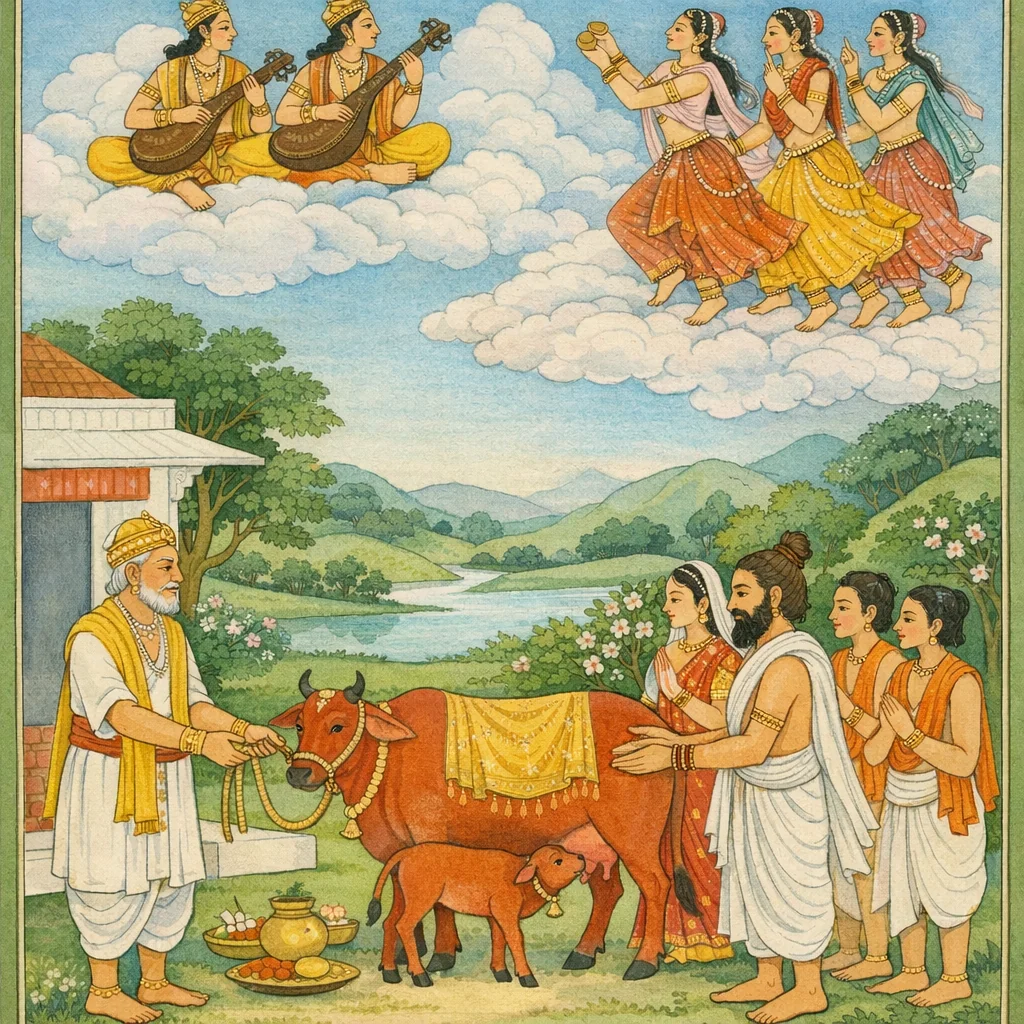
गोप्रदानरतो याति भित्त्वा जलदसंचयान् | विमानेनार्कवर्णेन दिवि राजन् विराजते,राजन! गोदानमें अनुरागपूर्वक तत्पर रहनेवाला पुरुष सूर्यके समान देदीप्यमान विमानमें बैठकर मेघमण्डलको भेदता हुआ स्वर्गमें जाकर सुशोभित होता है
Vasiṣṭha said: O King, one devoted to the gift of cows, giving with heartfelt eagerness, pierces the gathered masses of clouds and, seated in a sun-hued celestial chariot, goes to heaven and shines there in glory.
Verse 25
तं॑ चारुवेषा: सुश्रोण्य:ः सहस्न॑ सुरयोषित: । रमयन्ति नरश्रेष्ठ गोप्रदानरतं नरम्,उस गोदानपरायण श्रेष्ठ मनुष्यको मनोहर वेष और सुन्दर नितम्बवाली सहस्ोरों देवांगनाएँ (अपनी सेवासे) रमण कराती हैं
Vasiṣṭha said: O best of men, thousands of heavenly maidens—beautifully adorned and fair-hipped—delight and attend upon the man who is devoted to the gift of cows.
Verse 26
वीणानां वल्लकीनां च नूपुराणां च सिज्जितै: । हासैश्न हरिणाक्षीणां सुप्त: स प्रतिबोध्यते,वह वीणा और वल्लकीके मधुर गुंजन, मृगनयनी युवतियोंके नूपुरोंकी मनोहर झनकारों तथा हास-परिहासके शब्दोंको श्रवण करके नींदसे जागता है
Though asleep, he is awakened by the sweet resonance of vīṇās and vallakīs, by the charming jingling of women’s anklets, and by the playful laughter of doe-eyed maidens.
Verse 27
यावन्ति रोमाणि भवन्ति धेन्वा- स्तावन्ति वर्षाणि महीयते सः । स्वर्गच्युतश्नापि ततो नूलोके प्रसूयते वै विपुले गृहे स:,गौके शरीरमें जितने रोएँ होते हैं, उतने वर्षोतक वह स्वर्गलोकमें सम्मानपूर्वक रहता है। फिर पुण्यक्षीण होनेपर जब स्वर्गसे नीचे उतरता है, तब इस मनुष्यलोकमें आकर सम्पन्न घरमें जन्म लेता है
Vasiṣṭha said: “For as many hairs as there are on a cow’s body, for that many years the giver is honored in heaven. When that merit is exhausted and he falls from heaven, he is then born again in this human world in a prosperous household.”
Verse 79
इति श्रीमहा भारते अनुशासनपर्वणि दानधर्मपर्वणि गोप्रदानिके एकोनाशीतितमो<ध्याय:
Thus, in the revered Mahābhārata, within the Anuśāsana Parva—specifically in the section on the dharma of gifts (dāna-dharma), in the episode concerning the gifting of cows (go-dāna)—ends the eighty-ninth chapter.
Frequently Asked Questions
The chapter prescribes reverence and benefaction toward cows—especially through go-dāna and service—arguing that cows are materially and ritually indispensable to yajña and socially sustaining to agrarian life.
Cows are presented as both a limb of yajña and as effectively constitutive of yajña because key offerings (milk products such as dadhi and ghṛta) are prerequisites for ritual continuity and for havya/kavya transactions.
Yes. The discourse states that recitation/teaching to brāhmaṇas in sacrificial and ancestral contexts yields durable merit; devotion to cows is further linked to attainment of desired aims such as progeny, spouse, wealth, dharma, learning, and happiness.