Adhyaya 11
Navavyūha-pūjāvidhi: Bhūta-śuddhi, Nyāsa, Yogapīṭha, Maṇḍala-racanā, Mudrā-prayoga
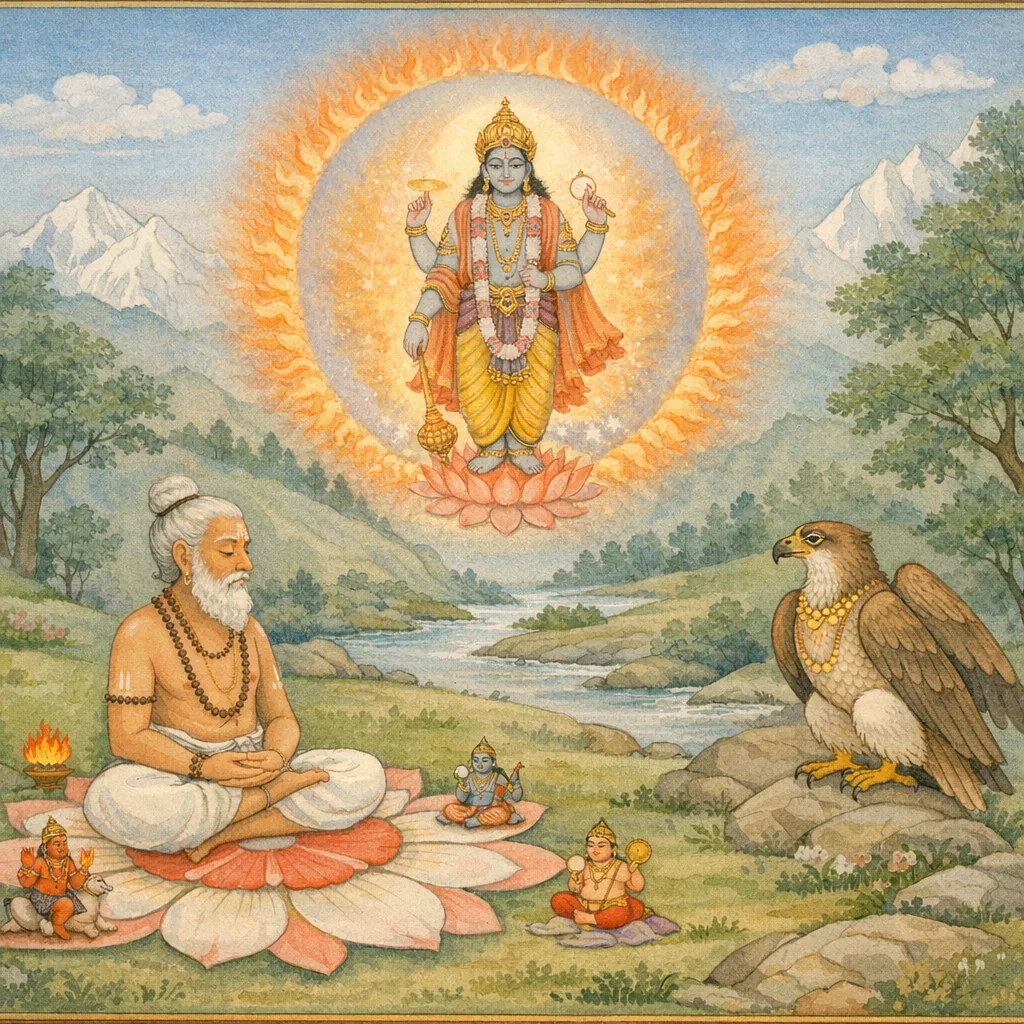
Hari teaches Kaśyapa the received method for worship of the nine Vyūhas, beginning with inner yogic preparation: raising prāṇa to the crown and settling it in the inner expanse, then performing bhūta-śuddhi with bīja-mantras that burn and dissolve the elemental body and fill awareness with cosmic pervasion and amṛta-bhāvanā. The practitioner then meditates on the four-armed, yellow-robed Lord within a radiant sphere, with the identity-reflection “That is I.” Layered nyāsa follows on hands and body, installing the sixfold protections (hṛdaya, śiras, śikhā, kavaca, netra, astra) over heart, head, eyes, hands, and the directions. The rite proceeds to construct the yogapīṭha by placing Dharma–Jñāna–Vairāgya–Aiśvarya and their opposites, then an eight-direction lotus and the stacked maṇḍalas of Sun, Moon, and Fire. Directional powers of Keśava and Vyūha-seeds are set at doors and corners along with Garuḍa, Sudarśana, Śrī/Lakṣmī, and divine weapons and emblems; guardians and cosmic supports (Brahmā above, Ananta below) are contemplated. Worship concludes with a defined mudrā-sequence, mantra-forms, color correspondences, and syllabic mappings for the emblems, and enters the offering protocol (arghya, pādya, etc.) with Puṇḍarīkākṣa-vidyā, preparing for the subsequent chapters.
Shlokas
Verse 1
नाम दशमो ऽध्यायः हरिरुवाचं / नवव्यूहार्चनं वक्ष्ये यदुक्तं कश्यपाय हि / जीवमुत्क्षिप्य मूर्धन्यं नाभ्यां व्योम्निनिवेशयेत्
Hari said: “I shall explain the worship of the nine Vyūhas, as it was indeed taught to Kaśyapa. Having raised the life-force to the crown of the head, one should establish it—by way of the navel—into the inner expanse (vyoman).”
Verse 2
ततोरमिति बीजेन दहेद्भूतात्मकं वपुः / यमित्यनेन बीजेन तच्च सर्व विनाशयेत्
Then, with the seed-mantra “ram”, one should burn the elemental-bodied frame; and with the seed-mantra “yam”, one should completely dissolve and destroy all that remains of it.
Verse 3
लमित्यनेन बीजेन प्लावयेत्सचराचरम् / वमित्यनेन बीजेन चिन्तयेदमृतं ततः
With the seed-syllable “lam”, one should cause the entire moving and unmoving world to be flooded (pervaded). Then, with the seed-syllable “vam”, one should meditate upon ambrosial immortality.
Verse 4
ततो बुद्वुदमध्ये तु पीतवासाश्चतुर्भुजः / अहं मतस्तथात्मानं ध्यानेन परिचिन्तयेत्
Then, within the midst of a luminous sphere (like a bubble), one should contemplate by meditation the four-armed Lord clad in yellow garments—thinking, “That (Lord) is I,” and thus reflect upon one’s own Self.
Verse 5
मन्त्रन्यासं ततः कुर्यात्त्रिविधं करदेहयोः / द्वादशाक्षरबीजेन उक्तबीजैरनन्तरम्
Then one should perform mantra-nyāsa in three ways—upon the hands and upon the body—using the twelve-syllabled seed-mantra, and immediately thereafter with the bījas previously declared.
Verse 6
षडङ्गेन ततः कुर्यात्साक्षाद्येन हरिर्भवेत् / दक्षिणाङ्गुष्ठमारभ्य मध्याङ्गुष्ठन्दले न्यसेत्
Then one should perform the sixfold nyāsa (ṣaḍaṅga), by which Hari becomes directly manifest. Beginning with the right thumb, one should place the mantra-power in the maṇḍala-circle of the middle thumb.
Verse 7
मध्ये बीजद्वयं न्यस्य न्यसेदङ्गे ततः पुनः / हृच्छिरसि शिखावर्ंमवक्क्राक्ष्युदहपृष्ठतः
Placing the pair of seed-mantras in the middle, one should again perform nyāsa upon the body—upon the heart and the head; upon the śikhā as varma, an armour of protection; upon the face, the hands, the eyes, the astra (weapon-mantra), and upon the back behind.
Verse 8
बाह्वोश्च करयोर्जान्वोः पादयोश्चापि विन्यसेत् / पद्माकारौ करौ कृत्वा मध्ये ऽङ्गुष्ठं निवेशयेत्
One should place (nyāsa) upon the arms, the hands, the knees, and also the feet; forming the two hands in the shape of a lotus, one should set the thumbs in the middle.
Verse 9
चिन्तयेत्तत्र सर्वेशं परं तत्त्वमनामयम् / क्रमाच्चैतानि बीजानि तर्जन्यादिषु विन्य सेत्
There one should meditate upon the Lord of all—the supreme Reality, unchanging and free from every affliction. Then, in due order, one should place these seed-syllables upon the fingers, beginning with the index finger.
Verse 10
ततो मूर्धाक्षिवक्क्रेषु कण्ठे च हृदये तथा / नाभौ गुह्ये तथा जान्वोः पादयोर्विन्यसेत्क्रमात्
Then, in proper order, one should install (by nyāsa) upon the head, the eyes and face, the throat, and the heart; likewise upon the navel, the secret region, the knees, and finally the feet.
Verse 11
पाण्योः षडङ्गबीजानि न्यस्य काये ततो न्यसेत् / अङ्गुष्ठादिकनिष्ठान्तं विन्यसेद्वीजपञ्चकम्
Having placed the six-limbed seed-mantras (ṣaḍaṅga-bīja) upon both hands, one should then perform nyāsa upon the body. From the thumb to the little finger, one should install the set of five seed-syllables.
Verse 12
करमध्ये नेत्रबीजमङ्गन्यासऽप्ययं क्रमः / हृदये हृदयं न्यस्य शिरः शिरसि विन्यसेत्
In the middle of the palms one should place the ‘eye-seed’ (netra-bīja); this too is the sequence of aṅga-nyāsa. Placing the heart-mantra upon the heart, one should place the head-mantra upon the head.
Verse 13
शिखायां तु शिखां न्यस्य कवचं सर्वतस्तनौ / नेत्रं नेत्रे विधातव्यमस्त्रञ्च करयोर्द्वयोः
Placing the śikhā-mantra upon the crown-tuft, one should then install the kavaca (armor-mantra) over the entire body. The netra (eye-protection) is to be established upon the eyes, and the astra (weapon-mantra) upon both hands.
Verse 14
तेनैव च दिशो बद्धा पूजा विधिमथाचरेत् / हृदये चिन्तयेत्पूर्वं योगपीठं समाहितः
By that very act, having ritually secured the directions, one should then carry out the prescribed procedure of worship. First, composed and attentive, one should contemplate within the heart the yogapīṭha, the yogic seat.
Verse 15
धर्म ज्ञनं च वैराग्यमैश्वर्यं च यथाक्रमम् / आग्नेयादौ च पूर्वादावधर्मादींश्च विन्यसेत्
One should assign, in proper sequence, Dharma, Knowledge (Jñāna), Dispassion (Vairāgya), and Sovereignty (Aiśvarya); and likewise, beginning from the south‑east (Agneya) and then from the east, one should set Adharma and the remaining opposing principles in their respective places.
Verse 16
एभिः परिच्छन्नतनुं पीठभूतं तदात्मकम् / अनन्तं विन्सेत्पश्चात्पूर्वकायोन्नतं स्थितम्
Enveloped by these constituents, the embodied one becomes a supporting seat (pīṭha) and takes on their very nature; thereafter one should seek the Infinite (Ananta), abiding and raised above the former body.
Verse 17
ततो विद्यात्सरोजातं दलाष्टसमदिग्दलम् / सिताब्जं शतपत्राढ्यं विप्रकीर्णोर्धकर्णिकम्
Then one should visualize a lotus arisen: eight petals aligned with the eight directions—pure white, abundant as though with a hundred petals, its central pericarp raised and spread out above.
Verse 18
ध्यात्वा वेदादिना पश्चात्सूर्यसोमानलात्मनाम् / मण्डलानि क्रमादेवमुपर्युपरि चिन्तयेत्
After meditating as enjoined in the Vedas, one should then contemplate, in due sequence, the maṇḍalas of the Sun, the Moon, and Fire, envisioning them successively one above the other.
Verse 19
ततः पूर्वादिदिक्संस्थाः शक्तीः केशवगोचराः / विमलाद्या न्यसेदष्टौ नवमीं कर्णिकागताम्
Then one should place (invoke) the powers (Śaktis) of Keśava abiding in the directions beginning with the east—eight in number, starting with Vimalā—and the ninth upon the lotus’s central pericarp (karnikā).
Verse 20
एवं ध्यात्वा समभ्यर्च्य योगपीठमनन्तरम् / मनसावाह्य तत्रेशं हरिं शार्ङ्गं न्यसेत्पुनः
Thus, having meditated and duly worshipped the yogic seat, one should then invoke within the mind the Lord abiding there—Hari, wielder of the Śārṅga bow—and establish Him again in the rite.
Verse 21
हृदयादीनि पूर्वादिचतुर्दिग्दलयोगतः / मध्ये नेत्रं तु कोणेषु अस्त्रमन्त्रं न्यसेत्ततः
Placing the mantras beginning with the Heart (hṛdaya) in the four cardinal directions starting from the east, one should then place the Eye (netra) in the center; thereafter, one should place the Weapon-mantra (astra) in the corners.
Verse 22
सङ्कर्षणादिबीजानि पूर्वादिक्रमयोगतः / द्वारि पूर्वे परे चैव वैनतेयं तु विन्यसेत्
Arranging the seed-mantras beginning with Saṅkarṣaṇa in the proper sequence starting from the eastern direction, one should place them at the doorway—on the eastern side and likewise on the opposite side—and then install Vainateya (Garuda) there.
Verse 23
सुदर्शनं सहस्रारं दक्षिणे द्वारि विन्यसेत् / श्रियं दक्षिणतो न्यस्य लक्ष्मीमुत्तरतस्तथा
One should place the thousand-spoked Sudarśana at the southern doorway; placing Śrī to the south, and likewise Lakṣmī to the north.
Verse 24
द्वार्यत्तरे गदां न्यस्य शङ्खं कोणेषु विन्यसेत् / देवदक्षिणतः शार्ङ्गं वामे चैव सुधीर्न्यसेत्
Placing the mace (gadā) at the northern side of the doorway, one should set the conch (śaṅkha) in the corners. The wise should also place Śārṅga, the divine bow, to the right side of the deity, and the remaining emblem to the left as well.
Verse 25
तद्वत्खङ्गं तथा चक्रं न्यसेत्पार्श्वद्वयोर्द्वयम् / ततो ऽन्तर्लोकपालांश्च स्वदिग्भेदेन विन्यसेत्
In the same manner, one should place the sword and the discus, one on each of the two sides. Then, according to the division of one’s own directions, one should install the intermediate guardian-deities of the worlds.
Verse 26
वज्रादीन्यायुधान्येव तथैव विनिवेशयेत् / ऊर्घ्वं ब्रिह्म तथानन्तमधश्च परिचिन्तयेत्
One should similarly arrange weapons such as the thunderbolt and the rest; and one should contemplate Brahmā above, Ananta (the Infinite Serpent) as well, and also what is below.
Verse 27
सर्वं ध्यात्वेति संपूज्य मुद्राः सन्दर्शयेत्ततः / अञ्जलिः प्रथमा मुद्रा क्षिप्रं देवप्रसाधनी
Having meditated upon everything and duly completed the worship, one should then display the mudrās. The first mudrā is Añjali (joined palms), which quickly brings the deity’s grace.
Verse 28
वन्दनी हृदयासक्तात्सार्धं दक्षिणतोन्नता / ऊर्धाङ्गुण्ठो वाममुष्टिर्दक्षिणाङ्गुष्ठबन्धनः
In the Vandanī gesture of reverent salutation, the hands are held close to the heart and slightly raised toward the right; the left hand is clenched as a fist with the thumb held upright, and the right thumb is bound/held in place.
Verse 29
सव्यस्य तस्य चाङ्गुष्ठो यः स उद्धः प्रकीर्तितः / तिस्रः साधारणा ह्येता मूर्तिभेदेन कल्पिताः
The thumb on his left side is declared to be the “Uddha”. These three are common in essence, and are conceived as distinct only due to differences of form.
Verse 30
कनिष्ठादिप्रमोकेण अष्टौ मुद्रा यथाक्रमम् / अष्टानां पूर्वबीजानां क्रमशस्त्ववधारयेत्
Beginning with the release of the little finger and proceeding in order, one should perform the eight mudrās in sequence; and one should also carefully retain, in due order, the eight seed-syllables (bīja) taught earlier.
Verse 31
अङ्गुष्ठेन कनिष्ठान्तं नामयित्वाङ्गुलित्रयम् / मुद्रेयं नरसिंहस्य न्युब्जं कृत्वा करद्वयम्
Bending the tip of the little finger with the thumb and folding the three fingers, one should form with both hands the Narasiṃha mudrā, keeping the hands turned downward.
Verse 32
सव्यहस्तं तथोत्तानं कृत्वोर्धं भ्रामयेच्छनैः / नवमीयं स्मृता मुद्रा वराहाभिमता सदा
Keeping the left hand open and upturned, one should slowly rotate it upward. This is known as the ninth mudrā, ever favored by (Lord) Varāha.
Verse 33
मुष्टिद्वयमथोत्तानमृज्वैकैकेन मोचयेत् / उत्कुञ्चयेत्सर्वमुक्ता अङ्गमुद्रेयमुच्यते
Then, from both clenched fists, with the palms facing upward, one should release the fingers one by one, keeping them straight; when fully opened and slightly drawn inward, this is called the “Aṅga-mudrā,” the gesture of the limbs.
Verse 34
मुष्टिद्वयमथो बद्धा एवमेवानुपूर्वशः / दशानां लोकपालानां मुद्राश्च क्रमयोगतः
Then, with both fists clenched and bound in the prescribed manner, thus in due sequence, the mudrās of the ten Lokapālas are to be performed in their proper order.
Verse 35
सुरमाद्यं द्वितीयं च उपान्त्यञ्चान्त्यमेव च / वासुदेवो बलः कामो ह्यनिरुद्धो यथाक्रमम्
In due sequence—Suramā (the first), the second, the one just before the last, and the last—are respectively Vāsudeva, Bala, Kāma, and Aniruddha.
Verse 36
प्रणवस्तत्सदित्येतद् हुं क्षैं भूरिति मन्त्रकाः / नारायणस्तथा ब्रह्मा विष्णुः सिंहो वराहराट्
The mantra-forms are: Praṇava (Oṁ), ‘tat’ and ‘sat’; also ‘huṁ’, ‘kṣaiṁ’, and ‘bhūḥ’. Likewise the Divine is invoked as Nārāyaṇa, Brahmā, Viṣṇu, the Lion (Nṛsiṁha), and the Sovereign Boar (Varāha).
Verse 37
सितारुणहरिद्राभा नीलश्यामल्लोहिताः / मेघाग्निमदुपिङ्गाभा वर्णतो नवनामकाः
By their colors they bear nine designations: white, reddish, turmeric-yellow, blue, dark (blackish), blood-red, cloud-colored, fire-colored, and honey-tawny.
Verse 38
कं टं पं शं गरुत्मान्स्याज्जं खं वं च सुदर्शनम् / षं चं फं षं गदादेवी वं लं मं क्षं च शङ्खकम्
The syllables ‘ka, ṭa, pa, śa’ are to be understood as Garuḍa; ‘ja, kha, va’ as Sudarśana (the discus); ‘ṣa, ca, pha, ṣa’ as the goddess Gadā (the mace); and ‘va, la, ma, kṣa’ as the conch (Śaṅkha).
Verse 39
घं ढं भं हं भवेच्छ्रीश्च गं जं वं शं च पुष्टिका / घं वं च वनमाला स्याच्छ्री वत्सं दं सं भवेत्
The syllables ‘ghaṃ, ḍhaṃ, bhaṃ, haṃ’ become Śrī (Lakṣmī); ‘gaṃ, jaṃ, vaṃ, śaṃ’ become Puṣṭikā (nourishing prosperity). ‘ghaṃ, vaṃ’ become the forest-garland (Vanamālā), and ‘daṃ, saṃ’ become the Śrīvatsa mark.
Verse 40
छं डं पं यं कौस्तुभः प्रोक्तश्चानन्तो ह्यहमेव च / इत्यङ्गानियथायोगं देवदेवस्य वै दशा
The syllables “chaṃ”, “ḍaṃ”, “paṃ”, and “yaṃ” are declared as sacred designations; “Kaustubha” is proclaimed, and “Ananta” indeed is none other than I Myself. Thus, in proper correspondence, the ten limbs (aspects) of the God of gods are to be understood.
Verse 41
गरुडो ऽम्बुजसंकाशो गदा चैवासिताकृतिः / पुष्टिः शिरीषपुष्पाभा लक्ष्मीः काञ्चनसन्निभा
Garuda shines like a lotus; the mace (Gadā) bears a dark-hued form. Puṣṭi appears like the blossom of the śirīṣa tree, and Lakṣmī is radiant like gold.
Verse 42
पूर्णचन्द्रनिभः शङ्खः कौस्तुभस्त्वरुणद्युतिः / चक्रं सूर्यसहस्राभं श्रीवत्सः कुन्दसन्निभः
His conch is like the full moon; the Kaustubha jewel shines with youthful radiance. His discus blazes like a thousand suns, and the Śrīvatsa mark is like a white jasmine blossom.
Verse 43
पञ्चवर्णनिभा माला ह्यनन्तो मेघसन्निभः / विद्युद्रूपाणि चास्त्राणि यानि नोक्तानि वर्णतः
A garland of five hues adorns Him; Ananta (Śeṣa) appears like a mass of clouds. And there are also thunderbolt-like weapons—those not described in detail by name.
Verse 44
अर्घ्यपाद्यादि वै दद्यात्पुण्डरीकाक्षविद्यया
One should indeed offer arghya, pādya, and the other customary offerings, while employing the Puṇḍarīkākṣa-vidyā—the sacred invocation/mantra of the Lotus-eyed Lord.
Frequently Asked Questions
These six are the standard ṣaḍaṅga protective-and-invoking mantra-limbs used to make worship both safeguarded and ‘present-tense.’ Hṛdaya and śiras anchor devotion and clarity; śikhā and kavaca establish a protective seal; netra sanctifies perception; astra functions as a ritual ‘weapon’ that wards obstacles and stabilizes the maṇḍala and the practitioner’s field.
The yogapīṭha is a metaphysical seat: by installing foundational virtues and their counter-forces in mapped positions, the sādhaka frames the ritual space as an ordered cosmos where right principles support the deity’s manifestation. This makes the body-mind a qualified basis (ādhāra) for higher contemplation and for invoking Hari beyond the ‘former’ limited embodiment.