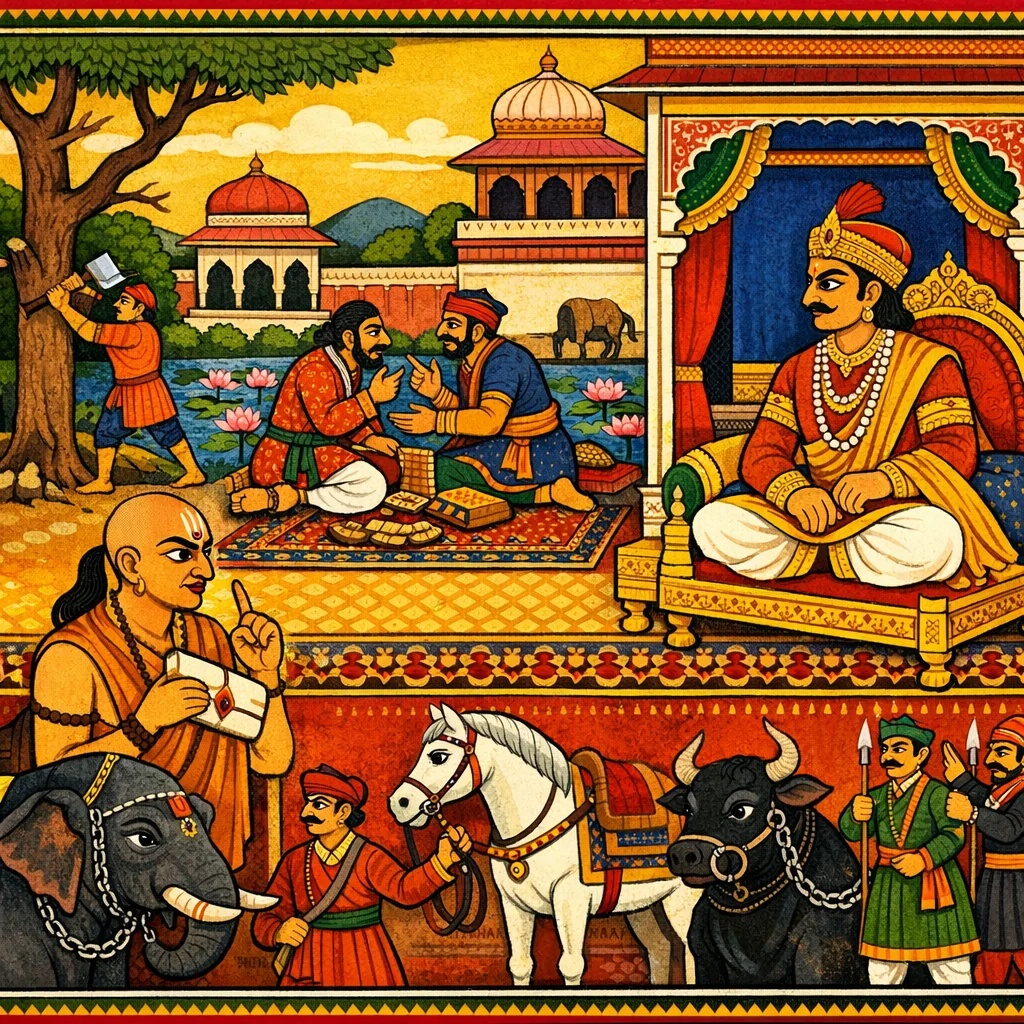
Chapter 7: Chapter 7: Prudence, Restraint, and Social Strategy
Adhyaya 7
The Transformative Power of True Knowledge
Adhyaya 7 presents a cluster of didactic aphorisms typical of Nītiśāstra and the wider subhāṣita tradition, emphasizing prudence, discretion, and calibrated social behavior. The verses describe the management of reputation through concealment of personal losses and domestic troubles, and they frame shame (lajjā) as context-dependent—set aside in practical matters like resource use, learning, food, and transactions. A sustained contrast is drawn between contentment (santoṣa) as a stabilizing ethical affect and acquisitive restlessness as a source of mental agitation. The chapter also records historical norms of bodily etiquette and spatial boundaries around sacred figures (fire, guru, Brahmin), vulnerable persons, and animals, reflecting social hierarchies and ritual sensibilities. Several maxims develop strategic distance and proportional response toward threats, including typologies of “good” and “wicked” persons and counsel on handling the powerful and the malicious. Wealth is treated sociologically as a magnet for kinship and friendship, while signs of “heavenly” and “hellish” dispositions are cataloged as moral diagnostics. The section closes with a contemplative motif of discerning inner essences in substances, aligning ethical insight with viveka (discriminative discernment).
Key Concepts
Key Principles
Strategic Themes
Shlokas in Chapter 7
Verse 1
अर्थनाशं मनस्तापं गृहे दुश्चरितानि च । वञ्चनं चापमानं च मतिमान्न प्रकाशयेत् ॥
A discerning person should not make public: loss of wealth, mental anguish, misdeeds within the household, deception, or humiliation.
Verse 2
धनधान्यप्रयोगेषु विद्यासङ्ग्रहणे तथा । आहारे व्यवहारे च त्यक्तलज्जः सुखी भवेत् ॥
In using wealth and grain, in acquiring learning, and likewise in food and social dealings, one who sets aside shame lives happily.
Verse 3
सन्तोषामृततृप्तानां यत्सुखं शान्तिरेव च । न च तद्धनलुब्धानामितश्चेतश्च धावताम् ॥
Those filled with the “nectar” of contentment know happiness and peace; the greedy for wealth, whose minds run here and there, do not find that joy.
Verse 4
सन्तोषस्त्रिषु कर्तव्यः स्वदारे भोजने धने । त्रिषु चैव न कर्तव्योऽध्ययने जपदानयोः ॥
Be content in three: your own spouse, food, and wealth. But in three, never be content: study, recitation (japa), and giving (dāna).
Verse 5
विप्रयोर्विप्रवह्न्योश्च दम्पत्योः स्वामिभृत्ययोः । अन्तरेण न गन्तव्यं हलस्य वृषभस्य च ॥
Do not pass between two Brahmins, between a Brahmin and the sacred fire, between husband and wife, between master and servant, nor between a plough and its ox.
Verse 6
पादाभ्यां न स्पृशेदग्निं गुरुं ब्राह्मणमेव च । नैव गां न कुमारीं च न वृद्धं न शिशुं तथा ॥
Do not touch with your feet fire, your teacher, or a Brahmin; nor a cow, an unmarried maiden, an elder, or a child.
Verse 7
शकटं पञ्चहस्तेन दशहस्तेन वाजिनम् । गजं हस्तसहस्रेण देशत्यागेन दुर्जनम् ॥
Safety has its measures: keep five hands from a cart, ten from a horse, a thousand from an elephant; but from a wicked man, keep away by leaving the place.
Verse 8
हस्ती अङ्कुशमात्रेण वाजी हस्तेन ताड्यते । शृङ्गी लगुडहस्तेन खड्गहस्तेन दुर्जनः ॥
An elephant is guided by a mere goad; a horse is corrected by the hand; a horned beast is controlled by a staff in hand; but a wicked man is restrained by a sword in hand.
Verse 9
तुष्यन्ति भोजने विप्रा मयूरा घनगर्जिते । साधवः परसम्पत्तौ खलाः परविपत्तिषु ॥
Brahmins are pleased by a meal; peacocks by thunder’s roar. The virtuous rejoice in another’s prosperity; the wicked rejoice in another’s misfortune.
Verse 10
अनुलोमेन बलिनं प्रतिलोमेन दुर्जनम् । आत्मतुल्यबलं शत्रुं विनयेन बलेन वा ॥
Approach the powerful by agreement; meet the wicked with counter-measures. An enemy equal to your strength is handled either with deference or with force.
Verse 11
बाहुवीर्यं बलं राज्ञां ब्रह्मणो ब्रह्मविद्बली । रूपयौवनमाधुर्यं स्त्रीणां बलमनुत्तमम् ॥
A king’s strength is the vigor of his arms; a brahmin’s strength is the power born of knowledge of Brahman. A woman’s unsurpassed strength is beauty, youth, and sweetness of charm.
Verse 12
नात्यन्तं सरलैर्भाव्यं गत्वा पश्य वनस्थलीम् । छिद्यन्ते सरलास्तत्र कुब्जास्तिष्ठन्ति पादपाः ॥
Do not be overly straightforward. Go and see the forest: the straight trees are cut down there, while the crooked ones remain standing.
Verse 13
यत्रोदकं तत्र वसन्ति हंसा- स्तथैव शुष्कं परिवर्जयन्ति । न हंसतुल्येन नरेण भाव्यं स्त्यजन्तः पुनराश्रयन्ते ॥
Swans dwell where there is water and abandon what has dried up. Do not deem steadfast the man like a swan: he leaves, then returns again to seek refuge.
Verse 14
उपार्जितानां वित्तानां त्याग एव हि रक्षणम् । तडागोदरसंस्थानां परीवाह इवाम्भसाम् ॥
Accumulated wealth is safeguarded by relinquishment—giving and spending—just as pond water is preserved by having an outflow.
Verse 15
यस्यार्थास्तस्य मित्राणि यस्यार्थास्तस्य बान्धवाः । यस्यार्थाः स पुमाँल्लोके यस्यार्थाः स च पण्डितः ॥
He who has wealth has friends; he who has wealth has kin. He who has wealth is deemed a person of consequence in the world, and is even taken for a learned man.
Verse 16
स्वर्गस्थितानामिह जीवलोके चत्वारि चिह्नानि वसन्ति देहे । दानप्रसंगो मधुरा च वाणी देवार्चनं ब्राह्मणतर्पणं च ॥
One deemed “heaven-abiding” even in this life bears four signs: readiness to give, sweet speech, worship of the gods, and offerings/hospitality to Brahmins.
Verse 17
अत्यन्तकोपः कटुका च वाणी दरिद्रता च स्वजनेषु वैरम् । नीचप्रसंगः कुलहीनसेवा चिह्नानि देहे नरकस्थितानाम् ॥
Signs of one in a “hellish state” are: extreme anger, harsh speech, poverty, enmity among one’s own, association with the base, and service to a family without lineage.
Verse 18
गम्यते यदि मृगेन्द्रमन्दिरं लभ्यते करिकपालमौक्तिकम् । जम्बुकालयगते च प्राप्यते वत्सपुच्छखरचर्मखण्डनम् ॥
Go to the lion’s dwelling and you may gain a pearl from an elephant’s skull; go to a jackal’s lair and you will find only a scrap of donkey-hide and a calf’s tail.
Verse 19
शुनः पुच्छमिव व्यर्थं जीवितं विद्यया विना । न गुह्यगोपने शक्तं न च दंशनिवारणे ॥
Life without learning is as futile as a dog’s tail: it can neither conceal what should be concealed nor prevent biting.
Verse 20
वाचां शौचं च मनसः शौचमिन्द्रियनिग्रहः । सर्वभूतदयाशौचमेतच्छौचं परार्थिनाम् ॥
Purity is purity of speech and purity of mind, together with restraint of the senses; compassion toward all beings is also purity—this is the purity of those devoted to others’ welfare.
Verse 21
पुष्पे गन्धं तिले तैलं काष्ठेऽग्निं पयसि घृतम् । इक्षौ गुडं तथा देहे पश्यात्मानं विवेकतः ॥
Fragrance is in the flower, oil in sesame, fire in wood, and ghee in milk; likewise, within the body discern the Self through discriminative understanding.
Frequently Asked Questions
The chapter foregrounds a historical Nīti principle of prudential self-governance: discretion in speech about misfortune, cultivation of contentment as mental stability, and discriminative discernment (viveka) in assessing persons, power, and inner qualities.
Relationships are described through pragmatic and moral typologies: friends and kin are depicted as clustering around wealth; “good” persons are characterized as rejoicing in others’ prosperity, while “wicked” persons are depicted as taking satisfaction in others’ adversity; enemies are classified by relative strength (strong, malicious, equal-strength) with corresponding modes of approach (conciliatory alignment, reversal, discipline or force).
The aphorisms align with broader South Asian strategic literature by combining ethical diagnostics with practical counsel on managing power asymmetries, reputation, and alliances. In comparison to the Arthaśāstra’s systematic statecraft and the Pañcatantra’s narrative pedagogy, this chapter functions as compact, portable maxims emphasizing social psychology, calibrated response to adversaries, and the sociological role of wealth in forming networks.